SEARCH
OUR BOOK
IS NOW
IN PRINT!

Humoring the Horror
of the
Converging Emergencies
94 color pages
$24.99
Read FREE online!
|
Explore: |

|
|
Play: |

It's weekly, funny, and free!
|
|
Play: |

Click for paper-free fun!
|
 |
Ads for potentially
microfunding this site:
|
 |
 |
|
 |
Apocadocument
Weekly Archives:
Sep 26 - Dec 31, 1969
Sep 19 - Sep 26, 2011
Sep 12 - Sep 19, 2011
Sep 5 - Sep 12, 2011
Aug 29 - Sep 5, 2011
Aug 22 - Aug 29, 2011
Aug 15 - Aug 22, 2011
Aug 8 - Aug 15, 2011
Aug 1 - Aug 8, 2011
Jul 25 - Aug 1, 2011
Jul 18 - Jul 25, 2011
Jul 11 - Jul 18, 2011
Jul 4 - Jul 11, 2011
Jun 27 - Jul 4, 2011
Jun 20 - Jun 27, 2011
Jun 13 - Jun 20, 2011
Jun 6 - Jun 13, 2011
May 30 - Jun 6, 2011
May 23 - May 30, 2011
May 16 - May 23, 2011
May 9 - May 16, 2011
May 2 - May 9, 2011
Apr 25 - May 2, 2011
Apr 18 - Apr 25, 2011
Apr 11 - Apr 18, 2011
Apr 4 - Apr 11, 2011
Mar 28 - Apr 4, 2011
Mar 21 - Mar 28, 2011
Mar 14 - Mar 21, 2011
Mar 6 - Mar 14, 2011
Feb 27 - Mar 6, 2011
Feb 20 - Feb 27, 2011
Feb 13 - Feb 20, 2011
Feb 6 - Feb 13, 2011
Jan 30 - Feb 6, 2011
Jan 23 - Jan 30, 2011
Jan 16 - Jan 23, 2011
Jan 9 - Jan 16, 2011
Jan 2 - Jan 9, 2011
Dec 26 - Jan 2, 2011
Dec 19 - Dec 26, 2010
Dec 12 - Dec 19, 2010
Dec 5 - Dec 12, 2010
Nov 28 - Dec 5, 2010
Nov 21 - Nov 28, 2010
Nov 14 - Nov 21, 2010
Nov 7 - Nov 14, 2010
Nov 1 - Nov 7, 2010
Oct 25 - Nov 1, 2010
Oct 18 - Oct 25, 2010
Oct 11 - Oct 18, 2010
Oct 4 - Oct 11, 2010
Sep 27 - Oct 4, 2010
Sep 20 - Sep 27, 2010
Sep 13 - Sep 20, 2010
Sep 6 - Sep 13, 2010
Aug 30 - Sep 6, 2010
Aug 23 - Aug 30, 2010
Aug 16 - Aug 23, 2010
Aug 9 - Aug 16, 2010
Aug 2 - Aug 9, 2010
Jul 26 - Aug 2, 2010
Jul 19 - Jul 26, 2010
Jul 12 - Jul 19, 2010
Jul 5 - Jul 12, 2010
Jun 28 - Jul 5, 2010
Jun 21 - Jun 28, 2010
Jun 14 - Jun 21, 2010
Jun 7 - Jun 14, 2010
May 31 - Jun 7, 2010
May 24 - May 31, 2010
May 17 - May 24, 2010
May 10 - May 17, 2010
May 3 - May 10, 2010
Apr 26 - May 3, 2010
Apr 19 - Apr 26, 2010
Apr 12 - Apr 19, 2010
Apr 5 - Apr 12, 2010
Mar 29 - Apr 5, 2010
Mar 22 - Mar 29, 2010
Mar 15 - Mar 22, 2010
Mar 7 - Mar 15, 2010
Feb 28 - Mar 7, 2010
Feb 21 - Feb 28, 2010
Feb 14 - Feb 21, 2010
Feb 7 - Feb 14, 2010
Jan 31 - Feb 7, 2010
Jan 24 - Jan 31, 2010
Jan 17 - Jan 24, 2010
Jan 10 - Jan 17, 2010
Jan 3 - Jan 10, 2010
Dec 27 - Jan 3, 2010
Dec 20 - Dec 27, 2009
Dec 13 - Dec 20, 2009
Dec 6 - Dec 13, 2009
Nov 29 - Dec 6, 2009
Nov 22 - Nov 29, 2009
Nov 15 - Nov 22, 2009
Nov 8 - Nov 15, 2009
Nov 1 - Nov 8, 2009
Oct 26 - Nov 1, 2009
Oct 19 - Oct 26, 2009
Oct 12 - Oct 19, 2009
Oct 5 - Oct 12, 2009
Sep 28 - Oct 5, 2009
Sep 21 - Sep 28, 2009
Sep 14 - Sep 21, 2009
Sep 7 - Sep 14, 2009
Aug 31 - Sep 7, 2009
Aug 24 - Aug 31, 2009
Aug 17 - Aug 24, 2009
Aug 10 - Aug 17, 2009
Aug 3 - Aug 10, 2009
Jul 27 - Aug 3, 2009
Jul 20 - Jul 27, 2009
Jul 13 - Jul 20, 2009
Jul 6 - Jul 13, 2009
Jun 29 - Jul 6, 2009
Jun 22 - Jun 29, 2009
Jun 15 - Jun 22, 2009
Jun 8 - Jun 15, 2009
Jun 1 - Jun 8, 2009
May 25 - Jun 1, 2009
May 18 - May 25, 2009
May 11 - May 18, 2009
May 4 - May 11, 2009
Apr 27 - May 4, 2009
Apr 20 - Apr 27, 2009
Apr 13 - Apr 20, 2009
Apr 6 - Apr 13, 2009
Mar 30 - Apr 6, 2009
Mar 23 - Mar 30, 2009
Mar 16 - Mar 23, 2009
Mar 9 - Mar 16, 2009
Mar 1 - Mar 9, 2009
Feb 22 - Mar 1, 2009
Feb 15 - Feb 22, 2009
Feb 8 - Feb 15, 2009
Feb 1 - Feb 8, 2009
Jan 25 - Feb 1, 2009
Jan 18 - Jan 25, 2009
Jan 11 - Jan 18, 2009
Jan 4 - Jan 11, 2009
Dec 28 - Jan 4, 2009
Dec 21 - Dec 28, 2008
Dec 14 - Dec 21, 2008
Dec 7 - Dec 14, 2008
Nov 30 - Dec 7, 2008
Nov 23 - Nov 30, 2008
Nov 16 - Nov 23, 2008
Nov 9 - Nov 16, 2008
Nov 2 - Nov 9, 2008
Oct 27 - Nov 2, 2008
Oct 20 - Oct 27, 2008
Oct 13 - Oct 20, 2008
Oct 6 - Oct 13, 2008
Sep 29 - Oct 6, 2008
Sep 22 - Sep 29, 2008
Sep 15 - Sep 22, 2008
Sep 8 - Sep 15, 2008
Sep 1 - Sep 8, 2008
Aug 25 - Sep 1, 2008
Aug 18 - Aug 25, 2008
Aug 11 - Aug 18, 2008
Aug 4 - Aug 11, 2008
Jul 28 - Aug 4, 2008
Jul 21 - Jul 28, 2008
Jul 14 - Jul 21, 2008
Jul 7 - Jul 14, 2008
Jun 30 - Jul 7, 2008
Jun 23 - Jun 30, 2008
Jun 16 - Jun 23, 2008
Jun 9 - Jun 16, 2008
Jun 2 - Jun 9, 2008
May 26 - Jun 2, 2008
May 19 - May 26, 2008
May 12 - May 19, 2008
May 5 - May 12, 2008
Apr 28 - May 5, 2008
Apr 21 - Apr 28, 2008
Apr 14 - Apr 21, 2008
Apr 7 - Apr 14, 2008
Mar 31 - Apr 7, 2008
Mar 24 - Mar 31, 2008
Mar 17 - Mar 24, 2008
Mar 10 - Mar 17, 2008
Mar 2 - Mar 10, 2008
Feb 24 - Mar 2, 2008
Feb 17 - Feb 24, 2008
Feb 10 - Feb 17, 2008
Feb 3 - Feb 10, 2008
Jan 27 - Feb 3, 2008
Jan 20 - Jan 27, 2008
Jan 13 - Jan 20, 2008
Jan 6 - Jan 13, 2008
Dec 30 - Jan 6, 2008
Dec 23 - Dec 30, 2007
Dec 16 - Dec 23, 2007
Dec 9 - Dec 16, 2007
Dec 2 - Dec 9, 2007
|
 |
DocWatch
|
 |
|
 |
|
 |
|
Thu, Aug 20, 2015
from NOAA, via CNN:
NOAA: July hottest month on record, and 2015 could be hottest year
July saw the highest average temperatures since record-keeping began -- globally, not just in the United States -- the National Oceanic and Atmospheric Administration reported Thursday.
Globally, the first seven months of the year also had all-time highs. The latest global temperature data make it likely that 2015 will be the hottest year on record, the agency said.
NOAA's findings follow reports by NASA and the Japan Meteorological Agency, which reached the same conclusion using their own data. ...
|
It ain't the heat, it's the humanity!
ApocaDoc
permalink
|
Fri, Feb 20, 2015
from TIME:
1 in 4 Americans Apparently Unaware the Earth Orbits the Sun
A National Science Foundation study involving 2,200 participants find that about 25 percent of Americans got this question wrong: 'Does the Earth go around the sun, or does the sun go around the Earth?'... And the fact that only 74 percent of participants knew that the Earth revolved around the sun is perhaps less alarming than the fact that only 48 percent knew that humans evolved from earlier species of animals. ...
|
I bet Copernicus is orbiting in his grave.
ApocaDoc
permalink
|
Wed, Jan 14, 2015
from Science:
Plan to save monarch butterflies backfires
It started with the best of intentions. When evidence emerged that monarch butterflies were losing the milkweed they depend on due to the spread of herbicide-resistant crops in the United States, people across the country took action, planting milkweed in their own gardens. But a new paper shows that well-meaning gardeners might actually be endangering the butterflies' iconic migration to Mexico. That's because people have been planting the wrong species of milkweed, thereby increasing the odds of monarchs becoming infected with a crippling parasite. ...
|
Sorry!
ApocaDoc
permalink
|
Mon, Dec 8, 2014
from Climate Central:
Low Oil Prices May Bode Ill For Climate
Climate change and falling crude oil prices coalesce at the gas pump.
Filling the gas tank of a Hummer for $2.18 per gallon in Texas or $2.39 per gallon in New Jersey when a year ago those prices were as much as 75 cents higher means that it's likely people will drive more, burning more gasoline and spewing more CO2 into the atmosphere, experts say.... But since the cost of gasoline fell as crude oil prices began falling earlier this year, gasoline consumption has increased by about 15 percent since January, according to the U.S. Energy Information Administration. ...
|
Hummer and Hummer to
ApocaDoc
permalink
|
Tue, Oct 21, 2014
from Mother Jones:
Why Did Top Scientific Journals Reject This Dr. Bronner's Ad?
David Bronner, CEO of Dr. Bronner's Magic Soaps, presides over a company with famously wacky product labels. Sample sentence, from the 18-in-1 Hemp PEPPERMINT soap bottle: "Each swallow works hard to be perfect pilot-provider-teacher-lover-mate, no half-true hate!" But Bronner himself, grandson of the founder (the one with the elaborate prose style), has emerged as a serious, though fun-loving, activist, particularly around pesticides and genetically modified crops, as Josh Harkinson's recent Mother Jones profile shows.
But apparently, Bronner's writing on GMOs is too hot for the advertising pages of the English-speaking world's two most renowned science journals, Science and Nature--even though a slew of magazines, including Scientific American, The New Yorker, Harper's, The Nation, Harvard, and, yes, Mother Jones, accepted the Bronner ad. It consists of a short essay, known in publishing as an advertorial, that's nothing like the wild-eyed rants on his company's soap bottles. Bronner's ad (PDF) focuses on how GMO crops have led to a net increase in pesticide use in the United States, citing an analysis by Ramon Seidler, a retired senior staff scientist at the Environmental Protection Agency. ...
|
I think those overly-respected journals just can't get behind 5-point type, saying 'pilot-provider-teacher-lover-mate, no half-true hate!'"
ApocaDoc
permalink
|
Tue, Oct 7, 2014
from Center for Investigative Reporting:
California water officials aren't following own call for conservation
Mike Soubirous is a prodigious water user, pumping more than 1 million gallons per year at his lushly landscaped home on a hot, windy Southern California hilltop. Soubirous also is a member of the Riverside City Council, which in July voted unanimously to impose tough new water conservation rules in this desert city of 317,000. Yet as California's drought worsened from 2012 to 2013, he consumed enough water to supply eight California households - more than any other top water official in the state, records show. ...
|
The fox is drowning the henhouse.
ApocaDoc
permalink
|
Tue, Sep 30, 2014
from New York Times:
President's Drive for Carbon Pricing Fails to Win at Home
President Obama stood in the chamber of the United Nations General Assembly last week and urged the world to follow his example and fight global warming. But a major new declaration calling for a global price on carbon -- signed by 74 countries and more than 1,000 businesses and investors -- is missing a key signatory: the United States.
The declaration, released by the World Bank the day before Mr. Obama's speech at the United Nations Climate Summit, has been signed by China, Shell, Dow Chemical and Coca-Cola. It calls on all nations to enact laws forcing industries to pay for the carbon emissions that scientists say are the leading cause of global warming. ...
|
Carbon pricing: It's the real solution.
ApocaDoc
permalink
|
Tue, Sep 23, 2014
from National Geographic:
New Reports Offer Clearest Picture Yet of Rising Greenhouse Gas Emissions
Two days before the UN Climate Summit in New York, three new studies paint the clearest picture yet of rising greenhouse gas emissions and the dwindling opportunity for staving off the worst impacts--and also of at least one way that huge undertaking might be shared fairly among the nations of the world....
In Nature Geoscience, Friedlingstein and his colleagues write that the world has already used up two thirds of the CO2 emissions quota that scientists say will keep the planet from warming more than 2?C (3.6?F). Beyond that temperature threshold, serious consequences are expected from sea-level rise and widespread disruption of weather patterns....
The researchers consider two basic principles for distributing the global emissions quota: "inertia," under which countries would continue to emit the same share of global emissions as they do now, and "equity," under which countries would be allowed to emit according to their population, with per capita emissions being the same everywhere.
...
|
As long as only property owners are allowed to vote!
ApocaDoc
permalink
|
Sat, Aug 23, 2014
from Mongabay, via DesdemonaDespair:
Twenty percent of Africa's elephants killed in three years - 'We are shredding the fabric of elephant society and exterminating populations across the continent'
Around 100,000 elephants were killed by poachers for their ivory on the African continent in just three years, according to a new paper in the Proceedings of the National Academy of Sciences. Between 2010 and 2012 an average of 6.8 percent of the elephant population was killed annually, equaling just over 20 percent of the continent's population in that time. Elephant deaths are now exceeding births, which on average are 5 percent annually....
...
|
And tragically, the remaining 80 percent never forgets.
ApocaDoc
permalink
|
Thu, Aug 21, 2014
from Grist:
Meet the climate deniers who want to be president
The Republican Party of 2008 was a big enough tent to include people who admitted demonstrable problems existed and supported free-market-oriented solutions. Not anymore. The rise of the Tea Party movement and the rightward shift of the Republican base and the politicians who pander to it put an end to all that. Whoever is the Republican nominee for president in 2016, it's a safe bet that he - and yes, it will be a he, as all the leading contenders are male - will oppose taking any action on climate change. Chances are that he won't even admit it exists.
The Republicans basically fall into four categories: (1) Flat-Earthers, who deny the existence of manmade climate change; (2) Born-Again Flat-Earthers, who do the same, but who had admitted climate change exists back before President Obama took office; (3) Do-Nothings, who sort of admit the reality of climate change but oppose actually taking any steps to prevent it; and (4) Dodgers, who have avoided saying whether they believe climate change is happening, and who also don't want to take any steps to alleviate it. Louisiana Gov. Bobby Jindal and Wisconsin Gov. Scott Walker fall into the latter category. The Do-Nothings are blue and purple state governors, Chris Christie of New Jersey and John Kasich of Ohio.... ...
|
Who needs science? Surf's up!
ApocaDoc
permalink
|
Mon, Jul 14, 2014
from TrueActivist.com:
Forest, Trees; Choose Two
In this fascinating video, UBC Professor Suzanne Simard explains how trees are much more complex than most of us ever imagined. Although Charles Darwin assumed trees are simply individual organisms competing for survival of the fittest, Simard demonstrates just how wrong he was. In fact, the opposite is true: trees survive through mutual co-operation and support, passing around essential nutrients "depending on who needs it".
Nitrogen and carbon are shared through miles of underground fungi networks, ensuring that all trees in the forest eco-system give and receive just the right amount to keep them all healthy. This invisible web works in a very similar way to the networks of neurons in our brains, and when one tree is destroyed it has consequences for all.
...
|
Now they'll declare forests a socialist threat.
ApocaDoc
permalink
|
Sun, Jul 13, 2014
from Mother Jones:
Don't Call Them "Climate Deniers." Call them "Climate Optimists."
Las Vegas is parched. A 14-year drought has left Lake Mead, the local water source, dangerously low. It has dropped 100 feet in the past decade. If it drops 12 more feet, federal water rationing rules will kick in. Some climate scientists predict that will happen in the next year. And most believe the situation will only worsen over time.
The view from inside Las Vegas' Mandalay Bay Resort and Casino, however, is considerably rosier. That's where scientists, activists, and bloggers have assembled this week for the Heartland Institute's 9th International Conference on Climate Change, which I've been following via live stream. It's the world's largest gathering of "climate skeptics"--people who believe, for one reason or another, that the climate change crisis is overblown.... ...
|
or call them "Wishfully Thinking Mass Murderers."
ApocaDoc
permalink
|
Tue, Jul 8, 2014
from Reuters, via HuffingtonPost:
Pope Francis Calls Exploitation Of Nature The Sin Of Our Time
"This is one of the greatest challenges of our time: to convert ourselves to a type of development that knows how to respect creation," he told students, struggling farmers, and laid-off workers in a university hall.
"When I look at America, also my own homeland (South America), so many forests, all cut, that have become land ... that can longer give life. This is our sin, exploiting the Earth and not allowing her to her give us what she has within her," the Argentine pope said in unprepared remarks.
Francis, who took his name from Francis of Assisi, the 13th century saint seen as the patron of animals and the environment, is writing an encyclical on man's relationship with nature. ...
|
You mean God didn't place us on the earth to use it up as fast as possible?
ApocaDoc
permalink
|
Want more context?
Try reading our book FREE online:
Humoring the Horror of the Converging Emergencies!
More fun than a barrel of jellyfish!
|  |
Tue, Jul 1, 2014
from Telegraph (UK):
The race to stop Las Vegas from running dry
America's most decadent destination has been engaged in a potentially catastrophic gamble with nature and now, 14 years into a devastating drought, it is on the verge of losing it all.
"The situation is as bad as you can imagine," said Tim Barnett, a climate scientist at the Scripps Institution of Oceanography. "It's just going to be screwed. And relatively quickly. Unless it can find a way to get more water from somewhere Las Vegas is out of business. Yet they're still building, which is stupid."
The crisis stems from the Las Vegas's complete reliance on Lake Mead, America's largest reservoir, which was created by the Hoover Dam in 1936 - after which it took six years to fill completely....
Mr Barnett predicts it may be a "dead pool" that provides no water by about 2036.
The lake currently looks as if someone has removed a giant plug from it.
Around its edges a strip of bleached rock known locally as the "bath tub ring" towers like the White Cliffs of Dover, showing where the water level used to be. Pyramid-shaped mountains rise from the shallow waters. ...
|
If I draw the Ace of Spades, I'll have a Royal Flush!
ApocaDoc
permalink
|
Thu, Jun 12, 2014
from GuyMcPherson.com:
Guy McPherson Sings Sad Songs without Solace
... American actress Lily Tomlin is credited with the expression, "No matter how cynical you become, it's never enough to keep up." With respect to climate science, my own efforts to stay abreast are blown away every week by new data, models, and assessments. It seems no matter how dire the situation becomes, it only gets worse when I check the latest reports....
I'm not implying conspiracy among scientists. Science selects for conservatism. Academia selects for extreme conservatism. These folks are loathe to risk drawing undue attention to themselves by pointing out there might be a threat to civilization. Never mind the near-term threat to our entire species (they couldn't care less about other species). If the truth is dire, they can find another, not-so-dire version....
Gradual change is not guaranteed, as pointed out by the U.S. National Academy of Sciences in December 2013: "The history of climate on the planet -- as read in archives such as tree rings, ocean sediments, and ice cores -- is punctuated with large changes that occurred rapidly, over the course of decades to as little as a few years." ...
|
This article changes my perspective entirely on my credit score.
ApocaDoc
permalink
|
Mon, Jun 9, 2014
from Daily Camera:
CU-Boulder researchers track 'hedging' language in climate news
As scientists' level of confidence that human activities are contributing to significant changes in the Earth's climate increases, the amount of "hedging" language used by some prominent journalists in writing on that subject has also risen, a team of University of Colorado researchers has found.
"The language itself is very important for how people perceive the information," said Adriana Bailey, a doctoral student at the CU's Cooperative Institute for Research in Environmental Sciences and lead author on a newly published study.
"And so what we wanted to look at is what kind of language choices are being made to discuss the scientific uncertainties that do exist ... or to construct new uncertainties that might be extrinsic to the science."...
For example, the word "uncertainty" was counted in a New York Times article that read " ... substantial uncertainty still clouds projections of important impacts ... ." It was not counted in a sentence from the same newspaper that read " ... uncertainty was removed as to whether humans had anything to do with climate change. ..."
They found that in 2001, the U.S. papers used 189 hedging words or expressions for every 10,000 words printed, while the Spanish papers used 107. In 2007, the number of hedging words and expressions used per 10,000 words was up to 267 in the U.S. and 136 in Spain.
"I think I did find it surprising that there was more hedging language used over time," said Maxwell Boykoff, a CIRES fellow and assistant professor in environmental studies at CU and co-author on the study.
...
|
Uncertainty over certainty was created by faux uncertainty, certainly produced by energy companies certain about the need for uncertainty.
ApocaDoc
permalink
|
Tue, Apr 1, 2014
from Huffington Post:
Cable Networks Largely Ignore Major Climate Change Report
The New York Times led Monday's paper with an ominous headline potentially affecting everyone on Earth: "Panel's Warning On Climate Risk: Worst Is To Come."... But such dramatic findings weren't treated with similar urgency Monday morning on CNN, MSNBC and Fox News. The three cable news networks largely ignored the IPCC's findings between 6:00 a.m. and noon, according to a search using media monitoring service TVEyes.
CNN briefly mentioned the U.N. report during two news roundups, speaking about it for roughly 40 seconds of airtime out of six hours.
However, CNN found plenty of time to devote to missing Malaysia Airlines Flight 370. The network has been obsessively covering the mystery for several weeks, regardless of whether there's any new information to report. ...
|
We do love a mystery!
ApocaDoc
permalink
|
Sat, Mar 29, 2014
from Fuel Fix:
New US wind power installations plummet
U.S. investors in wind-generated power nearly abandoned the business last year as Congress let lucrative tax credits for wind projects tumble away, according to a new report.
New installations of U.S. wind projects fell 93 percent in 2013, measured by power generation capacity. New wind power installations had climbed to a record 13,100 megawatts the year before, Navigant Research reported. One megawatt is enough to power 500 Texas homes in normal weather.
Financiers yanked much of their backing last year after legislative deadlines passed and it was too late for the $2 billion tax credit to bolster investments in wind installations. ...
|
One step forward, three steps back.
ApocaDoc
permalink
|
Sat, Mar 29, 2014
from Indianapolis Star:
Gov. Pence lets energy program expire without signing bill
A 2-year-old program designed to cut energy consumption in Indiana homes, schools and businesses will end Dec. 31 without Gov. Mike Pence's signature.
In a statement issued shortly after 8 p.m. today, Pence said he had mixed feelings on the bill but would allow it to become law without his signature. That means he neither signed or vetoed the measure, but will let it take effect anyway... The decision will remove Indiana from the ranks of 26 states that require utilities to offer programs that reduce energy use, part of a growing national effort to reduce electricity demand, lower prices and cut carbon emissions. ...
|
Hoosiers are now loosiers.
ApocaDoc
permalink
|
Wed, Mar 19, 2014
from Wired:
Voracious Worm Evolves to Eat Biotech Corn Engineered to Kill It
One of agricultural biotechnology's great success stories may become a cautionary tale of how short-sighted mismanagement can squander the benefits of genetic modification.
After years of predicting it would happen -- and after years of having their suggestions largely ignored by companies, farmers and regulators -- scientists have documented the rapid evolution of corn rootworms that are resistant to Bt corn.
Until Bt corn was genetically altered to be poisonous to the pests, rootworms used to cause billions of dollars in damage to U.S. crops. Named for the pesticidal toxin-producing Bacillus thuringiensis gene it contains, Bt corn now accounts for three-quarters of the U.S. corn crop. The vulnerability of this corn could be disastrous for farmers and the environment. ...
|
We're on the corns of a dilemma.
ApocaDoc
permalink
|
Fri, Mar 14, 2014
from BBC:
'Shocking' scale of pangolin smuggling revealed
The globally threatened animals are sought for their scales which are used in traditional Chinese medicine.
Annual seizures have been estimated at roughly 10,000 animals but experts warn the illegal trade is far greater....
"The numbers of pangolins traded are shocking, and all the more so considering the pharmaceutical pointlessness of the trade. This trade is intolerably wasteful," said Prof Macdonald, director of the University of Oxford's Wildlife Conservation Research Unit (WildCRU), and a co-author of the paper....
Prolific smugglers have received prison sentences from 11 years to life but with demand out-stripping supply, the trade is only becoming more lucrative.
According to the report, pangolin scales are currently worth $600 per kilo, twice the amount they traded for in 2008.
...
|
Pharmaceutically pointless pangolin plates' prolific profits preempts protection. Please!
ApocaDoc
permalink
|
Thu, Jan 9, 2014
from Fargo Forum:
911 calls from Casselton train derailment show crew member first reported his train carried ethanol
Emergency 911 calls indicate at least one member of the crew involved in the Dec. 30 train derailment and explosion west of Casselton thought the train was carrying ethanol instead of highly combustible Bakken crude oil.
Another railroad worker shortly after the accident told dispatchers he was worried the derailed cars could explode, and sought permission to decouple burning cars to prevent a chain reaction. ...
|
Asleep at the switch(grass).
ApocaDoc
permalink
|
Tue, Dec 17, 2013
from London Guardian:
EPA reels as climate-change expert awaits sentencing for $1m CIA fraud
It is a story that flummoxed investigators - how a highly paid climate-change expert at the Environmental Protection Agency managed to defraud the government of nearly $1m, by pretending for a decade to be an undercover CIA agent.
John Beale, 65, is to undergo sentencing in a DC federal court on Wednesday, after pleading guilty to defrauding the government of $900,000 in salary and other benefits. Beale, who used his ruse to disappear for months at a time, has agreed to pay some $1.3m in restitution. He faces up to three years in jail... His fraud consisted largely of failing to turn up for work - in one instance for 18 months - and offering excuses connected to his fake intelligence role at the CIA. ...
|
Central Idiots Agency
ApocaDoc
permalink
|
Thu, Dec 5, 2013
from London Guardian:
ALEC calls for penalties on 'freerider' homeowners in assault on clean energy
An alliance of corporations and conservative activists is mobilising to penalise homeowners who install their own solar panels -- casting them as "freeriders" -- in a sweeping new offensive against renewable energy, the Guardian has learned.
Over the coming year, the American Legislative Exchange Council (Alec) will promote legislation with goals ranging from penalising individual homeowners and weakening state clean energy regulations, to blocking the Environmental Protection Agency, which is Barack Obama's main channel for climate action. ...
|
The people united will never be defeated (by ALEC).
ApocaDoc
permalink
|
Wed, Nov 20, 2013
from New York Times:
Energy Dept. Is Told to Stop Collecting Fee for Nuclear Waste Disposal
A federal appeals court ruled Tuesday that the Energy Department must stop collecting fees of about $750 million a year that are paid by consumers and intended to fund a program for the disposal of nuclear waste. The reason, the court said, is that there is no such program. Congress passed a law that established the fee in the early 1980s, to be paid by customers who use electricity from reactors. But soon after President Obama took office, he made good on a campaign promise and stopped work on the disposal site selected by Congress, Yucca Mountain, about 100 miles from Las Vegas. ...
|
I wonder if I can get my money back?
ApocaDoc
permalink
|
Thu, Nov 7, 2013
from Planet Ark:
Hopes for strong 2015 climate deal fade, as risks grow
World governments are likely to recoil from plans for an ambitious 2015 climate change deal at talks next week, concern over economic growth at least partially eclipsing scientists' warnings of rising temperatures and water levels.
"We are in the eye of a storm," said Yvo de Boer, United Nations climate chief in 2009 when a summit in Copenhagen ended without agreement. After Copenhagen, nations targeted a 2015 deal to enter into force from 2020 with the goal of averting more floods, heatwaves, droughts and rising sea levels.
The outline of a more modest 2015 deal, to be discussed at annual U.N. climate talks in Warsaw on November 11-22, is emerging that will not halt a creeping rise in temperatures but might be a guide for tougher measures in later years. ...
|
Oh well. There's always next planet.
ApocaDoc
permalink
|
You're still reading! Good for you!
You really should read our short, funny, frightening book FREE online (or buy a print copy):
Humoring the Horror of the Converging Emergencies!
We've been quipping this stuff for more than 30 months! Every day!
Which might explain why we don't get invited to parties anymore.
| |
Thu, Nov 7, 2013
from EurekAlert:
US media consumption to rise to 15.5 hours a day -- per person -- by 2015
A new study by a researcher at the San Diego Supercomputer Center (SDSC) at the University of California, San Diego, says that by 2015, the sum of media asked for and delivered to consumers on mobile devices and to their homes would take more than 15 hours a day to see or hear. That volume is equal to 6.9 million-million gigabytes of information, or a daily consumption of nine DVDs worth of data per person per day.
So when do we have time to sleep or work if we spend every waking minute being exposed to myriad media? The answer is that media delivered is not a measure of attention or comprehension of that media....
"While machines can always overload us, it's more a question of, how can we design these systems to produce meaningful value? That's the critical challenge as we speed further into the age of digitally-based information," according to Short.
...
|
Ten hours is already committed to celebrities and scandals, two hours for Facebook, two hours for news about tv series and movies, an hour and a half for browsing YouTube and upworthy.com. Where is the time for hi-def 3D Nature retrospectives?
ApocaDoc
permalink
|
Thu, Oct 31, 2013
from Politico:
Polls show energy doesn't spark Americans' interest
The U.S. is a rising energy power with soaring oil and gas production and lots of big decisions to make about pipelines, fracking, the future of wind and solar power, and how to tackle climate change.
But the public may not be paying much attention. Recent polls show that Americans are largely disengaged from the fierce energy debates that embroil the capital and that many people know few details -- or even the larger trends -- about where the U.S. gets its energy and how much it costs.
Most don't know that U.S. energy production is going up, and a large majority think the nation's biggest oil supplier is Saudi Arabia. (The correct answer: Canada.) And some polls reveal apparent inconsistencies in people's opinions on big energy questions: They want more natural gas production but oppose fracking, the technology that produced the U.S. gas boom.
...
|
Land of the free, the brave and the oblivious.
ApocaDoc
permalink
|
Thu, Oct 31, 2013
from Omaha World-Herald:
Nebraska lawmakers spar over intent of $44,000 climate change study
The Nebraska lawmaker who initiated the Legislature's first study of climate change now prefers to see the study abandoned rather than continue along what he called a politicized, scientifically invalid path.
State Sen. Ken Haar of Malcolm said Tuesday the state committee handling the study is disregarding the intent of the Legislature.
Haar, a Democrat, is asking his fellow senators to help him salvage the $44,000 study by encouraging the committee to reconsider the restrictions it published Monday in the official request for study assistance.
The request says researchers "should consider 'cyclical climate change' to mean a change in the state of climate due to natural internal processes and only natural external forcings such as volcanic eruptions and solar variations."
The use of the term "natural" would rule out the primary cause of the climate changes that have occurred in the last half-century: humans.
The issue of "cyclical" climate change was successfully amended into Haar's bill by Sen. Beau McCoy of Omaha, a Republican candidate for governor. McCoy on Tuesday elaborated on his opposition to using state tax dollars to study man-made climate change: Humans aren't capable of influencing climate patterns.
"I firmly believe our planet goes through cyclical weather patterns. There have been hotter times, colder times, wetter times and drier times," he said. ...
|
Nebraska's education system must really be in shambles.
ApocaDoc
permalink
|
Thu, Sep 19, 2013
from San Francisco Chronicle:
Masses of food wasted - 'use by' dates mislead
Americans throw away 40 percent of the food they buy, often because of misleading expiration dates that have nothing to do with safety, said a study released Wednesday by Harvard University Law School and the Natural Resources Defense Council, an environmental group.
"The date labeling system is not a system at all," said NRDC staff scientist Dana Gunders, co-author of the report, the first to assess date labeling laws nationwide.
The report said 90 percent of Americans toss good food into the garbage because they mistakenly think that "sell by," "best before," "use by" or "packed on" dates on food containers indicate safety. One-fifth of consumers, the report said, "always" throw away food based on package dates. ...
|
Homo Wastiens
ApocaDoc
permalink
|
Sun, Sep 1, 2013
from Kunstler.com:
Kunstler on impending worldwide financial collapse
The world is swiftly moving to the dangerous place where nations won't be able to do business with each other because they don't trust the institutions that control wealth, which includes central banks, commercial banks, and governments.
It will happen when the purveyors of international commodities, oil especially, refuse to accept the letters of credit issued by untrustworthy intermediaries. And when that dark moment arrives, nations will throw tantrums. The USA may be the loudest baby in the playpen....
When it does blow, at least the NSA will have its prepared "to-do" list, and then perhaps all the unemployed can be enlisted at $8 an hour to harass the rest of the people trying to go about their daily lives. The roar you hear in the distance this September will be the sound of banks crashing, followed by the silence of business-as-usual grinding to a halt. After that, the crackle of gunfire. ...
|
It's as if he's predicting a long emergency or something.
ApocaDoc
permalink
|
Tue, Aug 13, 2013
from Midwest Energy News:
Q&A: ALEC's new tactics to weaken renewable laws
The American Legislative Exchange Council (ALEC) continued its assault on state renewable portfolio standards (RPS) during its 40th annual conference in Chicago earlier this month, with members voting on model legislation that could limit the power of the laws to spark new clean energy construction.
Though bills meant to revoke or undercut renewable standards in numerous states failed last session, clean energy advocates say the model Market Power Renewables Act and the Renewable Energy Credit Act proposed by ALEC's energy task force during the conference pose a fresh threat.
The Market Power Renewables Act argues for a "voluntary market" that would allow people to invest in renewable energy if they choose without instituting mandates... ...
|
The only thing "voluntary" the fossil fuel industry does is voluntarily ruin the earth.
ApocaDoc
permalink
|
Thu, Jul 18, 2013
from The Hill:
Hoeven predicts efficiency bill will collapse without Keystone pipeline attached
Sen. John Hoeven (R-N.D.) predicted Wednesday that bipartisan energy efficiency legislation heading to the Senate floor faces a grim future unless it eventually includes language to advance the Keystone XL oil pipeline.
A broad energy efficiency bill sponsored by Sens. Jeanne Shaheen (D-N.H.) and Rob Portman (R-Ohio) is believed to be coming to the Senate floor in late July.
Hoeven, who is weighing offering a Keystone amendment to the bill, said there's not enough Republican support for the legislation on Capitol Hill unless it includes Keystone.
...
|
Dude, we are all facing a grim future.
ApocaDoc
permalink
|
Wed, May 8, 2013
from Al Jazeera:
Climate talks end inconclusively, again
Another week of international climate negotiations ended in Bonn, Germany on Friday, but there was little mid-level bureaucrats could do when world leaders remain in thrall to the fossil fuel industry, say environmentalists. ...
|
Sources say Al Jazeera is in thrall to the fossil fuel industry. Perhaps not?
ApocaDoc
permalink
|
Mon, May 6, 2013
from Reuters:
Low-key U.S. plan for each nation to set climate goals wins ground
A U.S.-led plan to let all countries set their own goals for fighting climate change is gaining grudging support at U.N. talks, even though the current level of pledges is far too low to limit rising temperatures substantially.
The approach, being discussed this week at 160-nation talks in Bonn, Germany, would mean abandoning the blueprint of the 1997 Kyoto Protocol, which set central goals for industrialized countries to cut emissions by 2012 and then let each work out national implementation. ...
|
That way we can blame everyone for planetary destruction.
ApocaDoc
permalink
|
Mon, Apr 8, 2013
from Fort Wayne Journal Gazette:
286-acre solar farm OK'd for Indianapolis
A sprawling solar farm planned for Indianapolis' south side faces opposition from nearby residents worried its solar arrays will create irritating glints of reflected sunlight and harm property values.... Some said they feared reduced property values and problems with drainage and future development. ...
|
It's a new form of NIMBY: NOMDE, Not On My Deteriorating Earth.
ApocaDoc
permalink
|
Sat, Mar 30, 2013
from Huffington Post:
Climate Worst-Case Scenario May Backfire In Activists' Campaign: Study
Climate activists' strategy of barraging people with information about the consequences of climate change could end up hurting the cause, according to a benchmark study released Thursday....
When scientists told respondents about both the uncertainty on sea level rise and the potential for extreme weather, fewer survey respondents (51 percent) registered concern than when the storm information was presented alongside a simple high tail prediction of sea level rise (62 percent).
One reason for that, Krosnick suggested, could be that people are "overwhelmed" by information and "psycho defenses kick in."
...
|
I may have two ears, but I have only one span of attention.
ApocaDoc
permalink
|
Fri, Mar 29, 2013
from USA Today:
Report: Most insurers not prepared for climate change
Most insurance companies do not have comprehensive strategies to cope with climate change despite mounting weather-related claims, says a report to be released Thursday.
Of 184 companies surveyed, only 23 had such strategies, and 13 of those that did were foreign-owned, according to report by Ceres, a Boston-based non-profit that promotes eco-minded business practices. The report says the most prepared tend to be the largest companies with scientists on staff and those that insure property rather than life or health.
Many companies "won't talk about climate change" and if they do, they use "hedged" language to avoid the controversial issue of whether it's man-made, says author Sharlene Leurig, senior manager of Ceres' insurance program. She says the issue is less politically divisive in Europe, where insurers are often better prepared. ...
|
Could be our weird weather these days might or might not have not a little something to do with stuff we might or might not be doing.
ApocaDoc
permalink
|
Wed, Mar 20, 2013
from Guardian:
Monbiot: Japan's 'frozen gas' is worthless if we take climate change seriously
There's only one way of knowing whether or not governments are serious about climate change: have they decided to leave most of their fossil fuel reserves in the ground? We have already discovered far more carbon than we can afford to burn, if we are not to commit the world to very dangerous levels of heating. Only if most of it - four-fifths according to a detailed estimate - is left where it sits is there a good chance of preventing more than 2 degrees C of global warming.
Forgive me if you've heard me say this many times before. But it is the only point that is really worth making. It doesn't matter how many wind turbines you build, or energy-saving lightbulbs you install, or more economical cars you manufacture: unless most of our fossil fuel reserves are declared off-limits they will, sooner or later, be extracted and burned. The question of whether it is sooner or whether it is later makes little difference: we have already identified more underground carbon than we can afford to burn between now and the year 3000....
Like all the nations which continue to extend the fossil fuel frontier (such as Britain, where companies intend to start producing gas through fracking) Japan is adding to the mountain of fossil fuels we cannot responsibly burn. The brave new technology it has developed, now lauded in the media, would be worthless in a world that took climate change seriously.
...
|
George, whattaya tryna do, derail the economic recovery?
ApocaDoc
permalink
|
Tue, Mar 19, 2013
from NPR:
Where The Bank Really Keeps Your Money
Cyprus has about as many residents as the Bronx. All Cypriot banks combined are smaller than the 30th-largest U.S. bank. So why is the country's financial system front-page news today?
The answer, in large part, comes down to two words: Deposit insurance. Deposit insurance is one of those boring-sounding finance terms that's central to the way the world works today. Everybody is freaking out over Cyprus because the country just called into question the sanctity of deposit insurance.
Deposit insurance was invented because of a frightening fact: Even the most boring, safe, neighborhood bank is in a crazy, risky business. A bank takes money people put in checking and savings accounts -- money those people are allowed to withdraw at any time -- and lends it out to people who don't have to pay it back for 30 years....
In Cyprus, deposit insurance covers accounts up to 100,000 euros. At least, it was supposed to. But this weekend, the country broke the fundamental promise of deposit insurance.....
...
|
I thought generalized environmental collapse was scary, but this... is serious!
ApocaDoc
permalink
|
Sun, Feb 17, 2013
from ClimateCentral:
Ex-IPCC Head: Prepare for 5 degree C Warmer World
The world has missed the chance to keep greenhouse gas emissions below the level needed to prevent the temperature climbing above 2 degrees Celsius, according to the British scientist who used to chair the IPCC, the Intergovernmental Panel on Climate Change.
The scientist, Sir Robert Watson, chaired the Panel from 1997 until 2002, when he was ousted after U.S. pressure for his removal....
Speaking at a symposium at the London School of Hygiene & Tropical Medicine, Watson said: "All the promises in the world, which we're not likely to realize anyway, will not give us a world with only a 2 degree C rise. All the evidence, in my opinion, suggests we're on our way to a 3 degree C to 5 degree C world....
...
|
'Bye, Kevin Bacon. That's five degrees too many.
ApocaDoc
permalink
|
Thu, Feb 14, 2013
from Crosscut:
Businesses balk at dealing with ocean threat
Business interests say a proposal to deal with the rising acidity of Washington's coastal waters is "not ready for prime time."
The Association of Washington Business and the Washington Farm Bureau lined up Wednesday against a bill to create a council to advise the state government on how to tackle ocean acidification. The bill also calls for considering the acidity of water runoff in urban planning efforts.
"Most of those recommendations (by a 2012 scientific, business and legislative panel on how to deal with ocean acidification) the business community doesn't believe are ready for prime time," AWB representative Brandon Houskeeper told the Senate Environment and Energy Committee. ...
|
It's the reruns that'll be a bitch.
ApocaDoc
permalink
|
Sat, Feb 9, 2013
from Lester Brown, via TreeHugger.com:
New Era of Food Scarcity Echoes Collapsed Civilizations
This new era is one of rising food prices and spreading hunger. On the demand side of the food equation, population growth, rising affluence, and the conversion of food into fuel for cars are combining to raise consumption by record amounts. On the supply side, extreme soil erosion, growing water shortages, and the earth's rising temperature are making it more difficult to expand production. Unless we can reverse such trends, food prices will continue to rise and hunger will continue to spread, eventually bringing down our social system. Can we reverse these trends in time? Or is food the weak link in our early twenty-first-century civilization, much as it was in so many of the earlier civilizations whose archeological sites we now study? ...
|
More than an "echo," I'm afraid the rising feedbacks will amplify themselves into a final, desperate, shrieking scream. That, or we could just start changing things, today.
ApocaDoc
permalink
|
Wed, Feb 6, 2013
from Wildlife Conservation Society:
11,000 Elephants Slaughtered in National Park Once Home to Africa's Largest Forest Elephant Population
The Wildlife Conservation Society (WCS) announced February 6 that a national park, once home to Africa's largest forest elephant population, has lost a staggering 11,100 individuals due to poaching for the ivory trade. The shocking figures come from Gabon's Minkebe Park, where recent surveys of areas within the park revealed that two thirds of its elephants have vanished since 2004. The majority of these losses have probably taken place in the last five years.
Gabon contains over half of Africa's forest elephants, with a population estimated at over 40,000. ...
|
We don't deserve this planet!
ApocaDoc
permalink
|
Tue, Feb 5, 2013
from University of British Columbia:
Blowing Hot and Cold: U.S. Belief in Climate Change Shifts With Weather
A University of British Columbia study of American attitudes toward climate change finds that local weather -- temperature, in particular -- is a major influence on public and media opinions on the reality of global warming. The study, published February 5 by the journal Climatic Change, finds a strong connection between U.S. weather trends and public and media attitudes towards climate science over the past 20 years -- with skepticism about global warming increasing during cold snaps and concern about climate change growing during hot spells. ...
|
Americans. So bloody literal.
ApocaDoc
permalink
|
Sat, Feb 2, 2013
from Indiana Living Green:
Study: Mainstream media coverage of environment pretty much sucks
On Jan. 31, the non-profit organization Project for Improved Environmental Coverage released a report detailing how the media is handling coverage of the issues affecting the environment. Their goal centered on establishing where environmental coverage ranks among news headlines both nationally and locally, along with how concerned the American population is with such coverage and how it can be improved.
Headed by Tyson Miller and Todd Pollak, PIEC's data was gathered by the Pew Center's Project for Excellence in Journalism over a 17-month period spanning from early 2011 to 2012. The study found that only 1.2 percent of news headlines in the United States was represented by environmental coverage. ...
|
Here, at the ApocaDocs Project, it's always 100 percent!
ApocaDoc
permalink
|
Mon, Jan 7, 2013
from Milwaukee Journal Sentinel:
Green-power, low-energy users get brunt of utility rate increase
The sting of the We Energies rate increase that just went into effect will hurt most for those who use less energy and those who buy green power ... a We Energies customer who uses about half as much power as a typical customer will see bills jump by nearly 7 percent, whereas residential bills overall will rise by 5.6 percent, to about $90 a month.
Meanwhile, the premium paid by We Energies' green-power customers went up 74 percent, according to the PSC. That means an average customer who's paying extra for green power will pay more than $104 a month for electricity, an increase of more than 11 percent from last year. ...
|
No good deed goes unpunished.
ApocaDoc
permalink
|
Tue, Jan 1, 2013
from London Guardian:
2012: the year we did our best to abandon the natural world
It was the year of living dangerously. In 2012 governments turned their backs on the living planet, demonstrating that no chronic problem, however grave, will take priority over an immediate concern, however trivial. I believe there has been no worse year for the natural world in the past half-century.
Three weeks before the minimum occurred, the melting of the Arctic's sea ice broke the previous record. Remnants of the global megafauna -- such as rhinos and bluefin tuna -- were shoved violently towards extinction. Novel tree diseases raged across continents. Bird and insect numbers continued to plummet, coral reefs retreated, marine life dwindled. And those charged with protecting us and the world in which we live pretended that none of it was happening. ...
|
Who'd want to be in charge of this ecotastrophe?
ApocaDoc
permalink
|
Mon, Dec 10, 2012
from International Herald Tribune:
Ignoring Planetary Peril, a Profound "Disconnect" Between Science and Doha
...the Doha summit was almost politics as usual. It did take 24 hours of overtime, but the Doha Climate Gateway was finally approved Saturday. The agreement extends the Kyoto Protocol until 2020, when a more global emissions reduction agreement is to take effect.... Though the new, tougher and more inclusive treaty will be under negotiation until 2015, environmentalists warn that any deal that goes into effect in 2020 comes too late.... The American news media reported little on the climate talks, compared with Europe. That may be in part, as my colleague John Broder reports: "It has long been evident that the United Nations talks were at best a partial solution to the planetary climate change problem, and at worst an expensive sideshow...["] ...
|
Step right up ... to the three ring circus of our planet's demise.
ApocaDoc
permalink
|
Mon, Dec 3, 2012
from New York Times:
With Carbon Dioxide Emissions at Record High, Worries on How to Slow Warming
Global emissions of carbon dioxide were at a record high in 2011 and are likely to take a similar jump in 2012, scientists reported Sunday -- the latest indication that efforts to limit such emissions are failing. Emissions continue to grow so rapidly that an international goal of limiting the ultimate warming of the planet to 3.6 degrees Fahrenheit, established three years ago, is on the verge of becoming unattainable, said researchers affiliated with the Global Carbon Project. ...
|
We'll try again, next planet/evolution/Big Bang.
ApocaDoc
permalink
|
Tue, Nov 20, 2012
from London Guardian:
More than 1,000 new coal plants planned worldwide, figures show
More than 1,000 coal-fired power plants are being planned worldwide, new research has revealed.
The huge planned expansion comes despite warnings from politicians, scientists and campaigners that the planet's fast-rising carbon emissions must peak within a few years if runaway climate change is to be avoided and that fossil fuel assets risk becoming worthless if international action on global warming moves forward. ...
|
Happy Thanksgiving!
ApocaDoc
permalink
|
Thu, Nov 8, 2012
from The Telegraph:
'Super-Earth' with life-supporting climate discovered
A ''super-Earth'' that could have a life-supporting climate has been discovered in a multi-world solar system 42 light years from the Sun.
The planet, which is several times more massive than the Earth, lies just the right distance from its star to allow the existence of liquid surface water.
It orbits well within the star's ''habitable'' or ''Goldilocks'' zone - the region where temperatures are neither too hot nor too cold to sustain life.
The new world is one of six, all with masses a few times that of the Earth, believed to circle the dwarf star HD 40307 in the constellation Pictor. ...
|
Thank God! We've found our spare Earth, and it's bigger!
ApocaDoc
permalink
|
Fri, Oct 26, 2012
from Yahoo Finance:
Chesapeake Is Planning To Frack Within A Mile Of A Nuclear Plant
Natural gas giant Chesapeake Energy has been given permission to drill for natural gas via hydraulic fracturing, or "fracking," one mile away from the Beaver Valley Nuclear Power Station in Shippingport, Pennsylvania, according to multiple reports....
"We're not aware of any potential impacts and don't expect any," Jennifer Young said Monday. "We see no reason to be particularly concerned."...
"[T]here are no required setbacks specifically relating to a required distance between unconventional wells and nuclear facilities, just a blanket regulation requiring a 500-foot setback from any building to an unconventional well." ...
|
As long as they're not breaking any laws, right, Mr. Murphy?
ApocaDoc
permalink
|
Mon, Oct 22, 2012
from Associated Press:
'War On Coal' Label Obscures Reality During Presidential Campaign
...Blame the president, the script goes. Blame the Environmental Protection Agency. And now that it's election season, blame all incumbent politicians -- even those who have spent their careers in a delicate dance, trying to make mines safer while allowing their operators to prosper.
The war on coal is a sound bite and a headline, perpetuated by pundits, power companies and public relations consultants who have crafted a neat label for a complex set of realities, one that compels people to choose sides... In reality, U.S. Department of Labor figures show the number of coal jobs nationwide has grown steadily since 2008, with consistent gains in West Virginia and Virginia, and ups and down in Kentucky. ...
|
Who needs reality when making shit up is sooooo much more fun!
ApocaDoc
permalink
|
Sat, Oct 13, 2012
from Scientific American:
State of the Earth: Still Seeking Plan A for Sustainability
The state of the planet is grim, whether that assessment is undertaken from the perspective of economic development, social justice or the global environment. What's known as sustainable development--a bid to capture all three of those efforts in one effort and phrase--has hardly advanced since it was first used in the 1980s and the world is hardly closer to eradicating extreme poverty, respecting the dignity and rights of all peoples or resolving environmental challenges, whether climate change or the extinction of plants and animals....
"We've only felt half the warming from the gases already added to the atmosphere," thanks to the long lag time in warming the oceans, a process also already well under way. As a result, the world can expect at least as much warming of average global temperatures as has already happened--0.8 degree Celsius--even if all greenhouse gas emissions stopped today.
...
|
At least there's something I can do.
ApocaDoc
permalink
|
Tue, Oct 9, 2012
from Dallas Morning News:
McKinney scales back green initiatives, disbands environmental office
The city of McKinney logo signals a municipal interest in the environment -- it features a green tree and the slogan "Unique by nature.�
But this year that interest has come under greater scrutiny. Council members and city staff have re-evaluated how much money and effort should be spent on sustainability efforts. And residents have flooded the council with emails questioning the motives behind green initiatives, bike lanes and sustainability plans.
Now, amid pressure from some outspoken groups, the city is scaling back its environmental programs. The city's three-person Office of Environmental Stewardship has been disbanded, with the one remaining employee moving to the public works department. The City Council has scrapped the idea of implementing a sustainability master plan. And city staff is scaling back its effort to win environmental or conservation grants ...
|
We can't afford to save our lives?
ApocaDoc
permalink
|
Mon, Oct 8, 2012
from Midwest Energy News:
Q&A: Is Midwest coal destined for Asia?
As coal-fired power plants are closing down across the U.S. -- the result of competition from cheap natural gas and tougher pollution rules -- coal companies are looking to ramp up their exports overseas. Coal exports from the U.S. have already increased significantly in the past few years. The U.S. has long exported coal for power plants and steel-making (thermal and metallurgical, respectively) to Europe, South America, Asia and Africa. But now companies are looking to build new ports or expand existing ports in the Pacific Northwest and on the East and Gulf coasts. ...
|
(singing) Coal! Coal will bring us together!
ApocaDoc
permalink
|
Fri, Sep 14, 2012
from New York Times:
U.S. Declares a Disaster for Fishery in Northeast
The Commerce Department on Thursday issued a formal disaster declaration for the Northeastern commercial groundfish fishery, paving the way for financial relief for the battered industry and the communities that depend on it.... [NOAA] found that the population of Gulf of Maine cod -- a critical commercial species here -- was about 20 percent of its rebuilding target....
"This year has been the worst I've ever seen it," said John Our, who has caught only 500 of the 180,000 pounds of cod he was allotted this year and has shifted his focus to dogfish instead. "It is a disaster, I'll give them that. I just don't see any fish being landed." ...
|
Cod damn it!
ApocaDoc
permalink
|
Mon, Jul 30, 2012
from New York Times:
"Unprecedented" Greenland Surface Melt -- Every 150 Years?
The flow of news releases and background science content from NASA is generally excellent, but the space agency badly blew it earlier this week with this headline, which has now reverberated around the Web: "Satellites See Unprecedented Greenland Ice Sheet Surface Melt."
Unprecedented means "never done or known before." Yet the news release beneath the headline directly undercuts that description of this melting event, saying that it is rare -- the last wide surface melt was in 1889, recorded in separate ice cores at the Greenland ice-sheet summit and in the northwestern part of the vast frozen expanse -- and has happened roughly every 150 years over a long stretch of centuries, as recorded deeper in the ice. ...
|
It is not unprecedented that headline writers would use apocalyptic hyperbole!
ApocaDoc
permalink
|
Tue, Jul 17, 2012
from The Daily Climate:
Generation X on climate change: Meh
Generation X may not be the stereotypical slackers of those '90s cult classic movies, but here's one issue they have trouble caring about: climate change.
The generation that was once poked fun at in pop culture for being underachieving slackers has grown into an educated, wired and scientifically literate generation. But record-breaking heat waves, epic droughts and killer tornadoes haven't sounded the climate change alarm for these adults, aged 32 to 52, according to a University of Michigan report released on Tuesday.
With careers, families and kids, Gen X just has bigger concerns, the long-term survey found. They are only slightly more interested in climate change than their parents' generation -- even though more than half of those surveyed believed climate change is a real problem, the study found. ...
|
Dude, where's my SUV?
ApocaDoc
permalink
|
Tue, Jul 3, 2012
from Washington Post:
Global warming no longer Americans' top environmental concern, poll finds
Climate change no longer ranks first on the list of what Americans see as the world's biggest environmental problem, according to a new Washington Post-Stanford University poll.
Just 18 percent of those polled name it as their top environmental concern. That compares with 33 percent who said so in 2007, amid publicity about a major U.N. climate report and Al Gore's Oscar-winning documentary about global warming. Today, 29 percent identify water and air pollution as the world's most pressing environmental issue. ...
|
My top environmental concern is the EPA wants to shut down NASCAR!
ApocaDoc
permalink
|
Tue, Jul 3, 2012
from MediaMatters, via LivingGreen Magazine:
Study Finds Kardashians Get 40 Times More News Coverage Than Ocean Acidification
Carbon dioxide emissions are not just warming up our atmosphere, they're also changing the chemistry of our oceans. This phenomenon is known as ocean acidification, or sometimes as global warming's "evil twin" or the "osteoporosis of the sea."
Scientists have warned that it poses a serious threat to ocean life. Yet major American news outlets covered the Kardashians over 40 times more often than ocean acidification over the past year and a half....
According to the National Research Council, the chemical changes are taking place "at an unprecedented rate and magnitude" and are "practically irreversible on a time scale of centuries." ...
|
Well... yeah. The Kardashians require much more explanatory text.
ApocaDoc
permalink
|
Tue, Jun 5, 2012
from Bloomberg News:
Romney against tax breaks for wind energy
Mitt Romney's opposition to tax breaks for wind farms puts him at odds with conservative support for renewable energy in states such as Iowa and Texas that have built the largest wind industries with taxpayer help.
The presumptive Republican presidential nominee favors more oil drilling and fewer clean-air regulations and has voiced opposition to government backing for wind and solar projects.
Romney hasn't taken a position on renewing a federal tax credit for wind power that's set to expire Dec. 31, though he's ridiculed government subsidies for turbines. ...
|
Might mess up his hair.
ApocaDoc
permalink
|
Tue, May 15, 2012
from Edinburgh Scotsman:
The world is not enough: soon we'll need three planet Earths
HUMANS are using so many resources that by 2030 even an extra planet will not be enough to sustain our demands, a report has warned. Green group the WWF concludes in its Living Planet Report 2012 that mankind is already living as though we have one and a half planets at our disposal.
By 2030 even having two planets at our disposal will not be enough and if lifestyles do not change, by 2050 we would need almost three. ...
|
I'm seeing two planets right now!
ApocaDoc
permalink
|
Tue, May 8, 2012
from USA Today:
Public support slips for steps to curb climate change
From gas-mileage standards to tax breaks for windmills, public support for "green" energy measures to tackle global warming has dropped significantly in the past two years, particularly among Republicans, a new poll suggests.... Overall, support for various steps to cut greenhouse gas emissions has dropped an average of 10 percentage points since 2010, from 72 percent to 62 percent, lead researcher Jon Krosnick says. "Most Americans (62 percent) still support industry taking steps aimed at cutting greenhouse gas emissions," Krosnick says, "but they hate the idea of consumer taxes to do it."...Krosnick suggests that distrust of environmental scientists among Republican voters, expressed by about 41 percent of them in the poll, may explain much of the drop. ...
|
Distrust in science is a greenhouse gas.
ApocaDoc
permalink
|
Tue, May 8, 2012
from Telegraph.co.uk:
Demand for Rhino horns surges undoing decades of conservation efforts
South Africa is the epicentre of the poaching battle. A conservation success story, the country is home to 70 to 80 per cent of the world's rhinos.
In 2007, 13 rhinos were poached. Last year the number hit 448, and more than 200 have already been killed this year.
In Kenya, Zimbabwe and other countries, poaching is also on the rise, but at a less dramatic pace....
Demand for rhino horn in Asian traditional medicine is booming. On the black market, the horns are literally worth their weight in gold: about 50,000 euros ($66,000) per kilo....
Some private reserves that can't afford armed patrols have started dehorning rhinos. That's a difficult procedure in itself, and offers no long-term protection: the horns grow back. ...
|
Me no horny.
ApocaDoc
permalink
|
Sat, Apr 28, 2012
from Discover Magazine:
The Limits to Environmentalism
[Environmentalism is] still anti-nuclear, anti-technology, anti-industrial civilization. It still talks in mushy metaphors from the Aquarius age, cooing over Mother Earth and the Balance of Nature. And most of all, environmentalists are still acting like Old Testament prophets, warning of a plague of environmental ills about to rain down on humanity.
... No, I'm not talking about the UK's just-published Royal Society report, which, among other things, recommends that developed countries put a brake on economic growth. I'm talking about that other landmark report from 1972, the one that became a totem of the environmental movement.
I mention the 40-year old Limits to Growth book in connection with the new Royal Society report not just to point up their Malthusian similarities (which Mark Lynas flags here), but also to demonstrate what a time warp the collective environmental mindset is stuck in. Even some British greens have recoiled in disgust at the outdated assumptions underlying the Royal Society's report. Chris Goodall, author of Ten Technologies to Save the Planet, told the Guardian: "What an astonishingly weak, cliche ridden report this is... 'Consumption' to blame for all our problems? Growth is evil? A rich economy with technological advances is needed for radical decarbonisation. I do wish scientists would stop using their hatred of capitalism as an argument for cutting consumption."...
"Pro-technology, pro-city, pro-growth, the green modernist has emerged in recent years to advance an alternative vision for the future. His mission is to remake environmentalism: Strip it of outdated mythologies and dogmas, make it less apocalyptic and more optimistic, broaden its constituency. In this vision, the Anthropocene is not something to rail against, but to embrace. It is about welcoming that world, not dreading it. It is about creating a future that environmentalists will help shape for the better." ...
|
Oh good. I can again believe in continuous and endless growth, since those greenies are old-fashioned, and can be derided.
ApocaDoc
permalink
|
Fri, Apr 27, 2012
from Muncie Star Press:
Earth Day in Muncie brings fisticuffs over littering
An Indianapolis woman apparently took Sunday's celebration of Earth Day very seriously.
Andrea Jane Ginther, 44, told authorities she was driving on Muncie's south side on Sunday afternoon when she saw a woman "toss a piece of paper on the ground."
Ginther, according to a Muncie Police Department report, said she "does not take littering lightly," and stopped to confront the alleged litterer.
When two city police officers arrived at Memorial Drive and Mulberry Street a few minutes later, they reported finding Ginther punching the other woman in the face. ...
|
Let the litter wars begin.
ApocaDoc
permalink
|
Mon, Apr 16, 2012
from Wall Street Journal:
Grappling With a Garbage Glut
Each week, we push our trash to the curb, and it seemingly disappears. But where does it all go: the spent cartons of milk, the computer keyboard fried by spilled coffee, those empty dog food cans?
A team of researchers at the Massachusetts Institute of Technology decided to find out. In 2009, they began attaching transmitter chips to thousands of pieces of ordinary garbage. They tossed this "smart trash" into the bin, sat back and watched the tortuous, disturbing path that our garbage often takes: the meanderings of electronic waste as it headed for distant shores, of ratty old sneakers that ran the equivalent of a dozen marathons, of printer cartridges that traversed the continent not once but twice on the road to recycling.... the average American tosses out 4.4 pounds of trash a day, with about a third getting recycled and the rest going to landfills. ...
|
The United States of Wastrels
ApocaDoc
permalink
|
Fri, Apr 13, 2012
from ScienceDaily:
Gulf Coast Residents Say BP Oil Spill Changed Their Environmental Views
About one-fourth of our respondents said that as a result of the spill, their views on other environmental issues such as global warming or protecting wildlife had changed," said Lawrence Hamilton, professor of sociology at the University of New Hampshire.
"This proportion rose to 35 percent among those most affected economically by the spill. People reporting changed views also expressed greater concern about sea level rise due to climate change, more support for a moratorium on deepwater drilling, and were more likely to favor alternative energy rather than increased oil exploration," Hamilton said. ...
|
All it takes is a big enough catastrophe to make us believe in reality!
ApocaDoc
permalink
|
Wed, Apr 4, 2012
from MSNBC:
615 dead dolphins found on Peru beaches; acoustic tests for oil to blame?
Conservationists counted 615 dead dolphins along a 90-mile stretch of beaches in Peru, a wildlife group said Wednesday, and the leading suspect is acoustic testing offshore by oil companies.
"If you can count 615 dead dolphins, you can be sure there are a great many more out at sea and the total will reach into the thousands,� Hardy Jones, head of the conservation group BlueVoice.org, said in a statement after he and an expert with ORCA Peru walked the beaches.
Indeed, the head of a local fishermen's association told Peru21.pe that he estimated more than 3,000 dolphins had died so far this year, based on what he saw in the water and on beaches. ...
|
Dolphins can be pussies.
ApocaDoc
permalink
|
Wed, Apr 4, 2012
from Environmental Health News:
Burning irony: Flame retardants might create deadlier fires
In one of the deadliest nightclub fires in American history, 100 people died at a concert in Rhode Island nearly a decade ago. But the biggest killer wasn't the flames; it was lethal gases released from burning sound insulation and other plastics. In a fatal bit of irony, attempts to snuff fires like this catastrophic one could be making some fires even more deadly. New research suggests that chemicals -- brominated and chlorinated flame retardants -- that are added to upholstered furniture and other household items to stop the spread of flames are increasing emissions of two poisonous gases. In one experiment, nylon containing the flame retardant brominated polystyrene released six times more hydrogen cyanide when set afire than the same material containing a halogen-free flame retardant. Hydrogen cyanide, used in the Nazi gas chambers, is 35 times more deadly than carbon monoxide. During a fire, it can kill in as little as one minute. ...
|
When it comes to the human race sometimes all you can do is laugh!
ApocaDoc
permalink
|
Sun, Apr 1, 2012
from AFP, via Yahoo:
2 degrees C warming target now 'out of reach' -- ex UN climate chief
The UN's former climate chief on Tuesday said the global warming pledge he helped set at the Copenhagen Summit little more than two years ago was already unattainable.
"I think two degrees is out of reach," Yvo de Boer, former executive secretary of the UN's Framework Convention on Climate Change (UNFCCC), said on the sidelines of a conference here on June's Rio+20 summit....
"The two degrees is lost but that doesn't mean for me we should forget about it," de Boer said in the interview with AFP.
"It is a very significant target, it's not just a target that was plucked out of the air, it refers to trying to limit a number of impacts."...
On Sunday, 20 winners of the Blue Planet Prize, one of the world's most prestigious green awards, said there was only a "50-50" chance of limiting warming to 3 C (5.4 F).
There were "serious risks" of a 5 C (9.0 F) rise, a temperature last seen on the planet 30 million years ago. ...
|
Those scientists -- they're always such extremists.
ApocaDoc
permalink
|
Wed, Mar 21, 2012
from Reuters:
Smoking deaths triple over decade: tobacco report
Tobacco-related deaths have nearly tripled in the past decade and big tobacco firms are undermining public efforts that could save millions, a report led by the health campaign group the World Lung Foundation (WLF) said on Wednesday.
In the report, marking the tenth anniversary of its first Tobacco Atlas, the WLF and the American Cancer Society said if current trends continue, a billion people will die from tobacco use and exposure this century - one person every six seconds. ...
|
That's one way to reduce population!
ApocaDoc
permalink
|
Fri, Mar 16, 2012
from Associated Press:
Study: Young People Not So 'Green' After All
They have a reputation for being environmentally minded do-gooders. But an academic analysis of surveys spanning more than 40 years has found that today's young Americans are less interested in the environment and in conserving resources -- and often less civic-minded overall -- than their elders were when they were young. The findings go against the widespread belief that environmental issues have hit home with today's young adults, known as Millennials, who have grown up amid climate change discussion and the mantra "reduce, reuse, recycle." The environment is often listed among top concerns of young voters. ...
|
Dislike
ApocaDoc
permalink
|
Mon, Mar 5, 2012
from Los Angeles Times:
Shell oil rig set for landmark Alaska journey
Amid the tangle of towering steel, heavy cranes and overcast skies of Seattle's busy commercial shipyards, Shell Oil's massive Kulluk drilling rig is preparing to push off for the Arctic Ocean.
When it does, America's balance between energy needs and environmental fears will enter a new era. Barring unexpected court or regulatory action, by July the Kulluk will begin drilling exploratory oil wells in the frigid waters off Alaska's northern coast. ...
|
Apo-Kullukse!
ApocaDoc
permalink
|
Mon, Feb 27, 2012
from Fuel Fix:
Americans support Keystone XL pipeline, poll says
Americans who have heard about the Keystone XL pipeline overwhelmingly support the proposal to carry Canadian oil across the United States to Gulf Coast refineries, according to a Pew Research poll released Thursday.
Among those who knew about the pipeline, 66 percent said the federal government should approve the project. The poll found only 23 percent opposed it. ...
|
Yeah, but Americans also support rampant consumerism and the right to pollute with impunity.
ApocaDoc
permalink
|
Mon, Feb 27, 2012
from London Daily Mail:
U.S. billionaire Donald Trump funds £10m anti-wind farm war chest to 'preserve nature' ...
Donald Trump, the American property tycoon, is bankrolling a £10 million fighting fund for British anti-windfarm campaigners.
The move follows proposals for 11 giant turbines off the Aberdeenshire coast, which Mr Trump says will spoil the view from his golfing resort on the Balmedie estate, near Menie.
The billionaire believes the structures, each as high as a 64-storey building, will besmirch the unspoilt landscape surrounding the £750million, 1,200 acre complex.
...
|
NBMGC: Not By My Golf Course
ApocaDoc
permalink
|
Mon, Feb 27, 2012
from London Guardian:
Windfarms axed as UK loses its taste for turbines
The government and energy industry have quietly shelved plans for windfarms equivalent to four large traditional coal and nuclear power stations, amid growing public and political anger over the cost and sight of the turbines. ...
|
Thank goodness the Apocalypse will be aesthetically pleasing.
ApocaDoc
permalink
|
Mon, Feb 27, 2012
from FOX News:
Al Gore's role in Apple's global warming policy questioned at shareholder event
Former Vice President Al Gore's positions on climate change came under fire at Apple's annual shareholders meeting on Thursday when a non-profit group accused Gore, an Apple board member, of using his position to influence Apple's public stand on global warming.
Representatives of the conservative think tank National Center for Public Policy Research -- which holds shares in Apple -- said the consumer electronics giant's board should investigate whether Gore had influenced the company's decision in 2009 to leave the U.S. Chamber of Commerce.
"We are concerned that Apple's policy on greenhouse gas regulations was developed to personally benefit a board member in violation of the Company's Business Conduct Policy," read the group's claim, emailed to shareholders prior to the meeting and labeled "Proposal No. 4." The group alleged that Gore's personal portfolio of energy and green-industry stocks stood to gain if the global warming policies he advocates become law.
The proposal failed, having garnered a tiny fraction of stockholder votes. But Tom Borelli, director of the National Center for Public Policy Research's Free Enterprise Project, told FoxNews.com he stands by the proposal.
...
|
Think different.
ApocaDoc
permalink
|
Thu, Feb 9, 2012
from DesdemonaDespair:
Map of All Mercury Emissions from U.S. Coal-fired Power Plants, November 2011
Number of U.S. water bodies impaired by mercury, a particularly toxic component of coal plant pollution: 3,781
Of the 50 U.S. states, number that have fish consumption advisories due to unsafe mercury pollution levels: 50
Factor by which one study found mercury concentrations in fish have increased from the 1930s to today: 10
Portion of U.S. women of childbearing age who have enough mercury in their bloodstream to put their offspring at risk of health effects: 1 in 6
Percentage of U.S. women of childbearing age that had inorganic mercury in their blood in 1999: 2
That percentage in 2006: 30...
Amount of mercury released by U.S. coal-fired power plants in 2009: 134,365 pounds
...
|
Um... that mercury will biodegrade, right?
ApocaDoc
permalink
|
Thu, Feb 9, 2012
from MarketWatch:
How you can profit from the end of civilization: Doomsday Capitalists' winning strategy commentary
Doomsday Capitalists know how to get rich by playing the short-term stock market and ignoring long-term warnings of a global economic collapse. How? They have a secret weapon, a Doomsday Capitalists Winning Strategy....
So how can average Main Street investors build a winning portfolio? ... Start by thinking about Mad Max and Swiss Family Robinson. ... Then add a positive spin to Diamond's 12-part analysis of the historical collapse of civilizations. ... Mix in the Doomsday Capitalists short-term strategy. ... Ignore future consequences because you know you won't be around later, and hope new solutions will emerge through new technologies?.
Well folks, if Biggs can achieve this goal successfully for Super Rich clients who are preparing their well-stocked farming compounds for the "collapse of the civilization," you can too.
Start by picking some blue-chip stocks that fit Diamond's 12-part "Collapse Equation," hoping that while Diamond warns that throughout history politicians inevitably fail to plan or act in time to avoid a collapse, this time, maybe, just maybe, our profit-making capitalist giants will finally wake up to Adam Smith's vision and protect both their own self-interest and the public interest, thus reversing the inevitable historical trend into a collapse....
...
|
Investment strategy... is destiny.
ApocaDoc
permalink
|
Wed, Jan 18, 2012
from Scientific American:
Manta Rays Endangered by Sudden Demand from Chinese Medicine
Demand for the gills of manta and mobula rays has risen dramatically in the past 10 years for use in traditional Chinese medicine (TCM), even though they were not historically used for this purpose, a team of researchers from the conservation organizations Shark Savers and WildAid has discovered.
"We first came across manta and mobula ray gills in Asian markets several years ago, and followed the trail to the dried seafood markets of southern China," Manta Ray of Hope Project lead investigator Paul Hilton said in a prepared statement released on January 14. Specifically, the market was for gill rakers, the thin filaments that manta and mobula rays use to filter food from the water, which are being sold for up to $500 per kilogram. TCM practitioners are marketing the rakers--known locally as peng yu sai--as an ingredient for soup that they claim boosts the immune system by reducing toxins and enhancing blood circulation. Other supposed medical benefits include curing cancer, chickenpox, throat and skin ailments, male kidney issues and, as we often see with TCM, fertility issues....
The researchers found that some of the gill raker trade is conducted by the same networks responsible for the devastating trade in shark fins, which have turned to rays for additional profits as worldwide shark populations decline. ...
|
Man, ta think there's no real rayson for killing them kinda makes me sick.
ApocaDoc
permalink
|
Tue, Jan 3, 2012
from Mother Nature Network:
Mitt Romney slams the Chevy Volt
When it comes to the American auto industry, Mitt Romney believes its investment in a fuel-efficient future is a joke.
The 64-year-old Republican presidential candidate and former governor of Massachusetts responded with dismissive laughter when recently asked what he thought of the Chevy Volt, adding that the plug-in hybrid is an "idea whose time has not come." His campaign later went on to defend the statement as reflective of the car's slow sales - but critics were quick to pounce. ...
|
Funny. Mr. Flip-flop married a Volt a couple years ago.
ApocaDoc
permalink
|
Wed, Dec 28, 2011
from Politico:
Are GOP pledges to nix agencies undoable?
Republican presidential candidates are promising to save taxpayers a buck by turning entire government agencies into dust.
The familiar conservative rallying cry is met with almost universal skepticism from anyone who's seen the wreckage from past bungled attempts to ax big bureaucracies like the Education, Commerce and Energy departments.
...
|
As the anti-science party, perhaps the GOP should be turned to dust.
ApocaDoc
permalink
|
Mon, Dec 19, 2011
from Washington Post:
Virginia residents oppose preparations for climate-related sea-level rise
...A well-organized and vocal group of residents has taken a keen interest in municipal preparations for sea-level rise caused by climate change, often shouting their opposition, sometimes while planners and politicians are talking. The residents' opposition has focused on a central point: They don't think climate change is accelerated by human activity, as most climate scientists conclude..."Environmentalists have always had an agenda to put nature above man," said Donna Holt, leader of the Virginia Campaign for Liberty, a tea party affiliate with 7,000 members. ...
|
Man comes first; nature second. Women are a distant third.
ApocaDoc
permalink
|
Sun, Dec 11, 2011
from Guardian:
Climate deal: A guarantee our children will be worse off than us
The loans in euros, dollars and pounds will be called in within days, weeks, and months. But the environmental debt - run up by many decades of dumping carbon dioxide waste in the atmosphere - won't be due for full repayment before 2020, according to the plan from Durban. If this roadmap to agree a global deal to tackle climate change by 2015, which would take force by 2020, is a triumph, it is a pitiful one. It aspires to achieve in four year's time what was deemed essential by the world's governments in 2007, but crashed at the Copenhagen summit in 2009.
That eight-year failure is why the ecological debt will inevitably transform into a new economic debt dwarfing our current woes. Like a loan-shark's debt, the cost of halting global warming - and coping with the impacts already certain - spirals higher and higher the longer you leave repayment. At the moment, as record rises in carbon emissions show, we are paying back nothing. ...
|
Are you kidding? We'll just collateralize the debt and sell futures on it. It's worked so far.
ApocaDoc
permalink
|
Fri, Dec 9, 2011
from Scientific American:
Climate Negotiations Fail to Keep Pace with Science
DURBAN, South Africa-- By 2020, human activity could produce some 55 billion metric tons of greenhouse gases per year, up from roughly 36 billion metric tons currently. All the accumulating gas is enough to raise the global average temperatures by more than 3 degrees Celsius by century's end -- more than triple the amount of warming that has already occurred.... The latest science suggests that international negotiations are proceeding far too slowly to have any significant impact on global warming and may well dawdle too long to prevent catastrophic climate change. ...
|
Somebody wake me from this nightmare.
ApocaDoc
permalink
|
Fri, Dec 9, 2011
from Reality TV Magazine:
19 Kids and Counting's Michelle Duggar Suffers Miscarriage
Michelle and Jim Bob Duggar, star of TLC's 19 Kids and Counting, announced today that Michelle has suffered a miscarriage. During a routine doctor's visit to find out the sex of her 20th child, the doctor did not detect a heartbeat and concluded that a miscarriage had occurred.
Jim Bob and Michelle Duggar announced that they were expecting their 20th child in November. Thrilled and excited, Michelle Duggar thought her days of being pregnant had come to an end.
Their reality show underwent a name change in 2009 with the arrival of the Duggar's 19th child, Josie. ...
|
On the plus side, they don't have to rename the show.
ApocaDoc
permalink
|
Tue, Nov 22, 2011
from Associated Press:
Greenhouse gases soar; scientists see little chance of arresting global warming this century
Heat-trapping greenhouse gases in the atmosphere are building up so high, so fast, that some scientists now think the world can no longer limit global warming to the level world leaders have agreed upon as safe.
New figures from the U.N. weather agency Monday showed that the three biggest greenhouse gases not only reached record levels last year but were increasing at an ever-faster rate, despite efforts by many countries to reduce emissions. ...
|
This story brought to you by the Duh-partment of Duh.
ApocaDoc
permalink
|
Wed, Nov 9, 2011
from Guardian:
World headed for irreversible climate change in five years, IEA warns
The world is likely to build so many new fossil-fuelled power stations, energy-guzzling factories and inefficient buildings in the next five years that it will become impossible to hold global warming to safe levels, and the last chance of combating dangerous climate change will be "lost for ever", according to the most thorough analysis yet of world energy infrastructure.
Anything built from now on that produces carbon will continue to do so for decades to come, and this "lock-in" effect will be the single factor most likely to produce irreversible climate change, the world's foremost authority on energy economics has found. If this infrastructure is not rapidly changed within the next five years, the results are likely to be disastrous.
"The door is closing," Fatih Birol, chief economist at the International Energy Agency, told the Guardian. "I am very worried - if we don't change direction now on how we use energy, we will end up beyond what scientists tell us is the minimum [for safety]. The door will be closed forever." ...
|
Irreversible? What about magic, smartypants?
ApocaDoc
permalink
|
Mon, Nov 7, 2011
from San Francisco Chronicle:
PG&E pipe ruptures, causing I-280 landslide
A Pacific Gas and Electric Co. natural gas pipeline ruptured Sunday afternoon during a high-pressure water test that ripped a hole in a Peninsula hillside, sending a deluge of mud and rocks onto Interstate 280 and partially closing the freeway for four hours.
The pipeline is the same one that exploded in San Bruno last year, killing eight people and destroying 38 homes.
...
|
Thank goodness the Keystone XL Pipeline will be indestructible!
ApocaDoc
permalink
|
Fri, Oct 14, 2011
from New Scientist:
The real Greek tragedy may be the climate
GREECE is going to default, one way or another, that much is clear. The bigger question is whether it will also leave the euro and what that would mean. What is so far underappreciated is that a Greek exit would have appalling consequences for the climate....
The climate always takes a back seat when economies turn sour, but the impact of a euro break-up would be profound. Any country leaving the euro would also breach the treaties of Maastricht, Lisbon and Rome, and therefore be forced to leave the EU. A euro break-up is likely to shatter the EU, and with it the hard won architecture of climate policy.
For a start, the Emissions Trading System would be unlikely to survive....
There is much more riding on the outcome of the Greek crisis than the future of Europe or even the world economy. The danger is that a euro collapse could destroy the capital and institutions needed to combat climate change.
It is bitterly ironic that the meltdown of a minor economy that has little to sell but sunshine could condemn the planet to uncontrollable global warming.
...
|
The irony fist of the marketplace.
ApocaDoc
permalink
|
Tue, Oct 11, 2011
from Los Angeles Times:
A GOP assault on environmental regulations
Republicans in the House are best known for their inflexible opposition to tax hikes and government spending, but that's nothing new for the GOP; what marks this group as different is that it is perhaps the most anti-environment Congress in history. So far, that hasn't had much impact because Republicans control only one house, and Democrats in the Senate have blocked their most extreme attempts to gut the Clean Air and Clean Water acts. But recent legislative moves in the House provide a preview of what's to come in 2013 if the balance of power shifts further in favor of a GOP that is more united than ever in opposition to environmental regulation. ...
|
Does Mother Earth get a vote?
ApocaDoc
permalink
|
Sat, Oct 8, 2011
from Post Carbon Institute Energy Bulletin:
The peak oil initiation
I may be wrong, but I've long thought that one question above all would haunt my imagined historian of our future: why did we do it? Given that our entire civilization had plenty of warning, and that ten minutes of unprejudiced thought ought to have been enough to demonstrate to anybody the absurdity of expecting to get away with infinite economic growth on a finite planet, why didn't we do what must, to the eyes of the future, look like the obviously right decision, and downshift to a less energy- and resource-intensive steady state economy while we had the chance? Why, instead, did we keep on lurching blindly forward on a one-way street headed straight to history's compost bin, all the while angrily shouting down the few that tried to warn us of where we were going? ...
|
Because it's obvious: home values will go up forever. Right?
ApocaDoc
permalink
|
Wed, Sep 28, 2011
from Washington Post:
No regs are good regs: Single senator blocks pipeline safety bill on principle
A senator who opposes federal regulation on philosophical grounds is single-handedly blocking legislation that would strengthen safety rules for oil and gas pipelines, a bill that even the pipeline industry and companies in his own state support.
Republican Sen. Rand Paul's opposition to the bill hasn't wavered even after a gas pipeline rupture last week shook people awake in three counties in his home state of Kentucky. Paul, a tea party ally who shares with his father, Rep. Ron Paul of Texas, a desire to shrink the role of the federal government, won't discuss his role in stymieing the bill. But industry lobbyists, safety advocates and Senate aides said he is the only senator who is refusing to agree to procedures that would permit swift passage of the measure. ...
|
This is appaulling!
ApocaDoc
permalink
|
Sun, Sep 25, 2011
from AP, via PhysOrg:
The American 'allergy' to global warming: Why?
Tucked between treatises on algae and prehistoric turquoise beads, the study on page 460 of a long-ago issue of the U.S. journal Science drew little attention.
"I don't think there were any newspaper articles about it or anything like that," the author recalls.
But the headline on the 1975 report was bold: "Are We on the Brink of a Pronounced Global Warming?" And this article that coined the term may have marked the last time a mention of "global warming" didn't set off an instant outcry of angry denial.
In the paper, Columbia University geoscientist Wally Broecker calculated how much carbon dioxide would accumulate in the atmosphere in the coming 35 years, and how temperatures consequently would rise. His numbers have proven almost dead-on correct. Meanwhile, other powerful evidence poured in over those decades, showing the "greenhouse effect" is real and is happening. And yet resistance to the idea among many in the U.S. appears to have hardened....
These changes will feed on themselves: Released methane leads to warmer skies, which will release more methane. Ice-free Arctic waters absorb more of the sun's heat than do reflective ice and snow, and so melt will beget melt. The frozen Arctic is a controller of Northern Hemisphere climate; an unfrozen one could upend age-old weather patterns across continents. ...
|
That was more than 35 years ago. Thank goodness we've evolved since then!
ApocaDoc
permalink
|
Thu, Sep 15, 2011
from Guardian:
US environment agency to delay greenhouse gas proposals
New greenhouse gas regulations for US power plants are unlikely to be proposed by the end of the month, the head of the Environmental Protection Agency (EPA) has admitted.
The agency originally aimed at producing initial proposals by 30 September, but EPA administrator Lisa Jackson told news agency Reuters yesterday that the target will not be met.
"Greenhouse gases for power plants is first on the docket," she said on the sidelines of an event in San Francisco. "Although we are not going to make the date at the end of the month, we are still working and will be shortly announcing a new schedule."
The delay comes after the Obama administration decided to block a tightening of national smog standards, much to the consternation of green groups. ...
|
Let's wait to address the most important issue on the planet until all the politics are in!
ApocaDoc
permalink
|
Sun, Sep 11, 2011
from DoomerHumor:
Dot-connecting is so complicated
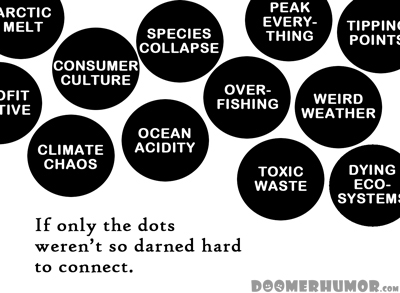 ... ...
|
When the dots get big enough, it'll be simple.
ApocaDoc
permalink
|
Fri, Sep 2, 2011
from Scientific American:
Thylacine Hunted into Extinction for No Reason, Study Reveals
The thylacine (Thylacinus cynocephalus), better known as the Tasmanian tiger, has long been the poster child for human-caused extinction. Hunted out of existence by Australian farmers who feared that the striped, canine-like marsupials would kill their sheep, the last thylacine died in captivity in Hobart Zoo 75 years ago next week, on September 7, 1936 (although the species was not officially declared extinct until about 25 years ago).
Now, just a few days before the annual observance of National Thylacine Day in Australia, a new study reveals that the predator was probably not a threat to sheep after all. Its notably long jaw (one of the animal's most distinctive features) could open to an amazing 120 degrees but was too weak to kill sheep, according to a study published September 1 in the Journal of Zoology.
"Our research has shown that its rather feeble jaw restricted it to catching smaller, more agile prey," lead author Marie Attard of the University of New South Wales in Australia, said in a prepared statement. Instead, it appears the thylacine killed and ate smaller animals, such as possums. ...
|
The sheep look up, and say "whatever."
ApocaDoc
permalink
|
Sun, Aug 21, 2011
from Guardian:
Rhinos threatened with extinction to meet demand for bogus cancer cure
We are at the frontline of a conflict that is threatening to turn some of South Africa's most beautiful nature reserves, a draw for tourists around the world, into lawless battlegrounds - and drive a magnificent animal towards the brink of extinction.
Some 265 rhinos have been poached so far this year, according to government figures, an average of more than one per day. This puts 2011 on course to surpass last year's record death toll of 333. In 2007, it was just 13.
Why? There is no mystery about it. Experts agree the carnage results from a false belief, widespread in the far east, that rhino horn can cure cancer and other life-threatening illnesses. There is now soaring demand from the newly moneyed consumers of China and Vietnam. Poaching gangs here are increasingly sophisticated, using helicopters, silent tranquillisers, body armour, night vision equipment and mercenaries experienced in rhino tracking.
Once a rhino's horn has been hacked off, they leave the animal to bleed to death. The horn is then smuggled out of the country by an international syndicate. The price of rhino horn is £35,000 per kilogram, making it more expensive than gold, according to the International Rhino Foundation. ...
|
Profitrees / bear strange fruit / Blood on the leaves / blood at the root.
ApocaDoc
permalink
|
Thu, Aug 18, 2011
from Associated Press:
Perry says he doesn't believe in global warming
GOP presidential candidate Rick Perry told New Hampshire voters Wednesday that he does not believe in manmade global warming, calling it a scientific theory that has not been proven.
"I think we're seeing almost weekly, or even daily, scientists that are coming forward and questioning the original idea that manmade global warming is what is causing the climate to change," the Texas governor said on the first stop of a two-day trip to the first-in-the-nation primary state.
He said some want billions or trillions of taxpayer dollars spent to address the issue, but he added: "I don't think from my perspective that I want to be engaged in spending that much money on still a scientific theory that has not been proven and from my perspective is more and more being put into question." ...
|
How do we know for sure that Rick Perry exists?
ApocaDoc
permalink
|
Mon, Aug 8, 2011
from TreeHugger:
USDA Hides Damning Report Of Antibiotic Abuse on Factory Farms
We've covered before the horrible consequences of constantly given factory farm animals antibiotics so they don't get sick in the sickening conditions we make them live. And recently the USDA commissioned a report reviewing the current research on antibiotics, antibiotic resistant infections and farm animals. The report was pretty damning of current industry practices, as Tom Philpott summarizes over at Mother Jones.
Perhaps even more disturbing, though, is that the document has since disappeared from the USDA website, apparently after the findings upset industry, and the report's author seems to have been prevented from talking to media.
Have no fear, there's a cached version: A Focus on Antimicrobial Resistance....
...
|
Modern agriculture will collapse without sustained, massive, prophylactic abuse of antibiotics!
ApocaDoc
permalink
|
Wed, Aug 3, 2011
from Greenwire:
House Democrats Take Aim at GOP Environmental Voting Record
The Republican-led House has voted to "stop," "block" or "undermine" efforts to protect the environment 110 times since taking over the majority in January, two senior Democrats said last week. Reps. Henry Waxman (D-Calif.) and Edward Markey (D-Mass.), who sponsored a bill that passed the House in 2009 that would have established a cap-and-trade scheme for greenhouse gas emissions, said the current House has done more to scuttle environmental protections than any in history.
"The new Republican majority seems intent on restoring the robber-baron era where there were no controls on pollution from power plants, oil refineries and factories," said Waxman, who serves as top Democrat on the Energy and Commerce Committee.
Natural Resources ranking member Markey, meanwhile, said the Republican agenda was a rifle "pointed right at the heart of America's clean energy future." ...
|
Republicans are good people who just tend to prefer a crappy, deadly environment.
ApocaDoc
permalink
|
Thu, Jul 28, 2011
from Conservation Magazine:
Cool White Dudes
"The more you think you know, the more you think you're right," goes an old saying. Now comes a study of sex, skin color and political ideology that suggests it pretty much sums up how some white male conservatives in the United States respond to climate change.
"Even casual observers" of those who argue that climate change isn't a serious problem "likely notice an obvious pattern," Aaron M. McCright of Michigan State University in East Lansing and Riley E. Dunlap of Oklahoma State University in Stillwater write in Global Environmental Change: The most prominent denialists are conservative white males" -- from media pundit Rush Limbaugh to politicians like Oklahoma Senator James Inhofe. But the pair wondered: "Does a similar pattern exist in the American public?"... Overall, while 29.6 percent of conservative white males (CWMs) believed that the effects of global warming "will never happen," just 7.4 percent of all other adults shared that view. Similarly, 58.5 percent of CWMs -- but only 31.5 percent of all other adults -- denied that recent temperature increases are primarily caused by human activities. ...
|
And the crackers shall inherit (what's left of) the earth.
ApocaDoc
permalink
|
Tue, Jul 26, 2011
from Rolling Stone:
The Plastic Bag Wars
American shoppers use an estimated 102 billion plastic shopping bags each year -- more than 500 per consumer. Named by Guinness World Records as "the most ubiquitous consumer item in the world," the ultrathin bags have become a leading source of pollution worldwide. They litter the world's beaches, clog city sewers, contribute to floods in developing countries and fuel a massive flow of plastic waste that is killing wildlife from sea turtles to camels... "There is simply zero justification for manufacturing them anymore, anywhere," the United Nations Environment Programme recently declared. But in the United States, the plastics industry has launched a concerted campaign to derail and defeat anti-bag measures nationwide. The effort includes well-placed political donations, intensive lobbying at both the state and national levels, and a pervasive PR campaign designed to shift the focus away from plastic bags to the supposed threat of canvas and paper bags -- including misleading claims that reusable bags "could" contain bacteria and unsafe levels of lead. ...
|
Beware the eeevil canvas and paper bags!
ApocaDoc
permalink
|
Tue, Jul 12, 2011
from VietNamNet:
Pollution threatens HCM City water supply
The pollution on Sai Gon River has become worse over the years as increasing industrialisation along the river bank threatens the main water source of HCM City.
The river flows through 40 industrial parks in Binh Duong, Binh Phuoc and Tay Ninh provinces and HCM City. Only 21 of them have an industrial waste treatment system.
Most of the treated water released from facilities does not meet the quality required by environmental authorities.
The Sai Gon River also is polluted by industrial and agricultural waste water from small-sized enterprises operating along the river, amounting to 65,000 cubic metres a day.
In addition, every day the river receives over 748,000 cubic metres of waste water, discharged from residential areas in localities, with more than 90 per cent of the waste water coming from HCM City...An expert said that with the limited number of waste water treatment plants, less than 20 per cent of household waste water was collected and treated, with the rest discharged directly into the river.
...
|
These poor folks are deep in shit!
ApocaDoc
permalink
|
Mon, Jul 11, 2011
from The Independent:
Annual demand for fish empties British waters in just six months
Britain's coastal waters are so overfished that they can supply the nation's chip shops, restaurants and kitchens for little more than six months of every year, research has shown.
Overfishing has caused so much damage to fish stocks across Europe that the quantity landed each year to satisfy the public appetite has fallen by 2 per cent on average every year since 1993.
So great is demand that next Saturday, 16 July, has been dubbed Fish Dependence Day - the day on which imports would have to be relied upon because native supplies would have run out if only home-caught fish had been eaten since 1 January. Last year it fell on 3 August, almost three weeks later, and in 1995 it was six weeks later. ...
|
We'll just import from that spare Earth I've heard tell about, right?
ApocaDoc
permalink
|
Sun, Jul 3, 2011
from New York Times:
Ruptured Pipeline Spills Oil Into Yellowstone River
An ExxonMobil pipeline running under the Yellowstone River in south central Montana ruptured late Friday, spilling crude oil into the river and forcing evacuations.
The pipeline burst about 10 miles west of Billings, coating parts of the Yellowstone River that run past Laurel -- a town of about 6,500 people downstream from the rupture -- with shiny patches of oil. Precisely how much oil leaked into the river was still unclear. But throughout the day Saturday, cleanup crews in Laurel worked to lessen the impact of the spill, laying down absorbent sheets along the banks of the river to mop up some of the escaped oil, and measuring fumes to determine the health threat....
While the cause of the rupture was not immediately known, Brent Peters, the fire chief for Laurel, told The A.P. that it may have been caused by high waters eroding parts of the river bed and exposing the pipeline to debris....
...
|
Who could have anticipated that a Montana riverbed might change in response to extreme weather?
ApocaDoc
permalink
|
Wed, Jun 22, 2011
from Al Gore, in Rolling Stone:
Climate of Denial: Can science and the truth withstand the merchants of poison?
Maybe it's just easier, psychologically, to swallow the lie that these scientists who devote their lives to their work are actually greedy deceivers and left-wing extremists -- and that we should instead put our faith in the pseudoscientists financed by large carbon polluters whose business plans depend on their continued use of the atmospheric commons as a place to dump their gaseous, heat-trapping waste without limit or constraint, free of charge.
The truth is this: What we are doing is functionally insane. If we do not change this pattern, we will condemn our children and all future generations to struggle with ecological curses for several millennia to come. Twenty percent of the global-warming pollution we spew into the sky each day will still be there 20,000 years from now! ...
Continuing on our current course would be suicidal for global civilization. But the key question is: How do we drive home that fact in a democratic society when questions of truth have been converted into questions of power? When the distinction between what is true and what is false is being attacked relentlessly, and when the referee in the contest between truth and falsehood has become an entertainer...?
The best available evidence demonstrates beyond any reasonable doubt that the reckless spewing of global-warming pollution in obscene quantities into the atmospheric commons is having exactly the consequences long predicted by scientists who have analyzed the known facts according to the laws of physics. ...
|
That guy is so inconvenient.
ApocaDoc
permalink
|
Thu, Jun 16, 2011
from Chicago Tribune:
Millions of Great Lakes fish killed in power plant intakes
Despite decades of efforts to restore and protect the Great Lakes, dozens of old power plants still are allowed to kill hundreds of millions of fish each year by sucking in massive amounts of water to cool their equipment.
Records obtained by the Tribune show that staggering numbers of fish die when pulled into the screens of water intake systems so powerful that most could fill an Olympic swimming pool in less than a minute. Billions more eggs, larvae and juvenile fish that are small enough to pass through the screens are cooked to death by intense heat and high pressure inside the coal, gas and nuclear plants.
Then the water is pumped back into Lake Michigan and the other Great Lakes up to 30 degrees hotter, encouraging the growth of oxygen-depleting algae that kills fish and fouls beaches.
Known as "once-through" cooling, the process is banned at new power plants. But for nearly four decades, federal and state environmental regulators largely have ignored the issue at old plants, even as fish populations decline sharply throughout the lakes and states spend millions of taxpayer dollars to stock the waters with game fish....
Critics compare the outdated technology to the Bass-o-Matic, the fish-pureeing prop from an old "Saturday Night Live" sketch.
...
|
Just try to imagine a more brutally effective fish-killing machine! This technique is badass!
ApocaDoc
permalink
|
Wed, May 25, 2011
from Politico:
Cold shoulder for climate change
Climate scientists are in a tough spot.
They have never been more certain about what they know. Powerful new satellites can hone in on mountainous regions to measure ice melt. Stronger computers model changes in disruptive weather patterns. Scientists are even more comfortable attributing climate change to visible effects around the globe, from retreating Himalayan glaciers to southwestern U.S. droughts and acidifying oceans. Yet scientists are still stuck in the mud trying to get that message out in Washington, where House Republicans made one of their first orders of business passing legislation to zero out research budgets for domestic and international climate efforts and unraveling a key EPA declaration that humans have played a critical role in changing the planet.
...
|
Oh you Republicans what a fantastical world you inhabit!
ApocaDoc
permalink
|
Fri, May 20, 2011
from Hartford Advocate:
You Have No Idea What Mowing Your Lawn Is Doing To The Planet
Imagine a scenario where tens of millions of Americans are condemned by their own illusions to hours of hot, sweaty, grueling unpaid labor every week involving expensive and potentially dangerous chemicals, ear-shattering machines and fuels that pollute the air and water.
This isn't some nightmarish dystopian science-fiction plot. It's happening right now as this nation's suburban homeowners renew their unending and damaging war against nature to preserve, protect and pamper the foreign organisms that make up the American lawn. ...
|
But if I don't make my lawn... just so... the gnomes get angry.
ApocaDoc
permalink
|
Tue, May 17, 2011
from St. Petersburg Times:
Once a major issue in Florida, climate change concerns few in Tallahassee
...In low-lying Florida, where 95 percent of the population lives within 35 miles of its 1,200 miles of coastline, a swelling of the tides could cause serious problems. So what is Florida's Department of Environmental Protection doing about dealing with climate change?
"DEP is not pursuing any programs or projects regarding climate change," an agency spokeswoman said in an e-mail to the St. Petersburg Times last week.
"That's a crying shame," said former Gov. Charlie Crist...Crist's successor, Gov. Rick Scott, doesn't think climate change is real, even though it's accepted as fact by everyone from NASA to the Army to the Vatican.
"I've not been convinced that there's any man-made climate change," Scott said last week. "Nothing's convinced me that there is." ...
|
Floriduh!
ApocaDoc
permalink
|
Tue, May 17, 2011
from Agence France-Press:
Extreme makeover: are humans reshaping Earth?
If alien geologists were to visit our planet 10 million years from now, would they discern a distinct human fingerprint in Earth's accumulating layers of rock and sediment?
Will homo sapiens, in other words, define a geological period in the way dinosaurs -- and their vanishing act -- helped mark the Jurassic and the Cretaceous?
A growing number of scientists, some gathered at a one-day symposium this week at the British Geological Society in London, say "yes"... For the first time in Earth's 4.7 billion year history, a single species has not only radically changed Earth's morphology, chemistry and biology, it is now aware of having done so. ...
|
Pimp my planet!
ApocaDoc
permalink
|
Tue, May 10, 2011
from Reno Gazette-Journal:
Fact checker: Don't see consensus on global warming? Look past Fox News
The claim: There is no scientific consensus that global temperatures are rising and humans are significantly to blame.
The background: This week's claim started because of a study done by the University of Maryland's Program on International Policy Attitudes. The study's aim was to determine whether the Citizens United case before the Supreme Court, which allowed unlimited campaign contributions from corporations and unions, affected people's perception of the truthfulness of the information being fed in the midterm elections.
The study wasn't intended to be concerned with where people got their information, just how accurate it seemed. But the researchers noticed a peculiar thing: Although some Americans were misinformed, they generally became more informed if they consumed more news -- with one major exception.
The study found that the more people watched Fox News, the less informed they became. ...
|
Unfair and unbalanced.
ApocaDoc
permalink
|
Mon, May 9, 2011
from Scientific American blogs:
Temperature Tantrum: James Hansen Speaks Out, Gets Busted, and Now Sues to Stop Global Warming
In the 1980s, however, he became so worried about global warming that he started speaking out. At a 1988 Senate hearing on climate change, he made headlines when he asserted with 99 percent certainty that greenhouse gases from human activities were causing global warming. Since then the correlated surge in atmospheric carbon dioxide and global temperatures has borne out his assertion....
Hansen advocates civil disobedience to block fossil-fuel operations; in 2009 he was arrested along with other protestors allegedly obstructing traffic into a coal-mining operation in West Virginia. Now he is trying another tactic: suing the government. Hansen serves as a scientific advisor for Our Children's Trust, an Oregon-based nonprofit formed "to protect Earth's natural systems for current and future generations." The group has organized a lawsuit that a coalition of environmental groups filed last week against the U.S. and other nations in attempt to force them to take measures to cut fossil-fuel emissions. ...
|
When science fails, and foresight fails, and prudence fails, and even reason fails to convince, all that's left is the legal system.
ApocaDoc
permalink
|
Wed, May 4, 2011
from Miller-McCune:
Environmental Footprints May Produce Backlash
Measuring a person's ecological footprint or carbon footprint is a popular tool among environmentalists. Many see it as a way to educate people about the damage they inflict on the environment on an everyday basis -- information that may prompt them to change their behavior.
But newly published research suggests that for many people -- perhaps most -- the receipt of such data may produce the opposite result.
In an experiment described in the journal Social Influence, "Only people who had invested their self-esteem in environmentalism -- a strong form of commitment -- reacted to negative environmental-footprint feedback by engaging in a pro-environment behavior," writes Santa Clara University psychologist Amara Brook. "Others were less likely to engage in a pro-environmental behavior after negative feedback." ...
|
Again I am reminded denial rules!
ApocaDoc
permalink
|
Sun, May 1, 2011
from Bloomberg:
Disaster Needed for U.S. to Act on Climate Change, Harvard's Stavins Says
The U.S. probably won't take significant steps to curb climate change until an environmental disaster sways public view and prompts political action, Robert Stavins of Harvard University said.
"It's unlikely that the U.S. is going to take serious action on climate change until there are observable, dramatic events, almost catastrophic in nature, that drive public opinion and drive the political process in that direction," Stavins, director of Harvard's Environmental Economics Program in Cambridge, Massachusetts, said today in an interview in Bloomberg's Boston office....
Stavins, an economist, is a member of the United Nations' Intergovernmental Panel on Climate Change, which said in 2007 that scientists are more than 90 percent certain that humans are causing global warming....
"There's a legit reason for the public to be skeptical about climate change because they don't see it," Stavins said.
Grabbing the public's attention would require a dramatic development, such as a "well-observed melting of parts of polar ice caps that result in some amount of sea-level rise," Stavins said. ...
|
Yeah, whaddaya expect from the public, abstract thinking?
ApocaDoc
permalink
|
Wed, Apr 27, 2011
from Alaska Dispatch:
Playing politics with climate change
What Americans believe about climate change depends almost entirely on their political affiliation and not their scientific understanding, according to a new national study that found the same dynamic in two regions of Southeast Alaska.
Democrats who claim knowledge of the issue appear to be in firm agreement with the nation's leading scientific organizations -- that human activity and greenhouse gas emissions have become the main drivers behind an accelerating global climate shift.
But Republicans don't buy it. While most do agree that the climate has begun to change, they mostly blame the phenomenon on natural forces that lie beyond human control. ...
|
Are you a Smartocrat or a Stupidlican?
ApocaDoc
permalink
|
Sun, Apr 24, 2011
from Associated Press:
Costly gasoline clouds Obama re-election prospects
With gas prices climbing and little relief in sight, President Barack Obama is scrambling to get ahead of the latest potential obstacle to his re-election bid, even as Republicans are making plans to exploit the issue....As Obama well knows, Americans love their cars and remain heavily dependent on them, and they don't hesitate to punish politicians when the cost of filling their tanks goes through the roof. ...
|
This Easter, give your car a big bunny hug because it's the most important thing on the planet.
ApocaDoc
permalink
|
Sat, Apr 9, 2011
from Sydney Morning Herald:
Backyards disguise toxic dumps
TONNES of hazardous waste have been secretly buried on private properties, hidden by layers of spray-on grass in Wollondilly, an important Sydney water-catchment area.
Residents have revealed that organised illegal dumping has been big business in the area for years, with some property owners filling unwanted gullies and dams with waste and being paid about $100 a truckload to take it.
The residents also said the dumps were often quickly disguised with a layer of top soil and spray-on lawn. ...
|
NIMTBY: Not in MY Toxic Backyard!
ApocaDoc
permalink
|
Sat, Apr 9, 2011
from Associated Press:
World stumbles toward climate summit
Nineteen years after the world started to take climate change seriously, delegates from around the globe spent five days talking about what they will talk about at a year-end conference in South Africa. They agreed to talk about their opposing viewpoints.
Delegates from 173 nations did agree that delays in averting global warming merely fast-forward the risk of plunging the world into "catastrophe." ...the U.N. meeting in Bangkok, which concluded late Friday after delegates cobbled together a broad agenda for the December summit, failed to narrow the deep divisions between the developing world and the camp of industrialized nations led by the United States. These may come to plague the summit in Durban. ...
|
Participants in this summit were given commemorative bronze fiddles.
ApocaDoc
permalink
|
Mon, Apr 4, 2011
from Guardian:
Why the UN can never stop climate change
On Sunday in Thailand diplomats opened another round of formal United Nations talks on global warming. For more than 20 years, the UN has been working on this problem, with little progress. Expectations have never been lower. The December 2009 conference in Copenhagen that was supposed to finalise a new treaty to replace the expiring Kyoto protocol ended in deadlock. Last year's talks in Cancun ended without agreement on most of the important new issues.
Some of the troubles with global warming diplomacy are unavoidable. Stopping climate change is one of the hardest challenges the international community has undertaken. The main cause of climate change, emissions of carbon dioxide, is intrinsic to the burning of fossil fuels that power the world economy. Even in the best of circumstances, getting off carbon will take decades and trillions of dollars. The world economic crisis makes that even harder as few societies choose to spend money on distant problems when they face more immediate challenges such as unemployment and poverty....
More progress will come from shifting efforts on three fronts. First, while the UN talks should not be abandoned, most diplomacy should shift to smaller forums which engage just the largest countries. In fact, 10 countries (treating the EU as one) account for nearly four-fifths of all warming emissions.... Second, talks need to shift focus to what is really achievable.... Third, talks must shift from focusing exclusively on controlling emissions to dealing with the reality that lots of climate change is inevitable.... ...
|
So if the UN, US, EU, and others can't, it sorta leaves up to you 'n' me, dunnit?
ApocaDoc
permalink
|
Tue, Mar 29, 2011
from Associated Press:
S. Carolina lawmakers take dim view of new light bulbs
South Carolina lawmakers are taking a stand in favor of states' lights.
With incandescent bulbs being phased out under federal law in favor of energy-efficient compact fluorescents, legislators want to exempt South Carolina from the measure, saying Washington has no business telling the state how to light its closets and countertops.
The proposed state law, called the Incandescent Light Bulb Freedom Act, "allows South Carolina to say to the federal government we are going to exercise our rights," said Republican state Rep. Bill Sandifer, a co-sponsor. ...
|
The Freedom to Ruin the Earth Edict (FREE)
ApocaDoc
permalink
|
Sat, Mar 19, 2011
from The Vancouver Sun:
Ocean garbage: Floating landmines
No matter where you travel on the B.C. coast, no matter how remote or seemingly untrammelled and pristine the fiord or inlet, a piece of plastic, Styrofoam or other garbage has been there before you. God knows how it got there: Dumped recklessly off a vessel, swept down a river or through a storm drain, blown by the wind off the land, or brought in by the ocean currents flowing across the vast North Pacific - including debris from the Japanese tsunami, which could start arriving on our coast in two years.
What we do know is that marine garbage is ubiquitous and wreaking havoc at every level of the marine environment.
A new B.C. study estimates there are 36,000 pieces of "synthetic marine debris" -garbage the size of fists to fridges -floating around the coastline, from remote inland fiords to 150 kilometres offshore.
...
|
We are the only species that shits where it sleeps and pisses into the wind.
ApocaDoc
permalink
|
Thu, Mar 17, 2011
from Scientific American:
House Repubs Vote That Earth Is Not Warming
Congress has finally acted on global warming--by denying it exists. It's in the grand lawmaking tradition of the Indiana state legislature's 1897 attempt to redefine the value of pi.
The Republican-led House of Representatives is currently working on the Energy Tax Prevention Act of 2011, which would bar the Environmental Protection Agency from regulating carbon dioxide emissions to mitigate climate change.
In the House Energy and Commerce Committee, California Democrat Henry Waxman had proposed an amendment calling on Congress to at least acknowledge that "warming of the climate system is unequivocal," just as abundant scientific evidence confirms.
But on Tuesday, March 15, all the committee's Republicans voted down that amendment, as well as two others acknowledging the threat of climate change to public well-being. ...
|
Rep. Strangelove: How I Learned to Stop Worrying and Love the Heat.
ApocaDoc
permalink
|
Tue, Mar 15, 2011
from AFP, via Yahoo News:
Fewer Americans worry about climate change: poll
The number of Americans who are worried about global warming has fallen to nearly the historic low reached in 1998, a poll released Monday showed.
Just 51 percent of Americans -- or one percentage point more than in 1998 -- said they worry a great deal or fair amount about climate change, Gallup's annual environment poll says.
In 2008, a year after former US vice president Al Gore and the UN Intergovernmental Panel on Climate Change won the Nobel Peace Prize, two-thirds of Americans were concerned about climate change.
The rate of concern among Americans has fallen steadily since then to 60 percent in 2009 and 52 percent last year....
"The reasons for the decline in concern are not obvious, though the economic downturn could be a factor," Gallup analysts say, citing a poll from two years ago that shows that in the minds of Americans, economy takes precedence over environment....
Just over a quarter of Americans believe reports in the press about climate change are generally correct, while nearly three in 10 believe the US media understates the effects of global warming. ...
|
Looks like our messaging is working!
ApocaDoc
permalink
|
Sun, Mar 13, 2011
from New York Times:
Spilled Milk Regulations a Myth, E.P.A. Says
To Representative Morgan Griffith, a freshman Republican from Virginia, nothing illustrates the Environmental Protection Agency's overreach more clearly than a new rule applying the same regulations that govern spilled oil to milk spilled on dairy farms. In the midst of a heated debate over the E.P.A.'s authority to regulate heat-trapping emissions like carbon dioxide, the charge makes for great political theater. But according to the agency, it is pure fiction.... Politifact, the Pulitzer Prize-winning fact-checking organization run by The St. Petersburg Times, also examined the Republican claims on the spilled milk regulations and rated them false.
...
|
Why let facts get in the way when you're dedicated to ruining the habitat!
ApocaDoc
permalink
|
Sat, Mar 12, 2011
from Greenwire:
Democrats Cry Foul Over GOP's Attempts to Tie Fuel Prices to EPA
House Republicans' move to join the two most politically volatile threads in the Washington, D.C., energy debate -- gas prices and U.S. EPA rules -- sparked Democratic charges of deception yesterday and silence so far from the Obama administration. Speaker John Boehner (R-Ohio) amplified the GOP gambit as he laid out a new project, dubbed the American Energy Initiative, calling for more domestic fossil-fuel production, new nuclear power plants and an end to EPA's authority over greenhouse gases. While the Republican message had percolated all week, Boehner's decision to spotlight the anti-EPA bill now sailing through the House Energy and Commerce Committee gave the gas-price charge a far broader platform.
The administration's offshore oil-production policies and regulation of greenhouse gases, Boehner said yesterday, represent a systematic hit to economic growth. "If the White House has its way -- and the EPA imposes a backdoor national energy tax -- gas prices will only go higher," the Ohioan told reporters. ...
|
I decree... that all politicians... abandon their limos and airplanes in lieu of riding bicycles.
ApocaDoc
permalink
|
Wed, Mar 9, 2011
from Climatewire:
Snubbing Skeptics Threatens to Intensify Climate War, Study Says
Listening to climate change doubters, and not dismissing them, might avert a "logic schism" similar to the political stalemate on abortion, according to a new paper involving research on skeptics. The paper (pdf) portrays doubters as being at a disadvantage. The majority of climate research comes from the fields of physical science, engineering and economics -- largely depicting rational outcomes in a world dominated by the view that the Earth is warming, and that something needs to be done about it.... Hair-raising warnings about climate catastrophes tend not to resonate with the skeptical crowd, the research says. And expensive government solutions to it definitely do not. Another way of talking about the issue is needed, the paper says. ...
|
How about we talk about it backwards? .raen si dne ehT
ApocaDoc
permalink
|
Wed, Mar 2, 2011
from Guardian, from DesdemonaDespair:
Scientists flee blaze in Chinese rainforest restoration project
One of the world's most advanced rainforest restoration projects may be going up in smoke in southern China.
A short while ago, I received a frantic phone call from Bulang Mountain in Xishuangbanna, where scientists and conservationists are fleeing 30m-high flames that, they said, were consuming trees in seconds.
Witnesses said the blaze had reached the edge of the Seeds of Heaven biodiversity development centre, where an ecologically healthy forest had been painstakingly rebuilt over the past four years on the site of a former rubber plantation....
"It's horrific. This model, which is recognised internationally as one of the most advanced of its type in the world, is now going up in flames."
The project - which was launched about five years ago by the German biologist Josef Margraf, now deceased, and his wife Minguo - pioneers a "rainforest farming" technique that creates a rich habitat for multiple species, from which a modest income for people can be cultivated from orchids, tea, honey and other products....
The flames appear to have spread from the direction of a neighbouring cow farm. Local officials say the spark was deliberately lit to create a controlled firebreak. Others told the visiting group that the fire may have been part of an effort to clear land for the expansion of a cattle farm.
"This is no accident. You just don't do a controlled fire on a windy day like today," said Pavlos Georgiadis, a former student of Margraf, who died of a heart attack last year. "This is the peak of the dry season. We haven't had rain for two months." ...
|
I bet they didn't even have insurance.
ApocaDoc
permalink
|
Wed, Feb 23, 2011
from Huffington Post:
Maine Gov. Paul LePage On BPA: 'Worst Case Is Some Women May Have Little Beards'
Maine Gov. Paul LePage's comment that the only bad thing about a chemical additive is that it might give women "little beards" has drawn a strong reaction from a health activist group.
LePage last week said he's not seen enough science to support a ban on bisphenol-A. A 2008 law to keep it out of consumer products is likely to be debated again.
LePage is quoted in the Bangor Daily News as saying that all he's heard is that "if you take a plastic bottle and put it in the microwave and you heat it up, it gives off a chemical similar to estrogen. So the worst case is some women may have little beards." ...
|
Who knew a philosopher-king ruled Maine?
ApocaDoc
permalink
|
Tue, Feb 8, 2011
from Wall Street Journal:
Business Groups' Target: EPA
The Environmental Protection Agency, which enforces rules that affect the U.S. economy from factories to farms, is the No. 1 target of complaints from business groups collected by House Republican leaders.
EPA rules were cited more than those from any other agency in more than 100 letters sent by trade associations, businesses and some conservative groups to House oversight committee chairman Darrell Issa (R., Calif.) in response to his call for businesses to identify regulations they deemed burdensome, according to documents reviewed by the Wall Street Journal. The letters are scheduled for release today. ...
|
I have this sneaking suspicion Issa is gonna pissa me off!
ApocaDoc
permalink
|
Sun, Jan 30, 2011
from London Independent:
Shoppers' green fatigue hits refill revolution
Green fatigue among shoppers has set back Britain's long-awaited refillable bottle revolution, with the latest attempts to persuade supermarket customers to reuse containers ending in failure.
Twelve years after one supermarket chain first began testing ways to encourage shoppers to refill detergent bottles rather than buy new ones, the group is no nearer to launching a national scheme across its stores.
Julian Walker-Palin, Asda's head of corporate sustainability, called its latest trial - which ran in five stores across the UK and offered customers the chance to save money while cutting their carbon footprint, by reusing specially designed fabric conditioner pouches - "disappointing". ...
|
The customer is always right even when they're messing up the planet.
ApocaDoc
permalink
|
Thu, Jan 27, 2011
from Associated Press:
Gingrich calls for replacing EPA
Former House Speaker Newt Gingrich called Tuesday for the elimination of the Environmental Protection Agency, which he wants to replace with a new organization that would work more closely with businesses and be more aggressive in using science and technology... Gingrich, who has made several visits to Iowa recently, said the EPA was founded on sound ideas but has become a traditional Washington bureaucracy. Gingrich had previously mentioned his desire to change the EPA, but Tuesday's explanation was the first time he made a specific proposal for replacing the agency...Gingrich denied his proposal would result in environmental damage, saying he would replace the EPA with what he called the Environmental Solution Agency. ...
|
An agency formerly known as the Business Aggrandizement and Earth Ruination Agency.
ApocaDoc
permalink
|
Fri, Jan 21, 2011
from The Australian:
Engineer's emails reveal Wivenhoe Dam releases too little, too late
LEAKED email communications from a Wivenhoe Dam engineering officer underline concerns that the Brisbane River flood was mostly caused by massive releases from the dam after it had held on to water too long over a crucial 72 hours before the severe rainfall that hit the region last week.
The emails, which become increasingly urgent in tone as the situation became critical as the dam's levels rise rapidly, were provided to The Australian by a source who said the stream of data had convinced him the river flood of Brisbane could have been largely avoided if the dam's operators had taken action much earlier....According to figures from Wivenhoe's operator, SEQWater, the dam's capacity went from 106 per cent full on the morning of Friday, January 7, to 148 per cent full on the morning of Monday, January 10, due to the limited weekend releases.
...
|
I know when my weekend releases are limited, I tend to burst!
ApocaDoc
permalink
|
Sat, Jan 15, 2011
from Guardian:
Australian floods: Why were we so surprised?
After 10 years of drought, we are having the inevitable flooding rains. The pattern is repeated regularly and yet Australians are still taken by surprise.
The meteorologists will tell you that the current deluge is a product of La Nina. At fairly regular intervals, atmospheric pressure on the western side of the Pacific falls; the trade winds blow from the cooler east side towards the trough, pushing warm surface water westwards towards the bordering land masses. As the water-laden air is driven over the land it cools and drops its load. In June last year the bureau of meteorology issued a warning that La Nina was about "to dump buckets" on Australia. In 1989-90 La Nina brought flooding to New South Wales and Victoria, in 1998 to New South Wales and Queensland. Dr Andrew Watkins, manager of the bureau's climate prediction services, told the assembled media: "Computer model forecasts show a significant likelihood of a La Nina in 2010." In Brisbane the benchmark was the flood of 1974; most Queenslanders are unaware that the worst flood in Brisbane's history happened in 1893. Six months ago the meteorologists thought it was worthwhile to warn people to "get ready for a wet, late winter and a soaked spring and summer". So what did the people do? Nothing. They said, "She'll be right, mate". She wasn't.... The rest of the world might well be scratching its head. Though the rise of the Brisbane river had been predicted for many days, owners left their boats on the river, some of them moored to pontoons, which were themselves ripped from their moorings. Literally hundreds of pontoons went careering down the river, crashing into unmanned powerboats that were already cannoning into each other. A long section of the riverside walkway broke away and became a waterborne missile.... After the Fitzroy river flooded Rockhampton in 1991, all the corals and sea grasses round the Keppel Islands died. The area had not yet recovered when the brown tide returned at the beginning of January, and keeps coming. The fresh water now entering the seas off Australia is expected to drift northwards to where the Great Barrier Reef is already struggling with rising sea temperatures. In ecological terms, worse, perhaps very much worse, is on the way. Australia owes it to the rest of the world to get a handle on its regular floods. Or she won't be right, mate. ...
|
But if we started believing computer models' predictions, we'd have to change our lifestyle!
ApocaDoc
permalink
|
Tue, Jan 11, 2011
from McClatchy Newspapers:
Climate change reveals disease as national security threat
One of the most worrisome national security threats of climate change is the spread of disease, among both people and animals, U.S. intelligence and health officials say.
But more than a decade after such concerns were first raised by U.S. intelligence agencies, significant gaps remain in the health surveillance and response network -- not just in developing nations, but in the United States as well, according to those officials and a review of federal documents and reports.
And those gaps, they say, undermine the ability of the U.S. and world health officials to respond to disease outbreaks before they become national security threats.
...
|
I bet we don't understand the language.
ApocaDoc
permalink
|
Tue, Jan 11, 2011
from McClatchy Newspapers:
Why the CIA is spying on a changing climate
... As [CIA] intelligence officials assess key components of state stability, they are realizing that the norms they had been operating with -- such as predictable river flows and crop yields -- are shifting...Back in the 1990s, the CIA opened an environmental center, swapped satellite imagery with Russia and cleared U.S. scientists to access classified information. But when the Bush administration took power, the center was absorbed by another office and work related to the climate was broadly neglected.
In 2007, a report by retired high-ranking military officers called attention to the national security implications of climate change, and the National Intelligence Council followed a year later with an assessment on the topic. But some Republicans attacked it as a diversion of resources.
And when CIA Director Leon Panetta stood up the climate change center in 2009, conservative lawmakers attempted to block its funding.
"The CIA's resources should be focused on monitoring terrorists in caves, not polar bears on icebergs," Sen. John Barrasso, R-Wyo., said at the time.
...
|
Is "Barrasso" pronounced "bare-asshole"?
ApocaDoc
permalink
|
Wed, Jan 5, 2011
from BBC:
Bluefin tuna sets new price record in Japan
A tuna has sold at auction for a record 32.49m yen in Tokyo, nearly $400,000... The fish was a blue fin, a variety prized for making the finest sushi. It was bought by a joint Japanese and Chinese bid.
The first auction in January at Tokyo's Tsukji fish market is a cherished part of Japan's New Year celebrations, and record prices are often set.
Japan is the world's biggest consumer of seafood.
After bells rang at 0500 local time (2000 GMT on Tuesday) to start the sale, bidding was brisk.... Traders at Tsukiji market say growing Chinese demand for sushi is also helping to push up prices. ...
|
The inexorable law of supply and consume in action. Wait, is that it?
ApocaDoc
permalink
|
Mon, Jan 3, 2011
from Associated Press:
End of Days in May? Christian group spreads word
If there had been time, Marie Exley would have liked to start a family. Instead, the 32-year-old Army veteran has less than six months left, which she'll spend spreading a stark warning: Judgment Day is almost here.
Exley is part of a movement of Christians loosely organized by radio broadcasts and websites, independent of churches and convinced by their reading of the Bible that the end of the world will begin May 21, 2011. ...
|
It would be sweet if the Rapture took all the big carbon emitters away.
ApocaDoc
permalink
|
Mon, Dec 27, 2010
from Beckly Register-Herald:
What's in a name? 'Mountaintop removal' vs. 'mountaintop development'
Coal operators and environmentalists have been pondering the value of a name since the revelation that the coal industry may push for "rebranding" surface mining as "mountaintop development" instead of "mountaintop removal."
The process of blasting the top of a mountain to obtain its underground coal reserves instead of digging a mine has been a much easier target for environmentalists since it has become known as mountaintop removal. However, coal industry executives say the term "mountaintop development" would paint a more accurate picture of the practice. ...
|
How about they call themselves the Coal Liberation Front?
ApocaDoc
permalink
|
Wed, Dec 15, 2010
from MediaMatters:
FOX boss ordered staff to cast doubt on climate science
In the midst of global climate change talks last December, a top Fox News official sent an email questioning the "veracity of climate change data" and ordering the network's journalists to "refrain from asserting that the planet has warmed (or cooled) in any given period without IMMEDIATELY pointing out that such theories are based upon data that critics have called into question."
The directive, sent by Fox News Washington managing editor Bill Sammon, was issued less than 15 minutes after Fox correspondent Wendell Goler accurately reported on-air that the United Nations' World Meteorological Organization announced that 2000-2009 was "on track to be the warmest [decade] on record."... A month after Sammon sent his memo, NASA's Goddard Institute for Space Studies released data confirming that 2009 was the second warmest year on record and marked the end of the warmest decade on record. ...
|
FOX just wants us all to be happy. As patriotic Americans, we deserve it!
ApocaDoc
permalink
|
Mon, Dec 13, 2010
from Huffington Post:
South Korean Fishing Boat Sinks Off Antarctica
A South Korean fishing boat sank in the Antarctic Ocean's frigid waters Monday, with 22 sailors feared killed in the open sea where vessels trawl for deep-water fish.... Many fishing vessels ply the remote seas to haul in deep-water fish such as the Patagonian toothfish, also known as Chilean sea bass, to sell to restaurants around the world. With world consumption of seafood increasing, commercial fleets have begun to operate farther offshore to meet demand. ...
|
And how much "farther offshore" can we go, exactly, and for how long?
ApocaDoc
permalink
|
Sat, Dec 4, 2010
from Associated Press:
Ft. Wayne billboard to herald Jesus' return in May
A Christian group is proclaiming Jesus' impending return in billboards going up Fort Wayne and other U.S. cities for the holiday season.
Allison Warden, one of the founders of Raleigh, N.C.-based We Can Know, said Wednesday that an analysis of Scripture, particularly the genealogies, shows Jesus will come in May.
"God actually provides a calendar that points to May 21, 2011, as the day for Christ to return," she said. ...
|
As an ApocaDoc, I gotta say May can't come soon enough!
ApocaDoc
permalink
|
Fri, Dec 3, 2010
from TalkingPointsMemo:
US House Republicans kill climate change committee
US President Barack Obama's Republican foes in the House of Representatives said Wednesday they were disbanding the chamber's committee on battling global warming, calling it a waste of money. Democrats immediately assailed what they branded the "very disappointing" decision to dismantle the Select Committee on Global Warming, which did not have the power to approve legislation.
"We have pledged to save taxpayers' money by reducing waste and duplication in Congress," said a spokesman for Republican House speaker-designate John Boehner, Michael Steel.
The committee "was a clear example, and it will not continue in the 112th Congress," he told AFP by email.
A spokesman for outgoing Democratic House Speaker Nancy Pelosi, set to hand Boehner her gavel when a new US Congress convenes in January, said the panel had played an important role in the debate on climate change and energy. ...
|
Is it true we elect the politicians we deserve?
ApocaDoc
permalink
|
Tue, Nov 23, 2010
from Climatewire:
Republicans Learn the Perils of Being Politically Incorrect on Climate Change
Defeat came for Republican Rep. Bob Inglis because he slid to "Satan's side." hat's how South Carolina voters perceive Inglis' newfound belief in climate change, says the outgoing lawmaker, who lost his primary bid in June to tea party candidate, and now representative-elect, Trey Gowdy.
Inglis reflected on several blasphemies he committed in the eyes of voters in a departing interview last week, held in his congressional office. They ranged from opposing President George W. Bush's troop surge in Iraq to supporting his Troubled Asset Relief Program. But none of those, Inglis said, had as strong an impact as his assertions that atmospheric warming is a scientific certainty. ...
|
Dear God... could you please bestow some brains upon your followers?
ApocaDoc
permalink
|
Mon, Nov 22, 2010
from Scientific American:
Fear-Based Messaging May Drive Skepticism of Global Warming
Earlier this year a Gallup poll found that 48 percent of Americans believe that global warming concerns are exaggerated. Back in 1997 31 percent of Americans thought the concerns were overrated. Why the increase?
Well it might have to do with the framing of the issue.... Those who received more positive messaging trusted the science. On the other hand those subjects who read the "doomsday" messaging were skeptical of global warming, and for those who think the world is generally a fair place had even stronger doubts about global warming after reading the negative messaging. The study is published in the January issue of Psychological Science.
So the authors note that while many tend to use fear-based messaging, in the case of global warming our reaction to a negative consequence may indeed overpower any logic. ...
|
Don't worry. Be happy.
ApocaDoc
permalink
|
Thu, Nov 11, 2010
from London Daily Mail:
'The planet won't be destroyed by global warming because God promised Noah,' says politician bidding to chair U.S. energy committee
A Republican congressman hoping to chair the powerful House Energy Committee refers to the Bible and God on the issue of global warming.
Representative John Shimkus insists we shouldn't concerned about the planet being destroyed because God promised Noah it wouldn't happen again after the great flood.
Speaking before a House Energy Subcommittee on Energy and Environment hearing in March, 2009, Shimkus quoted Chapter 8, Verse 22 of the Book of Genesis.
He said: 'As long as the earth endures, seed time and harvest, cold and heat, summer and winter, day and night, will never cease.' The Illinois Republican continued: 'I believe that is the infallible word of God, and that's the way it is going to be for his creation.
'The earth will end only when God declares its time to be over. Man will not destroy this earth. This earth will not be destroyed by a flood. ...
|
Dear God: Could you please make sure this guy is in charge of nothing?
ApocaDoc
permalink
|
Tue, Nov 9, 2010
from Mother Jones:
The GOP's Coming Climate Witch Hunt
Last Tuesday, as Americans across the country headed to the polls, a group of climate scientists gathered in Denver to discuss strategies for fighting back against right-wing attacks on global warming science. Their timing couldn't have been better. With the ascent of the Republicans, climate science -- and scientists -- will be a major target for the new House majority... Rep. Darrell Issa (R-Calif.), the incoming head of the House Oversight and Government Reform Committee, has pledged to hold hearings on the "Politicization of Science," which will consist of a rehashing of the so-called ClimateGate "scandal." He's also called for greater oversight of the Environmental Protection Agency's coming regulations of greenhouse gases. With Issa in charge, the oversight committee will devote a good deal of time to hauling government and university climate scientists before Congress. ...
|
Issa is going to pissa me off!
ApocaDoc
permalink
|
Tue, Nov 2, 2010
from Washington Post:
Meat industry unhappy over limiting the use of antibiotics
For decades, factory farms have used antibiotics even in healthy animals to promote faster growth and prevent diseases that could sicken livestock held in confined quarters.
The benefit: cheaper, more plentiful meat for consumers.
But a firestorm has erupted over a federal proposal recommending antibiotics only when animals are actually sick.
Medical and public health experts in recent years say overuse and misuse of antibiotics pose a serious public health threat by creating new strains of bacteria that are difficult to treat - both in animals and humans.
"Over time, we have created some monster bugs," said Russ Kremer, a Bonnots Mill, Mo., farmer who speaks nationally about the threat to the food supply. "It is truly harmful to everyone to feed antibiotics to animals just for growth promotion and economic gain." ...
|
Broad-spectrum antibiotics are just like vitamins for meat animals, right? What's the harm?
ApocaDoc
permalink
|
Tue, Nov 2, 2010
from Reuters:
U.S. wind power posts slowest quarter since 2007
The U.S. wind power industry had its slowest quarter since 2007 in the just-ended third quarter, as investors turned away from the sector after Congress did not pass a renewable power mandate, an industry group said.
The American Wind Energy Association (AWEA) said U.S. developers added 395 megawatts of electricity capacity at wind farms in the third quarter -- the slowest quarter since 2007. Year-to-date installations of 1,634 MW, were down 72 percent versus the same period last year.
The U.S. Senate has not passed a national renewable energy mandate that would have required power utilities to generate minimum amounts of power from sources like wind and solar power. ...
|
At this point, 'bout all we have is breeze power.
ApocaDoc
permalink
|
Tue, Nov 2, 2010
from Monthly Review:
Capitalism and the Curse of Energy Efficiency
The curse of energy efficiency, better known as the Jevons Paradox--the idea that increased energy (and material-resource) efficiency leads not to conservation but increased use--was first raised by William Stanley Jevons in the nineteenth century. Although forgotten for most of the twentieth century, the Jevons Paradox has been rediscovered in recent decades and stands squarely at the center of today's environmental dispute.... Economists and environmentalists who try to measure the direct effects of efficiency on the lowering of price and the immediate rebound effect generally tend to see the rebound effect as relatively small, in the range of 10 to 30 percent in high-energy consumption areas such as home heating and cooling and cars. But once the indirect effects, apparent at the macro level, are incorporated, the Jevons Paradox remains extremely significant. It is here at the macro level that scale effects come to bear: improvements in energy efficiency can lower the effective cost of various products, propelling the overall economy and expanding overall energy use. ...
|
I just got an ultra-efficient refrigerator, so now my old one's in the basement, keeping the beer cold!
ApocaDoc
permalink
|
Fri, Oct 29, 2010
from Pew Research Center:
Wide Partisan Divide Over Global Warming
...Views about climate change continue to be sharply divided along party lines. A substantial majority of Democrats (79 percent) say there is solid evidence that the average temperature on earth has been increasing over the past few decades, and 53 percent think the earth is warming mostly because of human activity. Among Republicans, only 38 percent agree the earth is warming and just 16 percent say warming is caused by humans. Roughly half of Republicans (53 percent) say there is no solid evidence of warming. These patterns are little changed from a year ago.
More than half of independents (56 percent) say there is solid evidence of warming, but just 32 percent think it can mostly be attributed to human actions. Opinions among independents who lean toward the Republican Party or Democratic Party are similar to those of partisans. ...
|
Whew! I thought global warming was real but it's actually ideological!
ApocaDoc
permalink
|
Tue, Oct 26, 2010
from Politico:
Climate skeptics wanted for GOP primary
It's going to be hard winning the Republican presidential nomination if you're not a climate skeptic.
Recent comments from top White House and congressional contenders suggest an awkward mix of outright hostility or, at best, ambivalence toward the widespread scientific consensus that humans are responsible for the warming planet. Fueled by tea party rage, anti-government sentiment and hostility to anything attached to President Barack Obama, the 2012 GOP primary field is expected to run to the right... A New York Times/CBS News poll this month found that 53 percent of tea party supporters think global warming will not have serious impacts at any time in the future, while just 22 percent of the rest of the public felt the same way. ...
|
What do you suppose those people put in their tea?
ApocaDoc
permalink
|
Wed, Oct 20, 2010
from Live Science:
End of the Earth Postponed
It's a good news/bad news situation for believers in the 2012 Mayan apocalypse. The good news is that the Mayan "Long Count" calendar may not end on Dec. 21, 2012 (and, by extension, the world may not end along with it). The bad news for prophecy believers? If the calendar doesn't end in December 2012, no one knows when it actually will - or if it has already.
A new critique, published as a chapter in the new textbook "Calendars and Years II: Astronomy and Time in the Ancient and Medieval World" (Oxbow Books, 2010), argues that the accepted conversions of dates from Mayan to the modern calendar may be off by as much as 50 or 100 years. ...
|
Something else to worry about: We don't know which day is doomsday!
ApocaDoc
permalink
|
Fri, Oct 15, 2010
from Jerry Mander, in the Guardian:
Climate change v capitalism: the feast is almost over
So, while Obama talked climate change in Copenhagen, he pushed for accelerated growth and consumption, emphasising such climate-deadly industries as private automobile production, new road construction, nuclear power generation, and continued coal extraction (including horrendous "mountain top removal") while extolling an entirely theoretical "clean coal".... Whether it's the political left or right, Obama, or Cameron, or Sarkozy, or Putin, or Wen, or Harper or Miliband or Gingrich or Palin, or any political candidate for any office, they're all talking about the necessity to stimulate growth. The media does, too, whether it's the Guardian or the Murdoch press, the Financial Times or the New York Times. They all agree on the one thing: growth, growth, growth. That's the lifeblood of the system. Everyone is hunting the magic elixir to revive rapid growth. How to build and sell more cars? How to increase industrial production, from computers to heavy equipment to industrial agriculture? How to increase exports?
But there's a missing link in the discussion, ignored by nearly everyone in the mainstream debate: nature. They speak about our economy as if it were a separate entity, its own ever-expanding universe, unconnected to any realities outside itself, not embodied within a larger system from which, actually, it emerged and can't escape. Nature cannot be left out of the discussion. It may be the most important detail of the entire conversation. Leaving it out of consideration is, well, suicidal. Here's the point: never-ending growth on a small planet with finite resources is a profound impossibility. It's an absurdity. A fantasy. It's time to wake up. ...
|
Just so's you know, that fantasy has been makin' me rich.
ApocaDoc
permalink
|
Tue, Oct 12, 2010
from Reuters:
SCENARIOS-Republican election impact on climate control
Republicans are poised to make big gains in the Nov. 2 congressional elections, putting them in position to reverse Democrats' drive for comprehensive climate control legislation.
President Barack Obama's Democrats currently hold majorities in both chambers of the U.S. Congress.
A Republican takeover of either chamber, or even large gains by Republicans, will make it harder, or impossible, for Obama to win legislation imposing mandatory reductions of greenhouse gas emissions from smokestacks and tailpipes. ...
|
Mommy, why do Repubwicans hate pwanet earth?
ApocaDoc
permalink
|
Mon, Oct 11, 2010
from London Independent:
Green fatigue hits campaign to reduce carbon footprint
Britons are less environmentally conscious than they were five years ago, with twice as many people now "bored" by talk of climate change as in 2005. Four in 10 take no action at all to reduce their household carbon dioxide emissions. Experts warn that green fatigue is a major reason why there are more cars on the roads, more planes in the sky and no reduction in the mountain of packaging waste.
As a new energy report reveals that too few people are making an effort to reduce their household CO2 emissions, environmentalists believe the recession is further undermining public commitment. ...
|
For those "bored" ones, things are about to get really exciting.
ApocaDoc
permalink
|
Fri, Oct 8, 2010
from Der Spiegel:
The Traveling Salesmen of Climate Skepticism
A handful of US scientists have made names for themselves by casting doubt on global warming research. In the past, the same people have also downplayed the dangers of passive smoking, acid rain and the ozone hole. In all cases, the tactics are the same: Spread doubt and claim it's too soon to take action.
With his sonorous voice, Fred Singer, 86, sounded like a grandfather explaining the obvious to a dim-witted child. "Nature, not human activity, rules the climate," the American physicist told a discussion attended by members of the German parliament for the business-friendly Free Democratic Party (FDP) three weeks ago.... Singer is one of the most influential deniers of climate change worldwide. In his world, respected climatologists are vilified as liars, people who are masquerading as environmentalists while, in reality, having only one goal in mind: to introduce socialism. ...
|
At 86, Singer still has time to see the truth.
ApocaDoc
permalink
|
Tue, Oct 5, 2010
from Huffington Post:
Biodegradable Packaging Criticized For Being Too Noisy, so Frito-Lay Returns to Plastic
Frito-Lay hopes to quiet complaints about its noisy SunChips bags by switching out the biodegradable bags for the old packaging on most flavors.
The company is switching back to original packaging, which is made of a type of plastic, for five of the six varieties of the chips. It will keep the biodegradable and recyclable bags for its sixth variety, its original plain flavor.... Spokeswoman Aurora Gonzalez said the company received complaints about the noise from the bags, although it also received thanks from customers who liked being able to recycle them.
So the decision was made to remove the bulk of the biodegradable line.
"We need to listen to our consumers," she said. "We clearly heard their feedback." ...
|
Can I slap those stupid customers for being too noisy?
ApocaDoc
permalink
|
Tue, Oct 5, 2010
from Associated Press:
Oil industry has yet to adopt lessons of BP spill
Oil industry and government officials could get caught flat-footed again by another deep-water blowout in the coming months because they have yet to incorporate many of the lessons learned during the BP disaster, experts inside and outside the business tell The Associated Press.
For one thing, it could be another year before a bigger, better cap-and-siphon containment system is developed to choke off leaks many thousands of feet below the surface. Also, existing skimmers still don't have the capacity to quickly suck up millions of gallons of oil flowing at once.... And despite an overhaul of the federal agency that regulates the industry, there are lingering doubts about whether the government can effectively police Big Oil at the same time it relies on the industry for revenue. ...
|
Why should they learn their lessons... people are still driving their cars around like there's no tomorrow!
ApocaDoc
permalink
|
Tue, Sep 28, 2010
from WBAL-TV Baltimore:
What Is Energy Star? What Gets Certified?
Greg Kutz, a managing director of forensic audits and special investigations for the U.S. Government Accountability Office, the investigative arm of Congress... and his team put the Energy Star certification program to the test by setting up four bogus companies. They gave the bogus companies creative names, such as Tropical Thunder, Spartan Digital Electronics, Cool Rapport and Futurizon Solar Innovations.
Over a period of several months, the made-up companies submitted bogus products in an effort to get the coveted Energy Star certification.
"We started with basic things like computer monitors, refrigerators, dishwashers," Kutz said. "Once we saw how easily those where being certified, we went to more egregious things like the gas-powered alarm clock." ...
|
Now that's what I call a real wake-up call.
ApocaDoc
permalink
|
Tue, Sep 28, 2010
from Associated Press:
Peabody looks to expand southern Ill. coal mine
Peabody Energy Corp. said Monday it expects to spend $175 million to expand one of its southern Illinois coal mines by 40 percent, extending by 16 years the life of a site that environmental critics believe has no business getting bigger... "We are expanding Gateway [Mine] to serve one of the fastest-growing markets in the United States," said Gregory Boyce, chairman and chief executive at Peabody, which fuels roughly one-tenth of all U.S. electricity generation and more than 2 percent worldwide.
The Sierra Club's Illinois chapter worries that broadening Gateway could fan pollution of the area's water and air. But the group's Joyce Blumenshine said challenging Peabody's push beyond just a public hearing could be a David-vs.-Goliath scenario the cost-conscious agency may not be able to afford. ...
|
Wait a minute. Doesn't David win?
ApocaDoc
permalink
|
Sun, Sep 19, 2010
from New York Post:
Rat-eating opossums now run amok in Brooklyn
The city played possum -- and Brooklyn residents lost.
In a bizarre attempt to outwit Mother Nature, city officials introduced beady-eyed opossums in Brooklyn years ago to scarf down rats running amok in the borough, according to local officials.
Surprise: Operation opossum didn't work.
Not only do wily rats continue to thrive, but the opossums have become their own epidemic, with bands of the conniving creatures sauntering through yards, plundering garbage cans and noshing on fruit trees.... "Didn't any of those brain surgeons realize that the opossums were going to multiply?"... The opossums were set free in local parks and underneath the Coney Island boardwalk, with the theory being they would die off once the rats were gobbled up, said Councilman Domenic Recchia (D-Brooklyn).
...
|
They tell me 'possum tastes a lot like chicken.
ApocaDoc
permalink
|
Fri, Sep 17, 2010
from PLOS-One, through DesdemonaDespair:
Bottom trawling more damaging to sea floor than all other human activities combined
Scientists have for the first time estimated the physical footprint of human activities on the deep seafloor of the North East Atlantic. The findings published in the journal PLoS ONE reveal that the area disturbed by bottom trawling commercial fishing fleets exceeds the combined physical footprint of other major human activities considered.... Using available data for the year 2005, they mapped and estimated the spatial extent of intentional human activities occurring directly on the seafloor as well as structures and artefacts present on the seafloor resulting from past activities.... Even on the lowest estimates, the spatial extent of bottom trawling is at least ten times that for the other activities assessed, with a physical footprint greater than that of all the others combined. ...
|
You're implying that something I can't see is more important than things I ignore?
ApocaDoc
permalink
|
Sat, Sep 11, 2010
from Guardian:
RyanAir CEO: Global warming is 'horseshit.'
"I believe it's all a load of bullshit. But it's amazing the way the whole fucking eco-warriors and the media have changed. It used to be global warming, but now, when global temperatures haven't risen in the past 12 years, they say 'climate change'.
Well, hang on, we've had an ice age. We've also had a couple of very hot spells during the Middle Ages, so nobody can deny climate change. But there's absolutely no link between man-made carbon, which contributes less than 2 percent of total carbon emissions [and climate change].... The scientific community has nearly always been wrong in history anyway. In the Middle Ages, they were going to excommunicate Galileo because the entire scientific community said the Earth was flat... I mean, it is absolutely bizarre that the people who can't tell us what the fucking weather is next Tuesday can predict with absolute precision what the fucking global temperatures will be in 100 years' time. It's horseshit." ...
|
I trust this man's insight, because he is very rich.
ApocaDoc
permalink
|
Sun, Sep 5, 2010
from Postmedia News:
U.S. study says people are hesitant to believe good news from scientists
A newly released American study suggests the public often rejects the opinions of scientific experts.
The public tends not to trust scientists, says research from California - but there's a twist. People are mainly reluctant to believe good news, it turns out - such as the message that a flu vaccine is safe. But the public is more likely to trust the researchers who frighten with bad news.
Overall, the study, published in a research journal called Public Understanding of Science, concludes that "scientists' efforts to influence public opinion have a limited effect." ...
|
Thank goodness politicians listen to scientists!
ApocaDoc
permalink
|
Sun, Sep 5, 2010
from New Orleans Times-Picayune:
5 key human errors, colossal mechanical failure led to fatal Gulf oil rig blowout
A string of mistakes, first by people, then by a supposedly fail-safe machine, sealed the fates of 11 rig workers and led to the fouling of the Gulf of Mexico and hundreds of miles of its coastline. More than 100 hours of testimony before a federal investigative panel, two dozen congressional hearings and several internal company reports have brought the genesis of the spill into sharp focus. The record shows there was no single fatal mistake or cut corner. Rather, five key human errors and a colossal mechanical failure combined to form a recipe for unprecedented disaster. The rig's malfunctioning blowout preventer ultimately failed, but it was needed only because of human errors. Those errors originated with a team of BP engineers in Houston who knew they had an especially tough well, one rig workers called "the well from hell." ...
|
The "well from hell" turned out to be the "rig you don't dig."
ApocaDoc
permalink
|
Thu, Sep 2, 2010
from Scientific American:
Eternal Fascinations with the End: Why We're Suckers for Apocalyptic Endings
You might think that the enterprise of science, with its method and its facts, would inoculate us against the most extravagant doomsday obsessions. But it doesn't. If anything, it just gives us more to worry about.
Some of the most fervent and convincing doomsayers, after all, are scientists. Bill Joy, co-founder and former chief scientist of Sun Microsystems, has warned that of out-of-control nanobots could consume everything on earth. Astronomer Royal Martin Rees has publicly offered a bet that a biological catastrophe--accidental or intentional--will kill at least one million people by 2020 (so far, no takers). Numerous climatologists sound the alarm about the possibility of runaway global warming. They all stand on the shoulders of giants: British economist Thomas Malthus predicted in the 19th century that the rise in population would lead to widespread famine and catastrophe. It never happened, but that didn't stop Stanford biologist Paul R. Ehrlich from renewing the warning in his 1968 book The Population Bomb when he predicted that global famine was less than two decades away. Catastrophe didn't arrive then, either, but does that mean it never will? Not necessarily. Still, people often worry disproportionately about disasters that are unlikely to occur.... Some researchers think that apocalyptic dread feeds off our collective anxiety about events that lie outside our individual control.... The desire to treat terrible events as the harbinger of the end of civilization itself also has roots in another human trait: vanity.... Our fears of the apocalypse may in the end mirror the most fundamental fear of all: fear of our own mortality. ...
|
Does it matter if we hope we're wrong?
ApocaDoc
permalink
|
Thu, Sep 2, 2010
from Jeffrey Sachs, in Scientific American:
The Deepening Crisis: When Will We Face the Planet's Environmental Problems?
During the four years of this column, the world's inability to face up to the reality of the growing environmental crisis has become even more palpable. Every major goal that international bodies have established for global environmental policy as of 2010 has been postponed, ignored or defeated. Sadly, this year will quite possibly become the warmest on record, yet another testimony to human-induced environmental catastrophes running out of control.
This was to be the year of biodiversity. In 2002 nations pledged, under the auspices of the United Nations Convention on Biological Diversity, to slow significantly the planetary loss of biodiversity by 2010. This goal was not even remotely achieved. Indeed, it was barely even noticed by Americans: the U.S. signed the convention in 1992 but never ratified it. Ratification fell victim to the uniquely American delusion that virtually all of nature should be subdivided into parcels of private property, within which owners should have their way.... The Senate, true to form, sustained its 18th year of inaction on global warming since ratifying the U.N. Framework Convention on Climate Change in 1992.... Fifth, vested corporate interests have mastered the dark arts of propaganda, and they can use their deep pockets to purchase a sea of deliberate misinformation to deceive the public.
...
|
The free market of corporate politics is my friend! They told me so!
ApocaDoc
permalink
|
Thu, Sep 2, 2010
from Associated Press:
Calif. rejects ban on plastic shopping bags
California lawmakers have rejected a bill seeking to ban plastic shopping bags after a contentious debate over whether the state was going too far in trying to regulate personal choice.
The Democratic bill, which failed late Tuesday, would have been the first statewide ban, although a few California cities already prohibit their use.
The measure offered California an opportunity to emerge at the forefront of a global trend... Republicans and some Democrats opposed it, saying it would add an extra burden on consumers and businesses at a time when many already are struggling financially. "If we pass this piece of legislation, we will be sending a message to the people of California that we care more about banning plastic bags than helping them put food on their table," said Sen. Mimi Walters, R-Lake Forest. ...
|
And what would I use to pick up my dog's shit?
ApocaDoc
permalink
|
Wed, Sep 1, 2010
from American Institute for Biological Sciences, via EurekAlert:
Researchers analyze 'the environmentalist's paradox'
Global degradation of ecosystems is widely believed to threaten human welfare, yet accepted measures of well-being show that it is on average improving globally, both in poor countries and rich ones. A team of authors writing in the September issue of BioScience dissects explanations for this "environmentalist's paradox."... Three likely reasons they identify--past increases in food production, technological innovations that decouple people from ecosystems, and time lags before well-being is affected--provide few grounds for complacency, however.... The researchers resolve the paradox partly by pointing to evidence that food production (which has increased globally over past decades) is more important for human well-being than are other ecosystem services. They also establish support for two other explanations: that technology and innovation have decoupled human well-being from ecosystem degradation, and that there is a time lag after ecosystem service degradation before human well-being will be affected. ...
|
None are so paradoxed as those who will not see.
ApocaDoc
permalink
|
Mon, Aug 30, 2010
from Bloomberg News:
Low prices stoke coal sales, despite pollution concerns
Coal trading is poised to rise to a record high this year as prices at less than half their 2008 peak stoke demand, defying governments' efforts to phase out the most-polluting fossil fuel. The volume of coal derivatives bought and sold around the world may jump as much as 46 percent this year to 2.3 billion metric tons, based on data from exchanges and brokers, according to Guillaume Perret, founder of Perret Associates Ltd. and a former trader at RWE AG, Germany's second-biggest utility.
That would exceed the record 2.2 billion tons traded in 2007.
"It's looking pretty good for coal," Kris Voorspools, director of 70Watt Capital Management, a Luxembourg hedge fund that specializes in trading spreads in energy and carbon markets, said last week. "It's the fuel for the developing world. China and India are using it to grow." ...
|
That sucking sound you hear is humanity's last gasp of growth.
ApocaDoc
permalink
|
Sun, Aug 29, 2010
from SolveClimate:
Chinese Climate Negotiator Provides Candid Take on What Happened in Copenhagen
First, by announcing programs and targets for the coming decade prior to the talks, the government continued to show the world that China is a responsible nation. Those plans were unconditional, as we do not believe that the future of mankind should be used as a bargaining chip - a position that contrasts sharply with the stance of developed nations.... They did not consider that their proposed 30 percent cuts have a long list of conditions attached, yet when we aim to cut carbon-intensity by 40 percent they say we are doing nothing.... The talks focused on two issues. One was long term goals. As disagreement over atmospheric carbon-dioxide concentrations and 2050 emissions targets was too great, these were not covered in the agreement, which specified only a goal of limiting any temperature increase to two degrees Celsius [above pre-industrial levels].... China is bound to be dependent on coal for energy - we cannot afford oil as an alternative when it costs more than US$100 dollars (680 yuan) a barrel.... Many problems can only be solved through development.
We cannot blindly accept that protecting the climate is humanity's common interest - national interests should come first.... The individual can save power, but there are 600 million people in India without electricity - the country has to develop and meet that need. And if that increases emissions, I say, "So what?" The people have a right to a better life.... Some EU nations have done well on emissions reductions, but the United States, New Zealand, Australia, Japan, Spain and Italy have not just failed to make cuts – they have significantly increased their emissions. And they do not seem to feel they have done anything wrong. ...
|
This is the way the world ends / not with a bang, but an economic justification.
ApocaDoc
permalink
|
Sat, Aug 28, 2010
from BBC:
Anti-whaling NGOs warn of 'contaminated' whale meat
Environmental and animal-welfare groups are urging the International Whaling Commission (IWC) to persuade the World Health Organization (WHO) to act over fears about eating whale meat.
The coalition of organisations wants the WHO to issue guidelines amid fears about the safety of the meat.
The groups say whale meat is highly contaminated with mercury and should not be eaten.
But whaling nations say they already have health guidelines in place....
They say dangerously high levels of mercury accumulate up the food chain.
Small cetaceans, like tooth whales and pilot whales, are near the top of it and therefore a lot more toxic compounds tend to accumulate in these mammals' tissues than in smaller inhabitants of the marine world, warn the NGOs....
[Faroe Island whaling defender]: "It's true that pilot whales have very high levels of mercury in the meat and PCBs in the blubber and in 1998, the relevant health authorities at the Faroes issued a safety recommendation advising people on how much it was safe to eat. And people have taken that advice on board."...
"If we don't have the whale meat and the blubber, what do we eat instead? We don't have meat production as such in the Faroes other than sheep and a limited amount of cattle that is kept mostly for milk. The sheep population is certainly not enough to serve the meat needs," [she continued]....
Though the conservationists think it is rather unlikely for the IWC to extend the whaling ban to cover the small cetaceans, many hope that getting people to think about their health will do the trick. ...
|
I have the right to murder an intelligent mammal, because I want to eat its toxic fat and meat. How hard is that to understand?
ApocaDoc
permalink
|
Tue, Aug 24, 2010
from AP, via Washington Post:
Experts: Gators in northern waters probably pets
Two gators in the Chicago River. One strolling down a Massachusetts street. Another in bustling New York City. And that's just in the past few weeks.
From North Dakota to Indiana, alligators are showing up far from their traditional southern habitats - including a 3-footer captured Tuesday in the Chicago River.
But experts say it's not the latest sign of global warming. Instead the creatures almost certainly were pets that escaped or were dumped by their owners.
"People buy them as pets and then they get too big and at some point they decide they just can't deal with it," said Kent Vliet, an alligator expert from the University of Florida who tracks media reports about the reptiles.... Vliet said such small alligators don't pose much of a threat to humans - preferring to dine on fish, snails, crayfish, frogs and small snakes - though they probably would bite if handled.
"It's not like it's going to hunt you down," he said.
The greater risk is to the reptiles, which probably wouldn't survive long in northern climates, experts said. ...
|
That's presuming there aren't, y'know, sewers.
ApocaDoc
permalink
|
Sun, Aug 22, 2010
from Guardian:
We've gone into the ecological red
At the weekend, Saturday 21 August to be precise, the world as a whole went into "ecological debt".
That means in effect that from now until the end of the year, humanity will be consuming more natural resources and producing more waste than the forests, fields and fisheries of the world can replace and absorb. By doing so, the life-support systems that we all depend on are worn ever thinner. Farms become less productive, fish populations crash and climate regulating forests decline. All become less resilient in the face of extreme weather events.
The date is arrived at by comparing our annual environmental resource budget with our ecological footprint - the rate at which we spend it.
The more we overshoot the available budget, the earlier in the year we start to go into the ecological red. Collectively we started to live beyond our means in the 1980s. Since then the date has crept earlier and earlier in the year. Improved measurement and data bring the latest date forward by a whole month in comparison with last year's date. It now takes about 18 months for the planet to generate what we consume in just 12. ...
|
I'm not worried -- I invested in ecology default swaps.
ApocaDoc
permalink
|
Tue, Aug 17, 2010
from American for Psychological Science, via EurekAlert:
People who cannot escape a system are likely to defend the status quo
...[P]eople who are told that their right to emigrate will be restricted have what could be considered a strange reaction: they respond by defending their country's system.... The researchers interpret that to mean that people who feel trapped in their country are more likely to try to justify the country's system and rationalize away its dissatisfactory elements.
"We focused on policies, but there are a lot of other reasons that make it hard for people to leave. One of these is poverty," says Laurin. "It's a depressing thought that the poor, the very people who are put in the worst position by a particular system, might be the ones that are the most motivated to defend that system." ...
|
Thank goodness we live in the best of all possible worlds.
ApocaDoc
permalink
|
Tue, Aug 17, 2010
from Huffington Post:
Biggest US Coal Power Expansion In 2 Decades
Utilities across the country are building dozens of old-style coal plants that will cement the industry's standing as the largest industrial source of climate-changing gases for years to come.
An Associated Press examination of U.S. Department of Energy records and information provided by utilities and trade groups shows that more than 30 traditional coal plants have been built since 2008 or are under construction.... The expansion, the industry's largest in two decades, represents an acknowledgment that highly touted "clean coal" technology is still a long ways from becoming a reality and underscores a renewed confidence among utilities that proposals to regulate carbon emissions will fail. The Senate last month scrapped the leading bill to curb carbon emissions following opposition from Republicans and coal-state Democrats.
"Building a coal-fired power plant today is betting that we are not going to put a serious financial cost on emitting carbon dioxide," said Severin Borenstein, director of the Energy Institute at the University of California-Berkeley. "That may be true, but unless most of the scientists are way off the mark, that's pretty bad public policy." ...
|
Why the hell would you want to slow down the economic recovery with burdensome carbon regulations?
ApocaDoc
permalink
|
Sun, Aug 15, 2010
from InvestigateWest:
States struggle to curb pollution by cruise ships
In a single day, the federal Environmental Protection Agency estimates, passengers aboard a typical cruise ship will generate:
* 21,000 gallons of sewage
* One ton of garbage
* 170,000 gallons of wastewater from sinks, showers and laundry
* More than 25 pounds of batteries, fluorescent lights, medical wastes and expired chemicals
* Up to 6,400 gallons of oily bilge water from engines
* Four plastic bottles per passenger - about 8,500 bottles per day for the Carnival Spirit
Cruise ships incinerate between 75 and 85 percent of their garbage, according to the EPA in its 2008 study, contributing to smog in coastal communities and on the ocean. They also release incinerator ash and sewage sludge into the ocean. They contribute nutrients, metals, ammonia, pharmaceutical waste, chemical cleaners and detergent to deep marine environments from sewage treatment systems that either don't work as planned or aren't able to remove such substances, according to tests in Washington and Alaska, interviews with state officials, the EPA study, and information provided by the Olympic Coast National Marine Sanctuary. It's legal to discharge untreated sewage in most areas of the United States farther than three miles from shore. ...
|
You cruise... you lose.
ApocaDoc
permalink
|
Fri, Aug 13, 2010
from Scientific American:
Plastic Surf: The Unhealthful Afterlife of Toys and Packaging
By now even schoolchildren know that the plastics we discard every year in the millions of tons persist in the environment for hundreds of years. And we have all heard of the horrors caused by such debris in the sea: fur seals entangled by nylon nets, sea otters choking on polyethylene six-pack rings, and plastic bags or toys stuck in the guts of sea turtles....Scientists fear the possible effects of this plastic confetti on zooplankton and other creatures at the base of the marine food web, which get consumed by larger organisms--turtles, fish, birds--and, ultimately, by us. ...
|
So if schoolkids know this, then why do they keep asking Santa for this crap!?
ApocaDoc
permalink
|
Fri, Aug 6, 2010
from Fast Company:
Desertification of Nebraska Not Enough to Convince Climate Change Deniers, Says Poll
The tipping point that turns skeptics into believers seems nearly impossible to reach when it comes to climate change. That isn't changing anytime soon, according to the Shelton Group's new Green Living Pulse study. The poll surveyed 1,098 consumers who buy green products on occasion, and asked climate change skeptics what it would take for them to believe that climate change is real and caused by humans. Answer: even an ice-free North Pole or a dustbowl on the Great Plains barely move the needle.
The study says that 15 percent of skeptical respondents would be convinced by a melted polar ice cap, 15 percent would respond if kids should no longer go outside to play in the summer because of dangerous pollution levels, 3 percent would be swayed if changing weather patterns turned Nebraska into a desert, 2 percent would warm to the idea if there were only 20 polar bears left in the wild, and just 0.6 percent would be convinced if residents of America Samoa had to relocate because of rising tides. ...
|
This ship is unsinkable!
ApocaDoc
permalink
|
Wed, Aug 4, 2010
from New York Times:
Pessimism Clouds Climate Meeting
This week in Bonn, negotiators are meeting to prepare for this year's annual climate meeting, COP-16 (the 16th Conference of the Parties of the United Nations Framework Convention on Climate Change), which opens in late November in Cancun, Mexico. There is little optimism this time around. Even the few areas of agreement that were hailed as great accomplishments in the Copenhagen Accord seem to be back on the negotiating table.
The negotiating document for the Bonn session, which ends on Friday, leaves open - once again -- whether the goal of a new treaty should be to limit the temperature rise to 1 degree, 1.5 degrees or 2 degrees Celsius.
Delegates will have to decide anew whether developed countries should "commit to a goal of mobilizing" $100 billion to support poorer nations or should be "assessed contributions of 1.5 percent of the G.D.P."
Likewise, the negotiating document suggests that delegates will be revisiting emissions reductions goals for richer nations: Should developed countries, as a group, be required to reduce their greenhouse gas emissions by "75 to 85 percent," or "at least 80 to 95 percent," or "more than 95 percent" from 1990 levels by 2050? ...
|
And once more, we'll revisit the question "is humankind fatal to humans?"
ApocaDoc
permalink
|
Fri, Jul 30, 2010
from LiveScience, via DesdemonaDespair:
Oceans May Be Primed for Mass Extinction
The Gulf and the rest of the world's waters also face the uncertain and potentially devastating effects of climate change. Warming ocean temperatures reduce the water's oxygen content, and rising atmospheric carbon dioxide is altering the basic chemistry of the ocean, making it more acidic. There is no shortage of evidence that both of these effects have begun to wreak havoc on certain important creatures.... "Today the synergistic effects of human impacts are laying the groundwork for a comparably great Anthropocene mass extinction in the oceans, with unknown ecological and evolutionary consequences...". When it comes to the oceans, research shows a parallel to the Permian-Triassic extinction -- also known as the Great Dying -- which eradicated 95 percent of marine species when the oceans lost their oxygen about 250 million years ago.
The same phenomenon is taking place in many areas of today's oceans.... "If current trends continue, the extinctions of the coming decades will be clearly visible to future geologists comparable in scale to the great extinction events in Earth's history," he wrote. "I think it will be an enigmatic extinction. Future geologists will try to figure out why we apparently tried to kill off so many species, but they will find it hard to believe that simple reason is stupidity." ...
|
It's not that we're stupid. It's that we know we're the king of the world.
ApocaDoc
permalink
|
Wed, Jul 21, 2010
from Wall Street Journal:
A Water Fight Over Luxury Showers
Regulators are going after some of the luxury shower fixtures that took off in the housing boom. Many have multiple nozzles, cost thousands of dollars and emit as many as 12 gallons of water a minute. In May, the DOE stunned the plumbing-products industry when it said it would adopt a strict definition of the term "showerhead" in enforcing standards that have been on the books -- but largely unenforced -- for nearly 20 years.
Industry response has been fast and furious. "It was not the legislative intent of Congress to authorize DOE to regulate the bathing habits of Americans," wrote Frederick Desborough, vice president of California Faucets, a Huntington Beach, Calif., manufacturer, in a letter to the DOE in June.
The showdown is a challenge to President Barack Obama and his energy secretary, Steven Chu, as they try to cajole -- or compel -- Americans to use water and energy more efficiently. ...
|
It is my God-given, American right to waste as much water as I please!
ApocaDoc
permalink
|
Sat, Jul 10, 2010
from Associated Press:
New Palin biography aimed at 9- to 12-year-olds
You might call it Sarah Palin's introduction to the cubs.
A biography of the former Alaska governor and self-described "mama grizzly" is set for release in September by Christian book publisher Zondervan.
"Speaking Up: The Sarah Palin Story," is one in a series of biographies aimed at 9- to 12-year-old readers. Others feature 2007 Heisman Trophy winner Tim Tebow and U2 frontman Bono.
Kathleen Kerr, an acquisitions editor for Zondervan's Zonderkidz division, said the subjects are prominent figures who children hear about in the news and role models for tweens who are "working for the betterment of the world in which we live and who are motivated primarily by their Christian faith." ...
|
Occasionally I struggle with my decision to love everyone.
ApocaDoc
permalink
|
Tue, Jun 29, 2010
from Prison Planet:
Rationing us to Death: The Real Green Agenda!
How quickly 'climategate' and all the other exposed lies and fraud of the 'climate change' lobby are forgotten. How quickly they try to sweep the coldest winter in 50 years under the climate change carpet. Instead they keep up the mantra that we must get used to warmer drier summers.
Well, bring it on is all I can say! History shows that warmer weather leads to a world of abundance of food which could, in the right hands, help the poorest in society, particularly those in the Third World to develop their countries to Western Standards. Isn't that what we should all hope and wish for so that our fellow human beings can simply survive instead of dying of starvation when even today it's unnecessary and only brought about by corruption and despotism funded by the West, including us folks? ... It has nothing whatsoever to do with CO2 and I openly challenge anyone to show me the evidence to the contrary, including Gormley and Sweeny who continually show their utter ignorance of scientific facts and continue to promote their own fantasy fiction of manmade global warming to the gullible and quite frankly, brainwashed masses.... Are the general public, so dumbed down by the fluoride in the water that has been proven to lower IQ's in children and cause bone cancer amongst other fatal conditions that they can't see through this blatant propaganda?... We are HUMAN BEINGS being treated like DUMB ANIMALS. ...
|
Ain't nobody going to tell me what I can't do. And besides, I have factoids and assertion on my side.
ApocaDoc
permalink
|
Tue, Jun 15, 2010
from New York Times:
Efforts to Repel Gulf Oil Spill Are Described as Chaotic
...For much of the last two months, the focus of the response to the Deepwater Horizon explosion has been a mile underwater, 50 miles from shore, where successive efforts involving containment domes, "top kills" and "junk shots" have failed, and a "spillcam" shows tens of thousands of barrels of oil hemorrhaging into the gulf each day.
Closer to shore, the efforts to keep the oil away from land have not fared much better, despite a response effort involving thousands of boats, tens of thousands of workers and millions of feet of containment boom.
From the beginning, the effort has been bedeviled by a lack of preparation, organization, urgency and clear lines of authority among federal, state and local officials, as well as BP. As a result, officials and experts say, the damage to the coastline and wildlife has been worse than it might have been if the response had been faster and orchestrated more effectively. ...
|
Somehow I think our response to the Apocalypse will be similarly disorganized.
ApocaDoc
permalink
|
Fri, Jun 4, 2010
from Greenwire:
Federal Funding Cuts Leave Oceanographers, Spill Responders in Dark
...For more than a decade, scientists have called for federal funding of a network of radar, buoys and other sensors that would provide the equivalent of a weather forecast system for the Gulf of Mexico. Yet despite what seemed like promising support in Washington, funding for these programs has dropped by half or more in recent years, leaving oceanographers to use satellite snapshots and imperfect models to guess where the oil will travel, dragged by unwatched currents. ...
|
But think of the money we temporarily saved!
ApocaDoc
permalink
|
Mon, May 31, 2010
from Guardian:
Copenhagen climate failure blamed on 'Danish text'
The latest revelations come from the man at the very heart of the debacle, UN climate chief Yvo de Boer. Normally the model of a discreet and guarded international bureaucrat, his confidential letter of explanation to his colleagues, written only days after the meeting ended, displays a mix of bemusement, clarity and exasperation. "How could several years of negotiation and high level diplomacy be allowed to end up this way?", he asks. The letter appears in a new Danish book by journalist Per Meilstrup.... The key event, he suggests, was Rasmussen's draft text. This, known widely as the "Danish text", was due to be wheeled out just when the talks reached a deadlock, as they were bound to do. The trouble was, implies De Boer, the text was clearly advantageous to the US and the west, would have steamrollered the developing countries, and was presented to a few countries a week before the meeting officially started.
De Boer, the experienced diplomat, could see the Danish text it would be a disaster and says that the UN tried desperately to stop it but failed. Within days the worst had happened. The text had been leaked to the Guardian, put on the internet and had outraged the 157-odd countries who had not seen it. From then on, the meeting was polarised. ...
|
Man! That was so easy!!
ApocaDoc
permalink
|
Wed, May 19, 2010
from Charleston Gazette:
Hundreds turn out for EPA mountaintop removal hearing
Several hundred coal industry supporters on Tuesday evening objected to the Obama administration's plan to crack down on mountaintop removal coal mining, urging federal regulators to back off a threatened veto of the permit for a huge mine in Logan County.
Coal miners and their families, along with other industry employees, supporters and political leaders, packed a U.S. Environmental Protection Agency public hearing held as part of EPA's review of whether to block Arch Coal Inc.'s Spruce No. 1 Mine... Supporters of the permit complained that EPA was wrong to step in after a mining permit was already issued... ...
|
Government MUST NOT stand in the way of our right to destroy our world!
ApocaDoc
permalink
|
Sun, May 16, 2010
from London Daily Mail:
After 12,000-mile flight to green meeting, there's MUTINY in the Climate Camp
A decision by a climate-change group to fly leading activists 12,000 miles to a conference threatens to tear the movement apart.
The leadership of Climate Camp - which is opposed to flying and airport expansion - have been accused of hypocrisy after they sent two members on a 1,200 [pounds] round-trip to Bolivia.
The leaders argued it was necessary to attend the 'transnational protest' - even though the flights generated eight tons of carbon dioxide greenhouse gases. Now a furious backlash against the trip threatens to split the group, which in the past has blockaded Heathrow airport and clashed with police at demonstrations against coal-fired power stations.
...
|
Why can't we all just get (telepathically) along?
ApocaDoc
permalink
|
Sun, May 9, 2010
from AP, via PhysOrg.com:
Montana, Idaho consider tripling wolf hunt quotas
Hunters in Montana would be allowed to kill nearly three times as many gray wolves this fall compared with last year's inaugural hunt, under a proposal announced Friday by state wildlife officials. Wolves in neighboring Idaho also face a potentially higher quota. And hunters there could be allowed to use traps, electronic calls and, in some regions, bait to increase their odds of a successful kill. Final details are pending.... "We've learned a lot over the past year," [Montana Chief of Wildlife] McDonald said. "It's our responsibility to address the fact that more than 200 sheep and about 100 head of cattle were killed by wolves last year and that wolves have depressed deer and elk populations in some areas." ...
|
Killing 200 wolves to save 200 sheep and 100 cows seems a fair compromise.
ApocaDoc
permalink
|
Tue, May 4, 2010
from 'Doc Michael, at DailyKos:
Gulf Gusher -- How Bad Can It Be?
The news media, unsurprisingly, generally tell the news, not the implications. They don't want to get hyperventilating -- that's not what journalists do, after all -- they just report.
Consequently, the signs of "worse than expected," "faster than expected," or "unbelievably bad" are often sort of after-thoughted, usually down near the end of a story. A few of these are indicators, to me, of how astonishingly bad the Gulf Gusher is likely to turn out to be.... We are complicit in this Chernobyl. We feed the beast of greed with our profligacy; our unwillingness to imagine that "the American Way of Life" -- which is fundamentally unsustainable -- could change in response to the new realities must be called into question.
The paradigm is shifting -- and we need to shift it in directions that create a life we are proud of, not one of convenience, at the cost of the rest of the world.
...
|
I can't wait 'til we try geoengineering!
ApocaDoc
permalink
|
Mon, May 3, 2010
from GlobalPost:
10 worst man-made environmental disasters
As oil threatens the Gulf Coast, a list of 10 other disasters both forgotten and infamous, from the Dust Bowl to Bhopal... The oil slick in the Gulf of Mexico is now about the size of Puerto Rico. It's already reached the marshes of Louisiana. Oil-covered wildlife are starting to show up along the shores. Shrimp, fish and oyster harvest areas have been closed. Residents of Mississippi and Alabama are just waiting for the oil to hit.
As environmental calamity for the Gulf Coast appears imminent, GlobalPost looks at 10 other man-made environmental disasters -- both forgotten and infamous -- that could have been prevented. ...
|
Strangely, nowhere on the list is Donald Trump's "Celebrity Apprentice."
ApocaDoc
permalink
|
Wed, Apr 28, 2010
from HandsOffMotherEarth:
Hands off Mother Earth
Hands Off Mother Earth (H.O.M.E) is a global campaign to defend our one precious home, Planet Earth, against the threat of geoengineering experiments.
The HOME campaign provides a common platform for organizations and individuals around the world to register their opposition to geoengineering experiments. The campaign asserts that the seas, skies and soils of our home planet should not be used as a laboratory for these unjust and risky technological fixes.
The HOME campaign was launched in April 2010 at The World People's Conference on Climate Change and the Rights of Mother Earth in Cochabamba Bolivia by a coalition of international civil society groups, indigenous peoples organizations and social movements. These groups invite other organizations worldwide as well as individuals to sign up in support of the campaign. ...
|
Aw, c'mon. WE understand Nature better than Nature does.
ApocaDoc
permalink
|
Fri, Apr 16, 2010
from Reuters, via DesdemonaDespair:
World marine debris totals 10 million pieces in 1-day cleanup
More than 10 million pieces of trash were plucked from the world's waterways in a single day last year. But for Philippe Cousteau, the beach sandals that washed up in the Norwegian arctic symbolized the global nature of the problem of marine debris.
"We saw flip-flops washing ashore on these islands in far northern Norway near the Arctic Circle," Cousteau, a conservationist and grandson of famed oceanographer Jacques Cousteau, said in a telephone interview.... "People don't wear flip-flops in the Arctic, at least not if they're sane," Cousteau said. "I think people are starting ... to realize that this is a global problem." ... Last year, 10,239,538 pieces of junk were retrieved from shorelines on one day, September 19, 2009, by about half a million volunteers in the conservancy's annual international coastal cleanup. This year's cleanup day is September 25. ...
Nearly 20 percent of the items collected threaten public health, including bacteria-laden medical waste, appliances, cars and chemical drums, the report said. Some debris is a threat to marine animals, which can become tangled in dumped fishing nets and line or ingest floating plastic junk. ...
|
Unfortunately, "sanity" has not been demonstrated to be held in high regard.
ApocaDoc
permalink
|
Thu, Apr 15, 2010
from BBC:
China ship 'seriously damaged' Great Barrier Reef
The Australian authorities have said a Chinese bulk carrier which ran aground off Queensland has caused widespread damage to the famed Great Barrier Reef.
The cleanup is likely to be the biggest operation ever undertaken there...The authorities are particularly worried about toxic paint that has been scraped off the hull - because it has immediately started killing off corals in the vicinity. ...
|
More reef grief.
ApocaDoc
permalink
|
Mon, Mar 29, 2010
from Guardian:
James Lovelock: Humans are too stupid to prevent climate change
Humans are too stupid to prevent climate change from radically impacting on our lives over the coming decades. This is the stark conclusion of James Lovelock, the globally respected environmental thinker and independent scientist who developed the Gaia theory.... "I don't think we're yet evolved to the point where we're clever enough to handle a complex a situation as climate change," said Lovelock in his first in-depth interview since the theft of the UEA emails last November. "The inertia of humans is so huge that you can't really do anything meaningful."
One of the main obstructions to meaningful action is "modern democracy", he added. "Even the best democracies agree that when a major war approaches, democracy must be put on hold for the time being. I have a feeling that climate change may be an issue as severe as a war. It may be necessary to put democracy on hold for a while." ...
|
Sheesh, why didn't I think of that?
ApocaDoc
permalink
|
Sat, Mar 27, 2010
from Guardian:
NatGeo cheapens its brand by linking with vile air freshener
So it was with a considerable sense of disappointment and deflation that I saw an ad on TV recently urging me to buy an Ambi Pur plug-in air freshener produced "in association with National Geographic". Surely not, I thought. National Geographic, one of the world's most recognised and respected brands, would never demean itself by agreeing to a marketing tie-up with one of the most pointless consumer items of the modern age - an air freshener that you plug into an electric socket so that it can periodically pump its revolting, synthetic fragrance at you?... Let's recap: glaciers and emissions from power stations are not exactly the best of buddies at the moment, are they?
And how does one go about recreating the scent of Alaska's Glacier Bay? Well, here's the ingredient listing from the website of Sara Lee, Ambi Pur's parent company (not for long it seems as it is being bought, according to the financial press, by another friend of the environment, Proctor & Gamble - if it can hurdle an EU investigation:
Ppg-3 Ethyl Ether, Parfum, Linalool, Alpha-Isomethyl Ionone, Hydroxyisohexyl 3-Cyclohexene Carboxaldehyde, Hydroxycitronellal, Geraniol, Coumarin, Citronellol, Cinnamyl, Alcohol, Limonene, Cinnamal
Mmmmm, I love the smell of Hydroxyisohexyl 3-Cyclohexene Carboxaldehyde in the morning. Don't you? ...
|
Say it ain't so, NatGeo!
ApocaDoc
permalink
|
Sat, Mar 27, 2010
from London Guardian:
Beijing to sweeten stench of rubbish crisis with giant deodorant guns
Beijing is to install 100 deodorant guns at a stinking landfill site on the edge of the city in a bid to dampen complaints about the capital's rubbish crisis.
The giant fragrance sprays will be put in place by May at the Asuwei dump site, one of several hundred tips that are the focus of growing public concerns about sanitation, environmental health and a runaway consumer culture.
Municipal authorities say they will also apply more plastic layers to cover the site in response to furious protests by local residents who have to put up with the stench when the wind blows in their direction.
The high-pressure guns, which can spray dozens of litres of fragrance per minute over a distance of up to 50m, are produced by several Chinese firms and based on German and Italian technology. They are already in use at several landfill sites, but they are merely a temporary fix. ...
|
I think we need one of these guns big enough for the entire planet!
ApocaDoc
permalink
|
Fri, Mar 26, 2010
from London Guardian:
Blighted beaches: Britain's shores are drowning in litter
From the mundane debris of food wrappers and cigarette butts, to a laboratory incubator and a dead goat, Britain's beaches are strewn with litter, according to the Marine Conservation Society.
The volunteers who conducted the survey, the UK's biggest, found one piece for each step along the shore. The results showed litter levels along the coasts have increased dramatically since 1994, from 1,000 items per kilometre to over 1,800 items. It also found that plastic litter was at its highest level ever.
In 2009, the overall number of items on beaches declined - falling 16 percent from last year's record high to 342,000. But the percentage of plastic litter reached an unprecedented 64 percent. Emma Snowden, litter projects coordinator at MCS, said: "It's a lot of these single throwaway items." ...
|
For humans, it seems, earth itself is a throwaway item.
ApocaDoc
permalink
|
Thu, Mar 25, 2010
from Times Online:
Public scepticism prompts Science Museum to rename climate exhibition
The Science Museum is revising the contents of its new climate science gallery to reflect the wave of scepticism that has engulfed the issue in recent months.
The decision by the 100-year-old London museum reveals how deeply scientific institutions have been shaken by the public's reaction to revelations of malpractice by climate scientists.
The museum is abandoning its previous practice of trying to persuade visitors of the dangers of global warming. It is instead adopting a neutral position, acknowledging that there are legitimate doubts about the impact of man-made emissions on the climate.
Even the title of the £4 million gallery has been changed to reflect the museum's more circumspect approach. The museum had intended to call it the Climate Change Gallery, but has decided to change this to Climate Science Gallery to avoid being accused of presuming that emissions would change the temperature. ...
|
How about we change your name to "The Belief Museum"? The Cro-magnon yee-hawing atop Brontosaurus will be a big draw.
ApocaDoc
permalink
|
Mon, Mar 22, 2010
from Annie Leonard, via HuffingtonPost:
The Story of Bottled Water: Fear, Manufactured Demand and a $10,000 Sandwich
[On World Water Day, along] with a bunch of North America's leading environmental groups ... release our new film: The Story of Bottled Water. It's a seven-minute animated film that, like The Story of Stuff, uses simple images and words to explain a complex problem caused by what I call the 'take-make-waste' economy. In this case, we explain how you get Americans to buy half a billion bottles of water a week when most can get it almost free from the tap in their kitchen.... Each year, according to the Pacific Institute's Peter Gleick, making the plastic water bottles used in the U.S. takes enough oil and energy to fuel a million cars. And that doesn't even include the fuel required to ship, fly or truck water across continents and state lines.... Three-fourths of the half-a-billion plastic water bottles sold in the U.S. every week go to the landfill or to incinerators. It costs our cities more than $70 million to landfill water bottles alone each year, according to Corporate Accountability International. ...
|
I like the convenience.
ApocaDoc
permalink
|
Fri, Mar 19, 2010
from Times Online:
World votes to continue trading in species on verge of extinction
Proposals to ban trade in bluefin tuna and polar bears were overwhelmingly rejected yesterday at the Convention on International Trade in Endangered Species (Cites), meeting in Doha, Qatar.... Campaigners reacted with dismay. Oliver Knowles, of Greenpeace, said: "It is an own-goal by Japan. By pushing for a few more years of this luxury product it has put the future of bluefin, and the future of its own supply, at serious risk. The abject failure of governments here at Cites to protect Atlantic bluefin tuna spells disaster for its future, and sets the species on a pathway to extinction."... The Cites process, which requires a two-thirds majority for a proposal to be adopted, is vulnerable to well-funded lobbying by countries and industries that depend on trade in a species. The vested interests exploit uncertainties in the estimates of population numbers, and strike backroom deals to secure the votes of developing countries where endangered species are far down the list of political priorities. ...
|
The "world" didn't vote -- the moneyed status quo voted.
ApocaDoc
permalink
|
Thu, Mar 18, 2010
from Guardian:
Bluefin tuna fails to make UN's list of protected fish
Japan, Canada and scores of developing nations opposed the measure on the grounds that ban would devastate fishing economies.... Global talks on the conservation of endangered species have rejected calls to ban international trade in bluefin tuna, raising new fears for the future of dwindling stocks.
Countries at the meeting of the Convention on International Trade in Endangered Species (Cites) in Qatar voted down a proposal from Monaco to grant the fish stronger protection. The plan drew little support, with developing countries joining Japan in opposing a measure they feared would hit fishing economies. ...
|
It's clear the long-term interests of the economy are in good hands.
ApocaDoc
permalink
|
Thu, Mar 18, 2010
from BBC:
Africans 'take blame for climate change'
Many Africans blame themselves for climate change even though fossil fuel emissions there are less than 4 percent of the global total, a new survey suggests.
The report, the most extensive survey ever conducted on public understanding of the issue, found that others blamed God for changes in weather patterns.... It has become a well-worn truism of international climate politics that those that did the least to cause climate change are those set to suffer the most from it.... ...
|
As a Westerner, let me just say: mea maxima culpa! And, good luck!
ApocaDoc
permalink
|
Thu, Mar 18, 2010
from CBC:
Bluefin tuna export ban opposed by Japan
Opposition grew Wednesday against a proposal to ban the export of Atlantic bluefin tuna, with several Arab countries joining Japan in arguing it would hurt poor fishing nations and was not supported by sound science.
Other countries, including Australia and Peru, have expressed support for a weakened proposal, which is expected to be introduced Thursday at the 175-nation Convention on International Trade in Endangered Species, or CITES.
They want the trade regulated for the first time by CITES but not banned outright as demanded by conservationists, who contend the Atlantic bluefin is on the brink of extinction.
"Most Mediterranean countries are afraid because they export this tuna," said Ahmed Said Shukaili, a delegate from the Persian Gulf country of Oman, whose nation will follow the Arab League position opposing the ban.
... "The big players will continue fishing," Miyahara said. "If necessary, let's stop fishing using ICCAT measures. Then everyone must give up the fishing. But here, it is very unfair."
Critics, however, argue that ICCAT consistently ignores its own scientists in setting quotas and does little to stop countries from exceeding already high quotas or cracking down on widespread illegal fishing.
...
|
Don't make me shoot myself -- I'd rather do it on my own!
ApocaDoc
permalink
|
Sat, Mar 13, 2010
from New York Times:
New U.N. Climate Change Group is All Male
Women at some environmentally conscious nonprofits are indignant that a new group overseeing financing for a United Nations climate change effort has 19 members -- none of them women.
The group's task is to allocate funds to developing countries to help mitigate the impact of climate change.
"It includes equal representation between industrialized countries and developing countries," Elizabeth Becker, a member of Oxfam America, and Suzanne Ehlers, president of Population Action International, wrote in a joint blog post on Grist. "But what it does not include at all is women." ...
|
The group should have some trees, fish and birds involved, too.
ApocaDoc
permalink
|
Fri, Mar 12, 2010
from Mother Jones:
Americans More Confused About Climate Than Ever
How effective has the resurgence of the climate denial machine been? Look no farther than the latest Gallup poll on American attitudes on global warming, which found significant declines in public concern about the topic.
Forty-eight percent of Americans now believe that the "seriousness of global warming is generally exaggerated," up from 41 percent last year and 31 percent in 1997. "[T]he percentage of Americans who now say reports of global warming are generally exaggerated is by a significant margin the highest such reading in the 13-year history of asking the question," Gallup notes.
The majority of Americans still believe that global warming is happening, and 53 percent say the effects of the problem have already begun or will do so in a few years. But the number of people who think climate change is caused by human activity has dropped - from 61 percent in 2003 to 50 percent today. The percentage of people who believe that global warming is "going to affect them or their way of life in their lifetimes" has dropped to 32 percent, down from 40 percent in 2008. ...
|
A confused populace is a passive populace. That's just the way I like it.
ApocaDoc
permalink
|
Tue, Mar 9, 2010
from Christian Science Monitor:
Global warming doubts could hamper climate legislation
A recent poll suggests that high-profile controversies regarding climate science are weakening public confidence in the validity of global warming, And that could endanger congressional efforts to pass climate legislation. In 2008, 71 percent of respondents said they thought global warming was happening, while 10 percent thought it wasn't. This year, only 57 percent thought global warming was a reality, and the number of doubters increased to 20 percent, according to a poll conducted by the Yale Project on Climate Change and the Center for Climate Change Communication at George Mason University in Fairfax, Va.
"We've seen some pretty significant changes over the past year," says Anthony Leiserowitz, director of the Yale Project on Climate Change. "We found a very significant drop in the percentage of Americans who think global warming is happening, and a significant drop in those who think humans are responsible. Generally speaking, we've seen a drop in public concern about the issue." ...
|
United Skeptics of America!
ApocaDoc
permalink
|
Thu, Mar 4, 2010
from Yale 360:
Younger Americans Disengaged On Global Warming, Survey Finds
Although they have grown up during an era when global warming has emerged as a major issue, Americans between the ages of 18 and 34 are relatively apathetic about the threat, according to a new survey. And even when they do think about it, young Americans are just as divided as older Americans about whether global warming is real, according to results of the survey conducted by the Yale Project on Climate Change and the George Mason University Center for Climate Change Communication. Adults under 35 are significantly less likely than older Americans to say they have thought about global warming, with 22 percent saying they have never thought about the issue. Only 38 percent of younger Americans say they had previously thought about global warming either "a lot" or "some," compared to 51 percent of those aged 35 to 59. And 54 percent of Americans aged 18 to 34 said they were not at all worried or not very worried about global warming. Sixty-one percent of younger Americans said that most of their friends were generally not taking actions to reduce global warming. And nearly two-thirds of younger Americans are unsure whether global warming is real, with 20 percent saying they didn't know enough to make a judgment and 40 percent saying that there is a lot of disagreement among scientists on the issue.
...
|
Ah youth. Wasted on the stupid.
ApocaDoc
permalink
|
Tue, Mar 2, 2010
from Environmental Research Web:
Media play hockey with climate change
Climate scientists around the world have been struggling to understand the public backlash against anthropogenic global warming over the last 12 months or so. In several panels at the recent American Association for the Advancement of Science (AAAS) meeting, leading scientists struggled with how best to respond to a rising tide of climate-change scepticism.
"There is a good deal of difference between scepticism derived from evidence, which many of us are familiar with, and scepticism derived from ideology," said Boykoff.
"It raises questions about who has authority. Who has expertise? Who has the authority to speak for the climate?" ...
Freudenburg also said that there is strong pressure to publish results that surprise readers, both in the academic literature and the popular press. This inevitably leads to papers that lean towards hyperbole and ultimately cause laypeople to doubt the entire field, rather than individual papers. ...
|
Is there much evidence of hyperbole?
ApocaDoc
permalink
|
Sun, Feb 28, 2010
from Associated Press:
Warming Panel, Under Attack, Seeks Outside Review
The Intergovernmental Panel on Climate Change says it's seeking some kind of independent review because of recent criticism about its four 2007 reports.
Critics have found a few unsettling errors, including projections of retreats in Himalayan glaciers, in the thousands of pages of the reports.
Scientists say the problems are minor and have nothing to do with the major conclusions about man-made global warming and how it will harm people and ecosystems...But one of the troubles is that the IPCC is written by most of the world's top experts in climate science. And the experts who don't write it, often review it, so it's hard to find someone both independent and knowledgeable. ...
|
Then let's get skeptics and deniers to review it!
ApocaDoc
permalink
|
Sat, Feb 27, 2010
from New York Times:
Independent Board to Review Work of Top Climate Panel
An independent board of scientists will be appointed to review the workings of the world's top climate science panel, which has faced recriminations over inaccuracies in a 2007 report, a United Nations environmental spokesman said Friday.... The Intergovernmental Panel on Climate Change has been under fire since it was pointed out that the 2007 report included a prediction that Himalayan glaciers would vanish by 2035, although there is no scientific consensus to that effect.
That brief citation -- drawn from a magazine interview with a glaciologist who says he was misquoted -- and sporadic criticism of the panel's leader have fueled skepticism in some quarters about the science underlying climate change. The climate panel's assessments are a crucial source of guidance for policy makers addressing global warming.
But mainstream scientists and the United Nations have said repeatedly that the evidence that human activity is a major factor in global warming remains unshaken.
Mr. Nuttall said the review body would be made up of "senior scientific figures" who could perhaps produce a report by late summer for consideration at a meeting of the climate panel in October in South Korea. ...
|
Scientists investigating scientists? Have they no shame?
ApocaDoc
permalink
|
Fri, Feb 26, 2010
from Sydney Morning Herald:
Too late for all but prayers
You could not accuse Clive Hamilton of peddling false hope. In his new book, Requiem for a Species, he sees no hope at all. The Australian National University professor and public intellectual, who has written about climate change for 15 years, says the world is on a path to a very unpleasant future and it is too late to stop it.... "Even the most optimistic assessment of the possibility of taking action on climate change is nowhere near adequate to the task of trying to protect the world from dangerous climate change,'' he says. ''It's just too late now.'' ...
|
I think you're hinting at something... something...?
ApocaDoc
permalink
|
Tue, Feb 23, 2010
from Bloomberg News:
Climate-Change Fervor Cools Amid Disputed Science (Update1)
... Three years after former Vice President Gore won a Nobel Prize for sounding the alarm on climate change and GE, whose equipment generates about one-third of the world' s electricity, joined a coalition of companies pushing for a cap on greenhouse gases, public concern is flagging, along with U.S. and global efforts to mount government responses.
Polls find more Americans questioning whether human activity is leading to climate change, or whether the trend is so dire as to justify reshaping U.S. energy use during an economic slump, as President Barack Obama has proposed. Record snowfalls in the U.S. also are fueling doubts. ...
|
Americans lead the world in believing in their own opinions.
ApocaDoc
permalink
|
Tue, Feb 23, 2010
from AAAS, in Mongabay:
'No change whatsoever' in scientists' conviction that climate change is occurring
"There has been no change in the scientific community, no change whatsoever" in the consensus that globally temperatures are rising, said Gerald North, professor of atmospheric sciences at Texas A&M University. Recent data has shown that the decade from 2000-2009 was the warmest decade on record.... "The reporting on this has been truly abominable," said ocean scientist James McCarthy of Harvard in regards to the snow storms on the east coast. While media outlets, some politicians, and well-known figures -- such as business-mogul and TV personality Donald Trump -- have stated that the record snowfalls have proven climate change wrong, the science behind climate change has in fact predicted larger precipitation events due to a warmer atmosphere, and therefore increased evaporation.... The IPCC report spans thousands of pages, but has been undermined in the media, according to McCarthy, by "two sentences on glaciers". ...
|
I thought scientists could be convinced by groundless, passionate assertions.
ApocaDoc
permalink
|
Sun, Feb 21, 2010
from EarthJustice:
Proposal Would Let California Salmon Perish At The Pumps
Thousands of jobs linked to the decline of Sacramento River salmon have been lost -- but big agricultural interests in California are stepping up political efforts that may permanently extinguish salmon and the industries they support.
Even without this latest assault, the future of California's king salmon is in doubt. Salmon runs are at all time lows, due in large part to water pumps in the Sacramento-San Joaquin River delta that suck baby salmon in and kill them. The water is going to agricultural operators south of San Francisco Bay -- and now they want more.... The ag operators enlisted the support of Sen. Dianne Feinstein who proposed ramping up delta pumping even while the 2012 class of salmon is currently trying to migrate through the delta past those killer pumps. ...
|
Without that water, we won't have artichokes. The economy can't handle that.
ApocaDoc
permalink
|
Fri, Feb 19, 2010
from ASU, via EurekAlert:
Idea of restoring 'natural systems' misses mark as response to climate change challenges
Particularly in the debates about how to respond to atmospheric greenhouse gas buildup, climate change and humankind's impact on the global environment, Allenby says, "We are often framing the discussion from narrow and overly simplistic perspectives, but what we are dealing with are systems that are highly complex. As a result, the policy solutions we come up with don't match the challenges we are trying to respond to."... One misstep in such endeavors is that we are searching for solutions that will restore natural systems. But Allenby contends "the planet no longer has purely natural systems. What we have is an integrated natural-human environment, one shaped over centuries by a combination of natural factors and technological evolution."
The questions in which we must frame discussion of potential geoengineering solutions should be grounded in awareness of this reality, he says.
"Responding to something like climate change is not just a scientific and technical matter," he says. "Whatever attempted solutions we chose, or reject, will have significant cultural and ethical implications." ...
|
Centuries, as compared to the mere millions that evolved us to here.
ApocaDoc
permalink
|
Fri, Feb 19, 2010
from Guardian:
World's top firms cause $2.2tn of environmental damage, report estimates
The cost of pollution and other damage to the natural environment caused by the world's biggest companies would wipe out more than one-third of their profits if they were held financially accountable, a major unpublished study for the United Nations has found. The report comes amid growing concern that no one is made to pay for most of the use, loss and damage of the environment, which is reaching crisis proportions in the form of pollution and the rapid loss of freshwater, fisheries and fertile soils.... "What we're talking about is a completely new paradigm," said Richard Mattison, Trucost's chief operating officer and leader of the report team. "Externalities of this scale and nature pose a major risk to the global economy and markets are not fully aware of these risks, nor do they know how to deal with them." ...
|
One-third of our profits in exchange for a sustainable planet? That's too high a price to pay!
ApocaDoc
permalink
|
Fri, Feb 19, 2010
from Charleston Gazette:
Dow leak went undetected for nearly 2 weeks
A leak of more than 3,500 pounds of toxic ammonia gas from the Dow Chemical Co. facility in Institute went undetected for nearly two weeks, company officials disclosed Wednesday. An average of 270 pounds of ammonia leaked every day between Feb. 4 and Feb. 16, according to a Kanawha County Metro 911 Center summary of a phone call from Freddie Sizemore, a Dow employee who reported the incident to local authorities.
It is not clear when Dow officials first discovered the leak, but the Metro 911 report indicates it was not fixed until sometime on Wednesday. Dow reported the incident to Metro 911 shortly before 2 p.m. Wednesday. ...
|
D'ow!
ApocaDoc
permalink
|
Mon, Feb 15, 2010
from London Independent:
Seeds of discontent: the 'miracle' crop that has failed to deliver
A new 'ethical' biofuel is damaging the impoverished people it was supposed to help... Five years ago jatropha was hailed by investors and scientists as a breakthrough in the battle to find a biofuel alternative to fossil fuels that would not further impoverish developing countries by diverting resources away from food production.
Jatropha was said to be resistant to drought and pests and able could grow on land that was unsuitable for food production. But researchers have found that it has increased poverty in countries including India and Tanzania. Millions of the plants have been grown in anticipation of rich returns, only for growers to be hit by poor yields, conflict over land and a lack of infrastructure to process the oil-rich seeds. ...
|
Jatropha, we hardly re-KNEW-able ya!
ApocaDoc
permalink
|
Sun, Feb 14, 2010
from Kansas City Star:
Many meteorologists break with science of global warming
We now take you live to a storm within the ranks of America's weathercasters.
It is a quiet controversy about global warming. At least one local broadcaster had been hoping to keep it quiet.
But after considerable persuasion last week, the Fox affiliate WDAF reluctantly allowed its chief meteorologist, Mike Thompson, to explain in an e-mail to The Kansas City Star why he breaks from the scholarly worldview of the causes of climate change.
"It has become completely political -- it's not about science at all," he wrote in an e-mail. "If science were the objective, then we would be seeing an entirely different debate. But there are agendas at play, and it has undermined the credibility of climate science."... It is important to know that meteorologists are not climatologists.
...
|
I'd venture that instead of reading the science, he's been reading stories on the controversy about the science.
ApocaDoc
permalink
|
Thu, Feb 11, 2010
from Environmental Research Web:
Climate scientists hit out at 'sloppy' melting glaciers error
The experts, who worked on the section of the Intergovernmental Panel on Climate Change (IPCC) report that considered the physical science of global warming, say the error by "social and biological scientists" has unfairly maligned their work. Some said that Rajendra Pachauri, the panel's chair, should resign, though others supported him.... nother said: "I am annoyed about this and I do think that WG1, the physical basis for climate change, should be distinguished from WG2 and WG3. The latter deal with impacts, mitigation and socioeconomics and it seems to me they might be better placed in another arm of the United Nations, or another organisation altogether."... "This is a transient and manufactured crisis and will likely go away with time," one IPCC author said. "What the science community needs is a few huge donors to throw millions of dollars behind PR campaigns to counter the propaganda out there. We are being attacked through baseless smear campaigns and we are not PR experts."
They added: "The sad reality is this whole manufactured climate controversy is like arguing over the dinner menu on the Titanic as it sinks. The fact is, the climate is warming. Do we want to deal with this problem or not? Do we owe anything to future generations who are not here today to be part of the decision-making process. Science and the IPCC cannot answer these questions." ...
|
At least the physicists called them "scientists."
ApocaDoc
permalink
|
Wed, Feb 10, 2010
from New Scientist:
Lost leviathans: Hunting the world's missing whales
They are enigmatic sea monsters -- rare, magnificent beasts patrolling the ocean depths. Yet old chronicles tell of populations of whales hundreds of times greater than today. Such tales have long been dismissed as exaggerations, but could they be true? Have humans killed such a staggering number of whales?
New genetic techniques for analysing whale populations, alongside a growing archive of fresh historical analysis, suggest so. Taken together, they indicate that we have got our ideas about marine ecology completely upside down: whales may once have been the dominant species in the world's oceans.
This is not simply an academic question. It matters now more than ever before. Whale numbers have been recovering slowly since the end of large-scale hunting in 1986, but this global moratorium is only temporary. The International Whaling Commission, the club of mostly former whaling nations which maintains the ban, has rules that say it can reconsider hunting a given whale species if its population climbs back to more than 54 per cent of its pre-hunting levels. Right now, according to IWC estimates, Atlantic humpbacks and Pacific minkes may have recovered sufficiently to put them back in whalers' sights. But, crucially, such decisions rest on the veracity of the IWC's estimates of historical whale populations -- 54 per cent of what, exactly? If the old salts' tales of whale abundance are true, it is way too early to be dusting off those harpoons. ...
|
Without whale oil, whatever would we do?
ApocaDoc
permalink
|
Mon, Feb 8, 2010
from Chicago Tribune:
Chicago schools pile up lunch waste
...Every day, kids in the Chicago Public Schools district throw out nearly a quarter of a million lunch and breakfast trays made of polystyrene foam. That's more than 1 million a week, about 5 million a month.
And those trays are just the start of a river of trash from school meals that ends up in landfills, including nacho-stained containers, half-empty milk cartons, plastic cookie wrappers and plastic tubs that will sit in thick polyethylene bags for centuries without biodegrading.
The Prosser students, led by biology teacher Marnie Ware, found their Belmont-Cragin-area school created 1,500 pounds of cafeteria garbage a day over five periods, including breakfast. ...
|
Whatever happened to edible dishes.
ApocaDoc
permalink
|
Sun, Feb 7, 2010
from London Independent:
Think-tanks take oil money and use it to fund climate deniers
An orchestrated campaign is being waged against climate change science to undermine public acceptance of man-made global warming, environment experts claimed last night.
The attack against scientists supportive of the idea of man-made climate change has grown in ferocity since the leak of thousands of documents
on the subject from the University of East Anglia (UEA) on the eve of the Copenhagen climate summit last December.
Free-market, anti-climate change think-tanks such as the Atlas Economic Research Foundation in the US and the International Policy Network in the UK have received grants totalling hundreds of thousands of pounds from the multinational energy company ExxonMobil. Both organisations have funded international seminars pulling together climate change deniers from across the globe. ...
|
It requires a lot to money to lie this big.
ApocaDoc
permalink
|
Sat, Feb 6, 2010
from BBC:
Climate scepticism 'on the rise', BBC poll shows
The Populus poll of 1,001 adults found 25 percent did not think global warming was happening, a rise of 8 percent since a similar poll was conducted in November.
The percentage of respondents who said climate change was a reality had fallen from 83 percent in November to 75 percent this month.
And only 26 percent of those asked believed climate change was happening and "now established as largely man-made". ...
|
My problems always go away when I ignore them.
ApocaDoc
permalink
|
Sat, Feb 6, 2010
from Los Angeles Times:
Movement to suspend California's global-warming law gathers steam
Republican politicians and conservative activists are launching a ballot campaign to suspend California's landmark global-warming law, in what they hope will serve as a showcase for a national backlash against climate regulations.
Supporters say they have "solid commitments" of nearly $600,000 to pay signature gatherers for a November initiative aimed at delaying curbs on the greenhouse gas emissions of power plants and factories until the state's unemployment rate drops.... "We are on fire," said GOP Assemblyman Dan Logue, a sponsor of the proposed initiative. "People are calling from all over the country. This will be the most intense campaign the state has seen in 50 years."
...
|
A rather unfortunate metaphor, dude.
ApocaDoc
permalink
|
Sun, Jan 24, 2010
from Sydney Morning Herald, via DesdemonaDespair:
Koala forest to be logged for wood chips
LOGGING is set to start within weeks in a forest that supports the last known koala colony on the NSW far south coast.
The NSW Government is yet to release data from a comprehensive survey of koala habitat and population in Mumbulla and Murrah state forests, near Tathra, even though some trees have been marked for removal.... One source described a map of the area that had been drawn and redrawn in search of a compromise between felling trees and maintaining enough forest to allow the koalas to survive.... The logging operation, due to begin in early March, would involve taking some high-quality timber and some timber for woodchips.
Most of the timber from felled trees in the region goes to a mill in Eden, which exports woodchips to Japan. ...
|
With these chips, the koalas are forced to go "all in." Holding a pair of threes.
ApocaDoc
permalink
|
Thu, Jan 21, 2010
from New York Times:
U.N. Official Says Climate Deal Is at Risk
Just a month after world leaders fashioned a tentative and nonbinding agreement at the climate change summit meeting in Copenhagen, the deal already appears at risk of coming undone, the top United Nations climate official warned on Wednesday.... Fewer than two dozen countries have even submitted letters saying they agree to the terms of the three-page accord. And there has been virtually no progress on spelling out the terms of nearly $30 billion in short-term financial assistance promised to those countries expected to be hardest hit by climate change. Still unresolved are such basic questions as who will donate how much, where the money will go and who will oversee the spending. ...
|
Tentative, nonbinding, dithering, and nonexistent -- just the way we like it!
ApocaDoc
permalink
|
Thu, Jan 21, 2010
from Chicago Tribune:
Asian carp DNA found in Lake Michigan
The DNA of Asian carp has been found in Lake Michigan for the first time, researchers said Tuesday, igniting a new round of calls for urgent action and renewed criticism of Illinois and the federal government for allowing the voracious carp to migrate up the state's waterways.
The alarming find came just hours after the U.S. Supreme Court refused to address the carp issue, rejecting Michigan's request for an injunction to force Illinois to stop its waterways from flowing into Lake Michigan. That left the issue in the hands of federal and state officials in Illinois....the discovery may bring the region a step closer to a scenario in which the carp devastate the Great Lakes' fragile ecology and commercial fishing interests. ...
|
Don't they get these carp are also a metaphor?!?
ApocaDoc
permalink
|
Thu, Jan 21, 2010
from Reuters:
Massachusetts vote hurts US climate bill
Republican Scott Brown's upset victory on Tuesday in the special U.S. Senate race has dealt a further blow to Democrats' drive to pass a climate control bill in 2010.
Last June, the House of Representatives narrowly passed a cap and trade bill that would require reductions in industrial emissions of carbon dioxide and other greenhouse gases over the next four decades. It also would allow pollution permits to be traded in a new regulated market.
But the global warming bill has languished in the Senate, where some members have been trying to find a compromise. Once Brown takes office, Democrats will hold 59 of the 100 votes in the Senate and the Republicans 41. The bill needs 60 votes to overcome procedural hurdles that could block passage. ...
|
What the hell... we have all the time in the world.
ApocaDoc
permalink
|
Tue, Jan 19, 2010
from Associated Press:
What's in a cigarette? US to study ingredients
The Food and Drug Administration is working to lift the smokescreen clouding the ingredients used in cigarettes and other tobacco products. In June, tobacco companies must tell the FDA their formulas for the first time, just as drugmakers have for decades. Manufacturers also will have to turn over any studies they've done on the effects of the ingredients... Companies have long acknowledged using cocoa, coffee, menthol and other additives to make tobacco taste better. The new information will help the FDA determine which ingredients might also make tobacco more harmful or addictive. It will also use the data to develop standards for tobacco products and could ban some ingredients or combinations. ...
|
We've waited this long... can't we be ignorant a little while longer?
ApocaDoc
permalink
|
Wed, Jan 13, 2010
from Guardian (UK):
Climate scientists to convene global geo-engineering summit
Scientists are to hold a high-level summit to discuss how the world could take emergency measures such as blocking out the sun to slow dangerous global warming.
Experts from around the world have been invited to attend the meeting in March in California, which will examine possible field trials of so-called geo-engineering schemes, such as pumping chemicals into the air and oceans to combat climate change.
The move follows the failure of the recent Copenhagen climate talks to set meaningful carbon reduction targets, and comes amid mounting concern that such controversial techniques may be the only way to curb rising temperatures. ...
|
EXPERTS?! There are no experts in geoengineering, only amateurs, pretending they understand.
ApocaDoc
permalink
|
Tue, Jan 5, 2010
from BBC (UK):
Kenya arrests 'rhino poaching gang'
Kenyan authorities have arrested a gang suspected of killing a white rhino and cutting off and selling its horns.
Julius Kipng'etich of the Kenya Wildlife Service said the suspects were caught with two rhino horns and 647,000 shillings ($8,500) in cash.
It is thought some of the 12 suspects were buyers of the horns and had used the money to pay the poachers.
Kenya had many thousands of rhinos in the 1970s but only hundreds remain after decades of poaching.
The hunters supply an illegal trade in rhino horns, which are widely used in traditional medicines in Asia. ...
|
I hear that ground poacher's penises are an aphrodisiac. Pass it on!
ApocaDoc
permalink
|
Sun, Jan 3, 2010
from London Daily Telegraph:
Battle to save tigers intensifies with only 3,200 left on Earth
Conservationists say there are just 3,200 tigers left in the world as the future of the species is threatened by poachers, destruction of their habitat and climate change.
The world population of tigers has fallen by 95 per cent in the past century. The WWF said it intends to intensify pressure to save the Panthera tigris by classifying it as the most at risk on its roster of 10 critically endangered animals. ...
|
What hath man wrought?
ApocaDoc
permalink
|
Sat, Dec 26, 2009
from Deutsche Welle:
Food waste turns stomachs in environmental circles
Christmas has become a traditional time for over indulgence in Western countries. The holiday season seems to provide everyone with an excuse to eat and drink to excess. Supermarkets burst with sweet treats and a mind-boggling selection of festive fare. While most of it will be ingested, more than a third of food in Europe and the United States will grow moldy fur in the back of the fridge, pass its use-by date and land in garbage.... Experts believe that much of the responsibility for reducing food waste rests with the manufacturers. The food industry must find ways to reduce waste throughout the production and supply chain, and find ways to redistribute finished food products and reuse by-products of the production process. ...
|
Plus, I can let a hungry human live in my fridge and eat my leftovers!
ApocaDoc
permalink
|
Wed, Dec 23, 2009
from Newsweek:
The Great Pacific Cleanup
Since the Great Pacific Garbage Patch, the world's biggest communal garbage dump, was discovered swirling about 1,000 miles north of Hawaii in 1997, scientists and environmentalists have dared to dream if a cleanup might be possible. Consisting of an estimated 3.5 million tons of trash and scattered over an area roughly the size of the continental United States, the garbage comes from countries all over the world, most of it flushed through waterways leading to the ocean.... Now an unlikely partnership between ocean scientists and the waste-management industry is working on ways to clean up the mess... There's no perfect way to fish it all out of the ocean, especially not without harming ocean creatures in the process. ...
|
As a species we have pissed in the wind, and shat where we sleep.
ApocaDoc
permalink
|
Sun, Dec 20, 2009
from New Scientist:
Sceptical climate researcher won't divulge key program
A physicist whose work is often highlighted by climate-change sceptics is refusing to provide the software he used to other climate researchers attempting to replicate his results.
Nicola Scafetta, a physicist at Duke University in Durham, North Carolina, has published a series of papers over the past few years that suggest the sun played a much bigger role in warming over the 20th century than is generally accepted. In particular, one 2006 paper he co-authored concluded that: "The sun might have contributed approximately 50 per cent of the observed global warming since 1900" (Geophysical Research Letters, DOI: 10.1029/2006GL027142).
This paper has been widely cited by those seeking to cast doubt on the scientific consensus on the cause of climate change, including US senator James Inhofe. Scafetta has also contributed to a book that claimed that "carbon dioxide probably is not the driving factor behind climate change". ...
|
Maybe the software is a just a little soft in the head.
ApocaDoc
permalink
|
Fri, Dec 11, 2009
from PhysOrg.com:
AGU session marks 30th anniversary of report on climate change projections
In 1979, the National Academy of Sciences issued a report estimating that global average temperatures would increase between 2 and 3.5 degrees Celsius by the middle of the 21st century if carbon dioxide concentrations were to double. This report, Carbon Dioxide and Climate: A Scientific Assessment, became known as the "Charney report" after the report committee's chair.... One of the first climate change assessments designed for policymakers, the Charney report found that regional shifts in climate would be significant, particularly in high latitudes where warming would exceed the global average. The report also found that the deep oceans' capacity to absorb heat had been underestimated, and that the rates of circulation between the upper oceans and the cold deeper oceans would slow the rate of warming. ...
|
Is thirty years long enough to be convincing?
ApocaDoc
permalink
|
Wed, Dec 9, 2009
from London Daily Telegraph:
Copenhagen climate summit: global warming 'caused by sun's radiation'
As the world gathered in the Danish capital for the UN Climate Change Conference, more than 50 scientists, businessmen and lobby groups met to discuss the arguments against man made global warming.
Although the meeting was considerably smaller than the official gathering of 15,000 people meeting down the road, the organisers claimed it could change the course of negotiations.... The meeting was organised by Danish group Climate Sense and the lobby group Committee for a Constructive Tomorrow (CFACT). ...
|
AKA DenialFest 2009
ApocaDoc
permalink
|
Mon, Dec 7, 2009
from BBC:
BBC climate change poll shows rising concerns
Nearly two-thirds of 24,071 people polled in 23 countries said climate change was a "very serious" problem -- up from 44 percent in a GlobeScan 1998 poll.
There was a roughly equal split between people who wanted their governments to push for rapid action on climate change and those favouring a gradual approach...The US and China buck the general trend, becoming less concerned about climate change over the past two years. ...
|
The spoiled brats of the planet -- USA -- strike again!
ApocaDoc
permalink
|
Fri, Dec 4, 2009
from London Times:
Climate change may be real, but it's still not easy being green
...Despite mournful polar bears and charts showing carbon emissions soaring, most people find it hard to believe that global warming will affect them personally. Recent polls by the Pew Research Centre in Washington, DC, found that 75-80 per cent of participants regarded climate change as an important issue. But respondents ranked it last on a list of priorities....Part of the fault lies with our inner caveman. Evolution has programmed humans to pay most attention to issues that will have an immediate impact. Our ancestors fretted about club-swinging neighbours and the predator at the watering hole. Any carbon emissions from the cave didn’t make the grade then and still don’t today....By the time we wake up to the threat posed by climate change, it could well be too late. And if we’re not going to make rational decisions about the future, others may have to help us to do so. ...
|
My inner caveman wants to drag people by the hair to MAKE them change. Think that'll work?
ApocaDoc
permalink
|
Thu, Dec 3, 2009
from Climate Wire:
Rising Partisanship Sharply Erodes U.S. Public's Belief in Global Warming
On the eve of major international climate change negotiations in Copenhagen, belief in global warming in the United States has slipped to the lowest point in 12 years of measuring, according to a poll from New York-based Harris Interactive Inc. As U.S. negotiators fly to the Danish capital to forge a political agreement based on President Obama's proposal to cut U.S. greenhouse gas emissions by about 17 percent, most of the American public doesn't know what the talks are about, according to the Harris survey.
Just 51 percent of adults questioned said they believed carbon dioxide and other greenhouse gases would cause the Earth's average temperature to increase. Two years ago, fully 71 percent of respondents linked greenhouse gases directly to global warming. ...
|
Imagination has always been an essential aspect of being an American.
ApocaDoc
permalink
|
Thu, Dec 3, 2009
from BBC (UK):
Climate e-mail hack 'will impact on Copenhagen summit': Saudis
E-mails hacked from a climate research institute suggest climate change does not have a human cause, according to Saudi Arabia's lead climate negotiator.
Mohammad Al-Sabban told BBC News that the issue will have a "huge impact" on next week's UN climate summit, with countries unwilling to cut emissions.
Other scientists say the e-mails from the University of East Anglia do not alter the picture of man-made warming.... "It appears from the details of the scandal that there is no relationship whatsoever between human activities and climate change," he told BBC News.... As the world's leading oil producer, Saudi Arabia has previously fought attempts to agree curbs on emissions, and has also argued that it should receive financial compensation for "lost" revenue, given that constraints on emissions might restrict oil sales. ...
|
I'm glad Saudi Arabia is an unbiased and objective voice in this matter.
ApocaDoc
permalink
|
Wed, Dec 2, 2009
from WWF, via EurekAlert:
Rhino poaching surges in Asia, Africa
Rhino poaching worldwide is on the rise, according to a new report by TRAFFIC and the International Union for the Conservation of Nature (IUCN).
The trade is being driven by Asian demand for horns and is made worse by increasingly sophisticated poachers, who now are using veterinary drugs, poison, cross bows and high caliber weapons to kill rhinos, the report states.... The situation is most serious in Zimbabwe where rhino numbers are now declining and the conviction rate for rhino crimes in Zimbabwe is only three percent. Despite the introduction of a number of new measures, poaching and illicit horn trade in South Africa has also increased. ...
|
I'd better get my "Natural Viagra" now, before it's too late.
ApocaDoc
permalink
|
Mon, Nov 30, 2009
from New York Times:
Intrigue and Plot Twists in Global Climate Talks
In the otherwise ponderous and unhurried context of global climate negotiations, the past two weeks have seen a variety of gripping twists. It started this month in Singapore, where Barack Obama, the U.S. president, and other leaders used the sidelines of an economic forum to deflate expectations for a treaty at the December climate summit meeting in Copenhagen... Those rooting for a climate pact at Copenhagen were left to mull over the meeting's shrinking significance until -- twist! -- computer hackers turned the global climate conversation on its head with a trove of spicy e-mail messages. ...
|
With the amount of sex available in Copenhagen, the spiciness has only begun.
ApocaDoc
permalink
|
Sun, Nov 29, 2009
from London Observer:
Climate change denier Nick Griffin to represent EU at Copenhagen
Nick Griffin, the leader of the British National party, is to represent the European parliament at the UN climate change conference in Copenhagen, which opens next week.
Last night politicians and scientists reacted furiously to news that the far-right politician and climate change denier should be attending the summit on behalf of the EU....n a speech in the parliament last week, Griffin denounced those who warn of the consequences of climate change as "cranks". He said they had reached "an Orwellian consensus" that was "based not on scientific agreement, but on bullying, censorship and fraudulent statistics".
"The anti-western intellectual cranks of the left suffered a collective breakdown when communism collapsed. Climate change is their new theology�" ...
|
And you, Nick Griffin, in that new theology, are the devil.
ApocaDoc
permalink
|
Sat, Nov 28, 2009
from London Daily Telegraph:
Who's to blame for Climategate?
...East Anglia is now ground zero in a controversy which just might influence the entire future of our planet. A little over a week ago, hundreds of internal emails written by scientists working at the CRU were obtained by a hacker and posted on the internet, some of which appeared to show that researchers had deliberately faked evidence of global warming by manipulating statistics.... Phil Jones, the 57-year-old director of the CRU, is the man who has suddenly found himself the number one target of climate change conspiracy theorists the world over after he sent the most damaging of all the emails exposed by the anonymous hacker.
In one message, dated November 1999, he wrote: "I've just completed Mike's trick of adding in the real temps to each series for the last 20 years (ie from 1981 onwards) and from 1961 to hide the decline." ...
|
"Climategate" will later look like just one more bump on the road to ruin.
ApocaDoc
permalink
|
Fri, Nov 27, 2009
from Southport Visitor:
Stationary motorists in Sefton could be fined for leaving engines running if plans are approved
PLANS to fine motorists who leave their engines on when stationary in Sefton have been proposed.
The Environmental Protection Department (EPD) is seeking authorisation for plans to hand drivers on the spot fines of up to £40 if they do not switch off their vehicle when stood still for more than a couple of minutes.
This has come after the EPD received a number of complaints about stationary cars being left with their engine running whilst waiting at level crossing barriers, as well as waiting for buses and delivery vehicles to move on.
In particular, numerous complaints about bus drivers leaving engines on for up to 30 minutes have been received and concerned members of the public brought up the issue during the recent consultation process. ...
|
Idling cars are the devil's smokestack.
ApocaDoc
permalink
|
Fri, Nov 27, 2009
from Science:
Americans' Eating Habits More Wasteful Than Ever
After their biggest meal of the year, Americans might reflect on the fate of those moldering Thanksgiving leftovers. Nearly 40 percent of the food supply in the United States goes to waste, according to a new study, and the problem has been getting worse. "The numbers are pretty shocking," says Kevin Hall, a quantitative physiologist at the National Institute of Diabetes and Digestive and Kidney Diseases (NIDDK) in Bethesda, Maryland.... Much of the waste is probably happening at home, say experts. A study published earlier this year by Jeffery Sobal, a sociologist at Cornell University, and colleagues examined food waste in Tompkins County, New York, through interviews. They found that production accounted for 20 percent of waste, distribution for about another 20 percent, and consumers for the remaining 60 percent. "Food waste used to be a cultural sin," Sobal says. ...
|
Now, apparently, food waste is a virtue.
ApocaDoc
permalink
|
Thu, Nov 26, 2009
from Toronto Star:
Why media tell climate story poorly
"The media (are) giving an equal seat at the table to a lot of non-qualified scientists," Julio Betancourt, a senior scientist at the U.S. Geological Survey, told a group of environment and energy reporters during a week-long learning retreat in New Mexico.... "The scientific evidence reported in peer-reviewed journals is growing by the day, and it suggests the pace of climate change has surpassed the worst-case scenarios predicted just a few years ago.... More difficult is that scientists such as Betancourt are realizing the climate changes observed are not happening in a gradual, predictable fashion but, instead, in sudden steps. Systems reach a certain threshold of environmental stress and then "pop," they act quickly to restabilize. ...
|
A "retreat" for "reporters"? I smell a "conspiracy." Those "reporters" and "scientists" are making "billions" selling this "story."
ApocaDoc
permalink
|
Wed, Nov 25, 2009
from ABC News:
POLL: Fewer Republicans and Conservatives Believe Global Warming Is Happening
The number of Americans who believe global warming is occurring has declined to its lowest since 1997, though at 72 percent, it's still a broad majority. The drop has steepened in the last year-and-a-half -- almost exclusively among conservatives and Republicans... Belief that Earth is warming peaked at 85 percent in 2006, then flattened before turning back. Even with the decline, Americans who think global warming probably is occurring outnumber those who think not by nearly 3-1, 72 percent to 26 percent. ...
|
Having opinions about global warming is a luxury we can no longer afford.
ApocaDoc
permalink
|
Wed, Nov 25, 2009
from Environmental Health News:
Inhaling Human Pathogens With Cigarette Smoke
Cigarettes contain hundreds of different strains of bacteria, including many human pathogens that may play a role in lung diseases and respiratory infections, new research shows. Most health research has focused on the impact of chemicals in cigarettes and the particulates that are produced when tobacco is burned. But a new study, published in the journal Environmental Health Perspectives, paints the most complete picture to date of the bacteria in tobacco, suggesting that the germs could be another potential source of infection and disease. The research -- which shows that smokers are inhaling live bacteria -- is the first time cigarettes have been implicated as a source of potentially pathogenic microbes.... Smoking cigarettes harms almost every organ system in the human body. The chemicals and heavy metals found in tobacco -- nearly 3,000 of them -- and the particulates get most of the blame for the harmful effects of cigarettes, such as lung cancer and chronic obstructive pulmonary disease (COPD). However, emerging research points to smoking as a risk factor for respiratory illnesses such as the common cold, influenza, asthma, bacterial pneumonia and interstitial lung disease. ...
|
Not to mention the 4.5 trillion butts discarded on the planet each year.
ApocaDoc
permalink
|
Mon, Nov 23, 2009
from Greenpeace:
Final voyage of the Japanese whaling fleet...
Following a week of potentially crippling budgetary reviews and a high-profile visit from US President Barack Obama to Japan, the so-called 'scientific' whaling fleet crept out of port. Greenpeace called for the departure to be the program's last.... This year, the fleet's Antarctic hunt will be subsidized by $8.8 million of taxpayer money. However, the program already operates at a loss due to lack of demand for whale meat -- the wholesale price of whale meat has just been lowered for the second time this year in an effort to stimulate the low demand -- and program costs are set to increase.... With well over 9,000 minke whales killed in 22 years and no useful data produced, Japan's so-called 'research' in the Antarctic is an international embarrassment. ...
|
"No useful data"? Those are 9,000 data points.
ApocaDoc
permalink
|
Fri, Nov 20, 2009
from Discovery News:
Toxic Butts
Even with a small amount of unburnt tobacco clinging to it, a single cigarette butt soaked for a day is enough to turn a liter of water a sickly yellow brown and kill 50 percent of fish swimming in it. Without tobacco, it takes about 4 smoked filters to do the same job.
That's a lot of butts in a small area, and the research team that conducted the laboratory study, led by Elli Slaughter of San Diego State University, is quick to point out that no research has been done yet to test how much poison leaches from butts into ponds, lakes, streams and the ocean... According to one estimate, some 4.5 trillion filters from spent smokes make their way into the environment every year.
When immersed in water, each one becomes a time-released capsule of compounds like nicotine, cancer-causing benzenes, heavy metals and other dangerous compounds.... "You might as well have small vials of toxins -- trillions of them -- in the water." ...
|
But I thought nicotine was a nutrient.
ApocaDoc
permalink
|
Mon, Nov 16, 2009
from BBC (UK):
Tuna management body fails yet again
The body responsible for managing Atlantic bluefin tuna has decided not to suspend the fishery in response to concerns over dwindling stocks.
The International Commission for the Conservation of Atlantic Tunas (Iccat) instead decided to lower the annual catch quota by about one third.
Conservation groups said the decision would encourage illegal fishing.
Iccat scientists said recently that bluefin numbers were at about 15 percent of pre-industrial-fishing levels.
They also said that drastic limits on fishing now would facilitate the growth of a more profitable industry in years to come, as stocks became more plentiful. ...
|
Why act now, when the future is uncertain?
ApocaDoc
permalink
|
Mon, Nov 9, 2009
from George Monbiot:
Death Denial
There is no point in denying it: we're losing. Climate change denial is spreading like a contagious disease. It exists in a sphere which cannot be reached by evidence or reasoned argument; any attempt to draw attention to scientific findings is greeted with furious invective. This sphere is expanding with astonishing speed.... A survey last month by the Pew Research Centre suggests that the proportion of Americans who believe there's solid evidence that the world has been warming over the past few decades has fallen from 71 percent to 57 percent in just 18 months.... On Amazon.co.uk, books championing climate change denial are currently ranked at 1,2,4,5,7 and 8 in the global warming category(5). Never mind that they've been torn to shreds by scientists and reviewers, they are beating the scientific books by miles. What is going on? ...
|
Could it be that denial is an evolutionary survival instinct?
ApocaDoc
permalink
|
Thu, Nov 5, 2009
from Associated Press:
AP IMPACT: Clunker pickups traded for new pickups
The most common deals under the government's $3 billion Cash for Clunkers program, aimed at putting more fuel-efficient cars on the road, replaced old Ford or Chevrolet pickups with new ones that got only marginally better gas mileage, according to an analysis of new federal data by The Associated Press.
The single most common swap -- which occurred more than 8,200 times -- involved Ford F150 pickup owners who took advantage of a government rebate to trade their old trucks for new Ford F150s. They were 17 times more likely to buy a new F150 than, say, a Toyota Prius. The fuel economy for the new trucks ranged from 15 mpg to 17 mpg based on engine size and other factors, an improvement of just 1 mpg to 3 mpg over the clunkers. ...
|
Seems we flunked the Clunker program.
ApocaDoc
permalink
|
Thu, Oct 29, 2009
from Environmental Health News:
Idling school buses spew black carbon, fine particles
...Idling longer than one minute in a school zone is illegal in New York City for all vehicles, but the laws are rarely enforced. Before dismissal, around the corner on Madison Avenue, a produce delivery truck idled for several minutes, double-parked—all while a traffic enforcement cop stood two cars down.
Idling buses, cars and trucks may not seem like a big deal, but in New York City they spew out as much pollution as nine million diesel trucks driving from the Bronx to Staten Island, according to the Environmental Defense Fund. That’s roughly 130,000 tons of carbon dioxide, 940 tons of nitrogen oxide, 24 tons of soot particles, and 6,400 tons of carbon monoxide each year.
Vehicles running on diesel fuel release fine particulate matter and elemental carbon—also known as black carbon. In studies around the world, particulates have been linked to deaths from respiratory disease and heart attacks. Diesel exhaust also contains several carcinogens and other toxic substances. ...
|
Idling cars are the devil's parking lot.
ApocaDoc
permalink
|
Fri, Oct 23, 2009
from TIME Magazine:
Tallying the Real Environmental Cost of Biofuels
...Are biofuels really green? A pair of new studies in the Oct. 22 issue of Science damningly demonstrate that the answer is no, at least not the way we currently create and use them. In the first study, a team of researchers led by Jerry Melillo of the Marine Biological Laboratory in Woods Hole, Mass., projected the effects of a major biofuel expansion over the coming century and found that it could end up increasing global greenhouse-gas emissions instead of reducing them. In the second paper, another team of researchers led by Tim Searchinger of Princeton University uncovered a potentially damaging flaw in the way carbon emissions from bioenergy are calculated under the Kyoto Protocol and in the carbon cap-and-trade bill currently being debated in Congress. If that error in calculation goes unfixed, a future increase in biofuel use could end up backfiring and derailing efforts to control global warming, according to the paper. ...
|
Gee, us Docs knew this a long time ago...
ApocaDoc
permalink
|
Thu, Oct 22, 2009
from Associated Press:
Poll: Americans' belief in global warming cools
The number of Americans who believe there is solid evidence that the Earth is warming because of pollution is at its lowest point in three years, according to a survey released Thursday.
The poll of 1,500 adults by the Pew Research Center for the People & the Press found that only 57 percent believe there is strong scientific evidence that the Earth has gotten warmer over the past few decades, and as a result, people are viewing the problem as less serious. That's down from 77 percent in 2006.
The steepest drop occurred during the last year, as Congress and the Obama administration have taken steps to control heat-trapping emissions for the first time. The drop also was seen during a time of mounting scientific evidence of climate change -- from melting ice caps to the world's oceans hitting the highest monthly recorded temperatures this summer. ...
|
Pewwwwww!
ApocaDoc
permalink
|
Thu, Oct 15, 2009
from Toronto Globe and Mail:
Why people are chilled by warming
Tim Flannery, the well-known Australian environmentalist, was on CBC Radio the other day to issue more alarms about global warming. He was more pessimistic than ever. "It's now or never," he said. "We have about 20 years to address climate change or else our entire future is in jeopardy." He painted an apocalyptic picture of drought, flooding, famine and war. But global warming -- or rather, the massive action demanded to address it -- has become a tougher sell... Why are people cooling on warming? One reason is surely the apocalyptic language of Mr. Flannery and others. When they say we are doomed unless we radically change our way of life by the end of next week, people figure the problem is exaggerated -- or else far too big to fix. They're being "stunned into inaction," said Nigel Winser of Earthwatch. ...
|
"Inaction," of course, except for burning carbons, overconsuming and farting!
ApocaDoc
permalink
|
Wed, Oct 14, 2009
from USGS, via EurekAlert:
Report documents the risks of giant invasive snakes in the US
Five giant non-native snake species would pose high risks to the health of ecosystems in the United States should they become established here, according to a U.S. Geological Survey (USGS) report released today.
The USGS report details the risks of nine non-native boa, anaconda and python species that are invasive or potentially invasive in the United States. Because all nine species share characteristics associated with greater risks, none was found to be a low ecological risk. Two of these species are documented as reproducing in the wild in South Florida, with population estimates for Burmese pythons in the tens of thousands.... In addition, he said, most of these snakes can inhabit a variety of habitats and are quite tolerant of urban or suburban areas. Boa constrictors and northern African pythons, for example, already live wild in the Miami metropolitan area. ...
|
Those snakes should have stayed on the plane.
ApocaDoc
permalink
|
Mon, Oct 12, 2009
from Telegraph.co.uk:
Hunters shoot bear dead in front of horrified tourists
Pamela Locke, her husband and 13-year-old son were among the tourists -- some just four years-old -- left shocked by the hunters in Alaska.... They parked with the other vehicles and walked to the guardrail to see a young male brown bear in the river below the embankment. An Alaska State Trooper patrol car was also at the scene.
Mrs Locke said another vehicle parked in the lay-by and two men in camouflage armed with hunting rifles got out and started heading toward the bear.... She said the men shot the bear twice in the backside, and it rolled down the hill and up by the side of the highway.
She added: "He wasn't dead at that point, with all of us standing there with a wounded brown bear on the highway.... Mrs Locke said the troopers got into their patrol car to leave after the bear was dead, but she flagged them down.... "It was like you could have been wearing a clown suit and shot this bear. It was not a hunt. I equate it to shoving my way through a zoo and shooting a bear in a cage.
"I'm just disgusted at the whole situation. My family supports ethical hunting, but this is anything but sportsmanlike. And any decent hunter knows if you don't have a clean shot you don't shoot. It took at least five shots to put it down, aiming up the hill while it was running away. ...
|
Harold! Not in front of the children!
ApocaDoc
permalink
|
Wed, Oct 7, 2009
from Financial Times:
Shopping habits of China's 'suddenly wealthy'
And while China's nouveaux riches share many of the tastes of their counterparts in any other part of the world, there are also a number of customs and cultural legacies that have created new markets for products that have little value elsewhere. This has encouraged global companies to invest an increasing amount of time and money in understanding what makes the Chinese customer special and how best to market or customise products.
In some cases, traditional Chinese tastes, combined with the explosion in wealth during the past decade, have created a rapacious and unsustainable call for the body parts of endangered species. The manufacture of traditional delicacies, ornaments and medicinal ingredients has helped to cut swathes through populations of sharks, elephants, seahorses and other species across the world -- and that demand is only expected to increase. ...
|
The new evolutionary imperative: Consumer Demand.
ApocaDoc
permalink
|
Wed, Oct 7, 2009
from Journal of San Juans, in DesdemonaDespair:
Derelict fishing nets in Puget Sound kill 30,000 marine birds, 110,000 fish and 2 million invertebrates a year
"Lost" gill nets are never really lost.
Fishing boat operators cut loose snagged nets and get their boats free and head for port. The derelict nets remain where they were snagged -- often for decades -- catching and killing marine life.... Since 2001, the foundation's Derelict Net Survey and Removal Project has removed 1,300 gill nets covering 280 acres through June of this year. The effort was stalling for lack of money. ...
|
Let's just call them "static micro-ecosystems" and be done with it.
ApocaDoc
permalink
|
Wed, Oct 7, 2009
from BusinessGreen:
Rich nations' carbon targets condemn planet, report warns
The study analysed the carbon targets proposed by the European Union, Japan, Russia, New Zealand, Australia, Norway, Belarus, Ukraine and Canada as well as those set out in the US Waxman-Markey climate bill, which has yet to be passed.
It found that the combined pledges equate to cuts of between 10 and 24 per cent on 1990 levels by 2020, depending on various assumptions regarding inclusion or exclusion of land use, land-use change and forestry data and whether countries opt for the lower or upper end of their targets. For example, the EU has said it will upgrade its goal of cutting emissions 20 per cent by 2020 to 30 per cent if other industrialised countries agree to similar targets.... Large emerging economies such as China and India are refusing to adopt their own binding emission targets until rich nations agree to targets that are in line with that recommended by climate scientists.
In response, industrialised nations have been reluctant to sign up to more demanding goals, fearing an economic advantage for those emerging economies that face less demanding emission targets. ...
|
Can we at least compromise to equalized future misery instead of fatal collapse?
ApocaDoc
permalink
|
Tue, Oct 6, 2009
from Telegraph.co.uk:
Most people in denial over climate change, according to psychologists
He compared the situation to the psychology of the British and German populations before the Second World War and said the only way to make people change their behaviour is to "ramp up the fear factor."
Prof Hamilton applied traditional psychological reactions to the threat of future risk.
In a paper presented to an Oxford University conference this week, he said people react in three different ways to a frightening situation: denial, apathy or action.
In the case of climate change, he said a minority of people in Britain are in complete denial and refuse to believe man-made greenhouse gases are causing the temperatures to rise. He said a smaller minority are taking action by lobbying Government and adapting their lifestyles through driving less, not eating meat and generally living a low carbon lifestyle. ...
|
I don't see any denial going on. About what?
ApocaDoc
permalink
|
Fri, Oct 2, 2009
from Associated Press:
EPA: Dow Chemical Co. study little help in planning dioxin cleanup
A scientific analysis of dioxin exposure near a Dow Chemical Co. plant in Midland will be of little use in planning a long-delayed cleanup, government regulators said Thursday.
Dow paid for the study done by a University of Michigan team and designed partly to help officials decide how to deal with dioxin pollution in a 50-mile-long watershed including the Tittabawassee and Saginaw rivers and Lake Huron's Saginaw Bay. For decades, the company's plant released dioxins and related chemical byproducts believed to cause cancer.
The study was well done and produced credible information, said the U.S. Environmental Protection Agency, which is negotiating details of the cleanup with Dow and state officials. But the absence of crucial data limits its usefulness, an EPA review said. ...
|
D'oh! Dow D'oh!
ApocaDoc
permalink
|
Tue, Sep 29, 2009
from London Times:
Third World population controls won't save climate, study claims
The population explosion in poor countries will contribute little to climate change and is a dangerous distraction from the main problem of over-consumption in rich nations, a study has found.
It challenges claims by leading environmentalists, including Sir David Attenborough and Jonathon Porritt, that strict birth control is needed to reduce greenhouse gas emissions.
The study concludes that spending billions of pounds of aid on contraception in the developing world will not benefit the climate because poor countries have such low emissions. It says that Britain and other Western countries should instead focus on reducing consumption of goods, services and energy among their own populations. ...
|
Door #3: Rich nations should have population controls!
ApocaDoc
permalink
|
Tue, Sep 29, 2009
from DC Bureau:
Fish and Paint Chips Part II: The Politics of Ocean Trash
When it comes to reducing garbage in the world's oceans, the political angle is just as important as the scientific, to judge by industry's behavior. On Aug. 18, Seattle voters passed by a 53-47 margin a referendum to overturn a 20-cent fee approved last year by the city council for using plastic bags at supermarkets, pharmacies and convenience stores. According to the Seattle Post-Intelligencer and other public information, the referendum was backed primarily by the American Chemistry Council (ACC), the plastics industry trade association, and the 7-11 chain of convenience stores. The ACC made local headlines with its all-out summer media blitz to promote the referendum, ultimately spending $1.4 million before the vote was held. In comparison, the Seattle Green Bag Campaign to support the fee raised less than $100,000.
In a press release trumpeting its victory, the ACC argued that whatever its environmental implications, plastic is good for the economy. ...
|
Sometimes... I just don't think we deserve the earth.
ApocaDoc
permalink
|
Sun, Sep 27, 2009
from New Scientist:
Population: Overconsumption is the real problem
THERE is a pervading myth that efforts to fight climate change and other environmental perils will be to no avail unless we "do something" about population growth. Even seasoned analysts talk about the threat of "exponential" population growth. But there is no exponential growth. In most of the world fertility rates are falling fast, and the countries where population growth continues are those that contribute least to our planetary predicament.... Yet the arguments still don't fit the reality. The population "bomb" is fast being defused. Women across the poor world are having dramatically fewer babies than their mothers did -- mostly out of choice, not compulsion. Half a century ago, the worldwide average for the number of children a woman had was between five and six. Now she has 2.6. In the face of such a fall it is hard to see what more "doing something" about global population might achieve.... Even if the world population does stabilise soon and starts to glide downwards, that won't solve the world's environmental problems. The real issue is not overpopulation but overconsumption -- mostly in rich countries that have long since given up adding substantial numbers to their population. ...
|
Overconsumption leads to growth, and that's what the economy needs, right?
ApocaDoc
permalink
|
Thu, Sep 24, 2009
from Washington Post:
Environmentalists Seek to Wipe Out Plush Toilet Paper
It is a fight over toilet paper: the kind that is blanket-fluffy and getting fluffier so fast that manufacturers are running out of synonyms for "soft" (Quilted Northern Ultra Plush is the first big brand to go three-ply and three-adjective).
It's a menace, environmental groups say -- and a dark-comedy example of American excess.
The reason, they say, is that plush U.S. toilet paper is usually made by chopping down and grinding up trees that were decades or even a century old. They want Americans, like Europeans, to wipe with tissue made from recycled paper goods.
It has been slow going. Big toilet-paper makers say that they've taken steps to become more Earth-friendly but that their customers still want the soft stuff, so they're still selling it. ...
|
If we in the US don't make this change, I daresay we are -- literally -- assholes.
ApocaDoc
permalink
|
Tue, Sep 22, 2009
from Journal of Consumer Research, via EurekAlert:
Hummer owners claim moral high ground to excuse overconsumption
"As we studied American Hummer owners and their ideological beliefs, we found that they consider Hummer driving a highly moral consumption choice," write the authors. "For Hummer owners it is possible to claim the moral high ground."
The authors explain that Hummer owners employ the ideology of American foundational myths, such as the "rugged individual," and the "boundless frontier" to construct themselves as moral protagonists. They often believe they represent a bastion again anti-American discourses evoked by their critics.
"Our analysis of the underlying American identity discourses revealed that being under siege by (moral) critics is an historically established feature of being an American," write the authors. "The moralistic critique of their consumption choices readily inspired Hummer owners to adopt the role of the moral protagonist who defends American national ideals." ...
|
I assert my freedom every time I "jackrabbit start" my Hummer. And if you disagree with me, you're a terrorist.
ApocaDoc
permalink
|
Mon, Sep 21, 2009
from Norfolk Eastern Daily Press:
Wave power setback as giant machine capsizes
A pioneering plan to create power from the waves suffered a major setback last night when the machine capsized off the north Suffolk coast.
The seabed off Southwold was being used to test a new way of harnessing power from the waves which could ultimately generate electricity on a large scale.
But as the experimental wave generator, weighing 80 tonnes, was being towed into position on a floating pontoon yesterday, the pontoon capsized. Local shipping had to be warned as the 18 metre (59ft) high generator was floating loose and drifting with the tide.
It was later connected to one of the tugs which had been towing the pontoon and towed to a safe location at Dunwich Bay, near the beach, where it was out of the way of shipping.
...
|
They sure Suffolked this up!
ApocaDoc
permalink
|
Sun, Sep 20, 2009
from New York Times:
Belatedly, Egypt Spots Flaws in Wiping Out Pigs
CAIRO — It is unlikely anyone has ever come to this city and commented on how clean the streets are. But this litter-strewn metropolis is now wrestling with a garbage problem so severe it has managed to incite its weary residents and command the attention of the president... When the government killed all the pigs in Egypt this spring — in what public health experts said was a misguided attempt to combat swine flu — it was warned the city would be overwhelmed with trash.
The pigs used to eat tons of organic waste. Now the pigs are gone and the rotting food piles up on the streets of middle-class neighborhoods like Heliopolis and in the poor streets of communities like Imbaba. ...
|
This pig in a poke went to hell in a handcart.
ApocaDoc
permalink
|
Sat, Sep 19, 2009
from Agence France-Presse:
Car sales spike in Beijing, capital nears 4 million auto mark
Sales of new cars in Beijing have spiked to about 2,000 a day, a trend that will put up to four million vehicles on the streets of China's capital by year's end, state media said Friday.
About 60,100 cars were sold in the month of August in Beijing -- the largest number of auto purchases this year and nearly double the amount of vehicles sold in the same month in 2008, the China Daily said....an increase of one million cars in just two years. ...
|
It's the Carpocalypse!
ApocaDoc
permalink
|
Sat, Sep 19, 2009
from Washington Post:
Left in the Flat-Screen Dust
...America's unquenchable craving, even in a recession, for the latest and greatest in electronics, and the nation's switch to digital television broadcasting in June, have combined to send consumers racing for flat-screen TVs -- and has made them anxious to rid their homes of their tube-based relics... nobody will take their old TVs, not even for free, and local governments are scrambling to stop the rejects, laden with lead, from being dumped in landfills or poor Asian countries.... As new TVs enter the home, many people hide the old ones in basements, garages or closets. The Environmental Protection Agency estimates that 99 million TVs were stored this way two years ago. But many TVs are simply tossed. In 2007, 27 million units were discarded, and 77 percent of them were tossed out with the trash (most of the rest are recycled). ...
|
I know! Let's turn the TVs into aquariums — to replace our collapsing ocean and lake ecosystems!
ApocaDoc
permalink
|
Wed, Sep 16, 2009
from Paul Gilding, in ClimateProgress:
In its place we are entering a period of consequences
Some days my head hurts, as I shift between what feels like two parallel universes in the climate change debate.... They tell me the science says it is almost certain the impacts will be serious and destabilising for our society and our economy. The science also describes a lower level of risk -- which they find hard to quantify but generally say between 10 percent and 50 percent -- that the impacts of climate change will be catastrophic, perhaps even civilisation threatening. This could include widespread famine, war and economic collapse. Not certain, but a reasonable possibility.... Then I shift into the parallel universe.
I spend time in corporate boardrooms and listen to the analysis of business executives who explain how we mustn't damage the economy by "over-reacting."... But they still fall for the easy way out, the path of denial and avoidance. Not because they’re bad people, but because they're not thinking clearly and courageously.
My message on this topic is clear and direct. We are at a crucial moment in human history. 2009 is to climate change what 1939 was to WWII. Poland has been invaded -- the Arctic is melting, the bushfires are burning, the droughts are strengthening and the floods are sweeping away communities. There is only one question you have to ask yourself: "what will I tell my children?" ...
|
I'm resolved to be irresolute. Dithering is so much more pleasant.
ApocaDoc
permalink
|
Mon, Sep 14, 2009
from :
From the ApocaDesk
As a film, The Age of Stupid is a strange brew, a combination science fiction drama and present-day documentary. The premise of the narrative makes it work: An archivist in the year 2050 sits atop the now permanently melted Arctic in a structure that houses all the great art and books and media of the history of humanity. The Archivist, played by Pete Postlethwaite (In the Name of the Father, The Usual Suspects), muses aloud about the imminent destruction of the habitat, as he sifts through the footage of the past, trying to figure out the answer to an essential question.
Why didn't we try and save ourselves?
The story is a pastiche of snippets of CNN and Fox broadcasters and other media moments, but six main narratives are threaded together, tied more or less loosely by the idea of oil. These are real people, and they represent a broad cross-section of age and geographical location, from the New Orleans-based Alvin Duvernay to 8 year old Jamila, an Iraqi refugee living, homeless, in Jordan.
A third main thread of the story -- in addition to the archivist and the real humans -- are numerous animated pieces that info-graphically and entertainingly tell the story of how mass consumerism and obsession with oil combined to lead to the ruination of the planet.
Three-fold, these elements of The Age of Stupid hold together, anchored by the sweet sad face of The Archivist.
Director Franny Armstrong tackled one facet of consumerism in McLibel and now she's grappling with a larger -- well, the largest == canvas. It was four years in the making, and funded by a "crowd" - i.e. numerous smaller investors, and her film is an entertaining and harrowing look at now through eyes of later.
According to the filmmakers, the documentary started off as a Soderbergh Traffic-style narrative, weaving the six real folks into one complex story called Crude. Knowing that may help you view the film; for me, giant issues of habitat collapse are missing from The Age of Stupid -- most notably the erosive effects of corporate farming, and the potential for potential pandemic plague to be cooked up its cauldrons. Then there's over-population, only slightly brushed against in the film. But understanding that Armstrong and company were hoping to stay on message with oil helps focus an otherwise potentially overwhelming subject.
So as a film, The Age of Stupid works, and as a piece of persuasion... well, you had me at stupid. The title is fun to say, and can morph into any number of entertaining phrases: "Have you seen 'Stupid' yet?" "I thought 'Stupid' was brilliant." "Hey, I'll join the 'Stupid' team!"
The Age of Stupid is going its own way in hopes of building a team of Stupids to help. On Monday, Sept. 21 at 7:30 (Eastern time), a New York-based live presentation of the film will feature the movie, followed by a panel discussion between the filmmakers, scientists and environmental leaders, with Radiohead's Thom Yorke wrapping up the event with an acoustic performance of the film's title track. This gathering will be as green as green can be, from a carbon emission standpoint, and will tape-delay broadcast to more than 30 countries. Hey, we're all in this together, or, rather, all going down together if we don't take the film's message to heart.
Ultimately, to rate this film, to recommend it, to criticize is absurd. On the brink of the December climate gathering in Copenhagen, on the precipice of disaster, shall we quibble about the entertainment value of a piece of culture like The Age of Stupid? The real question is: Does it contribute to the necessary awakening of humanity?
Our stupid answer is: It sure does, stupid.
For a complete list of screens -- there are more than 440 theaters involved -- go to www.FathomEvents.com. And please, carpool, bicycle or use public transportation. Because driving yourself, alone, to the theater would just be ... well, you know. For more info, go to www.ageofstupid.net. ...
|
It's the collapse of the habitat, stupid!
ApocaDoc
permalink
|
Sat, Sep 12, 2009
from Huffington Post:
New Dr. Strangeloves and the Prospect of Geo-Engineered Climate 'Adaptation'
He said, "We may have to do the impossible and the unforgivable to address the unavoidable."... I let those words percolate. And then I pondered... Even more problematically, geo-engineering approaches and theory enshrine a false sense of control over the uncontrollable, while simultaneously institutionalizing desperate measures. They play into the agendas of business-as-usual proponents, holding out a mechanistic hope that science and engineering schemes to cool the planet would extend the shelf life of entrenched economic, political, and corporate structures.... Nourished by hubris, enthralled by a cold rationality, geo-engineering advocates live comfortably in flats in London, Stockholm, or Palo Alto. They work at Royal Dutch Shell or the Royal Swedish Academy of Science or the Royal Society, or some equally reputable academic, corporate, or scientific institution. They think they're qualified to talk about love and hope, when their real experience centers on attempting to influence business outcomes via scenario planning or, even more implausibly, planetary and civilization outcomes via the climate system's non-existent thermostat. ...
|
Gimme an H! a U! a B-R-I-and-S! Hu-bris, Hu-bris, that's what we love best!
ApocaDoc
permalink
|
Fri, Sep 11, 2009
from ARC Center, in Science, via EurekAlert:
Man-made crises 'outrunning our ability to deal with them,' scientists warn
The world faces a compounding series of crises driven by human activity, which existing governments and institutions are increasingly powerless to cope with, a group of eminent environmental scientists and economists has warned.... "Energy, food and water crises, climate disruption, declining fisheries, ocean acidification, emerging diseases and increasing antibiotic resistance are examples of serious, intertwined global-scale challenges spawned by the accelerating scale of human activity," say the researchers, who come from Australia, Sweden, the United States, India, Greece and The Netherlands.... The scientists acknowledge that the main challenge is getting countries to agree to take part in global institutions designed to prevent destructive human practices. "Plainly, agreements must be designed such that countries are better off participating than not participating," they say. ...
|
I hate it when scientists agree with us.
ApocaDoc
permalink
|
Wed, Sep 9, 2009
from EcoWorldly:
Japanese Dolphin Slaughter to Continue Despite Current Suspension
"It has been an exciting morning and the people here are very hostile, but as long as this goes on and we keep the pressure on, they cannot hunt the dolphins."
Sadly, O'Barry admits solemnly, this is only temporary. O'Barry keeping a watchful eye on the dolphin fishermen, has managed to disrupt the first two days of the annual dolphin hunt in the Japanese town of Taiji, but accepts that as soon as he leaves the fishermen will resume the killing.... According to the Japan Fisheries Agency, around 20,000 dolphins will be killed all around Japan this season. The documentary revealed that dolphin meat is often sold illegally to the Japanese school system, and that school children often have no idea that what they are eating is dolphin meat. Dolphin meat has been shown to have high levels of mercury, which can be a huge problem for developing children. ...
|
Some stories you just can't get out of your head.
ApocaDoc
permalink
|
Wed, Sep 9, 2009
from Lexington Herald-Leader:
Massey CEO blasts climate bill at rally
The chief executive of coal mining giant Massey Energy blasted supporters of climate-change legislation and other environmental issues affecting the coal industry at a free Labor Day concert and rally in southern West Virginia.
CEO Don Blankenship said he wanted to show people at the event how government regulation is hurting the coal industry, driving up energy prices and making the country less competitive.... Headlining the event were Fox News personality Sean Hannity and [Hank] Williams, [Jr.], while rocker Ted Nugent served as master of ceremonies and played briefly.
"Today's the day when the American worker takes back this country," Nugent said.
Hannity blasted President Barack Obama on several topics, including energy policy.
"Barack Obama hates the coal industry. Barack Obama hates the oil industry," Hannity said. "If they shut down the coal industry, we lose America as we know it."
...
|
I hear Obama wants coal-loving people to go before death panels.
ApocaDoc
permalink
|
Wed, Sep 2, 2009
from BBC (UK):
Engineering Earth 'is feasible'
A UK Royal Society study has concluded that many engineering proposals to reduce the impact of climate change are "technically possible".
Such approaches could be effective, the authors said in their report.... Of the two basic geo-engineering approaches, the report concluded that those involving the removal of carbon dioxide were preferable, as they effectively return the climate system closer to its pre-industrial state.
But the authors found that many of these options were currently too expensive to implement widely.... The study also said that many of these approaches had huge logistical demands, and it could take several decades for them to be implemented. ...
|
I am sanguine in my belief that humans understand ecosystem complexities well enough to predict all the consequences of our actions.
ApocaDoc
permalink
|
Tue, Sep 1, 2009
from Louisville Courier-Journal:
Ky., Ind. lead nation in coal ash ponds
Indiana and Kentucky are the nation's top two states for coal ash ponds -- and many of the holding basins for the toxic mess were built without the guidance of trained engineers, according to new information from the U.S. Environmental Protection Agency. The accounting, which found nearly 600 ash ponds across the U.S. -- 53 in Indiana and 44 in Kentucky -- is based on a survey of the nation's electric utilities that the EPA conducted after a massive December coal ash spill in Tennessee.... The EPA reported numerous ponds that had not been designed by an engineer, including three at Duke Energy's Gibson County, Ind., plant, seven Kentucky Utilities ponds scattered around Kentucky, and LG&E's 10 ponds at its Cane Run and Mill Creek plants in Louisville. Some also weren't overseen by a professional engineer during construction. ...
|
I play an engineer on television! I'll help!
ApocaDoc
permalink
|
Thu, Aug 27, 2009
from Environmental Research Web:
Agricultural methods of early civilizations may have altered global climate, study suggests
Massive burning of forests for agriculture thousands of years ago may have increased atmospheric carbon dioxide enough to alter global climate and usher in a warming trend that continues today, according to a new study that appears online Aug. 17 in the journal Quaternary Science Reviews.... "They used more land for farming because they had little incentive to maximize yield from less land, and because there was plenty of forest to burn," said William Ruddiman, the lead author and a professor emeritus of environmental sciences at the University of Virginia. "They may have inadvertently altered the climate." ...
|
Good thing we don't have plenty of anything to burn, and that CO2 is just a theory.
ApocaDoc
permalink
|
Tue, Aug 25, 2009
from Guardian (UK):
Cree aboriginal group to join London climate camp protest over tar sands
"British companies such as BP and RBS (Royal Bank of Scotland) in partnership with dozens of other companies are driving this project, which is having such devastating effects on our environment and communities.
"It is destroying the ancient boreal forest, spreading open-pit mining across our territories, contaminating our food and water with toxins, disrupting local wildlife and threatening our way of life," she said.
It showed British companies were complicit in "the biggest environmental crime on the planet" and yet very few people in Britain even knew it was happening, said Deranger. She was speaking ahead of an annual Climate Camp that will be held for one week somewhere in Greater London from this Thursday.... The tar sands are seen by many as a particularly dangerous project providing enough carbon to be released in total to tip the world into unstoppable climate change. ...
|
This doesn't sound like "Better Petroleum" -- or even "Reasonably Budgeted Survival."
ApocaDoc
permalink
|
Thu, Aug 20, 2009
from Guardian (UK):
French transport workers threaten to pollute river Seine
Angry lorry drivers at Serta, a struggling transportation company, are threatening to pour more than 8,000 litres of toxic fuel additive into the Seine if their demands for redundancy pay-offs are not met. Acknowledging the "dramatic" effect this could have on the river's fish population, they insist they will not be dissuaded unless their bosses give in.
"It's less dramatic than ... people being made redundant and sacrificed," Jean-Pierre Villemin from the CFDT union told French radio. "It's the only means we have of getting what we want."
Around 50 workers at the distribution site at La Vaupaliere near Rouen are demanding severance packages of 15,000 euros after Serta, which went into administration a year ago, announced job cuts. The transportation company, which has suffered badly in the financial crisis, has already cut around 80 jobs since the start of the year. ...
|
We do not negotiate with environmental terrorists.
ApocaDoc
permalink
|
Sun, Aug 16, 2009
from BusinessGreen:
UN climate change chief: If we continue at this rate, we won't make it
Yvo de Boer, the UN's top climate change official, has today closed the latest round of talks in Bonn with the stark warning that a deal will not be reached at the Copenhagen meeting this December unless the pace of negotiations increases significantly.... He said that negotiators could not afford to lose sight of the scale of the challenge that they faced, reminding them that they needed to recognise that "serious climate change is equal to game over".
De Boer also offered a stinging rebuke to those critics arguing action on climate change could be delayed, saying that Copenhagen offered the last best chance of avoiding catastrophe.
"As Copenhagen approaches, I keep hearing those who say we can delay action on climate change, that we can survive a rise of more than two degrees in temperature, that we can safely cut costs and safely cut corners, and that there are other priorities that we need to be focusing on," he said. "I believe this is a way to a global disaster. A climate change deal in Copenhagen this year is simply an unequivocal requirement to stop climate change slipping out of control." ...
|
Do we then get to push "restart" on this game?
ApocaDoc
permalink
|
Sun, Aug 9, 2009
from Sacramento News:
Amid drought, Sacramento water use climbed
As the state entered a severe drought, many of the city of Sacramento's biggest water users increased their watering dramatically, including some familiar locations: the City Cemetery, Land Park and Curtis Park... Even when Sacramento issued its first-ever "spare the water" alert this summer, forbidding outdoor watering by residents from 10 a.m. to 6 p.m., the city's own park and cemetery workers apparently missed the memo... In the Sacramento Historic City Cemetery off Broadway and Riverside Drive, streams from antiquated jets pooled on crypts. The cemetery may host a drought-resistant garden of native plants maintained by volunteers, but its overall consumption grew by 76 percent from 2006 to 2008, the second-fastest rise of any large user. ...
|
The irony of watering the dead ... is nearly too much to bear.
ApocaDoc
permalink
|
Fri, Aug 7, 2009
from New Scientist:
Consumerism is 'eating the future'
[A]ccording to leading ecologists speaking this week in Albuquerque at the annual meeting of the Ecological Society of America, few of us realise that the main cause of the current environmental crisis is human nature.
More specifically, all we're doing is what all other creatures have ever done to survive, expanding into whatever territory is available and using up whatever resources are available, just like a bacterial culture growing in a Petri dish till all the nutrients are used up. What happens then, of course, is that the bugs then die in a sea of their own waste.... He points out that like the accelerated growth of a cancer, the human population has quadrupled in the past 100 years, and at this rate will reach a size in 2025 that leads to global collapse and catastrophe.... In an ideal world, it would be a counter-advertising campaign to make conspicuous consumption shameful.
"Advertising is an instrument for construction of people's everyday reality, so we could use the same media to construct a cultural paradigm in which conspicuous consumption is despised," he says. "We've got to make people ashamed to be seen as a 'future eater'." ...
|
The business community and vested interests would surely sponsor those PSAs!
ApocaDoc
permalink
|
Thu, Aug 6, 2009
from National Geographic News:
In Just Four Years: Vast Aral Sea Vanishing
From 2006 through 2009, Central Asia's vast Aral Sea dramatically retreated, with its eastern section losing about 80 percent of its water in just four years (above, newly released NASA satellite images are animated to show the regression).
The [formerly] immense body of water, which straddles Uzbekistan and Kazakhstan (see map), was once the world's fourth largest freshwater lake.... By 2000 the Large Aral Sea had split into two sections, an eastern and western lobe.
Without an influx of freshwater, the concentration of salts and minerals in the soil began to build up, making the remaining water saltier. This caused the commercial fishing industry to collapse. ...
|
Perhaps it should be called TFSKATA... The Former Sea Known As The Aral?
ApocaDoc
permalink
|
Sat, Aug 1, 2009
from National Geographic News:
Giant Ocean-Trash Vortex Attracts Explorers
It may lack the allure of the North Pole or Mount Everest, but a Pacific Ocean trash dump twice the size of Texas is this summer's hot destination for explorers. The Eastern Pacific Garbage Patch, situated in remote waters between California and Hawaii, is created by ocean currents that pick up millions of tons of the world's discarded plastic... This summer, two separate expeditions will set sail for the patch to document the scope of the problem and call global attention to disastrous ocean pollution...Follow the Kaisei expedition's progress with an interactive voyage tracker: http://www.projectkaisei.org/ ...
|
You had me @ "hot"!
ApocaDoc
permalink
|
Sat, Aug 1, 2009
from Charleston Daily Progress:
Forged letters to congressman anger local groups
As U.S. Rep. Tom Perriello was considering how to vote on an important piece of climate change legislation in June, the freshman congressman’s office received at least six letters from two Charlottesville-based minority organizations voicing opposition to the measure.
The letters, as it turns out, were forgeries.
“They stole our name. They stole our logo. They created a position title and made up the name of someone to fill it. They forged a letter and sent it to our congressman without our authorization,” said Tim Freilich, who sits on the executive committee of Creciendo Juntos, a nonprofit network that tackles issues related to Charlottesville’s Hispanic community. “It’s this type of activity that undermines Americans’ faith in democracy.” ...
|
As if letters to politicians matter anyway!
ApocaDoc
permalink
|
Wed, Jul 29, 2009
from The Charleston Gazette:
DuPont reports chemical leak -- two days later
Management at DuPont Co.'s chemical plant in Belle waited more than two days before reporting a toxic material leak to state and local authorities last week, government and company officials confirmed Tuesday.
The leak of sulfur trioxide started at 11 a.m. on July 22, but was not reported to the state until 4:36 p.m. on July 24, according to state Environmental Protection and Homeland Security officials.
No injuries were reported, and DuPont officials described the leak as a minor incident. ...
|
When I ignore my problems they almost always go away!
ApocaDoc
permalink
|
Tue, Jul 28, 2009
from London Times:
Eco-awareness festival halted by safety concerns
Organisers of Europe’s biggest eco-awareness event have had to cancel their 15th annual festival after police and the local council raised safety fears days before it was to start... Described as a “celebration of our natural world” in a village fête atmosphere, the festival combines practical advice and demonstrations on sustainable lifestyles combined with entertainment powered by the wind and the sun....organisers surrendered their licence yesterday after concerns, including issues involving road and fire safety, could not be resolved with police and the local council. ...
|
TOTAL BUZZKILL
ApocaDoc
permalink
|
Mon, Jul 27, 2009
from BBC (UK):
Threatened whale found wedged dead on cruise ship bow
A rare whale was discovered wedged on to the bow of a cruise ship when it docked in a Canadian port.
The 70ft fin whale, a threatened species in Canada, was found when the Sapphire Princess docked at the Port of Vancouver, the cruise company said.
It said it had "strict whale avoidance" measures and it was unclear where, when or how the whale became stuck.
Tourists looked on as the dead whale was examined by fisheries department staff. ...
|
Ooops. We had been calling out "watch out, whales" but it didn't work.
ApocaDoc
permalink
|
Sun, Jul 26, 2009
from Macedonian International News Agency:
India not buying Global Warming story
India rejected key scientific findings on global warming, while the European Union called for more action by developing states on greenhouse gas emissions.
Jairam Ramesh, the Indian environment minister, accused the developed world of needlessly raising alarm over melting Himalayan glaciers.
He dismissed scientists' predictions that Himalayan glaciers might disappear within 40 years as a result of global warming.
"We have to get out of the preconceived notion, which is based on western media, and invest our scientific research and other capacities to study Himalayan atmosphere," he said.
"Science has its limitation. You cannot substitute the knowledge that has been gained by the people living in cold deserts through everyday experience." ...
|
When did Inhofe get over to India? And how did he get to be environmental minister?
ApocaDoc
permalink
|
Thu, Jul 23, 2009
from Guardian (UK):
Meet Belchatow, Europe's biggest carbon polluter
The biggest single producer of carbon emissions in the European Union has been named -- and it is about to get even bigger. The appropriately titled Elektrownia Belchatow -- a massive coal-fired power station -- belched out 30,862,792 tonnes of CO2 last year and by 2010 the whole generating facility will have grown by 20 percent.... Elektrownia Belchatow is raising coal-fired capacity from 4,400 megawatts to 5,258 from next year. The facility, which burns the most polluting lignite "brown" coal from its own mine next door, is earmarked for a full carbon capture and storage prototype, but only by 2015 at the earliest.... New coal stations are being planned in big numbers in the US and China but the EU has been arguing that all countries should proceed only if they use CCS to turn them into "clean" coal projects. ...
|
What's Polish for "you are building our future hell," I wonder?
ApocaDoc
permalink
|
Fri, Jul 17, 2009
from Mongabay:
Florida announces python hunt following snake invasion
The population of Burmese pythons has exploded following its introduction into Florida's ecosystems by irresponsible pet owners in the early 1990s. Tens of thousands continue to be imported into the United States for the pet trade, including 144,000 between 2000 and 2005. The snake, which can reach a length of 26 feet and weigh more than 200 pounds, has decimated local wildlife, even going after alligators.... "They reproduce 50 to 100 eggs when they lay the eggs," Behnke said. "They have the ability to withstand different temperatures so there's a possibility they could move north. Now is the time to get started on this and try to prevent it before it becomes even a bigger problem."
...
|
Will they leave if we start calling them Myanmar pythons?
ApocaDoc
permalink
|
Thu, Jul 16, 2009
from The Hudson Star-Observer:
Meteorologist says man not cause of climate issue
Dave Dahl, chief meteorologist at KSTP in the Twin Cities, told Hudson Rotarians that man is not the culprit when it comes to global warming, or climate change, issues.
Dahl spoke to the Hudson Thursday Noon Rotary Club on July 9 and said what was called "global warming" is now tabbed "climate change" -- because temperatures on the planet have decreased in the past couple years.... He said that the heating of the earth -- which is mostly a good thing -- is caused primarily by water vapor -- about 98 percent. He said carbon and other elements account for about 2 percent of the mix. Of that 2 percent, human involvement represents only about 2 percent of that (.0004 percent). ...
|
Weather anchors like this are weighing us down!
ApocaDoc
permalink
|
Mon, Jul 13, 2009
from New York Times:
Boiling the Frog
Is America on its way to becoming a boiled frog?... the consensus of the climate experts is utterly terrifying. At this point, the central forecast of leading climate models -- not the worst-case scenario but the most likely outcome -- is utter catastrophe, a rise in temperatures that will totally disrupt life as we know it, if we continue along our present path. How to head off that catastrophe should be the dominant policy issue of our time.
But it isn't, because climate change is a creeping threat rather than an attention-grabbing crisis... Unfortunately, if we wait to act until the climate crisis is that obvious, catastrophe will already have become inevitable. ...
|
No matter what metaphor -- frogs, canaries, whatever -- we are pretty much dead meat.
ApocaDoc
permalink
|
Sat, Jul 11, 2009
from New York Times:
Survey Shows Gap Between Scientists and the Public
When it comes to climate change, the teaching of evolution and the state of the nation's research enterprise, there is a large gap between what scientists think and the views of ordinary Americans, a new survey has found... while almost all of the scientists surveyed accept that human beings evolved by natural processes and that human activity, chiefly the burning of fossil fuels, is causing global warming, general public is far less sure.
Almost a third of ordinary Americans say human beings have existed in their current form since the beginning of time, a view held by only 2 percent of the scientists. Only about half of the public agrees that people are behind climate change, and 11 percent does not believe there is any warming at all. ...
|
This is evadense our public edjucation system are flawed.
ApocaDoc
permalink
|
Fri, Jul 10, 2009
from Los Angeles Times:
Despite Obama's pledge, G-8 makes little headway on global warming
Reporting from Washington and L'Aquila, Italy -- Addressing leaders of the world's most important economies early Thursday, President Obama wasted no time in proclaiming a new day for U.S. policy on climate change.
"I know that in the past, the United States has sometimes fallen short of meeting our responsibilities," he said. "So let me be clear: Those days are over."
But by the end of the day, when the Group of 8 summit in L'Aquila, Italy, wrapped up its deliberations on climate, Obama found himself stymied by many of the same roadblocks that plagued previous efforts to tackle global warming.
Leaders of the most developed nations again declined to commit themselves to any specific actions now or in the immediate future to curb the greenhouse gas emissions that contribute to global warming -- actions that would require increasing energy prices, raising taxes or imposing other unpopular economic measures on their people.
Instead, they embraced the high-sounding goal of reducing their own emissions by 80 percent and worldwide emissions by 50 percent by 2050 -- without pledging to take any specific steps to get there. ...
|
Our leaders need to get the lead out!
ApocaDoc
permalink
|
Tue, Jul 7, 2009
from Christian Science Monitor:
Will we empty the oceans?
Early European explorers to the Americas encountered an astounding abundance of marine life. White beluga whales, now limited to the arctic, swam as far south as Boston Bay. Cod off Newfoundland were so plentiful that fishermen could catch them with nothing more than a weighted basket lowered into the water. As late as the mid-19th century, river herring ran so thick in the eastern United States that wading across certain waterways meant treading on fish. And everywhere sharks were so numerous that, after hauling in their catches, fishers often found them stripped to the bone.
So how did we get from that world, where the oceans teemed with marine life, to the growing aquatic wasteland we see today? The answer: One catch at a time. ...
|
Miles-long driftnets, factory fishing, and trawlers might have had something to do with it.
ApocaDoc
permalink
|
Sat, Jul 4, 2009
from CBC (Canada):
Backyard wind turbine rejected by Ontario Municipal Board
An Ottawa resident who has been lobbying to put a wind turbine in his backyard in the city's Westboro neighbourhood has been told that his project is grinding to a halt.
Graham Findlay had applied for a variance to install what's known as an "energy ball" on his property near Island Park Drive.
Findlay is a commercial wind arm developer with Ottawa-based 3G Energy Corporation and has said that he wants to mount that "energy ball" on a pole in his backyard to make it 10 metres high so he can produce his own energy at home.
In October, the city refused to approve his application to mount the turbine in his backyard, so he appealed through the Ontario Municipal Board.
His neighbours, however, testified at the OMB hearings that they felt the turbine would be invasive and could be dangerous if the tall pole with a turbine on top fell over.
Even though the turbine has been designed specifically for residential areas, the OMB said in its June ruling that it supported Findlay's neighbour's concerns. ...
|
Not in your backyard.
ApocaDoc
permalink
|
Sat, Jun 20, 2009
from Guardian (UK):
Europe to hunt more whales than Japan, figures show
Europe plans to hunt more whales than Japan for the first time in many years, dividing EU countries and dismaying conservationists who say that whaling is escalating in response to the worldwide recession.
Figures seen by the Guardian before a meeting of more than 80 countries next week, show that Norway, Denmark and Iceland propose to hunt 1,478 whales compared to Japan's 1,280 in 2009. This would be an increase of nearly 20 percent by Europe on last year.
"Europe likes to point the finger at Japan as a rogue whaling nation but Europeans are killing whales in increasing numbers in their own waters. Europe has become whale enemy number one", said Kate O'Connell, campaigner for the Whale and Dolphin Conservation Society (WDCS). ...
|
Exactly what part of sentient, self-aware, intelligent mammal aren't we getting?
ApocaDoc
permalink
|
Fri, Jun 19, 2009
from Christian Science Monitor:
The Pacific isn't the only ocean collecting plastic trash
...while the Pacific Ocean has garnered much attention for what some call the "Great Pacific Garbage Patch" -- a vast expanse of floating plastic deposited in the middle of the ocean by circulating currents -- the problem doesn't stop there.
New research shows that plastic has collected in a region of the Atlantic as well, held hostage by converging currents, called gyres, to form a swirling "plastic soup." And those fragments of plastic could also be present at the other three large gyres in the world's oceans, says Kara Lavender Law, a member of the oceanography faculty at the Sea Education Association (SEA) in Woods Hole, Mass., which conducted the study. ...
|
Keeping up w/ the plastic garbage Joneses.
ApocaDoc
permalink
|
Fri, Jun 12, 2009
from San Francisco Chronicle:
Agricultural panel jeopardizes climate bill
Democratic lawmakers on the House Agriculture Committee on Thursday threatened to derail controversial legislation to combat climate change unless it does more to support forestry and farming interests. "As this bill stands today, I can't vote for it," said Rep. Leonard Boswell, D-Iowa. "I don't know anyone else here who can. We've got a lineup of people ... who are very uneasy."
Rep. Collin Peterson, D-Minn., the agriculture panel chairman and an outspoken critic of the sweeping climate change legislation, said the measure could be in jeopardy...
Peterson is leading a growing Democratic mutiny against the measure. He claims support of more than 40 lawmakers who represent rural interests and worry the legislation tilts too heavily in favor of urban communities. ...
|
Maybe in seven or eight billion years newly-evolved hominids might have the courage to tackle this.
ApocaDoc
permalink
|
Tue, Jun 9, 2009
from Sydney Morning Herald:
Fielding slammed over solar flare theory
Scientists have slammed Family First's Steve Fielding after he returned from the US suggesting solar flares rather than human activity are responsible for climate change.
Senator Fielding said he wanted to debate the cause of global warming with government scientists before he votes on Labor's climate change legislation.
He recently returned from a trip to the United States where he met climate change sceptics who blame global warming on solar flares, not human activity or carbon emissions.
It is a theory he believes has some credibility. ...
|
The Solar Flare Society: a branch of the Flat Earth Society.
ApocaDoc
permalink
|
Sun, Jun 7, 2009
from CNN:
Search for downed plane highlights ocean trash problem
The massive amount of garbage in the ocean likely complicates the search for the remains of an Air France flight that went missing Monday near Brazil, oceanographers who spoke with CNN said. Earlier this week, investigators said they had located pieces of the plane in the southern Atlantic Ocean, which might have given them clues to the origin of Air France Flight 447's crash.
But on Thursday, Brazilian officials said what they had found was nothing more than run-of-the-mill ocean trash.... Much of the ocean trash is plastic, which means it won't go away for hundreds of years, if ever. And the problem has gotten so bad that soupy "garbage patches" have developed in several locations, called gyres, where ocean currents swirl.
One of them is estimated to be the size of Texas. There are about five or six major trash-collecting gyres in the world's oceans, with the most famous located in the Pacific Ocean about midway between North America and Asia... ...
|
At least the trash is trying to be tidy.
ApocaDoc
permalink
|
Sat, May 30, 2009
from Associated Press:
GOP belittles Democrats' climate change proposal
...Indiana Gov. Mitch Daniels, in the GOP's weekly radio and Internet address, said the House's climate bill was "a classic example of unwise government." The address culminated a week of coordinated Republican attacks on the Democratic proposal, which would require the first nationwide reductions in carbon dioxide and other greenhouse gases blamed for global warming... The proposal to cap greenhouse emissions "will cost us dearly in jobs and income and it stands no chance of achieving its objective of a cooler earth" because other nations such as China and India will not have to follow, Daniels said. "The cost for all American taxpayers will be certain, huge, and immediate. Any benefits are extremely uncertain, minuscule, and decades distant," he contended. ...
|
Then by all means let's just destroy the habitat, together, ASAP!
ApocaDoc
permalink
|
Fri, May 29, 2009
from New York Times:
Cigarette Butts: Tiny Trash That Piles Up
...Nationally, cigarette butts account for one-quarter or more of the items tossed onto streets and other roadways, San Francisco and other cities report.... smokers see butts as a more natural kind of trash than, say, a plastic bottle. But they are not biodegradable: they contain plastic filters that enter sewers and storm drains, and get swept into rivers and then out to sea, where they can release toxic chemicals including nicotine, benzene and cadmium. For years, campaigns for heavy per-pack taxes and smoking bans in office buildings, restaurants and bars were driven mainly by health concerns about secondhand smoke, which can lead to lung cancer, emphysema and other diseases. In moving on to butt litter, municipalities are reckoning with the broader environmental consequences of the country's most vilified personal habit. ...
|
People who don't take care of their butts are asses.
ApocaDoc
permalink
|
Wed, May 27, 2009
from University of Warwick, via EurekAlert:
Research suggests we are genetically programmed to care about climate change
Dr Peter Sozou suggests that individuals may have an innate tendency to care about the long-term future of their communities, over timescales much longer than an individual's lifespan. This in turn may help to explain people's wish to take action over long-term environmental problems.... Dr Sozou said: 'This analysis shows that the social discount rate is generally lower than the private discount rate. An individual's valuation of a future benefit to herself is governed by the probability that she will still be alive in future. But she may value future benefits to her community over a timescale considerably longer than her own lifespan.
'Evolution is driven by competition. Caring about the future of your community makes evolutionary sense to the extent that future members of your community are likely to be your relatives.' ...
|
I wish our genetics would hurry up then.
ApocaDoc
permalink
|
Tue, May 26, 2009
from London Daily Mail:
...Could you be gargling your way to cancer?
...are mouthwashes as effective, or as healthy, as they seem? Earlier this month, one well-known manufacturer was forced to recall thousands of bottles after they were found to have 'microbiological problems' that could cause chest infections.
While investigations revealed this was related to a production rather than ingredient problem, it came hot on the heels of another, more worrying, revelation - that some mouthwashes may increase the risk of oral cancer.
According to a report published in January in the Dental Journal of Australia, there was 'sufficient evidence' linking breath-freshening products containing alcohol with a higher risk of the disease. Not only does alcohol seem to make the mouth's cells more vulnerable to cancer-causing agents, explained Professor Michael McCullough from Melbourne University, but 'its first breakdown product is acetaldehyde, a known human carcinogen'. ...
|
As long as my breath is minty fresh I don't think I care!
ApocaDoc
permalink
|
Mon, May 25, 2009
from Associated Press:
Renowned climber warns Everest facing climate damage
A Sherpa from Nepal who holds the world's record for scaling Mount Everest said Monday the planet's highest peak was littered with trash and warned that its glaciers were melting because of global warming.
Appa, who like most Sherpas goes by only one name, scaled the peak last week not to draw attention to his own amazing feat -- he has now climbed Everest a record 19 times -- but to the impact that global warming is having on the majestic site.
Glaciers are melting at an alarming rate, creating lakes whose walls could burst and flood villages below. Melting ice and snow also make the routes for mountaineers less stable and more difficult to follow.
"We have only one Everest, we need to clean it, protect it," said Appa, who flew back to Katmandu on Monday after reached the 29,035-foot (8,850-meter) summit last Thursday for the 19th time. ...
|
Everest, the poster child for beleaguered peaks.
ApocaDoc
permalink
|
Mon, May 25, 2009
from Sandusky Register:
Latta: Energy bill could destroy Ohio jobs
Global warming is billed as one of the most dire problems facing the Earth. But will the burden of fixing it fall unfairly upon residents and businesses in Ohio?
U.S. Rep. Bob Latta, R-Bowling Green, is trying to sound the alarm.
He warns a new bill making its way through the House will destroy jobs in Ohio and increase the costs of energy for almost everyone -- all in the name of reducing greenhouse gases.
"If you use coal, you're whacked," said Latta, whose district includes Huron County.
He notes in Ohio, unlike states such as California where "green" legislation is popular, everyone depends on electricity produced by coal plants. ...
|
Poor widdle buckeyes...
ApocaDoc
permalink
|
Mon, May 25, 2009
from London Times:
Manta rays next on restaurant menus as shark populations plummet
Conservationists fear a falling shark population is prompting Asian chefs to look for manta and devil rays to help meet the voracious demand for shark fin soup.
Found in coastal waters throughout the world, rays present an easy target as they swim slowly near the surface with their huge wings. So far, they have escaped commercial exploitation and have been hunted only by small numbers of subsistence fishermen, who traditionally catch them using harpoons.... Until now, getting caught in nets intended for other fish has been the biggest threat to rays, listed as "near threatened" on the International Union for Conservation of Nature (IUCN) Red List. ...
|
Manta rays will now officially be listed as "near screwed."
ApocaDoc
permalink
|
Sun, May 17, 2009
from Newark Star-Ledger:
With no other ship in sight, a common crime spoils sea
...the amount of oil illegally dumped by oceangoing ships has a far greater impact on the environment than accidental spills. Some estimates... put shipboard waste-dumping at more than 88 million gallons a year -- some eight times the amount of crude oil spilled when the Exxon Valdez hit a reef in Alaska's Prince William Sound 20 years ago.
Sludge filtered out from the low-grade fuel burned by many ships is particularly bad for the environment. It is supposed to be incinerated or off-loaded in port... One study has estimated 300,000 seabirds are killed annually along Canada's Atlantic coast from the type of routine discharge of oily waste, federal officials said. A chemical "oil fingerprint" analysis conducted by the Coast Guard found the bilge waste from one ship charged with environmental crimes was consistent with oil found on nearby beaches. ...
|
Perhaps we should just go take a leak on their shoes!
ApocaDoc
permalink
|
Tue, May 5, 2009
from Washington Post:
For Old Drugs, New Tricks
...leftover pills can seem so small, so easily disposable, that many people routinely flush them down toilets, wash them down sinks or throw them in trash that goes to a landfill.
And then they often end up in places where they shouldn't be, like the public water supply.
The average American takes more than 12 prescription drugs annually, with more than 3.8 billion prescriptions purchased each year, according to the Kaiser Family Foundation. The most commonly cited estimates from Environmental Protection Agency researchers say that about 19 million tons of active pharmaceutical ingredients are dumped into the nation's waste stream every year.
...
|
Funny how I always feel my mood elevated after a cool drink of tapwater.
ApocaDoc
permalink
|
Mon, May 4, 2009
from All Headline News:
Pig Farmers Clash With Police In Egypt To Prevent Mass Slaughter
Cairo, Egypt (AHN) - Hundreds of pig farmers reportedly clashed with the riot police on Sunday in the capital city of Egypt as they try to stop the government from taking away their pigs to slaughter.
At least 300 residents gathered in the Egyptian capital Cairo to demand to stop of slaughter and threw stones and bottles at police, who responded with tear gas and rubber bullets, BBC reported.
The authorities in Cairo have stepped up measures to accelerate pigs slaughter to curb the spread of swine influenza A (H1N1) virus.
Some of the pig farmers in Cairo also submitted complaint to the local churches, but they refused to interfere with the slaughtering or culling of farmers' pigs.
The government has also been criticized for overreacting to the threat and not providing compensation to the pig-farmers for their losses. ...
|
Pigs vs. pigs!
ApocaDoc
permalink
|
Sun, May 3, 2009
from McClatchy Newspapers:
Inspectors find safety problems at nuclear weapons complex
Contractors at one of the nation's major nuclear weapons complexes repeatedly used substandard construction materials and components that could've caused a major radioactive spill, a recently completed internal government probe has found.
One of the materials used at the Savannah River Site on the South Carolina-Georgia border failed to meet federal safety standards and "could have resulted in a spill of up to 15,000 gallons of high-level radioactive waste," the Energy Department's inspector general found....The DOE inspector general's probe found instances of hiring Savannah River Site subcontractors who sold standard commercial materials instead of the required military-grade components, which are subjected to tougher testing during production under higher standards. One commercial subcontractor sold goods through retail catalogues.
...
|
Surely, they'd be more careful when constructing nuclear power plants, right?
ApocaDoc
permalink
|
Sat, May 2, 2009
from New York Times:
Seeking to Save the Planet, With a Thesaurus
The problem with global warming, some environmentalists believe, is "global warming." The term turns people off, fostering images of shaggy-haired liberals, economic sacrifice and complex scientific disputes, according to extensive polling and focus group sessions conducted by ecoAmerica, a nonprofit environmental marketing and messaging firm in Washington.
Instead of grim warnings about global warming, the firm advises, talk about "our deteriorating atmosphere." Drop discussions of carbon dioxide and bring up "moving away from the dirty fuels of the past." Don't confuse people with cap and trade; use terms like "cap and cash back" or "pollution reduction refund." ...
|
And what's so wrong about calling it The Apocalypse?
ApocaDoc
permalink
|
Mon, Apr 27, 2009
from Dhaka Daily Star:
All Dhaka rivers left 'dead'
Soft attitude of the government towards polluters and lack of awareness among city dwellers have literally left dead all the rivers and other surface waters in and around the capital.
Over the years the government agencies conducted small-scale drives against the polluters without yielding any major success. The polluters have meanwhile continued polluting the rivers side by side with city dwellers linking excreta discharge to the storm sewerage that ultimately falls into the rivers.
The immediate past caretaker government had earlier directed industrialists to install Effluent Treatment Plants (ETP) at their respective industries by October 31, 2007. But most of the industrialists defied the directive and the government also did not go for action against the violators. ...
|
We have met the enemy and he has crapped all over himself.
ApocaDoc
permalink
|
Sat, Apr 25, 2009
from London Daily Telegraph:
Drowning in plastic: The Great Pacific Garbage Patch is twice the size of France
...The Great Pacific Garbage Patch has now been tentatively mapped into an east and west section and the combined weight of plastic there is estimated at three million tons and increasing steadily. It appears to be the big daddy of them all, but we do not know for sure.
Dr Pearn Niiler of the Scripps Oceanographic Institute in San Diego, the world's leading authority on ocean currents, thinks that there is an even bigger garbage patch in the South Pacific, in the vicinity of Easter Island, but no scientists have yet gone to look. ...
|
Well that'll balance things out at least.
ApocaDoc
permalink
|
Wed, Apr 22, 2009
from Mother Jones:
Plastic? Fantastic
...Inexpensive to make and easy to discard, plastic morphed from an engineering triumph into a global scourge. In 1960, Americans sent 390,000 tons of plastics to the landfill; today we annually trash more than 28.5 million tons—around 11 percent of all municipal waste. Plastic doesn't biodegrade, and the very characteristic that makes it so versatile—its protean ability to be resilient or stiff, soft or hard, opaque or transparent—makes it extremely difficult to recycle efficiently. Even the most common recyclable categories of plastic (No. 1 water bottles, for instance) consist of incompatible polymers with different melting points. In 2007, less than 7 percent of Americans' plastic waste was recycled (mostly milk jugs and water and soda bottles), as opposed to 55 percent of paper.
A 2000 survey by the American Chemistry Council (ACC) found that fewer than half of Americans had a positive opinion of the miracle material; 25 percent "strongly believed" that plastic's environmental negatives outweighed its benefits. ...
|
To top it off, my toy GI Joe shot me yesterday!
ApocaDoc
permalink
|
Wed, Apr 22, 2009
from The Charleston Gazette:
Bayer safety lapses 'could have eclipsed Bhopal'
Significant safety lapses by management of Bayer CropScience's Institute plant caused a fatal August 2008 explosion that could have turned into a disaster worse than Bhopal, according to evidence presented Tuesday to a congressional committee.
Bayer plant officials continued to use long-deficient equipment, leading employees to bypass safety gear in the plant's Methomyl-Larvin unit where the explosion occurred, U.S. Chemical Safety Board officials told a House subcommittee.
The runaway explosion sent a 5,000-pound chemical vessel rocketing into the air and across the plant, where it could have easily smashed into a nearby methyl isocyanate tank, "the consequences of which could have eclipsed the 1984 disaster in India," congressional committee staffers concluded in their report. ...
|
Given that it's Bayer, though, at least it wouldn't have hurt as bad.
ApocaDoc
permalink
|
Tue, Apr 21, 2009
from Boston Globe:
Fewer showers to help prevent global warming?
...Officials at the Kingston campus set out to see if they could change student behavior around some of the most common and wasteful energy habits on campus: leaving computers on when not in use, keeping the heat and/or air conditioners on when they leave a room, and taking excessively long showers....Based on an initial survey, URI students took showers that lasted an average of 13 minutes each. After the first semester, shower length remained virtually unchanged, but students reduced the number they took from eight to 6.8 per week. "Shower length is the most difficult behavior to change; it seems to be ingrained in people as a right," said Scott Finlinson, coordinator of the project for NORESCO, the energy services company hired by the University.
"While men tend to be willing to reduce the length of their showers, women say that they have too much to do in the shower to cut back on the time spent there." ...
|
When the Apocalypse comes... I intend on smelling real good!
ApocaDoc
permalink
|
Tue, Apr 21, 2009
from Discovery News:
World's Land Slipping in Quality
Nearly 25 percent of land around the world is in bad shape and getting worse, according to a new study, and human activities are to blame.
It's the first study to directly measure the extent of human-induced global land degradation. The phenomenon describes a decline in the quality of soil and vegetation that the land can't recover from on its own.... One and a half billion people currently live in degraded areas. And as soils decline, people reach a point where they can't grow enough food to feed themselves. They move on, leaving the dead land behind....The scientists calculated that all of the vegetation that has been lost from the world's degraded land would have removed an extra billion tons of carbon out of the atmosphere if it were still healthy and green. ...
|
Dead zones in the oceans... now dead lands, too!
ApocaDoc
permalink
|
Sun, Apr 19, 2009
from Associated Press:
AP IMPACT: Tons of released drugs taint US water
U.S. manufacturers, including major drugmakers, have legally released at least 271 million pounds of pharmaceuticals into waterways that often provide drinking water — contamination the federal government has consistently overlooked, according to an Associated Press investigation.
Hundreds of active pharmaceutical ingredients are used in a variety of manufacturing, including drugmaking: For example, lithium is used to make ceramics and treat bipolar disorder; nitroglycerin is a heart drug and also used in explosives; copper shows up in everything from pipes to contraceptives... trace amounts of a wide range of pharmaceuticals -- including antibiotics, anti-convulsants, mood stabilizers and sex hormones -- have been found in American drinking water supplies. Including recent findings in Dallas, Cleveland and Maryland's Prince George's and Montgomery counties, pharmaceuticals have been detected in the drinking water of at least 51 million Americans. ...
|
But I like having manboobs.
ApocaDoc
permalink
|
Wed, Apr 15, 2009
from San Francisco Chronicle:
Study: Spammers scourge to inbox and environment
There are plenty of reasons to hate spammers. Add this to the list: They're environmentally unfriendly.
A report being released Wednesday by security company McAfee Inc. finds that spammers are a scourge to your inbox and the environment, generating an astounding 62 trillion junk e-mails in 2008 that wasted enough electricity to power 2.4 million U.S. homes for a year.
The "Carbon Footprint of E-mail Spam Report" estimated the computational power needed to process spam -- from criminals tapping their armies of infected PCs to send it, Internet providers transmitting it, and end users viewing and deleting it.
The report concluded that the electricity needed to process a single spam message results in 0.3 grams of carbon dioxide being released into the atmosphere -- the equivalent of driving 3 feet in a car.
...
|
At least I'm lasting longer in bed.
ApocaDoc
permalink
|
Thu, Apr 9, 2009
from Telegraph.co.uk:
Litter on beaches in UK doubles in 14 years
The 2008 annual survey recorded and removed some 385,659 items of rubbish including plastic bags, sanitary items, fishing nets, cigarette butts and cotton bud sticks from beaches across the UK.
The average amount of rubbish found was 2,195 items per kilometre (0.6 miles) -- more than two pieces for every metre (3.3ft) of beach, and more than double the 1,045 items per kilometre picked up during the first annual survey in 1994.... More than a third of the rubbish was generated by the public followed by fishing litter, sewage-related rubbish and debris from shipping. The worse problem was plastic, which accounted for more than half of the litter found. It never breaks down and is a threat to wildlife. ...
|
It's clear the Great Plastic Continent is not doing its job effectively.
ApocaDoc
permalink
|
Tue, Apr 7, 2009
from Wall Street Journal:
Study Finds High Obesity Rates in U.S. 4-Year-Olds
A striking new study says almost one in five American 4-year-olds is obese, and the rate is alarmingly higher among American Indian children, with nearly one-third of them obese. Researchers were surprised to see differences by race at so early an age.
Overall, more than half a million 4-year-olds are obese, the study suggests. Obesity is more common in Hispanic and black youngsters, too, but the disparity is most startling in American Indians, whose rate is almost double that of whites.
The lead author said that rate is worrisome among children so young, even in a population at higher risk for obesity because of other health problems and economic disadvantages.
...
|
Humans getting fatter... Arctic ice getting thinner... Is there a connection here?
ApocaDoc
permalink
|
Tue, Apr 7, 2009
from Boston Globe:
Sick bats' PR problem could prove to be deadly
To a public raised on vampire movies, bats are loathsome, frightening creatures - blind, flying rodents that all carry rabies, suck human blood, and get impossibly tangled in long hair. None of it is true. But scientists trying to drum up a public outcry - and government funding - to stop a mysterious illness ravaging bat populations from Vermont to Virginia believe these myths are thwarting their efforts. The researchers say they are learning a harsh truth about the public's desire to save animals: Cuteness rules.
...
|
Then it's time to lose the PSAs starring a blood-stained Dracula!
ApocaDoc
permalink
|
Mon, Apr 6, 2009
from USA Today:
Leaks, wasteful toilets cause cascading water loss
The Environmental Protection Agency estimates that more than 1.25 trillion gallons of water -- equivalent to the annual water use of Los Angeles, Chicago and Miami combined -- leak from U.S. homes each year.
According to the EPA, toilets account for nearly 30 percent of indoor water consumption in American homes. Old, inefficient toilets are responsible for the majority of the water wasted -- 200 gallons a day each in some cases.
Often such leaks can be stopped by simply replacing the flapper, the piece of rubber that seals water into the tank and allows it to leave when you flush.... According to the U.S. Government Accountability Office, 36 states anticipate water shortages over the next five years. ...
|
Can we put our heads together and solve this? -- yes we can!
ApocaDoc
permalink
|
Sun, Mar 29, 2009
from Times Online (UK):
Consumers beware the costly spin of wind turbines
The view from the top could not be clearer: Ed Miliband, the minister for energy and climate change, said last week that opposing the onward march of wind turbines -- on which the government is pinning its hopes of meeting its targets on renewable energy -- should be as "socially unacceptable" as not wearing a seatbelt or failing to stop at a zebra crossing.
Hmm. Tell that to the people who believe the view over Britain's last remaining wildernesses is about to be destroyed for ever -- and for a very dubious set of returns. Will wind farms turn out to be a truly revolutionary source of energy for the future or an expensive folly?
Whatever the final answer, there's no doubt about the expense. Over the past decade developers have grown rich on lavish -- and, critics would say, misdirected -- government subsidies. Wind farming is the new gold rush. ...
|
Long-term survival?
Not folly.
ApocaDoc
permalink
|
Thu, Mar 26, 2009
from The Onion (thanks, Peter):
Report: Majority Of Americans Unprepared For Apocalypse
Over 87 percent of Americans are unprepared to protect themselves from even the most basic world-ending scenarios, according to a study released Monday by the nonpartisan doomsday think-tank The Malthusian Institute.
Despite "more than ample warning" for the most likely means of worldwide destruction, less than one million American households have taken even the simplest precautions against nuclear shockwaves, asteroid impact, or a host of angels bearing swords of fire, the study concluded.... "Almost no one is prepared for a sudden shift in the Earth's polarity or the eating of the Sun and moon by evil wolves Skol and Hati during Ragnarok." ...
|
C'mon, America -- we can do better!
ApocaDoc
permalink
|
Sat, Mar 21, 2009
from BBC:
Third case of salmon farm infection
A disease which can kill salmon has been confirmed at a third fish farm in Shetland.
Infectious Salmon Anaemia (ISA) was found at a fish farm close to two others where the disease was first detected in January.
All fish at the site, which is within a controlled zone, will now be killed as soon as possible.
The disease does not affect humans but can cause serious damage to stocks of farmed Atlantic salmon in seawater. ...
|
Who would have thought that concentrating fish in with their own shit would cause troubles?
ApocaDoc
permalink
|
Wed, Mar 18, 2009
from Reuters:
Vatican defends pope's stand on condoms as criticism mounts
The Vatican on Wednesday defended Pope Benedict's opposition to the use of condoms to stop the spread of AIDS as scientists and countries including his native Germany criticized it as unrealistic and dangerous.
Benedict, arriving in Africa, said on Tuesday that condoms "increase the problem" of AIDS. The comment, made to reporters aboard his plane, caused a worldwide storm of criticism.
"My reaction is that this represents a major step backwards in terms of global health education, is entirely counter-productive, and is likely to lead to increases in HIV infection in Africa and elsewhere," said Prof Quentin Sattentau, Professor of Immunology at Britain's Oxford University.
"There is a large body of published evidence demonstrating that condom use reduces the risk of acquiring HIV infection, but does not lead to increased sexual activity," he said.
The Church teaches that fidelity within heterosexual marriage and abstinence are the best ways to stop AIDS. ...
|
Aw... the pope's just being a dick again.
ApocaDoc
permalink
|
Wed, Mar 18, 2009
from Guardian (UK):
James Hansen: 'democratic process isn't working'
Protest and direct action could be the only way to tackle soaring carbon emissions, a leading climate scientist has said. James Hansen, a climate modeller with NASA, told the Guardian today that corporate lobbying has undermined democratic attempts to curb carbon pollution. "The democratic process doesn't quite seem to be working," he said. ... "The first action that people should take is to use the democratic process. What is frustrating people, me included, is that democratic action affects elections but what we get then from political leaders is greenwash. ...
|
"Greenwash" is such a nicer term than bullgreenshit.
ApocaDoc
permalink
|
Sat, Mar 14, 2009
from London Guardian:
Postlethwaite lambasts climate deniers on eve of green film premiere
Actor Pete Postlethwaite yesterday denounced climate change deniers as a "negative force" with their "heads in the sand". Ahead of Sunday's premiere of The Age of Stupid, an environmental doomsday docudrama, he compared those who do not accept that human-induced global warming is occurring with Holocaust deniers, and said the evidence for global change is now beyond doubt... In the film, the Oscar-nominated actor stars as a future survivor of the 21st century's climate apocalypse, who looks back on the present through documentary footage and asks why humanity failed to save itself while it could. ...
|
Hey. Remember, this guy worked for Keyser Soze.
ApocaDoc
permalink
|
Wed, Mar 11, 2009
from Reuters:
Tidal wave of trash threatens world oceans
A tidal wave of man-made trash is threatening world oceans, damaging wildlife, tourism and seafood industries and piling additional stress on seas already hit by climate change, conservationists said on Tuesday.
A report by U.S.-based Ocean Conservancy detailed what it called a "global snapshot of marine debris" based on itemized records of rubbish collected by nearly 400,000 volunteers in 104 countries and places in a single day in September 2008.
Close to 7 million pounds (3.2 million kg) of trash -- the weight of 18 blue whales -- was collected from oceans, lakes, rivers and waterways in the 2008 cleanup, the group said in its report "A Rising Tide of Ocean Debris and What We Can Do About It".
It warned of a "tidal wave of ocean debris," calling it a major pollution problem of the 21st century.
Topping the list of the 11.4 million items of trash collected were cigarette butts, plastic bags, and food wrappers and containers. In the Philippines alone, 11,077 diapers were picked up and 19,504 fishing nets were recovered in Britain.
"Our ocean is sick, and our actions have made it so," Vikki Spruill, president and chief executive of Ocean Conservancy, said in a statement accompanying the report. ...
|
As the seas rise, our trash will come back to haunt us.
ApocaDoc
permalink
|
Mon, Mar 9, 2009
from New York Times:
Skeptics Dispute Climate Worries and Each Other
More than 600 self-professed climate skeptics are meeting in a Times Square hotel this week to challenge what has become a broad scientific and political consensus: that without big changes in energy choices, humans will dangerously heat up the planet.... Organizers say the discussions, which began Sunday, are intended to counter the Obama administration and Democratic lawmakers, who have vowed to tackle global warming with legislation requiring cuts in the greenhouse gases that scientists have linked to rising temperatures.
But two years after the United Nations Intergovernmental Panel on Climate Change concluded with near certainty that most of the recent warming was a result of human influences, global warming�s skeptics are showing signs of internal rifts and weakening support. ...
|
This conference is brought to you by those fine folks at The Flat Earth Society.
ApocaDoc
permalink
|
Sun, Mar 8, 2009
from Telegraph.co.uk:
The toxic sea: the other CO2 problem
They are calling it "the other CO2 problem". Its victim is not the polar bear spectacularly marooned on a melting ice floe, or an eagle driven out of its range, nor even a French pensioner dying of heatstroke. What we have to mourn are tiny marine organisms dissolving in acidified water.
In fact we need to do rather more than just mourn them. We need to dive in and save them. Suffering plankton may not have quite the same cachet as a 700-kilo seal-eating mammal, but their message is no less apocalyptic. What they tell us is that the chemistry of the oceans is changing, and that, unless we act decisively, the limitless abundance of the sea within a very few decades will degrade into a useless tidal desert. ... On average, each person on Earth contributes a tonne of carbon to the oceans every year. The result is a rapid rise in acidity -- or a reduction in pH, as the scientists prefer to express it -- which, as it intensifies, will mean that marine animals will be unable to grow shells, and that many sea plants will not survive. With these crucial links removed, and the ecological balance fatally disrupted, death could flow all the way up the food chain, through tuna and cod to marine mammals and Homo sapiens. As more than half the world's population depends on food from the sea for its survival, this is no exaggeration. ...
|
It's just a little evolutionary pressure. Come on, species, get with it!
ApocaDoc
permalink
|
Sat, Mar 7, 2009
from Montreal Gazette:
The Styrofoam dilemma
It's in your plastic cutlery, it's under your meat, it's the lid on your latte.
And it's in your world -- for at least 200 years longer than you will be -- clogging up storm drains and landfills.
So why is this tenacious product, better known by its trademark, Styrofoam, still being used to wrap everything from green peppers to sirloin steaks?...Some numbers:
- According to the French ministry of ecology and sustainable development, more than 14 million tons of polystyrene are produced every year around the world. Given its light weight -- Styrofoam is 95-per-cent air -- the volume it represents is huge.
- Americans throw away an estimated 25 billion Styrofoam cups every year -- or about 82 cups per person.
- The U.S. Environmental Protection Agency says of the 3 million tons of polystyrene produced in the U.S., 2.3 million tons end up in landfills, with much of the remainder finding its way into waterways.
- Indeed, so-called "white pollution" is the most common form of marine debris and costs local governments millions in storm-drain cleanup costs. ...
|
What's the dilemma? Just stop using it!
ApocaDoc
permalink
|
Wed, Mar 4, 2009
from New Energy Finance, via EurekAlert:
Clean energy investment not on track to avoid climate change
The world economic crisis has hit investment in clean energy and means its growth is no longer on track for the world to avert the worst impact of climate change, according to leading clean energy and carbon market analysts, New Energy Finance.... Investment in clean energy -- renewables, energy efficiency and carbon capture and storage -- increased from $34bn in 2004 to around $150bn in each of 2007 and 2008. New Energy Finance's latest Global Futures report demonstrates that investment needs to reach $500bn per annum by 2020 if CO2 emissions from the world's energy system are to peak before 2020. ...
|
Hey man, my portfolio is down -- why should I invest in the future?
ApocaDoc
permalink
|
Sun, Mar 1, 2009
from New Scientist:
Drug-resistant gonorrhoea on the rise
In the latest setback, quinolone resistance seems to have spread to Canada. Kaede Ota and her colleagues at the Hospital for Sick Children in Toronto found that quinolone-resistant infections in Ontario soared from 4 per cent of infections in 2002 to 28 per cent in 2006 (Canadian Medical Association Journal, DOI: 10.1503/cmaj.080222). The team blames the surge on a mixture of unsafe sex and people not completing prescribed courses of antibiotics.
The fear is that strains resistant to all antibiotics will appear. The first cephalosporin-resistant strains appeared in 2008 in Japan. ...
|
What's the sound of one quinolone clapping?
ApocaDoc
permalink
|
Fri, Feb 27, 2009
from Scientific American:
The Great Garbage Patch
In 1997 Captain Charles Moore, founder of the Algalita Marine Research Foundation, set sail from Hawaii and discovered, in a remote part of the North Pacific, an island -- made of plastic.
Moore measured about 300,000 tiny pieces of plastic per square kilometer back then, but a decade later there are approximately 2.3 million pieces of plastic per square kilometer. What is known as the Great Pacific Garbage Patch is now the size of the United States, according to Moore.... The plastic never degrades, but sunlight and wave friction break it into tiny particles, smaller than five millimeters, that remain suspended in the water. Holly Bamford, of the National Oceanic and Atmospheric Administration, says it's likely that filter feeders like clams or jellyfish are eating the plastic, which may prove dangerous all the way up the food chain. Ongoing studies will try to determine the patch's impact. ...
|
That's no patch -- that's a continent!
ApocaDoc
permalink
|
Thu, Feb 26, 2009
from New York Times:
In Climate Debate, Exaggeration Is a Pitfall
Social scientists who study the interface of climate science and public policy say that campaigners and officials who seek to curb emissions of heat-trapping gases face an uphill battle in changing people's minds about the issue. Even with the success of "An Inconvenient Truth," the Oscar-winning 2006 documentary featuring Mr. Gore, and widely publicized images of melting Arctic ice, surveys show that most Americans are either confused about climate change, mildly concerned about it or completely disengaged from the issue.
A variety of surveys show that roughly 20 percent of Americans are in Mr. Gore's camp and another 20 percent in Mr. Will's, rejecting the idea that humans could dangerously alter global climate. That division is unlikely to change any time soon, said David Ropeik, a consultant on risk communication who teaches at Harvard University. ...
|
We'd say that hyperbole was polarizing, if there were any poles left.
ApocaDoc
permalink
|
Fri, Feb 20, 2009
from Mongabay:
Indonesia confirms that peatlands will be converted for plantations
Indonesia's Minister for the Environment has approved a decree that will allow the conversion of carbon-rich peatlands for oil palm plantations, reports The Jakarta Post.
Rachmat Witoelar said that oil palm plantations will only be established in areas where peat is less than 3 meters (10 feet) deep. Conversion will require an environmental impact analysis (Amdal).
"The conversion of peatlands is possible for certain criteria, but should be done very selectively," Rachmat told The Jakarta Post on Wednesday. "The conversion is strictly forbidden in [peatland] more than 3 meters deep." ... "Allowing the destruction of more peatlands is a disaster for the fight against climate change, and will only confirm Indonesia's status as the world's third biggest polluter," Greenpeace Southeast Asia forest campaigner Bustar Maitar told The Jakarta Post. ...
|
Oh. Only ten feet deep? Guess we didn't measure in that spot. Oh well.
ApocaDoc
permalink
|
Mon, Feb 16, 2009
from Associated Press:
British, French nuclear subs collide in Atlantic
LONDON -- Nuclear submarines from Britain and France collided deep in the Atlantic Ocean this month, authorities said Monday in the first acknowledgment of a highly unusual accident that one expert called the gravest in nearly a decade.
Officials said the low-speed crash did not damage the vessels' nuclear reactors or missiles or cause radiation to leak. But anti-nuclear groups said it was still a frightening reminder of the risks posed by submarines prowling the oceans powered by radioactive material and bristling with nuclear weapons.
The first public indication of a mishap came when France reported in a little-noticed Feb. 6 statement that one of its submarine had struck a submerged object -- perhaps a shipping container. But confirmation of the accident only came after British media reported it.
France's defense ministry said Monday that the sub Le Triomphant and the HMS Vanguard, the oldest vessel in Britain's nuclear-armed submarine fleet, were on routine patrol when they collided in the Atlantic this month. It did not say exactly when, where or how the accident occurred. ...
|
Whoa. Two satellites just collided recently, too. Sounds like Machines Gone Wild!
ApocaDoc
permalink
|
Mon, Feb 16, 2009
from Mongabay:
Mass media 'screwing up' global warming reporting, says renowned climatologist
"Business managers of media organizations," [Stephen Schneider] said, "you are screwing up your responsibility by firing science and environment reporters who are frankly the only ones competent to do this."
Schneider points to CNN, which in December fired all of its science and technology reporters. "Why didn't they fire their economics team or their sports team?" asks Schneider. "Why don't they send their general assignment reporters out to cover the Superbowl?" ... Schneider's frustration doesn't stop at the media. He believes scientists are not living up to their responsibility to actively participate in scientific discussions with the mainstream media. ...
|
Not until we declare war on climate change will we see sexy coverage on CNN: [Swoosh! Climate in Crisis! Day 14,233!]
ApocaDoc
permalink
|
Sun, Feb 15, 2009
from Stanford University, via EurekAlert:
When fish farms are built along the coast, where does the waste go?
All those fish penned up together consume massive amounts of commercial feed, some of which drifts off uneaten in the currents. And the crowded fish, naturally, defecate and urinate by the tens of thousands, creating yet another unpleasant waste stream.
The wastes can carry disease, causing damage directly. Or the phosphate and nitrates in the mix may feed an algae bloom that sucks the oxygen from the water, leaving it uninhabitable, a phenomenon long associated with fertilizer runoff. It has been widely assumed that the effluent from pens would be benignly diluted by the sea if the pens were kept a reasonable distance from shore, said Jeffrey Koseff, a professor of civil and environmental engineering and co-director of Stanford's Woods Institute for the Environment. But early results from a new Stanford computer simulation based on sophisticated fluid dynamics show that the icky stuff from the pens will travel farther, and in higher concentrations, than had been generally assumed, Koseff said. ...
|
"It has been widely assumed" that such assumptions are asstupid.
ApocaDoc
permalink
|
Fri, Feb 13, 2009
from Forbes:
Secondhand Smoke Linked to Dementia
People exposed to secondhand smoke may face as much as a 44 percent increased risk of developing dementia, a new study suggests.
While previous research has established a connection between smoking and increased risk for dementia and Alzheimer's disease, this new study is the largest review to date showing a link between secondhand smoke and the threat of dementia, the authors said.
"There is an association between cognitive function, which is often but not necessarily a precursor of dementia, and exposure to passive smoking," said lead researcher Iain Lang, a research fellow in the Public Health and Epidemiology Group at Peninsula Medical School in Exeter, England.
What's more, Lang said, the risk of impaired cognitive function increases with the amount of exposure to secondhand smoke, the findings suggest. "For people at the highest levels of exposure, the risk is probably higher," he said. ...
|
Your cigarette smoke is driving me nuts!
ApocaDoc
permalink
|
Thu, Feb 12, 2009
from Reuters:
U.S. and Russia track satellite crash debris
Space officials in Russia and the United States were on Thursday tracking hundreds of pieces of debris that were spewed into space when a U.S. satellite collided with a defunct Russian military satellite.
The crash, which Russian officials said took place on Tuesday at about 1700 GMT (12:00 p.m. EST) above northern Siberia, is the first publicly known satellite collision and has raised concerns about the safety of the manned International Space Station.
The collision happened in an orbit heavily used by satellites and other spacecraft and the U.S. Strategic Command, the arm of the Pentagon that handles space, said countries might have to maneuver their craft to avoid the debris.
"The collision of these two space apparatuses happened by chance and these two apparatuses have been destroyed," Major-General Alexander Yakushin, first deputy commander of Russia's Space Forces, told Reuters.
"The fragments pose no danger whatsoever to Russian space objects," he said. When asked if the debris posed a danger to other nations' space craft, he said: "As for foreign ones, it is not for me say as it is not in my competency." ...
|
Whoa, dude... this is soooooooo totally cosmic.
ApocaDoc
permalink
|
Thu, Feb 12, 2009
from Christian Science Monitor:
On 'Darwin Day,' many Americans beg to differ
...In the US, though, Darwin remains a controversial figure. Two centuries after the famed naturalist's birth, more than 40 percent of Americans believe human beings were created by God in their present form, according to recent polls from Gallup and the Pew Research Center – a view impossible to reconcile with evolution propelled by natural selection.
Such creationist beliefs lack scientific merit, educators say, and in classrooms evolution reigns supreme. Opponents have tried an array of challenges over the decades, and the latest tactic recently scored its first major victory. It's a tack that is changing the way the cultural battle over evolution is fought.
In June of last year, Louisiana became the first state to pass what has become known as an "academic freedom" law. In the past, fights over evolution took place at the local school board level, but academic freedom proponents specifically target state legislatures.
Such laws back away from outright calls for alternative theories to evolution, electing instead to legislate support for teachers who discuss the "scientific strengths and scientific weaknesses" of issues such as evolution in the name of protecting the freedom of speech of instructors and students alike. ...
|
"Academic freedom"... to make shit up?
ApocaDoc
permalink
|
Wed, Feb 4, 2009
from New York Times:
Dark Days for Green Energy
Wind and solar power have been growing at a blistering pace in recent years, and that growth seemed likely to accelerate under the green-minded Obama administration. But because of the credit crisis and the broader economic downturn, the opposite is happening: installation of wind and solar power is plummeting. Factories building parts for these industries have announced a wave of layoffs in recent weeks, and trade groups are projecting 30 to 50 percent declines this year in installation of new equipment, barring more help from the government.
Prices for turbines and solar panels, which soared when the boom began a few years ago, are falling. Communities that were patting themselves on the back just last year for attracting a wind or solar plant are now coping with cutbacks. ...
|
They're laying off people working in renewable energy? Is this the "invisible hand of the market" picking the pocket of my future?
ApocaDoc
permalink
|
Wed, Feb 4, 2009
from Telegraph.co.uk:
Japan rejects deal to limit whaling to its own waters
The [International Whaling Commission] has proposed that Japan scale back or halt its whaling in the Antarctic Ocean over the next five years, a suggestion that Shigeru Ishiba, minister of fisheries, dismissed as "unacceptable."
Tokyo "will not be able to accept any proposal that would prohibit Japan from continuing its research whaling," he told reporters.
Environmental campaigners have also condemned the IWC plan.... "This one-way compromise would lift the commercial whaling moratorium, allow the government of Japan to kill endangered species and permit illegal high-seas whaling to continue," he said. ...
|
"Unacceptable" to whom? You're killing smart, social, thoughtful mammals, you barbarians.
ApocaDoc
permalink
|
Sat, Jan 31, 2009
from Abu Dhabi National:
"The lake doesn't have a future"
Lake Victoria, spanning 68,800 square kilometres and three countries – Tanzania, Kenya and Uganda – is home to more than 30 million people, a population that depends on this body of water, even as they choke the life out of it.
Godfrey Ogonda, an environmental scientist with the Friends of Lake Victoria, describes the assault on the lake as an "integrated" problem. It sounds innocuous enough until he explains that deforestation upstream is speeding soil erosion and washing excessive nutrients into the lake; unplanned settlements are pouring untreated human waste into the mix; overfishing is chronic; climate change is reducing rainfall and raising temperatures; and invasive species are attacking the weakened ecosystem... Named in 1858 after Queen Victoria, the largest tropical lake in the world is the reservoir of the mighty Nile river and it is close to joining the ranks of dying lakes.
...
|
Perhaps it's time to re-name it Lake Failuria.
ApocaDoc
permalink
|
Fri, Jan 30, 2009
from Michigan State University, via EurekAlert:
What we don't know still hurts us, environmental researchers warn
A worldwide 2005 Millennium Ecosystem Assessment enlisted hundreds of scientists to develop a view of ecosystems through the lens of services those ecosystems provide humanity, said Thomas Dietz, director of the MSU Environmental Science and Policy Program and professor in sociology and crop and soil sciences. The MEA found about 60 percent of ecosystem services supporting life -- including fresh water, fisheries, clean air, pests and climate -- are being degraded or used unsustainably. The MEA projected continued deterioration at current rates.... But drawing conclusions is still limited by what researchers call discipline-bound approaches that don't fully describe the range of the Earth's dynamic and complex biophysical and social systems.
"In only a few cases are the abilities of ecosystems to provide human well-being holding steady, and in almost every case we're seeing declines in ecosystems underpinning human well-being," said Dietz, who was involved in the original MEA.... "The conclusion that things are getting worse in general comes out of the Millennium Ecosystem Assessment," he said. "Our job was to say 'OK, what science do we need to do?'" ...
|
You mean we've been doing all this shit without understanding what we've been doing all along!?
ApocaDoc
permalink
|
Thu, Jan 29, 2009
from New York Times:
Detroit Calls Emissions Proposals Too Strict
DETROIT A -- automakers said Monday that they were working toward President Obama's goal of reducing fuel consumption, but rapid imposition of stricter emissions standards could force them to drastically cut production of larger, more profitable vehicles, adding to their financial duress.... The California regulations, if enacted today, "would basically kill the industry, said David E. Cole, chairman of the Center for Automotive Research, an independent research organization in Ann Arbor, Mich. "It would have a devastating effect on everybody, and not just the domestics." ...
|
I'm not thinking Detroit has shown much reason to trust its judgment, recently. Isn't that what they said about seat belts? Air bags?
ApocaDoc
permalink
|
Tue, Jan 27, 2009
from Associated Press:
Octuplets born in California doing 'very well'
The octuplets born to a mother in Southern California are doing "very, very well" and breathing on their own, one of their doctors said Tuesday.
Dr. Mandhir Gupta, a neonatologist at Kaiser Permanente Bellflower Medical Center, told ABC's "Good Morning America" the eight babies were in stable condition.
Two of the newborns -- the second live octuplets born in U.S. history -- were initially put on ventilators, but their breathing tubes have been removed.
"Only three babies need some sort of oxygen through the nose right now but they are breathing on their own," Gupta said. "The babies are doing actually very, very well."
The mother, who was not identified, gave birth Monday to the six boys and two girls weighing between 1 pound, 8 ounces, and 3 pounds, 4 ounces. The eighth baby was a surprise to the parents and doctors who had been expecting only seven children. ...
|
At the risk of being called a curmudgeon, why on earth are we celebrating mass births?
ApocaDoc
permalink
|
Mon, Jan 26, 2009
from Telegraph.co.uk:
Ocean 'fertilisation' team ordered to halt global warming experiment
An expedition including British scientists that hoped to "fertilise" the ocean to combat global warming was last night ordered to stop because of concerns that the experiment could breach international law. ... Environmentalists had claimed that the experiment -- aimed at creating a 186-square-mile bloom of plankton between Cape Horn and the Cape of Good Hope so big that it will be visible from outer space -- could have a devastating impact on the oceans and may even speed up global warming. ...
|
The "unintended consequences police." Again!
ApocaDoc
permalink
|
Sun, Jan 25, 2009
from Calgary Herald (Canada):
More plastic than plankton in Pacific Ocean
At least 80 per cent of the plastic in the ocean originated from the land. Thousands of cargo containers fall overboard in stormy seas each year. In 2002, 33,000 blue-and-white Nike basketball shoes were spilled off the coast of Washington.
Plastic in the ocean acts like sponges attracting neuro-toxins like mercury and pyrethroids, insecticides, carcinogens such as PCBs, DDT and PBDE (the backbone of flame retardants), and man-made hormones like progesterone and estrogen that at high levels induce both male and female reproductive parts on a single animal.
Japanese scientists found [plastic nuggets] with concentrations of poisons listed above as high as one million times their concentrations in the water as free-floating substances.
Each year, a million sea birds and 100,000 sharks, turtles, dolphins and whales die from eating plastic.... Currently, there is six times more plastic than plankton floating in the middle of the Pacific. ...
|
Twice as much I could handle, even three times, but gosh, six times as much plastic as plankton? Maybe I should start getting worried?
ApocaDoc
permalink
|
Fri, Jan 23, 2009
from New York Times (US):
Environmental Issues Slide in Poll of Public's Concerns
A new poll suggests that Americans, preoccupied with the economy, are less worried about rising global temperatures than they were a year ago but remain concerned with solving the nation's energy problems.... In the poll, released Thursday by the nonpartisan Pew Research Center, global warming came in last among 20 voter concerns; it trailed issues like addressing moral decline and decreasing the influence of lobbyists. Only 30 percent of the voters deemed global warming to be "a top priority," compared with 35 percent in 2008.
"Protecting the environment," which had surged in the rankings from 2006 to 2008, dropped even more precipitously in the poll: only 41 percent of voters called it a top priority, compared with 56 percent last year. ...
|
Clearly, we are not getting the message across.
ApocaDoc
permalink
|
Fri, Jan 23, 2009
from Guardian (UK):
World's biggest wind turbine-maker says global downturn slashing demand
The world's biggest wind turbine manufacturer Vestas says the current economic downturn has left it with 15 percent excess manufacturing capacity as demand for the technology falls short of projections. The news came as company works to restore its reputation following the discovery of fraud in its Spanish subsidiary.... "Six months ago everyone (in the investment community) said we were not doing enough to meet demand growing at an expected 40 percent this year. Now people are saying 'Why have you put in place plans for a 40 percent increase in capacity when growth levels are only going to be 25 percent?'," he explained. ...
|
The investment community's time horizon is that short and their perceptions that wrong? These are the Masters of the Universe?
ApocaDoc
permalink
|
Tue, Jan 20, 2009
from Sydney Morning Herald:
Endangered list grows as slow and steady lose race
AFTER surviving for more than 100 million years, the world's largest sea turtle has been placed on the national threatened species.
Leatherback turtles, which are found in waters off NSW as well as south Queensland and Western Australia, can grow up to 1.6 metres in length and 700 kilograms.
The Environment Minister, Peter Garrett, said yesterday that the turtles, which had previously been classified as vulnerable, were now considered an endangered species.
"The uplisting is mainly due to the ongoing threat the turtle faces from unsustainable harvesting of egg and meat, and pressures from commercial fishing outside Australian waters," he said. ...
|
Hare today; gone tomorrow.
ApocaDoc
permalink
|
Thu, Jan 15, 2009
from AFP:
Indonesia to allow trawling despite overfishing fears
Indonesia will allow trawling in selected areas for the first time in 30 years despite concerns about overfishing, an official said Thursday.
Trawling, in which boats tow long nets that scoop up everything in their path, would be permitted this year off four areas of Borneo island's east Kalimantan province, maritime ministry official Bambang Sutejo said.
He dismissed concerns about overfishing but acknowledged that illegal trawling was already rampant in the area.
"There will not be overfishing this time as we're only allowing small boats to trawl, and it's not allowed in other parts of Indonesia," he said, adding that legalising trawling would help fight illegal trawlers. ...
|
Yeah -- let's burn that ecosystem to save it.
ApocaDoc
permalink
|
Tue, Jan 13, 2009
from Associated Press:
Removing cats to protect birds backfires on island
BANGKOK, Thailand -- It seemed like a good idea at the time: Remove all the feral cats from a famous Australian island to save the native seabirds.
But the decision to eradicate the felines from Macquarie island allowed the rabbit population to explode and, in turn, destroy much of its fragile vegetation that birds depend on for cover, researchers said Tuesday.
Removing the cats from Macquarie "caused environmental devastation" that will cost authorities 24 million Australian dollars ($16.2 million) to remedy, Dana Bergstrom of the Australian Antarctic Division and her colleagues wrote in the British Ecological Society's Journal of Applied Ecology. ...
|
With the toe bone connected to the foot bone...
ApocaDoc
permalink
|
Tue, Jan 13, 2009
from New York Times:
Research Ties Human Acts to Harmful Rates of Species Evolution
Human actions are increasing the rate of evolutionary change in plants and animals in ways that may hurt their long-term prospects for survival, scientists are reporting. Hunting, commercial fishing and some conservation regulations, like minimum size limits on fish, may all work against species health... Based on an analysis of earlier studies of 29 species — mostly fish, but also a few animals and plants like bighorn sheep and ginseng — researchers from several Canadian and American universities found that rates of evolutionary change were three times higher in species subject to “harvest selection” than in other species. Writing in The Proceedings of the National Academy of Sciences, the researchers say the data they analyzed suggested that size at reproductive maturity in the species under pressure had shrunk in 30 years or so by 20 percent, and that organisms were reaching reproductive age about 25 percent sooner. ...
|
Whatever happened to 'if it don't kill ya it makes ya stronger'? ...wussy nature...
ApocaDoc
permalink
|
Mon, Jan 12, 2009
from Ayn Rand Center:
Pain of Recession Foretells Agony of Green Economy
Washington, D.C.--For the first time in 25 years, global demand for oil is expected to decline two years in a row. The decline is an effect of the global economic recession, which has dramatically reduced production and trade worldwide.
“This recession, with all its grim news of job loss and economic hardship, should be seen as a cautionary tale against coercive energy and climate policies,” said Keith Lockitch, fellow of the Ayn Rand Center for Individual Rights.
“Energy is the motive power that fuels production and trade. When economic activity slows, so does energy demand. But it goes the other way too. Imposing restrictions on the use of energy--as would occur under a system of carbon regulation--would choke off the economy’s fuel and shut down productive activity. The economic pain we’re all feeling in this recession is nothing compared to the pain we would feel if we adopt green policies that cut off fossil fuel consumption ...
|
All we 'Docs can do is shrug at this fountainhead of stupidity.
ApocaDoc
permalink
|
Sun, Jan 11, 2009
from Reuters:
Obese Americans now outweigh the merely overweight
WASHINGTON (Reuters) - The number of obese American adults outweighs the number of those who are merely overweight, according to the latest statistics from the federal government.
Numbers posted by the National Center for Health Statistics show that more than 34 percent of Americans are obese, compared to 32.7 percent who are overweight. It said just under 6 percent are "extremely" obese.
"More than one-third of adults, or over 72 million people, were obese in 2005-2006, the NCHS said in its report.
...
|
It's over for America. The Fat Lady has sung.
ApocaDoc
permalink
|
Fri, Jan 9, 2009
from Guardian (UK):
US recycling: 'I don't even think we have an industry'
"Across the street we would process 600 customers on a weekday, 1,000 at the weekend," he says. "The whole spectrum -- the homeowner who has stockpiled aluminium cans, the bar down the street that has a load of beer bottles, the liquor store with used cardboard. Now it's probably half that number."
Young is on the frontline of a crash in commodity prices that has seen the global market for recycled paper, cardboard, plastic, metals and glass all but disappear. In three weeks in October, the price of paper went from $200 to $20 a ton, corrugated cardboard dropped from $250 a ton in August to $100 in December. It is the worst he has seen since founding the company in 1963. ...
|
Looks like littering is back in style again. Heck, Nature can just swallow it all, right?
ApocaDoc
permalink
|
Fri, Jan 9, 2009
from Yahoo/AP:
Tangerine growers tell beekeepers to buzz off
Is it trespassing when bees do what bees do in California's tangerine groves?
That is the question being weighed by state agriculture officials caught between beekeepers who prize orange blossom honey and citrus growers who blame the bees for causing otherwise seedless mandarin oranges to develop pips.... Beekeepers say that, with development in the state's agricultural regions, there already are a limited number of places to take the bees for feeding.
"Our winter losses are increasing (because of colony collapse), and part of the problem is finding places to put bees where they have access to natural food, and citrus is part of that," said Gene Brandi, a Los Banos beekeeper and legislative liaison for the California State Beekeepers Association. [thanks, Janet!] ...
|
This is somehow like that orange-burning scene in "The Pips of Wrath."
ApocaDoc
permalink
|
Thu, Jan 8, 2009
from Guardian (UK):
Daily Mail turns incandescent with lightbulb rage
As of just now the Daily Mail's hotline, giving away 5,000 sets of traditional incandescent no-nonsense lightbulbs is all out of its daily allocation of gas guzzling bulbs. The Mail is kindly dispensing them as a rebellion against the phasing out of 75w and 100w lightbulbs by 2012.... But deep down I know they've gone to people who take the right to install gas guzzling bulbs as the right to bear arms and whine on about how (traditional) incandescent lightbulbs heat the house with all that excess heat -- about efficient as using a hairdryer as your primary source of space heating... ...
|
How cute. Next, they'll be providing Right Whale steaks, since there's fewer than 400 of them alive today.
ApocaDoc
permalink
|
Sat, Jan 3, 2009
from Guardian (UK):
Paradise lost on Maldives' rubbish island
It may be known as a tropical paradise, an archipelago of 1,200 coral islands in the Indian Ocean. But the traditional image of the Maldives hides a dirty secret: the world's biggest rubbish island.
A few miles and a short boat ride from the Maldivian capital, Malé, Thilafushi began life as a reclamation project in 1992. The artificial island was built to solve Malé's refuse problem. But today, with more than 10,000 tourists a week in the Maldives adding their waste, the rubbish island now covers 50 hectares (124 acres).... Environmentalists say that more than 330 tonnes of rubbish is brought to Thilafushi a day. Most of it comes from Malé, which is one of the world's most densely populated towns: 100,000 people cram into 2 square kilometres.
Brought on ships, the rubbish is taken onshore and sifted by hand. Some of the waste is incinerated but most is buried in landfill sites. There is, say environmental campaigners, also an alarming rise in batteries and electronic waste being dumped in Thilafushi's lagoon.
"We are seeing used batteries, asbestos, lead and other potentially hazardous waste mixed with the municipal solid wastes being put into the water...." ...
|
Actually, the continent of plastic in the Pacific likely holds that dubious prize.
ApocaDoc
permalink
|
Mon, Dec 29, 2008
from San Francisco Chronicle:
Drillers eye oil reserves off California coast
The federal government is taking steps that may open California's fabled coast to oil drilling in as few as three years, an action that could place dozens of platforms off the Sonoma, Mendocino and Humboldt coasts, and raises the specter of spills, air pollution and increased ship traffic into San Francisco Bay. Millions of acres of oil deposits, mapped in the 1980s when then-Interior Secretary James Watt and Energy Secretary Donald Hodel pushed for California exploration, lie a few miles from the forested North Coast and near the mouth of the Russian River, as well as off Malibu, Santa Monica and La Jolla in Southern California.
"These are the targets," said Richard Charter, a lobbyist for the Defenders of Wildlife Action Fund who worked for three decades to win congressional bans on offshore drilling. "You couldn't design a better formula to create adverse impacts on California's coastal-dependent economy."
...
|
I'm sure Bush will come up with something!
ApocaDoc
permalink
|
Sat, Dec 27, 2008
from Reuters:
Pollution at home often lurks unrecognized
NEW YORK (Reuters Health) - Many people may be surprised by the number of chemicals they are exposed to through everyday household products, a small study finds, suggesting, researchers say, that consumers need to learn more about sources of indoor pollution.
In interviews with 25 women who'd had their homes and bodies tested for various environmental pollutants, researchers found that most were surprised and perplexed by the number of chemicals to which they'd been exposed.... The term "fragrance" on household-product labels can signal the presence of potentially harmful chemicals. One of the uses of phthalates, for example, is to stabilize fragrances. ...
|
I'd rather die than my home have housatosis!
ApocaDoc
permalink
|
Sat, Dec 20, 2008
from The Economist:
Fiddling with words as the world melts
...At this pace, it seems hard to believe that a global deal on emissions targets (reconciling new emitters with older ones) can be reached next December at a meeting in Copenhagen, seen as a make-or-break time for UN efforts to cool the world.
In the background of the Poznan meeting, there was mild optimism (and a reluctance by others to put fresh cards on the table) ahead of an expected change of stance by an Obama administration in America; resentment (among the poor and green) over the refusal of Japan and Canada to promise deeper cuts; and strong demands from China for the transfer of technology from the rich to others. In the final hours of the conference, the governments of small, sinking island nations were delighted to learn that they, and not some global body, would control a fund to help them adapt to a warming world. Their mood changed when it became known that no extra money had been set aside for this purpose.
...
|
If we don't stop squabbling about all this and get busy, we're screwed.
ApocaDoc
permalink
|
Sun, Dec 14, 2008
from Indo-Asian News Service:
Get ready for worse climate change impacts: expert
Poznan (Poland), Dec 14 (IANS) An extra billion people will face water shortage, cereal production in developing countries will drop and coastal regions will face more damage from floods and storms because of delay in combating climate change, says a leading expert.
The world should be prepared to face far worse effects of global warming than it is facing now, Martin Parry, a professor at the Imperial College in London, said in the backdrop of little substantial progress at the Dec 1-12 climate summit here. ...
|
Parry, from what I hear, teaches in the Duh!-partment of the Obvious.
ApocaDoc
permalink
|
Sat, Dec 13, 2008
from Telegraph.co.uk:
Al Gore: World cares more about Paris Hilton than saving the planet
In a rousing speech to hundreds of delegates at the UN Climate Change Conference in Poznan, the former US Presidential candidate echoed President-elect Barack Obama in calling for change.
"It is wrong for this generation to destroy the habitability of the planet and ruin the prospects of every future generation. That realisation must carry us forward. Our children have a right to hold us to a high standard when the future of all human kind is hanging in the balance."... "The political systems of the developed world have become sclerotic. We have to overcome the paralysis that has prevented us from acting and focus clearly and unblinkingly on this crisis rather than spending so much time on OJ Simpson, Paris Hilton and Anna Nicole Smith." ...
|
Well... yeah. I wonder what Paris thinks about what Al said??
ApocaDoc
permalink
|
Fri, Dec 12, 2008
from WWF:
Another fisheries commission throws the science overboard
The Western and Central Pacific Fisheries Commission (WCPFC) today over-rode the advice of its science committee and rejected the recommendations of its chair in choosing only minor reductions in catch for bigeye and yellowfin tuna and watering down or deferring most measures for achieving reduced catches.... Measures adopted by the WCPFC will see a catch reduction of less than seven per cent for 2009 on WWF estimations, well down on a recommendation of a 30 percent cut which it was conceded would still not have eliminated overfishing. Among the discarded, delayed or reduced measures were high seas fishing closures, restrictions on gear types, and important initiatives to better record and verify catches and crack down on rampant illegal fishing. ...
|
Why use predictive information when business interests are involved?
ApocaDoc
permalink
|
Fri, Dec 12, 2008
from New York Times:
Interior Department Rule Eases a Mandate Under a Law on Wildlife
The Interior Department on Thursday announced a rule that has largely freed federal agencies from their obligation to consult independent wildlife biologists before they build dams or highways or permit construction of transmission towers, housing developments or other projects that might harm federally protected wildlife.... In announcing the rule, Interior Secretary Dirk Kempthorne said his main intention was to ensure that the 1972 law was not used as a "back door" means of regulating the emission of the gases that accelerate climate change.... Pat Parenteau, a professor at the Vermont Law School, disagreed, saying, "For all federal agencies, if this isn't a carte blanche, it's certainly a broad license to decide for yourself that you don't need to consult." ...
|
If only these guys could be haunted forever by the ghosts of all they have destroyed.
ApocaDoc
permalink
|
Thu, Dec 11, 2008
from Guardian (UK):
The Environmental Protection Agency's 'Most Wanted' list
Importing autos that did not meet standards: 2. Pumping toxic waste secretly into Mississippi: 1. Dumping tonnes of oil-contaminated grain into ocean: 1. Dumping fuel into river: 1. Dumping hazmat and acidic chemwaste into sewer: 1. Importing 105 cylinders of ozone-killing contraband: 1. Illegal disposal of mercury-tainted soil: 1. Illegal discharge into ocean: 1. One count of illegal asbestos removal: 1. ...
|
THESE are the top ten? And they start off with car importers? (Hmm: is it possible the EPA has been a bit underconceptualized lately?)
ApocaDoc
permalink
|
Wed, Dec 10, 2008
from Telegraph.co.uk:
Fisherman land 30 per cent increase in North Sea cod quotas
Scottish fishermen have won a 30 per cent increase in the amount of cod they are allowed to land next year in return for signing up to tough new regulations.... Previously any fish under a certain size had to be discarded in a bid to preserve stocks, but under the new deal it will be prohibited to throw back any fish that is "marketable".
Bertie Armstrong, chief executive of the Scottish Fishermen's Federation, warned the new regulations could be burdensome, depending on the small print. ...
|
Talk to the Nova Scotians and Newfoundlanders about their former cod, you freakin' idiots -- and here's some small print for you: YOU'RE FISHING UNSUSTAINABLY!
ApocaDoc
permalink
|
Wed, Dec 10, 2008
from New York Times:
Back at Junk Value, Recyclables Are Piling Up
The economic downturn has decimated the market for recycled materials like cardboard, plastic, newspaper and metals. Across the country, this junk is accumulating by the ton in the yards and warehouses of recycling contractors, which are unable to find buyers or are unwilling to sell at rock-bottom prices.
Ordinarily the material would be turned into products like car parts, book covers and boxes for electronics. But with the slump in the scrap market, a trickle is starting to head for landfills instead of a second life. "It's awful," said Briana Sternberg, education and outreach coordinator for Sedona Recycles, a nonprofit group in Arizona that recently stopped taking certain types of cardboard...
"Either it goes to landfill or it begins to cost us money," Ms. Sternberg said. ...
|
There's a futures market here that is not paying attention.
ApocaDoc
permalink
|
Thu, Dec 4, 2008
from Canwest News Service:
Ice cleaners can make hockey players sick, doctor warns
A Quebec public health doctor says hockey-loving communities across the country should be wary of air poisoning related to the use of ice-surfacing machines after dozens of people became ill after attending hockey games last Sunday.
Some 35 people either checked into hospitals or saw doctors after suffering form symptoms of nitrogen poisoning related to a faulty ice-surfacing machine at Saint-Ubalde arena, west of Quebec City.... Participants of a garage league tournament Sunday evening started feeling ill hours after playing, said Dr. Henri Prud'homme of the Quebec City-area public health agency. One of the players was still reported to be in intensive care Wednesday. ...
|
Boned by the zamboni.
ApocaDoc
permalink
|
Sat, Nov 29, 2008
from Reuters:
Surging shoppers kill New York Wal-Mart worker
NEW YORK (Reuters) -- A man working for discount retailer Wal-Mart was killed on Friday in a stampede by frenzied shoppers who broke down doors and surged into a Long Island, New York store, a police spokesman said.
The 34-year-old man was at the entrance of the Valley Stream Wal-Mart store just after it opened at 5 a.m. and was knocked to the ground, the police report said.... Wal-Mart said it was saddened by the death of the man, who was working for a temporary employment agency serving the retailer, and by the injuries suffered by shoppers. ...
|
This poor temp worker had no idea how temp he was gonna be.
ApocaDoc
permalink
|
Sat, Nov 29, 2008
from NPR:
Bluefin Tuna On Edge Of Collapse, Scientists Say
Many of the world's fish are heading toward commercial extinction. The next one to go could be the majestic Atlantic bluefin tuna.
This week, an international committee meant to protect the species approved fishing levels that far exceed what scientists say is sustainable.
Conservationists fear that in just a few years, the remaining stocks of bluefin tuna in the Western Atlantic and Mediterranean could collapse completely. ...
|
The spokestuna for the bluefin is heart-breakingly eloquent. Listen in!
ApocaDoc
permalink
|
Fri, Nov 28, 2008
from Fort Worth Star-Telegram:
Environmental groups warn against dumping TV sets
The big switch to digital television has people scrambling to make decisions: Cable or converter box? New TV? Satellite?
As the deadline approaches, and with the holiday shopping season in full swing, environmental groups are warning consumers about an unseen consequence of their purchases: the impact on the environment halfway around the world.
TVs and other electronics shipped overseas are frequently recycled under dangerously primitive conditions. Lead is melted over open coal fires. Wires are burned to expose the metal core. Gold and other metals are recovered in vats of acid. The resulting waste, much of it toxic, is dumped haphazardly.
The groups are worried that the problem will be exacerbated in the run-up to the digital switch, scheduled for Feb. 18. ...
|
Not only is TV a waste of time, it's also contaminating the earth!
ApocaDoc
permalink
|
Fri, Nov 28, 2008
from Washington Post (US):
Costs of Food Waste Pile Up
... Food waste has been a chronic problem for restaurants and grocery stores -- with millions of tons lost along the way as crops are hauled hundreds of miles, stored for weeks in refrigerators and prepared on hectic restaurant assembly lines. But the historically high price of commodities is making it an even bigger drag on the bottom line.... Roughly 30 percent of food in the United States goes to waste, costing some $48 billion annually, according to a Stockholm International Water Institute study. A 2004 University of Arizona study estimated that 40 to 50 percent of food in the United States is wasted.
...
|
This story ... makes me want to vomit!
ApocaDoc
permalink
|
Tue, Nov 25, 2008
from Canwest News:
WARMING TO GLOBAL WARMING
...a group of global-warming experts, made up mainly of university economists and anthropologists, is pushing the notion that global warming might not be an unmitigated disaster, especially for certain northerly regions, such as Canada, Russia and Scandinavia. Leading the charge is Robert Mendelsohn, an economics professor at Yale University, who says the benefits of global warming for Canada - from a longer growing season to the opening up of shipping through the Northwest Passage - will outweigh the negative effects.
"You're lucky because you're a northern-latitude country, Mendelsohn says. "If you add it all up, it's a good thing for Canada." ...
|
It would appear this economics prof can't do the true math that everything is connected.
ApocaDoc
permalink
|
Tue, Nov 25, 2008
from Associated Press:
One-third of China's Yellow River heavily polluted with industrial discharge
BEIJING (AP) _ Newly released scientific results show one-third of the famed Yellow River, which supplies water to millions of people in northern China, is heavily polluted by industrial waste and unsafe for any use.
The Yellow River, the second-longest in China, has seen its water quality deteriorate rapidly in the last few years, as discharge from factories increases and water levels drop because of diversion for booming cities.
The river supplies a region chronically short of water but rich in industry.
The Yellow River Conservancy Committee said 33.8 percent of the river's water sampled registered worse than level 5, meaning it's unfit for drinking, aquaculture, industrial use and even agriculture, according to criteria used by the United Nations Environmental Program. ...
|
The Yellow River: Livin' up to its name!
ApocaDoc
permalink
|
Sun, Nov 23, 2008
from Williamson Daily News:
Coal CEO calls environmentalists crazy
Don Blankenship, CEO of Massey Energy, the fourth largest coal company in the country, blasted politics and the press, comparing Charleston Gazette Editor James. A. Haught to Osama Bin Laden Thursday evening when he addressed the Tug Valley Mining Institute in Williamson.... "They can say what they want about climate change," he said. "But the only thing melting in this country that matters is our financial system and our economy."... Many people would give support to groups who work to disprove global warming if it was not so politically incorrect, Blankenship said. ...
|
Maybe he should try hitting up the Flat Earth Society for some funds to disprove global warming.
ApocaDoc
permalink
|
Wed, Nov 19, 2008
from Seattle Post-Intelligencer:
Bug bombs don't just kill pests: People, pets also sickened by foggers
...Last month, the federal Centers for Disease Control and Prevention released a study the agency says is the first look at pesticide poisoning incidents related to bug bombs. Using the records of eight states where such incidents are tracked most carefully, including Washington, they documented 466 cases of injuries or illness from 2001 to 2006.
The U.S. Environmental Protection Agency responded this month by launching an effort to re-examine bug bombs' labels and packaging.
The agency is also trying to figure out how to make consumers more aware of the need to read directions carefully.... ...
|
We are all connected.
ApocaDoc
permalink
|
Tue, Nov 18, 2008
from Canwest News:
Continents of garbage adrift in oceans
Scientists are growing alarmed about massive floating dumps that are believed to be building up in centres of nearly all of the world's oceans.
The best-known patch, known by some as the Great Pacific Ocean Garbage Patch, consists of an estimated 100 million tonnes of plastic debris that has accumulated inside a circular vortex of currents known as the North Pacific gyre. Environmentalists call it the Pacific Trash Vortex....An estimated 100,000 marine mammals die each year from eating or being entangled in debris -- mostly plastic -- in the North Pacific alone. Hence the vortex's other nickname: the Plastic Killing Fields. ...
|
Maybe we should spend less time making up nicknames and more time finding solutions!
ApocaDoc
permalink
|
Fri, Nov 14, 2008
from Greater Good Magazine:
Are Human Beings Hard-Wired to Ignore the Threat of Catastrophic Climate Change?
...a growing number of social scientists are offering their expertise in behavioral decision making, risk analysis, and evolutionary influences on human behavior to explain our limited responses to global warming. Among the most significant factors they point to: The way we're psychologically wired and socially conditioned to respond to crises makes us ill-suited to react to the abstract and seemingly remote threat posed by global warming. Their insights are also leading to some intriguing recommendations about how to get people to take action-including the potentially dangerous prospect of playing on people's fears. ...
|
You mean we evolved to this state?
ApocaDoc
permalink
|
Sun, Nov 9, 2008
from Wired:
Plastic Additives in Common Lab Gear Could Contaminate Critical Research
Highly reactive chemicals can easily leak from plastic lab equipment used by scientists worldwide, interfering with results and potentially contaminating everything from basic biological research to drug development.... The best-known plastic additive is bisphenol A, a hard plastic ingredient that has drawn headlines for its hormone-disrupting effects in animals and, perhaps, humans.... Holt then tested his lab's pipette tips and microplates; once again, they found additives. When he told other researchers in his department, three of 20 teams reported evidence of interference, including a colleague working on the GABA neurotransmitter, key to the central nervous system and a target of tranquilizer drugs. ...
|
Not only are we disrupting the endocrine systems of animals, we're also disrupting the reality systems of science.
ApocaDoc
permalink
|
Sun, Nov 2, 2008
from Conservation International, via EurekAlert:
Eastern Pacific tuna hang in the balance
Whether this 16-nation Commission will act to protect declining tuna stocks, or once again demonstrate their impotence to do so, remains to be seen. The fate of Pacific tuna stocks hangs in the balance.
Tuna populations are showing signs of trouble in the eastern tropical Pacific. Bigeye tuna populations are falling to low levels, the average size of captured yellowfin tuna is in decline and high levels of very small juvenile tuna are being caught accidentally. The Commission's own scientific staff have issued repeated warnings about these signs and urged nations to collectively adopt measures that include establishment of closure periods for overall stock recoveries, special closure areas where fish are most reproductively active and limits on annual catches. Despite five attempts in two years, the Commission has yet to agree on a single measure to address overfishing. ...
|
If only there was a Viagra for Commissions like this.
ApocaDoc
permalink
|
Sat, Nov 1, 2008
from Time Magazine:
What the Public Doesn't Get About Climate Change
In a paper that came out Oct. 23 in Science, John Sterman -- a professor at Massachusetts Institute of Technology's (MIT) Sloan School of Management -- wrote about asking 212 MIT grad students to give a rough idea of how much governments need to reduce global greenhouse gas emissions by to eventually stop the increase in the concentration of carbon in the atmosphere. These students had training in science, technology, mathematics and economics at one of the best schools in the world -- they are probably a lot smarter than you or me. Yet 84 percent of Sterman's subjects got the question wrong, greatly underestimating the degree to which greenhouse gas emissions need to fall. When the MIT kids can't figure out climate change, what are the odds that the broader public will? ...
|
Wonder how much these "MIT kids" are spending on their worthless educations?
ApocaDoc
permalink
|
Tue, Oct 14, 2008
from CBC News (Canada):
Methane hydrates: Energy's most dangerous game
All the energy America needs for the next 100 years lies under the sea off the coast of South Carolina. One problem: Digging it out could cause a global climate disaster.
Welcome to the final frontier in fossil fuels, the wild card in climate change theories and the dark horse in the scramble to secure access to clean energy. Meet methane hydrates, the world's most promising and perilous energy resource.... In other words, the extraction process, if done improperly, could cause sudden disruptions on the ocean floor, reducing ocean pressure rates and releasing methane gas from hydrates. A mass release of methane into the sea and atmosphere could have catastrophic consequences on the pace of climate change. More than 50 million years ago, undersea landslides resulted in the release of methane gas from methane hydrate, which contributed to global warming that lasted tens of thousands of years. ...
|
Exxon: Heck, we'll be careful, don't worry.
ApocaDoc
permalink
|
Tue, Oct 14, 2008
from Daily Mail (UK):
Rick Stein vows to continue using endangered fish in his restaurants
Rick Stein, Britain's top seafood chef, has vowed to go on using endangered species of fish in his acclaimed restaurants despite warnings of over-fishing.
The 61-year-old claimed following government and fishery guidelines would lose him 80 per cent of his menus and he would not be able to keep his four restaurants in Padstow going.
And, controversially, he questioned whether the fish stocks situation is really as bad as the government and marine conservationists are saying. ...
|
Now or later, Rick.
Now or later.
Idiot.
ApocaDoc
permalink
|
Sun, Oct 12, 2008
from McClatchy Newspapers:
U.S. taps Canada's oil sands -- but at an environmental cost
...While oil supplies are dwindling in some places, or disrupted by hurricanes, threatened by terrorist attacks or controlled by hostile governments, Alberta's oil sands -- a patch of forest about the size of Florida with a sea of oil beneath it -- produce more crude than all the wells in Texas or Alaska...The sands contain a form of crude oil called bitumen that's as thick as peanut butter. To remove the sand and clay to turn the bitumen into heavy crude that can flow to refineries takes a lot of energy. ...
|
Crude oil from bitumen sounds a lot like blood from a turnip.
ApocaDoc
permalink
|
Sat, Oct 11, 2008
from London Guardian:
ABC deems Gore climate change advert too 'controversial' for TV
The ABC network has refused to air an advert produced by Al Gore's environmental group, ruling that its charge of US government favouritism to the oil industry is too "controversial" for television.
The TV commercial, part of the WE campaign run by Gore's Alliance for Climate Protection, was submitted for airing after this week's presidential debate between Barack Obama and John McCain - both of whom have vowed to limit greenhouse gas emissions if elected. But ABC concluded that the advert violated its internal policy against "controversial" content during network-sponsored programmes, network spokeswoman Julie Hoover told the Guardian. ...
|
Clearly, since oil companies can buy all the ads they want, the revolution won't be televised!
ApocaDoc
permalink
|
Thu, Oct 9, 2008
from Bloomberg News:
World Fisheries Waste $50 Billion as Stocks Decline, UN Says
The damage to fish stocks through over-fishing has resulted in larger fleets chasing fewer resources, the report said. The waste amounts to 63 percent of the $80 billion worth of fish caught each year, the UN said in a summary of the report.
Scientists say the world's fisheries may collapse by 2048 if catch levels are maintained. Government subsidies have reduced incentives for change, the UN-World Bank report said. Reducing fleet capacity would increase profitability and allow fish stocks to recover, increasing yields, the report said. ...
|
We're killing the ocean in order to harvest it.
ApocaDoc
permalink
|
Mon, Oct 6, 2008
from Brisbane Courier-Mail:
Australians 'bored' by climate change
AUSTRALIANS are becoming bored with the issue of climate change and many still doubt whether the phenomenon is actually happening, according to a new survey.
Only 46 per cent of Australians said they would take action on climate change if they were in charge of making decisions for Australia, a dip from 55 per cent last year, according to the Ipos-Eureka Social Research Institute's third annual climate change survey. ...
|
Well, one thing we know for sure: the Apocalypse won't be boring!
ApocaDoc
permalink
|
Tue, Sep 30, 2008
from National Research Council, via Miami Herald (FL):
Report blasts slow progress on Everglades restoration
After eight years, the ambitious effort to restore the Everglades has produced stacks of science and engineering studies, created a sprawling bureaucracy and burned though $7 billion or so of taxpayer money.
But it hasn't restored much of anything.
That's the conclusion of a National Research Council progress report on the Everglades released Monday.
It finds that while the great marsh and its wildlife continue to decline, projects intended to revive the River of Grass have been tied up in red tape, interagency turf battles, budget shortfalls and waffling political support. Construction runs years behind schedule and billions over budget.... "Portions of the ecosystem are close to thresholds that, if they continue to deteriorate, it will be too late." ...
|
Is this a harbinger of how we'll go about restoring the earth?
ApocaDoc
permalink
|
Sat, Sep 27, 2008
from Chicago Tribune:
Citing cost, USDA kills pesticide-testing program
WASHINGTON -- The Bush administration has abruptly halted a government program that tests the levels of pesticides in fruits, vegetables and field crops, arguing that the $8 million-a-year program is too expensive --a decision critics say could make it harder to protect consumers from chemicals in their food.
Data from the 18-year-old Agricultural Chemical Usage Program administered by the U.S. Department of Agriculture were collected until this year, and the Environmental Protection Agency used the data to set safe levels of pesticides in food. ...
|
Too bad their isn't a pesticide that's effective against the Bush administration. Oh wait. It's called voting.
ApocaDoc
permalink
|
Sat, Sep 6, 2008
from Kansas City Star:
An end run around expert advice
The proposed change would put the fox in charge of the chicken coop. Federal agencies that want to build dams or roads or pursue any other project could decide on their own whether they would harm a protected species.
The bureaucrats -- not the scientists -- would be in charge. Federal agencies would be far more likely to to protect their own projects than to protect threatened wildlife. Currently agencies must consult biologists and other scientific experts at the U.S. Fish and Wildlife Service or the National Marine Fisheries Service before they are allowed to proceed on proposed projects that could adversely affect species. ...
|
Expertise is just a theory.
ApocaDoc
permalink
|
Thu, Jul 31, 2008
from The Seattle Times:
Group to sue over protection for polar bears
"A conservative legal-advocacy group said Wednesday it plans to sue the federal government over its recent decision to list the polar bear as a threatened species. The group, the Pacific Legal Foundation, contends the listing paves the way for lawsuits against any industry responsible for large-scale carbon emissions that could be connected to the steady warming of the bear's Arctic habitat." ...
|
And what, pray tell, is wrong with holding industry responsible for large-scale carbon emissions? Sheesh!
ApocaDoc
permalink
|
Sat, Jul 26, 2008
from Globe and Mail (Canada), via Taras Grescoe:
Finny finis?
Stern trawlers the size of destroyers, purse-seiners that can encircle a dozen nuclear submarines, sonar, spotter planes, GPS and DuPont's nylon monofilament netting become the norm. Equipped with the latest technology, the fishing fleets of the world become armadas facing enemies with brains the size of chickpeas.
By the turn of the millennium, 90 per cent of the world's predator fish - tuna, sharks, swordfish - have been removed from the ocean; leading marine ecologists to project that, because of pollution, climate change and overfishing, all the world's major fisheries will collapse within the next 50 years. The saga ends where it began, in North Atlantic fishing towns, where the locals are reduced to catching slime eels and tourists in search of the quaint get served farmed-in-China tilapia at local seafood shacks. ...
|
Phytoplankton curry, anyone?
ApocaDoc
permalink
|
Sun, Jul 13, 2008
from The Independent (UK):
Return of the ivory trade
The world trade in ivory, banned 19 years ago to save the African elephant from extinction, is about to take off again, with the emergence of China as a major ivory buyer.
Alarmed conservationists are warning of a new wave of elephant killing across both Africa and Asia if China is allowed to become a legal importer, as looks likely at a meeting in Geneva next week. ... "This is going to mean a return to the bad old days where elephants are being shot into extinction," said Allan Thornton, of the Environmental Investigation Agency (EIA), the group which provided much of the evidence on which the original ivory ban was based in 1989. ...
|
Like the elephants, we will never forget.
ApocaDoc
permalink
|
Fri, Jul 11, 2008
from Washington Post:
EPA Won't Act on Emissions This Year
"The Bush administration has decided not to take any new steps to regulate greenhouse gas emissions before the president leaves office, despite pressure from the Supreme Court and broad accord among senior federal officials that new regulation is appropriate now." ...
|
Oh well. We've gone this long, why not wait some more?
ApocaDoc
permalink
|
Mon, Jul 7, 2008
from University of Exeter, via EurekAlert:
Study shows rise in Cornwall's dolphin, whale and porpoise deaths
The research team analysed records of cetacean strandings from 1911 to 2006 from around Cornwall's north and south coasts and the Isles of Scilly. They found a marked increase from the early 1980s, with common dolphins and harbour porpoises being the worst-affected species. In total, fewer than 50 cetacean strandings a year occurred in Cornwall in the 1980s but numbers since 2000 have ranged from 100 to 250 per annum.... The researchers analysed records of 2,257 cetaceans, 862 of which were common dolphins. They found that, since 1990, at least 61 percent of incidents in Cornwall are the result of fishing activity, with animals being caught up in nets in a phenomenon known as 'bycatch'. The seas around Cornwall are known to be a major hotspot for large scale fisheries, with many vessels coming from other EU nations. ...
|
I thought that was called
collateral damage.
ApocaDoc
permalink
|
Sun, Jun 29, 2008
from New York Times:
Citing Need for Assessments, U.S. Freezes Solar Energy Project
Faced with a surge in the number of proposed solar power plants, the federal government has placed a moratorium on new solar projects on public land until it studies their environmental impact, which is expected to take about two years.... "It doesn't make any sense," said Holly Gordon, vice president for legislative and regulatory affairs for Ausra, a solar thermal energy company in Palo Alto, Calif. "The Bureau of Land Management land has some of the best solar resources in the world. This could completely stunt the growth of the industry." ...
|
When all else fails, just delay.
ApocaDoc
permalink
|
Tue, Jun 17, 2008
from CTV (Canada):
Supermarkets contribute to failing fisheries by selling 'Red List'
North American supermarkets can be blamed for contributing to the looming global fisheries collapse, according to a report authored by Greenpeace.... "As key players in the seafood supply chain, retailers have an important role to play in ensuring their customers only have one seafood choice: fair and sustainable products," says the report. ...
|
Hey, there's a market for this stuff!
ApocaDoc
permalink
|
Sat, Jun 14, 2008
from Associated Press:
Companies get OK to annoy polar bears
"Less than a month after declaring polar bears a threatened species because of global warming, the Bush administration is giving oil companies permission to annoy and potentially harm them in the pursuit of oil and natural gas. The Fish and Wildlife Service issued regulations this week providing legal protection to seven oil companies planning to search for oil and gas in the Chukchi Sea off the northwestern coast of Alaska if "small numbers" of polar bears or Pacific walruses are incidentally harmed by their activities over the next five years." ...
|
They are going to badger these poor polar bears until the cows come home.
ApocaDoc
permalink
|
Thu, Jun 12, 2008
from Telegraph.co.uk:
Sharks 'functionally extinct' in Mediterranean
Researchers used fishermens' notes and archives to show that numbers had declined by as much as 99 per cent in the last two centuries.... The scientists who conducted the study said that 47 species of sharks live in the Mediterranean, but that many of them had not been seen for decades.
They added that other predators, such as whales, turtles and large fish such as tuna, "had declined similarly" and that the entire ecosystem of the Mediterranean was at risk. Sharks help control the populations of various fish and keep the food chain balanced. ...
|
That's winning the war on terror.
ApocaDoc
permalink
|
Thu, Jun 5, 2008
from Pew Institute for Ocean Science, via ScienceDaily:
Quotas Allow More Caviar Export, Further Jeopardize Endangered Sturgeon
[M]ore caviar will be exported from Caspian Sea and Amur River states this year as a result of unacceptably permissive new trade quotas... Most sturgeon species are endangered and some, like beluga sturgeon, are threatened with extinction. These quotas will further damage this ancient fish's chance of recovery and survival, since sturgeon must be killed to harvest their prized eggs which are then processed into caviar, the group says.... "Sturgeon have been on earth since the time of the dinosaurs, but are being wiped out because of inadequate international and domestic controls. We urge consumers to protest with their wallets by not purchasing any wild-caught caviar." ...
|
Once they're gone, we'll just have to find another exotic item to value to extinction, lovey. Turtle tongues, anyone?
ApocaDoc
permalink
|
Wed, Jun 4, 2008
from Guardian (UK):
End of the road for Hummer after sales of 'world's most anti-environmental car' dive
Loathed by environmentalists, military-style Hummers have survived years of vandalism, arson and abuse. But the lumbering American gas-guzzling vehicles have met their match in the rocketing cost of filling a tank with petrol.
Alarmed by a slump in demand for vehicles that consume vast quantities of fuel, Hummer's owner, General Motors, is reviewing the future of the Hummer brand which was originally a civilian version of the US military's armoured Humvee. The struggling Detroit-based carmaker said it was considering off-loading the business -- and with US sales plunging, its prospects are cloudy. ...
|
One species we're glad to see going extinct.
ApocaDoc
permalink
|
Mon, Jun 2, 2008
from Religious Intelligence Ltd:
Climate change question not proven, says bishop
The Anglican Bishop of Chester has described the question of how much carbon dioxide contributes to global warming as "in some respects still open".... "[T]he phenomena under investigation are so large: the whole of the earth's surface, the whole of the earth's atmosphere, and the sun itself. That makes precision difficult to achieve. The history of science is littered with scientific consensuses that have come to be overturned one way or another. The fact that there has been a degree -- somewhat less than one degree -- of global warming over the past century does seem to be fairly clearly established. Its correlation with CO2 emissions is less so in my view, although there may be --- and we should probably say, 'probably is' -- a link. But it is still, I think, in the realms of probability." ...
|
This bishop has been rooked, and is now a pawn. Good knight.
ApocaDoc
permalink
|
Sat, May 10, 2008
from The Asian Pacific Post:
Everest turning into world's highest cesspool
"A deadly peril lurks on Mount Everest, the highest summit in the world. It is far more dangerous than the freezing cold, gale winds and recently posted security forces who are empowered to shoot at the sight of political activities. The new hazard comes from hundreds of tonnes of human waste scattered along the mountain slopes... While conscientious mountaineers have been trying to clear the garbage left on the mountains, nothing has been done to treat the human waste." ...
|
The ghost of Sir Edmund Hillary must be shitting a brick over this news!
ApocaDoc
permalink
|
Thu, May 8, 2008
from Sacramento Bee:
Law firm vows to sue if U.S. links climate to polar bear
"A Sacramento law firm known for its conservative advocacy is poised to join the political melee over the fate of the polar bear, vowing Wednesday to sue the government if global warming is cited as a threat to the species. The Pacific Legal Foundation's warning comes in response to a much-anticipated decision next week by the U.S. Fish and Wildlife Service on whether to protect Alaskan polar bears under the Endangered Species Act. The service faces a court-ordered deadline of May 15 for that ruling.... Reed Hopper, a foundation attorney, claimed polar bears are thriving and already adequately protected." ...
|
Thriving? Howzabout Reed Hopper goes and gets some polar bear facts from, say, http://www.wwf.ca/?
ApocaDoc
permalink
|
Mon, May 5, 2008
from The Globe and Mail (Canada):
Comfy stilettos? Give em the needle.
We keep beating down the flesh at the bottom of our feet, and with age we lose the fat pads. This can result in burning and pain, especially on the balls of the foot.
But, as with many symptoms of aging, help is but a needle away. Dr. Suzanne Levine, a New York-based "podiatrist to the stars," has pioneered a treatment using injectables that creates the feeling of "pillows in your feet."
"It's biodegradable hyaluronic acid and Sephadex [sugar glucose beads], which stimulates your own soft tissue to produce more collagen," Chelin explains. "We're just replacing what nature takes away."
Results can last up to 18 months, he says, although "many high-heel devotees get treated about a week before their big glam outings." ...
|
Another possibility: simple bone implants for permanent stilettos. Troublesome for the trampoline, but if the screw-off option is included....
ApocaDoc
permalink
|
Fri, May 2, 2008
from Guardian (UK):
"Dishonest, irresponsible": Shell lambasted for pulling out of world's biggest windfarm
Oil giant drops plan days after it reports £4bn profits. Shell was accused last night of being greedy and irresponsible as it came under ferocious attack from politicians and environmentalists for its decision to drop a commitment to the biggest offshore wind farm in the world.... "Mere days after reporting first-quarter profits of £4bn, Shell has shown its true colours in what can only be described as a PR disaster for the company, and further proof that its media-friendly "greenspeak" is both dishonest and irresponsible." ...
|
If we can't trust the oil companies to be honest, who can we trust?
ApocaDoc
permalink
|
Mon, Apr 28, 2008
from Globe and Mail (Canada):
Killer Sea Lice
Alarmed, Ms. Morton took out a dip net and pulled up dozens of wild juvenile pink salmon. They were bleeding from the eyeballs and the base of the fins. Most of them were covered with brown flecks -- juvenile sea lice. As they grow, changing their body shape every few days, these parasitic copepods strip mucus, scales and skin from the growing fish. While a full-grown salmon has an armour coating of scales and can survive an infestation, the parasites exhaust the young fish and quickly kill them off.
Using hand seine nets to sample local waters, Ms. Morton established that the salmon farmers were raising millions of adult farmed Atlantic salmon along the migration routes of wild Pacific salmon - in exactly those inlets and estuaries where juvenile wild Pacific fattened up before going to sea. Suddenly, the decline of wild salmon populations did not seem like such a mystery: The 27 farms in the Broughton, had, by crowding normally nomadic fish into tightly packed nets, become ranches for sea lice, concentrating and fatally passing on parasites to wild salmon when they were at their most vulnerable. In 2002, government scientists predicted that 3.6 million pink salmon would return to the Broughton. Fewer than 150,000 did - a 97-per cent-population crash. ...
|
We're killing the species in order to save it.
ApocaDoc
permalink
|
Mon, Apr 21, 2008
from Science Daily (US):
Fishing Throws Targeted Species Off Balance, Study Shows
Research led at Scripps with a distinguished team of government and international experts (including two chief scientific advisors to the United Kingdom) demonstrates that fishing can throw targeted fish populations off kilter. Fishing can alter the "age pyramid" by lopping off the few large, older fish that make up the top of the pyramid, leaving a broad base of faster-growing small younglings. The team found that this rapidly growing and transitory base is dynamically unstable-a finding having profound implications for the ecosystem and the fishing industries built upon it.... Fishing typically extracts the older, larger members of a targeted species and fishing regulations often impose minimum size limits to protect the smaller, younger fishes.
"That type of regulation, which we see in many sport fisheries, is exactly wrong," said Sugihara. "It's not the young ones that should be thrown back, but the larger, older fish that should be spared. Not only do the older fish provide stability and capacitance to the population, they provide more and better quality offspring." ...
|
One fish, two fish. Big fish, small fish.
Big fish: more big fish.
Small fish: more small fish.
ApocaDoc
permalink
|
Sun, Apr 20, 2008
from Globe and Mail (Canada):
Canadian landowners threaten clear-cut as protest
Rural landowners are threatening to clear-cut a huge swath of land in Eastern Ontario to protest against the lack of compensation in the province's new endangered species law, an action that could leave an endangered bird homeless, the Ontario Landowners' Association said yesterday.... "We're making a point," said Mr. MacLaren. "This legislation will have the opposite effect from what is intended ... You're forcing good stewards of the land, good stewards of the environment and therefore good stewards of endangered species to do the unthinkable." ...
|
And we thought only Americans cut off their nose to spite their face.
ApocaDoc
permalink
|
Wed, Apr 16, 2008
from Associated Press:
World beaches strewn with 6 million pounds of garbage
"The world's beaches and shores are anything but pristine. Volunteers scoured 33,000 miles of shoreline worldwide and found 6 million pounds of debris from cigarette butts and food wrappers to abandoned fishing lines and plastic bags that threaten seabirds and marine mammals.
A report by the Ocean Conservancy, to be released today, catalogues nearly 7.2 million items that were collected by volunteers on a single day last September as they combed beaches and rocky shorelines in 76 countries from Bahrain to Bangladesh and in 45 states from Southern California to the rocky coast of Maine." ...
|
Humans are nothing but an infestation of litterbugs!
ApocaDoc
permalink
|
Sun, Mar 30, 2008
from University of Missouri-Columbia:
Despite Awareness Of Global Warming Americans Concerned More About Local Environment
"...Results from a recent survey conducted by a University of Missouri professor reveal that the U.S. public, while aware of the deteriorating global environment, is concerned predominantly with local and national environmental issues. "The survey's core result is that people care about their communities and express the desire to see government action taken toward local and national issues," said David Konisky, a policy research scholar with the Institute of Public Policy. "People are hesitant to support efforts concerning global issues even though they believe that environmental quality is poorer at the global level than at the local and national level. This is surprising given the media attention that global warming has recently received and reflects the division of opinion about the severity of climate change." ...
|
Why would it be surprising that Americans are only concerned about their own little worlds?
ApocaDoc
permalink
|
Sat, Mar 22, 2008
from FishUpdate.com:
North Sea protected area network would devastate industry, claims trade body
According to the WWF UK report, published today, a network of marine reserves, that cover at least 30 per cent of the North Sea, is needed to help rebuild populations of many fish species, and protect the habitats upon which these, and other species depend.
In the report, 'A Return to Abundance: A Case for Marine Reserves in the North Sea', WWF-UK suggests a network of five experimental marine reserves that it says will improve the sustainability of fisheries, protect biodiversity, and help establish a healthy ecosystem....
Describing the proposals as "flawed", Bertie Armstrong, chief executive of the Scottish Fishermen�s Federation said "The sweeping assumption is made that very large fixed marine protected areas would prove beneficial in the North Sea based on evidence gained from elsewhere. Such an assumption cannot safely be made, given the unique nature of the mixed fisheries in the North Sea." ...
|
What a laughable concept: using evidence from elsewhere to protect a common resource.
Besides, the fish are getting more valuable all the time!
ApocaDoc
permalink
|
Sat, Mar 22, 2008
from Milwaukee Journal-Sentinel:
FDA relied on industry studies to judge safety
"Ignoring hundreds of government and academic studies showing a chemical commonly found in plastic can be harmful to lab animals at low doses, the Food and Drug Administration determined the chemical was safe based on just two industry-funded studies that didn't find harm. In response to a congressional inquiry, Stephen Mason, the FDA's acting assistant commissioner for legislation, wrote in a letter that his agency's claim relied on two pivotal studies sponsored by the Society of the Plastics Industry, a subsidiary of the American Chemistry Council. ...
|
Those foxes at the FDA are watching the henhouse while scratching each other's backs.
ApocaDoc
permalink
|
Wed, Mar 19, 2008
from Montgomery Advertiser:
Climatologist says global warming not alarming, carbon fuels not to blame
"The Earth is getting warmer, but Alabama's state climatologist says carbon fuels aren't to blame. John Christy, who heads the Earth System Science Center at the University of Alabama- Huntsville, told a group of civic and business leaders Tuesday that the Earth's warming is well within historical ranges. He spoke at the Energy and Environment Lecture sponsored by Auburn Montgomery and Alabama Power Co. Carbon dioxide levels have increased 38 percent in the last 100 years, Christy said, leading to an increase in the average surface temperature of about 1.26 degrees. Even if carbon dioxide doubled, temperatures would increase only about 3.6 degrees, according to Christy." ...
|
So, a lecture by Dr. Christy, sponsored by the Alabama Power Co....What did you think the guy was going to say?
ApocaDoc
permalink
|
Tue, Feb 19, 2008
from Natural Sciences and Engineering Research Council:
Sharks In Peril: Ocean
"Sharks are disappearing from the world's oceans. The numbers of many large shark species have declined by more than half due to increased demand for shark fins and meat, recreational shark fisheries, as well as tuna and swordfish fisheries, where millions of sharks are taken as bycatch each year." ...
|
Play the theme from Jaws in your head as you read this story ... then weep.
ApocaDoc
permalink
|
Thu, Feb 14, 2008
from Financial Times:
Study finds profit in cutting emissions
"Half the cuts in greenhouse gas emissions needed to make the world safe can be achieved at a net profit to the global economy, a study has found. McKinsey, the consultancy, publishes a report on Thursday concluding that investment in energy efficiency of about $170bn a year worldwide would yield a profit of about 17 per cent, or $29bn. Diana Farrell, director of the McKinsey Global Institute, said: "It shows just how much deadweight loss there is in the economy in energy use." ...
|
We can think of some other deadweight losses, too, such as people who idle their cars in drive-thru fast food lanes.
ApocaDoc
permalink
|
Mon, Jan 28, 2008
from The Independent:
Big business says addressing climate change rates very low on the agenda
"Global warming ranks far down the concerns of the world's biggest companies, despite world leaders' hopes that they will pioneer solutions to the impending climate crisis, a startling survey will reveal this week. Nearly nine in 10 of them do not rate it as a priority, says the study, which canvassed more than 500 big businesses in Britain, the US, Germany, Japan, India and China. Nearly twice as many see climate change as imposing costs on their business as those who believe it presents an opportunity to make money. And the report's publishers believe that big business will concentrate even less on climate change as the world economy deteriorates. The survey demolishes George Bush's insistence that global warming is best addressed through voluntary measures undertaken by business ..." ...
|
So if world leaders can't do it, and big business isn't interested, then we figure it's up to us little people to take care of the planet. Of course, we might have to move the world leaders and big business out of the way...
ApocaDoc
permalink
|
|
|
 |
|
 |
|
|
 |
|
 |
Copyright 2009 The Apocadocs.com
|