Fri, Jun 10, 2016 from http://phys.org/news/2014-07-vapor-global-amplifier.html#: New study confirms water vapor as global warming amplifier "The study is the first to confirm that human activities have increased water vapor in the upper troposphere," said Brian Soden, professor of atmospheric sciences at the UM Rosenstiel School and co-author of the study....
Using the set of climate model experiments, the researchers showed that rising water vapor in the upper troposphere cannot be explained by natural forces, such as volcanoes and changes in solar activity, but can be explained by increased greenhouse gases, such as CO2....
Climate models predict that as the climate warms from the burning of fossil fuels, the concentrations of water vapor will also increase in response to that warming. This moistening of the atmosphere, in turn, absorbs more heat and further raises the Earth's temperature.
...
Tue, Mar 29, 2016 from Cosmos Magazine: Arctic sea ice hits a record low wintertime maximum The Arctic Ocean ice cap peaked for the winter on 24 March at 14.52 million square kilometres - a record low and 20,000 square kilometres less than the previous record low maximum extent.
The 13 smallest maximum extents on the satellite record have happened in the last 13 years.
Record high temperatures were recorded in December, January and February around the world. In the Artic average air temperatures were up to 5.5 degrees C above average at the edges of the ice pack. ...
Wed, Mar 16, 2016 from Globe & Mail (Canada): Winter ice coverage in Arctic sea reaching record low, scientists warn Scientists warn that the area covered by this winter's Arctic sea ice could turn out to be the lowest ever measured.
The news comes on top of a long season of freakishly warm weather at the top of the planet, including above-freezing days at the North Pole and a months-long string of temperature records.
"The winter, overall, has been extremely warm in the Arctic," said Ted Scambos, a glaciologist at the National Snow and Ice Data Centre in Colorado.
...
The Arctic had the same sort of Wimpter that we had!
Thu, Jan 7, 2016 from Washington Post: U.S. wildfires just set an amazing and troubling new record Last year's wildfire season set a record with more than 10 million acres burned. That's more land than Maryland, the District and Delaware combined.... Lawmakers base their funding on the average cost to fight fires over the previous decade. But that doesn't account for wildfire seasons that now run from April through December instead of June to September. ...
Tue, Jan 5, 2016 from Washington Post: What scientists just discovered in Greenland could be making sea-level rise even worse Rising global temperatures may be affecting the Greenland ice sheet -- and its contribution to sea-level rise -- in more serious ways that scientists imagined, a new study finds. Recent changes to the island's snow and ice cover appear to have affected its ability to store excess water, meaning more melting ice may be running off into the ocean than previously thought.... Through on-the-ground observations, the scientists have shown that the recent formation of dense ice layers near the ice sheet's surface are making it more difficult for liquid water to percolate into the firn -- meaning it's forced to run off instead. ...
Tue, Nov 10, 2015 from CommonDreams: Overheated Planet Entering 'Uncharted Territory at Frightening Speed' With new evidence that the concentration of greenhouse gases broke yet another record in 2014, the head of the World Meteorological Organization (WMO) warned on Monday that the warming planet is hurtling "into uncharted territory at a frightening speed."
The United Nations weather agency's latest Greenhouse Gas Bulletin (pdf) reports that atmospheric concentrations of carbon dioxide (CO2) reached 397.7 parts per million (ppm) in 2014, substantially beyond the 350ppm level deemed "safe" by scientists to avoid global warming....
"Every year we report a new record in greenhouse gas concentrations," Jarraud continued. "Every year we say that time is running out. We have to act NOW to slash greenhouse gas emissions if we are to have a chance to keep the increase in temperatures to manageable levels." ...
That scientist sounds as if he actually knows about this stuff. Can we have a different pundit, please?
Thu, Aug 20, 2015 from NOAA, via CNN: NOAA: July hottest month on record, and 2015 could be hottest year July saw the highest average temperatures since record-keeping began -- globally, not just in the United States -- the National Oceanic and Atmospheric Administration reported Thursday.
Globally, the first seven months of the year also had all-time highs. The latest global temperature data make it likely that 2015 will be the hottest year on record, the agency said.
NOAA's findings follow reports by NASA and the Japan Meteorological Agency, which reached the same conclusion using their own data. ...
Fri, Jul 10, 2015 from Esquire: Climatologists' Psyches: When the End of Human Civilization Is Your Day Job ... I wanted to meet Box to find out how this outspoken American is holding up. He has left his country and moved his family to witness and study the melting of Greenland up close. How does being the one to look at the grim facts of climate change most intimately, day in and day out, affect a person? Is Box representative of all of the scientists most directly involved in this defining issue of the new century? How are they being affected by the burden of their chosen work in the face of changes to the earth that could render it a different planet?...
Among climate activists, gloom is building. Jim Driscoll of the National Institute for Peer Support just finished a study of a group of longtime activists whose most frequently reported feeling was sadness, followed by fear and anger....
And many scientists now think we're on track to 4 or 5 degrees--even Shell oil said that it anticipates a world 4 degrees hotter because it doesn't see "governments taking the steps now that are consistent with the 2 degrees C scenario." That would mean a world racked by economic and social and environmental collapse.
"Oh yeah," Schmidt says, almost casually. "The business-as-usual world that we project is really a totally different planet. There's going to be huge dislocations if that comes about."
But things can change much quicker than people think, he says. Look at attitudes on gay marriage.
And the glaciers?
"The glaciers are going to melt, they're all going to melt," he says....
And the rising oceans? Bangladesh is almost underwater now. Do a hundred million people have to move?
"Well, yeah. Under business as usual. But I don't think we're fucked."
Resource wars, starvation, mass migrations . . .
"Bad things are going to happen. What can you do as a person? You write stories. I do science. You don't run around saying, 'We're fucked! We're fucked! We're fucked!' It doesn't--it doesn't incentivize anybody to do anything." ...
Mon, Jun 29, 2015 from Reuters: Pakistan morgues run out of space as heat wave kills more than 1,000 The worst heat wave to hit Pakistan's southern city of Karachi for nearly 35 years has killed more than 1,000 people, a charity said on Thursday, as morgues ran out of space and residents rushed to supply over-stretched public hospitals. ...
Mon, Jun 29, 2015 from London Independent: Society will collapse by 2040 due to catastrophic food shortages, says study A scientific model has suggested that society will collapse in less than three decades due to catastrophic food shortages if policies do not change... "In this scenario, global society essentially collapses as food production falls permanently short of consumption."
...
Wed, Jun 10, 2015 from InsideClimate News: Global Warming's Great Hiatus Gets Another Debunking ...A new study by researchers at the National Oceanic and Atmospheric Administration finds that the world's warming never really stalled during the last 15 years--it was just masked by incomplete data records that have been improved and expanded in recent years.... The "newly corrected and updated global surface temperature data from NOAA's NCEI do not support the notion of a global warming 'hiatus,'" wrote the study authors.
The scientists argue the findings even underestimate the world's warming because they don't consider what has happened in the Arctic, where temperatures have increased rapidly in recent decades, but where there is a limited number of weather recording stations. ...
Let's put weather stations on those oil rigs heading into the Arctic!
Thu, Apr 2, 2015 from Yale360: How Long Can Oceans Continue To Absorb Earth's Excess Heat? The ocean has been heating at a rate of around 0.5 to 1 watt of energy per square meter over the past decade, amassing more than 2 X 10²³ joules of energy -- the equivalent of roughly five Hiroshima bombs exploding every second -- since 1990. Vast and slow to change temperature, the oceans have a huge capacity to sequester heat, especially the deep ocean, which is playing an increasingly large uptake and storage role.
That is a major reason the planet's surface temperatures have risen less than expected in the past dozen or so years, given the large greenhouse gas hike during the same period, said Kevin Trenberth, senior scientist with the National Center for Atmospheric Research...
But scientists say that when the cycle eventually swings back to its positive, warm phase, which history suggests could occur within a decade, the winds will wind down, the pumping will let up, and buried heat will rise back into the atmosphere.
"There's a hint this might already be starting to happen," said Matthew England, an ocean sciences professor at the University of New South Wales in Sydney, Australia....
Scientists are also learning that the ocean has gained more heat, and at greater depth, than they had realized. That means the entire climate is even more out-of-whack than is evident today....
The long-term heat gain in the top 700 meters (.43 miles) of the world’s oceans has likely been underestimated by as much as half, according to Lawrence Livermore National Laboratories research scientist Paul Durack. ...
Our ocean heat has grown / Vaster than empires / and more slow
Tue, Mar 24, 2015 from ThinkProgress: Smithsonian Stands By Wildly Misleading Climate Change Exhibit Paid For By Kochs But what may be most shocking of all is that the Smithsonian hasn't fixed the misleading evolution exhibit at its National Museum of Natural History, which thoroughly whitewashes the dangers of modern-day climate change. This "Hall of Human Origins" was made possible by a $15 million grant from billionaire polluter David Koch. It has now been five years since Climate Progress exposed the myriad flaws in the exhibit, a story the New Yorker and others picked up.
Last week I spent some time going through the exhibit again with Dr. Lise Van Susteren, a psychiatrist and climate expert who has been featured by The Smithsonian. We were both stunned by the "Don't worry, be happy" picture it paints of current climate change....
In particular, the most embarrassing and scientifically misleading display the Smithsonian designed -- which directly suggests that humans can simply evolve to deal with global warming -- is still in the exhibit. The final section about the present and future has a nonsensical interactive video that lets visitors create a "future human" who evolves over a long period of time to a variety of changing conditions. ...
Tue, Mar 3, 2015 from Mashable: Seeds of war Manmade global warming helped spark the brutal civil war in Syria by doubling to tripling the odds that a crippling drought in the Fertile Crescent would occur shortly before the fighting broke out, according to a groundbreaking new study published on March 2.
The study, published in the journal Proceedings of the National Academy of Sciences, is the first to attribute the drought in Syria in large part to global warming.
In doing so, it provides powerful evidence backing up the Pentagon and intelligence community's assessments that climate change is likely to play the role of a "threat multiplier" in coming decades, pushing countries that are already vulnerable to upheaval over the edge and into open conflict. ...
Thu, Feb 12, 2015 from Phys.org: Methane emissions from natural gas industry higher than previously thought World leaders are working to reduce greenhouse gas emissions, but it's unclear just how much we're emitting. In the U.S., the Environmental Protection Agency (EPA) has a new program to track these emissions, but scientists are reporting that it vastly underestimates methane emissions from the growing natural gas industry. Their findings, published in two papers in the ACS journal Environmental Science & Technology, could help the industry clamp down on "superemitter" leaks. ...
Mon, Feb 2, 2015 from Daily Climate: A 50th anniversary few remember: LBJ's warning on carbon dioxide It is a key moment in climate change history that few remember: This week marks the 50th anniversary of the first presidential mention of the environmental risk of carbon dioxide pollution from fossil fuels. President Lyndon Baines Johnson, in a February 8, 1965 special message to Congress warned about build-up of the invisible air pollutant that scientists recognize today as the primary contributor to global warming. ...
Let's celebrate this extraordinary anniversary by procrastinating a little while longer.
Wed, Jan 14, 2015 from Reuters: Experts warn governments to plan for climate change migrants Governments need to plan better for rising migration driven by climate change, experts said on Thursday, citing evidence that extreme weather and natural disasters force far more people from their homes than wars.
Projections by leading climate scientists of rising sea levels, heatwaves, floods and droughts linked to global warming are likely to oblige millions of people to move out of harm's way, with some never able to return. ...
Wed, Dec 31, 2014 from Associated Press: More Monarchs return to Mexico, but now face cold More Monarch butterflies appear to have made the long flight from the U.S. and Canada to their winter nesting ground in western Mexico, raising hopes after their number dropped to a record low last year. But experts still fear that unusual cold temperatures will threaten the orange and black insects.
While an official census won't be ready until mid-January, observers are seeing healthy populations of butterflies bunched together on fir and pine trees in protected sanctuaries... Mexico's National Meteorological Service predicts 55 cold fronts for the country through May, a 15 percent increase from the average, and with the possibility for repeated cold systems to extend into March and April. ...
We're going to have to knit them little hats, coats and mittens.
Tue, Dec 30, 2014 from Reuters: Monarch butterfly eyed for possible U.S. endangered species protection Monarch butterflies may warrant U.S. Endangered Species Act protection because of farm-related habitat loss blamed for sharp declines in cross-country migrations of the orange-and-black insects, the U.S. Fish and Wildlife Service said on Monday.
Monarch populations are estimated to have fallen by as much as 90 percent during the past two decades because of destruction of milkweed plants they depend on to lay their eggs and nourish hatching larvae, according to the Xerces Society for Invertebrate Conservation. ...
Mon, Dec 15, 2014 from London Guardian: Earth faces sixth 'great extinction' with 41 percent of amphibians set to go the way of the dodo A stark depiction of the threat hanging over the world's mammals, reptiles, amphibians and other life forms has been published by the prestigious scientific journal, Nature. A special analysis carried out by the journal indicates that a staggering 41 percent of all amphibians on the planet now face extinction while 26 percent of mammal species and 13 percent of birds are similarly threatened. ...
Fri, Dec 12, 2014 from NBC News: 2014 Boils Toward Warmest Year Ever with Three More Records Broken Even if it's freezing in your personal universe, Earth as a whole just broke three "warmest" records and is likely to see 2014 go down as the warmest since record keeping began in 1880, scientists reported Thursday.
Driven by record warm oceans, combined sea and land temperatures in October were the warmest on record, according to data released by the National Oceanic and Atmospheric Administration. On top of that, January-October was the warmest first 10 calendar months, while November 2013 to October 2014 was the warmest 12-month block. ...
Some days ... you just don't want to get out of bed for fear what you'll find.
Thu, Dec 11, 2014 from BBC: Global group of Catholic bishops call for end to fossil fuels Catholic bishops from around the world are calling for an end to fossil fuel use and increased efforts to secure a global climate treaty.
Catholics, they say, should engage with the process leading to a proposed new deal to be signed in Paris next year.
The statement is the first time that senior church figures from every continent have issued such a call.
...
Wed, Dec 10, 2014 from Associated Press: As US cleans up, it's exporting more pollution Heat-trapping pollution released into the atmosphere from rising exports of U.S. gasoline and diesel dwarfs the cuts made from fuel efficiency standards and other efforts to reduce global warming in the United States, according to a new Associated Press investigation.
Under President Barack Obama, the U.S. has reduced more carbon pollution from energy than any other nation, about 475 million tons between 2008 and 2013, according to U.S. Energy Department data. Less than one-fifth of that amount came from burning less gasoline and diesel fuel.
Yet the U.S. is sending more fuel than ever to other parts of the world, where efforts to address resulting pollution are just getting underway, if advancing at all. U.S. exports of gasoline and diesel released roughly 1 billion tons of carbon pollution into the atmosphere elsewhere during the same period, according to AP's analysis.
This fossil fuel trade has helped President Barack Obama meet political goals to curb carbon dioxide at home, by taking it off America's pollution balance sheet. But that does not necessarily help the planet. ...
This is one of those good news/apocalyptic news type scenarios.
Tue, Dec 2, 2014 from CNN: NOAA: 2014 is shaping up as hottest year on record The first ten months of 2014 have been the hottest since record keeping began more than 130 years ago, according to data from the National Oceanic and Atmospheric Administration.
That may be hard to believe for people in places like Buffalo, New York, which saw a record early snowfall this year.
But NOAA says, despite the early bitter cold across parts of the United States in recent weeks, it's been a hot year so far for the Earth.
With two months left on the calendar, 2014 is shaping up to be the hottest year on record. ...
Are you saying it's NOT all about the United States?
Mon, Dec 1, 2014 from Associated Press: Climate Funds for Coal Highlight Lack of UN Rules About $1 billion in loans under a U.N. initiative for poor countries to tackle global warming is going toward the construction of power plants fired by coal, the biggest human source of carbon pollution.
Japan gave the money to help its companies build three such plants in Indonesia and listed it with the United Nations as climate finance... Japan's coal projects highlight the lack of rules to steer the flow of climate finance from rich to poor countries -- a critical part of U.N. talks on global warming, which resume Monday in Lima, Peru. There is no watchdog agency that ensures the money is spent in the most effective way, and no definition of what climate finance is. ...
You're still reading! Good for you!
You really should read our short, funny, frightening book FREE online (or buy a print copy): Humoring the Horror of the Converging Emergencies!
We've been quipping this stuff for more than 30 months! Every day!
Which might explain why we don't get invited to parties anymore.
Mon, Dec 1, 2014 from New York Times: Optimism Faces Grave Realities at Climate Talks ... But while scientists and climate-policy experts welcome the new momentum ahead of the Lima talks, they warn that it now may be impossible to prevent the temperature of the planet's atmosphere from rising by 3.6 degrees Fahrenheit. According to a large body of scientific research, that is the tipping point at which the world will be locked into a near-term future of drought, food and water shortages, melting ice sheets, shrinking glaciers, rising sea levels and widespread flooding -- events that could harm the world's population and economy.
Recent reports show that there may be no way to prevent the planet's temperature from rising, given the current level of greenhouse gases already in the atmosphere and the projected rate of emissions expected to continue before any new deal is carried out. ...
Mon, Nov 24, 2014 from Public News Service: Poll Finds Support for Climate Action, Despite Some IN Opposition Some of Indiana's leaders have voiced outspoken opposition to the Environmental Protection Agency's proposed first-ever limits on carbon pollution from power plants, but a new poll indicates a majority of voters don't share those views.
Melissa Williams, national political director for the Sierra Club, says the group's new post-election poll of voters in six key states finds, regardless of who they supported in the 2014 midterm election, most want congressional action to address climate change. ...
If we wanted leaders who listen we would elect listeners NOT leaders.
Wed, Nov 19, 2014 from Los Angeles Times: 40 percent decline in polar bears in Alaska, western Canada heightens concern The number of polar bears in eastern Alaska and western Canada has declined by 40 percent, according to a scientific study that raises more questions about the impact of global warming on the creature that has become the symbol of some of its worst effects. ...
Wed, Oct 29, 2014 from Washington Post: Maybe you can change people's minds about climate change after all ...climate science education may well work to counteract political ideology after all -- at least if you get to kids when they're young enough, before ideological views have become crystalized. ...
Mon, Oct 20, 2014 from InsideClimate News: September Was Warmest on Record, NASA Data Shows Like August before it, September 2014 was the warmest September on record, according to newly updated NASA data. The warm month makes it even more likely that 2014 will become the warmest year on record.
This September was about 1.4F above the 1951-1980 average temperature for the month, data from NASA's Goddard Institute for Space Studies (GISS) showed. That makes it the warmest September in GISS records, edging out the previous September record set in 2005. GISS records extend back to 1880. ...
Tue, Oct 14, 2014 from New York Times: Pentagon Signals Security Risks of Climate Change The Pentagon on Monday released a report asserting decisively that climate change poses an immediate threat to national security, with increased risks from terrorism, infectious disease, global poverty and food shortages. It also predicted rising demand for military disaster responses as extreme weather creates more global humanitarian crises. The report lays out a road map to show how the military will adapt to rising sea levels, more violent storms and widespread droughts. The Defense Department will begin by integrating plans for climate change risks across all of its operations, from war games and strategic military planning situations to a rethinking of the movement of supplies. ...
We will be at constant war with the wild weather we have reared.
Tue, Oct 7, 2014 from Huffington Post: Save the Humans ...Each year, the U.S. grows and kills about 10 billion livestock animals. Globally, we're raising and slaughtering about 56 billion animals animal agriculture each year. If you do the math, that means we're killing 1,776 animals for food every second of every day. That doesn't even include fish and other seafood.
But even though I'm a vegan for ethical reasons, I don't want to write about the animal ethics of animal agriculture. I want to write about the ways in which animal agriculture is killing us and ruining our planet.... The U.N. released a conservative report wherein they stated that animal agriculture causes about 18 percent of current greenhouse gas emissions. ...
Mon, Sep 22, 2014 from New York Times: Global Rise Reported in 2013 Greenhouse Gas Emissions Global emissions of greenhouse gases jumped 2.3 percent in 2013 to record levels, scientists reported Sunday, in the latest indication that the world remains far off track in its efforts to control global warming.
The emissions growth last year was a bit slower than the average growth rate of 2.5 percent over the past decade, and much of the dip was caused by an economic slowdown in China, which is the world's single largest source of emissions. It may take an additional year or two to know if China has turned a corner toward slower emissions growth, or if the runaway pace of recent years will resume.
In the United States, emissions rose 2.9 percent, after declining in recent years. ...
Way to get back in the game, US! The decline was starting to be embarrassing.
Mon, Sep 22, 2014 from Associated Press: NOAA: Yet more global heat records fall in August The globe smashed more heat records last month, including Earth's hottest August and summer, federal meteorologists said Thursday.
May, June and August all set global heat records this year. Meteorologists at the National Oceanic and Atmospheric Administration said the average world temperature in August was 61.36 degrees Fahrenheit (16.35 degrees Celsius), breaking a record set in 1998.
Scientists at NASA, who calculate global temperature a tad differently, also found August as the hottest on record. ...
The plan to set the earth on fire is unfolding beautifully!
Wed, Sep 17, 2014 from Midwest Energy News: In fight against pollution, nurses union on the front lines ...a growing mission among nurses nationwide: the pursuit of environmental justice, fueled by a growing awareness of the environmental factors that could be linked to, causing or exacerbating the cancers, respiratory ailments or other conditions that affect their patients.
Nurses have individually become increasingly aware of the role of the environment in health, and over the past two years the National Nurses United labor union has launched a concerted campaign to mobilize on environmental justice issues -- including the role of fossil fuels in both local pollution and climate change. ...
Tue, Sep 2, 2014 from Climate News Network: New Satellite Maps Show World's Major Ice Caps Melting at Unprecedented Rate German researchers have established the height of the Greenland and Antarctic ice caps with greater precision than ever before. And the new maps they have produced show that the ice is melting at an unprecedented rate... Over a three-year period, the researchers collected 200 million measurements in Antarctica and more than 14 million in Greenland. They were able to study how the ice sheets changed by comparing the data with measurements made by NASA's ICESat mission. ...
Tue, Aug 26, 2014 from USA Today: Ken Burns: Glacier National Park in trouble If you're interested in seeing the namesake glaciers of Glacier National Park, Ken Burns has a piece of advice: hurry.
"The great sadness of Glacier National Park is that it's probably going to be true that fairly soon, we're going to call it 'The National Park Formerly Known as Glacier'," Burns says.
With current global warming trends, the United States Geological Survey warns that Glacier National Park's glaciers could disappear within the next several decades. ...
At least the Rocky Mountains will always be comprised of rocks.
Fri, Aug 22, 2014 from Climate Central: Epic Drought in West is Literally Moving Mountains Climate change is driving the Greenland Ice Sheet to melt, which is contributing to sea level rise. But imagine that the same amount of water melting from Greenland each year is being lost in California and the rest of the West because of the epic drought there.
What happens? The land in the West begins to rise.
In fact, some parts of California's mountains have been uplifted as much as 15 millimeters (about 0.6 inches) in the past 18 months because the massive amount of water lost in the drought is no longer weighing down the land, causing it to rise a bit like an uncoiled spring, a new study shows. ...
In the post-apocalypse, the mountains will ascend into the sky.
Tue, Aug 19, 2014 from Bloomberg: Many Republicans Privately Support Action On Climate In stark contrast to their party's public stance on Capitol Hill, many Republicans privately acknowledge the scientific consensus that human activity is at least partially responsible for climate change and recognize the need to address the problem.... Most say the reluctance to publicly support efforts to address climate change has grown discernibly since the 2010 congressional elections, when Tea Party-backed candidates helped the Republican Party win control of the House, in part by targeting vulnerable Democrats for their support of legislation establishing a national emissions cap-and-trade system.
However, they see little political benefit to speaking out on the issue, since congressional action is probably years away, according to former congressmen, former congressional aides and other sources. ...
The ApocaTea Party wields the Great Hammer of Denial.
Wed, Aug 13, 2014 from Financial Review: Coal always wins and will stay No. 1, says carbon king Boyce Peabody Energy chief executive Greg Boyce is calling on coal producers to spend more time and money fighting "symbolic" movements against the industry and is confident China will not adopt a cap on carbon emissions.
As the anti-coal collective gathers more mainstream backers, St Louis-based Mr Boyce says the industry needs to do more to counter the attacks, particularly the global fossil fuels divestment campaign.
But he is confident that "coal always wins out". ...
Fri, Aug 8, 2014 from The Register-Guard: Goals for carbon reduction become law in Eugene The Eugene City Council voted Monday to put some teeth into previously approved goals to reduce the city's fossil fuel use and carbon emissions.
The so-called "climate recovery ordinance," which passed on a 6-2 vote, seeks to cut communitywide fossil fuel use by 50 percent by 2030, compared with 2010 usage.
It also calls for city government operations to be entirely "carbon neutral" by 2020, either by reducing its own greenhouse gas emissions or by funding local emission reduction projects.... Mayor Kitty Piercy responded that "science" was the motivation for the ordinance.
"What's the cost of not doing something?" she asked.
...
The scientific revolution, now hundreds of years in the making, continues.
Wed, Aug 6, 2014 from Washington Post: Scientists may have cracked the giant Siberian crater mystery -- and the news isn't good ...By now, you've heard of the crater on the Yamal Peninsula. It's the one that suddenly appeared, yawning nearly 200 feet in diameter, and made several rounds in the global viral media machine... There's now a substantiated theory about what created the crater. And the news isn't so good.
It may be methane gas, released by the thawing of frozen ground. According to a recent Nature article, "air near the bottom of the crater contained unusually high concentrations of methane -- up to 9.6 percent -- ... Some scientists contend the thawing of such terrain, rife with centuries of carbon, would release incredible amounts of methane gas and affect global temperatures. ...
Mon, Aug 4, 2014 from University of New South Wales: Atlantic warming turbocharges Pacific trade winds Rapid warming of the Atlantic Ocean, likely caused by global warming, has turbocharged Pacific Equatorial trade winds. This has caused eastern tropical Pacific cooling, amplified the Californian drought, accelerated sea level rise three times faster than the global average in the Western Pacific and has slowed the rise of global average surface temperatures since 2001.... While active, the stronger Equatorial trade winds have caused far greater overturning of ocean water in the West Pacific, pushing more atmospheric heat into the ocean... This increased overturning appears to explain much of the recent slowdown in the rise of global average surface temperatures.
Importantly, the researchers don't expect the current pressure difference between the two ocean basins to last. When it does end, they expect to see some rapid changes, including a sudden acceleration of global average surface temperatures.
...
A tale of two oceans ... and one world on the precipice of climate chaos.
Mon, Jul 28, 2014 from Ecowatch: Last Month Was the Hottest June of All Time Just like the month that preceded it, June 2014 was the hottest of its kind in our planet's history.
According to data from the National Oceanic and Atmospheric Administration (NOAA), global land and ocean surface temperatures combined for an average of 61.2 degrees, making last month the hottest June ever. That figure exceeded the previous record in 1998 by 1.3 degrees.
In addition to marking the second consecutive month with a record high global temperature, June was also the fifth month this year to rank among the four hottest of all time for its respective month. February was the only exception. ...
Mon, Jul 28, 2014 from DeSmog Blog: U.S. Becomes Biggest Oil Producer After Overtaking Saudi Arabia Is President Obama's "all of the above" energy policy a success? Or a climate failure?
A report issued recently by Bank of America declared the U.S. has now surpassed Saudi Arabia as the world's largest oil producer. The daily output average for the first quarter of 2104 exceeded 11 million barrels, a significant increase from the previous quarters' (Sept-Dec 2013) average of 7 million barrels, according to the International Energy Agency. The expansion of domestic oil production in the U.S. has been significant under President Obama, supported by his "all of the above"--or rather the American Petroleum Institute's "all of the above"--energy strategy which has overseen a four-fold increase in drilling rigs under his administration. ...
Mon, Jul 28, 2014 from National Center for Atmospheric Research (NCAR): Climate Change Increases Risk of Crop Slowdown in Next 20 Years The world faces a small but substantially increased risk over the next two decades of a major slowdown in the growth of global corn and wheat yields because of climate change, according to new research. Such a slowdown would occur as global demand for crops rapidly increases.... the risk is about 20 times more significant than it would be without global warming, and it may require planning by organizations that are affected by international food availability and price.
...
Thu, Jun 19, 2014 from Grist: Everything you need to know about El Niño -- and more While European scientists now say there is a 90 percent chance of an El Niño forming this year (if it hasn't indeed formed already), what, exactly, an El Niño will do depends a lot on its particular strength....
But whether the boy is coming this year or not, we haven't seen the last of him. Scientists believe that the so-called "global warming pause" we've seen in the past 16 years is the result of the Pacific Ocean spewing out so much of its heat during the El Niño of 1997-'98. Since then, it has had more of an appetite to suck atmospheric heat back in -- and because the trade winds haven't slackened much since then, the Pacific has held on to all that warmth. So, when a big El Niño does form again, us landlubbers are going to heat up ... really fast.
On the positive side, that could help convince more people that this whole climate change thing is real. And a little rain would be welcome in drought-stricken California. But there will be many, many downsides -- and not just especially bad traffic jams. ...
I'll see your El Nino, and raise you a derecho and a deluge.
Sun, Jun 8, 2014 from Huffington Post: Will New Climate Regulations Destroy the Economy? (Hint: No.) There is a long history of claims that new rules to protect the environment or human health will seriously harm the United States economy. These claims are political fodder, they are provocative, and they are always wrong. In fact, the evidence shows the opposite: environmental regulations consistently produce enormous net benefits to the economy and to human health. In 2008, for example, the United States' environmental technologies and services industry supported 1.7 million jobs. The industry at that time generated approximately $300 billion in revenues and exported goods and services worth $44 billion... Some polluting industries might suffer, but it is past time to unleash American ingenuity in the name of reducing the devastating threat of climate change. ...
Mon, Jun 2, 2014 from The Hill: Survey: Majority favor renewable energy over coal, despite costs ... a new survey from an environmentally-friendly business group finds a majority of people would support efforts to overhaul the nation's electric power grid to make room for more renewable forms of energy.
The Advanced Energy Economy (AEE) survey found that two-thirds of people said it is a good idea to "modernize" the nation's power system, while three in four respondents said they would like to use electricity more efficiently in order to reduce the need for old power plants.
But 58 percent of people believe say they would like to move from old power sources like coal to new renewable forms of energy like wind, solar, and hydropower, even if it costs more to do so. ...
Imagine the numbers when people realize renewable energy is cheaper!
Mon, May 19, 2014 from University of Leeds: Antarctica's ice losses on the rise
Three years of observations show that the Antarctic ice sheet is now losing 159 billion tons of ice each year -- twice as much as when it was last surveyed. Scientists have now produced the first complete assessment of Antarctic ice sheet elevation change.... On average West Antarctica lost 134 gigatonnes of ice, East Antarctica three gigatonnes, and the Antarctic Peninsula 23 gigatonnes in each year between 2010 and 2013 -- a total loss of 159 gigatonnes each year.
...
What a comfort it is to have such accurate numbers!
Fri, May 16, 2014 from NASA, via ThinkProgress: NASA: Last month was second-warmest April in history of temperature data recording We may not have felt it in the United States, but last month was the second-warmest April worldwide since scientists began recording temperature data, according to a preliminary report from NASA.
Around the planet, April temperatures averaged 58.5 deg F, which is 1.3 deg F above average temperatures. This is only a tad lower than than the warmest April ever recorded, a milestone hit in 2010 when NASA calculated global temperatures of 1.44 deg F above average, according to the data sheet.
The data announcement also marks this April as the 350th month in a row where the globe has experienced above-average temperatures, a phenomenon that scientists agree is largely caused by increases of man-made greenhouse gases emitted into the atmosphere. Incidentally, April 2014 also marked the first month in human history when average carbon dioxide levels in the atmosphere reached above 400 parts per million. ...
April is the cruelest month. And the most worthy of denial.
Wed, May 14, 2014 from Time Magazine: Climate Change Poses Growing National-Security Threat, Report Says A new report published by the Center for Naval Analyses Military Advisory Board this week finds that climate change is a "catalyst for conflict" and a "threat multiplier," proving to be a growing threat not only to the environment but also U.S. national security ...
Wed, May 14, 2014 from ThinkProgress: The Impact Of Climate Change On The Midwest: More Heat, More Droughts, More Floods, Fewer Crops The 2014 National Climate Assessment, the single largest attempt to compile the science and data concerning climate change's impact on the United States, was released on Tuesday. For the American Midwest, the report comes with some stark projections: more extreme heat, along with heavier downpours and flooding, and serious consequences for the ecosystems of the Great Lakes and for large portions of the region's economy. ...
Mon, May 5, 2014 from National Center for Atmospheric Research/University Corporation for Atmospheric Research: Climate change threatens to worsen U.S. ozone pollution Ozone pollution across the continental United States will become far more difficult to keep in check as temperatures rise, according to new research. The detailed study shows that Americans face the risk of a 70 percent increase in unhealthy summertime ozone levels by 2050. This is because warmer temperatures and other changes in the atmosphere related to a changing climate, including higher atmospheric levels of methane, spur chemical reactions that lead to ozone.
...
Wed, Apr 23, 2014 from VOX: Two degrees: How the world has failed on climate change ...[J]ust this month, the IPCC put out a new report saying, OK, not great, but we can still stay under 2 deg C. We just need to act more drastically and figure out some way to pull carbon dioxide back out of the atmosphere. (Never mind that we still don't have the technology to do the latter.)...
At current rates, the world will exhaust its carbon budget and breach 2°C in roughly three decades. (If climate sensitivity turns out to be low, that only buys us an extra decade or so.)
If we want to stay within the budget and avoid 2 deg C, then, our annual emissions need to start declining each year. Older, dirtier coal plants would need to get replaced with cleaner wind or solar or nuclear plants, say. Or gas-guzzling SUVs would need to get replaced with new low-carbon electric cars. But the longer we put this off, the harder it gets -- the carbon budget gets smaller, and there are more coal plants and SUVs to replace. ...
Tue, Apr 15, 2014 from Climate Central: March Was 4th Warmest on Record Globally March 2014 was the fourth-warmest March on record globally, according to recently released NASA data, making it the 349th month -- more than 29 years -- in which global temperatures were above the historic average. The planet's average March temperature was 57.9°F -- 0.7°C (or 1.2°F) above the average temperature from 1951-1980 -- behind only the March of 2002, 2010 and 1990, in that order... The warm winter period may surprise those in the U.S. who suffered through the effects of a wobbling polar vortex, but the months of December through February were 1.57°F above the 20th century average... ...
You mean the rest of the planet has temperatures too?
Tue, Apr 1, 2014 from Huffington Post: Cable Networks Largely Ignore Major Climate Change Report The New York Times led Monday's paper with an ominous headline potentially affecting everyone on Earth: "Panel's Warning On Climate Risk: Worst Is To Come."... But such dramatic findings weren't treated with similar urgency Monday morning on CNN, MSNBC and Fox News. The three cable news networks largely ignored the IPCC's findings between 6:00 a.m. and noon, according to a search using media monitoring service TVEyes.
CNN briefly mentioned the U.N. report during two news roundups, speaking about it for roughly 40 seconds of airtime out of six hours.
However, CNN found plenty of time to devote to missing Malaysia Airlines Flight 370. The network has been obsessively covering the mystery for several weeks, regardless of whether there's any new information to report. ...
Mon, Mar 31, 2014 from New York Times: Panel's Warning on Climate Risk: Worst Is Yet to Come Climate change is already having sweeping effects on every continent and throughout the world's oceans, scientists reported on Monday, and they warned that the problem was likely to grow substantially worse unless greenhouse emissions are brought under control... "Nobody on this planet is going to be untouched by the impacts of climate change," Rajendra K. Pachauri, chairman of the intergovernmental panel, said at a news conference here on Monday presenting the report.
The report was among the most sobering yet issued by the scientific panel. ...
Wed, Mar 26, 2014 from Reuters: World unprepared for climate damage to food security - Oxfam A key U.N. report on climate change, due out early next week, will show that the impacts of rising temperatures on food security will be more serious and hit earlier than previously thought, a situation the world is "woefully unprepared" to cope with, aid group Oxfam warned on Tuesday... Whether or not measures are taken to help farmers adapt to climate change, median crop yields will decline by up to 2 percent during the rest of the century, while crop demand grows 14 percent each decade until 2050... ...
Mon, Mar 24, 2014 from London Guardian: 13 of 14 warmest years on record occurred in 21st century - UN 13 of the 14 warmest years on record occurred this century, according to the UN.
Publishing its annual climate report, the UN's World Meteorological Organisation said that last year continued a long-term warming trend, with the hottest year ever in Australia and floods, droughts and extreme weather elsewhere around the world.
Michel Jarraud, the WMO's secretary-general, also said there had been no 'pause' in global warming, as has been alleged by climate change sceptics. "There is no standstill in global warming," Jarraud said. ...
Fri, Mar 21, 2014 from Washington Post: The biggest lease holder in Canada's oil sands isn't Exxon Mobil or Chevron. It's the Koch brothers. You might expect the biggest lease owner in Canada's oil sands, or tar sands, to be one of the international oil giants, like Exxon Mobil or Royal Dutch Shell. But that isn't the case. The biggest lease holder in the northern Alberta oil sands is a subsidiary of Koch Industries, the privately-owned cornerstone of the fortune of conservative Koch brothers Charles and David.
The Koch Industries subsidiary holds leases on 1.1 million acres -- an area nearly the size of Delaware -- in the oil sands region of Alberta, Canada, according to an activist group that studied Alberta provincial records. The Post confirmed the group's findings with Alberta Energy, the provincial government's ministry of energy. Separately, industry sources familiar with oil sands leases said Koch's lease holdings could be closer to two million acres. ...
Wed, Mar 19, 2014 from Reuters: Warmest winter on record worsens California drought California is coming off of its warmest winter on record, aggravating an enduring drought in the most populous U.S. state, federal weather scientists said Monday.
The state had a average temperature of 48 Fahrenheit (9 Celsius) for December, January and February, an increase from 47.2 F in 1980-81, the last hottest winter, and more than 4 degrees hotter than the 20th-century average in California, the National Oceanic and Atmospheric Administration (NOAA) said in a statement.
Warmer winters could make the already parched state even drier by making it less likely for snow to accumulate in the Sierra Nevada Mountains, NOAA spokesman Brady Phillips said. That snow, melting in the spring and summer and running down through the state's rivers, is vital for providing water in the summer, when the state typically experiences little rain. ...
When it rains it pours, and when it droughts it deserts.
Tue, Mar 4, 2014 from The Daily Caller: Warren Buffett: Global warming not causing extreme weather Business magnate Warren Buffett contradicted a major Obama administration talking point by saying that global warming was not causing extreme weather.
The CEO of Berkshire Hathaway told CNBC that he has not changed the way his companies calculate the likelihood of a natural disaster because of global warming.
Berkshire Hathaway owns several insurance companies that often have to pay out huge claims when natural disasters strike. Environmentalists and the Obama administration have warned that global warming has caused natural disasters like hurricanes to become fiercer and more common.
...
Sat, Mar 1, 2014 from Climate Central: NY State Expects All Utilities to Prep for Climate Change In a major settlement that could have far-reaching implications nationwide, New York's largest utility is now responsible for preparing for a future of extreme weather, including the impacts of climate change.
The state now expects all of the utilities it regulates to consider how sea level rise, extreme weather and other possible effects related to climate change will affect their operations and reliability as they make future construction plans and budgets. It's a model that experts say other states could use to address the ravages of climate change... Partly as a result of the damage the New York region and ConEd's infrastructure sustained during Hurricane Sandy, the settlement requires ConEd, one of the nation's largest utilities, to study how climate change will affect its infrastructure and how to adjust its operations to mitigate those effects. ...
Thu, Feb 27, 2014 from University of New South Wales: Climate change: No warming hiatus for extreme hot temperatures
While there are claims that there has been a hiatus in global average temperatures, no such hiatus has occurred at the extreme end of the temperature spectrum. New research shows extremely hot temperatures over land have dramatically and unequivocally increased in number and area despite claims that the rise in global average temperatures has slowed over the past 10 to 20 years...."It quickly became clear, the 'hiatus' in global average temperatures did not stop the rise in the number, intensity and area of extremely hot days," said one of the paper's authors, Dr Lisa Alexander.
...
Thu, Feb 20, 2014 from NASA: NASA satellites see Arctic surface darkening faster The retreat of sea ice in the Arctic Ocean is diminishing Earth's albedo, or reflectivity, by an amount considerably larger than previously estimated, according to a new study that uses data from instruments that fly aboard several NASA satellites.... As the sea ice melts, its white reflective surface is replaced by a relatively dark ocean surface. This diminishes the amount of sunlight being reflected back to space, causing Earth to absorb an increasing amount of solar energy.
The Arctic has warmed by 3.6 F (2 C) since the 1970s. The summer minimum Arctic sea ice extent has decreased by 40 percent during the same time period. These factors have decreased the region's albedo, or the fraction of incoming light that Earth reflects back into space -- a change that the CERES instruments are able to measure. ...
Mon, Feb 17, 2014 from Agence France-Press: Jet stream shift could prompt harsher winters: scientists A warmer Arctic could permanently affect the pattern of the high-altitude polar jet stream, resulting in longer and colder winters over North America and northern Europe, US scientists say.
The jet stream, a ribbon of high altitude, high-speed wind in northern latitudes that blows from west to east, is formed when the cold Arctic air clashes with warmer air from further south.
The greater the difference in temperature, the faster the jet stream moves.
According to Jennifer Francis, a climate expert at Rutgers University, the Arctic air has warmed in recent years as a result of melting polar ice caps, meaning there is now less of a difference in temperatures when it hits air from lower latitudes..."But over the past two decades the jet stream has weakened. This is something we can measure," she said.
As a result, instead of circling the earth in the far north, the jet stream has begun to meander, like a river heading off course.
This has brought chilly Arctic weather further south than normal, and warmer temperatures up north. Perhaps most disturbingly, it remains in place for longer periods of time. ...
Mon, Feb 10, 2014 from University of New South Wales: Pacific trade winds stall global surface warming ... for now Heat stored in the western Pacific Ocean caused by an unprecedented strengthening of the equatorial trade winds appears to be largely responsible for the hiatus in surface warming observed over the past 13 years. The strongest trade winds have driven more of the heat from global warming into the oceans; but when those winds slow, that heat will rapidly return to the atmosphere causing an abrupt rise in global average temperatures, scientists say.
...
Mon, Feb 3, 2014 from Washington Post: Five takeaways from State Department's review of the Keystone XL pipeline The State Department has finished its massive environmental review of the controversial Keystone XL pipeline, which would carry oil from the tar sands of Alberta, Canada, down to Steele City, Nebraska, where it would move on to refineries on the Gulf Coast. Bottom line: The report concludes that blocking or approving the northern leg of the Keystone XL pipeline would not have a "significant" impact on overall greenhouse-gas emissions and future tar-sands expansion. That's because, it argues, most of Alberta's oil will likely find a way to get to the market anyway -- if not by pipeline, then by rail. ...
Tue, Jan 14, 2014 from InsideClimate News: U.S. Carbon Emissions From Fossil Fuels Rose in 2013 as Coal Use Ticked Up When all the data is in, it looks like carbon dioxide emissions from the burning of fossil fuels will have gone up 2 percent in 2013 from the previous year, the U.S. Department of Energy (DOE) said on Monday.
The main reason, it said, is an uptick in the use of coal for electric power. But it's also a sign of growing economic activity in general... The agency said emissions are currently running at about 10 percent less than in 2005, putting the nation almost two-thirds of the way to its goal of cutting them 17 percent by 2020, with much steeper reductions promised even later. ...
Thu, Dec 26, 2013 from InsideClimate News: Need for More Tar Sands Imports Called Into Question With Latest U.S. Energy Data The U.S. Energy Department has sharply cut its forecast for crude oil imports in the next several years, saying that domestic oil will replace imports at a much faster rate than it expected just a few months ago.
Imports in 2016 will be one million barrels a day lower than it projected in April... So what looks like good news from the standpoint of U.S. energy independence is cold comfort to those environmental advocates and scientists who say that the U.S. and the rest of the world must act swiftly to reduce emissions of carbon dioxide in order to avoid the worst effects of global warming in the coming century. For them, higher production of fossil fuels is progress in the wrong direction. ...
Sat, Dec 21, 2013 from Rolling Stone: Obama and Climate Change: The Real Story If you want to understand how people will remember the Obama climate legacy, a few facts tell the tale: By the time Obama leaves office, the U.S. will pass Saudi Arabia as the planet's biggest oil producer and Russia as the world's biggest producer of oil and gas combined. In the same years, even as we've begun to burn less coal at home, our coal exports have climbed to record highs. We are, despite slight declines in our domestic emissions, a global-warming machine: At the moment when physics tell us we should be jamming on the carbon brakes, America is revving the engine.
...
Wed, Dec 11, 2013 from Guardian: Newly discovered greenhouse gas '7,000 times more powerful than CO2' A new greenhouse gas that is 7,000 times more powerful than carbon dioxide at warming the Earth has been discovered by researchers in Toronto.
The newly discovered gas, perfluorotributylamine (PFTBA), has been in use by the electrical industry since the mid-20th century....
"This is a warning to us that this gas could have a very very large impact on climate change - if there were a lot of it. Since there is not a lot of it now, we don't have to worry about it at present, but we have to make sure it doesn't grow and become a very large contributor to global warming."....
"PFTBA is just one example of an industrial chemical that is produced but there are no policies that control its production, use or emission," Hong said. "It is not being regulated by any type of climate policy."
...
Can we quit discovering shit, and try to fix the shit we know about?
Wed, Dec 4, 2013 from Climate News Network: James Hansen: 2C Temperature Rise Would Be "Disastrous" Governments have set the wrong target to limit climate change. The goal at present -- to limit global warming to a maximum of two degree Celsius higher than the average for most of human history -- "would have consequences that can be described as disastrous," say 18 scientists in a review paper in the journal PLOS One. With a two degree Celsius increase, "sea level rise of several meters could be expected," they say. "Increased climate extremes, already apparent at 0.8 degrees Celsuis warming, would be more severe. Coral reefs and associated species, already stressed with current conditions, would be decimated by increased acidification, temperature and sea level rise.... Warming of one degree Celsius relative to 1880 -- 1920 keeps global temperature close to the Holocene range, but warming of two degree Celsius, could cause "major dislocations for civilization." ...
Mon, Nov 11, 2013 from BBC: Ozone chemicals ban linked to global warming 'pause' A new study suggests that the ban on ozone depleting chemicals may have also impacted the rise in global temperatures.
CFC gases were responsible for a massive hole in the ozone layer but they also had a powerful greenhouse effect.
The authors link a ban on their use to a "pause" or slowdown in temperature increases since the mid 1990s.
The research is published in the journal Nature Geoscience....
"Our analysis suggests that the reduction in the emissions of ozone-depleting substances under the Montreal Protocol, as well as a reduction in methane emissions, contributed to the lower rate of warming since the 1990s," the authors write.
...
Sat, Nov 2, 2013 from New Scientist: Solar activity heads for lowest low in four centuries The sun's activity is in free fall, according to a leading space physicist. But don't expect a little ice age. "Solar activity is declining very fast at the moment," Mike Lockwood, professor of space environmental physics at Reading University, UK, told New Scientist. "We estimate faster than at any time in the last 9300 years."
Lockwood and his colleagues are reassessing the chances of this decline continuing over decades to become the first "grand solar minimum" for four centuries. During a grand minimum the normal 11-year solar cycle is suppressed and the sun has virtually no sunspots for several decades. This summer should have seen a peak in the number of sunspots, but it didn't happen.
Lockwood thinks there is now a 25 per cent chance of a repetition of the last grand minimum, the late 17th century Maunder Minimum, when there were no sunspots for 70 years. ...
Please, O Ra, sun-god of our ancestors, give us that extra time to save the world for our descendents.
Mon, Oct 14, 2013 from BBC: Global warming will increase intensity of El Nino, scientists say Scientists say they are more certain than ever about the impact of global warming on a critical weather pattern.
The El Nino-Southern Oscillation (ENSO) occurs in the Pacific Ocean but plays an important part in the world's climate system.
Researchers have until now been unsure as to how rising temperatures would affect ENSO in the future.
But this new study suggests that droughts and floods driven by ENSO will be more intense. ...
Mon, Oct 14, 2013 from Climate News Network: Ocean Deteriorating More Rapidly Than Thought Marine scientists say the state of the world's oceans is deteriorating more rapidly than anyone had realized, and is worse than that described in last month's U.N. climate report from the Intergovernmental Panel on Climate Change.
They say the rate, speed and impacts of ocean change are greater, faster and more imminent than previously thought -- and they expect summertime Arctic sea ice cover will have disappeared in around 25 years. ...
Wed, Oct 9, 2013 from University of Hawaii at Manoa: Urgent New Time Frame for Climate Change Revealed by Massive Analysis The seesaw variability of global temperatures often engenders debate over how seriously we should take climate change. But within 35 years, even the lowest monthly dips in temperatures will be hotter than we've experienced in the past 150 years, according to a new and massive analysis of all climate models. The tropics will be the first to exceed the limits of historical extremes and experience an unabated heat wave that threatens biodiversity and heavily populated countries with the fewest resources to adapt. ...
Mon, Sep 30, 2013 from NewScientist: Climate report: Lull in warming doesn't mean we're safe Humanity's role in driving climate change is more certain than ever before, but the most extreme scenarios of future warming are looking less likely than a few years ago. This is the upshot of the latest scientific assessment from the UN's Intergovernmental Panel on Climate Change (IPCC), published today.... The new report leaves no doubt that a storm is brewing. It is unequivocal -- temperatures are rising and human activity is to blame. Without drastic action to curb emissions, it says, the world faces a century of strong warming, in which glaciers and ice sheets melt, sea levels rise, the oceans acidify, weather systems shift and rainfall patterns change.... this stark warning will be sidelined by the scientific conundrum over the "missing heat" that should, according to most climate models, have been warming the atmosphere ever faster these past few decades. This may be a short-term blip -- perhaps a result of the oceans temporarily taking up more heat from the atmosphere, says one of the IPCC's lead authors, Myles Allen of the University of Oxford. The report underlines that, whatever is happening to the atmosphere, the oceans continue to warm dramatically. ...
Mon, Sep 30, 2013 from Associated Press: Big freighter traverses Northwest Passage for 1st time A large freighter completed a voyage through the hazardous Arctic Northwest Passage for the first time this week, showing the potential for cutting shipment times and costs as global warming opens new routes.
The 75,000 deadweight-ton Nordic Orion, built in 2011 by a Japanese shipyard, left the Canadian Pacific port of Vancouver in early September and is scheduled to arrive in the Finnish port of Pori on October 7, according to AIS shipping data.... As the ice continues to melt, some experts have estimated that shipping via the Arctic could account for a quarter of the cargo traffic between Europe and Asia by 2030. ...
Mon, Sep 30, 2013 from Bloomberg: Credits to Spur Renewable Energy Sources Seen Set to End: Taxes Tax credits for the production of wind power and other renewable energy sources face expiration at year's end amid few signs Congress will decide to continue them, tax lobbyists and other analysts say.
Failure to extend the 16 tax credits could stymie the development of wind power and the other renewables by undercutting incentives to invest in them, Bloomberg BNA reported... In addition to the 2.3 cent-per-kilowatt-hour tax credit for wind, geothermal and closed-loop biomass, other expiring energy incentives include a $1 per-gallon credit for biodiesel producers, a $1.01 per gallon credit for cellulosic ethanol and multiple credits for energy-efficient homes and appliances. ...
Dear God, please protect the tens of billions gifted to the fossil fuel industry each year...
Thu, Sep 19, 2013 from Midwest Energy News: Report: Social costs, if accounted for, make coal uneconomical New research from a national environmental group finds that the cost of producing electricity from renewable resources like wind and solar is lower than that of conventional coal-fired generation when factoring for the adverse costs of climate change and human health impacts. That conclusion, derived from analysis on the "social cost of carbon," is at the heart of a study published in the Journal of Environmental Studies and Sciences... ...
Clearly these durn tree huggers don't care a whit about keeping the poor healthcare industry alive!
Thu, Sep 19, 2013 from London Guardian: Arctic sea ice shrinks to sixth-lowest extent on record Sea ice cover in the Arctic has shrunk to one of its smallest extents on record, bringing the days of an entirely ice-free Arctic during the summer a step closer.
The annual sea ice minimum of 5,099m sq km reached last Friday was not as extreme as last year, when the collapse of ice cover broke all previous records.
But it was still the sixth lowest Arctic sea ice minimum on record, and well below the average set over the past 30 years of satellite records. ...
Thu, Sep 19, 2013 from Alternet: How Chicken Is Killing the Planet Earlier this month, while you were busy sneaking out of your empty office, hoping nobody would notice your starting the holiday weekend early, the USDA was also doing something it was hoping nobody would notice. It was green-lighting the sale of Chinese processed American chicken. As Politico explained, "U.S. officials have given the thumbs-up to four Chinese poultry plants, paving the way for the country to send processed chicken to American markets." But while, "eat first, China will only be able to process chicken that has been slaughtered in the U.S. or other certified countries," that should not be a comfort to fans of the McNugget, Campbell's chicken soup, or any other processed chicken product...Meat is already the No. 1 contributor to climate change. Don't expect shipping slaughtered chickens 7,000 miles to China and then bringing them back as processed food to lower that carbon footprint. And, of course, the Chinese poultry industry has its own dirty laundry, including a current bird flu outbreak, believed to have "evolved from migratory birds via waterfowl to poultry and into people," and already responsible for 44 deaths; the sale of 46- year-old chicken feet; and exporting tainted dog treats, sickening nearly a thousand American pets. ...
Wed, Sep 11, 2013 from Christian Science Monitor: '50 dirtiest' US power plants emit more greenhouse gases than South Korea Fifty US power plants emit more greenhouse gases from burning fossil fuels than all but six nations, says a new report. The study by Environment America paints a bulls-eye on the nation's biggest coal-fired power plants, suggesting that reining in a relatively small share of America's 6,000 electric generating facilities could have a significant impact on greenhouse gas emissions.... The administration's goal is to have power plant emissions regulations in place by 2015, and the new study provides a window into which plants could face steep federal fines unless they slash emissions or close....The "50 dirtiest" power plants generated nearly 33 percent of the US power sector's carbon dioxide emissions in 2011 but only about 16 percent of its electricity. ...
Mon, Sep 2, 2013 from Grist: U.S. government paid $17 billion for weather-withered crops last year Desiccated corn and sun-scorched soybeans have been in high supply lately -- and we're paying through the nose for them.
The federal government forked out a record-breaking $17.3 billion last year to compensate farmers for weather-related crop losses -- more than four times the annual average over the last decade.
The losses were mostly caused by droughts, high temperatures, and hot winds -- the sizzling harbingers of a climate in rapid flux. ...
The Sizzling Harbingers is the name of my new band, dude!
Tue, Aug 27, 2013 from Nature: Rising ocean acidity will exacerbate global warming The slow and inexorable increase in the oceans' acidity as they soak up carbon dioxide from the atmosphere could itself have an effect on climate and amplify global warming, according to a new study. Acidification would lead certain marine organisms to emit less of the sulphur compounds that help to seed the formation of clouds and so keep the planet cool....
Adding in the effects of acidification on DMS, which the team calculated using three different estimates of the strength of the link between pH and DMS production, led to additional increases ranging between 0.23 and 0.48 degrees C. Their paper is published in Nature Climate Change today.
(Thanks, DesdemonaDespair) ...
Wed, Aug 21, 2013 from Climate Central: July Adds To Globe's String of 341 Warm Months The year-to-date has been the sixth warmest on record globally, and July was also the sixth warmest such month since global surface temperature records first began in 1880, according to new data released on Tuesday by the National Oceanic and Atmospheric Administration (NOAA). The figures show that July 2013 was the 37th straight July, and the 341st straight month, with warmer-than-average global temperatures -- a more than 28-year timespan that reflects the significant warming observed worldwide since the 1970s. ...
Tue, Aug 20, 2013 from Reuters: Experts surer of manmade global warming but local predictions elusive ... Drafts seen by Reuters of the study by the U.N. panel of experts, due to be published next month, say it is at least 95 percent likely that human activities - chiefly the burning of fossil fuels - are the main cause of warming since the 1950s.
That is up from at least 90 percent in the last report in 2007, 66 percent in 2001, and just over 50 in 1995, steadily squeezing out the arguments by a small minority of scientists that natural variations in the climate might be to blame. ...
Tue, Aug 13, 2013 from American Geophysical Union: Ozone Hole Might Slightly Warm Planet, Computer Model Suggests A lot of people mix up the ozone hole and global warming, believing the hole is a major cause of the world's increasing average temperature. Scientists, on the other hand, have long attributed a small cooling effect to the ozone shortage in the hole. Now a new computer-modeling study suggests that the ozone hole might actually have a slight warming influence, but because of its effect on winds, not temperatures. The new research suggests that shifting wind patterns caused by the ozone hole push clouds farther toward the South Pole, reducing the amount of radiation the clouds reflect and possibly causing a bit of warming rather than cooling. ...
Fri, Aug 2, 2013 from Blue and Green Tomorrow: Greenland experiences 'record high' temperatures Greenland - 80 percent of which is ice - experienced its highest temperature since records began on Wednesday.
The new record, 25.9C (78.6F), was measured at Maniitoq Mittarfia near Baffin Bay on the west coast. The previous high was 25.5C (77.9F) at Kangerlussuaq in July 1990, with records dating back to 1958.
Scientists have previously calculated that if the annual average temperature in Greenland increases by 3C (5.4F), its ice sheet will begin to melt at an abnormal and potentially catastrophic rate....
NSIDC scientist Walt Meier said, "By itself it's just a number, and occasionally records are going to get set.
...
Isn't "occasional" supposed to mean "not very often"?
Tue, Jul 30, 2013 from RTCC: Alaska forest fires 'worst for 10,000 years' There have always been fires in the cold forests of Alaska. Periods of burning are part of the ecological regime, and fires return to black spruce stands of the Yukon Flats at intervals of tens to hundreds of years.
But recent evidence suggests that fire is about to come back with a vengeance - or, in the language of science, "a transition to a unique regime of unprecedented fire activity".
...
It seems that many things are "unprecedented" and part of a "unique regime." Goddamn it.
Wed, Jul 24, 2013 from LiveScience.com: North Pole Now a Lake Instead of snow and ice whirling on the wind, a foot-deep aquamarine lake now sloshes around a webcam stationed at the North Pole. The meltwater lake started forming July 13, following two weeks of warm weather in the high Arctic. In early July, temperatures were 2 to 5 degrees Fahrenheit (1 to 3 degrees Celsius) higher than average over much of the Arctic Ocean, according to the National Snow & Ice Data Center.
Meltwater ponds sprout more easily on young, thin ice, which now accounts for more than half of the Arctic's sea ice. The ponds link up across the smooth surface of the ice, creating a network that traps heat from the sun. Thick and wrinkly multi-year ice, which has survived more than one freeze-thaw season, is less likely sport a polka-dot network of ponds because of its rough, uneven surface.
...
I'm pretty sure I remember when "young and thin" was good thing.
Tue, Jul 23, 2013 from PhysOrg: Sea level rise: New iceberg theory points to areas at risk of rapid disintegration In events that could exacerbate sea level rise over the coming decades, stretches of ice on the coasts of Antarctica and Greenland are at risk of rapidly cracking apart and falling into the ocean, according to new iceberg calving simulations from the University of Michigan.
"If this starts to happen and we're right, we might be closer to the higher end of sea level rise estimates for the next 100 years," said Jeremy Bassis, assistant professor of atmospheric, oceanic and space sciences at the U-M College of Engineering, and first author of a paper on the new model published in the current issue of Nature Geoscience....
"Essentially, everything is driven by gravity," Bassis said. "We identified a critical threshold of one kilometer where it seems like everything should break up. You can think of it in terms of a kid building a tower. The taller the tower is, the more unstable it gets."...
...
Mon, Jul 15, 2013 from The Independent: Massive ice sheets melting 'at rate of 300bn tonnes a year', climate satellite shows "In the course of the mission, it has become apparent that ice sheets are losing substantial amounts of ice - about 300 billion tonnes a year - and that the rate at which these losses occurs is increasing," said Bert Wouters of Bristol University's Glaciology Centre....
In its last report in 2007, the Intergovernmental Panel on Climate Change said that average sea levels are rising by about 2 millimetres a year. But, other scientists calculated last year that the true rate is about 3.2mm a year - about 60 per cent faster.
"Compared to the first few years of the Grace mission, the ice sheets' contribution to sea-level rise has almost doubled in recent years," added Dr Wouters, the lead author of the study published in the Earth sciences journal Nature Geoscience. ...
Fri, Jun 28, 2013 from The Verge, via BoingBoing: Brain-eating amoebas thrive in US lakes as global warming heats waterways It's a fatal infection without an effective treatment, and one that strikes in a decidedly gruesome manner: An amoebic organism lurking in water is inadvertently inhaled during a swim on a hot summer's day. From there, it travels through the nasal passage and into the brain, where it multiplies, devours one's cerebral fluid and gray matter, and almost invariably causes death.
These "brain-eating amoebas" -- known to doctors and scientists as Naegleria fowleri, or N. fowleri -- aren't believed to kill often. In the US, researchers estimate that between three and eight people die from N. fowleri disease, commonly referred to as PAM (primary amebic meningoencephalitis) each year. But that might not be the case for long. In recent years, N. fowleri has popped up in unexpected locations, which some experts suggest is a sign that warmer waters -- caused by brutal summer heat waves and rising temperatures across the country -- are catalyzing their spread. ...
I prefer to have the more grammatically correct "amoebae" eat my brains.
Tue, Jun 4, 2013 from London Guardian: Jellyfish surge in Mediterranean threatens environment -- and tourists Scientists across the Mediterranean say a surge in the number of jellyfish this year threatens not just the biodiversity of one of the world's most overfished seas but also the health of tens of thousands of summer tourists.
"I flew along a 300km stretch of coastline on 21 April and saw millions of jellyfish," said Professor Stefano Piraino of Salento University in southern Italy. Piraino is the head of a Mediterranean-wide project to track the rise in the number of jellyfish as global warming and overfishing clear the way for them to prosper. "There are now beaches on the island of Lampedusa, which receives 300,000 tourists a year, where people can only swim for a week in the summer," said Piraino. ...
Offer tourists the opportunity to kill the jellyfish and ... problem solved!
Mon, Jun 3, 2013 from Bloomberg: TransCanada CEO says Keystone aids jobs and environment TransCanada Corp. (TRP)'s proposed Keystone XL oil pipeline would benefit U.S. employment and support efforts to tackle climate change, according to the company's Chief Executive Officer Russ Girling. ...
Mon, May 27, 2013 from The Daily Climate: Opinion: Stop the decay of our planet's life-support systems ...A statement released today and signed by more than 500 scientists from 44 countries who study the interactions of people with our planet is unequivocal: "Based on the best scientific information available, human quality of life will suffer substantial degradation by the year 2050 if we continue on our current path."... "By the time today's children reach middle age," the scientists warn, "it is extremely likely that Earth's life-support systems, critical for human prosperity and existence, will be irretrievably damaged by the magnitude, global extent, and combination of these human-caused environmental stressors, unless we take concrete, immediate actions to ensure a sustainable, high-quality future." ...
Mon, May 6, 2013 from Reuters: Low-key U.S. plan for each nation to set climate goals wins ground A U.S.-led plan to let all countries set their own goals for fighting climate change is gaining grudging support at U.N. talks, even though the current level of pledges is far too low to limit rising temperatures substantially.
The approach, being discussed this week at 160-nation talks in Bonn, Germany, would mean abandoning the blueprint of the 1997 Kyoto Protocol, which set central goals for industrialized countries to cut emissions by 2012 and then let each work out national implementation. ...
That way we can blame everyone for planetary destruction.
Thu, Apr 25, 2013 from RTCC: CO2 level nears 400ppm climate milestone Global atmospheric CO2 concentration is edging towards the 400 parts per million (ppm) mark for the first time in millions of years.
That's the expectation of scientists at the Mauna Loa recording station in Hawaii, widely regarded as the most reliable record of atmospheric CO2....
The annual peak is in May just before summer plant growth sucks more CO2 out of the atmosphere. Levels have risen every year since recording began.
Scripps estimates that the 400ppm mark could be breached this year and if not, it will definitely be broken in 2014. These levels were last sustained 3.2-5 million years ago when temperatures were 2-3 degrees C warmer.
"I wish it weren't true, but it looks like the world is going to blow through the 400ppm level without losing a beat," said Scripps geophysicist Ralph Keeling, whose father Dave established the network of remote CO2 monitoring. "At this pace we'll hit 450ppm within a few decades," said Ralph Keeling. ...
What's a number, anyway, but some arbitrary identification of a measurable amount?
Tue, Apr 23, 2013 from TckTckTck: Groundbreaking Study Reaffirms Human Impact on Climate A groundbreaking new study, published in Nature Geoscience, has found that global temperatures were warmer between 1970 and 2000 than any other 30-year period in the last 1,400 years.
The research, compiled by 73 scientists from 28 institutions worldwide, is the most comprehensive reconstruction of global temperatures to date. It used corals, ice cores, tree rings, lake and marine sediments, historical records, cave deposits and climate archives to help establish temperature trends over the last 2,000 years... The timing of the warming period correlates directly with an increase in carbon emissions from human activity over the same period and broadly confirms an ever-growing message from climate scientists: climate change is happening, it is caused by humans and billions of people will fall victim to it without urgent action. ...
Tue, Apr 9, 2013 from Planet Ark: Greens ask U.S. to delay Keystone decision after Arkansas leak Environmental groups on Monday asked the Obama administration to extend the approval process of the Keystone XL pipeline, using last month's spill of heavy Canadian crude oil in Arkansas as their latest reason to delay the project.
The Obama administration is deciding whether to approve the Canada-to-Nebraska leg of TransCanada Corp's proposed pipeline, which would link Canada's oil sands, the world's third richest crude oil deposit, to refineries in Texas.
The State Department, which issued a draft environmental assessment of the $5.3 billion project on March 1, indicated then that a final decision could come by July or August. ...
Fri, Apr 5, 2013 from Midwest Energy News: Midwest Generation gets more time to clean up Illinois coal plants The Illinois Pollution Control Board on Thursday granted Midwest Generation two extra years to meet a state multi-pollutant standard that would require they install emissions controls on their four Illinois plants by 2015 and 2016. ...
Wed, Apr 3, 2013 from Mongabay: Scientists find the 'missing heat' of global warming 700 meters below the sea Critics of climate change often claim that warming has stopped since the late 1990s. While this is categorically false (the last decade was the warmest on record and 2005 and 2010 are generally considered tied for the warmest year), scientists do admit that warming hasn't occurred over land as rapidly as predicted in the last ten years, especially given continually rising greenhouse gas emissions. But a recent study in Geophysical Research Letters has found this so-called missing heat: 700 meters below the surface of the ocean...."This signals the beginning of the most sustained warming trend in this record of [ocean heat content]," the scientists write in the paper. "Indeed, recent warming rates of the waters below 700 meters appear to be unprecedented."
...
We are nothing if not masters of the unprecedented consequence.
Tue, Mar 12, 2013 from American Geophysical Union: Canadian Arctic Glacier Melt Accelerating, Irreversible, Projections Suggest ...In the past few years, the mass of the glaciers in the Canadian Arctic archipelago has begun to plummet. Observations from NASA's Gravity Recovery and Climate Experiment (GRACE) satellites suggest that from 2004 to 2011 the region's glaciers shed approximately 580 gigatons of ice. Aside from glacier calving, which plays only a small role in Canadian glacier mass loss, the drop is due largely to a shift in the surface-mass balance, with warming-induced meltwater runoff outpacing the accumulation of new snowfall. ...
Mon, Mar 11, 2013 from Earth Policy Institute: Where Has All the Ice Gone? ... In September 2012, sea ice in the Arctic Ocean shrank to a record low extent and volume. The region has warmed two degrees Celsius (3.6 degrees Fahrenheit) since the 1960s -- twice as much as lower latitudes. With less snow and ice to reflect the sun's rays and with more exposed ocean to absorb heat, a vicious cycle leads to even warmer temperatures. Thinner ice combined with rising temperatures makes it increasingly difficult for the sea ice to recover. The historically ever-present white cap at the top of the globe could disappear entirely during the summer within two decades...Greenland's ice loss has accelerated from 51 billion tons per year in the 1990s to 263 billion tons per year today... parts of Antarctica's vast ice sheet may be even less stable. The continent is flanked by 54 major ice shelves, which act as brakes slowing the movement of ice in land-based glaciers out to sea. Twenty of them show signs of thinning and weakening, which translates into accelerated ice loss. ...
The air conditioner of the planet is turning into a space heater!
Fri, Mar 8, 2013 from AP, via Yahoo: Recent heat spike unlike anything in 11,000 years A new study looking at 11,000 years of climate temperatures shows the world in the middle of a dramatic U-turn, lurching from near-record cooling to a heat spike.
Research released Thursday in the journal Science uses fossils of tiny marine organisms to reconstruct global temperatures back to the end of the last ice age. It shows how the globe for several thousands of years was cooling until an unprecedented reversal in the 20th century.
Scientists say it is further evidence that modern-day global warming isn't natural, but the result of rising carbon dioxide emissions that have rapidly grown since the Industrial Revolution began roughly 250 years ago....
"In 100 years, we've gone from the cold end of the spectrum to the warm end of the spectrum," Marcott said. "We've never seen something this rapid. Even in the ice age the global temperature never changed this quickly."
...
Those scientists act as if time was something more than just a theory.
Wed, Mar 6, 2013 from Associated Press: US scientists report big jump in heat-trapping CO2 The amount of heat-trapping carbon dioxide in the air jumped dramatically in 2012, making it very unlikely that global warming can be limited to another 2 degrees as many global leaders have hoped, new federal figures show.
Scientists say the rise in CO2 reflects the world's economy revving up and burning more fossil fuels, especially in China.
Carbon dioxide levels jumped by 2.67 parts per million since 2011 to total just under 395 parts per million...
...
Tue, Mar 5, 2013 from PNAS, via PhysOrg: Global warming will open unexpected new shipping routes in Arctic, researchers find "The development is both exciting from an economic development point of view and worrisome in terms of safety, both for the Arctic environment and for the ships themselves," said lead researcher Laurence C. Smith, a professor of geography at UCLA. The findings, which explore accessibility during the Arctic's most navigable month of the year, September, appear in the latest issue of the scholarly journal Proceedings of the National Academy of Sciences Plus. The first thorough assessment of trans-Arctic shipping potential as global temperatures continue to rise, the study is based on independent climate forecasts for the years 2040 to 2059. By mid-century, even ordinary shipping vessels will be able to navigate previously inaccessible parts of the Arctic Ocean, and they will not need icebreakers to blaze their path as they do today, the researchers found. "We're talking about a future in which open-water vessels will, at least during some years, be able to navigate unescorted through the Arctic, which at the moment is inconceivable," said co-author Scott R. Stephenson, a Ph.D. candidate in the UCLA Department of Geography.
...
Tue, Mar 5, 2013 from New York Times: Cabinet Picks Could Take On Climate Policy President Obama on Monday named two people to his cabinet who will be charged with making good on his threat to use the powers of the executive branch to tackle climate change and energy policy if Congress does not act quickly... The appointments, which require Senate confirmation, send an unmistakable signal that the president intends to mount a multifaceted campaign in his second term to tackle climate change by using all the executive branch tools at his disposal.
But even with Ms. McCarthy and Mr. Moniz in place, Mr. Obama would have to confront major hurdles in trying to refashion the American way of producing and consuming energy, the same hurdles that stymied climate and energy policy in his first term.
Among the first of those is a decision on the Keystone XL pipeline, which the administration appears inclined to approve over the vociferous objections of environmental advocates. ...
Thank goodness he's hired people to bullshit us if he says yes to Keystone.
Mon, Mar 4, 2013 from University of Colorado at Boulder : Volcanic Aerosols, Not Pollutants, Tamped Down Recent Earth Warming A team led by the University of Colorado Boulder looking for clues about why Earth did not warm as much as scientists expected between 2000 and 2010 now thinks the culprits are hiding in plain sight -- dozens of volcanoes spewing sulfur dioxide.... previous observations suggest that increases in stratospheric aerosols since 2000 have counterbalanced as much as 25 percent of the warming scientists blame on human greenhouse gas emissions. "This new study indicates it is emissions from small to moderate volcanoes that have been slowing the warming of the planet"... ...
Thu, Feb 21, 2013 from Associated Press: TransCanada: Pipeline would not affect climate In a shift in strategy, the company that wants to build an oil pipeline from western Canada to Texas said Tuesday that the project will have no measurable effect on global warming.
Alex Pourbaix, TransCanada's president for energy and oil pipelines, said opponents of the proposed Keystone XL pipeline have grossly inflated its likely impact on emissions of greenhouse gases that contribute to global warming. ...
Tue, Feb 19, 2013 from Inside Climate News: Oil Sands Mining Uses Up Almost as Much Energy as It Produces The average "energy returned on investment," or EROI, for conventional oil is roughly 25:1. In other words, 25 units of oil-based energy are obtained for every one unit of other energy that is invested to extract it.
But tar sands oil is in a category all its own.
Tar sands retrieved by surface mining has an EROI of only about 5:1, according to research scheduled to be released Tuesday. Tar sands retrieved from deeper beneath the earth, through steam injection, fares even worse, with a maximum average ratio of just 2.9 to 1. That means one unit of natural gas is needed to create less than three units of oil-based energy.
"They have to use a lot of natural gas to upgrade this heavy, sticky, gooky almost tar-like stuff to make it fluid enough to use," said Charles Hall, a professor at the State University of New York's College of Environmental Science and Forestry. ...
Sun, Jan 27, 2013 from Guardian: Nicholas Stern: 'I got it wrong on climate change - it's far, far worse' Lord Stern, author of the government-commissioned review on climate change that became the reference work for politicians and green campaigners, now says he underestimated the risks, and should have been more "blunt" about the threat posed to the economy by rising temperatures.
In an interview at the World Economic Forum in Davos, Stern, who is now a crossbench peer, said: "Looking back, I underestimated the risks. The planet and the atmosphere seem to be absorbing less carbon than we expected, and emissions are rising pretty strongly. Some of the effects are coming through more quickly than we thought then."
The Stern review, published in 2006, pointed to a 75 percent chance that global temperatures would rise by between two and three degrees above the long-term average; he now believes we are "on track for something like four ". Had he known the way the situation would evolve, he says, "I think I would have been a bit more blunt. I would have been much more strong about the risks of a four- or five-degree rise." ...
Tue, Jan 22, 2013 from CNN: TRENDING: CNN Poll: Do Americans agree with Obama on climate change and immigration? ...According to the poll, which was conducted last week, 49 percent agree with the White House that global warming is a proven fact and is due to emissions from cars, power plants and factories. That's twice as high as the number who say that global warming has not been proven, as well as the 24 percent who say that it is a proven fact but is not due to manmade sources. But the 49 percent figure is down seven points from 2007.
There's an expected partisan divide on the question, with two-thirds of Democrats saying global warming is man made. That number drops to 48 percent among independent voters and is at 28 percent among Republicans. ...
The American Dream means you have the right to living in a fantasy world.
Mon, Jan 21, 2013 from EcoWatch: How Factory Farming Contributes to Global Warming ... Today, nearly 65 billion animals worldwide, including cows, chickens and pigs, are crammed into CAFOs ... CAFOs contribute directly to global warming by releasing vast amounts of greenhouse gases into the atmosphere -- more than the entire global transportation industry. The air at some factory farm test sites in the U.S. is dirtier than in America's most polluted cities, according to the Environmental Integrity Project. According to a 2006 report by the Food and Agriculture Organization of the United Nations (FAO), animal agriculture is responsible for 18 percent of all human-induced greenhouse gas emissions, including 37 percent of methane emissions and 65 percent of nitrous oxide emissions. The methane releases from billions of imprisoned animals on factory farms are 70 times more damaging per ton to the earth's atmosphere than CO2... Nitrous oxide pollution is even worse than methane -- 200 times more damaging per ton than CO2. And just as animal waste leaches antibiotics and hormones into ground and water, pesticides and fertilizers also eventually find their way into our waterways, further damaging the environment. ...
Tue, Jan 15, 2013 from USA Today: Climate change report: Seas rising, heat waves ahead Climate change is already affecting how Americans live and work, and evidence is mounting that the burning of fossil fuels has roughly doubled the probability of extreme heat waves, the Obama administration said Friday ... The 400-page report, required by a 1990 U.S. law, comes as 2012 set a century-plus record for hottest year in the United States. As Americans grapple with such extreme weather, President Obama has called for a national conversation on climate change.
...
Obama: from mum on the subject to all talky talky.
Mon, Jan 14, 2013 from Reuters: Emissions limits could cut climate damage by two-thirds: study The world could avoid much of the damaging effects of climate change this century if greenhouse gas emissions are curbed more sharply, research showed on Sunday.
The study, published in the journal Nature Climate Change, is the first comprehensive assessment of the benefits of cutting emissions to keep the global temperature rise to within 2 degrees Celsius by 2100, a level which scientists say would avoid the worst effects of climate change.
It found 20 to 65 percent of the adverse impacts by the end of this century could be avoided. ...
Soon as I finish with this phone call I'll drive my SUV to the mall to purchase a more energy-efficient blow dryer.
Wed, Jan 9, 2013 from AP, via Yahoo: US seared during hottest year on record by far A brutal combination of a widespread drought and a mostly absent winter pushed the average annual U.S. temperature last year up to 55.32 degrees Fahrenheit, the government announced Tuesday. That's a full degree warmer than the old record set in 1998.
Breaking temperature records by an entire degree is unprecedented, scientists say. Normally, records are broken by a tenth of a degree or so.
"It was off the chart," said Deke Arndt, head of climate monitoring at the National Climatic Data Center in Asheville, N.C., which calculated the temperature records.
Last year, he said, will go down as "a huge exclamation point at the end of a couple decades of warming." ...
Wed, Jan 9, 2013 from New York Times: Australian Forecasters Add New Colors to Temperature Charts to Capture Record Heat It's so hot that the government weather agency added two new colors -- deep purple and pink -- to temperature charts to convey the new record highs being measured in the worst heat wave ever recorded down under, as The Age newspaper reported today.
For the moment, while extreme and widespread heat is predicted to persist, the country looks to be avoiding the new purple zone. Here's an animation of the national heat forecast through the weekend... ...
Smooooke... on the water... a fire in the sky. They burned down the gamblin' house. And Swiss time was runnin' out.
Tue, Jan 1, 2013 from New York Times: Light Absorption Speeding Arctic Ice Melt The record-setting disappearance of Arctic sea ice this fall was an indication to many climate scientists and ice experts that the pace of climate change was outstripping predictions. Now a new study published this week in the journal Geophysical Research Letters provides a look at a dynamic that may further accelerate the process: the rate at which the ocean underneath the ice absorbs sunlight ... the more the ice melts in late summer, the more first-year ice replaces multiyear ice, and the warmer the ocean beneath the ice becomes, accelerating the melting process. ...
Tue, Jan 1, 2013 from London Guardian: 2012: the year we did our best to abandon the natural world It was the year of living dangerously. In 2012 governments turned their backs on the living planet, demonstrating that no chronic problem, however grave, will take priority over an immediate concern, however trivial. I believe there has been no worse year for the natural world in the past half-century.
Three weeks before the minimum occurred, the melting of the Arctic's sea ice broke the previous record. Remnants of the global megafauna -- such as rhinos and bluefin tuna -- were shoved violently towards extinction. Novel tree diseases raged across continents. Bird and insect numbers continued to plummet, coral reefs retreated, marine life dwindled. And those charged with protecting us and the world in which we live pretended that none of it was happening. ...
Mon, Dec 31, 2012 from The Morning Call: EPA successor faces fracking fight Lisa Jackson's exit as head of the Environmental Protection Agency leaves her successor to combat global warming and set rules for hydraulic fracturing over the objections of businesses and Republican lawmakers... Jackson used a combination of technical expertise and political charm to try to ease complaints from Republicans, such as Oklahoma Sen. James Inhofe.
"Lisa Jackson and I disagreed on many issues and regulations while she headed the EPA; however, I have always appreciated her receptivity to my concerns, her accessibility and her honesty," Inhofe said in a statement Thursday. "She was one of the few at the EPA that was honest with me." ...
So she's the one who told Inhofe global warming is a hoax!
Wed, Dec 26, 2012 from The ApocaDocs: The ApocaDocs 2012 Year in Review No better way to wrap up 2012, than looking to our top 100 stories of horror. 2012 will end up one of the warmest years on record, and so our extreme weather events are no coincidence. ...
No need to thank us. This is our sweat equity in Mother Earth.
Wed, Dec 26, 2012 from Live Science: 2012: A Memorable Year for Weather ...Record-breaking warmth: The data for the last of the year isn't in yet, but this year looks "virtually certain" to take the title of warmest year on record for the lower 48 states, according to the U.S. National Oceanic and Atmospheric Administration (NOAA)... Until this year, July 1936, during the Dust Bowl and the Great Depression, held the record for hottest month on record in the lower 48 states going back to 1895, but this July's heat surpassed even that record... ...
It's as if the weather is in competition with itself!
Thu, Dec 20, 2012 from New York Times: An Odometer Moment on a Warming Planet For those who might be keeping score, we just passed the 333rd consecutive month of global temperatures above the 20th-century average.
November 2012 was the fifth-warmest November since records began in 1880, the National Oceanic and Atmospheric Administration said in its monthly climate report. The agency calculated that the 10 warmest Novembers on record have all occurred within the past 12 years.
The last time global temperatures came in below the 20th-century average for the month of November was in 1976, and the last time any month came in below the average was February 1985. ...
Thu, Dec 20, 2012 from Reuters: Pinpoint climate studies flag trouble for Mexico, Central American farmers A growing body of scientific evidence ranks Mexico and its southern neighbors near the top of the list of countries most vulnerable to global warming, and advances in micro-forecasting foresee a grim future in alarming detail.
According to two new studies, a deadly combination of warmer weather and less rainfall in the years ahead will devastate yields of traditional crops like corn and beans, as well as the region's market-critical coffee harvest. ...
Mon, Dec 3, 2012 from London Metro: Climate change leaves us sweating through 333rd warm month in a row ...According to US government agency the National Oceanic and Atmospheric Administration (NOAA), our planet is warming at a remarkable consistency.
It measures the worldwide temperature on a monthly basis, comparing it to the average across the 20th century. A few weeks ago, it reported that October 2012 had been the 332nd consecutive month with an above-average temperature. When the figures for November come in on December 17, it is expected to make it 333 in a row.
That means you have to go all the way back to February 1985 for the last month with a below average temperature. ...
Tue, Nov 20, 2012 from London Guardian: More than 1,000 new coal plants planned worldwide, figures show More than 1,000 coal-fired power plants are being planned worldwide, new research has revealed.
The huge planned expansion comes despite warnings from politicians, scientists and campaigners that the planet's fast-rising carbon emissions must peak within a few years if runaway climate change is to be avoided and that fossil fuel assets risk becoming worthless if international action on global warming moves forward. ...
Tue, Nov 20, 2012 from Climate Central: CO2 Hits New High; World Could Warm 7 degrees F by 2060 The amount of heat-trapping carbon dioxide in the atmosphere reached a record 390.9 parts per million (ppm) in 2011, according to a report released Tuesday by the World Meteorological Organization (WMO). That's a 40 percent increase over levels in 1750, before humans began burning fossil fuels in earnest.
Although CO2 is still the most significant long-lived greenhouse gas, levels of other heat-trapping gases have also climbed to record levels, according to the report. Methane, for example hit 1813 parts per billion (ppb) in 2011, and nitrous oxide rose to 324.2 ppb. All told, the amount of excess heat prevented from escaping into outer space was 30 percent higher in 2011 than it was as recently as 1990. ...
Humans: born to outdo ourselves even if it kills us!
Mon, Nov 19, 2012 from The Hill: World Bank report warns of "devastating" global warming A major World Bank report warns that Earth is heading for a 4 degrees Celsius (7.2 degrees Fahrenheit) temperature rise by 2100 that would bring unprecedented heatwaves, droughts and floods -- effects that put some of the poorest nations at highest risk.
"No nation will be immune to the impacts of climate change," states the new report titled "Turn Down the Heat: Why a 4 [degrees] C Warmer World Must be Avoided." ...
Tue, Nov 13, 2012 from Omaha World-Herald: Global warming views hinge on gender Aside from people's political leanings, there's a dominant trait that helps define Nebraskans' views on global warming: their gender... While 63 percent of women believe that reports on the seriousness of global warming are correct or underestimated, just 45 percent of men feel the same way. By contrast, 51 percent of male survey respondents think those reports are exaggerated, compared with 31 percent of females. ...
Sat, Nov 10, 2012 from Foreign Policy: The Arctic is the Mediterranean of the 21st century. If climate scientists' prophesies of an ice-free Arctic Ocean pan out, the world will witness the most sweeping transformation of geopolitics since the Panama Canal opened. Seafaring nations and industries will react assertively -- as they did when merchantmen and ships of war sailing from Atlantic seaports no longer had to circumnavigate South America to reach the Pacific Ocean. There are commercial, constabulary, and military components to this enterprise. The United States must position itself at the forefront of polar sea power along all three axes....
Former U.S. Navy chief oceanographer David Titley estimates that "sometime between 2035 and 2040 there is a pretty good chance that the Arctic Ocean will be essentially ice-free for about a month" each year. If so, polar shipping lanes will cut transit distances by up to 40 percent, saving ship owners big bucks on fuel and maintenance. They could pass those savings on to producers and consumers of the cargo their vessels carry. Global warming, it appears, could bestow significant advantages on mariners, fostering economic growth in the bargain. New sources of wealth concentrate minds. ...
Tue, Nov 6, 2012 from CTV: Three men in a sailboat: Adventurers complete historic trip through Northwest Passage A Canadian-led group of eco-adventurers has returned home after achieving a historic first, successfully completing the most northern crossing of the Arctic Circle ever accomplished by a sailboat....
Peissel and two other crewmen successfully navigated a 31-foot fiberglass sailboat through the McClure Strait, travelling from Greenland to Alaska over a three-month period. The route has only been completed once before, in 1991, by a Russian icebreaker -- and never by a purely wind-powered vessel with no reinforcements for dealing with the ever-present ice.
...
Wed, Oct 24, 2012 from The Telegraph: Australia's Antarctic airstrip melts Researchers said global warming has caused the glacial ice on the runway to turn to mush just four years after it was built for about 30 million pounds. It was due to receive about 20 flights each summer but only six have been able to land in the past two years.
The runway was supposed to service Australia's three stations on the continent, Casey, Davis and Mawson. The stations can also be supplied via an American runway or by ships, which take about a fortnight to arrive from Tasmania. The flights take less than five hours.
The Australian Antarctic Division said global warming was causing the ice to melt faster than had been expected. Six flights are due to land on the runway in the coming months but none will be permitted in January. ...
Tue, Oct 16, 2012 from Climate Central: Globe Ties the Record for Warmest September According to data from the National Oceanic and Atmospheric Administration (NOAA), the globe recorded its warmest September on record, tying with 2005 for the title. Global surface temperature records stretch all the way back to 1880. September marked the 331st straight month with above-average temperatures, and the 36th straight September with a global temperature above the 20th-century average. ...
Sat, Sep 29, 2012 from Huffington Post: 2012 Will Be Hottest Year On Record Unless Winter Is Abnormally Cold The U.S. has experienced its warmest year-to-date (January-August) on record, and unless the next four months are about as cold as the first eight months were hot, 2012 will go down as the hottest year on record....
Additionally, according to The Weather Channel, taking only the years since World War II, the odds of not surpassing the warmest year are just 7 percent. So while it's certainly possible that 2012 won't be a record-breaker, it would take a heck of a cold snap to pull that off.
...
I understand the likelihood of a record-breaking wingspan on a pig is less than that.
Wed, Sep 26, 2012 from Live Science: Fox News Climate Coverage 93 percent Wrong, Report Finds Primetime coverage of global warming at Fox News is overwhelmingly misleading, according to a new report that finds the same is true of climate change information in the Wall Street Journal op-ed pages.
Both outlets are owned by Rupert Murdoch's media company News Corporation. The analysis by the science-policy nonprofit Union of Concerned Scientists (UCS) finds that 93 percent of primetime program discussions of global warming on Fox News are inaccurate, as are 81 percent of Wall Street Journal editorials on the subject.
"It's like they were writing and talking about some sort of bizarre world where climate change isn't happening," study author Aaron Huertas, a press secretary at UCS, told LiveScience. ...
Thu, Sep 6, 2012 from Deep Rogue Ram: Weathergirl goes rogue Arctic ice cover just reached its lowest point in recorded history. Pippa goes off script and drops some science....
The ApocaDocs approve this message. ...
Pippa must have actually read the statement from the American Meteorological Association!
Tue, Sep 4, 2012 from LA Times: Three-man sailboat makes record voyage, traverses Northwest Passage In an account of their voyage posted Monday, the crew of the 31-foot Belzebub II -- a fiberglass sailboat with a living space the size of a bathroom -- described how they crossed through the McClure Strait in northern Canada, a decreasingly ice-packed route through the famed Northwest Passage.
The international three-man crew -- an American, Canadian and Swede -- claim to have piloted the first sailboat to do so....
"With sails up in a light breeze we sailed swiftly toward the Northwest point of Banks Island and to becoming the first sailboat in history to complete this route," the crew wrote in their post....
"Our approach to sail across a historical stretch of water that has traditionally been frozen is meant to be a clear visual example of the extent of declining polar ice," the group said in a statement.
...
Sun, Sep 2, 2012 from AMS, via DesdemonaDespair: American Meteorological Society issues updated statement on climate change: 'Warming of the climate system now is unequivocal' The AMS has released its updated statement on climate change, and as expected, it is considerably more direct than the previous one issued in 2007. This is no surprise since the last 5 years have seen a remarkable increase in understanding, along with 5 more years of observations and measurements. Full disclosure here: I've been a proud member of the American Meteorological Society for around 35 years. I also serve on the AMS Committee for Station Science. ...
You don't need a meteorologist to know which way the wind blows.
Fri, Aug 24, 2012 from IPAC-CO2, via EurekAlert: Only 2 percent of Canadians deny climate change Only two per cent of Canadians believe climate change is not occurring, a new important survey released today by IPAC-CO2 Research Inc. concluded.
The survey comes on the heels of Alberta Premier Alison Redford's recent push for a National Energy Strategy, which would address the future of Canada's oil and gas industries, and its approach to carbon management.
"Our survey indicates that Canadians from coast to coast overwhelmingly believe climate change is real and is occurring, at least in part due to human activity" explained Dr. Carmen Dybwad, CEO of the environmental non-government organization. "These findings have been consistent from 2011 and 2012. Canadians care about issues like extreme weather, drought and climate change." ...
Well, duh! They even know where the Northwest Passage is!
Thu, Aug 23, 2012 from Guardian: Arctic sea ice levels to reach record low within days Arctic sea ice is set to reach its lowest ever recorded extent as early as this weekend, in "dramatic changes" signalling that man-made global warming is having a major impact on the polar region.
With the melt happening at an unprecedented rate of more than 100,000 sq km a day, and at least a week of further melt expected before it begins to reform ahead of the northern winter, satellites are expected to confirm the record - currently set in 2007 - within days....
"In the last few days it has been losing 100,000 sq km a day, a record in itself for August. A storm has spread the ice pack out, opening up water, bringing up warmer water. Things are definitely changing quickly."
Because ice thickness, volume, extent and area are all measured differently, it may be a week before there is unanimous agreement among the world's cryologists (ice experts) that 2012 is a record year. Four out of the nine daily sea ice extent and area graphs kept by scientists in the US, Europe and Asia suggest that records have already been broken. ...
It's as bad as the state of Kristin Stewart and Robert Pattinson's relationship!
Tue, Aug 21, 2012 from CBS News, via kbzk: West Nile virus outbreak: How to protect yourself Dallas planes took to the skies Friday to spray insecticides to combat the worst West Nile virus outbreak the United States has seen this year. Thus far, 10 people have been killed and at least 230 others have been sickened in the Dallas County area.
Nearly half of all West Nile cases in the U.S. so far this year are in Texas, according to the Centers for Disease Control and Prevention. If the trend continues, 2012 will be the worst West Nile year in state history....
The good news is about 80 percent of people who are infected with the virus won't show any symptoms at all. Up to 20 percent, however, may develop a fever, headache, body aches, vomiting, swollen lymph glands or a skin rash....
But about one in 150 people will develop a severe illness, in which they may have a high fever, neck stiffness, convulsions, vision loss, paralysis, coma or other neurological effects that may be permanent. ...
I simply surround myself with a constant cloud of DEET.
Tue, Aug 14, 2012 from Guardian: Rate of Arctic summer sea ice loss is 50 percent higher than predicted Sea ice in the Arctic is disappearing at a far greater rate than previously expected, according to data from the first purpose-built satellite launched to study the thickness of the Earth's polar caps.
Preliminary results from the European Space Agency's CryoSat-2 probe indicate that 900 cubic kilometres of summer sea ice has disappeared from the Arctic ocean over the past year.
This rate of loss is 50 percent higher than most scenarios outlined by polar scientists and suggests that global warming, triggered by rising greenhouse gas emissions, is beginning to have a major impact on the region. In a few years the Arctic ocean could be free of ice in summer, triggering a rush to exploit its fish stocks, oil, minerals and sea routes. ...
If that were 900 cubic miles, well, we'd be talking real meltdown.
Thu, Aug 9, 2012 from University of Alberta : Hibernation Altered by Climate Change Takes a Toll On Rocky Mountain Animal Species ... A University of Alberta-led international research team examined data on a population of Columbian ground squirrels and found a trend of late spring snow falls has delayed the animals' emergence from hibernation by 10 days over the last 20 years. "Losing just 10 days during their short active period reduces their opportunity to eat enough food so they can survive through the next hibernation period of eight to nine months," said [U of A Evolutionary Ecologist Jeff Lane]... The period of plant growth, their food supply, is only three to four months long on their home turf, skirting the Rocky Mountains. ...
Thu, Aug 9, 2012 from University of Colorado at Boulder : New Atmospheric Compound Tied to Climate Change, Human Health An international research team led by the University of Colorado Boulder and the University of Helsinki has discovered a surprising new chemical compound in Earth's atmosphere that reacts with sulfur dioxide to form sulfuric acid, which is known to have significant impacts on climate and health. The new compound, a type of carbonyl oxide, is formed from the reaction of ozone with alkenes, which are a family of hydrocarbons with both natural and human-made sources, said Roy "Lee" Mauldin III, a research associate in CU-Boulder's atmospheric and oceanic sciences department and lead study author. The study charts a previously unknown chemical pathway for the formation of sulfuric acid, which can result both in increased acid rain and cloud formation as well as negative respiratory effects on humans. ...
Thu, Aug 9, 2012 from Live Science: Could Space Mirrors Stop Global Warming? The record-breaking temperatures of the past few years are getting more people thinking about bigger solutions to climate change. Ideas once thought of as wacky are now receiving careful consideration, including an idea that sounds straight out of science fiction: cooling the earth by launching reflective mirrors into space.
Lowell Wood of Lawrence Livermore National Laboratory proposed a giant space mirror in the early 2000s, though he cautioned that the mirror should be considered only as a measure of last resort. Why? Because the mirror would have to have an area of 600,000 square miles - a slightly smaller area than Greenland - and launching something that big would be prohibitively expensive. Another option: billions of smaller mirrors. Roger Angel, researcher and optics expert at the University of Arizona, proposed that idea in 2006. ...
Wed, Aug 8, 2012 from CNN: NOAA: July hottest month on record for continental US The July heat wave that wilted crops, shriveled rivers and fueled wildfires officially went into the books Wednesday as the hottest single month on record for the continental United States.
The average temperature across the Lower 48 was 77.6 degrees Fahrenheit, 3.3 degrees above the 20th-century average, the National Oceanographic and Atmospheric Administration reported. That edged out the previous high mark, set in 1936, by two-tenths of a degree, NOAA said.
U.S. forecasters started keeping records in 1895. The seven months of 2012 to date are the warmest of any year on record and were drier than average as well, NOAA said. ...
Tue, Aug 7, 2012 from Live Science: Rules Lacking for Geoengineering Projects for Global Warming What if someone wanted to deploy a massive project to try to reverse climate change today? Perhaps some researchers wanted to spray sulfur particles into the stratosphere to reflect away some of the sun's energy, cooling the Earth in an attempt to compensate for global warming. Or perhaps a group wanted to unload some fertilizer into the ocean, so more algae will grow and absorb carbon dioxide from the atmosphere. Their actions may have global consequences, but would such projects have to answer to a global governing body? ...
Wed, Aug 1, 2012 from Live Science: Nature Still Sucking Up Considerable Carbon Dioxide While humans are emitting large amounts of greenhouse gases, particularly carbon dioxide, into the atmosphere, the planet sucks some of it back up.
A new study indicates that natural, carbon-removing processes, have not yet reached capacity, in spite of humans' increasing emissions over recent decades.
The oceans can absorb carbon dioxide out of the atmosphere, as can trees and other vegetation.
"Globally, these carbon dioxide 'sinks' have roughly kept pace with emissions from human activities, continuing to draw about half of the emitted [carbon dioxide] back out of the atmosphere," said study researcher and climate scientist Pieter Tans, with the U.S. National Oceanographic and Atmospheric Administration's Earth System Research Laboratory, in a statement. "However, we do not expect this to continue indefinitely." ...
Let it continue long enough that I might maximize my profits.
Tue, Jul 31, 2012 from ClimateWire: 1988 vs 2012: How heat waves and droughts fuel climate perception Coming on the heels of decades of research, the 1988 North American drought bridged the gap between scientific and popular understanding, pulling climate change down out of the atmosphere and planting it firmly in the minds of the U.S. public. From that union came the U.N.-sponsored Intergovernmental Panel on Climate Change, the modern climate movement and its counterpart, the climate skeptic movement. More than two decades later, the drought of 2012 has reignited national interest in global warming. National news coverage is up, and a recent poll found that recognition of climate change rose 5 percent on the back of the July heat wave.
Yet the debate today is framed within fundamentally different parameters, polarized by party lines and upstaged at every turn by the woes of a flagging global economy. For a significant portion of Americans' belief in climate change seems inextricably linked to the weather, rising with the temperature only to fade again as the seasons turn. ...
Sun, Jul 29, 2012 from HuffingtonPost: Koch-funded scientist Richard Muller: 'Humans Are Almost Entirely The Cause' Of Climate Change "Humans are almost entirely the cause" of climate change, according to a scientist who once doubted that global warming even existed....
Muller wrote in an NYT op-ed that after exhaustive research, he believes that an increase of greenhouse gases can be closely linked to the rise in the earth's temperature....
Muller, a UCBerkeley professor, founded the Berkeley Earth Surface Temperature project, which receives substantial funding from GOP powerhouse donor Charles Koch.
According to Greenpeace, the Koch brothers have given over $61 million to groups that deny the existence of climate change.
...
You'd think that $61,000,000 would buy a little more loyalty.
Sat, Jul 21, 2012 from Bill McKibben, in Rolling Stone: Global Warming's Terrifying New Math June broke or tied 3,215 high-temperature records across the United States. That followed the warmest May on record for the Northern Hemisphere - the 327th consecutive month in which the temperature of the entire globe exceeded the 20th-century average, the odds of which occurring by simple chance were 3.7 x 10-99, a number considerably larger than the number of stars in the universe....
The First Number: 2 Degrees Celsius... The Second Number: 565 Gigatons... Scientists estimate that humans can pour roughly 565 more gigatons of carbon dioxide into the atmosphere by midcentury and still have some reasonable hope of staying below two degrees.... The Third Number: 2,795 Gigatons...
The number describes the amount of carbon already contained in the proven coal and oil and gas reserves of the fossil-fuel companies, and the countries (think Venezuela or Kuwait) that act like fossil-fuel companies. In short, it's the fossil fuel we're currently planning to burn. And the key point is that this new number - 2,795 - is higher than 565. Five times higher. ...
Is that scale algorithmic, exponential, or apocalyptic?
Mon, Jul 16, 2012 from Texas A&M University: Antarctica at Risk from Human Activities The continent of Antarctica is at risk from human activities and other forces, and environmental management is needed to protect the planet's last great wilderness area, says an international team of researchers, including a Texas A&M University oceanographer, in a paper published in the current issue of Science magazine.... Antarctica faces growing threats from global warming, loss of sea ice and landed ice, increased tourism, over-fishing in the region, pollution and invasive species creeping into the area. One of the longer-term concerns that may present the greatest threat overall is the potential for oil, gas and mineral exploitation on the continent and in the surrounding ocean... ...
Why should anywhere on the planet be immune from this virus called humanity?
Mon, Jul 16, 2012 from NOAA via ScienceDaily: Back-To-Back La Ninas Cooled Globe and Influenced Extreme Weather in 2011 Worldwide, 2011 was the coolest year on record since 2008, yet temperatures remained above the 30 year average, according to the 2011 State of the Climate report released online today (July 10, 2012) by NOAA ... Two back-to-back La Ninas, each characterized by cooler-than-average water temperatures in the eastern equatorial Pacific, affected regional climates and influenced many of the world's significant weather events throughout the year. ...
Cormac McCarthy: You never know what worse luck your bad luck is saving you from.
Tue, Jul 10, 2012 from Reuters: Continental U.S. breaks heat record in first half of 2012 Scorching temperatures in June's second half helped the continental United States break its record for the hottest first six months in a calendar year, the National Oceanic and Atmospheric Administration said on Monday.
The last 12 months also have been the warmest since modern record-keeping began in 1895, narrowly beating the previous 12-month period that ended in May 2012.
Every state except Washington in the contiguous United States had warmer-than-average temperatures for the June 2011-June 2012 period.
The recent blistering heat wave broke records across much of the United States, threatening the Midwest's corn crop and helping to fan destructive wildfires. ...
Fri, Jul 6, 2012 from NSIDC, via Guardian: Arctic sea-ice levels at record low for June Sea ice in the Arctic has melted faster this year than ever recorded before, according to the US government's National Snow and Ice Data Centre (NSIDC).
Satellite observations show the extent of the floating ice that melts and refreezes every year was 318,000 square miles less last week than the same day period in 2007, the year of record low extent, and the lowest observed at this time of year since records began in 1979. Separate observations by University of Washington researchers suggest that the volume of Arctic sea ice is also the smallest ever calculated for this time of year....
The increased melting is believed to be a result of climate change. Arctic temperatures have risen more than twice as fast as the global average over the past half century.
...
Apocaiku:
Unfreezing our ice/ faster than all history/ yet onward we burn.
Tue, Jul 3, 2012 from Washington Post: Global warming no longer Americans' top environmental concern, poll finds Climate change no longer ranks first on the list of what Americans see as the world's biggest environmental problem, according to a new Washington Post-Stanford University poll.
Just 18 percent of those polled name it as their top environmental concern. That compares with 33 percent who said so in 2007, amid publicity about a major U.N. climate report and Al Gore's Oscar-winning documentary about global warming. Today, 29 percent identify water and air pollution as the world's most pressing environmental issue. ...
My top environmental concern is the EPA wants to shut down NASCAR!
Mon, Jul 2, 2012 from Drexel University: Rising Heat at the Beach Threatens Largest Sea Turtles, Climate Change Models Show For eastern Pacific populations of leatherback turtles, the 21st century could be the last. New research suggests that climate change could exacerbate existing threats and nearly wipe out the population. Deaths of turtle eggs and hatchlings in nests buried at hotter, drier beaches are the leading projected cause of the potential climate-related decline, according to a new study in the journal Nature Climate Change by a research team from Drexel University, Princeton University, other institutions and government agencies. Leatherbacks, the largest sea turtle species, are among the most critically endangered due to a combination of historical and ongoing threats including egg poaching at nesting beaches and juvenile and adult turtles being caught in fishing operations. ...
Sat, Jun 16, 2012 from RL Miller, via DailyKos: 2.7 × 10 to the -98th power This May was, in fact, warmer than the 20th century average May. It was the second warmest on record, calculates the National Oceanic and Atmospheric Administration. And - this is the scary part - it was the 327th month in a row (over 27 years) that a month has been warmer than the same month in the 20th century average. The odds of that happening are 2 to the -327th power, or 2.73046341 x 10 to the -98th power. For a bit of context, there are roughly 5 x 10 to the 20th power stars in the universe. Or, for those of us mathematically-challenged folk, the odds of that happening are REALLY, REALLY, REALLY LOW.
But, hey, it's just a coincidence, right? It's not like fate, or human activity, or weather on steroids, has a hand in any of this, right? ...
Doesn't this prove that there's a statistically measurable likelihood that it's not our fault?
Tue, Jun 12, 2012 from New York Times: Warming Will Unlock Carbon in Forests, Study Warns ...scientists have identified another feedback loop that may be accelerating the loss of carbon dioxide from the topsoil of forests in the United States, contributing to climate change. In a study published online on Monday, researchers at the University of California, Irvine, and the Lawrence Berkeley National Laboratory found that as temperatures rise, activity increases among the microbes that eat the topsoil and exhale carbon dioxide afterward.
While that finding is not surprising, said the lead author, Francesca Hopkins, a doctoral researcher in the Department of Earth System Science at Irvine, she and her collaborators also found that in warmer temperatures the microbes were better able to digest decades-old carbon stored in the soils. ...
Mon, Jun 11, 2012 from Anchorage Alaska Dispatch: Arctic tundra transforming into forest much quicker than expected Rising summer temperatures have triggered an arboreal facelift across a vast swath of Eurasian tundra, transforming patches of Arctic prairie into forest much faster than scientists ever thought possible.
Instead of trees slowly invading from the south over the course of centuries, stands of existing dwarf willows and alders have responded to the changing climate on their own -- growing up and branching out into groves of small trees during mere decades, according to a new detailed analysis published this week in the journal Nature Climate Change... The speed and scale of the change reported in the latest study -- as much as 15 percent of the willow and alder in the area had bloomed into six-foot-high groves over 30 to 40 years -- suggests that Arctic warming has the potential to dramatically accelerate, while creating new woodsy ecosystems in the process.
Since forested areas absorb more solar energy than grassy tundra, the spread of trees will also help jumpstart warming -- some climate models predict an extra two to four degrees Fahrenheit. This temperature rise, in turn, will promote even more forest growth. ...
Mon, Jun 11, 2012 from Reuters, via Guardian: Climate change rate could be faster than thought, study suggests China's carbon emissions could be nearly 20 percent higher than previously thought, a new analysis of official Chinese data showed on Sunday, suggesting the pace of global climate change could be even faster than currently predicted.
China has already overtaken the US as the world's top greenhouse gas polluter, producing about a quarter of mankind's carbon pollution that scientists say is heating the planet and triggering more extreme weather....
Scientists say the world is already racing towards a warming of 2 degrees Celsius or more in coming decades because of the rapid growth in emissions from burning fossil fuels and deforestation. Adding another billion tonnes into computer models would accelerate the pace of expected warming.
...
Faster than the extremely cautious scientific community predicted? How surprising.
Thu, Jun 7, 2012 from Agence France-Press: Environmental collapse now a serious threat: scientists Climate change, population growth and environmental destruction could cause a collapse of the ecosystem just a few generations from now, scientists warned on Wednesday in the journal Nature.
The paper by 22 top researchers said a "tipping point" by which the biosphere goes into swift and irreversible change, with potentially cataclysmic impacts for humans, could occur as early as this century.
The warning contrasts with a mainstream view among scientists that environmental collapse would be gradual and take centuries. ...
Tue, Jun 5, 2012 from E&E Publishing: Exotic diseases from warmer climates gain foothold in the U.S. Diseases once thought to be rare or exotic in the United States are gaining a presence and getting new attention from medical researchers who are probing how immigration, limited access to care and the impacts of climate change are influencing their spread.
Illnesses like schistosomiasis, Chagas disease and dengue are endemic in warmer, wetter and poorer areas of the world, often closer to the equator. According to the World Health Organization, almost 1 billion people are afflicted with more than one tropical disease. ...
Weird. My cats' names are Schistosomiasis, Chagas and Dengue!
Mon, Jun 4, 2012 from Climate Central: Geoengineered Sky: Bye-Bye Blue, Hello White ...an otherwise harmless side effect of one new geoengineering study might turn out to be deeply troubling. Geoengineering itself is a sort of Plan B, a way to fix global warming after the fact if we fail to limit greenhouse-gas emissions. One such scheme involves spewing particles of sulfur dioxide into the atmosphere to cut down on incoming sunlight -- and according to new paper in Geophysical Research Letters, that could make that canopy of deep blue a thing of the past. Instead, Ben Kravitz, of the Carnegie Institution for Science at Stanford and his colleagues say, the sky will become a washed-out white. ...
Mon, Jun 4, 2012 from Washington Post: Canadian government overhauling environmental rules to aid oil extraction For years, Canada has been seen as an environmental leader on the world stage, pushing other nations to tackle acid rain, save the ozone layer and sign global treaties to protect biodiversity.
Those were the old days. The government of Canadian Prime Minister Stephen Harper is rewriting the nation's environmental laws to speed the extraction and export of oil, minerals and other materials to a global market clamoring for Canada's natural resources. ...
Mon, May 28, 2012 from InsideClimate News: Why Tar Sands Oil Is More Polluting and Why It Matters The debate over the Keystone XL oil pipeline heated up again last week after the Congressional Research Service issued a report saying the project could raise U.S. greenhouse gas emissions by as much as 21 million metric tons a year -- the equivalent of adding 4 million cars to the road.
The Congressional Research Service is a branch of the Library of Congress that conducts policy analysis for lawmakers on Capitol Hill. Released last Tuesday -- less than two weeks after TransCanada re-applied for a permit to build the Keystone XL -- the report found that crude oil produced from Canadian oil sands (also known as tar sands) emits 14 to 20 percent more planet-warming gases than the conventional oil that is typically found in U.S. refineries. ...
Whoever created this report should be tar sandsed and feathered.
Mon, May 28, 2012 from USA Today: Culture splits climate views, not science smarts Support for climate science doesn't increase with science literacy, a survey suggests. Rather, people with technical backgrounds just dig in harder on their views about global warming, finds the study in the Nature Climate Change journal. Overall, technically astute people are more "culturally polarized" than other folks and tend to side with the views of people in their social setting about global warming, concludes the survey of 1,540 people nationwide.... Fitting in with your friends matters a lot more to people than getting climate science right... ...
Mon, May 28, 2012 from University of Bristol: It Took Earth Ten Million Years to Recover from Greatest Mass Extinction It took some 10 million years for Earth to recover from the greatest mass extinction of all time, latest research has revealed. Life was nearly wiped out 250 million years ago, with only 10 per cent of plants and animals surviving. It is currently much debated how life recovered from this cataclysm, whether quickly or slowly.... The end-Permian crisis, by far the most dramatic biological crisis to affect life on Earth, was triggered by a number of physical environmental shocks -- global warming, acid rain, ocean acidification and ocean anoxia. These were enough to kill off 90 per cent of living things on land and in the sea...Professor Benton added: "We often see mass extinctions as entirely negative but in this most devastating case, life did recover, after many millions of years, and new groups emerged. ...
Wed, May 16, 2012 from Associated Press: April 2012 heats up as 5th warmest month globally Unseasonable weather pushed last month to the fifth warmest April on record worldwide, federal weather statistics show.
The National Oceanic and Atmospheric Administration's National Climatic Data Center calculated that April's average temperature of 57.9 degrees (14.4 degrees Celsius) was nearly 1.2 degrees (0.7 degrees Celsius) above the 20th Century normal. Two years ago was the hottest April since recordkeeping started in 1880.
Last month was the third hottest April in the United States and unusually warm in Russia, but cooler than normal in parts of western Europe. This is despite a now ended La Nina which generally lowers global temperatures. ...
Wed, May 16, 2012 from University of California - Riverside: Humanmade Pollutants May Be Driving Earth's Tropical Belt Expansion: May Impact Large-Scale Atmospheric Circulation Black carbon aerosols and tropospheric ozone, both humanmade pollutants emitted predominantly in the Northern Hemisphere's low- to mid-latitudes, are most likely pushing the boundary of the tropics further poleward in that hemisphere, new research by a team of scientists shows... the researchers are the first to report that black carbon and tropospheric ozone are the most likely primary drivers of the tropical expansion observed in the Northern Hemisphere... "The question to ask is how far must the tropics expand before we start to implement policies to reduce the emissions of greenhouse gases, tropospheric ozone and black carbon that are driving the tropical expansion?" said Allen, who joined UCR in 2011. ...
Tropical belt growing bigger -- just like my own midsection.
Wed, May 9, 2012 from The Atlantic: An Inconvenient Lawsuit: Teenagers Take Global Warming to the Courts Alec Loorz turns 18 at the end of this month. While finishing high school and playing Ultimate Frisbee on weekends, he's also suing the federal government in U.S. District Court in Washington, D.C.
The Ventura, California, teen and four other juvenile plaintiffs want government officials to do more to prevent the risks of climate change -- the dangerous storms, heat waves, rising sea levels, and food-supply disruptions that scientists warn will threaten their generation absent a major turnabout in global energy policy. Specifically, the students are demanding that the U.S. government start reducing national emissions of carbon dioxide by at least six percent per year beginning in 2013.
"I think a lot of young people realize that this is an urgent time, and that we're not going to solve this problem just by riding our bikes more," Loorz said in an interview. ...
Wed, May 9, 2012 from Washington Post: U.S. completes warmest 12-month period in 117 years As far back as records go (1895), never has the U.S. strung together 12 straight months warmer than May 2011 to April 2012 according to new data released today by NOAA's National Climatic Data Center (NCDC).
The record-setting 12-month period edged out November 1999-October 2000, the 2nd warmest 12-month period, by 0.1 degrees F. The average temperature was 2.8 degrees F above the 20th century average. ...
Mon, Apr 30, 2012 from Waterville Morning Sentinel: Mild winter could lead to huge honeybee die-off come fall Beekeepers need to be especially careful this year.
A mild winter and unseasonably warm early spring have created conditions reminiscent of 2010, when beekeepers were caught off guard from an explosion of mite populations that killed off many honeybee colonies, according to a state expert. ...
Mon, Apr 30, 2012 from Reuters: Wind farms may have warming effect: research Carbon dioxide and other greenhouse gases from burning fossil fuels contribute to global warming, which could lead to the melting of glaciers, sea level rise, ocean acidification, crop failure and other devastating effects, scientists say.
In a move to cut such emissions, many nations are moving towards cleaner energy sources such as wind power.... Researchers at the State University of New York at Albany analysed the satellite data of areas around large wind farms in Texas, where four of the world's largest farms are located, over the period 2003 to 2011.
The results, published in the journal Nature Climate Change, showed a warming trend of up to 0.72 degrees Celsius per decade in areas over the farms, compared with nearby regions without the farms. ...
Tue, Apr 17, 2012 from London Guardian: Karakoram glaciers have grown over last decade, new research shows The glaciers flowing between the towering peaks of the Karakoram range on the Pakistan-China border have grown in size in the last decade, according to new research.
The impact of climate change on the ice in the greater Himalaya range has been controversial because of an unfounded claim by the United Nations' climate science panel over the rate of melting in the region. However the melting of vast volumes of ice into the sea in most other parts of the world has been clearly demonstrated. In March, scientists showed that far less ice was being lost across the Himalayas than had been estimated from sparse ground surveys on the remote slopes....Global warming is causing the loss of more than 500bn tonnes a year of ice from the world's ice caps and glaciers, but it is not yet understood why the Karakoram bucks that trend. ...
Fri, Apr 13, 2012 from IoP, via EurekAlert: Drastic changes needed to curb most potent greenhouse gas Meat consumption in the developed world needs to be cut by 50 per cent per person by 2050 if we are to meet the most aggressive strategy, set out by the Intergovernmental Panel on Climate Change (IPCC), to reduce one of the most important greenhouse gases, nitrous oxide (N2O)....
The findings have been made by Dr Eric A Davidson of The Woods Hole Research Center, Massachusetts, and demonstrate the magnitude of changes needed to stabilise atmospheric N2O concentrations as well as improve the diets of the growing human population.
N2O is the third highest contributor to climate change behind carbon dioxide (CO2) and methane (CH4); however, it poses a greater challenge to mitigate as nitrogen is an essential element for food production.
...
Didn't you get the memo? The American Way of Meat is Non-Negotiable. Next?
Tue, Apr 10, 2012 from Michael Tobis, Planet 3.0: Disequilibrium is not Your Friend If a place is ten degrees above normal at a time of one degree of global warming, it does not make sense to say that one degree is due to climate change, and nine degrees "would have happened anyway", even in a statistical sense. It implies that the dynamics of the system are the same under perturbation. Is that a realistic presumption in the absence of other evidence? I think it shows a weak understanding of general systems principles to make that case....
Sure enough, the distribution of regional anomalies isn't just shifting to the warm side. It's also getting broader. It seems to me surprising that anyone expected anything different. The presumption that global warming should be expected to be a benign and gradual process has no basis in anything but tradition. Any basis in general systems theory indicates the opposite....
And this is why "global warming" is an inadequate name for what is happening. Climate is changing very quickly. Some of the slower parts of the system are just starting to wake up. We are entering a period of increasing disequilibrium, and what we are seeing is unequivocally worse than we expected. ...
I don't think "Stop Global Disequilibration" will fit on a bumper sticker.
Thu, Apr 5, 2012 from Insurance Journal: Climate Contrarian Case Wilts, as More Studies Confirm Warming Trends A clutch of recent studies reinforces evidence that people are causing climate change and suggests debate should now move on to a more precise understanding of its impact on humans.
The reports, published in various journals in recent weeks, add new detail to the theory of climate change and by implication cast contrarians in a more desperate light.
To be clear: there's nothing wrong with doubting climate change; but doubts based on ignorance, a political bias or fossil fuel lobbying don't help....
Like any theory, climate change is based on probabilities and observations couched in error margins and difficult to prove conclusively.
It's complicated by the poor understanding of runaway effects which could make the planet all but unrecognizable -- in warming, desertification and sea level rise -- over the next few centuries, distracting from a cool view....
the basics of climate change are now understood and serious doubt is left only in the minds of those who cultivate it.
Climate science can now pin down the big uncertainties, about regional impacts, sea level rise and runaway effects, and help to put to work a response. ...
You mean the warmists have infiltrated the insurance industry too?!
Thu, Apr 5, 2012 from RealClimate: Thirty-year-old global temperature predictions close to spot-on -- even a bit optimistic Sometimes it helps to take a step back from the everyday pressures of research (falling ill helps). It was in this way we stumbled across [James] Hansen et al (1981) (pdf)....
They got 10 pages in Science, which is a lot, but in it they cover radiation balance, 1D and 3D modelling, climate sensitivity, the main feedbacks (water vapour, lapse rate, clouds, ice- and vegetation albedo); solar and volcanic forcing; the uncertainties of aerosol forcings; and ocean heat uptake. Obviously climate science was a mature field even then: the concepts and conclusions have not changed all that much. Hansen et al clearly indicate what was well known (all of which still stands today) and what was uncertain....
To conclude, a projection from 1981 for rising temperatures in a major science journal, at a time that the temperature rise was not yet obvious in the observations, has been found to agree well with the observations since then, underestimating the observed trend by about 30 percent, and easily beating naive predictions of no-change or a linear continuation of trends.
...
It's hard to believe that the warmist conspiracy was underway that long ago!
Mon, Apr 2, 2012 from Living on Earth: Africa's Great Green Wall of Trees Africa is turning to desert. Studies show that as much as two thirds of the continent's arable land could become desert by 2025 if current trends continue. But a bold initiative to plant a wall of trees 4,300 miles long across the African continent could keep back the sands of the Sahara, improve degraded lands, and help alleviate poverty... It's known as the Great Green Wall. ...
Mon, Apr 2, 2012 from The Daily Climate: Military sees threats, worry in climate change ...Making the SEALs into a leaner, greener tactical force is one of many such steps being taken by all branches as the U.S. military reduces its environmental footprint. The Army is targeting net-zero energy use at several bases, and the Navy and Air Force are experimenting with running jets on biofuels that use wood waste and algae and less petroleum. In Afghanistan, patrols now carry eco-friendly solar blankets and LED lamps.
Connecting the military's fossil-fuel and overall energy use with risks to our national security hasn't been easy in this political environment, especially with the presidential election looming. Congressional Republicans have repeatedly questioned and criticized the Armed Forces' new-energy strategies, portraying initiatives as political favors to clean-energy businesses.
But current and retired military leaders insist the policies are essential. The efforts protect soldiers and help them carry out missions. They also help curb climate change and its potential to intensify military conflicts. ...
I have an idea. Let's stop fighting other countries and start fighting Republicans.
Mon, Apr 2, 2012 from Bloomberg BusinessWeek: 'Mind Boggling' Warmth Set or Tied 7,577 Highs Chicago had its all-time warmest March, while New York's Central Park had its second-hottest as thousands of new weather records were set or tied across the U.S., according to the National Weather Service.
The average temperature for the month in Chicago was 53.5 degrees Fahrenheit (11.9 Celsius). That topped the previous mark of 48.6 degrees, set in 1910 and matched in 1945, the weather service said, citing data compiled since 1873.
In New York, the average temperature was 50.9 degrees, which was 8.9 degrees above normal, while below the record 51.1 degrees in 1945, according to the weather service.
"To put it in perspective, if it was April, it would still be in the top 10, as far as warmest. It is mind-boggling," said Tom Kines, a meteorologist for AccuWeather Inc. in State College, Pennsylvania. "There are many areas across the upper Midwest that have had their warmest March ever. That seems to be where the core of the warmth was." ...
Once again, reality is implying that warmists have a point.
Sun, Apr 1, 2012 from AFP, via Yahoo: 2 degrees C warming target now 'out of reach' -- ex UN climate chief The UN's former climate chief on Tuesday said the global warming pledge he helped set at the Copenhagen Summit little more than two years ago was already unattainable.
"I think two degrees is out of reach," Yvo de Boer, former executive secretary of the UN's Framework Convention on Climate Change (UNFCCC), said on the sidelines of a conference here on June's Rio+20 summit....
"The two degrees is lost but that doesn't mean for me we should forget about it," de Boer said in the interview with AFP.
"It is a very significant target, it's not just a target that was plucked out of the air, it refers to trying to limit a number of impacts."...
On Sunday, 20 winners of the Blue Planet Prize, one of the world's most prestigious green awards, said there was only a "50-50" chance of limiting warming to 3 C (5.4 F).
There were "serious risks" of a 5 C (9.0 F) rise, a temperature last seen on the planet 30 million years ago. ...
Those scientists -- they're always such extremists.
Fri, Mar 30, 2012 from Los Angeles Times: Conservatives' trust in science has declined sharply A study released Thursday in the American Sociological Review concludes that trust in science among conservatives and frequent churchgoers has declined precipitously since 1974, when a national survey first asked people how much confidence they had in the scientific community. At that time, conservatives had the highest level of trust in scientists.
Confidence in scientists has declined the most among the most educated conservatives, the peer-reviewed research paper found, concluding: "These results are quite profound because they imply that conservative discontent with science was not attributable to the uneducated but to rising distrust among educated conservatives." ...
Wed, Mar 28, 2012 from Reuters: Global warming close to becoming irreversible-scientists The world is close to reaching tipping points that will make it irreversibly hotter, making this decade critical in efforts to contain global warming, scientists warned on Monday.... Despite this sense of urgency, a new global climate treaty forcing the world's biggest polluters, such as the United States and China, to curb emissions will only be agreed on by 2015 - to enter into force in 2020 ...
Sat, Mar 24, 2012 from Agence France-Press: 2001-2010 warmest decade on record: WMO Climate change has accelerated in the past decade, the UN weather agency said Friday, releasing data showing that 2001 to 2010 was the warmest decade on record.
The 10-year period was also marked by extreme levels of rain or snowfall, leading to significant flooding on all continents, while droughts affected parts of East Africa and North America.... Nine of the 10 years also counted among the 10 warmest on record, it added, noting that "climate change accelerated" during the first decade of the 21st century. ...
Mon, Mar 19, 2012 from McClatchy Newspapers: As natural gas production grows, questions arise about methane leaks As natural gas production in the United States hits an all-time high, a major unanswered question looms: What does growing hydraulic fracturing mean for climate change?
The Obama administration lists natural gas as one of the "clean energy sources" it wants to expand. When burned, natural gas emits about half the heat-trapping carbon dioxide as coal. Yet natural gas production can result in releases of methane into the atmosphere.
Methane, the primary component of natural gas, is 25 times more potent as a greenhouse gas than carbon dioxide. Methane can enter the atmosphere when gas is stored or transported, but it's particularly a concern with shale gas production during flowback -- when fracking fluids, water and gases flow out of a well after drilling but before the gas is put into pipelines. ...
Wed, Mar 14, 2012 from Postmedia News: Feds discreet about foreign funding of climate skeptics While it has aggressively slammed environmental groups for using foreign dollars to finance a small portion of their budgets, Prime Minister Stephen Harper's government is being tight-lipped about revelations that climate change skeptics in Canada are getting money from an American think-tank with corporate funding.
Newly released documents have revealed three Canadians were part of a network of academics receiving monthly payments from the Chicago-based Heartland Institute as part of its advocacy work to cast doubt on scientific evidence linking human activity to global warming observed in recent decades.
Two of the three Canadians mentioned in the internal records have confirmed they were getting paid by the Heartland Institute. ...
Heartland Institute... the Mephistopheles of think-tanks.
Tue, Mar 13, 2012 from Traverse City Record-Eagle: Great Lakes ice down 71 percent since 1973 A published report says the amount of ice covering the Great Lakes has declined about 71 percent over the past 40 years, a drop that the lead author partly attributes to climate change.
The report published last month by the American Meteorological Society said only about 5 percent of the Great Lakes surface froze over this year.
"There was a significant downward trend in ice coverage from 1973 to the present for all of the lakes," according to the study, which appeared in the society's Journal of Climate. ...
I sure hope it's not ice that makes the Great Lakes great.
Mon, Mar 12, 2012 from Milwaukee Journal Sentinel: Warm weather puts chill on business for ski resorts It's been a challenging winter for Wisconsin ski resorts, to say the least.
First, there was no snow, and it wasn't cold enough for ski resorts to make their own. Then potential visitors assumed ski resorts weren't open because there was no snow anywhere else.
On Sunday, temperatures peaked at 66 degrees in Milwaukee, tying a record high from 1973 that's 25 degrees above normal. Meteorologists forecast a high in the 70s Wednesday. But if that didn't persuade resort managers it might be time to put away the mittens and give up on winter, all they had to do was look around.
"There's a gentleman sitting at the bar in shorts," Meg Sedgwick, assistant general manager with the Sunburst Ski Area in Kewaskum said Sunday. "We won't be making snow at this stage of the game anymore. It's not cost-effective. People start thinking of golf rather than skiing." ...
It's a comfort to know that in the post-Apocalypse there will be plenty of golf!
Wed, Mar 7, 2012 from Colorado Independent: Forestry budgets sapped by scourges of warming climate The warming climate is breeding more beetle-ravaged forest and prolonged fire seasons, U.S. Forest Service Chief Tom Tidwell testified before a Senate committee on Tuesday, as he fielded questions about the White House's proposed agency budget for fiscal year 2013.... The wildfire risk is heightened as beetles make their way through the forests, sucking the life from trees and leaving dead, dried wood in their wake. The expansion of bark beetles "has started to slow a little bit," [Tidwell] said, but "we're still seeing about an additional 600,000 acres infested each year, so we're going to have to continue to maintain this focus for the next few years." ...
Mon, Mar 5, 2012 from San Antonio Express-News: Climate change made the drought worse, scientists say Several scientists at NASA and the state climatologist say the record-setting heat and drought of last summer in Texas was made worse by climate change... "We conclude that extreme heat waves, such as that in Texas and Oklahoma in 2011 and Moscow in 2010, were 'caused' by global warming, because their likelihood was negligible prior to the recent rapid global warming," [James Hansen] wrote in the paper that is still undergoing peer review. "We can say with a high degree of confidence that these extreme anomalies were a consequence of global warming."
...
Mon, Mar 5, 2012 from Washington Post: In climate wars, radicalization of researchers brings risks ...Some researchers are taking on a greater public-advocacy role to confront what many of them consider an existential crisis. But this strategy carries inherent risks, since scientists' influence stems from the public perception that their credibility is beyond reproach.
That's why many in the scientific community recoiled when Peter Gleick, a respected hydrologist, admitted he had tricked the Heartland Institute , a free-market think tank that questions whether human activity contributes to global warming. ...
Given that public belief in climate change has decreased over the last decade, how's this working out?
Mon, Mar 5, 2012 from The Tyee: Spill from Hell: Diluted Bitumen On a July morning in 2010 in rural Michigan, a 30-inch pipeline owned by Calgary-based Enbridge Energy Partners burst and disgorged an estimated 843,000 gallons of thick crude into a tributary of the Kalamazoo River. This was no ordinary crude -- it was the first ever major spill into water of diluted bitumen from the Alberta oil sands.
The cleanup challenges and health impacts around Kalamazoo were unlike anything the U.S. Environmental Protection Agency had ever dealt with, and raise serious questions about the preparedness in British Columbia to respond to such a disaster on the B.C. coast -- or the Vancouver harbour. ...
Mon, Mar 5, 2012 from Los Angeles Times: Shell oil rig set for landmark Alaska journey Amid the tangle of towering steel, heavy cranes and overcast skies of Seattle's busy commercial shipyards, Shell Oil's massive Kulluk drilling rig is preparing to push off for the Arctic Ocean.
When it does, America's balance between energy needs and environmental fears will enter a new era. Barring unexpected court or regulatory action, by July the Kulluk will begin drilling exploratory oil wells in the frigid waters off Alaska's northern coast. ...
Wed, Feb 29, 2012 from Los Angeles Times: Global warming feeds bark beetles: Are they unstoppable? Hear the sound of chewing out in our vast forests of lodgepole pine, spruce and fir, the chewing that's already destroyed half the commercial timber in important regions like British Columbia? That's the sound of climate change, says biologist Reese Halter. Global warming in the form of a bark beetle... As winters grow warmer and summers drier, the West's evergreen forests are being eaten alive. And the infestation is not showing any signs of slowing.
The most disturbing part? Halter puts the blame squarely on climate change, of which the infestations are not only a symptom but a cause -- a feedback loop. ...
Wed, Feb 22, 2012 from InsideClimate News: GOP Not Listening to Its Own Scientists on Climate Change A number of prominent U.S. climate scientists who identify themselves as Republican say their attempts in recent years to educate the GOP leadership on the scientific evidence of man-made climate change have been futile. Now, many have given up trying and the few who continue notice very little change after speaking with politicians and their aides. ...
Mon, Feb 20, 2012 from Los Angeles Times: Climate denial in the classroom ...if we're about to enter a battle over classroom instruction on climate change, it won't go on for decades, because the impacts of global warming are already patently obvious. Seven of the 10 warmest years since global record-keeping began in 1880 have occurred in the 21st century. Despite an intense campaign to discredit his work, Pennsylvania State University professor Michael Mann's "hockey stick" graph, which shows that temperatures in the latter half of the 20th century soared to their highest level in 1,000 years, has been validated repeatedly. Last year set a record for the most climate-related disasters in the United States costing more than $1 billion in damage each... ...
Wed, Feb 15, 2012 from Mongabay: Arctic warms to highest level yet as researchers fear tipping points Last year the Arctic, which is warming faster than anywhere else on Earth due to global climate change, experienced its warmest twelve months yet. According to recent data by NASA, average Arctic temperatures in 2011 were 2.28 degrees Celsius (4.1 degrees Fahrenheit) above those recorded from 1951-1980. As the Arctic warms, imperiling its biodiversity and indigenous people, researchers are increasingly concerned that the region will hit climatic tipping points that could severely impact the rest of the world.
...
I so wish this was a sci-fi film instead of reality.
Wed, Feb 15, 2012 from Japan Times: Deep-sea temperature up 0.02 degree every decade Seawater to a depth of up to 700 meters is warming at a pace of 0.02 degree every 10 years worldwide, according to an analysis by the Meteorological Agency. In its first analysis into deep-water temperatures, the agency says that rises in seawater temperatures could lead to higher sea levels because heat expands, and to an accelerated pace of global warming because the warmer water may absorb less carbon dioxide. ...
Geoengineering idea: Drop Titanic-sized ice cubes into ocean.
Mon, Feb 13, 2012 from ABC Environment: Fake steak may feed the world It looks more like squid than steak and because it lacks the fat and protein found in real cattle, does not taste like traditional beef. So why would anyone eat meat grown in a lab?
Cultured or in-vitro meat may still be years away from our supermarkets, but scientists in The Netherlands say they will be able to grow a hamburger by the end of this year.
Professor Mark Post, who is refining the meat-making process at Maastricht University, says once perfected, the technology could slash the environmental footprint of growing food... Livestock for human consumption takes up 70 per cent of the world's arable land. They use eight per cent of global freshwater and produce 18 per cent of all global greenhouse gas emissions - some 3,000 million tonnes of carbon dioxide emissions every year (that's more than the entire world's transport sector). Deforestation to create farmland accounts for a third of those emissions. ...
Sun, Feb 12, 2012 from AFP: 2C warming goal now 'optimistic' - French scientists French scientists unveiling new estimates for global warming said on Thursday the 2 C (3.6 F) goal enshrined by the United Nations was "the most optimistic" scenario left for greenhouse-gas emissions.
The estimates, compiled by five scientific institutes, will be handed to the UN's Intergovernmental Panel on Climate Change (IPCC) for consideration in its next big overview on global warming and its impacts.
The report -- the fifth in the series -- will be published in three volumes, in September 2013, March 2014 and April 2014.
The French team said that by 2100, warming over pre-industrial times would range from two degrees Celsius (3.6 degrees Fahrenheit) to 5.0 C (9.0 F).
The most pessimistic scenarios foresee warming of 3.5-5.0 C (6.3-9.0 F), the scientists said in a press release.
Achieving 2C, "the most optimistic scenario," is possible but "only by applying climate policies to reduce greenhouse gases," they said. ...
Wed, Feb 8, 2012 from MSNBC: NASA satellites show how our icy world is melting The melt-off from the world's ice sheets, ice caps and glaciers over eight years of the past decade would have been enough to cover the United States in about 18 inches (46 centimeters) of water, according to new research based on the most-comprehensive analysis of satellite data yet.
Data, collected for the years 2003 through 2010, indicates that melting ice raised sea levels worldwide by an average of 1.48 millimeters (0.06 inches) each year. The loss of ice from Greenland and Antarctica has already been measured using satellite data, but the new analysis revealed that melting ice elsewhere accounted for about 0.41 mm (0.016 inches) of the annual rise....
The new data confirmed that most of the melting happened on ice-covered Greenland and Antarctica, where enough ice melted to raise sea levels by 1.06 millimeters (0.042 inches) per year between January 2003 and December 2010, the study period.... ...
And they say we have a fresh-water problem. I'm up to my knees in it!
Wed, Feb 8, 2012 from Bill McKibben, on TomDispatch: The Great Carbon Bubble Still, [the energy companies] could theoretically invest all that cash in new clean technology or research and development for the same. As it happens, though, they've got a deeper problem, one that's become clear only in the last few years. Put briefly: their value is largely based on fossil-fuel reserves that won't be burned if we ever take global warming seriously.
When I talked about a carbon bubble at the beginning of this essay, this is what I meant. Here are some of the relevant numbers, courtesy of the Capital Institute: we're already seeing widespread climate disruption, but if we want to avoid utter, civilization-shaking disaster, many scientists have pointed to a two-degree rise in global temperatures as the most we could possibly deal with.
If we spew 565 gigatons more carbon into the atmosphere, we'll quite possibly go right past that reddest of red lines. But the oil companies, private and state-owned, have current reserves on the books equivalent to 2,795 gigatons -- five times more than we can ever safely burn. It has to stay in the ground.
Put another way, in ecological terms it would be extremely prudent to write off $20 trillion worth of those reserves. In economic terms, of course, it would be a disaster, first and foremost for shareholders and executives of companies like ExxonMobil (and people in places like Venezuela).
If you run an oil company, this sort of write-off is the disastrous future staring you in the face as soon as climate change is taken as seriously as it should be, and that's far scarier than drought and flood. It's why you'll do anything -- including fund an endless campaigns of lies -- to avoid coming to terms with its reality. ...
That's twenty trillion dollars of economic development!
Tue, Feb 7, 2012 from Colorado Independent: Santorum and Gingrich dismiss climate change, vow to dismantle the EPA A day before Colorado Republicans voice presidential preferences at the caucuses, Rick Santorum dismissed climate change as "a hoax" and advocated an energy plan heavy on fossil fuels.
"We were put on this Earth as creatures of God to have dominion over the Earth, to use it wisely and steward it wisely, but for our benefit not for the Earth's benefit," Santorum told an audience at the Colorado School of Mines where he was a guest speaker Monday at the Colorado Energy Summit. "We are the intelligent beings that know how to manage things and through the course of science and discovery if we can be better stewards of this environment, then we should not let the vagaries of nature destroy what we have helped create," Santorum said to applause from the conservative crowd. ...
What a frothy mix of nonsense coming out of Santorum!
Thu, Jan 26, 2012 from Guardian: New map for what to plant reflects global warming Global warming is hitting not just home, but garden. The color-coded map of planting zones often seen on the back of seed packets is being updated by the government, illustrating a hotter 21st century.
It's the first time since 1990 that the U.S. Department of Agriculture has revised the official guide for the nation's 80 million gardeners, and much has changed. Nearly entire states, such as Ohio, Nebraska and Texas, are in warmer zones.
The new guide, unveiled Wednesday at the National Arboretum, arrives just as many home gardeners are receiving their seed catalogs and dreaming of lush flower beds in the spring.
It reflects a new reality: The coldest day of the year isn't as cold as it used to be, so some plants and trees can now survive farther north. ...
I miss the good ol' days when the government pretended global warming didn't exist.
Tue, Jan 24, 2012 from London Daily Mail: Livestock identified as having biggest impact on global warming - even more than usual suspect, carbon monoxide Forget the toxic fume-spouting industries. Livestock - mainly cows and buffaloes - has been identified as one of the primary contributors of greenhouse gases in India by Brighter Green, a US-based public policy action tank.
The animals play a major role in the emission of methane - a gas with a much more lethal impact on global warming than the usual suspect carbon dioxide.
Livestock is known to release a huge amount of methane through belching and flatulence, though the latter accounts for a smaller quantity.
...
My old Ford SUV burps and farts: that must be really bad!
Tue, Jan 24, 2012 from Washington Post: Global warming would harm the Earth, but some areas might find it beneficial "Global warming" and "climate change" succinctly describe a complicated phenomenon, and in just a few decades they have become common descriptors. But while global warming would be bad for the Earth as a whole, the accumulation of greenhouse gases in the atmosphere would affect different areas in different ways, and local climate change is what matters to many people. So let's look at the relative winners and losers.
Two factors will likely determine whether a particular region will prosper or suffer as climate change progresses: starting temperature and adaptability. You don't hear much talk about it, but countries that are cold right now could see very real benefits from a few extra degrees.
...
Gee, this apocalyptic cloud has a silver lining after all.
Mon, Jan 23, 2012 from BBC: Race to save Ecuador's 'lungs of the world' park The Yasuni National Park, known as "the lungs of the world" and one of the most bio-diverse places on earth, is under threat from oil drilling. The race is on to find the funds required to develop new sustainable energy programmes that would leave the oil - and the forest - untouched. ...
Fri, Jan 20, 2012 from Associated Press: World not quite as hot in 2011; ranks 11th warmest The world last year wasn't quite as warm as it has been for most of the past decade, government scientists said Thursday, but it continues a general trend of rising temperatures.
The average global temperature was 57.9 degrees Fahrenheit, making 2011 the 11th hottest on record, the National Oceanic and Atmospheric Administration said. That's 0.9 degrees warmer than the 20th century average, officials said. In fact, it was hotter than every year last century except 1998... This marks the 35th straight year that global temperatures were warmer than normal. NOAA's records for world average temperatures date back to 1880. ...
Wed, Jan 18, 2012 from National Geographic News: Shale Gas: A Boon That Could Stunt Alternatives, Study Says A team of researchers at Massachusetts Institute of Technology used economic modeling to show that new abundant natural gas is likely to have a far more complex impact on the energy scene than is generally assumed. If climate policy continues to play out in the United States with a relatively weak set of measures to control emissions, the new gas source will lead to lower gas and electricity prices, and total energy use will be higher in 2050.
Absent the shale supply, the United States could have expected to see GHG emissions 2 percent below 2005 levels by 2050 under this relatively weak policy. But the lower gas prices under the current shale gas outlook will stimulate economic growth, leading GHG emissions to increase by 13 percent over 2005. And the shale gas will retard the growth of renewable energy's share of electricity, and push off the development of carbon capture and storage technology, needed to meet more ambitious policy targets, by as long as two decades. ...
Tue, Jan 17, 2012 from Inter Press Service: Melting Ice Makes Arctic Access a Hot Commodity China, Brazil and India want seats on the Arctic Council as global warming creates new opportunities for shipping and resource extraction in the vast Arctic region.
There are concerns this is the beginning of a 21st century "scramble for the Arctic", but rather than staking territorial claims, non- Arctic countries want to exert economic and political influence in the region.
China already has a research station in Norway's high Arctic and is building an 8,000-tonne icebreaker. ...
Mon, Jan 16, 2012 from Mother Jones: A Pro Snowboarder's Guide to Climate Change A few years ago, Jeremy Jones was cutting up one of his favorite runs down a glacier in Chamonix, the legendary French ski area high in the Aiguilles Rouges mountains. Jones has been a regular at this spot for the last 15 years, coming for a few weeks every winter to hone the skills that have made him one of the world's leading big mountain snowboarders. But on this occasion, he did something he doesn't often do: stop short. The glacier, he said, had receded a few hundred yards up the valley, effectively chopping off the end of his run. "That's kind of a drastic deal," he told me, and not because he was bummed about losing the powder: "Glaciers aren't supposed to move that fast." ...
Thu, Jan 12, 2012 from Agence France-Press: 'Doomsday' ticks closer on nuclear, climate fears Global uncertainty on how to deal with the threats of nuclear weapons and climate change have forced the "Doomsday clock" one minute closer to midnight, leading international scientists said Tuesday. "It is now five minutes to midnight," said Allison Macfarlan, chair of the Bulletin of Atomic Scientists, which created the Doomsday clock in 1947 as a barometer of how close the world is to an apocalyptic end. ...
Thu, Jan 12, 2012 from London Guardian: Oil lobby's financial pressure on Obama over Keystone XL pipeline revealed New analysis of oil industry contributions to members of Congress has revealed the level of the oil lobby's financial firepower that Barack Obama can expect to face in the November elections if he refuses to approve the Keystone XL tar sands pipeline.
Obama has until 21 February to make a decision on whether to approve the pipeline, under a compromise tax measure approved late last year. America's top oil lobbyist warned last week that the president would face "huge political consequences" if he did not sign off on the project to pump tar sands crude across the American heartland to refineries on the Texas coast. ...
If he approves Keystone we'll have to call him Oilbama.
Tue, Jan 10, 2012 from Toronto Star: Titanic clash looms over proposed Northern Gateway pipeline A biologist, an energy lawyer and an aboriginal geologist will sit down Tuesday in a recreation centre in the wilderness of northern British Columbia to initiate what could be the fiercest environmental standoff ever seen in Canada.
Before the hearings in B.C. and Alberta are completed next year, more than 4,000 people are expected to appear before the three-member panel vetting the proposed Northern Gateway pipeline from Alberta through the Rockies to the B.C. coast.
Like the now-stalled Keystone XL project in the United States, the planned pipeline to carry tarsands-derived crude oil across the mountains to a new supertanker port in northern B.C. is shaping up as a titanic clash of economic and environmental imperatives. ...
Mon, Dec 26, 2011 from New York Times: Retreat of Glaciers Makes Some Climbs Tougher Three decades ago, when Mick Fowler climbed the north face of the Eiger in the Swiss Alps, he used crampons and ice axes to haul himself up sheer walls of snow and ice. Nowadays, during a hot summer, "you'll find virtually no snow and ice on its face -- none,� he said. "It's a huge change over the last 20 to 30 years.�
Like Mr. Fowler, mountaineers around the world find themselves forced to adjust to a warming world. Routes that were icy or glaciated in the middle part of the past century, when the world's highest peaks were being conquered for the first time, are turning into unstable and unappetizing rock. ...
Tue, Dec 20, 2011 from Greenwire: With federal green light, Shell hits the gas on Arctic plans In a sign that the Obama administration is willing to clear the regulatory decks for oil drilling in Alaska's remote Arctic waters, the Interior Department on Friday gave a conditional green light allowing Royal Dutch Shell PLC to explore for oil this summer in Alaska's Chukchi Sea.
More than 20 years after sinking its first exploratory well in the Chukchi, only to later abandon the project, Shell is seeking to reopen drilling in the nation's northern-most federal waters. The campaign has already had a colossal price tag. So far, Shell officials say they have sunk $4 billion in the project, including $350 million to build two of their own ice-breaking ships.
If exploration is successful, it will take 10-12 years before Shell can begin producing oil. During that time, the company would have to build a new ice-resistant drilling facility, install 100 miles of subsea pipeline from the pumping rig to the tiny community of Wainwright and construct a 500-mile pipeline from the shoreline to the beginning of the Trans-Alaska Pipeline in Prudhoe Bay. ...
It will be worth all the work, if we can indeed destroy the planet!
Mon, Dec 19, 2011 from Associated Press: Russia slams Kyoto Protocol MOSCOW (AP) Russia supports Canada's decision to pull out of the Kyoto Protocol, says its foreign ministry, reaffirming Friday that Moscow will not take on new commitments.
Ministry spokesman Alexander Lukashevich told Friday's briefing that the treaty does not cover all major polluters, and thus cannot help solve the climate crisis.
Canada on Monday pulled out of the agreement -- initially adopted in 1997 in Kyoto, Japan, to cut carbon emissions contributing to global warming. Its move dealt a blow to the treaty, which has not been formally renounced by any other country. ...
Wed, Dec 14, 2011 from ClimateWire: Scrubbing Carbon Dioxide from Air May Prove Too Costly One of the seemingly ideal and direct solutions to climate change is to efficiently vacuum up greenhouse gases straight from the atmosphere. But a new study finds that such a proposal is very far-fetched and tremendously expensive... in a paper published earlier this month in the Proceedings of the National Academy of Sciences, researchers found that trying to scrub the air is much more expensive than keeping it from getting dirty in the first place.
...
So what am I going to do with my zeppelin-sized scrub brush?
Tue, Dec 13, 2011 from Los Angeles Times: Vermont Law School's Top 10 Environmental Watch List for 2012 Vermont Law School, which has one of the top-ranked environmental law programs in the country, just released its second annual Top 10 Environmental Watch List of issues and developments that should be closely followed in 2012.
Top of the list? Republican attacks on the Environmental Protection Agency. According to an innovative online database set up by L.A.'s own Rep. Henry Waxman, there have been 170 anti-environmental votes under the Republican majority in the 112th Congress, and 91 of them attacked the EPA.
Other hot topics on the watch list include that same EPA and the White House clashing over ozone standards, the activist effort to stop the Keystone XL pipeline, and landmark settlements under the Endangered Species Act. ...
Actually, top of the list: Republicans' farts; they're way worse than Democrats' farts.
Tue, Dec 13, 2011 from London Independent: Shock as retreat of Arctic sea ice releases deadly greenhouse gas Dramatic and unprecedented plumes of methane -- a greenhouse gas 20 times more potent than carbon dioxide -- have been seen bubbling to the surface of the Arctic Ocean by scientists undertaking an extensive survey of the region.
The scale and volume of the methane release has astonished the head of the Russian research team who has been surveying the seabed of the East Siberian Arctic Shelf off northern Russia for nearly 20 years.
In an exclusive interview with The Independent, Igor Semiletov, of the Far Eastern branch of the Russian Academy of Sciences, said that he has never before witnessed the scale and force of the methane being released from beneath the Arctic seabed....
"Earlier we found torch-like structures like this but they were only tens of metres in diameter. This is the first time that we've found continuous, powerful and impressive seeping structures, more than 1,000 metres in diameter. It's amazing," Dr Semiletov said. "I was most impressed by the sheer scale and high density of the plumes. Over a relatively small area we found more than 100, but over a wider area there should be thousands of them." ...
You know you're trouble when scientists freak out!
Tue, Dec 13, 2011 from Associated Press: Canada pulls out of Kyoto Protocol Canada pulled out of the Kyoto Protocol on climate change Monday, saying the accord won't help solve the climate crisis. It dealt a blow to the anti-global warming treaty, which has not been formally renounced by any other country.
Environment Minister Peter Kent said that Canada is invoking its legal right to withdraw and said Kyoto doesn't represent the way forward for Canada or the world... "The Kyoto Protocol does not cover the world's largest two emitters, United States and China, and therefore cannot work," Kent said. "It's now clear that Kyoto is not the path forward to a global solution to climate change. If anything it's an impediment."
...
Fri, Dec 9, 2011 from NASA, via ScienceDaily: Paleoclimate Record Points Toward Potential Rapid Climate Changes In studying cores drilled from both ice sheets and deep ocean sediments, Hansen found that global mean temperatures during the Eemian period, which began about 130,000 years ago and lasted about 15,000 years, were less than 1 degree Celsius warmer than today. If temperatures were to rise 2 degrees Celsius over pre-industrial times, global mean temperature would far exceed that of the Eemian, when sea level was four to six meters higher than today, Hansen said.
"The paleoclimate record reveals a more sensitive climate than thought, even as of a few years ago. Limiting human-caused warming to 2 degrees is not sufficient," Hansen said. "It would be a prescription for disaster."
Hansen focused much of his new work on how the polar regions and in particular the ice sheets of Antarctica and Greenland will react to a warming world....
"We don't have a substantial cushion between today's climate and dangerous warming," Hansen said. "Earth is poised to experience strong amplifying feedbacks in response to moderate additional global warming." ...
Thu, Dec 1, 2011 from Reuters: WMO: 2011 one of hottest years on record The world is getting hotter, with 2011 one of the warmest years on record, and humans are to blame, a report by the World Meteorological Organization (WMO) said on Tuesday.
It warned increasing global average temperatures were expected to amplify floods, droughts and other extreme weather patterns.
"Our science is solid and it proves unequivocally that the world is warming and that this warming is due to human activities," WMO Deputy Secretary-General Jerry Lengoasa told reporters in Durban, where almost 200 nations are gathered for U.N. climate talks. ...
Tue, Nov 29, 2011 from Associated Press: World on track for nearly 11-degree temperature rise, energy expert says The chief economist for the International Energy Agency said Monday that current global energy consumption levels put the Earth on a trajectory to warm by 6 degrees Celsius (10.8 degrees Fahrenheit) above pre-industrial levels by 2100, an outcome he called "a catastrophe for all of us.
Fatih Birol spoke as as delegates from nearly 200 countries convened the opening day of annual U.N. climate talks in Durban, South Africa.
...
Or, put another way, 6 degrees of separation between us -- and our continued existence.
Tue, Nov 22, 2011 from Associated Press: Greenhouse gases soar; scientists see little chance of arresting global warming this century Heat-trapping greenhouse gases in the atmosphere are building up so high, so fast, that some scientists now think the world can no longer limit global warming to the level world leaders have agreed upon as safe.
New figures from the U.N. weather agency Monday showed that the three biggest greenhouse gases not only reached record levels last year but were increasing at an ever-faster rate, despite efforts by many countries to reduce emissions. ...
This story brought to you by the Duh-partment of Duh.
Tue, Nov 15, 2011 from The New Yorker: Two Degrees of Disaster According to the I.E.A., "The door to 2 degrees C is closing." The group warned that unless dramatic action is taken by 2017, so many additional billions of tons of emissions will effectively be "locked in" that a temperature increase exceeding two degrees will become inevitable....
In fact, many scientists have warned that holding the average global temperature increase to "only" two degrees Celsius is a bit like limiting yourself to "only" a few rounds of Russian roulette: unless you're uncommonly lucky, the result is not likely to be happy....
Meanwhile, even if it's only self-interest in the narrowest possible sense that moves people, global warming still ought to be high on almost everybody's list of concerns. Between here and 4 degrees C, or now and the 2070s, there are all sorts of potential calamities of which the punishing drought in Texas, the flooding in Thailand, and the famine that has recently killed tens of thousands of Somalis are just a foretaste.
...
Heck, we're almost reaching Kevin Bacon territory!
Tue, Nov 8, 2011 from The Independent: Hard-up UK puts climate change on back burner Britain's carbon emissions grew faster than the economy last year for the first time since 1996, as a cash-strapped population relegated the environment down its league of concerns and spent more money keeping warm, according to a new report....
The rise in Britain's so-called carbon intensity increases the danger that the country will miss legally binding targets on reducing emissions, warns PricewaterhouseCoopers (PwC), the consultancy behind the report.
Furthermore, it found that Britain's rising carbon intensity is part of a worldwide trend which threatens to push global warming above a two-degree Celsius increase on pre-industrial levels.
This is the temperature that the G8 group of leading economies has pledged not to breach in the hope of avoiding the worst consequences of climate change....
Jonathan Grant, director of sustainability and climate change at PwC, said: "When money is tight people's attention goes elsewhere and it becomes harder to implement high-cost, low-carbon technologies.
"Many people have higher priorities than climate change right now, it is probably fair to say. Maybe people are taking their eye off the ball a bit." ...
Your money or your future. D'you feel lucky, punk?
Sat, Nov 5, 2011 from AP, via LA Times: Biggest-ever jump seen in global warming gases The global output of heat-trapping carbon dioxide jumped last year by the biggest amount on record, the U.S. Department of Energy calculated, a sign of how feeble the world's efforts are at slowing man-made global warming.
The new figures for 2010 mean that levels of greenhouse gases are higher than the worst-case scenario outlined by climate experts just four years ago."The more we talk about the need to control emissions, the more they are growing," said John Reilly, co-director of MIT's Joint Program on the Science and Policy of Global Change.
The world pumped about 564 million more tons of carbon into the air in 2010 than it did in 2009. That's an increase of 6 percent. That amount of extra pollution eclipses the individual emissions of all but three countries -- China, the United States and India, the world's top producers of greenhouse gases.
It is a "monster" increase that is unheard of, said Gregg Marland, a professor of geology at Appalachian State University, who has helped calculate Department of Energy figures in the past. ...
Is that a cliff we're speeding toward, or is it just a wall?
Mon, Oct 31, 2011 from Associated Press: Skeptic finds he now agrees global warming is real A prominent physicist and skeptic of global warming spent two years trying to find out if mainstream climate scientists were wrong. In the end, he determined they were right: Temperatures really are rising rapidly.
The study of the world's surface temperatures by Richard Muller was partially bankrolled by a foundation connected to global warming deniers. He pursued long-held skeptic theories in analyzing the data. He was spurred to action because of "Climategate," a British scandal involving hacked emails of scientists...One-quarter of the $600,000 to do the research came from the Charles Koch Foundation, whose founder is a major funder of skeptic groups and the tea party.
...
Thu, Oct 27, 2011 from Oregon State University via ScienceDaily: Production of Biofuel from Forests Will Increase Greenhouse Gas Emissions, Study Finds The largest and most comprehensive study yet done on the effect of biofuel production from West Coast forests has concluded that an emphasis on bioenergy would increase carbon dioxide emissions from these forests at least 14 percent, if the efficiency of such operations is optimal. The findings are contrary to assumptions and some previous studies that suggest biofuels from this source would be carbon-neutral or even reduce greenhouse gas emissions.
In this research, that wasn't true in any scenario. ...
Wed, Oct 26, 2011 from Reuters: Crop scientists now fret about heat not just water Crop scientists in the United States, the world's largest food exporter, are pondering an odd question: could the danger of global warming really be the heat?... scientists now wonder if a more immediate issue is an unusual rise in day-time and, especially, night-time summer temperatures being seen in crop belts around the world.
Interviews with crop researchers at American universities paint the same picture: high temperatures have already shrunken output of many crops and vegetables.
...
Wed, Oct 26, 2011 from Agence France-Press: Iceland to help France save trees from global warming Iceland and France are looking into the possibility of taking French trees endangered by global warming and planting them in Iceland to safeguard them for the future, officials said.
"The main emphasis (in the collaboration) is on research and finding ways to ensure the protection and preservation of the DNA... of the trees in Iceland," Adalsteinn Sigurgeirsson of the Icelandic Forestry Service told AFP.
The service is working with France's Office National des Forets, and their collaboration is focusing on trees from the French Alps and Pyrenees, such as beech. ...
Thu, Oct 20, 2011 from BBC: Global warming 'confirmed' by independent study The Earth's surface really is getting warmer, a new analysis by a US scientific group set up in the wake of the "ClimateGate" affair has confirmed.
The Berkeley Earth Project has used new methods and some new data, but finds the same warming trend seen by groups such as the UK Met Office and Nasa.The project received funds from sources that back organisations lobbying against action on climate change....
The Berkeley group found about 40,000 weather stations around the world whose output has been recorded and stored in digital form.
It developed a new way of analysing the data to plot the global temperature trend over land since 1800.
What came out was a graph remarkably similar to those produced by the world's three most important and established groups, whose work had been decried as unreliable and shoddy in climate sceptic circles. ...
This just proves that the warmists have corrupted everyone!
Tue, Oct 18, 2011 from The Daily Climate: Evidence builds that scientists underplay climate impacts The warnings were dire: 188 predictions showing that climate-induced changes to the environment would put 7 percent of all plant and animal species on the globe - one out of every 14 critters - at risk of extinction. Predictions like these have earned climate scientists the obloquy from critics for being "alarmist" - dismissed for using inflated descriptions of doom and destruction to push for action, more grant money or a global government.
But as the impacts of climate change become apparent, many predictions are proving to underplay the actual impacts. Reality, in many instances, is proving to be far worse than most scientists expected. ...
Scientists... nothin' but a bunch of scaredy-cats.
Tue, Oct 18, 2011 from Agence France-Press: Climate change downsizing fauna, flora: study Climate change is reducing the body size of many animal and plant species, including some which supply vital nutrition for more than a billion people already living near hunger's threshold, according to a study released Sunday.
From micro-organisms to top predators, nearly 45 percent of species for which data was reviewed grew smaller over multiple generations due to climate change, researchers found.
The impact of rapidly climbing temperatures and shifts in rainfall patterns on body size could have unpredictable and possible severe consequences, they warned. ...
Tue, Oct 18, 2011 from via ScienceDaily: Sea Levels to Continue to Rise for 500 Years? Long-Term Climate Calculations Suggest So Rising sea levels in the coming centuries is perhaps one of the most catastrophic consequences of rising temperatures. Massive economic costs, social consequences and forced migrations could result from global warming. But how frightening of times are we facing? Researchers from the Niels Bohr Institute are part of a team that has calculated the long-term outlook for rising sea levels in relation to the emission of greenhouse gases and pollution of the atmosphere using climate models.... Even in the most optimistic scenario, which requires extremely dramatic climate change goals, major technological advances and strong international cooperation to stop emitting greenhouse gases and polluting the atmosphere, the sea would continue to rise. ...
Tue, Oct 11, 2011 from Los Angeles Times: A GOP assault on environmental regulations Republicans in the House are best known for their inflexible opposition to tax hikes and government spending, but that's nothing new for the GOP; what marks this group as different is that it is perhaps the most anti-environment Congress in history. So far, that hasn't had much impact because Republicans control only one house, and Democrats in the Senate have blocked their most extreme attempts to gut the Clean Air and Clean Water acts. But recent legislative moves in the House provide a preview of what's to come in 2013 if the balance of power shifts further in favor of a GOP that is more united than ever in opposition to environmental regulation. ...
Wed, Oct 5, 2011 from Rolling Stone: Climate Change and the End of Australia Want to know what global warming has in store for us? Just go to Australia, where rivers are drying up, reefs are dying, and fires and floods are ravaging the continent...In the past year -- one of the hottest on record -- extreme weather has battered almost every corner of the planet. There have been devastating droughts in China and India, unprecedented floods and wildfires in the United States, and near-record ice melts in the Arctic. Yet the prosperous nations of the world have failed to take action to reduce the risk of climate change, in part because people in prosperous nations think they're invulnerable. They're under the misapprehension that, as Nobel Prize-winning economist Tom Schelling puts it, "Global warming is a problem that is going to primarily affect future generations of poor people." To see how foolish this reasoning is, one need only look at Australia, a prosperous nation that also happens to be right in the cross hairs of global warming. "Sadly, it's probably too late to save much of it," says Joe Romm, a leading climate advocate who served as assistant energy secretary in the Clinton administration. ...
This continent, apparently, is not too big to fail.
Tue, Oct 4, 2011 from New York Times: TransCanada Pipeline Foes See U.S. Bias in E-Mails With the Obama administration about to decide whether to green-light a controversial pipeline to take crude oil from Canada's oil sands to the Gulf Coast, e-mails released Monday paint a picture of a sometimes warm and collaborative relationship between lobbyists for the company building the billion-dollar pipeline and officials in the State Department, the agency that has final say over the pipeline... The e-mails, the second batch to be released in response to a Freedom of Information Act request filed by the environmental group Friends of the Earth, show a senior State Department official at the United States Embassy in Ottawa procuring invitations to Fourth of July parties for TransCanada officials, sharing information with the company about Secretary of State Hillary Rodham Clinton's meetings and cheering on TransCanada in its quest to gain approval of the giant pipeline, which could carry 700,000 barrels a day. ...
We're all just one big happy family burning down our house!
Sat, Oct 1, 2011 from ThinkProgress: Too Hot for Chocolate? Climate Change Could Decimate the $9 Billion Cocoa Industry, Study Finds Half of the world's cocoa supply comes from the West African countries of Ghana and Côte d'Ivoire. But in the coming decades, climate change could severely limit production in the region -- disrupting local farmers and squeezing global chocolate supply.
A new report out from the International Center for Tropical Agriculture finds that between 2030 and 2050, land area suitable for cocoa production will fall dramatically. While rising temperatures and changing rainfall pattern may shift cocoa production to land currently not suitable, the net impact to this $9 billion-per-year industry could be severe....
"Already we're seeing the effects of rising temperatures on cocoa crops currently produced in marginal areas, and with climate change these areas are certain to spread. At a time when global demand for chocolate is rising fast, particularly in China, there is already upward pressure on prices. It's not inconceivable that this, combined with the impact of climate change, could cause chocolate prices to increase sharply."b
...
The food of the Gods, in peril? What hath God wrought?
Thu, Sep 29, 2011 from The Independent: World's leading climate sceptic sees his funding melt away fast Bjorn Lomborg, author of The Skeptical Environmentalist and bete noire of climate change activists around the world, has been told that the incoming Danish government will cut off his £1m a year funding.
Mr Lomborg, whose 2001 book suggested the planet should adapt to global warming rather than wasting resources trying to prevent it, has made his name by accusing scientists and others of exaggerating the extent and effects of climate change....
"The reason he received funding in the first place was ideological," said Ms Auken, environment spokesman for SF, the junior partner in the incoming coalition. "We believe that it is wrong to give funding to specific ideological researchers."...
The centre has received funding from private sources in the past, including the Carlsberg Group and the EU. However, the lion's share of its income comes from the Danish state. ...
Wed, Sep 28, 2011 from Salon: One Republican candidate's hellfire George Bush Park burst into flames on Sept. 13, one month to the day after Texas Gov. Rick Perry announced his candidacy for president of the United States. In a summer of fierce wildfires across Texas, the George Bush Park blaze was the first big fire to erupt inside the city limits of a major metropolis -- in this case, Houston, the nation's fourth largest city and the headquarters of the oil and gas industry, a major contributor to the man-made global warming that Gov. Perry famously insists does not exist... Sizable though it was, the George Bush Park fire was a minor fire in the context of Texas 2011. Some 3.7 million acres of Texas have burned in the last 12 months, an area roughly equal to the state of Connecticut. Fires are still burning today, as the Texas Forest Service reports, yet Gov. Perry has offered little in the way of relief but the power of prayer and positive thinking. ...
Wed, Sep 28, 2011 from New York Times: Climate Change and the Exodus of Species To most humans, so far, climate change is still more of an idea than an experience. For other species, it is an immediate reality. Many will be left behind as the climate alters, unable to move quickly enough or with nowhere to move to. Others are already adapting. An iconic example of these swift changes is the recent discovery that Atlantic and Pacific populations of bowhead whales -- long kept apart by the frozen Arctic -- are now overlapping in the open waters of the Northwest Passage. A team of scientists from the University of York examined the movement of 2,000 animal and plant species over the past decade. According to their study, published in Science last month, in their exodus from increasing heat, species have moved, on average, 13.3 yards higher in altitude -- twice the predicted rate -- and 11 miles higher in latitude -- three times faster than expected. These changes have happened most rapidly where the climate has warmed the most.
Chris Thomas, an author of the study, says, these changes "are equivalent to animals and plants shifting away from the equator at around 20 centimeters per hour" for the past 40 years. ...
Sun, Sep 25, 2011 from AP, via PhysOrg: The American 'allergy' to global warming: Why? Tucked between treatises on algae and prehistoric turquoise beads, the study on page 460 of a long-ago issue of the U.S. journal Science drew little attention.
"I don't think there were any newspaper articles about it or anything like that," the author recalls.
But the headline on the 1975 report was bold: "Are We on the Brink of a Pronounced Global Warming?" And this article that coined the term may have marked the last time a mention of "global warming" didn't set off an instant outcry of angry denial.
In the paper, Columbia University geoscientist Wally Broecker calculated how much carbon dioxide would accumulate in the atmosphere in the coming 35 years, and how temperatures consequently would rise. His numbers have proven almost dead-on correct. Meanwhile, other powerful evidence poured in over those decades, showing the "greenhouse effect" is real and is happening. And yet resistance to the idea among many in the U.S. appears to have hardened....
These changes will feed on themselves: Released methane leads to warmer skies, which will release more methane. Ice-free Arctic waters absorb more of the sun's heat than do reflective ice and snow, and so melt will beget melt. The frozen Arctic is a controller of Northern Hemisphere climate; an unfrozen one could upend age-old weather patterns across continents. ...
That was more than 35 years ago. Thank goodness we've evolved since then!
Thu, Sep 22, 2011 from EnvironmentalResearchWeb: Arctic sea ice reaches minimum 2011 extent, the second lowest in the satellite record The blanket of sea ice that floats on the Arctic Ocean appears to have reached its lowest extent for 2011, the second lowest recorded since satellites began measuring it in 1979, according to the University of Colorado Boulder's National Snow and Ice Data Center....
While this year's September minimum extent was greater than the all-time low in 2007, it remains significantly below the long-term average and well outside the range of natural climate variability, according to scientists involved in the analysis. Most scientists believe the shrinking Arctic sea ice is tied to warming temperatures caused by an increase in human-produced greenhouse gases pumped into Earth's atmosphere. ...
All the news stories last week were about a record. See how those warmists exaggerate?
Wed, Sep 21, 2011 from CBS News: EPA grants air permit to Shell for Arctic drilling Shell Oil Co. on Monday took a step closer to tapping vast petroleum reserves off Alaska's Arctic coasts when the federal Environmental Protection Agency approved an air quality permit for one of the company's drilling vessels.
The EPA approved the air permit for the drilling vessel Noble Discover, which Shell hopes to use for exploratory wells in the Chukchi Sea off Alaska's northwest coast, and its support fleet of oil spill response and supply vessels.
Shell Alaska spokesman Curtis Smith said the permit was a hopeful step.
"The delivery of final air permits for our exploration program is another in a series of recent, positive developments and adds to our confidence that we will be drilling our offshore Alaska leases by July of next year," Smith said in an email. ...
Tue, Sep 20, 2011 from Reuters: "Missing" global heat may hide in deep oceans The mystery of Earth's missing heat may have been solved: it could lurk deep in oceans, temporarily masking the climate-warming effects of greenhouse gas emissions, researchers reported on Sunday.
Climate scientists have long wondered where this so-called missing heat was going, especially over the last decade, when greenhouse emissions kept increasing but world air temperatures did not rise correspondingly.
The build-up of energy and heat in Earth's system is important to track because of its bearing on current weather and future climate... Computer simulations suggest most of it was trapped in layers of oceans deeper than 1,000 feet (305 metres) during periods like the last decade when air temperatures failed to warm as much as they might have. ...
Thu, Sep 15, 2011 from Agence France-Press: Nobel physicist quits US group over climate stance Norwegian physicist and Nobel laureate Ivar Giaever has quit a major US physics society due to its stance on global warming, a spokeswoman for the group told AFP Thursday.
"I can confirm he has resigned," American Physical Society spokeswoman Tawanda Johnson said, noting that Giaever, 82, sent a letter to that effect to the group's executive director Kate Kirby on Tuesday.
"His reason is that he takes issue with APS's stance on climate change."
The APS, which is a member organization of 48,000, adopted a national policy statement in 2007 which states: "The evidence is incontrovertible: Global warming is occurring." ...
Wed, Sep 14, 2011 from Wall Street Journal: Coal Industry Backs Boehner U.S. coal companies have pumped $1.5 million into House Speaker John Boehner's political operation this year, a sign of the industry's beefed-up efforts to fight new and proposed regulations from the Obama administration.
The coal industry now ranks as one of the top sources of cash for the Ohio Republican, rivaling such perennial GOP donors as Wall Street and the real-estate industry. A large part of the coal industry's donations came in a single week at the end of June. ...
all that coal money / must be giving Congressman / Boehner a woody
Wed, Sep 14, 2011 from The Daily Climate: Al Gore is back He has shared the Nobel Prize, won an Emmy, was the subject of an Oscar-winning documentary, served as vice president and took the popular vote for the presidency. Few can point to so many achievements as Al Gore, yet few have fallen so flatly with the public they strive to inspire.
Five years after An Inconvenient Truth hit the big screen, Gore is back trying to whip up public awareness on climate change with a revised version of his now-famous slide show... some media observers say, is that Al Gore has become the brand: No one else with anything approaching his stature has taken up the climate cause, yet his personality is wooden and his style didactic. ...
Still, he'll be more than a mere tasty morsel in the post-Apocalypse.
Fri, Sep 9, 2011 from Associated Press: UN chief calls for urgent action on climate change United Nations Secretary-General Ban Ki-moon said Thursday that urgent action was needed on climate change, pointing to the famine in the Horn of Africa and devastating floods in northern Australia as examples of the suffering caused by global warming.
Ban lashed out at climate change skeptics during a speech at the University of Sydney, arguing that science has proven climate change is real..."Watching this high tide standing on the shore of Kiribati, I said, 'High tide shows it's high time to act,'" Ban said. "We are running out of time." ...
"High" this... "high" that... I just want to get high.
Fri, Sep 9, 2011 from NOAA: U.S. experiences second warmest summer on record The blistering heat experienced by the nation during August, as well as the June through August months, marks the second warmest summer on record according to scientists at NOAA's National Climatic Data Center (NCDC) in Asheville, N.C. The persistent heat, combined with below-average precipitation across the southern U.S. during August and the three summer months, continued a record-breaking drought across the region.
...
Gee, thanks, NOAA; next you'll be telling us there's no need to build an ark.
Tue, Sep 6, 2011 from Climate Central: Insurance Companies Unprepared for Climate Change, Report Says Across much of Vermont, New York, and New Jersey this week, home and business owners have been coping with devastating flood damage unleashed by Hurricane Irene. The immense storm is already listed as one of the costliest natural disasters in American history, and total damage expenses will probably surpass $10 billion. Unfortunately, for most people affected by the storm, standard insurance doesn't cover flooding, which means individuals will be footing repair bills on their own.
But insurance companies aren't off the hook in the wake of Irene. In a year with a record number of billion-dollar weather disasters, Hurricane Irene has added to an already expensive year for insurers.... According to the Ceres report, most insurance companies are unprepared for how to cope with the risks that a warmer climate poses. ...
Sounds like the insurance companies need insurance companies with insurance...
Mon, Sep 5, 2011 from New York Times: A Debate Arises on Job Creation and Environment Do environmental regulations kill jobs? Republicans and business groups say yes, arguing that environmental protection is simply too expensive for a battered economy. They were quick to claim victory Friday after the Obama administration abandoned stricter ozone pollution standards.
Many economists agree that regulation comes with undeniable costs that can affect workers. Factories may close because of the high cost of cleanup, or owners may relocate to countries with weaker regulations. ...
My job is to die prematurely due to toxic pollution.
Thu, Sep 1, 2011 from UC-Davis, via EurekAlert: Warming streams could be the end for salmon Warming streams could spell the end of spring-run Chinook salmon in California by the end of the century, according to a study by scientists at UC Davis, the Stockholm Environment Institute and the National Center for Atmospheric Research.
There are options for managing water resources to protect the salmon runs, although they would impact hydroelectric power generation, said Lisa Thompson, director of the Center for Aquatic Biology and Aquaculture at UC Davis....
They fed in scenarios for climate change out to 2099 from models developed by David Yates at NCAR in Boulder, Colo.
In almost all scenarios, the fish died out because streams became too warm for adults to survive the summer to spawn in the fall.
The only option that preserved salmon populations, at least for a few decades, was to reduce diversions for hydropower generation at the warmest time of the year.
"If we leave the water in the stream at key times of the year, the stream stays cooler and fish can make it through to the fall," Thompson said....
Salmon are already under stress from multiple causes, including pollution, and introduced predators and competitors, Thompson said. Even if those problems were solved, temperature alone would finish off the salmon -- but that problem can be fixed, she said.
...
My money is on the nano-powered CoolingSalmonSuits™.
Thu, Sep 1, 2011 from Associated Press: Federal agency lifts Alaska scientist's suspension An Alaska scientist whose observations of drowned polar bears spurred national publicity on climate warming returned to work Friday at the federal agency that oversees offshore petroleum drilling.
Dr. Charles Monnett was suspended from his job at the Anchorage office of the Bureau of Ocean Energy, Management, Regulation and Enforcement after federal inspectors said he helped a polar bear researcher prepare a proposal even though he was the government official responsible for determining whether the proposal met minimum qualifications. He was away from his job for the last six weeks.
But advocacy group Public Employees for Environmental Responsibility has claimed Monnett was targeted for his 2006 paper in a scientific journal on the drowned polar bears. ...
It would seem scientists are a threatened species as well.
Thu, Aug 25, 2011 from Reuters: Polar bear death at BP oil field under investigation Federal authorities are investigating the fatal shooting of a polar bear at an Alaska oil field operated by BP, the U.S. Fish and Wildlife Service and the oil company said on Thursday.
The female bear was shot in early August by a security guard working for a BP contractor and died of its wounds about 11 days later, the agency and BP officials said.
BP said the guard had been trying to ward off the bear rather than kill it and believed he was firing nonlethal ammunition....Polar bears, considered to be at risk because the Arctic sea ice they depend upon is dwindling, are listed as threatened with extinction under the U.S. Endangered Species Act. They are also managed under the Marine Mammal Protection Act, which generally forbids hunting of the animals.
...
BP can either wait for global warming to kill them or take matters into their own hands.
Tue, Aug 23, 2011 from ABC News: Jon Huntsman Comes Out Swinging Against GOP Rivals Former Utah Governor and U.S. Ambassador to China Jon Huntsman came out swinging against his rivals for the Republican presidential nomination, taking aim at Texas Gov. Rick Perry and Rep. Michele Bachmann for statements made on the campaign trail about global warming, gas prices, and the Federal Reserve.
Huntsman warned that his opponents' stances on the "extreme end" may make them "unelectable" in the general election.... "The minute that the Republican Party becomes the party -- the anti-science party, we have a huge problem," Huntsman told ABC News Senior White House correspondent Jake Tapper. "We lose a whole lot of people who would otherwise allow us to win the election in 2012."
"When we take a position that isn't willing to embrace evolution, when we take a position that basically runs counter to what 98 of 100 climate scientists have said -- about what is causing climate change and man's contribution to it, I think we find ourselves on the wrong side of science, and, therefore, in a losing position," Huntsman added. ...
A pro-science Republican? What's the world coming to?
Thu, Aug 18, 2011 from Associated Press: Perry says he doesn't believe in global warming GOP presidential candidate Rick Perry told New Hampshire voters Wednesday that he does not believe in manmade global warming, calling it a scientific theory that has not been proven.
"I think we're seeing almost weekly, or even daily, scientists that are coming forward and questioning the original idea that manmade global warming is what is causing the climate to change," the Texas governor said on the first stop of a two-day trip to the first-in-the-nation primary state.
He said some want billions or trillions of taxpayer dollars spent to address the issue, but he added: "I don't think from my perspective that I want to be engaged in spending that much money on still a scientific theory that has not been proven and from my perspective is more and more being put into question." ...
Tue, Aug 9, 2011 from ThinkProgress: Arctic Death Spiral: Sea Ice Passes De Facto Tipping Point Thanks to Deniers, Media Blow The Story, Again The Arctic is all but certain to be virtually ice free within two decades (barring extreme volcanic activity). I'm happy to make bets with any bloggers, like Andy Revkin, who apparently believe otherwise.
The recent scientific literature makes clear that while that death spiral could theoretically be reversed, it would require policies that climate science deniers have successfully demonized, policies many in the traditional media regularly pooh pooh or undercut.
So we have passed a de facto tipping point, "the critical point in an evolving situation that leads to a new and irreversible development." If that wasn't obvious from observations, then it should have been clear from a December study in Nature widely misunderstood by the media. That study showed sea ice extent crashing by two thirds by the 2030s and then collapsing to near-zero shortly thereafter -- unless we cut GHG emissions about 60 percent to 70 percent almost immediately and have further cuts after that, an implausible assumption the authors never spelled out clearly....
The best recent models show staggeringly high Arctic warming this century if we stay on our current emissions path (see "M.I.T. doubles its 2095 warming projection to 10 deg F -- with 866 ppm and Arctic warming of 20 deg F"). Cooling ain't in the cards. Quite the reverse. ...
But with three or four percent of the experts thinking differently, there's reason for hope!
Sat, Aug 6, 2011 from Agence France-Press: US opens ways for Shell drilling in Arctic Ocean US officials have granted Anglo-Dutch energy giant Shell conditional approval to begin drilling exploration wells in the Arctic Ocean from next year, in a move swiftly slammed by conservationists as "inexcusable."
The US Interior Department has opened the doors to Shell's proposal for four shallow water exploration wells in Alaska's Beaufort Sea to start in July 2012, said the Bureau of Ocean Energy Management, Regulation and Enforcement (BOEMRE) in a statement Thursday. ...
Fri, Aug 5, 2011 from Agence France-Press: Arctic ice cap near 2007 record minimum: Russia The polar ice cap in the Arctic has melted to near its 2007 record minimum level and in some areas is 50 percent smaller than average, Russia's environmental monitoring agency said Thursday.
"According to the results of observations, the Arctic ice sheet is currently near the minimum that was observed in 2007 in the polar region," the Roshydromet agency said in a statement.
It said the ice sheet covered an area of 6.8 billion square kilometres (2.6 billion square miles) and was much smaller than normal in Russia's Arctic seas.... "In September we can expect very easy navigation conditions in the Northern sea route," it said. ...
Whew! For some reason, I thought this was going to be bad news!
Thu, Aug 4, 2011 from Telegraph.co.uk: Record breaking UK spring due to warm weather The Woodland Trust survey of 40,000 volunteers found that the traditional signs of spring were on average 17 days earlier because of the hot weather in April.
The orange-tipped butterfly was spotted almost a month early on 13th April, the earliest sighting since records began in 1891. The horse chestnut, dog rose and purple lilac also broke records for coming into leaf early....
Professor Tim Sparks, nature advisor to the Woodland Trust, said it was the earliest spring since 'bulk recording' began.
People were also mowing lawns early and spotting rooks nesting and frog spawn in ponds early.
"We had a cold winter but this was followed by a particularly warm and dry spring, which included the warmest April on record. This warmth is undoubtedly the main factor which led to many events occurring earlier than usual. ...
Wed, Aug 3, 2011 from Reuters: Himalaya glaciers shrinking on global warming, some may disappear Three Himalaya glaciers have been shrinking over the last 40 years due to global warming and two of them, located in humid regions and on lower altitudes in central and east Nepal, may disappear in time to come, researchers in Japan said on Tuesday.
Using global positioning system and simulation models, they found that the shrinkage of two of the glaciers -- Yala in central and AX010 in eastern Nepal -- had accelerated in the past 10 years compared with the 1970s and 1980s... "For Yala and AX, these regions showed significant warming ... that's why the rate of shrinking was accelerated," Fujita told Reuters by telephone. "Yala and AX will disappear but we are not sure when..." ...
In time to come? Researchers are now plying poetry to persuade.
Wed, Aug 3, 2011 from Greenwire: House Democrats Take Aim at GOP Environmental Voting Record The Republican-led House has voted to "stop," "block" or "undermine" efforts to protect the environment 110 times since taking over the majority in January, two senior Democrats said last week. Reps. Henry Waxman (D-Calif.) and Edward Markey (D-Mass.), who sponsored a bill that passed the House in 2009 that would have established a cap-and-trade scheme for greenhouse gas emissions, said the current House has done more to scuttle environmental protections than any in history.
"The new Republican majority seems intent on restoring the robber-baron era where there were no controls on pollution from power plants, oil refineries and factories," said Waxman, who serves as top Democrat on the Energy and Commerce Committee.
Natural Resources ranking member Markey, meanwhile, said the Republican agenda was a rifle "pointed right at the heart of America's clean energy future." ...
Republicans are good people who just tend to prefer a crappy, deadly environment.
Tue, Jul 26, 2011 from Solve Climate News: Climate Change Forcing Buried Toxics Back Into Atmosphere, Scientists Say During the industrial boom of the mid-twentieth century thousands of man-made chemicals were created to make chemical processes and products stronger and more durable.
The substances became useful in pest control and crop production, but it wasn't long before they also proved deadly, causing cancers, birth defects and other health problems.
Known as persistent organic pollutants (or POPs), this group of the world's most toxic compounds takes decades to degrade as they circulate through Earth's oceans and the atmosphere, gradually accumulating in the fatty tissues of humans and wildlife.... Climatologists at Environment Canada, the Canadian environmental agency, found that as climate change heats up oceans and melts sea ice and snow, the buried pollutants, known as legacy POPs, are being re-released back into the atmosphere. ...
Thu, Jul 21, 2011 from National Geographic News: Longest Polar Bear Swim Recorded--426 Miles Straight A female polar bear swam for a record-breaking nine days straight, traversing 426 miles (687 kilometers) of water -- equivalent to the distance between Washington, D.C., and Boston, a new study says.
The predator made her epic journey in the Beaufort Sea..., where sea ice is shrinking due to global warming, forcing mother bears to swim greater and greater distances to reach land -- to the peril of their cubs.
The cub of the record-setting bear, for instance, died at some point between starting the swim and when the researchers next observed the mother on land. She also lost 22 percent of her body weight. ...
Wed, Jul 20, 2011 from Agence France-Press: Act now on climate, no need to wait: top UN scientist The key facts on global warming are already known and leaders should not wait for the next edition of the UN climate panel's report to step up action, the body's top scientist told AFP.
The 4th Intergovernmental Panel on Climate Change (IPCC) report, released in 2007, "is very clear," Rajendra Pachauri said Monday in Paris, ahead of a five-day meeting of the body in Brest, France.
The fifth multi-volume assessment, which summarizes peer-reviewed science to help policy makers make decisions, is due out in 2013-2014.
"We have enough evidence, enough scientific findings which should convince people that action has to be taken," he said after a round-table discussion with France's environment minister, Nathalie Kosciusko-Morizet. ...
I don't know how you can have "a round-table discussion" with just two people!
Tue, Jul 19, 2011 from Los Angeles Times: Meat Eater's Guide ranks foods by environmental, health effects Lamb, beef and cheese generate the most greenhouse gases of 20 popular meat, fish, dairy and vegetable proteins, according to a new study from the Environmental Working Group. The Meat Eater's Guide, released by the Washington-based environmental research firm, used a cradle-to-grave life-cycle assessment to determine each food's rank, including the amount of fertilizer used to grow animal feed, as well as data on each food's processing, transportation and disposal... The guide considers the effects of meat, fish, dairy and vegetable consumption on the environment and the climate, as well as human health and animal welfare. Ruminant livestock, such as sheep and cows, "release substantial amounts of methane," a greenhouse gas 25 times more powerful than carbon dioxide, according to the guide. In the U.S., 149 million acres of cropland, 167 million pounds of pesticides and 17 billion pounds of nitrogen fertilizer are used just to grow livestock feed; U.S. livestock generate around 500 million tons of manure annually, which contributes to groundwater and air pollution, the guide said. ...
Sat, Jul 16, 2011 from New York Times: House Republicans Accuse EPA, Enviros of Collusion Rep. Ed Whitfield (R-Ky.) believes that U.S. EPA has worked out a nifty way to make an end run around both Congress and the federal regulatory process when it wants to implement a new rule that may be politically sensitive. All the agency has to do is get some green group to sue over some aspect of the desired rule, he said. Then EPA can roll over in the ensuing legal battle and head right to settlement proceedings, claiming it was "forced" by the court system and consent decrees to initiate the new rulemaking. It is a path devoid of both messy public comment periods and political accusations over whether EPA is moving unilaterally. And if that wasn't enough, the group that sues EPA can even get its legal expenses covered for its trouble, Whitfield said. ...
Those evildoers... Sounds like they're trying save the planet, dammit!
Thu, Jul 14, 2011 from Huffington Post: Global Warming: Nature Can't Save Us From Ourselves The notion that nature itself will act as a check on the atmospheric excesses of humanity has long held a fair amount of appeal, not least because it draws on a nugget of high-school science that most people can quickly comprehend. Plants inhale carbon dioxide, after all -- they need it to grow. Add more CO2 to the air, as human civilization has been doing in copious amounts since the dawn of the Industrial Revolution, and the result will surely be thicker, more expansive biomass....
It's a conviction readily embraced by climate skeptics....
But scientists generally agree that the influence of increased biomass will be modest, essentially acting like a brake on a runaway freight train. It might be able to slow steadily rising temperatures, but it will hardly be enough to stop global warming in its tracks....
"To solve the carbon-climate problem, we need to transform our energy system into one that does not dump its waste into the sky," Caldeira said. "Land plants help. It looks like they won't help quite as much as we thought they would. Clearly, we can't expect nature to solve our problems for us." ...
Aren't we lucky that just around the corner, there's technology to save us from ourselves!
Thu, Jul 14, 2011 from The Daily Climate: Economists find flaws in federal estimate of climate damage Uncle Sam's estimate of the damage caused by each ton of carbon dioxide is fundamentally flawed and "grossly understates" the potential impacts of climate change, according to an analysis released Tuesday by a group of economists. The study found the true cost of those emissions to be far beyond the $21 per ton derived by the federal government.
The figure, commonly known as the "social cost of carbon," is used by federal agencies when weighing the costs and benefits of emissions-cutting regulations, such as air conditioner efficiency standards and greenhouse gas emissions limits for light trucks.
A truer value, according to the Economics for Equity and the Environment Network, an organization of economists who advocate for environmental protection, could be as high as $900 per ton - equivalent to adding $9 to each gallon of gas. Viewed another way, with the United States emitting the equivalent of close to 6 million tons of carbon dioxide annually, the higher figure suggests that avoiding those emissions could save the nation $5.3 trillion annually, one-third of the nation's economic output.
...
Tue, Jul 12, 2011 from Deutsche Press-Agentur: Mixed mating creates hybrid bears Polar bears and brown bears are coming together again to survive the next major climate change, which is expected to have dire effects on their endangered populations, a study published Thursday said.
Melting arctic ice, the result of global warming blamed on massive carbon emissions, could force polar bears into the natural home of the brown bear, setting the two species up for more genetic mixing, according to the study in the twice-monthly scientific journal Current Biology.
"When they come into contact, there seems to be little barrier to them mating," said Beth Shapiro, researcher at The Pennsylvania State University. ...
Mon, Jul 11, 2011 from PlanetForward: Evolution and Climate: Thoreau's Woods Reveal Patterns Primack combined his data with that of Henry David Thoreau, a 19th century naturalist, to illustrate that the effect of climate change on different plant species is biased against certain lineages. Groups of closely related plants that have not shifted the timing of traits (such as when they flower) to match changes in temperature have decreased in abundance due to climate change.
Primack wanted to know how evolutionary relationships influence plant species' susceptibility to climate change. He and his students surveyed Thoreau's woods for flowering-time responses and abundance of the same plants Thoreau and other botanists counted a century and a half earlier. Thoreau's woods, located in the town of Concord, Massachusetts, are ideal for such studies because up to 60 percent of Concord land is protected or undeveloped....
More specifically, there was a correlation between flowering-time tracking of seasonal temperatures and changes in abundance, indicating that plant species that did not track temperatures have experienced greater declines than species that do track temperature. This pattern was found in plant families such as dogwood, mint, orchids and roses. The study is notable because it shows that climate change-induced species loss is happening and does not occur randomly. Entire lineages, encompassing many closely related species, are being lost completely. ...
Fri, Jul 8, 2011 from New York Times: E.P.A. Issues Tougher Rules for Power Plants The Environmental Protection Agency on Thursday issued new standards for power plants in 28 states that would sharply cut emissions of chemicals that have polluted forests, farms, lakes and streams across the Eastern United States for decades. The agency said the regulations, which will take effect in 2012, would reduce emissions of compounds that cause soot, smog and acid rain from hundreds of power plants by millions of tons at an additional cost to utilities of less than $1 billion a year. The E.P.A. said the cleaner air would prevent as many as 34,000 premature deaths, 15,000 nonfatal heart attacks and hundreds of thousands of cases of asthma and other respiratory ailments every year. ...
But... the healthier people are, the longer they live and the more electricity they'll need.
Thu, Jul 7, 2011 from NOAA, via MotherJones: Scary Maps of the New Climate Normal NOAA just updated its Climate Normals for the United States. Per agreement of the World Meteorological Organization, "normals" are calculated per decade, rather than per year. NOAA's latest update is crunched from three-decades-worth of weather data between 1981 to 2010.
The new annual normal temperatures for the US strongly reflect a warming world....
Parts of the Great Plains, the Mississippi Valley, and the Northeast experienced slightly cooler July maximums from 1981-2010 compared to 1971-2000 (top map).
Far more striking are the January minimums (bottom map). Nighttime January temps were higher everywhere except the Southeast. Warmer nights were most pronounced in the northern plains and northern Rocky Mountains.
In some places the new normal were several degrees warmer than the old normal.
As you can see in the maps above, based on average year-round temperatures, every state experienced warmer temperatures in 1981-2010 compared to 1971-2000. ...
Yes, but what is the mean? or the mode? or the pangaiatic min-max hypotenuse that proves natural variation?
Tue, Jul 5, 2011 from EnvironmentalResearchWeb: Going beyond the IPCC 'worst case' In order to see how climate models react over a wide range of greenhouse gas concentrations, researchers in the US have modelled emissions scenarios that are significantly higher than the IPCC's "worst case" scenarios. They found - perhaps unsurprisingly - that the extent of climate change will be significantly worse than for the IPCC's A1FI scenario.
"Relative to the A1FI scenario, our highest scenario results in an additional 2 deg C (3.6F) of global mean warming above A1FI levels by 2100, a complete loss of Arctic summer sea ice by 2070 and an additional 43 percent sea level rise due to thermal expansion above A1FI levels by 2100," said Ben Sanderson from the National Center for Atmospheric Research in the US....
The team also assumed that the shares of primary energy derived from different fuel sources remain fixed over time at 2000 levels; that is, the carbon intensity of energy supply is assumed to remain constant.
In the second scenario (AllCoal), the researchers make more extreme assumptions. They maintain the A1FI per capita energy projection, but assume population follows the UN high scenario as implemented in the IPCC A2 scenario, reaching 15 billion by 2100. They also make the bounding assumption that all new demand for primary energy is satisfied by coal.
"This assumption is not intended to represent a plausible future, but a useful thought experiment that could help inform the exploration of upper bounds on emissions," said Sanderson. "It is astounding, for example, that this combination of assumptions leads to emissions in 2100 that are about four times those in the A1FI scenario, or about 105 gigatonnes of carbon per year." ...
"Astounding" only if you believe in common sense directing the actions of societies.
Fri, Jul 1, 2011 from MSNBC: Report: Twenty-five years since global temperatures were below average It's been more than 300 months since the average global average temperature was below average, scientists and the U.S. government said in the annual State of the Climate report released Tuesday.
The experts tracked 41 climate indicators, four more than in the previous year, and "they all show a continued tendency," said Tom Karl, director of the National Climatic Data Center. "The indicators show unequivocally that the world continues to warm."
"There is a clear and unmistakable signal from the top of the atmosphere to the depths of the oceans," added Peter Thorne of the Cooperative Institute for Climate and Satellites at North Carolina State University....
At the NOAA briefing, Karl added that the Greenland ice sheet lost more mass last year than any year in the last decade. Melting of the land-based ice sheets in places like Greenland, Antarctica and other regions has raised concerns about rising sea levels worldwide.
"The arctic is changing faster that most of the rest of the world," added Walt Meier, a research scientist at the National Snow and Ice Data Center, University of Colorado. "This has long been expected." In addition, he said, the September Arctic sea ice extent was the third smallest in 30 years, older, thicker sea ice is disappearing, there is a shorter duration of snow cover, and the permafrost is melting. ...
Is that a new average reality hitting our head or are you just mad to see us?
Thu, Jun 30, 2011 from NOAA: State of the Climate for 2010 (PDF of slideshow) Global average surface temperature among the two warmest of the instrumental record ~~ Greenland's ice sheet lost more mass in 2010 than at any time in the past ten years ~~ Consistent and unmistakable signal from the top of the atmosphere to the bottom of the oceans ~~ Many extreme events at regional and local levels ~~ Trends in snow cover duration, permafrost, and vegetation continued or accelerated ~~ Record-setting temperatures along entire western Greenland, both near the ground and higher in the atmosphere ~~ 2010 report tracks 41 climate indicators. Long-term trends continue to show the world is warming. ...
Tue, Jun 28, 2011 from Reuters: American climate skeptic Soon funded by oil, coal firms Willie Soon, a U.S. climate change skeptic who has also discounted the health risks of mercury emissions from coal, has received more than $1 million in funding in recent years from large energy companies and an oil industry group, according to Greenpeace.
Soon, an astrophysicist at the Harvard-Smithsonian Center for Astrophysics, has also gotten funding from scientific sources including NASA and the Massachusetts Institute of Technology. But starting early in the last decade, Soon began receiving more funding from the energy companies, Greenpeace reported.
Last year, the foundation of Charles Koch, chairman and CEO of privately held Koch Industries, gave Soon $65,000 to study how variations in the Sun are related to climate change.
Koch is co-owned by David Koch, founder of Americans for Prosperity, a group aligned with the Tea Party movement, which opposes new air pollution regulations....
Southern gave Soon $120,000 starting in 2008 to study the Sun's relation to climate change, according to the FOIA documents. Spokeswoman Stephanie Kirijan said Southern has spent about $500 million on environmental research and development and funding and did not fund Soon last year....
Soon also got $131,000 from oil major Exxon Mobil Corp in 2007 and 2008 received grants to study the Sun's role in climate change and global warming in the Arctic, Greenpeace said. ...
There's probably a joke about prostitutes and Koch, but it's eluding me....
Wed, Jun 22, 2011 from Al Gore, in Rolling Stone: Climate of Denial: Can science and the truth withstand the merchants of poison? Maybe it's just easier, psychologically, to swallow the lie that these scientists who devote their lives to their work are actually greedy deceivers and left-wing extremists -- and that we should instead put our faith in the pseudoscientists financed by large carbon polluters whose business plans depend on their continued use of the atmospheric commons as a place to dump their gaseous, heat-trapping waste without limit or constraint, free of charge.
The truth is this: What we are doing is functionally insane. If we do not change this pattern, we will condemn our children and all future generations to struggle with ecological curses for several millennia to come. Twenty percent of the global-warming pollution we spew into the sky each day will still be there 20,000 years from now! ...
Continuing on our current course would be suicidal for global civilization. But the key question is: How do we drive home that fact in a democratic society when questions of truth have been converted into questions of power? When the distinction between what is true and what is false is being attacked relentlessly, and when the referee in the contest between truth and falsehood has become an entertainer...?
The best available evidence demonstrates beyond any reasonable doubt that the reckless spewing of global-warming pollution in obscene quantities into the atmospheric commons is having exactly the consequences long predicted by scientists who have analyzed the known facts according to the laws of physics. ...
Tue, Jun 21, 2011 from NSF, via EurekAlert: Fastest sea-level rise in 2 millennia linked to increasing global temperatures he rate of sea level rise along the U.S. Atlantic coast is greater now than at any time in the past 2,000 years--and has shown a consistent link between changes in global mean surface temperature and sea level.
The findings are published this week in the journal Proceedings of the National Academy of Sciences (PNAS)....
The team found that sea level was relatively stable from 200 BC to 1,000 AD.
Then in the 11th century, sea level rose by about half a millimeter each year for 400 years, linked with a warm climate period known as the Medieval Climate Anomaly.
Then there was a second period of stable sea level during a cooler period called the Little Ice Age. It persisted until the late 19th century.
Since the late 19th century, sea level has risen by more than 2 millimeters per year on average, the steepest rate for more than 2,100 years.
"Sea-level rise is a potentially disastrous outcome of climate change," says Horton, "as rising temperatures melt land-based ice, and warm ocean waters." ...
It can be beautiful when the laws of physics work together.
Mon, Jun 20, 2011 from RealClimate: What if the Sun went into a new Grand Minimum? An analysis of historic sunspot observations shows that the 11-year solar activity cycle was interrupted during the late 17th century.
This period of time, during which the Sun appeared without sunspots most of the time, was called the Maunder Minimum by Jack Eddy in his famous Science paper....
The Maunder Minimum falls within the climatically cooler period of the "Little Ice Age", during which temperatures were particularly low over continents in the Northern hemisphere (especially in winter). It has long been suspected that the low solar activity during the Maunder Minimum was one of the causes of the Little Ice Age, although other factors like a small drop in greenhouse gas concentrations around 1600 and strong volcanic eruptions during that time likely played a role as well....
According to these results, a 21st-century Maunder Minimum would only slightly diminish future warming. Moreover, it would be only a temporary effect since all known grand solar minima have only lasted for a few decades....
However, our model reproduces the historic Maunder minimum with these estimates of solar irradiance. Furthermore, even if one multiplied the solar effects by a huge factor of 5 (which is unrealistic), no absolute cooling would take place (the temperatures would be temporarily cooler than the base scenario, but the trends would still be warming).
It is clear that if a grand minimum were to happen it would be a tremendously exciting opportunity for solar physicists, however it is unlikely to be very exciting for anyone else.
...
Sun, Jun 19, 2011 from Anchorage Daily News: Arctic warming even faster than predicted, scientists say Surface temperatures in the Arctic since 2005 have been higher than for any five-year period since record keeping began in 1880, according to a new report from the Arctic Monitoring and Assessment Program, an international group within the Arctic Council that monitors the Arctic environment and provides advice on Arctic environmental protection.
The rate of sea-ice decline has accelerated and the decline rate in the past 10 years has been higher than the Intergovernmental Panel on Climate Change predicted in 2007, the report says....
Temperatures in the Arctic permafrost have risen by up to 3.5 degrees in the past two to three decades, and the southern limit of the permafrost has been moving north, with the limit having retreated by 80 miles in the past 50 years in the Canadian province of Quebec, for example, the report says....
And, in terms of mitigation, deep and immediate cuts are required in the emission of the greenhouse gases that most scientists blame for the high, observed rate of global warming, the report says.
...
Like I've been saying for years, we've got Nature on the run!
Wed, Jun 15, 2011 from London Daily Telegraph: Cows are having fewer calves because of climate change Warmer springs are encouraging cows to breed earlier in the year so their calves are born in the middle of winter, when they have less chance of survival
The changes have been observed in a herd of cattle in Chillingham, Northumberland, which were first studied by Charles Darwin, the biologist. Dr Sarah Burthe, of the Centre for Ecology and Hydrology, studied the change in breeding patterns over the last 60 years.
She said: "Winter-born calves don't do very well and are more likely to die before they reach the age of one. This suggests that the cattle are responding to climate change but this is having a negative impact on them." ...
Wed, Jun 15, 2011 from Reuters: U.S. EPA delays rollout of CO2 rule on power plants The U.S. Environmental Protection Agency, under pressure from Republicans and big utilities, said on Monday it had extended a deadline by two months on draft rules that would for the first time limit greenhouse gas emissions from power plants.
The EPA said it had moved the date for proposing the rule from July 26 to Sept. 30 after listening to businesses and states that will have to implement the regulation.
The rule, known as a performance standard, would limit the amount of carbon dioxide that U.S. power plants may emit. ...
Sounds like the EPA is having performance anxiety.
Tue, Jun 14, 2011 from London Guardian: Climate change should be excluded from curriculum, says adviser Climate change should not be included in the national curriculum, the government adviser in charge of overhauling the school syllabus in England has said.
Tim Oates, whose wide-ranging review of the curriculum for five- to 16-year-olds will be published later this year, said it should be up to schools to decide whether - and how - to teach climate change, and other topics about the effect scientific processes have on our lives.... ...
It seems the tea party has made its way to England.
Fri, Jun 10, 2011 from BBC: Global warming since 1995 'now significant' By widespread convention, scientists use a minimum threshold of 95 percent to assess whether a trend is likely to be down to an underlying cause, rather than emerging by chance.
If a trend meets the 95 percent threshold, it basically means that the odds of it being down to chance are less than one in 20.
Last year's analysis, which went to 2009, did not reach this threshold; but adding data for 2010 takes it over the line.
"The trend over the period 1995-2009 was significant at the 90 percent level, but wasn't significant at the standard 95 percent level that people use," Professor Jones told BBC News.
"Basically what's changed is one more year [of data]. That period 1995-2009 was just 15 years - and because of the uncertainty in estimating trends over short periods, an extra year has made that trend significant at the 95 percent level which is the traditional threshold that statisticians have used for many years.
"It just shows the difficulty of achieving significance with a short time series, and that's why longer series - 20 or 30 years - would be a much better way of estimating trends and getting significance on a consistent basis." ...
Thu, Jun 9, 2011 from Los Angeles Times: Former Interior secretary calls out Obama on the environment President Obama has failed to answer Republican attacks on environmental safeguards "forcefully and persuasively" and to articulate his own vision for conserving American wilderness and water, former Interior Secretary Bruce Babbitt charged Tuesday.
Babbitt, who served under President Clinton, said in an interview that he would lay out his concerns about the Republican environmental agenda and the Obama administration's response in a speech in Washington on Wednesday. ...
Wed, Jun 8, 2011 from London Guardian: Australian climate scientists receive death threats A number of Australia's leading climate scientists have been moved into safer accommodation after receiving death threats, in a further escalation of the country's increasingly febrile carbon price debate.
The revelation of the death threats follows a week of bitter exchanges between the government and the opposition in the wake of a pro-carbon price TV advert featuring actor Cate Blanchett.
The Australia National University (ANU) in Canberra said that it has moved a number of its climate scientists to a secure facility after they received a large number of threatening emails and phone calls. ...
The planet has been receiving death threats from us all for some time.
Tue, Jun 7, 2011 from Sydney Australian: Warming sceptic has frosty reception PARLIAMENTARIANS from Julia Gillard down appear ready to give the cold shoulder to Czech President Vaclav Klaus, an outspoken climate change sceptic, when he visits Australia next month.
Mr Klaus, a critic of the theory of human-caused global warming, will attend a series of seminars organised by the Institute of Public Affairs think tank. ...
Tue, Jun 7, 2011 from Stanford University via ScienceDaily: Climate Scientists Forecast Permanently Hotter Summers The tropics and much of the Northern Hemisphere are likely to experience an irreversible rise in summer temperatures within the next 20 to 60 years if atmospheric greenhouse gas concentrations continue to increase, according to a new climate study by Stanford University scientists... "According to our projections, large areas of the globe are likely to warm up so quickly that, by the middle of this century, even the coolest summers will be hotter than the hottest summers of the past 50 years," said the study's lead author, Noah Diffenbaugh... ...
Tue, Jun 7, 2011 from Associated Press: Greenhouse gas emissions hitting record highs Despite 20 years of effort, greenhouse gas emissions are going up instead of down, hitting record highs as climate negotiators gather to debate a new global warming accord.
The new report by the International Energy Agency showing high emissions from fossil fuels is one of several pieces of bad news facing delegates from about 180 countries heading to Bonn, Germany, for two weeks of talks beginning Monday...The figures are "a serious setback" to hopes of limiting the rise in the Earth's average temperature to 2 degrees Celsius (3.8 F) above preindustrial levels, he said.
Any rise beyond that, scientists believe, could lead to catastrophic climate shifts affecting water supplies and global agriculture, setting off more frequent and fierce storms and causing a rise in sea levels that would endanger coastlines. ...
Sat, Jun 4, 2011 from University of Bristol via ScienceDaily: Ocean Acidification Leaves Clownfish Deaf to Predators Baby clownfish use hearing to detect and avoid predator-rich coral reefs during the daytime, but new research from the University of Bristol demonstrates that ocean acidification could threaten this crucial behavior within the next few decades. Since the Industrial Revolution, over half of all the CO2 produced by burning fossil fuels has been absorbed by the ocean, making pH drop faster than any time in the last 650,000 years and resulting in ocean acidification. Recent studies have shown that this causes fish to lose their sense of smell, but a new study published in Biology Letters shows that fish hearing is also compromised. ...
Thu, Jun 2, 2011 from Newsweek: Are You Ready for More? ...Even those who deny the existence of global climate change are having trouble dismissing the evidence of the last year. In the U.S. alone, nearly 1,000 tornadoes have ripped across the heartland, killing more than 500 people and inflicting $9 billion in damage. The Midwest suffered the wettest April in 116 years, forcing the Mississippi to flood thousands of square miles, even as drought-plagued Texas suffered the driest month in a century. Worldwide, the litany of weather's extremes has reached biblical proportions. The 2010 heat wave in Russia killed an estimated 15,000 people. Floods in Australia and Pakistan killed 2,000 and left large swaths of each country under water. A months-long drought in China has devastated millions of acres of farmland. And the temperature keeps rising: 2010 was the hottest year on earth since weather records began.
From these and other extreme-weather events, one lesson is sinking in with terrifying certainty. The stable climate of the last 12,000 years is gone. Which means you haven't seen anything yet. And we are not prepared. ...
Wed, Jun 1, 2011 from Purdue University via Science Daily: Climate Change Allows Invasive Weed to Outcompete Local Species Yellow starthistle already causes millions of dollars in damage to pastures in western states each year, and as climate changes, land managers can expect the problem with that weed and others to escalate. When exposed to increased carbon dioxide, precipitation, nitrogen and temperature -- all expected results of climate change -- yellow starthistle in some cases grew to six times its normal size while the other grassland species remained relatively unchanged... ...
And the yellow starthistle shall inherit the earth.
Wed, Jun 1, 2011 from BBC: Rising food prices increase squeeze on poor - Oxfam Rising food prices are tightening the squeeze on populations already struggling to buy adequate food, demanding radical reform of the global food system, Oxfam has warned.
By 2030, the average cost of key crops could increase by between 120 percent and 180 percent, the charity forecasts.
It is the acceleration of a trend which has already seen food prices double in the last 20 years.
Half of the rise to come will be caused by climate change, Oxfam predicts. ...
Mon, May 30, 2011 from Guardian, from DesdemonaDespair: Worst ever CO2 emissions last year: less than 2 degrees C nearly impossible Greenhouse gas emissions increased by a record amount last year, to the highest carbon output in history, putting hopes of holding global warming to safe levels all but out of reach, according to unpublished estimates from the International Energy Agency.
The shock rise means the goal of preventing a temperature rise of more than 2 degrees Celsius - which scientists say is the threshold for potentially "dangerous climate change" - is likely to be just "a nice Utopia", according to Fatih Birol, chief economist of the IEA. It also shows the most serious global recession for 80 years has had only a minimal effect on emissions, contrary to some predictions.
Last year, a record 30.6 gigatonnes of carbon dioxide poured into the atmosphere, mainly from burning fossil fuel - a rise of 1.6Gt on 2009, according to estimates from the IEA regarded as the gold standard for emissions data.
"I am very worried. This is the worst news on emissions," Birol told the Guardian. "It is becoming extremely challenging to remain below 2 degrees. The prospect is getting bleaker. That is what the numbers say." ...
What does the cacophony of lost possible futures sound like?
Thu, May 26, 2011 from Bill McKibben, 350.org: Stay calm, it's just natural variation Caution: It is vitally important not to make connections. When you see pictures of rubble like this week's shots from Joplin, Mo., you should not wonder: Is this somehow related to the tornado outbreak three weeks ago in Tuscaloosa, Ala., or the enormous outbreak a couple of weeks before that (which, together, comprised the most active April for tornadoes in U.S. history). No, that doesn't mean a thing.
It is far better to think of these as isolated, unpredictable, discrete events. It is not advisable to try to connect them in your mind with, say, the fires burning across Texas -- fires that have burned more of America at this point this year than any wildfires have in previous years. Texas, and adjoining parts of Oklahoma and New Mexico, are drier than they've ever been -- the drought is worse than that of the Dust Bowl. But do not wonder if they're somehow connected....
It's far smarter to repeat to yourself the comforting mantra that no single weather event can ever be directly tied to climate change....
It's very important to stay calm. If you got upset about any of this, you might forget how important it is not to disrupt the record profits of our fossil fuel companies. ...
Just keep repeating: It's only a theory. It's only a theory.
Wed, May 25, 2011 from Politico: Cold shoulder for climate change Climate scientists are in a tough spot.
They have never been more certain about what they know. Powerful new satellites can hone in on mountainous regions to measure ice melt. Stronger computers model changes in disruptive weather patterns. Scientists are even more comfortable attributing climate change to visible effects around the globe, from retreating Himalayan glaciers to southwestern U.S. droughts and acidifying oceans. Yet scientists are still stuck in the mud trying to get that message out in Washington, where House Republicans made one of their first orders of business passing legislation to zero out research budgets for domestic and international climate efforts and unraveling a key EPA declaration that humans have played a critical role in changing the planet.
...
Oh you Republicans what a fantastical world you inhabit!
Wed, May 25, 2011 from Yale Environment 300: By Barcoding Trees, Liberia Looks to Save its Rainforests Nearly two-thirds of West Africa's remaining rainforests are in the small but troubled nation of Liberia. That is a small miracle. A decade ago, Liberia's forests were being stripped bare by warlords to fund a vicious 14-year civil war that left 150,000 dead. In 2003, the United Nations belatedly imposed an embargo on Liberian "logs of war." Revenues crashed and, coincidentally or not, the war swiftly came to an end.
Now the elected government of Harvard-trained President Ellen Johnson Sirleaf has signed a deal with the European Union to place timber sales on a permanently legal footing. The deal, agreed to this month, makes use of a unique national timber-tracking system that requires every legally harvestable tree and every cut log to carry a barcode that will enable it to be tracked from its origin to its final destination. ...
It's gonna take someone named Sirleaf to save the trees.
Wed, May 25, 2011 from Ohio State University via ScienceDaily: Two Greenland Glaciers Lose Enough Ice to Fill Lake Erie A new study aimed at refining the way scientists measure ice loss in Greenland is providing a "high-definition picture" of climate-caused changes on the island. And the picture isn't pretty.
In the last decade, two of the largest three glaciers draining that frozen landscape have lost enough ice that, if melted, could have filled Lake Erie.
The three glaciers -- Helheim, Kangerdlugssuaq and Jakobshavn Isbrae -- are responsible for as much as one-fifth of the ice flowing out from Greenland into the ocean. ...
This study makes me feel Kangerdlugssuaq all over!
Mon, May 23, 2011 from RealClimate: Seventeen Nobel Laureates Speak Out On Wednesday, 17 Nobel laureates who gathered in Stockholm have published a remarkable memorandum, asking for "fundamental transformation and innovation in all spheres and at all scales in order to stop and reverse global environmental change". The Stockholm Memorandum concludes that we have entered a new geological era: the Anthropocene, where humanity has become the main driver of global change. The document states:
Science makes clear that we are transgressing planetary boundaries that have kept civilization safe for the past 10,000 years. [...] We can no longer exclude the possibility that our collective actions will trigger tipping points, risking abrupt and irreversible consequences for human communities and ecological systems. We cannot continue on our current path. The time for procrastination is over. We cannot afford the luxury of denial. ...
Fri, May 20, 2011 from NSF: Big Clue to Future Climate Change in Small Plants Researchers from the University of Wisconsin-Eau Claire and University of Minnesota-Twin Cities conducted an 11-year experiment with 13 plant species common in U.S. Midwestern states.
The scientists added extra carbon dioxide (CO2) to the plants' environment to discover how--in the higher carbon dioxide world of global warming--the plants would respond.
The results suggest that plants' capacity to absorb extra carbon from the atmosphere as CO2 levels rise may be less than expected....
"They have major implications for models of future climate," says Peter Reich, a forest ecologist at the University of Minnesota and co-author of the paper. "Current state-of-the-art climate models assume that vegetation will soak up much of the extra CO2 we put into the air from fossil fuel burning."
But the new results, says biologist Tali Lee of the University of Wisconsin-Eau Claire and first author of the paper, "show that the capacity of some terrestrial ecosystems to absorb the extra CO2 may be less than the models assume."
That means that today's carbon cycle models likely underpredict the pace of increase of future CO2 levels, and therefore the pace of climate change, say Lee, Reich and Susan Barrott of the University of Minnesota, also a co-author of the paper.
"What this all boils down to," says Reich, "is that the world could warm even faster than we thought."
...
I don't think "boil down" is the kindest choice of words.
Tue, May 17, 2011 from St. Petersburg Times: Once a major issue in Florida, climate change concerns few in Tallahassee ...In low-lying Florida, where 95 percent of the population lives within 35 miles of its 1,200 miles of coastline, a swelling of the tides could cause serious problems. So what is Florida's Department of Environmental Protection doing about dealing with climate change?
"DEP is not pursuing any programs or projects regarding climate change," an agency spokeswoman said in an e-mail to the St. Petersburg Times last week.
"That's a crying shame," said former Gov. Charlie Crist...Crist's successor, Gov. Rick Scott, doesn't think climate change is real, even though it's accepted as fact by everyone from NASA to the Army to the Vatican.
"I've not been convinced that there's any man-made climate change," Scott said last week. "Nothing's convinced me that there is." ...
Tue, May 17, 2011 from Agence France-Press: Extreme makeover: are humans reshaping Earth? If alien geologists were to visit our planet 10 million years from now, would they discern a distinct human fingerprint in Earth's accumulating layers of rock and sediment?
Will homo sapiens, in other words, define a geological period in the way dinosaurs -- and their vanishing act -- helped mark the Jurassic and the Cretaceous?
A growing number of scientists, some gathered at a one-day symposium this week at the British Geological Society in London, say "yes"... For the first time in Earth's 4.7 billion year history, a single species has not only radically changed Earth's morphology, chemistry and biology, it is now aware of having done so. ...
Fri, May 13, 2011 from Post Carbon Institute, via Huffington Post: Natural Gas Revolution Is Overblown, Study Says A veritable explosion in the number of natural gas wells in the United States in the late 2000's resulted in only modest gains in production, a new study finds, suggesting that the promise of natural gas as a bountiful and economical domestic fuel source has been wildly oversold.
The findings, part of a broader analysis of natural gas published Thursday by the Post Carbon Institute, an energy and climate research organization in California, is one of a growing number of studies to undermine a natural gas catechism that has united industry, environmental groups and even the Obama White House in recent years....
But the actual productivity profile of new, unconventional wells -- often tapped at tremendous expense -- is far less clear than is normally portrayed, Hughes said. Studies at existing fields, or plays, suggest that many shale wells tend to be highly productive in their first year, and then decline steeply -- sometimes by as much as 80 percent or more -- after that, requiring new wells to be plumbed....
If that's the case, Hughes said, then those hoping that the shale gas boom might one day provide enough natural gas to replace coal for electricity generation, or oil as a transportation fuel, will be sadly disappointed. Indeed, he said, the number of new wells that would be needed to meet these goals would create a dystopian landscape of well pads and gas pipelines that few people would want to inhabit. ...
If energy was too cheap to meter, who knows what I'd put up with.
Tue, May 10, 2011 from Cardiff Western Mail: Hi-tech teen lifestyle fuels climate change TODAY'S teenagers are consuming more energy than any previous generation - despite receiving unprecedented education on climate change and other green issues, an academic has warned.
Mobile phones, gaming devices, televisions, computers and hair straighteners are just some of the gadgets commonly found in the bedrooms of modern teenagers.
Professor Ian Williams, who has studied the Facebook generation's lifestyles and environmentalism, says a typical teenager may have amassed more electrical items than an entire household would have owned a generation earlier.
...
Tue, May 10, 2011 from Reno Gazette-Journal: Fact checker: Don't see consensus on global warming? Look past Fox News The claim: There is no scientific consensus that global temperatures are rising and humans are significantly to blame.
The background: This week's claim started because of a study done by the University of Maryland's Program on International Policy Attitudes. The study's aim was to determine whether the Citizens United case before the Supreme Court, which allowed unlimited campaign contributions from corporations and unions, affected people's perception of the truthfulness of the information being fed in the midterm elections.
The study wasn't intended to be concerned with where people got their information, just how accurate it seemed. But the researchers noticed a peculiar thing: Although some Americans were misinformed, they generally became more informed if they consumed more news -- with one major exception.
The study found that the more people watched Fox News, the less informed they became. ...
Fri, May 6, 2011 from Guardian: Monbiot: Let's face it: none of our environmental fixes break the planet-wrecking project But even if we can accept an expansion of infrastructure, the technocentric, carbon-counting vision I've favoured runs into trouble. The problem is that it seeks to accommodate a system that cannot be accommodated: a system that demands perpetual economic growth....
Accommodation makes sense only if the economy is reaching a steady state. But the clearer the vision becomes, the further away it seems. A steady state economy will be politically possible only if we can be persuaded to stop grabbing. This in turn will be feasible only if we feel more secure. But the global race to the bottom and its destruction of pensions, welfare, public services and stable employment make people less secure, encouraging us to grasp as much for ourselves as we can....
The problem we face is not that we have too little fossil fuel, but too much. As oil declines, economies will switch to tar sands, shale gas and coal; as accessible coal declines, they'll switch to ultra-deep reserves (using underground gasification to exploit them) and methane clathrates. The same probably applies to almost all minerals: we will find them, but exploiting them will mean trashing an ever greater proportion of the world's surface. We have enough non-renewable resources of all kinds to complete our wreckage of renewable resources: forests, soil, fish, freshwater, benign weather. Collapse will come one day, but not before we have pulled everything down with us. ...
Thu, May 5, 2011 from Associated Press: Climate scientists told to 'stop speaking in code' Scientists at a major conference on Arctic warming were told Wednesday to use plain language to explain the dramatic melt in the region to a world reluctant to take action against climate change.
An authoritative report released at the meeting of nearly 400 scientists in Copenhagen showed melting ice in the Arctic could help raise global sea levels by as much as 5 feet this century, much higher than earlier projections…Prominent U.S. climate scientist Robert Corell said researchers must try to reach out to all parts of society to spread awareness of the global implications of the Arctic melt.
"Stop speaking in code. Rather than 'anthropogenic,' you could say 'human caused,'" Corell said. ...
Sat, Apr 30, 2011 from Mother Jones: The Science of Why We Don't Believe Science ... an array of new discoveries in psychology and neuroscience has further demonstrated how our preexisting beliefs, far more than any new facts, can skew our thoughts and even color what we consider our most dispassionate and logical conclusions. This tendency toward so-called "motivated reasoning" helps explain why we find groups so polarized over matters where the evidence is so unequivocal: climate change, vaccines, "death panels," the birthplace and religion of the president (PDF), and much else. It would seem that expecting people to be convinced by the facts flies in the face of, you know, the facts...We're not driven only by emotions, of course -- we also reason, deliberate. But reasoning comes later, works slower -- and even then, it doesn't take place in an emotional vacuum. Rather, our quick-fire emotions can set us on a course of thinking that's highly biased, especially on topics we care a great deal about. ...
Sat, Apr 30, 2011 from USA Today: Climate change could spawn more tornadoes As with any major weather disaster these days -- from floods and hurricanes to wildfires and this week's tornado outbreak in the South -- people ask questions about its relation to the huge elephant that's lurking in the corner, global climate change.
Two separate studies in 2007 reported that global warming could bring a dramatic increase in the frequency of weather conditions that feed severe thunderstorms and tornadoes by the end of the 21st century.
One study, in the Proceedings of the National Academy of Sciences, found that locations could see as much as a 100 percent increase in the number of days that favor severe thunderstorms. ...
And by "elephant," are we referring to those blood-sucking, climate-denying Republicans??
Wed, Apr 27, 2011 from Alaska Dispatch: Playing politics with climate change What Americans believe about climate change depends almost entirely on their political affiliation and not their scientific understanding, according to a new national study that found the same dynamic in two regions of Southeast Alaska.
Democrats who claim knowledge of the issue appear to be in firm agreement with the nation's leading scientific organizations -- that human activity and greenhouse gas emissions have become the main drivers behind an accelerating global climate shift.
But Republicans don't buy it. While most do agree that the climate has begun to change, they mostly blame the phenomenon on natural forces that lie beyond human control. ...
Mon, Apr 25, 2011 from University of Kansas Biodiversity Institute via ScienceDaily: Brown Recluse Spider: Range Could Expand in N. America With Changing Climate One of the most feared spiders in North America is the subject a new study that aims to predict its distribution and how that distribution may be affected by climate changes...The researchers concluded that the range may expand northward, potentially invading previously unaffected regions. Newly influenced areas may include parts of Nebraska, Minnesota, Wisconsin, Michigan, South Dakota, Ohio, and Pennsylvania. ...
Mon, Apr 25, 2011 from London Observer: Spring may lose song of cuckoos, nightingales and turtle doves Some of Britain's most cherished spring visitors are disappearing in their thousands. Ornithologists say species such as the cuckoo, nightingale and turtle dove are undergoing catastrophic drops in numbers, although experts are puzzled about the exact reasons for these declines.
The warning, from the RSPB, comes as the songs of the cuckoo, nightingale and wood warbler herald the return of spring...There is almost certainly a significant problem caused by climate change. Migrant birds arrive and breed and then have chicks at times which are no longer synchronised with the best periods when food, such as insects, is available. ...
Sun, Apr 24, 2011 from Associated Press: Costly gasoline clouds Obama re-election prospects With gas prices climbing and little relief in sight, President Barack Obama is scrambling to get ahead of the latest potential obstacle to his re-election bid, even as Republicans are making plans to exploit the issue....As Obama well knows, Americans love their cars and remain heavily dependent on them, and they don't hesitate to punish politicians when the cost of filling their tanks goes through the roof. ...
This Easter, give your car a big bunny hug because it's the most important thing on the planet.
Sat, Apr 23, 2011 from Science News: Salt clouds relieve some Arctic warming Earth's warming in recent years has had an exaggerated impact in the Arctic. There, temperatures have soared relative to temperate areas, resulting in an increased summer melting of sea ice. But new research indicates that the local warming would be even more dramatic if it weren't for salt sprays kicked up by whitecaps from the Arctic's increasingly open waters.
Snow and sea ice reflect much of the sun's warming rays back into space. As an increasing share of the Arctic Ocean's year-round cover of sea ice has disappeared, the sea surface has darkened -- or reduced its albedo -- and become an increasingly better absorber of solar energy. The open water starts to develop in spring and doesn't ice over again until fall. Year-round ice is ice that survives the summer...As expected, the salt clouds can exert a subtle cooling of the Arctic, the team reports online April 13 in Atmospheric Chemistry and Physics. ...
Hey, this gives me a geoengineering idea: zeppelin saltshakers!
Fri, Apr 22, 2011 from Alaska Dispatch: Arctic glacier meltdown accelerates Glaciers in the Canadian High Arctic -- home to about one third of the world's ice outside of the continental sheets of Antarctica and Greenland -- are melting away much faster than anybody realized. Between 2004 and 2009, the frigid runoff from the ice tongues of Ellesmere, Baffin and hundreds of other islands in the Canadian Far North would have filled Lake Erie three quarters full, according to a new study published this week in the journal of Nature.
Toward the end of that period, the accumulated meltdown had surpassed the runoff from the glaciers rimming the Gulf of Alaska and became the greatest single contributor to global sea-level rise outside the continental sheets... ...
Wed, Apr 20, 2011 from Discovery News: As Gold Prices Go Up, Forests Are Coming Down A worldwide growth in the price of gold has accelerated the pace of deforestation in some of the most pristine parts of the Peruvian Amazon, where miners are cutting down trees in order to extract the valuable natural resource.
From 2003 to 2009, found a new study, the rate of deforestation in two gold-mining areas increased six-fold alongside record-setting leaps in the international price of gold. During one two-year period, as gold prices climbed steadily, forests disappeared at a rate of 4.5 American football fields a day from one of the two sites.
Alongside the accelerating paces of both mining and deforestation, the study found, there has also been an exponential rise in the use of mercury, which helps miners extract gold from the Earth. ...
Someday soon we'll realize these trees were worth their weight in gold.
Wed, Apr 13, 2011 from Greenwire: Shale Gas Isn't Cleaner Than Coal, Cornell Researchers Say Cornell University researchers say that natural gas pried from shale formations is dirtier than coal in the short term, rather than cleaner, and "comparable" in the long term. That finding -- fiercely disputed by the gas industry -- undermines the widely stated belief that gas is twice as "clean" as coal in terms of greenhouse gas emissions. The gas industry has promoted that concept as a way for electric utilities to prepare for climate change regulations by switching from coal-fired plants to gas.... "Compared to coal, the footprint of shale gas is at least 20 percent greater and perhaps more than twice as great on the 20-year horizon and is comparable when compared over 100 years," states a pre-publication copy (pdf) of the study... ...
Wed, Apr 13, 2011 from Australia ABC News: Ice melt a weighty problem: expert Melting ice sheets could cause a redistribution of the world's gravitational field causing higher than expected rises in sea level for some parts of the world, according to a senior Australian scientist.
Dr John Church, chief research scientist with CSIRO Marine and Atmospheric Research, says the full effect of this shift in gravity hasn't been factored into sea level rise predictions....the gravitational effect is lost and sea levels will be slightly lower than expected around the icy regions, but higher than expected in far away places such as New York or the Pacific islands. ...
Does this massive global shift make my butt look big?
Tue, Apr 12, 2011 from New York Times: Study: Pot Growers Inhale 1 percent of U.S. Electricity, Exhale GHGs of 3M Cars Indoor marijuana cultivation consumes enough electricity to power 2 million average-sized U.S. homes, which corresponds to about 1 percent of national power consumption, according to a study by a staff scientist at the Lawrence Berkeley National Laboratory....
Researcher Evan Mills' study notes that cannabis production has largely shifted indoors, especially in California, where medical marijuana growers use high-intensity lights usually reserved for operating rooms that are 500 times more powerful that a standard reading lamp....
Narrowing the implications even further reveals some staggering numbers. Mills said a single marijuana cigarette represents 2 pounds of CO2 emissions, an amount equal to running a 100-watt light bulb for 17 hours.
Mills, a member of the U.N. Intergovernmental Panel on Climate Change, drew his data from open literature and interviews with horticultural equipment retailers. ...
Tue, Apr 12, 2011 from Telegraph.co.uk: Rare fish carried up a mountain on backs of llamas to escape global warming The endangered vendace, that has been in Britain since the Ice Age, is in danger of dying out as lakes and rivers warm up because of man made global warming.
To ensure the species survival, the UK's environmental watchdog took eggs from Derwentwater in Cumbria, thought to be the only remaining site where the fish are found in England and Wales.
They then took 25,000 young fish from the hatchery to a cooler lake higher up the mountains of the Lake District, Sprinkler Tarn, to establish a new 'refuge' population that is more likely to survive warming temperatures.
Because the route to the lake is so rocky and uneven, it was impossible to use conventional transport like a 4x4 motorbike or landrover. So, the fish were given a ride during part of the two-hour trek by sure-footed llamas from a local charity. The journey was finished by fisheries officers on foot to ensure none of the smarts were spilt. ...
Sat, Apr 9, 2011 from Washington Post: Plants' earlier bloom times hurting some creatures Cristol Fleming has gone out hunting for the first wildflower blooms of spring for close to four decades. She knows where every tiny bluish clump of rare phacelia can be found, where every fragile yellow trout lily grows....So it was with some consternation that the local field botanist found two of her favorite early flowers -- sprigs of white and purple "harbinger of spring� no higher than an inch and graceful white twinleaf -- in full bloom in the chill of late March....Bloom hunters like Fleming, who for 40 years have been tramping through the woods, roaming along riverbanks and scrambling over rocky outcrops to document the first blooms of spring in the Washington area, worry that what they have been seeing is nothing less than the slow, inexorable shift of global warming. ...
Sat, Apr 9, 2011 from Associated Press: World stumbles toward climate summit Nineteen years after the world started to take climate change seriously, delegates from around the globe spent five days talking about what they will talk about at a year-end conference in South Africa. They agreed to talk about their opposing viewpoints.
Delegates from 173 nations did agree that delays in averting global warming merely fast-forward the risk of plunging the world into "catastrophe." ...the U.N. meeting in Bangkok, which concluded late Friday after delegates cobbled together a broad agenda for the December summit, failed to narrow the deep divisions between the developing world and the camp of industrialized nations led by the United States. These may come to plague the summit in Durban. ...
Participants in this summit were given commemorative bronze fiddles.
Mon, Apr 4, 2011 from Edmonton Journal: Mountain pine beetles could infect forests across Canada Mountain pine beetles have successfully made the species jump from lodgepole pine to jack pine, increasing concerns that the pest could infect forests from British Columbia to the East coast, according to a University of Alberta-led research team.
The group of U of A tree biologists and geneticists discovered that, as the mountain pine beetle spread eastward from central B.C., it successfully jumped species from its main host, the lodgepole pine, to the jack pine. Jack pine is the dominant pine species in Canada's boreal forest, which stretches east from Alberta all the way to the Maritime provinces....
"Mountain pine beetle is not (native) to the boreal forest and therefore should be considered an invasive species and managed as such. Forest ecosystems in North America have already been challenged with numerous pest invasions that represent a considerable threat. When we factor in climate change, the vulnerability of ecosystems such as the boreal forest to disturbance is further increased putting an extremely important ecosystem in jeopardy." ...
Fri, Apr 1, 2011 from Reuters: Aircraft contrails stoke warming, cloud formation Aircraft condensation trails criss-crossing the sky may be warming the planet on a normal day more than the carbon dioxide emitted by all planes since the Wright Brothers' first flight in 1903, a study said on Tuesday.
It indicated that contrails -- white lines of Vapor left by jet engines -- also have big knock-on effects by adding to the formation of high-altitude, heat-trapping cirrus clouds as the lines break up.
The findings may help governments fix penalties on planes' greenhouse gas emissions in a U.N.-led assault on climate change. Or new engines might be designed to limit Vapor and instead spit out water drops or ice that fall from the sky....
The main climate effect of white lines and related cirrus clouds is to trap heat radiating back from the Earth's surface. They also have a smaller, counter-effect by slightly dimming sunlight and so slowing warming. Contrails are especially dense over parts of Europe and eastern United States. ...
Tue, Mar 29, 2011 from Associated Press: S. Carolina lawmakers take dim view of new light bulbs South Carolina lawmakers are taking a stand in favor of states' lights.
With incandescent bulbs being phased out under federal law in favor of energy-efficient compact fluorescents, legislators want to exempt South Carolina from the measure, saying Washington has no business telling the state how to light its closets and countertops.
The proposed state law, called the Incandescent Light Bulb Freedom Act, "allows South Carolina to say to the federal government we are going to exercise our rights," said Republican state Rep. Bill Sandifer, a co-sponsor. ...
Tue, Mar 29, 2011 from The Daily Climate: Shift in boreal forest has wide impact Vegetation change underway in northern forests as a result of climate change creates feedback loop that prompts more warming, scientists say. Boreal forests across the Northern hemisphere are undergoing rapid, transformative shifts as a result of a warming climate that, in some cases, is triggering feedback loops producing even more regional warming, according to several new studies. Russia's boreal forest - the largest continuous expanse of forest in the world - has seen a transformation in recent years from larch to conifer trees, according to new research by University of Virginia researchers.... "The climate has shifted. It's done, it's clear, and the climate has become unsuitable for the growth of the boreal forest across most of the area that it currently occupies," said Glenn Juday, a forestry professor at the University of Alaska, Fairbanks. ...
I wish that durn scientist wouldn't beat around bush.
Sat, Mar 26, 2011 from National Science Foundation via ScienceDaily: Kudzu Vines Spreading North from US Southeast With Warming Climate Kudzu, the plant scourge of the U.S. Southeast. The long tendrils of this woody vine, or liana, are on the move north with a warming climate. But kudzu may be no match for the lianas of the tropics, scientists have found. Data from sites in eight studies show that lianas are overgrowing trees in every instance.
If the trend continues, these "stranglers-of-the-tropics" may suffocate equatorial forest ecosystems. ...
Sounds like someday we will all live in the Land of Kudzuliana.
Thu, Mar 24, 2011 from London Daily Mail: The European invader that's after your blood: Ticks from continent discovered in UK A breed of blood-sucking tick normally found on the continent has been discovered in Britain for the first time.
Scientists say that climate change has brought the parasite to the UK - and warned that it may have brought with it new strains of disease from Europe.
The researchers, from the University of Bristol, also found that the number of pet dogs infested with ticks was far higher than previously thought.
This increases the risk thatdiseases carried by the foreign tick - Dermacentor reticulatus - will spread quickly to people and animals in this country, they cautioned.
...
Sat, Mar 19, 2011 from Nature: 'Wilful ignorance': Nature opinion At a subcommittee hearing on 14 March, anger and distrust were directed at scientists and respected scientific societies. Misinformation was presented as fact, truth was twisted and nobody showed any inclination to listen to scientists, let alone learn from them. It has been an embarrassing display, not just for the Republican Party but also for Congress and the US citizens it represents....
[T]he legislation is fundamentally anti-science, just as the rhetoric that supports it is grounded in wilful ignorance. One lawmaker last week described scientists as "elitist" and "arrogant" creatures who hide behind "discredited" institutions....
[T]o deny that there is reason to be concerned, given the decades of work by countless scientists, is irresponsible. ...
Why should we listen to egghead smarty-pantses? What do they know?
Thu, Mar 17, 2011 from Scientific American: House Repubs Vote That Earth Is Not Warming Congress has finally acted on global warming--by denying it exists. It's in the grand lawmaking tradition of the Indiana state legislature's 1897 attempt to redefine the value of pi.
The Republican-led House of Representatives is currently working on the Energy Tax Prevention Act of 2011, which would bar the Environmental Protection Agency from regulating carbon dioxide emissions to mitigate climate change.
In the House Energy and Commerce Committee, California Democrat Henry Waxman had proposed an amendment calling on Congress to at least acknowledge that "warming of the climate system is unequivocal," just as abundant scientific evidence confirms.
But on Tuesday, March 15, all the committee's Republicans voted down that amendment, as well as two others acknowledging the threat of climate change to public well-being. ...
Rep. Strangelove: How I Learned to Stop Worrying and Love the Heat.
Wed, Mar 16, 2011 from Montreal Gazette: Could global warming be causing recent earthquakes? Severe earthquakes in Haiti, Chile and now Japan have experts around the world asking whether the world's tectonic plates are becoming more active -- and what could be causing it.
Some scientists theorize that the sudden melting of glaciers due to man-made climate change is lightening the load on the Earth's surface, allowing its mantle to rebound upwards and causing plates to become unstuck....The surface of the Earth is elastic. A heavy load such as a glacier will cause it to sink, pushing aside the liquid rock underneath.
...
Regardless, these earthquakes are good practice for the Apocalypse.
Tue, Mar 15, 2011 from AFP, via Yahoo News: Fewer Americans worry about climate change: poll The number of Americans who are worried about global warming has fallen to nearly the historic low reached in 1998, a poll released Monday showed.
Just 51 percent of Americans -- or one percentage point more than in 1998 -- said they worry a great deal or fair amount about climate change, Gallup's annual environment poll says.
In 2008, a year after former US vice president Al Gore and the UN Intergovernmental Panel on Climate Change won the Nobel Peace Prize, two-thirds of Americans were concerned about climate change.
The rate of concern among Americans has fallen steadily since then to 60 percent in 2009 and 52 percent last year....
"The reasons for the decline in concern are not obvious, though the economic downturn could be a factor," Gallup analysts say, citing a poll from two years ago that shows that in the minds of Americans, economy takes precedence over environment....
Just over a quarter of Americans believe reports in the press about climate change are generally correct, while nearly three in 10 believe the US media understates the effects of global warming. ...
Mon, Mar 14, 2011 from Wall Street Journal: EPA Tangles With New Critic: Labor The Obama administration's environmental agenda, long a target of American business, is beginning to take fire from some of the Democratic Party's most reliable supporters: Labor unions.
Several unions with strong influence in key states are demanding that the Environmental Protection Agency soften new regulations aimed at pollution associated with coal-fired power plants. Their contention: Roughly half a dozen rules expected to roll out within the next two years could put thousands of jobs in jeopardy and damage the party's 2012 election prospects.
"If the EPA issues regulations that cost jobs in Pennsylvania and Ohio, the Republicans will blast the President with it over and over," says Stewart Acuff, chief of staff to the president of the Utility Workers Union of America. "Not just the President. Every Democratic [lawmaker] from those states." ...
Those of you hoping the US will get its shit together... are dreaming!
Sat, Mar 12, 2011 from New York Times: Polar Ice Loss Is Accelerating, Scientists Say ...On Wednesday, a research team led by a NASA scientist unveiled a new study that is sure to stir debate on the topic. The paper concludes that ice loss from both Greenland and Antarctica is accelerating, and that the ice sheets' impact on the rise in sea levels in the first half of the 21st century will be substantially higher than previous studies had projected.
The increasing ice loss means that, for the first time, Greenland and Antarctica appear to be adding more to sea-level rise than the world's other reserves of ice -- primarily mountain glaciers, which are also melting because of rising temperatures. In 2006 alone, the study estimated that the two ice sheets lost roughly 475 billion metric tons of ice.... If the rates of melting observed in the study were to continue, the ice sheets could add nearly six inches to the rise in global sea levels in the next forty years -- a far larger contribution than the United Nations Intergovernmental Panel on Climate Change, the international scientific body, has projected. ...
Six inches in 40 years? I can crawl away from that!
Sat, Mar 12, 2011 from Living on Earth: Can a Hollywood Producer inspire Americans on Climate? ...Secretary General Ban Ki Moon and the organization's climate chief Christiana Figueres... urged film and TV industry bigwigs to pitch in and put their talents to use to raise awareness about global warming.
Among the 400 Hollywood celebs in the audience was Marshall Herskovitz - the producer of the TV series "thirtysomething" and "My So Called Life." He also produced a dozen films, including "Blood Diamond" and "I am Sam." Now, Marshall Herskovitz has two new projects underway dealing with climate change in which he says he's going to put many of the Hollywood tricks-of-the-trade to use....GELLERMAN: Well, isn't that the idea: that you don't hit people over the head with the message, but you weave the message into the motion picture.
HERSKOVITZ: Well, yes, it's the idea, except for the fact that we are either in a planetary emergency or we're not. (Laughs). And it's fine to say, 'don't hit people over the head,' but in fact, we need to hit people over the head. We need people to act right now, and we need people to act in a huge manner. It's very hard to get across to people the scale at which we have to act. ...
Sat, Mar 12, 2011 from Greenwire: Democrats Cry Foul Over GOP's Attempts to Tie Fuel Prices to EPA House Republicans' move to join the two most politically volatile threads in the Washington, D.C., energy debate -- gas prices and U.S. EPA rules -- sparked Democratic charges of deception yesterday and silence so far from the Obama administration. Speaker John Boehner (R-Ohio) amplified the GOP gambit as he laid out a new project, dubbed the American Energy Initiative, calling for more domestic fossil-fuel production, new nuclear power plants and an end to EPA's authority over greenhouse gases. While the Republican message had percolated all week, Boehner's decision to spotlight the anti-EPA bill now sailing through the House Energy and Commerce Committee gave the gas-price charge a far broader platform.
The administration's offshore oil-production policies and regulation of greenhouse gases, Boehner said yesterday, represent a systematic hit to economic growth. "If the White House has its way -- and the EPA imposes a backdoor national energy tax -- gas prices will only go higher," the Ohioan told reporters. ...
I decree... that all politicians... abandon their limos and airplanes in lieu of riding bicycles.
Wed, Mar 9, 2011 from NUVO Newsweekly: Greening the faith ... Last Saturday, leaders from 16 Christian denominations, along with Buddhist, Jewish, Muslim, Sikh, and Unitarian leaders, gathered at First Baptist Church of Indianapolis to celebrate the inauguration of Hoosier Interfaith Power & Light. The organization is an affiliate of the national Interfaith Power & Light (IPL) organization, founded in 1998, which considers itself the "religious response to global warming."
Its goal is to educate religious congregations on energy efficiency, renewable energy, and conservation.
"The first goal of Hoosier Interfaith Power & Light is to reduce our carbon use, our energy use, within our places of worship," explained Luke Gascho, board chair of the new organization and director of the Merry Lea Environmental Center at Goshen College, to the gathering of about 200 Indiana church leaders.... "Every mainstream religion that I know of has a mandate to care for the earth," said Interfaith Power & Light's founder Rev. Bingham. "For Christians who are commanded to love God and love our neighbors, it could not be clearer... If you love your neighbor, love one another, you don't pollute your neighbor's air and water." ...
I don't believe in God, but I believe in Reverend Bingham.
Wed, Mar 9, 2011 from Climatewire: Snubbing Skeptics Threatens to Intensify Climate War, Study Says Listening to climate change doubters, and not dismissing them, might avert a "logic schism" similar to the political stalemate on abortion, according to a new paper involving research on skeptics. The paper (pdf) portrays doubters as being at a disadvantage. The majority of climate research comes from the fields of physical science, engineering and economics -- largely depicting rational outcomes in a world dominated by the view that the Earth is warming, and that something needs to be done about it.... Hair-raising warnings about climate catastrophes tend not to resonate with the skeptical crowd, the research says. And expensive government solutions to it definitely do not. Another way of talking about the issue is needed, the paper says. ...
How about we talk about it backwards? .raen si dne ehT
Wed, Mar 9, 2011 from Science News: Soot hastens snowmelt on Tibetan Plateau In high-elevation snowy regions, the warming effects of greenhouse gases pale in comparison to those triggered by soot, new computer calculations show. The finding could help explain the accelerating pace of melting on the Tibetan Plateau, which holds the world's largest reservoir of ice outside of the polar regions.
Located north of the Himalayan range, the plateau's spring meltwater feeds rivers that ultimately slake much of Asia's thirst. In recent years, spring melting has been starting earlier, triggering downstream floods and shortening the time that irrigation water is available to farmers... new simulations indicate that the estimated amounts of black carbon on the Plateau can reduce snow's reflectivity in spring by 4 to 6 percent. That's enough to warm the average surface air temperature across the Tibetan Plateau by around 1 degree Celsius... ...
Tue, Mar 8, 2011 from Guardian: China's coal reserves 'will make it new Middle East', says energy chief Vast reserves of coal in the far west of China mean it is set to become the "new Middle East", a leading figure in the global coal industry has claimed. Fred Palmer, the chairman of the London-based World Coal Association and a key executive at Peabody Energy, the world's largest privately owned coal company, also said that China is leading the US in efforts to develop technology to "clean" coal of its carbon emissions by burying them underground....
"I think Xinjiang province in the west of China, where they say there's a trillion tonnes of resources, will be the new Middle East. Anyone who has the notion that we're going to move away from fossil fuels just isn't paying attention."
China is "ahead of the US" when it comes to developing low-carbon coal technology, said Palmer, and "we should be doing what they are doing". This weekend, the Chinese government announced a new five-year plan, which included a pledge to reduce emissions growth relative to GDP by 17 per cent. Palmer added that the world should "applaud" China for consuming so much coal "because it makes the world better for everyone for no other reason that it takes huge price pressures off of oil". China processes a significant amount of its coal to produce liquid fuels which can be used as an oil replacement. ...
A warmer climate will do us all good. Who wouldn't like the lazy hazy days of summer, all year 'round?
Sat, Mar 5, 2011 from Associated Press: NASA research satellite plunges into the sea For the second time in two years, a rocket glitch sent a NASA global warming satellite to the bottom of the sea Friday, a $424 million debacle that couldn't have come at a worse time for the space agency and its efforts to understand climate change.
Years of belt-tightening have left NASA's Earth-watching system in sorry shape, according to many scientists. And any money for new environmental satellites will have to survive budget-cutting, global warming politics and, now, doubts on Capitol Hill about the space agency's competence... Thirteen NASA Earth-observing satellites remain up there, and nearly all of them are in their sunset years. ...
I wonder why I'm getting the feeling that we're in for some bad luck...
Thu, Mar 3, 2011 from Associated Press: New report exonerates climate researchers A Commerce Department investigation has found no evidence of wrongdoing on the part of federal climate researchers whose e-mails were leaked in the debate over global climate change.
The report Thursday from the department's inspector general is the latest to exonerate climate scientists whose communications with the Climate Research Unit at England's University of East Anglia were stolen and made public in 2009. The department reviewed all 1,073 leaked e-mails, but focused on 289 that involved National Oceanic and Atmospheric Administration scientists. ...
Can we please now let scientists proceed with the business of telling us how doomed we are.
Tue, Mar 1, 2011 from Greenwire: Regulators Face Deep Cuts as Governors Close Budget Gaps As they battle record deficits, governors nationwide are digging into state environmental regulatory bodies in budget proposals, many in the name of increasing efficiency and creating states that are "open for business." In some states, environmental groups say budget proposals unfairly target those departments over other state agencies and would set back conservation efforts by years. They also argue that cutting environmental spending will end up costing more jobs than are created by bolstering other state programs.... Industry supporters and budget hawks say environmental agencies have to face the ax like everyone else. ...
I know. Let's let the US have this planet to kill, and the rest of us can go find a new one.
Tue, Mar 1, 2011 from Center for Public Integrity: Issa Oversight Committee Staffs Up with Industry Insiders First as ranking minority member and now as chairman of one of the most powerful committees in Congress, San Diego Republican Darrell Issa has built a team that includes staff members with close connections to industries that could benefit from his investigations.
Issa took control of the House Committee on Oversight and Government Reform last month, and asked companies, nonprofits and industry associations for guidance on federal regulations. The committee, which includes 23 Republicans and 17 Democrats, has broad powers to investigate government and industry, and to issue subpoenas.
Issa's staff already has released findings sympathetic to industries bent on softening or eliminating certain government regulations. ...
This is what happens when power shifts to the GOP: the environment goes to shit!
Mon, Feb 28, 2011 from London Guardian: Can a group of scientists in California end the war on climate change? The Berkeley Earth project say they are about to reveal the definitive truth about global warming... The aim is so simple that the complexity and magnitude of the undertaking is easy to miss. Starting from scratch, with new computer tools and more data than has ever been used, they will arrive at an independent assessment of global warming. The team will also make every piece of data it uses -- 1.6bn data points -- freely available on a website. It will post its workings alongside, including full information on how more than 100 years of data from thousands of instruments around the world are stitched together to give a historic record of the planet's temperature.
Muller is fed up with the politicised row that all too often engulfs climate science. By laying all its data and workings out in the open, where they can be checked and challenged by anyone, the Berkeley team hopes to achieve something remarkable: a broader consensus on global warming. ...
This hope pre-supposes climate skeptics are willing to change their minds.
Sun, Feb 27, 2011 from Topeka Capital-Journal: House seeks to choke EPA regs Nearly every member of the Kansas House is convinced air-quality regulators at the federal Environmental Protection Agency are spewing toxic rules.
Rep. Forrest Knox, R-Altoona, took the lead on pushing through a resolution declaring convergence of EPA carbon-limiting edicts, tied to anxiety about greenhouse gases and global warming, should be likened to a runaway railroad engine screaming down the tracks toward certain disaster... 116 members of the House voted for a resolution urging Congress to prohibit EPA by any means necessary -- such as stripping funding from the federal agency -- to block regulation of greenhouse gas emissions. ...
Kansans have a proud history of undermining their own existence.
Thu, Feb 24, 2011 from Washington Post: UN: Global warming rate could be halved by controlling ground-level ozone and methane, black carbon The projected rise in global temperatures could be cut in half in coming years if world governments focused on reducing emissions of two harmful pollutants - black carbon and ground-level ozone, including methane - rather than carbon dioxide alone, according to a U.N. study released Wednesday.
The study, "Integrated Assessment of Black Carbon and Tropospheric Ozone," by the U.N. Environment Programme, shows the impact that the two short-lived pollutants have on the environment, compared with carbon dioxide, which can stay in the atmosphere for decades....
The impact from reducing short-lived pollutants such as black carbon and ground-level ozone such as methane is more immediately felt. Carbon dioxide remains in the atmosphere for years, so the effects of reducing the emissions take longer to register.
To reduce black carbon emissions, the study recommends placing a ban on open-field burning of agricultural waste, replacing industrial coke ovens with modern recovery ovens, introducing clean-burning biomass cook stoves for cooking and heating in developing countries and eliminating high-emitting vehicles. ...
Tue, Feb 22, 2011 from Albany Times Union: An assault on the environment The new House Republican majority likes to say that the American people spoke last year. If the GOP's spending bill is any indication, it seems the American people are clamoring for more mercury in their fish, oil on their coasts and pollution in their drinking water.
Those would be just some of the environmental highlights of a House spending bill to keep the government running through Sept. 30. Or perhaps anti-environmental highlights would be more apt. Anti-health, too.
...
Tue, Feb 22, 2011 from The Daily Climate: Sniffle, snort, achoo! Allergy season is extending, scientists find. Bad news for - achoo! - those who sniffle, er suffer their way through ragweed - sniff, snort, itch - season: A team of researchers has found that increased warming, particularly in the northern half of North America, has added weeks to the fall pollen season. It's enough to make you grab a tissue: Minneapolis has tacked 16 days to the ragweed pollen season since 1995; LaCrosse, Wisc. has added 13 days, Winnipeg and Saskatoon in Canada have added 25 and 27 days, respectively. The new research, published Monday in the journal Proceedings of the National Academy of Sciences, finds the longer pollen seasons correlate with the disproportionate warming happening around the planet and attributed to greenhouse gas emissions. ...
Sat, Feb 19, 2011 from Climatewire: House Republicans Fire White House Climate Advisers as Frenzied Budget Debate Continues House Republicans and 13 Democrats passed a measure last night eliminating the salaries of President Obama's international climate change envoy and other top officials, a defiant GOP challenge that will further complicate tough budget negotiations looming with Senate Democrats. The amendment to "sack the czars" ignited protests from Democrats who called it a political attack masquerading as a principled spending cut. It is among hundreds of amendments in the Republican budget package being assembled to fund the government for the next seven months while slashing $60 billion.
One of amendment's top targets is U.S. Special Envoy for Climate Change Todd Stern, Obama's chief treaty negotiator at the U.N. global warming talks. It also defunds Obama's climate adviser, a post formerly held by Carol Browner, and several other "czar" positions that Republicans decry as unaccountable to Congress. ...
If they sack the czars we can pretty much bag our chances of recovery.
Thu, Feb 17, 2011 from Associated Press: Scientists connect global warming to extreme rain Extreme rainstorms and snowfalls have grown substantially stronger, two studies suggest, with scientists for the first time finding the telltale fingerprints of man-made global warming on downpours that often cause deadly flooding.
Two studies in Wednesday's issue of the journal Nature link heavy rains to increases in greenhouse gases more than ever before... For years scientists, relying on basic physics and climate knowledge, have said global warming would likely cause extremes in temperatures and rainfall. But this is the first time researchers have been able to point to a demonstrable cause-and-effect by using the rigorous and scientifically accepted method of looking for the "fingerprints" of human-caused climate change. ...
Sun, Feb 13, 2011 from Reuters: Climate change keenly felt in Alaska's national parks Thawing permafrost is triggering mudslides onto a key road traveled by busloads of sightseers. Tall bushes newly sprouted on the tundra are blocking panoramic views. And glaciers are receding from convenient viewing areas, while their rapid summer melt poses new flood risks.
These are just a few of the ways that a rapidly warming climate is reshaping Denali, Kenai Fjords and other national parks comprising the crown jewels of Alaska's heritage as America's last frontier.
These and some better-known impacts -- proliferation of invasive plants and fish, greater frequency and intensity of wildfires, and declines in wildlife populations that depend on sea ice and glaciers -- are outlined in a recent National Park Service report. ...
These kinds of new excitements should increase tourism!
Thu, Feb 10, 2011 from Associated Press: New drilling method opens vast oil fields in US new drilling technique is opening up vast fields of previously out-of-reach oil in the western United States, helping reverse a two-decade decline in domestic production of crude.
Companies are investing billions of dollars to get at oil deposits scattered across North Dakota, Colorado, Texas and California. By 2015, oil executives and analysts say, the new fields could yield as much as 2 million barrels of oil a day -- more than the entire Gulf of Mexico produces now.... Environmentalists fear that fluids or wastewater from the process, called hydraulic fracturing, could pollute drinking water supplies. ...
Wed, Feb 9, 2011 from Associated Press: Global warming heats up Republican attacks on EPA Vowing to curb the authority and the budget of the Environmental Protection Agency, congressional Republicans are attacking the agency to a degree not seen since President Richard Nixon created it 40 years ago.
The EPA's effort to tackle the latest and perhaps most challenging environmental problem -- global warming -- has made it a central target of the new Republican leadership's anti-regulatory agenda. Having failed last year to enact new legislation to curb global warming, the administration is left to use existing law -- the Clean Air Act -- to start reducing the pollution causing the planet's temperature to rise.
During a hearing on Wednesday, GOP members of a House subcommittee contended that such actions will only raise electricity prices and penalize industries that otherwise could be creating jobs. ...
Tue, Feb 8, 2011 from New York Times: Climate Scientist Sues Skeptic for Libel A prominent Canadian climate scientist is suing a leading climate skeptic for libel, arguing that an article published online in January contained false and malicious claims.
Andrew Weaver, a climate modeler at the University of Victoria, filed the suit against Tim Ball, a former professor of climatology at the University of Winnepeg and a vocal critic of the science linking man-made emissions to global warming, over an article published by the Canada Free Press, a conservative Web site.
The article described Dr. Weaver, who served as a lead author of the 2007 United Nations Intergovernmental Panel on Climate Change, as lacking a basic understanding of climate science and incorrectly stated that he would not take part in the next I.P.C.C. panel because of concerns about its credibility. Dr. Weaver is already involved in the preparation of the next report from the panel and has never said that he was ending his involvement with it.
Dr. Ball's article has been removed from the Canada Free Press site, which published a long retraction and apology to Dr. Weaver after being contacted by the scientist's attorney....
"I stand by the story," said Dr. Ball, who was prominently featured as a climate change expert in the 2007 film "The Great Global Warming Swindle." ...
He "stands by the story" even in the face of overwhelming evidence. Funny, that.
Tue, Feb 8, 2011 from Wall Street Journal: Business Groups' Target: EPA The Environmental Protection Agency, which enforces rules that affect the U.S. economy from factories to farms, is the No. 1 target of complaints from business groups collected by House Republican leaders.
EPA rules were cited more than those from any other agency in more than 100 letters sent by trade associations, businesses and some conservative groups to House oversight committee chairman Darrell Issa (R., Calif.) in response to his call for businesses to identify regulations they deemed burdensome, according to documents reviewed by the Wall Street Journal. The letters are scheduled for release today. ...
I have this sneaking suspicion Issa is gonna pissa me off!
Sat, Feb 5, 2011 from EnvironmentalResearchWeb: Wolverines threatened by climate change The wolverine - a member of the weasel family that resembles a small bear - could disappear from the US as a direct result of man-made climate change, according to predictions by researchers at the US National Center for Atmospheric Research (NCAR).
The wolverine is unique among mammals in that it is heavily dependent on spring snow pack. Deep snow is required for successful wolverine reproduction because female wolverines dig elaborate dens in the snow for their offspring. These dens are not only insulating for the newborn kits, but also protect them from predators.
"While other species such as the Arctic fox or caribou are adapted to snow, their relationship with snow is not as critical as that of the wolverine," NCAR's Synte Peacock told environmentalresearchweb. "Other species may be able to adapt if there is no spring snow, but without dens, the wolverine cannot reproduce."... "The impact of their disappearance would probably be relatively low and it is possible that the wolverine may continue to thrive in parts of Canada and Scandinavia where conditions are cold year-round and snow cover persists throughout spring." ...
Fri, Feb 4, 2011 from ScienceDaily: Still Hope for Arctic Sea Ice The substantial decline of Arctic sea ice in recent years has triggered some fears that the ice cover might be approaching a "tipping point" beyond which the loss of the remaining sea ice would become unstoppable. However, new research carried out at the Max Planck Institute for Meteorology in Hamburg/Germany now indicates that such tipping point is unlikely to exist for the loss of Arctic summer sea ice. The sea-ice cover reacts instead relatively directly to the climatic conditions at any given time. Hence, the ongoing loss of Arctic sea ice could be slowed down and eventually stopped if global warming were to be slowed down and eventually stopped.... The researchers underline that their results do not question the dramatic loss of Arctic sea ice or its relation to anthropogenic climate change. "If we don't slow down global warming extensively, we will lose the summer sea-ice cover in the Arctic within a few decades," says Tietsche. "Our research shows that the speed of sea-ice loss is closely coupled to the speed of global warming. We think that it's important to know that we can still do something about slowing down or possibly even stopping the loss of the sea-ice cover." ...
I'm delighted there are no other tipping points involved.
Fri, Feb 4, 2011 from London Guardian: Communities not getting a say in how forests are managed Governments have been accused by grassroots groups and scientific researchers of reneging on commitments to give communities a say in how forests are managed, and doing little to address the causes of worldwide deforestation.
The charges came as the UN secretary general, Ban Ki-moon, declared 2011 to be the international year of forests, and politicians from around the world meet in New York for the high level segment of the UN's ninth forestry forum (UNFF).
Non-government groups released a report showing that indigenous peoples and forest communities have done a much better job at conservation than governments. ...
When are going to go ahead and declare an international year of panic!!!
Wed, Feb 2, 2011 from EnvironmentalResearchWeb: Planet is 'more sensitive to carbon dioxide than we thought' ... Kiehl describes how he examined the relationship between global temperatures and high levels of carbon dioxide in the atmosphere tens of millions of years ago. Global temperatures then averaged about 16 deg C above pre-industrial levels.
The article pulls together several recent studies that look at various aspects of the climate system, while adding a mathematical approach by Kiehl to estimate average global temperatures in the distant past.
The study found that carbon dioxide may have two times or more the effect on global temperatures than currently projected by computer models of global climate. The world's leading computer models generally project that a doubling of carbon dioxide in the atmosphere would have a climate feedback factor (ratio of change in surface temperature to radiative forcing) in the range of 0.5 to 1.0 deg C per watts per square metre.
However, the published data show that the comparable climate feedback factor of carbon dioxide 35 million years ago amounted to about 2 deg C per watt per square metre.... Because carbon dioxide is being pumped into the atmosphere at a rate that has never been experienced, Kiehl could not estimate how long it would take for the planet to fully heat up. However, a rapid warm-up would make it especially difficult for societies and ecosystems to adapt, he says. He estimates that global temperatures may take centuries or millennia to fully adjust in response to the higher carbon dioxide levels. ...
Planet, if you want our respect, you'll need to toughen up.
Mon, Jan 31, 2011 from New York Times: Once Popular, Car Pools Go the Way of Hitchhiking Remember the 1970s? Watergate, disco, oil embargoes and, of course, car-pooling. Many big companies organized group rides for their employees, and roughly one in four Americans who drove to work shared a ride with others. But now far more people are driving alone, as companies have spread out, Americans are wealthier and cars have become cheaper to own. The percentage of workers who car-pool has dropped by almost half since 1980, the first time the Census Bureau started systematically tracking the numbers, according to new data from the bureau. ...
And thus we shall drive / one person per vehicle / unto our ruin
Mon, Jan 31, 2011 from London Guardian: Greenpeace protests at Koch brothers' rally Prominent figures on both the right and left of the US political spectrum gathered in the luxury enclave of Rancho Mirage in the Californian desert today amid increasingly heated debate about the influence of the secrecy-loving billionaires Charles and David Koch on the political process.
About 200 key figures in business, energy, the media and law were expected to assemble at a five-star hotel at the invitation of the Koch brothers for the latest of their twice-yearly discussion groups on how to forward their libertarian causes...
As the attendees arrived in their private jets, they were greeted by an airship that circled over the hotel's golf courses and tennis courts bearing the logo: "Koch brothers dirty money."
It was sent up by Greenpeace, the environmental campaign group, which has joined forces with several other left-leaning organisations to hold a counter-rally to the Koch meeting. ...
Sun, Jan 30, 2011 from Fairbanks Daily News-Miner: Alaska seeing impact of climate change in its infrastructure, villages Climate change has already begun to make life difficult for state transportation managers. And they expect it to become a bigger and more expensive challenge if warming trends continue as predicted.
"With over 6,600 miles of coastline and 80 percent of the state underlaid by ice-rich permafrost, you can certainly imagine we are at the forefront of climate change impacts," said Mike Coffey, maintenance and operations chief for the Alaska Department of Transportation and Public Facilities.
Coffey discussed the impact of climate change on transportation in a webinar last week, hosted by the Alaska Center for Climate Assessment and Policy at the University of Alaska Fairbanks. New challenges include warming permafrost, coastal erosion and the potential for more dramatic storms and flooding, he said. These could lead to more highways and facilities cracking, icing up or even washing away. The hardest-hit areas are northern, western and Interior Alaska, where roads and structures are built over permafrost and near the coast. ...
Benefits of climate change include seeing Russia more easily from Alaskan windows.
Sat, Jan 29, 2011 from The Economist: Burning ambitions IN RICH countries, where people worry about air quality and debate ways of pricing carbon emissions, coal is deeply unfashionable. Elsewhere demand for the dirty rocks has never been stronger. The International Energy Agency (IEA) reckons world consumption will increase by a fifth over the next 25 years, assuming governments stick to their current climate-change policies. A new age of coal is upon us.... the coal boom blows yet another hole in the effort to restrain greenhouse-gas emissions. The Kyoto protocol makes countries responsible only for their own direct emissions. As environmentalists point out, rich countries that spurn coal-fired power while exporting the rocks to countries with less ambitious emissions targets are merely shifting the problem around the globe. ...
Sat, Jan 29, 2011 from University of Colorado at Boulder via ScienceDaily: Warming North Atlantic Water Tied to Heating Arctic The temperatures of North Atlantic Ocean water flowing north into the Arctic Ocean adjacent to Greenland -- the warmest water in at least 2,000 years -- are likely related to the amplification of global warming in the Arctic, says a new international study involving the University of Colorado Boulder...The team believes that the rapid warming of the Arctic and recent decrease in Arctic sea ice extent are tied to the enhanced heat transfer from the North Atlantic Ocean..."Cold seawater is critical for the formation of sea ice, which helps to cool the planet by reflecting sunlight back to space..." ...
Fri, Jan 28, 2011 from London Guardian: Climate change: Barack Obama less interested than Bush, analysis reveals Barack Obama has paid less attention to climate change in his State of the Union addresses than any other president in the past 20 years, an analysis by a British researcher has found.
Obama made no mention of the words climate change, global warming or environment in his hour-long speech on Tuesday night -- when presidents typically employ the pomp and ceremony of the annual occasion to put forward their priorities before an American television audience in the tens of millions. ...
Thu, Jan 27, 2011 from Reuters: Arctic short-cut shipping to leap in 2011 -Russia Russia predicted on Tuesday a surge in voyages on an Arctic short-cut sea route in 2011 as a thaw linked to climate change opens the region even more to shipping and oil and mining companies.
High metals and oil prices, linked to rising demand from China and other emerging economies, is helping to spur interest in the Arctic and the route between the Atlantic and Pacific Oceans as an alternative to travelling via the Suez canal. ...
Thu, Jan 27, 2011 from Associated Press: Gingrich calls for replacing EPA Former House Speaker Newt Gingrich called Tuesday for the elimination of the Environmental Protection Agency, which he wants to replace with a new organization that would work more closely with businesses and be more aggressive in using science and technology... Gingrich, who has made several visits to Iowa recently, said the EPA was founded on sound ideas but has become a traditional Washington bureaucracy. Gingrich had previously mentioned his desire to change the EPA, but Tuesday's explanation was the first time he made a specific proposal for replacing the agency...Gingrich denied his proposal would result in environmental damage, saying he would replace the EPA with what he called the Environmental Solution Agency. ...
An agency formerly known as the Business Aggrandizement and Earth Ruination Agency.
Wed, Jan 26, 2011 from Rolling Stone: 12 Politicians and Execs Blocking Progress on Global Warming No one does more to spread dangerous disinformation about global warming than [Rupert] Murdoch. In a year of recÂord heat waves in Africa, freak snowstorms in America and epic flooding in Pakistan, the Fox network continued to dismiss climate change as nothing but a conspiracy by liberal scientists and Big Government. Glenn Beck told viewers the Earth experienced no warming in the past decade -- the hottest on record. Sean Hannity declared that "global warming doesn't exist" and speculated about "the true agenda of global-warming hysterics." Even Brian Kilmeade, co-host of the chatty Fox & Friends, laughed off the threat of climate change, joking that the real problem was "too many polar bears." ...
Wed, Jan 26, 2011 from ProPublica: Climate Benefits of Natural Gas May Be Overstated The United States is poised to bet its energy future on natural gas as a clean, plentiful fuel that can supplant coal and oil. But new research by the Environmental Protection Agency -- and a growing understanding of the pollution associated with the full "life cycle" of gas production -- is casting doubt on the assumption that gas offers a quick and easy solution to climate change. Advocates for natural gas routinely assert that it produces 50 percent less greenhouse gases than coal and is a significant step toward a greener energy future. But those assumptions are based on emissions from the tailpipe or smokestack and don't account for the methane and other pollution emitted when gas is extracted and piped to power plants and other customers.
The EPA's new analysis doubles its previous estimates for the amount of methane gas that leaks from loose pipe fittings and is vented from gas wells, drastically changing the picture of the nation's emissions that the agency painted as recently as April. ...
Tue, Jan 25, 2011 from Ecole Polytechnique Federale de Lausanne via ScienceDaily: Humans Have Been Provoking Climate Change for Thousands of Years, Carbon History Shows The Roman Conquest, the Black Death and the discovery of America -- by modifying the nature of the forests -- have had a significant impact on the environment. These are the findings of EPFL scientists who have researched our long history of emitting carbon into the environment. Humans didn't wait for the industrial revolution to provoke environment and climate change. They have been having an influence for at least 8000 years." ...
Tue, Jan 25, 2011 from Inter Press Service: Driving Straight Into Catastrophe Despite repeated warnings by environmental and climate experts that reduction of fossil fuel consumption and greenhouse gas emissions is fundamental to forestalling global warming, disaster appears imminent. According to the latest statistics, unprecedented climate change has Earth hurtling down a path of catastrophic proportions. The Paris-based International Energy Agency (IEA) estimates that the global consumption of primary energy in 2010 reached some 500 exajoules (EJ), a number just under the worst-case scenario formulated ten years ago by the Intergovernmental Panel on Climate Change (IPCC). The IPCC's Special Report on Emissions Scenarios, published in 2000, calculated the worst-case scenario as 525 EJ consumed in one calendar year.
The IEA found that coal was one of the largest sources of energy consumed in 2010, comprising approximately 27 percent of the total energy consumption. Coal, one of the cheapest sources of energy, is considered the filthiest of all, as far as greenhouse gases emissions (GHGE) are concerned. ...
If you're heading for a cliff might as well accelerate!
Mon, Jan 24, 2011 from McClatchy: With health care 'repealed,' GOP turns to climate change Now that the House of Representatives has voted to repeal the health care law, Republicans say they're likely to move soon to another target -- a rewrite of the Clean Air Act so that it can't be used to fight climate change.... "Standing up for American workers and addressing EPA's rampant regulations is a top priority, Rep. Fred Upton, R-Mich., said Thursday. "We will be active and aggressive using every tool in the toolbox to protect American jobs and our economy by rolling back the job-destroying (greenhouse gas) regulations."
Like the health-care repeal, though, it's largely a symbolic effort since the Senate retains its Democratic majority and President Barack Obama wields his veto pen.
...
Sun, Jan 23, 2011 from London Independent: Fish threatened by global warming to be moved north Fish from the Lake District will be moved to cooler waters in Scotland under radical plans -- which will be unveiled this week -- aimed at coping with climate change.
The first seven of more than 100 reports by government agencies and utility companies will set out how Britain needs to change to cope with hotter summers and wetter winters. They will highlight the risks -- and potential costs -- of more landslides, buckled railway lines, crumbling water pipes and rising sea levels threatening lighthouses around the coast. Officials say the studies are needed because levels of carbon emissions mean climate change over the next four decades is unavoidable.
The dangers to wildlife have triggered the most extreme solutions: the Environment Agency is poised to catch and transfer thousands of vendace and schelly, both freshwater white fish, from the lakes of Cumbria to Scottish lochs. ...
Ideally, there is so much Prozac in the water the fish won't even care they're being abducted!
Sun, Jan 23, 2011 from Agence France-Press: Climate change: Dogs of law are off the leash From being a marginal and even mocked issue, climate-change litigation is fast emerging as a new frontier of law where some believe hundreds of billions of dollars are at stake. Compensation for losses inflicted by man-made global warming would be jaw-dropping, a payout that would make tobacco and asbestos damages look like pocket money.
Imagine: a country or an individual could get redress for a drought that destroyed farmland, for floods and storms that created an army of refugees, for rising seas that wiped a small island state off the map.
In the past three years, the number of climate-related lawsuits has ballooned, filling the void of political efforts in tackling greenhouse-gas emissions. ...
That won't be a problem here in the United States where climate change is an ideological issue.
Sat, Jan 22, 2011 from Climatewire: Greenland's Ice Feels the Heat in Record-Setting 2010 Greenland's massive ice sheet experienced record surface melting and runoff last year, according to research released today. Unusually warm conditions in much of the country helped extend the annual melting season by up to 50 days longer in 2010 than the average observed between 1979 and 2009, researchers found... Last year was the warmest in Greenland's capital, Nuuk, since record keeping began there in 1873. Nuuk, on the country's southwest coast, also set records in 2010 for warmest winter, spring and summer seasons. ...
Sat, Jan 22, 2011 from London Independent: 2.4 billion extra people, no more land: how will we feed the world in 2050? The finite resources of the Earth will be be stretched as never before in the coming 40 years because of the unprecedented challenge of feeding the world in 2050, leading scientists have concluded in a report to be published next week.
Food production will have to increase by between 70 and 100 per cent, while the area of land given over to agriculture will remain static, or even decrease as a result of land degradation and climate change. Meanwhile the global population is expected to rise from 6.8 billion at present to about 9.2 billion by mid-century. ...
Too many people, too little food... solution seems rather obvious to me!
Wed, Jan 19, 2011 from BusinessGreen: 'Normal' weather set to change in US this year The definition of 'normal weather' across the US is about to change, according to new figures from the agency that publishes climate data that also show it is getting steadily hotter.Each decade, the National Climate Data Centre, which is part of the National Oceanic and Atmospheric Administration, updates a set of weather data known as the 'normals'. This data averages temperature and precipitation over a thirty-year period to help businesses predict weather trends. For example, utilities use it to predict electricity sales, and it is also useful for the agricultural industry and other commercial sectors.... According to staff responsible for the project, losing the 1970s data will increase the average temperature. ...
The average of the mean of the median of the mode indicates a statistical probability of shifting baselines.
Tue, Jan 18, 2011 from Medill National Security Journalism Initiative: Losing the Andes glaciers Glacier melt hasn't caused a national crisis in Peru, yet. But high in the Andes, rising temperatures and changes in water supply have decimated crops, killed fish stocks and forced entire villages to question how they will survive for another generation.
U.S. officials are watching closely because without quick intervention, they say, the South American nation could become an unfortunate case study in how climate change can destabilize a strategically important region and, in turn, create conditions that pose a national security threat to Americans thousands of miles away.
"Think what it would be like if the Andes glaciers were gone and we had millions and millions of hungry and thirsty Southern neighbors," said former CIA Director R. James Woolsey. "It would not be an easy thing to deal with." ...
Kind of a bummer for those Southern neighbors as well.
Mon, Jan 17, 2011 from University of Cambridge via ScienceDaily: Warming Climate Means Red Deer Rutting Season Arrives Early Wild red deer on the Isle of Rum are rutting earlier in the year, a study shows. Scientists believe the annual rutting season on the Isle of Rum could be changing because of warming spring and summer temperatures. The study shows that the rutting and calving seasons are now up to two weeks earlier on average compared with 30 years ago... Scientists at the Universities of Cambridge and Edinburgh, who maintained the long-term research, say this provides rare evidence that warming temperatures are affecting the behaviour of British mammals. ...
Mon, Jan 17, 2011 from McClatchy Newspapers: Northwest's unusually foggy summer mystifies experts The summer of 2010 was the foggiest on record in the Pacific Northwest, according to a researcher dubbed "Dr. Fog" by his colleagues.
Record levels of fog were reported in Seattle, Portland, Ore., Olympia, Wash., and from North Bend, Ore., to Quillayute, Wash., along the coast, said James Johnstone, a postdoctoral research associate at the University of Washington's Joint Institute for the Study of the Atmosphere and Oceans who's focused on West Coast fog.
Though the increase in fog is consistent with global warming computer models for the West Coast, Johnstone said there were other factors in play, with California actually becoming less foggy as the Northwest grew foggier.
...
Fog, by its very nature, is supposed to be mysterious!
Thu, Jan 13, 2011 from Associated Press: 2010 ties 2005 as warmest year on record worldwide It's a tie: Last year equaled 2005 as the warmest year on record, government climate experts reported Wednesday.
The average worldwide temperature was 1.12 degrees Fahrenheit (0.62 degree Celsius) above normal last year. That's the same as six years ago, the National Climatic Data Center announced.
Climate experts have become increasingly concerned about rising global temperatures over the last century. Most atmospheric scientists attribute the change to gases released into the air by industrial processes and gasoline-burning engines.
In addition, the Global Historical Climatology Network said Wednesday that last year was the wettest on record. Rain and snowfall patterns varied greatly around the world. ...
It's as if... the years are competing with each other!
Tue, Jan 11, 2011 from Washington Post: As Arctic melts, U.S. ill equipped to tap resources ...Like the rest of the 2.5-million-square-foot area at the top of the world, this chunk of the U.S. Arctic is melting quickly because of accelerated climate change. The prospect of newly thawed sea lanes and a freshly accessible, resource-rich seabed has nations jockeying for position. And government and military officials are concerned the United States is not moving quickly enough to protect American interests in this vulnerable and fast-changing region. ...
Sat, Jan 8, 2011 from ScienceDaily: What Carbon Cycle? College Students Lack Scientific Literacy, Study Finds Most college students in the United States do not grasp the scientific basis of the carbon cycle -- an essential skill in understanding the causes and consequences of climate change, according to research published in the January issue of BioScience.... "Improving students' understanding of these biological principles could make them better prepared to deal with important environmental issues such as global climate change," said Charles "Andy" Anderson, MSU professor of teacher education and co-investigator on the project.... Students trying to explain weight loss, for example, could not trace matter once it leaves the body; instead they used informal reasoning based on their personal experiences (such as the fat "melted away" or was "burned off"). In reality, the atoms in fat molecules leave the body (mostly through breathing) and enter the atmosphere as carbon dioxide and water.
Most students also incorrectly believe plants obtain their mass from the soil rather than primarily from carbon dioxide in the atmosphere. "When you see a tree growing," Anderson said, "it's a lot easier to believe that tree is somehow coming out of the soil rather than the scientific reality that it's coming out of the air." ...
When you've learned your science from TV ads, you've really learned a lot!!
Fri, Jan 7, 2011 from Aquatic Research, via DesdemonaDespair: Ocean currents changing drastically due to global warming Examination of deep sea corals reveals that there have been drastic changes to oceanic currents in the western North Atlantic since the 1970s. The influence of the cold water Labrador Current, which is in periodic interchange with the warm Gulf Stream, has been decreasing continually since the 1970s. Occurring at the same time as Global Warming this phenomenon is unique in the past 2000 years. These results are reported by researchers from the University of Basel and Eawag in the current edition of the scientific journal PNAS.... Using new geochemical methods, an international team of researchers including the biogeochemists Prof. Moritz Lehmann (University of Basel) and Dr. Carsten Schubert (Eawag - Swiss Federal Institute of Aquatic Science and Technology) were able to prove that a drastic change to a warm water mode occurred in the western North Atlantic in the early 1970s. This change, the timing of which coincides with and may be directly related to global warming, is unique in the last 2000 years.... The researchers were able to show a clear reduction in the 15N/14N ratio since 1970 which indicates that the role of the cold Labrador Current, with a higher 15N/14N ratio, is becoming less important. ...
Churning and churning in the shifting gyre / ocean warming will not heed the falconer / shores fall apart; the currents will not hold...
Wed, Jan 5, 2011 from Associated Press: Reinsurer says costs from natural disasters jumped in 2010, shows evidence of climate change A leading reinsurer said Monday that extreme natural catastrophes in 2010, including severe earthquakes, floods and heat waves, led to the sixth-highest total of insurers' losses since 1980 and showed evidence of climate change.
Munich Re AG said in its annual review that insured losses came in at $37 billion (euro27.69 billion) this year, up from $22 billion in 2009. It said total economic losses, including losses not covered by insurance, rose to $130 billion from last year's $50 billion.
"The high number of weather-related natural catastrophes and record temperatures both globally and in different regions of the world provide further indications of advancing climate change," the company said in a statement. ...
Wed, Jan 5, 2011 from London Independent: Tax on carbon: The only way to save our planet? Professor James Hansen's last formal engagement was delivering a keynote paper to the American Geophysical Union Autumn meeting. After that, he spent the holidays not enjoying wintry walks or taking advantage of the sales, but doing something altogether more industrious. "I'm writing a paper to provide the scientific basis for [law] suits against the government - just to make them do their job," he says..."I realised that if we [scientists] don't help to connect the dots from what the science says to what the implications are for policy, then those dots get connected by people who have special interests," says Hansen, explaining his decision. "I think scientists are able to be objective. Governments just don't face the facts clearly. And it's scary because as scientists we can see what the implications are for our own children and grandchildren."
...
You know what's really scary? That we have to find this story about a courageous American scientist ... in a London newspaper.
Mon, Jan 3, 2011 from Minneapolis Star Tribume: Our new Minnesota normal: Warmer and wetter The year 2011 will bring a change in the weather -- or at least what we think of as normal weather.
New "normal" settings for temperatures, rainfall and snow for Minnesota -- indeed, for 10,000 U.S. locations -- will be published later this year by the National Climate Data Center, which calculates them once a decade, much like the census. For the Twin Cities and much of Minnesota, normal will probably mean warmer and wetter.
The normal overall temperature for January for the Twin Cities could be 2.7 degrees warmer than the normal that's been in use for the past 10 years, based on previous calculations. That's a sizable jump in climate terms, but once people adjust to the new average, it's possible they might not be alarmed. ...
Sat, Jan 1, 2011 from DesdemonaDespair: 50 Doomiest Graphs of 2010 The Graph of the Day feature comprises Desdemona's assault on the left hemisphere of the brain, in the quixotic quest against delusional hope. This post complements the media barrage on the right hemisphere, 50 Doomiest Photos of 2010.
2010 yielded a torrent of new scientific data that documents the accelerating destruction of the biosphere, and Desdemona managed to capture a few graphs from the flood. Here are the most doom-laden graphs of 2010, chosen by scope, length of observational period, and sleekness of presentation. Open up your left hemisphere and drink in the data. ...
Now put both hemispheres together, and get busy! 2011 must be a year of change.
Tue, Dec 28, 2010 from Time: The Northeast Blizzard: One More Sign of Global Warming It's become as much a winter tradition as eggnog at Christmas and champagne on New Year's Eve -- the first major snowstorm of the year bringing out the climate-change skeptics. And the bona fide blizzard that has frozen much of the Northeast just a few days after winter officially began definitely qualifies as major. But while piles of snow blocking your driveway hardly conjure images of a dangerously warming world, it doesn't mean that climate change is a myth. The World Meteorological Organization recently reported that 2010 is almost certainly going to be one of the three warmest years on record, while 2001 to 2010 is already the hottest decade in recorded history. Indeed, according to some scientists, all of these events may actually be connected... The loss of Arctic sea ice helps accelerate the warming of the atmosphere in the far north, thanks to what's known as the albedo effect. White ice reflects sunlight into space, cooling the air, but when ice melts and is replaced with dark ocean water, the effect is reversed and more of the sun's heat is absorbed. As the Arctic air warms, it raises the altitude of discrete areas of high pressure, which can then alter wind patterns. This, in turn, can weaken the jet stream, allowing more cold air to seep out of the Arctic and into Europe and the eastern U.S. ...
Sun, Dec 26, 2010 from Associated Press: The problem with wheat In these volcanic valleys of central Mexico, on the Canadian prairies, across India's northern plain, they sow and they reap the golden grain that has fed us since the distant dawn of farming.
But along with the wheat these days comes a harvest of worry.
Yields aren't keeping up with a world growing hungrier. Crops are stunted in a world grown warmer. A devastating fungus, a wheat "rust," is spreading out of Africa, a grave threat to the food plant that covers more of the planet's surface than any other. ...
Thu, Dec 23, 2010 from Los Angeles Times: Polar bear status pits environmentalists vs. administration A dispute about how much the government should protect polar bears has turned into a battleground for environmentalists and some of the country's most powerful business organizations over the larger question of global warming.
On Wednesday, the Interior Department filed arguments in federal court defending its decision to classify polar bears as "threatened" rather than "endangered" despite widespread shrinkage of the sea ice that forms the bears' natural habitat.
What makes the issue so sensitive is that, if polar bears received the stricter endangered classification, the Obama administration would be pressured to attack the problem at its source: the petroleum, coal and manufacturing companies that emit the greenhouse gases scientists say are a major factor in climate change. ...
I propose a third category for polar bears: screwed.
Tue, Dec 21, 2010 from London Guardian: That snow outside is what global warming looks like ... There is now strong evidence to suggest that the unusually cold winters of the last two years in the UK are the result of heating elsewhere.... Here's what seems to be happening.
The global temperature maps published by Nasa present a striking picture. Last month's shows a deep blue splodge over Iceland, Spitsbergen, Scandanavia and the UK, and another over the western US and eastern Pacific. Temperatures in these regions were between 0.5C and 4C colder than the November average from 1951 and 1980. But on either side of these cool blue pools are raging fires of orange, red and maroon: the temperatures in western Greenland, northern Canada and Siberia were between 2C and 10C higher than usual. Nasa's Arctic oscillations map for 3-10 December shows that parts of Baffin Island and central Greenland were 15C warmer than the average for 2002-9. There was a similar pattern last winter. These anomalies appear to be connected.
...
In the future all our anomalies will be connected.
Mon, Dec 20, 2010 from CNN: Going green to save the white of the Alps In the Alps, the term "going green" is not necessarily a good thing.
While efforts to be more environmentally friendly are welcome, the region is under threat from climate change that could mean in the future the snowy, white slopes in the winter are more a grassy, green color... According to figures from an OECD report from 2007, a two degree Celsius rise in temperature would reduce the number of skiable areas in the Alps from nearly 700 to around 400. Those lying below 1,500 meters are most vulnerable.... ...
On the flip side, with sea level rise, we'll have more water skiing!
Mon, Dec 20, 2010 from Associated Press: 2010's world gone wild: Quakes, floods, blizzards This was the year the Earth struck back.
Earthquakes, heat waves, floods, volcanoes, super typhoons, blizzards, landslides and droughts killed at least a quarter million people in 2010 -- the deadliest year in more than a generation. More people were killed worldwide by natural disasters this year than have been killed in terrorism attacks in the past 40 years combined.
"It just seemed like it was back-to-back and it came in waves," said Craig Fugate, who heads the U.S. Federal Emergency Management Agency. It handled a record number of disasters in 2010.
"The term `100-year event' really lost its meaning this year."
And we have ourselves to blame most of the time, scientists and disaster experts say.
Even though many catastrophes have the ring of random chance, the hand of man made this a particularly deadly, costly, extreme and weird year for everything from wild weather to earthquakes. ...
The hand of man is a mighty instrument of ineptitude.
Sun, Dec 19, 2010 from London Daily Mail: Sandal-wearers won't save us from global warming - but greed and the U.S. Navy will ...I was in Cancun for the talks. But as the days passed, I spent less and less time chronicling the blather of the diplomats. It was moonshine at the Moon Palace. Instead, I cruised the numerous side meetings, where experts were discussing deeds rather than words.
And what I heard was staggering. People you would never suspect of being wedded to fighting climate change - rear admirals and farmers, shipping magnates and loggers - were all discussing their plans to cut their pollution and create a new low-carbon world, without the UN or any other global agreement. Because they wanted to, and because it will make them money.
Many environmentalists hate them for it. They want burden-sharing and hair shirts. They insist we must all suffer to fight climate change. But the truth is we are at a tipping point where green burden-sharing gives way to green profit-seeking. ...
Sun, Dec 19, 2010 from Toronto Globe and Mail: On the move in a warming world: The rise of climate refugees ... Across the Sahel, a band of semi-arid land south of the Sahara stretching from the Atlantic Ocean to the Red Sea, an estimated 10 million people suffered food shortages this year, including 850,000 children who are acutely malnourished and could die without urgent care. In the Sahel region of Chad, more than 20 per cent of children are acutely malnourished, on top of a chronic malnutrition rate of about 50 per cent. In some regions, mothers are desperately digging into anthills in search of tiny grains and seeds for their children. And this is just one of many places around the world where the changing climate has left the people dependent on foreign aid.
When the 190-nation climate conference in Cancun, Mexico, staggered to an end last weekend, there was no binding agreement on curbing carbon emissions and no sign of a treaty to replace the soon-expiring Kyoto Protocol. The negotiators will try again next December. But regardless of those negotiations, the facts on the ground will not change: The climate is growing more precarious, and millions of people are on the move. The question now is whether to encourage them to migrate - or to salvage their ravaged land with long-term investment, instead of simply handing out emergency aid. ...
Is there no other option, such as colonizing Mars? C'mon, people, where's the can-do vision?
Wed, Dec 15, 2010 from PhysOrg: Ancient forest emerges mummified from the Arctic The northernmost mummified forest ever found in Canada is revealing how plants struggled to endure a long-ago global cooling. Researchers believe the trees -- buried by a landslide and exquisitely preserved 2 to 8 million years ago -- will help them predict how today's Arctic will respond to global warming.
They also suspect that many more mummified forests could emerge across North America as Arctic ice continues to melt. As the wood is exposed and begins to rot, it could release significant amounts of methane and carbon dioxide into the atmosphere -- and actually boost global warming.... "Mummified forests aren't so uncommon, but what makes this one unique is that it's so far north. When the climate began to cool 11 million years ago, these plants would have been the first to feel the effects," Barker said. ...
Mummified forests releasing gases that then reveal more mummified forests -- are we sure this isn't another zombie-movie promo?
Wed, Dec 15, 2010 from Associated Press: Environmentalists sue ExxonMobil over air laws The largest oil refinery in the United States released more than 8 million pounds of illegal pollution in the past five years, violating the federal Clean Air Act thousands of times, according to a lawsuit filed Tuesday by environmental groups in Texas.
The lawsuit against ExxonMobil is the latest by Sierra Club and Environment Texas as part of their campaign to rein in what they call "illegal emissions" by dozens of refineries and chemical plants that operate in the Texas Gulf Coast. In recent months, the groups have reached multimillion-dollar, out-of-court settlements with Shell and Chevron Phillips after filing similar suits.
ExxonMobil denied the allegations and said it would fight the lawsuit... Texas has more oil refineries, chemical plants and coal-fired power plants that any other state and is the nation's leader in greenhouse gases. The state produces more than 20 percent of the nation's oil and one-third of the country's gas is refined along the Texas Gulf Coast. ...
Oil is the lifeblood of Uhmerica and it's the heart of Texas that pumps it.
Mon, Dec 13, 2010 from Reuters: Analysis: Next climate test: how to adapt ...Because nations are unlikely to make deep cuts in greenhouse gas emissions to prevent climate change, world leaders must work out how developing nations will adapt to more severe weather predicted in coming years that will hit food and water supplies...Until now, most efforts have been on curbing greenhouse gases from factories, power plants and vehicles -- not on adapting to a changing climate of droughts, floods and a creeping rise in sea levels. The Cancun deal asks countries to submit ideas by February 21 about steps to set up an "Adaptation Committee." ...
Sat, Dec 4, 2010 from Associated Press: As climate talks drag on, more ponder techno-fixes Like the warming atmosphere above, a once-taboo idea hangs over the slow, frustrating U.N. talks to curb climate change: the idea to tinker with the atmosphere or the planet itself, pollute the skies to ward off the sun, fill the oceans with gas-eating plankton, do whatever it takes.
As climate negotiators grew more discouraged in recent months, U.S. and British government bodies urged stepped-up studies of such "geoengineering."... Schemes were floated for using aircraft, balloons or big guns to spread sulfate particles in the lower stratosphere to reflect sunlight, easing the warming scientists say is being caused by carbon dioxide and other greenhouse gases emitted by industry, vehicles and agriculture.
Others suggested assembling gargantuan mirrors in orbit to fend off the solar radiation. Still others propose -- and a German experiment tried -- seeding the ocean with iron, a nutrient that would spur the spread of plankton, which absorb atmospheric carbon dioxide. ...
Hey, if we can't get real work done, we might as well fire up the bong!
Fri, Dec 3, 2010 from CBC: 2010 set to be Canada's warmest year The year 2010 is expected to be one of the three warmest years worldwide since the collection of reliable climate data began -- and Canada's on track to record its hottest year yet.
The data released Thursday by the UN's weather agency, the World Meteorological Organization, provides further evidence of a warming trend that has been seen for many years. Scientists blame a steady rise in man-made greenhouse gases, which have been building up in the atmosphere, trapping heat in.
During the first 10 months of 2010, the global combined sea surface and land surface air temperature was 0.55 degrees C above the 1961-1990 annual average of 14 degrees C....
The final ranking of 2010 won't be known until data from November and December are examined early next year. But measurements from the first 25 days of November suggest global temperatures continue to track record levels.
"Canada had its warmest winter on record, with national temperatures 4 degrees C above the long-term average," said the WMO."Winter temperatures were 6 degrees C or more above normal in parts of [Canada's] North."
...
Fri, Dec 3, 2010 from TalkingPointsMemo: US House Republicans kill climate change committee US President Barack Obama's Republican foes in the House of Representatives said Wednesday they were disbanding the chamber's committee on battling global warming, calling it a waste of money. Democrats immediately assailed what they branded the "very disappointing" decision to dismantle the Select Committee on Global Warming, which did not have the power to approve legislation.
"We have pledged to save taxpayers' money by reducing waste and duplication in Congress," said a spokesman for Republican House speaker-designate John Boehner, Michael Steel.
The committee "was a clear example, and it will not continue in the 112th Congress," he told AFP by email.
A spokesman for outgoing Democratic House Speaker Nancy Pelosi, set to hand Boehner her gavel when a new US Congress convenes in January, said the panel had played an important role in the debate on climate change and energy. ...
Mon, Nov 29, 2010 from Boston Globe: Sudden-drought scenario But according to recent research on the historical ecology of the Andes Mountains, conducted in part by an assistant professor at Westfield State University, those steady changes could reach a tipping point that would, in some cases, flip local ecosystems on their heads.
The scientists examined fossilized pollen in Lake Titicaca on the border of Peru and Bolivia, the world's highest-elevation great lake. That, they said, allowed them to look about 370,000 years back in time.
They found that in two periods of past warming, the lake shrank by as much as 85 percent, and the surrounding grassland ecosystem was turned into a desert.
Based on their work, the group then projected that if temperatures were to rise between 3 and 5 degrees Fahrenheit, parts of high-elevation Bolivia and Peru would become desert-like as early as 2040.
Such a change could be disastrous for the water supply for Bolivia's capital city, La Paz, and for farming.... Scientists have assumed such tipping points would take place, but the study allowed researchers to do something new: project the future.... "The implications would be profound for some 2 million people," said Paul Filmer, a foundation program director. ...
I'll see your two million and raise you six billion.
Tue, Nov 23, 2010 from University of Hawaii, via EurekAlert: Study could mean greater anticipated global warming Current state-of-the-art global climate models predict substantial warming in response to increases in greenhouse gases such as carbon dioxide. The models, though, disagree widely in the magnitude of the warming we can expect. The disagreement among models is mainly due to the different representation of clouds. Some models predict that global mean cloud cover will increase in a warmer climate and the increased reflection of solar radiation will limit the predicted global warming. Other models predict reduced cloudiness and magnified warming.... Having evaluated the model's simulation of present-day conditions, the researchers examined the response of simulated clouds in a warmer climate such as it might be in 100 years from now. The tendency for clouds to thin and cloud cover to reduce was more pronounced in this model than in any of the current global models. Co-author Kevin Hamilton concludes, "If our model results prove to be representative of the real global climate, then climate is actually more sensitive to perturbations by greenhouse gases than current global models predict, and even the highest warming predictions would underestimate the real change we could see." ...
Is that a cumulonimbus in your pocket, or are you just sad to see me?
Mon, Nov 22, 2010 from USA Today: Experts claim 2006 climate report plagiarized An influential 2006 congressional report that raised questions about the validity of global warming research was partly based on material copied from textbooks, Wikipedia and the writings of one of the scientists criticized in the report, plagiarism experts say.
Review of the 91-page report by three experts contacted by USA TODAY found repeated instances of passages lifted word for word and what appear to be thinly disguised paraphrases. The report was requested in 2005 by Rep. Joe Barton, R-Texas, then the head of the House energy committee. Barton cited the report in an October letter to The Washington Post when he wrote that Penn State climate scientist Michael Mann's work was "rooted in fundamental errors of methodology that had been cemented in place as 'consensus' by a closed network of friends." ...
At least scientists are good for cherry-pickin' and plagiarizin.'
Mon, Nov 22, 2010 from Scientific American: Fear-Based Messaging May Drive Skepticism of Global Warming Earlier this year a Gallup poll found that 48 percent of Americans believe that global warming concerns are exaggerated. Back in 1997 31 percent of Americans thought the concerns were overrated. Why the increase?
Well it might have to do with the framing of the issue.... Those who received more positive messaging trusted the science. On the other hand those subjects who read the "doomsday" messaging were skeptical of global warming, and for those who think the world is generally a fair place had even stronger doubts about global warming after reading the negative messaging. The study is published in the January issue of Psychological Science.
So the authors note that while many tend to use fear-based messaging, in the case of global warming our reaction to a negative consequence may indeed overpower any logic. ...
Sun, Nov 21, 2010 from AP, via PhysOrg: That 'other' climate problem Gas locked inside Siberia's frozen soil and under its lakes has been seeping out since the end of the last ice age 10,000 years ago. But in the past few decades, as the Earth has warmed, the icy ground has begun thawing more rapidly, accelerating the release of methane - a greenhouse gas 23 times more powerful than carbon dioxide - at a perilous rate.
Some scientists believe the thawing of permafrost could become the epicenter of climate change. They say 1.5 trillion tons of carbon, locked inside icebound earth since the age of mammoths, is a climate time bomb waiting to explode if released into the atmosphere.... Yet awareness of methane leaks from permafrost is so new that it was not even mentioned in the seminal 2007 report by the Intergovernmental Panel on Climate Change, which warned of rising sea levels inundating coastal cities, dramatic shifts in rainfall disrupting agriculture and drinking water, the spread of diseases and the extinction of species.... As the Earth warms, the summer thaw bites a bit deeper, awakening ice-age microbes that attack organic matter - vegetation and animal remains - buried where oxygen cannot reach, producing methane that gurgles to the surface and into the air.
The newly released methane adds to the greenhouse effect, trapping yet more heat which deepens the next thaw, in a spiraling cycle of increasing warmth. ...
Apocaiku: The ice-age microbes / reawaken. Can we wake / all the sleepwalkers?
Sun, Nov 21, 2010 from Guardian: Global emissions of carbon dioxide drop 1.3 percent, say international scientists Global emissions of carbon dioxide dropped by 1.3 percent in 2009 compared with the previous year, largely due to the effects of the economic crisis and an overall fall in GDP, according to an international team of scientists.
The drop is smaller than the 2.8 percent fall predicted by many experts for 2009, however, because the reductions in carbon emissions per unit of GDP - a measure of efficiency called the carbon intensity - was smaller than expected in many emerging economies.... Despite the 1.3 percent overall drop, the 2009 global fossil fuel emissions - 30.8bn tons of CO2 - were the second highest in human history, just below the all-time high of 2008.
The small overall decrease in global emissions masks some big regional shifts, according to the report published today in Nature Geoscience. Because the global financial crisis has mainly affected developed nations, this is where emissions dropped by the largest amounts: in the US by 6.9 percent, the UK by 8.6 percent, Germany by 7 percent, Japan by 11.8 percent, Russia by 8.4 percent and Australia by 0.4 percent.
In the emerging markets, however, there were big increases: China rose by 8 percent, India by 6.2 percent and South Korea by 1.4 percent. ...
Sat, Nov 20, 2010 from TheEnergyCollective: Oil industry insider exposé: what it took to wake some of them up on climate. I've just read Challenged by Carbon: The Oil Industry and Climate Change, which was written by Dr. Bryan Lovell, a former senior executive at British Petroleum.... Lovell writes about how it came to be that the senior European oil executives backed Kyoto while Exxon-Mobil continued on with its denial campaign. In the process, he also shows us what he and his European counterparts believe about how dangerous climate change is. I was astonished.... The oil execs understand and believe that the amount of carbon that is being moved into the atmosphere as civilization accelerates its use of fossil fuels is going in at such a rate that the only comparable event in Earth's history is the PETM (Paleocene-Eocene Thermal Maximum). They believe a recurrence of this event is not only possible but likely. They can't face being held responsible by history. The European senior oil execs, unlike their American counterparts, and perhaps only briefly, lost their nerve about the denial policy, backed Kyoto, and confronted the Americans. The science described by Lovell is why BP started its "Beyond Petroleum" campaign. The science hasn't changed. Obviously, BP has. ...
Hey, you think there'll even be any historians left? Ha! I'm safe.
Wed, Nov 17, 2010 from National Oceanic and Atmospheric Administration via ScienceDaily: Earth's Lower Atmosphere Is Warming, Review of Four Decades of Scientific Literature Concludes The troposphere, the lower part of the atmosphere closest to the Earth, is warming and this warming is broadly consistent with both theoretical expectations and climate models, according to a new scientific study that reviews the history of understanding of temperature changes and their causes in this key atmospheric layer.... The paper documents how, since the development of the very first climate models in the early 1960s, the troposphere has been projected to warm along with the Earth's surface because of the increasing amounts of greenhouse gases in the atmosphere....This new paper extensively reviews the relevant scientific analyses -- 195 cited papers, model results and atmospheric data sets -- and finds that there is no longer evidence for a fundamental discrepancy and that the troposphere is warming. ...
We now return you to your regularly-scheduled Apocalypse.
Tue, Nov 16, 2010 from UC Berkeley News: Dire messages about global warming can backfire, new study shows Dire or emotionally charged warnings about the consequences of global warming can backfire if presented too negatively, making people less amenable to reducing their carbon footprint, according to new research from the University of California, Berkeley.
"Our study indicates that the potentially devastating consequences of global warming threaten people's fundamental tendency to see the world as safe, stable and fair. As a result, people may respond by discounting evidence for global warming," said Robb Willer, UC Berkeley social psychologist and coauthor of a study to be published in the January issue of the journal Psychological Science.
"The scarier the message, the more people who are committed to viewing the world as fundamentally stable and fair are motivated to deny it," agreed Matthew Feinberg, a doctoral student in psychology and coauthor of the study.
But if scientists and advocates can communicate their findings in less apocalyptic ways, and present solutions to global warming, Willer said, most people can get past their skepticism. ...
Dog-gone it! The world needs a humor site for global warming!
Wed, Nov 10, 2010 from The Onion: Report: Global Warming Issue From 2 Or 3 Years Ago May Still Be Problem According to a report released this week by the Center for Global Development, climate change, the popular mid-2000s issue that raised awareness of the fact that the earth's continuous rise in temperature will have catastrophic ecological effects, has apparently not been resolved, and may still be a problem.... "Global warming, if you remember correctly, was the single greatest problem of our lifetime back in 2007 and the early part of 2008," CGD president Nancy Birdsall said. "But then the debates over Social Security reform and the World Trade Center mosque came up, and the government had to shift its focus away from the dramatic rise in sea levels, the rapid spread of deadly infectious diseases, and the imminent destruction of our entire planet." Continued Birdsall, "Because the problem of global warming and massive environmental devastation appears to be lingering, however, the time may be right for the federal government to consider dealing with it again in some way." ...
Leave it to The Onion to remind us. Damn you, satirists!
Mon, Nov 8, 2010 from LA Times: Climate scientists plan campaign against global warming skeptics Faced with rising political attacks, hundreds of climate scientists are joining a broad campaign to push back against congressional conservatives who have threatened prominent researchers with investigations and vowed to kill regulations to rein in man-made greenhouse gas emissions.
The still-evolving efforts reveal a shift among climate scientists, many of whom have traditionally stayed out of politics and avoided the news media. Many now say they are willing to go toe-to-toe with their critics, some of whom gained new power after the Republicans won control of the House in Tuesday's election.
On Monday, the American Geophysical Union, the country's largest association of climate scientists, plans to announce that 700 climate scientists have agreed to speak out as experts on questions about global warming and the role of man-made air pollution.... "The notion that truth will prevail is not working. The truth has been out there for the past two decades, and nothing has changed." ...
Oh, right -- that "data" thing scientists rattle on about.
Thu, Nov 4, 2010 from Telegraph.co.uk, from DesdemonaDespair: Earth would take 100,000 years to recover from global warming say geologists Professor Jim Zachos, of the University of California, said that 55 million years ago volcanic activity caused around 4,500 gigatons of greenhouse gases to be released into the atmosphere over thousands of years.
This caused the planet to warm by 6C (10.8F), forcing whole ecosystems, including early mammals, to adapt, migrate or die out in certain areas.
Prof Zachos said that if the world continues to pump out greenhouse gases at the current rate, around 5,000 gigatons of greenhouse gases will be released into the atmosphere over a few hundred years.
He said this will cause a more rapid temperature rise that at any other time in history and could cause "mass extinction of species".
"The impacts will be pretty severe compared to 55 million years ago in terms of evolution of this planet," he said.
The Geological Society warned that it could take the Earth 100,000 years to recover....
"The geological evidence from the 55 million year event and from earlier warming episodes suggests that such an addition [a massive increase in greenhouse gases caused by the activities of mankind] is likely to raise average global temperatures by at least 5 to 6C, and possibly more, and that recovery of the Earth's climate in the absence of mitigation measures could take 100,000 years or more. Numerical models of the climate system support such an interpretation. In the light of the evidence presented here it is reasonable to conclude that emitting further large amounts of carbon dioxide into the atmosphere over time is likely to be unwise, uncomfortable though that fact may be." ...
Tue, Oct 26, 2010 from Popular Science: Detailed Simulation of Space Tourism Finds It Could Accelerate Climate Change Last week we celebrated the dedication of Spaceport America, New Mexico's dedicated private spaceflight hub that hopes to begin launching regular flights to the edge of space sometime next year. This week we hear the other side of the story: space tourism's emissions of black carbon in the upper atmosphere could have dire consequences for climate change, increasing polar temperatures by 1.8 degrees and reducing polar sea ice by 5-15 percent.
A paper publishing in Geophysical Research Letters suggests that emissions from 1,000 private rocket launches each year would dump detrimental amounts of black carbon - the really bad kind - into the stratosphere where it could remain for up to a decade, altering global atmospheric conditions and the distribution of ozone. And because there's no weather up there to scrub the carbon away as it does commercial airline emissions, that black carbon could hang around for a while.... The models showed that all those firing rockets - 1,000 over the course of a year - would leave behind some 660 tons of black carbon annually, comparable to the emissions of the entire global aviation industry. ...
I know! We'll just have every rocket drop off a floating solar-powered black-carbon vacuum!
Tue, Oct 26, 2010 from Politico: Climate skeptics wanted for GOP primary It's going to be hard winning the Republican presidential nomination if you're not a climate skeptic.
Recent comments from top White House and congressional contenders suggest an awkward mix of outright hostility or, at best, ambivalence toward the widespread scientific consensus that humans are responsible for the warming planet. Fueled by tea party rage, anti-government sentiment and hostility to anything attached to President Barack Obama, the 2012 GOP primary field is expected to run to the right... A New York Times/CBS News poll this month found that 53 percent of tea party supporters think global warming will not have serious impacts at any time in the future, while just 22 percent of the rest of the public felt the same way. ...
What do you suppose those people put in their tea?
Mon, Oct 25, 2010 from Thanh Nien Daily: HCMC set to bear brunt of climate change impacts Ho Chi Minh City and other Asia's coastal megacities will suffer more frequent and severe flooding affecting millions of people, if current climate change trends continue, a new report says.
Major flooding could cost billions of dollars in infrastructure damage, hurting the economy. The hardest hit are likely to be urban poor populations, says the report titled Climate Risks and Adaptation in Asian Coastal Megacities...The cities have populations close to or over 10 million and are economic centers of their countries and the region.
Yet they are facing increased risks of climate change such as rising sea levels and an increased frequency in extreme weather conditions. ...
Here in the US we call that the trickle down effect.
Fri, Oct 22, 2010 from The Washington Post: Sea ice melting as Arctic temperature rises The temperature is rising again in the Arctic, with the sea ice extent dropping to one of the lowest levels on record, climate scientists reported Thursday.... Atmospheric scientists concerned about global warming focus on the Arctic because that is a region where the effects are expected to be felt first, and that has been the case in recent years.
There was a slowdown in Arctic warming in 2009, but in the first half of 2010 warming has been near a record pace, with monthly readings over 4 degrees Celsius (7.2 Fahrenheit) above normal in northern Canada, according to the report card released Thursday. ...
Earth's canary -- the Arctic -- is flying on a wing and a prayer.
Tue, Oct 19, 2010 from National Geographic: Winds Slowing Around the World, Study Suggests Around the world, surface winds are slowing down, a new study says. Strangely enough, the alleged culprits aren't new buildings but new trees.
The easing breezes--if also detected higher up--could affect movements of air pollution but may not necessarily give the wind power industry a case of the doldrums, experts say.
For the new study, published Sunday by the journal Nature Geoscience, scientists analyzed nearly 30 years' worth of wind speed data collected from more than 800 land-based weather stations, mostly in the Northern Hemisphere, where long-term wind-data collection has been most reliable.
The average annual surface wind speed in countries in mid-northern latitudes--including the United States, China, and Russia--had dropped by as much as 15 percent, from about 10.3 miles (17 kilometers) an hour to about 9 miles (14 kilometers) an hour, the study found.... But reforestation can explain only about 60 percent of the wind speed reductions, the study says. Changes in air circulation due to global warming may be responsible for the rest, but more studies are needed to be sure, according to Vautard. ...
Sat, Oct 16, 2010 from Yale Project on Climate Change Communication: Majority of Americans have 'limited understanding' about climate change Overall, we found that 63 percent of Americans believe that global warming is happening, but many do not understand why. In this assessment, only 8 percent of Americans have knowledge equivalent to an A or B, 40 percent would receive a C or D, and 52 percent would get an F. The study also found important gaps in knowledge and common misconceptions about climate change and the earth system. These misconceptions lead some people to doubt that global warming is happening or that human activities are a major contributor, to misunderstand the causes and therefore the solutions, and to be unaware of the risks. Thus many Americans lack some of the knowledge needed for informed decision-making in a democratic society.... [L]arge majorities incorrectly think that the hole in the ozone layer and aerosol spray cans contribute to global warming, leading many to incorrectly conclude that banning aerosol spray cans or stopping rockets from punching holes in the ozone layer are viable solutions.... [T]his study finds that Americans trust scientists and scientific organizations far more than any other source of information about global warming. ...
Wed, Oct 13, 2010 from Greenwire: It's Red States vs. Blue in Legal War Over EPA Greenhouse Gas Rules With climate legislation stalled in Congress and U.S. EPA just months away from regulating greenhouse gases for the first time, 37 states have taken sides in a court battle that could end up steering U.S. climate policy for years... The states' positions hew closely to a broader split in sentiments on climate change, said Matthew Kahn, an economist at the University of California, Los Angeles, who studies the geography of climate politics.
After looking over a map of the breakdown in the court battle, Kahn said the data seem to reflect what he called the "Prius factor" -- the divide between wealthier, more educated states that are sympathetic to green causes and blue-collar, more carbon-intensive states that would stand to lose the most if greenhouse gas regulations ended up imposing heavy costs on the economy. ...
Red... blue... green... what color will the Apocalypse be?
Tue, Oct 12, 2010 from Reuters: SCENARIOS-Republican election impact on climate control Republicans are poised to make big gains in the Nov. 2 congressional elections, putting them in position to reverse Democrats' drive for comprehensive climate control legislation.
President Barack Obama's Democrats currently hold majorities in both chambers of the U.S. Congress.
A Republican takeover of either chamber, or even large gains by Republicans, will make it harder, or impossible, for Obama to win legislation imposing mandatory reductions of greenhouse gas emissions from smokestacks and tailpipes. ...
Sun, Oct 10, 2010 from Associated Press: US, China blame each other for slow climate talks Modest progress at U.N. climate talks Saturday was overshadowed by a continuing deadlock between China and the United States, clouding prospects for a major climate conference in Mexico in less than two months' time.
Marred by an atmosphere of mistrust, negotiations have made limited headway as the world's two largest emitters of greenhouse gases blamed each other for holding up talks.
Chief U.S. negotiator Jonathan Pershing said he was disappointed by the resistance of China and other developing nations to a major issue: allowing the monitoring and verification of their efforts to curb the greenhouse gas emissions that are blamed for global warming.... Meanwhile his Chinese counterpart, Su Wei, hit back, charging developed countries with failing to commit to substantial reductions in carbon emissions while making unfair demands of developing nations. ...
Why don't we at least find common ground by monitoring and verifying our failures to commit.
Thu, Oct 7, 2010 from NUVO Newsweekly: A ringside seat at the end of the world: Call 'em economentalists The presiding predicament of our time is that many of us know we need to confront climate change, but there is concern that doing so will "hurt the economy."... The semantic problem, as I see it, is that in articles you read, the position is always "environmentalists say" versus what "politicians or business people or common folks say."
So it's always environmentalists under one giant umbrella; and the naysayers nay-saying under their own niche auspices.
I say let's even the score. Let's give the people who believe the economy is more important than the environment a name, a label.
Let's call them economentalists. ...
Tue, Oct 5, 2010 from Climatewire: Developing Countries Could Sue for Climate Action -- Study A new study out says vulnerable countries could sue the United States and other industrialized nations for action on climate change.
The report, published by the Foundation for International Environmental Law and Development (FIELD), based in the United Kingdom, says small island nations and other threatened countries have the right and likely the procedural means to pursue an inter-state case before the United Nations' International Court of Justice.
"Some of these countries are getting increasingly desperate," Christoph Schwarte, the paper's lead author, said. With little movement toward a new global climate change treaty, he said, many leaders are looking for ways to make the United States and others understand the threats they face from rising sea levels, droughts and storm surges. ...
Other than the fact this judicial process would probably take decades this is an outstanding idea!
Tue, Oct 5, 2010 from Washington Post: Threat of global warming sparks U.S. interest in geoengineering It's come to this: Climate-conscious policymakers are beginning to contemplate the possibility of playing God with the weather in the hope of slowing global warming. For years it was considered downright wacky in official Washington to discuss geoengineering: altering the climate by reflecting sunlight back into the sky, sucking carbon dioxide from the air - or a host of other gee-whiz schemes. But in the past year the wacky has won a following, spurred in part by the recent collapse of climate legislation as well as by growing interest among private entrepreneurs and foreign officials. ...
That whole "playing God" thing has worked out great so far!
Mon, Oct 4, 2010 from London Guardian: Malaria threatens 2 million in Pakistan as floodwaters turn stagnant More than 2m cases of malaria are expected in Pakistan in the coming months in the wake of the country's devastating floods, aid workers have warned.
Two months into the crisis, large areas remain submerged in southern Sindh province, creating stagnant pools of standing water that, combined with the heat, are powerful incubators of a disease spread by mosquitoes that breed and hatch in the pools.
More than 250,000 cases of suspected malaria, including some of the fatal falciparum strain, have been reported, according to the World Health Organisation. ...
Noah should have known to leave mosquitoes behind.
Mon, Oct 4, 2010 from EnvironmentalResearchWeb: Greenhouse amplification: gases may have hidden kick Emissions of methane and nitrous oxide (N2O) will cause temperature rises one-fifth higher than previously believed, because of the effects of carbon-climate feedbacks. So say researchers from Canada who have carried out a modelling study.
"The mechanism is that emission of other greenhouse gases leads to warming, which in turn leads to emissions of carbon dioxide from soil and from the ocean," Nathan Gillett of Environment Canada told environmentalresearchweb. "This additional carbon dioxide leads to additional warming, thereby amplifying the effect of the non-carbon-dioxide greenhouse gases over and above the warming that would have occurred without this carbon-cycle feedback."... Greenhouse gases other than carbon dioxide are estimated to have caused about 37 percent of the total greenhouse-gas forcing. And mitigation strategies that include a range of gases are likely to be 30-40 percent cheaper than those focusing on carbon dioxide alone. ...
Fri, Oct 1, 2010 from Reuters: Analysis: Soaring Chinese Economy At Odds With Climate Goals Just last year experts at the International Energy Agency proposed a target for China's carbon emissions to peak in 2020 before declining if the world were to be saved from devastating climate change. Too late now.
Figures from energy firm BP showed earlier this year that Chinese emissions will steamroll through the Paris-based IEA's 2020 peak target next year, nearly a decade early, with no sign of slowing down.
China, which hosts U.N. climate talks next week for the first time, is promoting what it calls ambitious plans to boost energy efficiency and curb emissions. But its supercharged growth means even with rapid efficiency gains it cancels out other global efforts to combat climate change.
China already emits a quarter of the world's CO2, the main gas contributing to global warming, making it the world's top emitter ahead of the United States. Its emissions have more than doubled since 2000. ...
There is no stopping this bull in the china shop called earth.
Thu, Sep 30, 2010 from Climatewire: Obama Promises to Push Climate Policies 'in Chunks' Next Year President Obama's newest pledge to resume an "urgent priority" on climate change next year could mark a new direction by Democrats that veers away from the politically hazardous effort to cut the bulk of national carbon emissions in one sprawling measure...
"We may end up having to do it in chunks, as opposed to some sort of comprehensive omnibus legislation," he added. "But we're going to stay on this because it is good for our economy, it's good for our national security, and, ultimately, it's good for our environment." ...
This approach makes me want to contribute my own chunks.
Thu, Sep 30, 2010 from NUVO Newsweekly: A ringside seat at the end of the world: Get your hands dirty For those of you have seen a couple of my columns, you might get the impression I'm just sitting around in my ringside seat, passively consuming news stories and grousing about the end of the world (as we know it).
Nay, no.
This year, I volunteered as head of the Trash Committee for my annual neighborhood festival that benefits our community association. It's a big deal for my sweet little neighborhood: hundreds of people show up, thousands of bucks are generated.
Though we have our political and cultural disagreements, we come together for the larger benefit of the community, which is the way life should be.
So. First thing I did as head of the Trash Committee was to change the name to the Waste Committee. It's a slight but significant shift in nomenclature.
Trash is one thing. Waste is another. ...
This is my new column... and you can save the planet by reading it!
Wed, Sep 29, 2010 from Associated Press: Could 'Goldilocks' planet be just right for life? Astronomers say they have for the first time spotted a planet beyond our own in what is sometimes called the Goldilocks zone for life: Not too hot, not too cold. Juuuust right.
Not too far from its star, not too close. So it could contain liquid water. The planet itself is neither too big nor too small for the proper surface, gravity and atmosphere.
It's just right. Just like Earth.
"This really is the first Goldilocks planet," said co-discoverer R. Paul Butler of the Carnegie Institution of Washington.
The new planet sits smack in the middle of what astronomers refer to as the habitable zone, unlike any of the nearly 500 other planets astronomers have found outside our solar system. And it is in our galactic neighborhood, suggesting that plenty of Earth-like planets circle other stars. ...
When we're done with this planet we can go mess up another!
Wed, Sep 29, 2010 from SPX: Wildfires: A Symptom Of Climate Change This summer, wildfires swept across some 22 regions of Russia, blanketing the country with dense smoke and in some cases destroying entire villages. In the foothills of Boulder, Colo., this month, wildfires exacted a similar toll on a smaller scale.
That's just the tip of the iceberg. Thousands of wildfires large and small are underway at any given time across the globe. Beyond the obvious immediate health effects, this "biomass" burning is part of the equation for global warming. In northern latitudes, wildfires actually are a symptom of the Earth's warming. ...
"Global burning" is so much more dramatic a term than "global warming."
Mon, Sep 27, 2010 from Newcastle Herald: Activists shut down Newcastle coal exports Climate activists brought Newcastle's billion-dollar coal-loaders to a grinding halt yesterday, suspending themselves midair to effectively shut down the world's largest coal export operation.
Police arrested 41 members of the Rising Tide group, which launched a simultaneous protest at three coal-loader sites at dawn yesterday.
The group said it was staging an "emergency intervention" into the main cause of global warming in Australia.
Nine protesters dressed in high-visibility work clothing, similar to employees at the loaders, breached security at the Carrington and Kooragang Island sites about 5am.
Five of the group used climbing equipment to scale coal-loaders and suspend themselves in midair, unveiling banners and forcing the immediate shutdown of machinery. ...
Thu, Sep 23, 2010 from New York Times: The 'Hockey Stick' Lives Yet while the attacks continue, the "hockey stick" graph's basic premise -- that the planet's recent warming is unprecedented over at least the last millennium -- continues to draw support from a growing number of independent studies.
Two new studies bolstering the "hockey stick" hypothesis were published just recently. One that appeared this month in the journal Geophysical Research Letters analyzed seashell deposits on the North Atlantic seafloor and determined that 20th-century warming in the region "had no equivalent during the last thousand years."
Another study, in The Journal of Geophysical Research, analyzed ice cores from glaciers in the eastern Bolivian Andes dating back to 400 A.D.
"The last decades of the past millennium are characterized again by warm temperatures that seem to be unprecedented in the context of the last 1,600 years," the researchers concluded.
A study published in September 2009 in the journal Science, meanwhile, found that temperatures in the Arctic in the last decade were likely warmer than any time since the birth of Christ. ...
Thu, Sep 23, 2010 from NOAA: Scientists Find 20 Years of Deep Water Warming Leading to Sea Level Rise Scientists analyzing measurements taken in the deep ocean around the globe over the past two decades find a warming trend that contributes to sea level rise, especially around Antarctica.
Greenhouse gases in the atmosphere, such as carbon dioxide, cause heating of the Earth. Over the past few decades, at least 80 percent of this heat energy has gone into the ocean, warming it in the process.
"Previous studies have shown that the upper ocean is warming, but our analysis determines how much additional heat the deep ocean is storing from warming observed all the way to the ocean floor," said Sarah Purkey, an oceanographer at the University of Washington and lead author of the study. This study shows that the deep ocean - below about 3,300 feet - is taking up about 16 percent of what the upper ocean is absorbing.... "A warming Earth causes sea level rise in two ways," said Gregory Johnson, a NOAA oceanographer at the Pacific Marine Environmental Laboratory in Seattle, and the study's co-author. "The warming heats the ocean, causing it to expand, and melts continental ice, adding water to the ocean. The expansion and added water both cause the sea to encroach on the land." ...
That's just the ocean giving the stressed earth a warm hug.
Thu, Sep 23, 2010 from Reuters: Big economies don't see climate pact this year-U.S. World powers are not aiming for a legally binding pact to fight global warming at a U.N. meeting in Mexico this year and are trying to stop backsliding from a 2009 agreement, the United States said on Tuesday.
U.S. climate envoy Todd Stern, speaking after a meeting of the Major Economies Forum in New York, reiterated the U.S. pledge to cut its emissions some 17 percent by 2020 compared to 2005 levels but declined to outline how that would be done in the absence of U.S. climate legislation...
Stern said some countries from the roughly 190-nation U.N. grouping had moved away from commitments made under the non-binding "Copenhagen Accord" last year to curb greenhouse gas emissions and acknowledged what has become largely accepted among climate watchers: no treaty would come out of Cancun. ...
Wed, Sep 22, 2010 from Miller-McCune: Climate Change Could Spell Disaster for National Parks Glacier National Park in Montana, one of the 10 oldest parks in the United States, is celebrating its centennial this year, but its glaciers won't be around for another 100 years: They will melt away by 2030, if not sooner, because of global warming.
In California, Joshua Tree National Park is preparing to celebrate its 75th anniversary in 2011, but the trees themselves, iconic symbols and "life centers" of the Mojave Desert, are projected to die out this century. Joshua trees need winter freezes to flower and produce seed, and the Mojave is heating up...In a strategic plan released this month, National Park Service Director Jon Jarvis calls climate change "the greatest threat to the integrity of our national parks that we have ever experienced." ...
Wed, Sep 22, 2010 from New York Times: Extreme Heat Bleaches Coral, and Threat Is Seen This year's extreme heat is putting the world's coral reefs under such severe stress that scientists fear widespread die-offs, endangering not only the richest ecosystems in the ocean but also fisheries that feed millions of people. From Thailand to Texas, corals are reacting to the heat stress by bleaching, or shedding their color and going into survival mode. Many have already died, and more are expected to do so in coming months. Computer forecasts of water temperature suggest that corals in the Caribbean may undergo drastic bleaching in the next few weeks. ...
Tue, Sep 21, 2010 from Melbourne Age: Call for mandatory 'green' study University students would be required to undertake "environmental literacy" subjects covering basic climate science and how their chosen field of study contributes to climate change under a proposal from the National Tertiary Education Union.
The union, which represents academics and other university staff, says students are not being prepared well enough for the challenges posed by climate change under current curriculums, particularly those destined to work in high emissions industries.
"The understanding of climate science is going to be essential for everyone in the future," the union's NSW secretary, Genevieve Kelly, said. "It shouldn't just be limited to people studying environmental science or choosing to focus on the environmental aspects of their discipline. It's a vital educational outcome." ...
Great idea. But let's start with kindergarten. Now.
Fri, Sep 17, 2010 from IRIN: Nepal: Global warming swells glacial lakes, endangering thousands As global warming shrinks glaciers along the world's highest peaks, glacial lakes in Nepal are increasingly at risk of bursting the natural dams containing them - endangering the lives of tens of thousands in communities below, experts say. Nepalese authorities have identified about 20 "priority" lakes at risk of leading to glacial lake outburst floods (GLOFs), and are using various methods to reduce the volume of water in some of them.... "GLOFs come very fast, carry great big boulders; they can push down rock walls and destroy river banks. The destructive impact is very, very high," Mool told IRIN by phone from Kathmandu.
...
Didn't the Himalayan glaciers get the message about the IPCC being wrong about them?
Tue, Sep 14, 2010 from Washington Post: Miniature nuclear reactors might be a safe, efficient source of power Take a mental stroll through the streets of Anytown, U.S.A. City hall is on your left, the movie theater on your right. Smell the delights from the bakery. And in the distance, there's the gentle steam plume billowing from the cooling tower of the miniature nuclear reactor that powers the quaint little burg. Not your idea of Americana? Wait a decade or two. The government and its private partners are developing reactors that one day might power your home town.
Not long ago, siting a nuclear reactor anywhere near a population center would have been unthinkable. While the 1979 Three Mile Island reactor meltdown didn't cause any deaths or injuries, it soured Americans on nuclear energy. Construction of new reactors came to an abrupt halt. The dramatic Chernobyl meltdown in 1986, meanwhile, created widespread fear that another accident could be even more disastrous. ...
Is that nuclear reactor in your pocket ... or are you happy to see me!
Mon, Sep 13, 2010 from The Vancouver Sun: Ottawa's media rules muzzling federal scientists, say observers The Harper government has tightened the muzzle on federal scientists, going so far as to control when and what they can say about floods at the end of the last ice age.
Natural Resources Canada scientists were told this spring they need "pre-approval" from Minister Christian Paradis' office to speak with national and international journalists. Their "media lines" also need ministerial approval, say documents obtained by Postmedia News through access-to-information legislation.
The documents say the "new" rules went into force in March and reveal how they apply to not only to contentious issues including the oilsands, but benign subjects such as floods that occurred 13,000 years ago.
They also give a glimpse of how Canadians are being cut off from scientists whose work is financed by taxpayers, critics say, and is often of significant public interest -- be it about fish stocks, genetically modified crops or mercury pollution in the Athabasca River.
"It's Orwellian," says Andrew Weaver, a climatologist at University of Victoria. The public, he says, has a right to know what federal scientists are discovering and learning. ...
We wouldn't want to unnecessarily alarm the public about the pre-Apocalypse, would we?
Sun, Sep 12, 2010 from London Independent: Britain must adapt to 'inevitable' climate change, warns minister Britons must radically change the way they live and work to adapt to being "stuck with unavoidable climate change" the Government will caution this week, as it unveils a dramatic vision of how society will be altered by floods, droughts and rising temperatures.
The coalition will signal a major switch towards adapting to the impact of existing climate change, away from Labour's heavy emphasis on cutting carbon emissions to reverse global temperature rises. Caroline Spelman, the Tory Secretary of State for the Environment, will use her first major speech on climate change since taking office to admit that the inevitable severe weather conditions will present a "survival-of-the-fittest scenario," with only those who have planned ahead able to thrive. Adapting to climate change will be "at the heart of our agenda," she is expected to say. ...
Sun, Sep 5, 2010 from Post-Tribune: Area universities urged to study climate change Adapting to climate change and mitigating its impacts are about to become bigger priorities in Northwest Indiana.
A committee of the region's largest planning agency, the Northwestern Indiana Regional Planning Commission, has taken an official stand on the issue and is calling on local universities to study the impact of climate change on health, the economy and the environment in the region. At least one university is ready to help.
The committee wants NIRPC to expand its public education program and spread the word that municipalities need to adapt to, and mitigate the effects of, climate change. The committee also wants the commission to promote green infrastructure as a way to mitigate climate change. Green infrastructure is a way of using nature to filter precipitation into the ground rather than sending it to sewers. ...
They need the universities because they sure as hell won't get any help from the governor!
Sun, Sep 5, 2010 from The Asian Age: Indian Ocean rising faster than others Newly detected rising sea levels in parts of the Indian Ocean have led Indian scientists to conclude that the Indian Ocean is rising faster than other oceans.
Dr Satheesh C. Shenoi, director, Indian National Centre for Ocean Infor-mation Services, speaking at a workshop on "Coasts, Coastal Populations and their Concerns" organised by the Centre for Science and Environment, warned that sea surface measurements and satellite observations confirm that an anthropogenic climate warming is amplifying regional sea rise changes in the Indian Ocean. This would have far-reaching impacts on the climate of vulnerable nations, including the coastlines on the Bay of Bengal, the Arabian Sea, Sri Lanka and parts of Indonesia as a result of human-induced increases in atmospheric greenhouse gases. ...
Being ahead of everyone else ain't always a good thing.
Wed, Sep 1, 2010 from Upshot: Noted anti-global-warming scientist reverses course With scientific data piling up showing that the world has reached its hottest-ever point in recorded history, global-warming skeptics are facing a high-profile defection from their ranks. Bjorn Lomborg, author of the influential tract "The Skeptical Environmentalist," has reversed course on the urgency of global warming, and is now calling for action on "a challenge humanity must confront."
Lomborg, a Danish academic, had previously downplayed the risk of acute climate change. A former member of Greenpeace, he was a vocal critic of the Kyoto Protocol -- a global U.N. treaty to cut carbon emissions that the United States refused to ratify -- as well as numerous other environmental causes. ...
Tue, Aug 31, 2010 from Washington Post: Judge rejects Ken Cuccinelli's probe of U-Va. global warming records A Virginia judge on Monday dismissed a civil subpoena issued by Attorney General Ken Cuccinelli II to the University of Virginia that had sought documents related to the work of a global warming scientist and former university professor.... Cuccinelli, a vocal global warming skeptic who has contended that climate scientists have colluded to skew data, said he thinks that the documents are key to deciding whether to launch a fraud investigation into Mann's work. He said he plans to reissue the demand, crafting it with the judge's ruling in mind. He indicated that he might appeal portions of the ruling. ...
I don't think global warming skeptics should be in positions of decision-making power.
Mon, Aug 30, 2010 from PhysOrg: Climate change implicated in decline of horseshoe crabs While the current decline in horseshoe crabs is attributed in great part to overharvest for fishing bait and for the pharmaceutical industry, the new research indicates that climate change also appears to have historically played a role in altering the numbers of successfully reproducing horseshoe crabs. More importantly, said King, predicted future climate change, with its accompanying sea-level rise and water temperature fluctuations, may well limit horseshoe crab distribution and interbreeding, resulting in distributional changes and localized and regional population declines, such as happened after the last Ice Age.... "Population size decreases of these ancient mariners have implications beyond the obvious," King said. "Genetic diversity is the most fundamental level of biodiversity, providing the raw material for evolutionary processes to act upon and affording populations the opportunity to adapt to their surroundings. For this reason, the low effective population sizes indicated in the new study give one pause." ...
Mon, Aug 30, 2010 from Bloomberg News: Low prices stoke coal sales, despite pollution concerns Coal trading is poised to rise to a record high this year as prices at less than half their 2008 peak stoke demand, defying governments' efforts to phase out the most-polluting fossil fuel. The volume of coal derivatives bought and sold around the world may jump as much as 46 percent this year to 2.3 billion metric tons, based on data from exchanges and brokers, according to Guillaume Perret, founder of Perret Associates Ltd. and a former trader at RWE AG, Germany's second-biggest utility.
That would exceed the record 2.2 billion tons traded in 2007.
"It's looking pretty good for coal," Kris Voorspools, director of 70Watt Capital Management, a Luxembourg hedge fund that specializes in trading spreads in energy and carbon markets, said last week. "It's the fuel for the developing world. China and India are using it to grow." ...
That sucking sound you hear is humanity's last gasp of growth.
Sat, Aug 28, 2010 from New York Times: Pacific Hot Spells Shifting as Predicted in Human-Heated World Federal researchers have published work concluding that a particular variant of the periodic El Niño warmups of the tropical Pacific Ocean is becoming more frequent and stronger. The pattern appears to fit what is expected from human-driven warming of the global climate, said the researchers, Tong Lee of NASA's Jet Propulsion Laboratory and Michael McPhaden of the Pacific Marine Environmental Laboratory, part of the National Oceanic and Atmospheric Administration....
"The two threads of evidence together-from data and from computer models--suggest that climate change is affecting El Nino, rather than a natural variation in El Nino causing trends that may appear as if they are the result of man-made climate change. We can't be 100 percent certain that this interpretation is correct because the data are limited and the models are imperfect. But it provides us a plausible working hypothesis for further investigation into the nature and impacts of a changing face to El Nino."... "To add to that, some folks have suggested the possibility of natural variability in causing the warming (for example, we just happen to capture the rising part of a 60-year natural cycle). While that is possible, the so-called Pacific Decadal Oscillation (PDO) index that is used to characterize decadal and multi-decadal variability of the Pacific Ocean has not shown a significant increasing or decreasing three-decade trend from the 1980's to the 2000's (it's dominated by quasi-decadal fluctuation since 1980). So it's difficult to blame the El Niño change to PDO." ...
Can't blame El Nino, can't blame PDO. Why isn't science doing its job?
Thu, Aug 26, 2010 from Sydney Morning Herald: Declining trees spell gloom for planet LESS rainfall and rising global temperatures are damaging one of the world's best guardians against climate change: trees.
A global study, published in the journal Science, shows that the amount of carbon dioxide being soaked up by the world's forests in the past decade has declined, reversing a 20-year trend.
It diminishes hopes that global warming can be seriously slowed down by the mass planting of trees in carbon sinks. Although plants generally grow bigger as a result of absorbing carbon-enriched air, they need more water and nutrients to do so, and they have been getting less. ...
Thu, Aug 26, 2010 from Inter Press Service: Climate Change Policy Ignores Women Farmers ...Research has shown that women are more likely to feel the effects of climate change because they have less access to resources. Changing weather patterns increase poor women's work burden on gathering water and firewood. Girls may be forced to forgo school in order to contribute to the increased household work.
Where traditional land tenure is practiced, women may lose land normally reserved for growing crops for household consumption to give way for commercial crops.
The South African government, through its Department of Environmental Affairs (DEA), is in the process of developing a national climate change policy. Consultations with a few environmental experts and civil society organisations took place in May.... ...
Does this mean my foot rub is going to be delayed again?
Wed, Aug 25, 2010 from Climatewire: If a Country Sinks Beneath the Sea, Is It Still a Country? Rising ocean levels brought about by climate change have created a flood of unprecedented legal questions for small island nations and their neighbors. Among them: If a country disappears, is it still a country? Does it keep its seat at the United Nations? Who controls its offshore mineral rights? Its shipping lanes? Its fish?
And if entire populations are forced to relocate -- as could be the case with citizens of the Maldives, Tuvalu, Kiribati and other small island states facing extinction -- what citizenship, if any, can those displaced people claim? ...
If a tree on a submerged island falls and there's no one there to hear it, will it drown?
Thu, Aug 19, 2010 from Guardian: Rising temperatures reducing ability of plants to absorb carbon, study warns Rising temperatures in the past decade have reduced the ability of the world's plants to soak up carbon from the atmosphere, scientists said today.
Large-scale droughts have wiped out plants that would have otherwise absorbed an amount of carbon equivalent to Britain's annual man-made greenhouse gas emissions.
Scientists measure the amount of atmospheric CO2 absorbed by plants and turned into biomass as a quantity known as the net primary production. NPP increased from 1982 to 1999 as temperatures rose and there was more solar radiation.
But the period from 2000 to 2009 reverses that trend - surprising some scientists.... Reduced plant matter not only reduces the world's natural ability to manage CO2 in the atmosphere but could also lead to problems with growing more crops to feed rising populations or make sustainable biofuels.
"Under a changing climate, severe regional droughts have become more frequent, a trend expected to continue for the foreseeable future," said the researchers. ...
Thu, Aug 19, 2010 from London Independent: On the frontline of climate change Irrigated by one of the world's mightiest river systems, the Murray-Darling Basin yields nearly half of Australia's fresh produce. But the basin is ailing, and scientists fear that as climate change grips the driest inhabited continent, its main foodbowl could become a global warming ground zero.
The signs are already ominous: in the Riverland, one of the nation's major horticulture areas, dying vines and parched lemon trees attest to critical water shortages. Farmers have had their water allocations slashed during the recent crippling drought; 200 sold up, and many of those who hung on are struggling... At one school, children have reportedly been stealing packed lunches from classmates. ...
Sun, Aug 15, 2010 from New York Times: In Weather Chaos, a Case for Global Warming The floods battered New England, then Nashville, then Arkansas, then Oklahoma -- and were followed by a deluge in Pakistan that has upended the lives of 20 million people. The summer's heat waves baked the eastern United States, parts of Africa and eastern Asia, and above all Russia, which lost millions of acres of wheat and thousands of lives in a drought worse than any other in the historical record.
Seemingly disconnected, these far-flung disasters are reviving the question of whether global warming is causing more weather extremes.
The collective answer of the scientific community can be boiled down to a single word: probably. ...
Thu, Aug 12, 2010 from Associated Press: Long hot summer of fire and floods fit predictions Floods, fires, melting ice and feverish heat: From smoke-choked Moscow to water-soaked Pakistan and the High Arctic, the planet seems to be having a midsummer breakdown. It's not just a portent of things to come, scientists say, but a sign of troubling climate change already under way.
The weather-related cataclysms of July and August fit patterns predicted by climate scientists, the Geneva-based World Meteorological Organization says -- although those scientists always shy from tying individual disasters directly to global warming.
The experts now see an urgent need for better ways to forecast extreme events like Russia's heat wave and wildfires and the record deluge devastating Pakistan. They'll discuss such tools in meetings this month and next in Europe and America, under United Nations, U.S. and British government sponsorship.
"There is no time to waste," because societies must be equipped to deal with global warming, says British government climatologist Peter Stott. ...
Sat, Aug 7, 2010 from AolNews: Giant Ice Island Breaks Off From Greenland A giant chunk of ice four times the size of Manhattan has broken off from one of Greenland's two biggest glaciers, creating the largest Arctic iceberg since 1962.
The new ice island has a surface area of about 100 square miles and a thickness of about half the height of the Empire State Building. It broke off from the Petermann Glacier on Thursday, and was spotted by a NASA satellite sensor... Icebergs often break off from glaciers in summer, when the ice begins to melt and gets thinner in some areas, triggering cracks. The process has been exacerbated by global warming, and the melting of arctic glaciers could lead to a rise in global sea levels. ...
Wed, Aug 4, 2010 from Bill McKibben, in TomDispatch: We're Hot as Hell and We're Not Going to Take It Any More I'm a mild-mannered guy, a Methodist Sunday School teacher. Not quick to anger. So what I want to say is: this is fucked up. The time has come to get mad, and then to get busy.... The task at hand is keeping the planet from melting. We need everyone -- beginning with the president -- to start explaining that basic fact at every turn.... Step two, we have to ask for what we actually need, not what we calculate we might possibly be able to get. If we're going to slow global warming in the very short time available to us, then we don't actually need an incredibly complicated legislative scheme that gives door prizes to every interested industry and turns the whole operation over to Goldman Sachs to run. We need a stiff price on carbon, set by the scientific understanding that we can't still be burning black rocks a couple of decades hence.... That undoubtedly means upending the future business plans of Exxon and BP, Peabody Coal and Duke Energy, not to speak of everyone else who's made a fortune by treating the atmosphere as an open sewer for the byproducts of their main business.
Instead they should pay through the nose for that sewer, and here's the crucial thing: most of the money raised in the process should be returned directly to American pockets.... Which leads to the third step in this process. If we're going to get any of this done, we're going to need a movement, the one thing we haven't had. ...
I'll give you your movement from the back end of my Hummer.
Sat, Jul 31, 2010 from USA Today: July could be hottest month on record Relentlessly scorching temperatures have July flirting with the record books to become the hottest month since weather data were first collected more than a century ago.
Cities such as New York, Washington and Las Vegas are on track to set record average temperatures for any month. Philadelphia, Phoenix and Raleigh, N.C., are on pace for their second-warmest month, the National Weather Service says.... Cool weather in the Northwest may keep July from setting a national heat record, says Deke Arndt of the climatic data center. Much of the Midwest and Deep South have been significantly warmer than average in July, but no records should be set in those areas. ...
I'm just relieved that it's weather, and not climate. Whew!
Sat, Jul 31, 2010 from Wisconsin State Journal: Glacier Park's future uncertain The gorgeous million-acre park in northwestern Montana celebrates its 100th birthday this year. But many of its glaciers have melted, and scientists predict the rest may not last even another decade.
The forests are drier and disease-ridden, leading to bigger wildfires. Climate change is forcing animals that feed off plants to adapt.... The change is visible to the naked eye, with vast moraines left behind as the giant glaciers melt away. Climate change is blamed for the increasing size and frequency of wildfires and for lower stream flows as summer progresses.
What this all means for the bears, wolves and other big predators in the park is unclear, Fagre said.... Fagre said that based on geologic evidence, the park had about 150 glaciers in 1850, the end of the so-called Little Ice Age. Most would have still been around when the park was established in 1910.
Only about 25 named glaciers are left, and they could be gone by 2020, Fagre said.
Many experts consider Glacier Park a harbinger of Earth's future, a laboratory where changes in the environment will likely show up first.... ...
What a naming opportunity! Oilco National Park? Coalco Energy Park?
Thu, Jul 29, 2010 from Christopher Booker, in the Telegraph: Desperate days for the warmists Ever more risibly desperate become the efforts of the believers in global warming to hold the line for their religion, after the battering it was given last winter by all those scandals surrounding the UN's Intergovernmental Panel on Climate Change.
One familiar technique they use is to attribute to global warming almost any unusual weather event anywhere in the world. Last week, for instance, it was reported that Russia has recently been experiencing its hottest temperatures and longest drought for 130 years. The head of the Russian branch of WWF, the environmental pressure group, was inevitably quick to cite this as evidence of climate change, claiming that in future "such climate abnormalities will only become more frequent". He didn't explain what might have caused the similar hot weather 130 years ago. Meanwhile, notably little attention has been paid to the disastrous chill which has been sweeping South America thanks to an inrush of air from the Antarctic, killing hundreds in the continent's coldest winter for years. ...
Tue, Jul 27, 2010 from The Daily Climate: Spread of disease linked to warming climate A deadly infectious disease once thought to be exclusively tropical has gained a toehold in the Pacific Northwest, and health experts suspect climate change is partially to blame. Last week the CDC issued a report warning U.S. doctors to be alert for patients showing signs of a cryptoccocal infection.
The infection is spread by a fungus, Cryptococcus gattii, that attacks the nasal cavity and spreads to other body sites, causing pneumonia, meningitis and other lung, brain or muscle ailments. The disease also affects animals.
Until 1999 most human cases were limited to Australia and other tropical and sub-tropical regions, including Asia and Africa, along with parts of southern California. ...
Mon, Jul 26, 2010 from Christian Science Monitor: Activists frustrated at Obama's environmental record ...recently, Obama and his administration have been taking flak from the left on the environment.
This past week, the Center for Biological Diversity sued the US Forest Service for failing to monitor and protect endangered species and habitat in Arizona and New Mexico national forests....But it is the inability to get comprehensive energy and climate legislation that environmental advocates see as Obama's biggest failure.
"Obama is the first president in history to articulate in stark terms both the why and how of the sustainable clean energy vision," writes physicist and author Joseph Romm. "But the question now is whether he really believed what he said." ...
Give it a rest, activists. With all your complaining... you'd think the world was at stake!
Sat, Jul 24, 2010 from Reuters: Moscow heatwave breaks 29-year record Moscow sweltered through its hottest day in almost 30 years on Thursday, a leading forecaster said, as a heatwave that has destroyed Russian crops over an area the size of Portugal showed no sign of abating.
Temperatures in the capital hit 35 degrees Celsius (95 degrees Fahrenheit) for the first time since 1981, said the Fobos weather forecasting centre, which provides weather data for the country's top media outlets.
Environmental groups including Greenpeace say Russia's heatwave is evidence of global warming, but forecasters with the national weather centre have said it is too early to draw a direct link. ...
Friction between environmentalists and meteorologists just increases the heat.
Fri, Jul 23, 2010 from Reuters: Senate climate bill in peril as Democrats delay action The U.S. Senate on Thursday dealt a potentially fatal blow to President Barack Obama's push to curb greenhouse gas emissions, postponing its bid to pass broad legislation to combat climate change.
Senate Majority Leader Harry Reid said he plans to bring up a narrower energy bill next week that would revamp offshore oil drilling rules in the wake of the BP oil spill.
But he will put off consideration of broader legislation sought by Obama until September at the earliest.
The delay means that Obama's fellow Democrats, who control Congress, have little time to advance the complex legislation amid intense political pressure in the weeks before November congressional elections.
It also could derail global climate change initiatives, as the world's major economies and greenhouse gas emitters insist the United States play a leading role. ...
Sometimes I think the US should just secede from the planet.
Thu, Jul 22, 2010 from New Scientist: Record-breaking heat does not 'prove' global warming After very cold winter weather in many parts of the northern hemisphere, the notion of global warming was ripe for mockery. The family of senator Jim Inhofe - who called global warming "a hoax", built an igloo in Washington DC, with a sign saying "Al Gore's new home".
And now? The winter weather has given way to a series of extraordinary heatwaves....
According to meteorologist Jeff Masters, nine countries have recorded their hottest ever temperatures this year, from the 53.5 degrees C recorded on 26 May in Pakistan to the 44 degrees C recorded in Russia on 11 July.
If these records are officially confirmed, it will mean more national heat records been set in one year than ever before. So should "global warmists" be crowing about how this record-breaking heat proves they were right all along?
No: the record-breaking heat does not "prove" global warming.... According to the US National Oceanic and Atmospheric Administration, for instance, June was the fourth consecutive warmest month on record. According to NASA, the average temperature over the past 12 months has been the hottest ever.... But the latest El Niño was not as especially strong. What's more, we are currently getting less heat from the sun than we have for decades. This means that it's the combination of a strong underlying global warming trend due to rising carbon dioxide, together with a moderate El Nino, that explains why the planet is so hot at the moment. ...
What's good enough for the gander is good enough for the cooked goose.
Thu, Jul 22, 2010 from Telegraph.co.uk: Malaysia closes diving reefs to try to save dying coral Twelve reefs that attract half a million tourists from around the world annually are now closed to divers and snorkellers until the end of October to allow the corals to recover from bleaching caused by warmer seas.
Abdul Jamal Mydin, director general of the Department of Marine Parks, said that the temperature of the seas has risen to 88 degrees F (31C) in recent months, up 4 degrees F (2 degrees C) from the normal level. Up to 90 per cent of the coral has started to turn white meaning it is dying off, threatening the delicate ecosystem. ...
Thu, Jul 22, 2010 from GMA News: Adaptation critical in fight vs climate change - CCC As the country braces for the possible arrival of stronger typhoons this year, the Climate Change Commission (CCC) said adaptation is the "critical aspect" in the fight against climate change.
CCC, the government arm tasked to promote climate change mitigation and adaptation, said it will forge an agreement with the Department of Interior and Local Government (DILG) to ensure that aggressive adaptation measures will be advocated in all levels of governance.
CCC vice-chairman Secretary Heherson Alvarez said the CCC will sign this month a Memorandum of Understanding (MOU) with the DILG and the Centre for Initiatives and Research in Climate Change Adaptation (CIRCA) of Albay province.
...
Sat, Jul 17, 2010 from Reuters: World simmers in hottest year so far The world is enduring the hottest year on record, according to a U.S. national weather analysis, causing droughts worldwide and a concern for U.S. farmers counting on another bumper year.
For the first six months of the year, 2010 has been warmer than the first half of 1998, the previous record holder, by 0.03 degree Fahrenheit, said Jay Lawrimore, chief of climate analysis at the federal National Climatic Data Center.
Period of a El Nino weather pattern is being blamed for the hot temperatures globally.
"We had an El Nino episode in the early part of the year that's now faded but that has contributed to the warmth not only in equatorial Pacific but also contributed to anomalously warm global temperatures as well," Lawrimore said. ...
Fri, Jul 16, 2010 from The Daily Climate: Locking in our future Welcome to the Anthropocene. Decisions made today about planet-warming emissions will influence climate impacts not just for decades but for centuries and perhaps even millennia, a panel from the National Academy of Sciences warned Friday. Given the longevity of carbon dioxide and other greenhouse gases in the atmosphere, these scientists said, these decisions effectively lock humanity in for a range of impacts, some of which can be "very severe."
"Emissions of carbon dioxide from the burning of fossil fuels have ushered in a new epoch where human activities will largely determine the evolution of Earth's climate," the scientists wrote. ...
Mon, Jul 12, 2010 from Reuters: Rising sea drives Panama islanders to mainland Rising seas from global warming, coming after years of coral reef destruction, are forcing thousands of indigenous Panamanians to leave their ancestral homes on low-lying Caribbean islands.
Seasonal winds, storms and high tides combine to submerge the tiny islands, crowded with huts of yellow cane and faded palm fronds, leaving them ankle-deep in emerald water for days on end.... World leaders have failed so far to reach a global accord to curb the greenhouse gas emissions blamed for climate change. A U.N. climate change conference later this year in Mexico aims to make progress toward a binding agreement.
If the islanders abandon their homes as planned, the exodus will be one of the first blamed on rising sea levels and global warming. ...
Sat, Jul 10, 2010 from Minneapolis Star Tribume: Great lake warms up C'mon in -- the water's fine (relatively speaking). Long notorious for its bone-chilling frigidity, Lake Superior is far warmer than normal for this time of year, and could be headed for record-setting high temperatures later this summer.
Thanks to less ice last winter and an early spring, the top layer of the big lake will be "exceptionally warm by August," according to researchers at the Large Lakes Observatory at the University of Minnesota-Duluth.
Temperatures in the top 30 to 50 feet of water usually peak at 59 degrees in mid-August, but they hit that mark this week. The record of 68 degrees, reached in 1998, could well be matched or broken. ...
Fri, Jul 9, 2010 from Associated Press: Scientists say we'd better get used to sweating out heat waves Folks sweating out the heat wave battering parts of the country may just have to get used to it.
As global warming continues such heat waves will be increasingly common in the future, a Stanford University study concludes.
13
0
5Share
"In the next 30 years, we could see an increase in heat waves like the one now occurring in the eastern United States or the kind that swept across Europe in 2003 that caused tens of thousands of fatalities," Noah Diffenbaugh, an assistant professor of environmental Earth system science at Stanford, said in a statement. ...
I'm going to become a climate skeptic so I don't have to feel this heat.
Sun, Jul 4, 2010 from New York Times: As Oil Industry Fights a Tax, It Reaps Billions From Subsidies an examination of the American tax code indicates that oil production is among the most heavily subsidized businesses, with tax breaks available at virtually every stage of the exploration and extraction process.
According to the most recent study by the Congressional Budget Office, released in 2005, capital investments like oil field leases and drilling equipment are taxed at an effective rate of 9 percent, significantly lower than the overall rate of 25 percent for businesses in general and lower than virtually any other industry.
And for many small and midsize oil companies, the tax on capital investments is so low that it is more than eliminated by various credits. These companies' returns on those investments are often higher after taxes than before. ...
Fri, Jul 2, 2010 from AP, via DesdemonaDespair: Indonesia's last glacier will melt within years -- 'These glaciers are dying' Lonnie Thompson spent years preparing for his expedition to the remote, mist-shrouded mountains of eastern Indonesia, hoping to chronicle the affect of global warming on the last remaining glacier in the Pacific. He's worried he got there too late.
Even as he pitched his tent on top of Puncak Jaya, the ice was melting beneath him.... By the time they were ready to head home, ice around their sheltered campsite had melted a staggering 12 inches (30 centimeters).
"These glaciers are dying," said Thompson, one of the world's most accomplished glaciologists. "Before I was thinking they had a few decades, but now I'd say we're looking at years." ...
The last anything makes a great tourist destination!
Thu, Jul 1, 2010 from YouTube, Frank Capra: Unchained Goddess: 1958 film on global warming For FIFTY YEARS scientists have known about global warming. This excerpt is from the well known educational documentary "Unchained Goddess" produced by Frank Capra for Bell Labs for their television program "The Bell Telephone Hour." It was so well made, that it went on to live a continued life in middle school science classrooms across the nation for decades.
Nearly half a century before Al Gore's "Inconvenient Truth," this film was made. But what does it reveal? That our scientists have known for over two generations about this danger, but our politicians and citizenry have chosen to ignore the dangerous implications of this fact until it really is too late to avoid the preventable consequences. ...
And those were two generations of unparalleled economic growth!
Fri, Jun 25, 2010 from Science: Hydrogen Isotopes Preclude Marine Hydrate CH4 Emissions at the Onset of Dansgaard-Oeschger Events The causes of past changes in the global methane cycle and especially the role of marine methane hydrate (clathrate) destabilization events are a matter of debate. Here we present evidence from the North Greenland Ice Core Project ice core based on the hydrogen isotopic composition of methane [{delta}D(CH4)] that clathrates did not cause atmospheric methane concentration to rise at the onset of Dansgaard-Oeschger (DO) events 7 and 8. Box modeling supports boreal wetland emissions as the most likely explanation for the interstadial increase. Moreover, our data show that {delta}D(CH4) dropped 500 years before the onset of DO 8, with CH4 concentration rising only slightly. This can be explained by an early climate response of boreal wetlands, which carry the strongly depleted isotopic signature of high-latitude precipitation at that time. [Translation provided in Science's TOC: "Catastrophic destabilization of marine methane clathrates did not trigger rapid warming episodes 39,000 and 35,000 years ago."] ...
Sat, Jun 19, 2010 from University of Tennessee, via EurekAlert: Scientist links increase in greenhouse gases to changes in ocean currents By examining 800,000-year-old polar ice, scientists increasingly are learning how the climate has changed since the last ice melt and that carbon dioxide has become more abundant in the Earth's atmosphere.
For two decades, French scientist Jérôme Chappellaz has been examining ice cores collected from deep inside the polar ice caps of Greenland and Antarctica. His studies on the interconnecting air spaces of old snow -- or firn air -- in the ice cores show that the roughly 40 percent increase of carbon dioxide in the atmosphere since the Earth's last deglaciation can be attributed in large part to changes in the circulation and biological activity of the oceanic waters surrounding Antarctica.... ...
Sweet! That means it's in large part not our fault, right?
Fri, Jun 18, 2010 from Utrecht University via ScienceDaily: Climate Change Threatens Food Supply of 60 Million People in Asia According to an article by three Utrecht University researchers published in the journal Science on 11 June, climate change will drastically reduce the discharge of snow and ice meltwater in a region of the Himalayas, threatening the food security of more than 60 million people in Asia in the coming decades. The Indus and Brahmaputra basins are expected to be the most adversely affected, while in the Yellow River basin the availability of irrigation water will actually increase. ...
Doesn't McDonald's sooo feed that many folks in, like, ten minutes?
Fri, Jun 18, 2010 from CanWest News Service: Carbon emissions having harmful, lasting impact on oceans: Reports The oil spill in the Gulf of Mexico is a disaster, but it may pale compared to what scientists say is brewing in the world's oceans due to everyday consumption of fossil fuels.
The billions of tonnes of carbon dioxide sent wafting into the atmosphere each year through the burning of oil, gas and coal are profoundly affecting the oceans, says a series of reports published Friday in the journal Science... Marine scientists Ove Hoegh-Guldberg, at the University of Queensland in Australia, and John Bruno, at University of North Carolina, describe how the oceans act as a "heat sink" and are slowly heating up along with the atmosphere as greenhouse gas emissions climb.
The warming, they say, is "likely to have profound influences on the strength, direction and behaviour" of major ocean currents and far-reaching impacts on sea life.
...
Thu, Jun 17, 2010 from London Guardian: Cutting greenhouse gases will be no quick fix for our weather, scientists say Global warming will continue to bring havoc to the world's weather systems for decades after reductions are made in greenhouse gas emissions, a new study shows.
Scientists at the Met Office Hadley Centre in Exeter say climate change could bring greater disruption to the planet's water cycle than previously thought.
The research suggests that increased floods and droughts could continue long after future efforts to stabilise temperature may succeed. ...
Creedence asks: "Who'll stop the rain?" ...looks like nobody!
Tue, Jun 15, 2010 from Cape Cod Times, from DesdemonaDespair: Cape lobster industry faces crisis In what could be the first major economic blow to local fisheries pinned on global warming, regulators are contemplating shutting down the lobster industry from Buzzards Bay to Long Island Sound for five years due to a drastic population drop brought on by temperature changes of just a few degrees in inshore waters.
Lobstermen south of Cape Cod have seen their catches nosedive for the past decade, from more than 20 million pounds in 1997 to less than 5 million last year. In the past, overfishing, water pollution, pesticides and an outbreak of shell disease were blamed for the failure of the fishery.
But tough fishing regulations have done nothing to reverse the trend, and some scientists now believe water temperature may be the primary obstacle to recovery.... It's called trophic shift -- when the environment changes so dramatically that the least tolerant resident species move out, and ones more adapted to live under those new conditions move in. ...
Mon, Jun 14, 2010 from Science News: Operation Icewatch 2010 gears up ...June is the time when polar scientists start to scrutinize in earnest how much ice will be left atop the Arctic Ocean after this year's summer melt season. The National Snow and Ice Data Center in Boulder, Colo., reported this week that ice extent -- a measure of total ice-covered area, including some gaps in the ice -- was, at the end of May, close to the lowest ever recorded for that time of year...there's no denying the remarkable overall decline of Arctic ice cover since satellite observations began in 1979. ...
It may be melting because we're paying attention to it!.
Sat, Jun 12, 2010 from AFP: World still heading for 3 degree Celsius by 2100: study The world is careering towards three degrees Celsius (5.4 degrees Fahrenheit) of warming by 2100 despite headline-making promises to curb carbon emissions, a study released at UN talks here said on Thursday.
"The current pledges and loopholes give us a virtual certainty of exceeding 1.5 C (2.7 F), with global warming very likely exceeding 2 C (3.6 F) and a more than 50-percent chance of exceeding 3 C (5.4 F) by 2100," said Bill Hare of Germany's Potsdam Institute for Climate Impact Research (PIK).
Around 120 countries have signed up to voluntary action on greenhouse gases under last December's Copenhagen Accord, which aims to limit warming since pre-industrial times to 2.0 C.... Scientists caution there is no consensus on what is a safe level for warming, and some say a rise of even 2.0 C could still have far-reaching risks for ice and snow cover and rainfall patterns.... Temperatures have already risen by around 0.8 C (1.4 F) since the start of the Industrial Revolution, causing worrying glacier melt, snow loss and retreating permafrost and an accelerating rise in ocean levels, according to the UN's Intergovernmental Panel on Climate Change (IPCC). ...
Something tells me more than twice as much change as we've seen in less time may have some untoward consequences.
Sat, Jun 5, 2010 from Guardian: 2010 on track to become warmest year ever New data from some of the world's leading climate researchers and institutions suggest that 2010 is shaping up to be one of the warmest years ever recorded.
Scientists at the US National Snow and Ice Centre Data Centre (NSIDC) report today that Arctic sea ice - frozen seawater that floats on the ocean surface - is now at its lowest physical extent ever recorded for the time of year, suggesting that it is on course to break the previous record low set in 2007.
Satellite monitoring by the NSIDC in Boulder, Colorado, shows that the melting of sea ice has been unusually fast this year, with as much as 40,000 sq km now disappearing daily.
The melt season started almost a month later than normal at the end of March and is not expected to end until September.... The Nasa research backs up findings by the US National Oceanic and Atmospheric Association (NOAA), the US national climate monitoring service that measures global temperatures by satellite. This has recorded the hottest ever first four months of a year. ...
Mon, May 31, 2010 from London Guardian: Hundreds die in Indian heatwave Record temperatures in northern India have claimed hundreds of lives in what is believed to be the hottest summer in the country since records began in the late 1800s.
The death toll is expected to rise with experts forecasting temperatures approaching 50C (122F) in coming weeks. More than 100 people are reported to have died in the state of Gujarat where the mercury topped at 48.5C last week. At least 90 died in Maharashtra, 35 in Rajasthan and 34 in Bihar.
Hospitals in Gujarat have been receiving around 300 people a day suffering from food poisoning and heat stroke, ministers said. Officials admit the figures are only a fraction of the total as most of the casualties are found in remote rural villages.
Wildlife and livestock has also suffered with voluntary organisations in Gujarat reporting the deaths of bats and crows and dozens of peacocks reported dead at a forest reserve in Uttar Pradesh. ...
This is an instance where being "hot" is not so desirable!
Sat, May 29, 2010 from New York Times: Not Dead, Only Resting? The Climate Bill A popular parlor game in Washington is trying to figure out whether the Deepwater Horizon oil spill has helped or hurt chances for passage of comprehensive energy and climate change legislation. President Obama tried to bolster its prospects in his news conference on Thursday, saying the crisis highlights the need to find alternatives to the deadly and dirty fossil fuels oil and coal. ...
Wed, May 26, 2010 from Reuters: Global CO2 Emissions To Rise 43 Percent By 2035: EIA The world's emissions of carbon dioxide from burning coal, oil, and natural gas should rise 43 percent by 2035 barring global agreements to reduce output of the gases blamed for warming the planet, the top U.S. energy forecaster said on Tuesday.
Global emissions of carbon dioxide from the fossil fuel sources should rise from 29.7 billion tonnes in 2007 to 42.4 billion tonnes in 2035, the Energy Information Administration said in its annual long-term energy outlook.
...
Tue, May 25, 2010 from Sydney Morning Herald: Mammoth gas emissions helped keep planet warm, scientists say Gassy mammoths helped fill the atmosphere with methane and keep the Earth warm more than 13,000 years ago, scientists say.
Together with other large plant-eating mammals that are now extinct, they released about 9.6 million tonnes of the gas each year, experts estimated.
When the megafauna disappeared there was a dramatic fall in atmospheric methane, which may have altered the climate. Analysis of gases trapped in ice cores suggests the loss of animal emissions accounted for a large amount of the decline. ...
Thu, May 20, 2010 from National Academy of Sciences: National Academy of Sciences: We Have Met the Enemy, and He is Us A strong, credible body of scientific evidence shows that climate change is occurring, is caused largely by human activities, and poses significant risks for a broad range of human and natural systems, concludes this panel report from the America's Climate Choices suite of studies. As decision makers respond to these risks, the nation's scientific enterprise can contribute both by continuing to improve understanding of the causes and consequences of climate change, and by improving and expanding the options available to limit the magnitude of climate change and adapt to its impacts. To make this possible, the nation needs a comprehensive, integrated, and flexible climate change research enterprise that is closely linked with action-oriented programs at all levels. The report recommends that a single federal entity or program be given the authority and resources to coordinate a national research effort integrated across many disciplines and aimed at improving both understanding and responses to climate change. The U.S. Global Change Research Program, established in 1990, could fulfill this role, but it would need to form partnerships with action-oriented programs and address weaknesses in its current program. A comprehensive climate observing system, improved climate models and other analytical tools, investment in human capital, and better linkages between research and decision making are also essential to a complete understanding of climate change. ...
What a weird idea: to acknowledge a problem and try to understand it through scientific inquiry. I thought it was just about attitude.
Mon, May 17, 2010 from NASA, via ClimateProgress: NASA: Easily the hottest April -- and hottest Jan-April -- in temperature record It was the hottest April on record in the NASA dataset. More significantly, following fast on the heels of the hottest March and hottest Jan-Feb-March on record, it's also the hottest Jan-Feb-March-April on record.
The record temperatures we're seeing now are especially impressive because we've been in "the deepest solar minimum in nearly a century." It now appears to be over. It's just hard to stop the march of manmade global warming, well, other than by reducing greenhouse gas emissions, that is.
Most significantly, NASA's March prediction has come true: "It is nearly certain that a new record 12-month global temperature will be set in 2010.″... After the endless disinformation-based global cooling stories of the past few years, it's time for the media to start do some serious fact-based global warming stories (unlike this piece of he-said, she-said journalistic crap from the Boston Globe I'll blog on Monday). ...
Those datas were manimulated by scintists to get reaserch money!
Mon, May 17, 2010 from Brown University, via EurekAlert: Geologists show unprecedented warming in Lake Tanganyika Lake Tanganyika, the second oldest and the second-deepest lake in the world, could be in for some rough waters.
Geologists led by Brown University have determined the east African rift lake has experienced unprecedented warming during the last century, and its surface waters are the warmest on record. That finding is important, the scientists write in the journal Nature Geoscience, because the warm surface waters likely will affect fish stocks upon which millions of people in the region depend.... Lake Tanganyika, one of the richest freshwater ecosystems in the world, is divided into two general levels. Most of the animal species live in the upper 100 meters, including the valuable sardines. Below that, the lake holds less and less oxygen, and at certain depths, it is anoxic, meaning it has no oxygen at all. What this all means is the lake is highly stratified and depends on wind to churn the waters and send nutrients from the depths toward the surface as food for algae, which supports the entire food web of the lake. But as Lake Tanganyika warms, the mixing of waters is lessened, the scientists find, meaning less nutrients are funneled from the depths toward the surface. Worse, more warming at the surface magnifies the difference in density between the two levels; even more wind is needed to churn the waters enough to ferry the nutrients toward the fish-dwelling upper layer. ...
Isn't it time these darned scientists started reporting the good news?
Tue, May 11, 2010 from DesdemonaDespair: South pole has warmest year on record: 2009 The South Pole experienced its warmest year on record in 2009, according to newly released data from the Amundsen-Scott South Pole Station.
The average temperature at the South Pole last year was still a bone-chilling minus 54.2 degrees Fahrenheit (minus 47.9 degrees Celsius) in 2009, making it the warmest year on record since 1957, when temperature records began at the South Pole.
The previous record high was minus 54.4 F (minus 48 C), recorded in 2002, according to Tim Markle, senior meteorologist at the South Pole Station in Antarctica.
Last year was also the second warmest year on record for the planet, according to NASA measurements of global surface temperatures released earlier this year. The global record warm year, in the period of near-global instrumental measurements since the late 1800s, was 2005. ...
What good is that? We don't even need a Southwest Passage.
Mon, May 10, 2010 from ScienceDaily: Rare 114-Year Record, Kept by Generations, Logs Changing Climate Every day since Jan. 1, 1896, an observer has hiked to a spot at The Mohonk Preserve, a resort and nature area some 90 miles north of New York City, to record daily temperature and other conditions there. It is the rarest of the rare: a weather station that has never missed a day of temperature recording; never been moved; never seen its surroundings change; and never been tended by anyone but a short, continuous line of family and friends, using the same methods, for 114 years.... Prior to 1980, it was rare for the thermometer to surpass about 89 degrees more than 10 days a year; since then, such events have come to Mohonk on at least 10 days a year -- and often, on more than 20 days. At the same time, the number of freezing days has been decreasing--about a day less every five years over the long term, but since the 1970s, at the accelerated rate of a day every two years. This also matches wide-scale observations in North America and elsewhere.... "The advantage to Mohonk is that we can revisit the record in detail, with minimal corrections. This helps confirm the large-scale trends, and it helps us identify stations with errors that need to be corrected." ...
Sun, May 9, 2010 from The Gillette News-Record: Barrasso: Finding cleaner ways to use coal is best way to cut greenhouse gases U.S. Sen. John Barrasso, R-Wyo., says his efforts to pass carbon capture legislation are all part of a plan to make energy as clean as possible, as fast as possible and as cheap as possible.
Barrasso believes that finding cleaner ways to use coal is one of the most viable methods to reduce greenhouse gas emissions while still meeting the energy demands that continue to grow around the world.
"We need the renewables," Barrasso told The News-Record on Saturday. "But (renewable energy development) is not keeping up with the overall demand for energy." ...
Fri, May 7, 2010 from Agence France-Press: World needs 'bailout plan' to protect endangered species Facing what many scientists say is the sixth mass extinction in half-a-billion years, our planet urgently needs a "bailout plan" to protect its biodiversity, a top conservation group said Thursday.
Failure to stem the loss of animal and plant species will have dire consequences on human well-being, the International Union for Conservation of Nature (IUCN) warned... A fifth of mammals, 30 per cent of amphibians, 12 per cent of known birds, and more than a quarter of reef-building corals -- the livelihood cornerstone for 500 million people in coastal areas -- face extinction, according to the IUCN's benchmark Red List of Threatened Species.
...
Perhaps... on some level ... we're just trying to winnow life down -- back to that original organism.
Fri, May 7, 2010 from TIME Magazine: Still Under Attack, Climate Scientists Fight Back ...Thanks in part to the events of Climategate last November -- when someone hacked into and released thousands of e-mails and documents from the Climatic Research Unit (CRU) at Britain's East Anglia University -- climate scientists now find themselves under fire... In the face of that dwindling in public confidence -- and a renewed surge in attacks from global-warming skeptics -- climate scientists are finally fighting back. In the May 7 edition of Science, 255 members of the U.S. National Academy of Sciences, including 11 Nobel laureates, signed a letter decrying what they call the "political assaults on scientists and climate scientists in particular."
...
That'll fix 'em because we know climate deniers always read 'Science.'
Wed, May 5, 2010 from BBC: Uganda's highest ice cap splits on Mt Margherita The ice cap on Uganda's highest peak has split because of global warming, Uganda's Wildlife Authority (UWA) says.
The glacier is located at an altitude of 5,109m (16,763ft) in the Rwenzori mountain range, near the border with the Democratic Republic of Congo.
The authorities say a crevasse has blocked access to the Margherita summit - the third-highest peak in Africa, and a popular destination with climbers.
Scientists say glaciers in the Rwenzori range could disappear within 20 years.... According to researchers, the ice cap covered 6 sq km (2 sq miles) 50 years ago. It is now less than 1 sq km.
The mountain range, which is one of the few places near the equator to have glaciers, was declared a Unesco World Heritage site in 1994.
...
Tue, May 4, 2010 from Purdue, via EurekAlert: NASA, Purdue study offers recipe for global warming-free industrial materials Let a bunch of fluorine atoms get together in the molecules of a chemical compound, and they're like a heavy metal band at a chamber music festival. They tend to dominate the proceedings and not always for the better.
That's particularly true where the global warming potential of the chemicals is concerned, says a new study by NASA and Purdue University researchers.
The study offers at least a partial recipe that industrial chemists could use in developing alternatives with less global warming potential than materials commonly used today.... "What we're hoping is that these additional requirements for minimizing global warming will be used by industry as design constraints for making materials that have, perhaps, the most green chemistry," says Joseph Francisco, a Purdue chemistry and earth and atmospheric sciences professor. The classes of chemicals examined in the study are widely used in air conditioning and the manufacturing of electronics, appliances and carpets. Other uses range from applications as a blood substitute to tracking leaks in natural gas lines.... ...
Hope may be the triumph of imagination over reality!
Fri, Apr 30, 2010 from American Chemical Society, via EurekAlert: A roadmap for 'the only practical way to preserve the planet' The United States could completely stop emissions of carbon dioxide from coal-fired electric power plants -- a crucial step for controlling global warming -- within 20 years by using technology that already exists or could be commercially available within a decade.... Pushker Kharecha and colleagues say that the global climate change problem becomes manageable only if society deals quickly with emissions of carbon dioxide from burning coal in electric power plants. "The only practical way to preserve a planet resembling that of the Holocene (today's world) with reasonably stable shorelines and preservation of species, is to rapidly phase out coal emissions and prohibit emissions from unconventional fossil fuels such as oil shale and tar sands," they state.... They include elimination of subsidies for fossil fuels; putting rising prices on carbon emissions; major improvements in electricity transmission and the energy efficiency of homes, commercial buildings, and appliances; replacing coal power with biomass, geothermal, wind, solar, and third-generation nuclear power; and after successful demonstration at commercial scales, deployment of advanced (fourth-generation) nuclear power plants; and carbon capture and storage at remaining coal plants. ...
That's too hard. Can't we just put up a big space umbrella over 10 percent of the globe?
Mon, Apr 26, 2010 from GSA: Geological Society of America revises position statement re climate change Decades of scientific research have shown that climate can change from both natural and anthropogenic causes. The Geological Society of America (GSA) concurs with assessments by the National Academies of Science (2005), the National Research Council (2006), and the Intergovernmental Panel on Climate Change (IPCC, 2007) that global climate has warmed and that human activities (mainly greenhouse‐gas emissions) account for most of the warming since the middle 1900s. If current trends continue, the projected increase in global temperature by the end of the twentyfirst century will result in large impacts on humans and other species. Addressing the challenges posed by climate change will require a combination of adaptation to the changes that are likely to occur and global reductions of CO2 emissions from anthropogenic sources.... Scientific advances in the first decade of the 21st century have greatly reduced previous uncertainties about the amplitude and causes of recent global warming. ...
Looks like the TriLateral Commission got to the GSA too!
Tue, Apr 20, 2010 from Folio: The Atlantic, Mother Jones, Others Collaborate on Environmental Editorial Project A major partnership that has been in the works since last year has come to fruition. The Atlantic, Mother Jones and Wired, along with Slate, Grist, the Center for Investigative Reporting and PBS current-affairs program "Need to Know," have teamed up to launch Climate Desk, a project dedicated to exploring the impact of climate change.
Hoping to tap into a combined online audience of more than 25 million monthly unique visitors, 1.5 million print readers and an anticipated TV audience of 1.5 million, the group will begin by publishing a series of articles exploring how American businesses are adapting to the liabilities, risks and opportunities surrounding climate change. During the final two weeks of April, two dozen stories on the topic will be posted to partner Web sites as well as to theclimatedesk.org. ...
Mon, Apr 19, 2010 from Environmental Research Web: Where has all the heat gone? In a commentary in today's issue of Science, Kevin Trenberth and John Fasullo of the National Center for Atmospheric Research in Colorado, US, identify a large and growing amount of solar energy that appears to have been absorbed by the Earth - but has yet to turn up in terrestrial measurements.... Trenberth told physicsworld.com that the discrepancy probably lies in the environment's largest heat reservoir. "I would say that the missing heat is mainly in the ocean," he argues.... Scientists already know the Southern Oscillation involves the absorption of solar energy by the Pacific Ocean during "La Nina" years and its release into the atmosphere during "El Nino" years - leading to significant changes in weather patterns in the Americas.
An El Nino began in 2009 and looks set to continue in 2010. Trenberth believes that it might result in much of the missing energy resurfacing - but adds that current data gathering and analysis techniques mean that it could be a year or two before we know. "One can argue that we should develop a system to do this in closer to real time as part of the new climate services," he said. ...
Fri, Apr 16, 2010 from National Center for Atmospheric Research/University Corporation for Atmospheric Research: 'Missing' Heat May Affect Future Climate Change Current observational tools cannot account for roughly half of the heat that is believed to have built up on Earth in recent years, according to a "Perspectives" article in this week's issue of Science. Scientists at the National Center for Atmospheric Research (NCAR) warn in the new study that satellite sensors, ocean floats, and other instruments are inadequate to track this "missing" heat, which may be building up in the deep oceans or elsewhere in the climate system. "The heat will come back to haunt us sooner or later," says NCAR scientist Kevin Trenberth, the lead author...Whereas satellite instruments indicate that greenhouse gases are continuing to trap more solar energy, or heat, scientists since 2003 have been unable to determine where much of that heat is going.
Either the satellite observations are incorrect, says Trenberth, or, more likely, large amounts of heat are penetrating to regions that are not adequately measured, such as the deepest parts of the oceans. Compounding the problem, Earth's surface temperatures have largely leveled off in recent years. Yet melting glaciers and Arctic sea ice, along with rising sea levels, indicate that heat is continuing to have profound effects on the planet. ...
Perhaps that heat we can't account for is being sequestered in skeptics.
Thu, Apr 15, 2010 from London Independent: Climate row: backing for scientists A distinguished panel of independent scientists has given a resounding vote of confidence in the credibility and integrity of the key studies into climate change that have emerged over the past 20 years from the embattled Climatic Research Unit (CRU) at the University of East Anglia.
The panel, chaired by Lord Oxburgh, a geologist and former rector of Imperial College London, was asked to review the scientific papers and methodology of the CRU following the theft of university emails, the leaking of which suggested a possible conspiracy to subvert data in order to support the case for man-made climate change.
Lord Oxburgh's investigation found no evidence to suggest that the CRU scientists had acted improperly or dishonestly. It found the unit's overall conclusions were sound but it criticised the CRU for not using the best statistical tools to analyse the data -- although this misjudgement did not alter the overall results and conclusions. ...
Whew! Now can get get back to the business of watching our habitat collapse?
Tue, Apr 13, 2010 from Guardian, from Wit's End: Peruvian glacier split triggers deadly tsunami A massive ice block broke from a glacier and crashed into a lake in the Peruvian Andes, unleashing a 23-metre tsunami and sending muddy torrents through nearby towns, killing at least one person.
The chunk of ice, estimated at the size of four football pitches, detached from the Hualcan glacier near Carhuaz, about 200 miles north of the capital, Lima, on Sunday. It plunged into a lagoon known as lake 513, triggering a tsunami that breached 23 metre (75ft) high levees and damaged Carhuaz and other villages, according to authorities.
The Indeci civil defence institute said 50 homes and a water processing plant serving 60,000 residents were wrecked. Trout fishermen initially presumed dead survived, leaving one confirmed death.
Authorities evacuated mountain valley settlements fearing that the ice block, measuring 500 metres by 200 metres, could be followed by more ruptures as the glacier melts.... It was the latest evidence that glaciers are vanishing from Peru, which has 70 percent of the world's tropical icefields. They have retreated by 22 percent since 1975, according to a World Bank report, and warmer temperatures are expected to erase them entirely within 20 years. ...
Tue, Apr 13, 2010 from Guardian: Confidential document reveals Obama's hardline US climate talk strategy A document accidentally left on a European hotel computer and passed to the Guardian reveals the US government's increasingly controversial strategy in the global UN climate talks.... Top of the list of objectives is to: "Reinforce the perception that the US is constructively engaged in UN negotiations in an effort to produce a global regime to combat climate change." It also talks of "managing expectations" of the outcome of the Cancun meeting and bypassing traditional media outlets by using podcasts and "intimate meetings" with the chief US negotiator to disarm the US's harsher critics.
But the key phrase is in paragraph three where the author writes: "Create a clear understanding of the CA's [Copenhagen accord's] standing and the importance of operationalising ALL elements."
This is the clearest signal that the US will refuse to negotiate on separate elements of the controversial accord, but intends to push it through the UN process as a single "take it or leave it" text. The accord is the last-minute agreement reached at the chaotic Copenhagen summit in December. Over 110 countries are now "associated" with the accord but it has not been adopted by the 192-nation UN climate convention. The US has denied aid to some countries that do not support the accord.... It lacks any specific cuts in greenhouse gas emissions and sets a temperature rise limit of 2C, which critics say is too high to prevent serious harm to Africa and other parts of the world. ...
Sun, Apr 11, 2010 from Lancaster Intelligencer Journal/New Era: Climate warming leaves 'em cold Harrisburg weatherman Rob Dixon is cool toward dire global warming scenarios.
He simply doesn't believe people have the ability to predict what's going to happen to the climate years in the future.
After all, reasons the ABC-TV 27 veteran, it's hard enough to nail the five-day.
Many of his peers in the area side with him.
They don't deny that the planet is running a fever.
"There's tons of anecdotal evidence," such as retreating glaciers in Montana and dwindling sea ice, Millersville University meteorologist Eric Horst said.
He and other weathermen think humans play at least a minor role. ...
Sun, Apr 11, 2010 from CanWest News Service: Scientists turn to Inuit traditions to collect data on Arctic weather Using traditional Inuit weather knowledge passed down through generations, environmental scientists have uncovered new data on Arctic climate change.
In a study appearing this month in the journal Global Environmental Change, researchers working closely with Inuit elders were able to "zero in on what we'd been hearing from the Inuit people for a number of years," said Elizabeth Weatherhead, chief author of the study and environmental scientist at the University of Colorado at Boulder... the study found Inuit consider a number of environmental factors when predicting the weather, such as interactions between wind, ocean currents, cloud formations and animal behaviour. The researchers were able to use that traditional knowledge to find evidence of the changes Inuit were describing. ...
Sounds to me like nothing more than a bunch of nanookery.
Sat, Apr 10, 2010 from London Guardian: US denies climate aid to countries opposing Copenhagen accord The US State Department is denying climate change assistance to countries opposing the Copenhagen accord, it emerged today.
The new policy, first reported by The Washington Post, suggests the Obama administration is ready to play hardball, using aid as well as diplomacy, to bring developing countries into conformity with its efforts to reach an international deal to tackle global warming.
The Post reported today that Bolivia and Ecuador would now be denied aid after both countries opposed the accord.... However, Alden Meyer, the climate change director for the Union of Concerned Scientists, warned that such a policy risked further inflaming the tensions between the industrialised world and developing countries that have been a major obstacle to getting a deal. ...
Perhaps we should send them to bed without their suppers as well!
Fri, Apr 9, 2010 from BBC: UN climate talks to resume amid fear of more divisions The first round of UN climate talks since December's bitter Copenhagen summit opens in Bonn on Friday with the future of the process uncertain.
Developing countries are adamant that the UN climate convention is the right forum for negotiating a global deal and want it done by the year's end.
But others, notably the US, appear to think this is not politically feasible.
Some delegates are concerned that the whole process could collapse, given the divisions and lack of trust. ...
Fri, Apr 9, 2010 from USA Today: On Plains, concern about another Dust Bowl ...Seventy-five years have passed since the worst of the Dust Bowl, a relentless series of dust storms that ravaged farms and livelihoods in the southern Great Plains that carried a layer of silt as far east as New York City. Today, the lessons learned during that era are more relevant than ever as impending water shortages and more severe droughts threaten broad swaths of the nation...Gary McManus, a climatologist for Oklahoma's state-run climate organization, says global warming could have a "catastrophic" impact across the parts of Texas, New Mexico, Colorado, Kansas and Oklahoma that suffered most in the "Dirty Thirties."
He says the region's climate is so dry, even in the best of times, that just a small increase in average temperatures could quickly cause critical amounts of moisture in the soil to evaporate. ...
My concern is more that we won't have John Steinbeck around this time.
Thu, Apr 8, 2010 from DailyKos: ...and then there were 25. Numbers and ice. Number of glaciers in Glacier National Park, Montana, in 1850: 150 (estimated).
Number of glaciers remaining in 2003: 27.
Number of glaciers remaining as of April 7, 2010: 25.
Date at which all remaining glaciers would disappear, 2005 estimate: 2030.
Date at which all remaining glaciers would disappear, 2010 estimate: 2020.
...
New Naming Opportunity! The Exxon Glacierless National Park!
Wed, Apr 7, 2010 from Scientific American: Climate Scientist Hansen Wins $100,000 Prize U.S. climate scientist James Hansen won a $100,000 environmental prize Wednesday for decades of work trying to alert politicians to what he called an unsolved emergency of global warming.
Hansen, born in 1941, will visit Oslo in June to collect the Sophie Prize, set up in 1997 by Norwegian Jostein Gaarder, the author of the 1991 best-selling novel and teenagers' guide to philosophy "Sophie's World."
"Hansen has played a key role for the development of our understanding of human-induced climate change," the prize citation said.... "We really have an emergency," Hansen said in a video link with the prize panel in Oslo about feared climate changes such as a thaw of ice sheets on Greenland or Antarctica or a loss of species of animals and plants in a warming world. ...
When asked what he'd do with the money, Hansen said "I've been hankering for a Ford Escalade for awhile now."
Tue, Apr 6, 2010 from AP, via PhysOrg.com: Study: Northeast seeing more, fiercer rainstorms The Northeast is seeing more frequent "extreme precipitation events" in line with global warming predictions, a study shows, including storms like the recent fierce rains whose floodwaters swallowed neighborhoods and businesses across New England. The study does not link last week's devastating floods to its research but examined 60 years' worth of National Weather Service rainfall records in nine Northeastern states and found that storms that produce an inch or more of rain in a day - a threshold the recent storm far surpassed - are coming more frequently.
"It's almost like 1 inch of rainfall has become pretty common these days," said Bill Burtis, spokesman for Clean Air-Cool Planet, a global warming education group that released the study Monday along with the University of New Hampshire's Carbon Solutions New England group.
The study's results are consistent with what could be expected in a world warmed by greenhouse gases, said UNH associate professor Cameron Wake. He acknowledged it would take more sophisticated studies to cement a warming link, though.
"I can't point to these recent storms and say, that is global warming," he said. ...
Don't know why / there's more clouds up in the sky...
Tue, Apr 6, 2010 from University of Maryland, via EurekAlert: New study shows rising water temperatures in US streams and rivers New research by a team of ecologists and hydrologists shows that water temperatures are increasing in many streams and rivers throughout the United States. The research, published in the journal Frontiers in Ecology and the Environment, documents that 20 major U.S. streams and rivers - including such prominent rivers as the Colorado, Potomac, Delaware, and Hudson - have shown statistically significant long-term warming.... "It's both surprising and remarkable that so many diverse river systems in North America behaved in concert with respect to warming," said Dr. David Secor of the UMCES Chesapeake Biological Laboratory whose work focused on Maryland's Patuxent River, where he has noted a 3°F increase since 1939.
The analysis indicates that 20 of the 40 streams studied showed statistically significant long term warming trends, while an additional 13 showed temperature increases that were not statistically significant. Two rivers showed significant temperature decreases. The longest record of increase was observed for the Hudson River at Poughkeepsie, New York. The most rapid rate of increase was recorded for the Delaware River near Chester, Pennsylvania. ...
Maybe the endocrine-disrupted fish will look hotter to each other.
Thu, Apr 1, 2010 from London Guardian: Britain brandishes olive branch to restart global climate change talks Britain brandished a diplomatic olive branch today as it tried to restart global climate change negotiations with an initiative to heal the rift between rich and poor countries following the failure of the Copenhagen summit.
Climate secretary Ed Miliband conceded considerable ground, offering to sign a new Kyoto treaty as developing countries' demand, but while also requiring that those nations enshrine their commitments to tackling global warming in international law.
Britain's unilateral move addresses the key issue that doomed Copenhagen -- that the rich accept the legally binding commitments to cut greenhouse gas emissions enshrined in Kyoto. ...
Mon, Mar 29, 2010 from EnergyBoom.com: Research Showing Carbon Emissions at All Time High -- And Accelerating Data taken at at Norway's Zeppelin station on the Arctic Svalbard archipelago indicates an increase in carbon dioxide levels in the atmosphere -- in spite of 2009's economic downturn, and efforts to improve global emissions.
Researchers from the Norwegian Polar Institute and Stockholm University -- where the aforementioned data was examined -- found carbon dioxide levels rose to a median 393.71 parts per million of the atmosphere in the first two weeks of March from 393.17 in the same period of 2009, extending years of gains. But perhaps what is most disconcerting about the information is how carbon emissions appear to be accelerating, which is surprising many.... The data "seem to show that we continue to emit as if there was no tomorrow," Kim Holmen, director of research at the Norwegian Polar Institute, said of the carbon readings. ...
Prove to me that "tomorrow" is more than a theory.
Sun, Mar 28, 2010 from via ScienceDaily: Dawn of the Anthropocene Epoch? Earth Has Entered New Age of Geological Time, Experts Say Geologists from the University of Leicester are among four scientists- including a Nobel prize-winner -- who suggest that Earth has entered a new age of geological time. The Age of Aquarius? Not quite -- It's the Anthropocene Epoch, say the scientists writing in the journal Environmental Science & Technology.
And they add that the dawning of this new epoch may include the sixth largest mass extinction in Earth's history... The scientists propose that, in just two centuries, humans have wrought such vast and unprecedented changes to our world that we actually might be ushering in a new geological time interval, and alter the planet for millions of years. ...
Sun, Mar 28, 2010 from Science: Scientists Call for 'Climate Intervention' Research With 'Humility' An international group of scientists, ethicists, and governance experts meeting here this week has agreed that research into large-scale modification of the planet is "indispensable" given the "threats" posed by climate change... a 5-day meeting on geoengineering, the idea of deliberate tinkering with the climate to reduce global warming. More than 175 scientists from 15 countries spanning the geosciences, ethics, business, and political science, convened on the leafy grounds of the Asilomar Conference Center along the Pacific Ocean in Northern California. Molecular biologist met here 35 years ago to hash out initial ethical and safety rules on recombinant DNA. So researchers dubbed this meeting "Asilomar 2."
Scientists emphasized that they are not saying whether large-scale geoengineering to combat climate change is needed--or if it is morally acceptable. Indeed, the statement urged that any discussion of the topic should be undertaken with "humility." ...
We won't need geoengineering if we adopt "humility" as a lifestyle. Now.
Fri, Mar 26, 2010 from Associated Press: Death of Coral Reefs Could Devastate Nations Coral reefs are dying, and scientists and governments around the world are contemplating what will happen if they disappear altogether. The idea positively scares them.
Coral reefs are part of the foundation of the ocean food chain. Nearly half the fish the world eats make their homes around them. Hundreds of millions of people worldwide -- by some estimates, 1 billion across Asia alone -- depend on them for their food and their livelihoods.
If the reefs vanished, experts say, hunger, poverty and political instability could ensue. ...
Mon, Mar 22, 2010 from London Guardian: Wind contributing to Arctic sea ice loss, study finds Much of the record breaking loss of ice in the Arctic ocean in recent years is down to the region's swirling winds and is not a direct result of global warming, a new study reveals.
Ice blown out of the region by Arctic winds can explain around one-third of the steep downward trend in sea ice extent in the region since 1979, the scientists say.
The study does not question that global warming is also melting ice in the Arctic, but it could raise doubts about high-profile claims that the region has passed a climate "tipping point" that could see ice loss sharply accelerate in coming years.
The new findings also help to explain the massive loss of Arctic ice seen in the summers of 2007-08, which prompted suggestions that the summertime Arctic Ocean could be ice-free withing a decade. About half of the variation in maximum ice loss each September is down to changes in wind patterns, the study says. ...
Shoo-eeee!! Maybe we can bio-engineer ourselves out of this mess after all!
Sun, Mar 21, 2010 from The Daily Climate: Global cooling is bunk, draft NASA study finds Global warming has neither stopped nor slowed in the past decade, according to a draft analysis of temperature data by NASA's Goddard Institute for Space Studies. The analysis, led by senior scientist Jim Hansen, attempts to debunk popular belief that the planet is cooling. It finds that global temperatures over the past decade have "continued to rise rapidly," despite large year-to-year fluctuations associated with the tropical El Nino-La Nina cycles.
The analysis also predicts, assuming current El Nino conditions hold, that 2010 will go down in history as the hottest year on record despite an unusually snowy winter in the Northern Hemisphere. ...
Sat, Mar 20, 2010 from Digital Journal: Expert Says Policy Makers Underestimate Climate Change Problems In a peer-reviewed article in the Journal of Oceanography, March 2010, Greene, Cornell professor of Earth and Atmospheric Science, has published a paper called "A Very Inconvenient Truth" along with colleagues D. James Baker, professor of the William J. Clinton Foundation and Daniel H. Miller of the Roda Group, Berkeley, California. They conclude that the United Nations Panel on Climate Change of 2007 underestimated the specific dangers that man-made climate change has created. The social problems now and in the future are considerable, according to these scientists.... "Of course, greenhouse gas emissions will not stop tomorrow, so the actual temperature increase will likely be significantly larger, resulting in potentially catastrophic impacts to society unless other steps are taken to reduce the Earth's temperature."
...
Don't worry -- we'll get back to preindustrial levels eventually!
Thu, Mar 18, 2010 from NOAA, via DesdemonaDespair: February 2010 had 2nd-hottest oceans on record, following hottest January # For the year to date, the combined global land and ocean surface temperature of 12.7°C (54.9°F) was the fifth warmest January-February period on record. This value is 0.60°C (1.08°F) above the 20th century average.
# The worldwide ocean surface temperature for February 2010 was the second warmest on record for February, 0.54°C (0.97°F) above the 20th century average of 15.9°C (60.6°F).
# The seasonal (December 2009 - February 2010) worldwide ocean surface temperature was also the second warmest on record, 0.54°C (0.97°F) above the 20th century average of 15.8°C (60.5°F).
# In the Southern Hemisphere, both the February 2010 average temperature for land areas and the Hemisphere as a whole (land and ocean surface combined), represented the warmest February on record. The Southern Hemisphere ocean temperature tied with 1998 as the warmest February on record. ...
Thank God that statistics are the Devil's plaything.
Wed, Mar 17, 2010 from USA Today: Poll: Worries about environment hit low Americans' worries about environmental issues have hit a 20-year low, largely because of economic concerns, according to a Gallup Poll released Tuesday.
Fewer adults worry "a great deal" about each of eight issues surveyed, including global warming, than a year ago, according to the poll of 1,014 Americans taken March 4-7. Their concerns about six of the issues hit record lows.
At the same time, in findings Gallup will release later this week, a record number -- 53 percent -- say economic growth takes precedence, even if it hurts the environment, says Frank Newport, Gallup's editor in chief. ...
Do Americans hate the environment or just love money?
Sun, Mar 14, 2010 from University of Maryland Center for Environmental Science via ScienceDaily: Aquatic 'Dead Zones' Contributing to Climate Change The increased frequency and intensity of oxygen-deprived "dead zones" along the world's coasts can negatively impact environmental conditions in far more than just local waters. In the March 12 edition of the journal Science, University of Maryland Center for Environmental Science oceanographer Dr. Lou Codispoti explains that the increased amount of nitrous oxide (N2O) produced in low-oxygen (hypoxic) waters can elevate concentrations in the atmosphere, further exacerbating the impacts of global warming and contributing to ozone "holes" that cause an increase in our exposure to harmful UV radiation. ...
Maybe we should call these dead zones zombie zones.
Sat, Mar 13, 2010 from New York Times: New U.N. Climate Change Group is All Male Women at some environmentally conscious nonprofits are indignant that a new group overseeing financing for a United Nations climate change effort has 19 members -- none of them women.
The group's task is to allocate funds to developing countries to help mitigate the impact of climate change.
"It includes equal representation between industrialized countries and developing countries," Elizabeth Becker, a member of Oxfam America, and Suzanne Ehlers, president of Population Action International, wrote in a joint blog post on Grist. "But what it does not include at all is women." ...
The group should have some trees, fish and birds involved, too.
Sat, Mar 13, 2010 from Associated Press: Meeting on deforestation boosts morale, budget A conference bringing together more than 60 nations Thursday added $1 billion to the fight against deforestation and boosted the morale of those hoping to save the world's forests -- a key defense against global warming.
Three months after a morose ending to climate change talks in Copenhagen, the one-day ministerial meeting in Paris attended by heavily forested countries such as Indonesia and those in the Amazon and Congo basins amounted to a confidence-builder for nations wondering what comes next in the battle against deforestation, many delegates said. ...
Wed, Mar 10, 2010 from Climatewire: Health and Life Insurers Grapple With Climate Effects Biting bugs are buzzing northward and asthma has spread like a dust cloud, but there are deep divisions about how concerned health and life insurers should be about disease and death caused by climate change. So far, this corner of the massive industry has remained in the background of its climate debate, letting its counterparts who specialize in property losses worry in public forums about potential risks from rising sea levels and more powerful storms.
But there can be storms inside the human body, as well, scientists say, pointing to increases in malaria, heat waves, lung illnesses and other diseases spread by insects that are expanding into new territory as temperate climates experience warmer winters ...
Wed, Mar 10, 2010 from Inter Press Service: "Famine Marriages" Just One Byproduct of Climate Change The negative fallout from climate change is having a devastatingly lopsided impact on women compared to men, from higher death rates during natural disasters to heavier household and care burdens.
In the 1991 cyclone disasters that killed 140,000 in Bangladesh, 90 percent of victims were reportedly women; in the 2004 Asian Tsunami, an estimated 70 to 80 percent of overall deaths were women.
And following the 2005 Hurricane Katrina in the United States, African-American women, who were the poorest population in some of the affected States in Alabama, Louisiana, and Mississippi, faced the greatest obstacles to survival, according to the New York-based Women's Environment and Development Organisation (WEDO)...women are particularly affected by climate change because they are the largest percentage -- accounting for about 70 percent -- of the poor population. ...
Next you'll be telling me menfolk emit more methane!
Tue, Mar 9, 2010 from Christian Science Monitor: Global warming doubts could hamper climate legislation A recent poll suggests that high-profile controversies regarding climate science are weakening public confidence in the validity of global warming, And that could endanger congressional efforts to pass climate legislation. In 2008, 71 percent of respondents said they thought global warming was happening, while 10 percent thought it wasn't. This year, only 57 percent thought global warming was a reality, and the number of doubters increased to 20 percent, according to a poll conducted by the Yale Project on Climate Change and the Center for Climate Change Communication at George Mason University in Fairfax, Va.
"We've seen some pretty significant changes over the past year," says Anthony Leiserowitz, director of the Yale Project on Climate Change. "We found a very significant drop in the percentage of Americans who think global warming is happening, and a significant drop in those who think humans are responsible. Generally speaking, we've seen a drop in public concern about the issue." ...
Tue, Mar 9, 2010 from Yale environment 360: World's Pall of Black Carbon Can Be Eased With New Stoves With a single, concerted initiative, says Lakshman Guruswami, the world could save millions of people in poor nations from respiratory ailments and early death, while dealing a big blow to global warming -- and all at a surprisingly small cost.
"If we could supply cheap, clean-burning cook stoves to the large portion of the world that burns biomass," says Guruswami, a Sri Lankan-born professor of international law at the University of Colorado, "we could address a significant international public health problem, and at the same stroke cut a major source of warming."...Some scientists now estimate that small, solid particles of black carbon are responsible for about one-fifth of warming globally and, as such, are the second-largest contributor to climate change, after carbon dioxide gas. ...
This dude's a guru and a swami ... all rolled into one.
Tue, Mar 9, 2010 from CBC: Pack ice scarce off Eastern Canada A Canadian Coast Guard official said Monday that many parts of the ocean near Newfoundland and Labrador are devoid of pack ice -- a condition that hasn't been seen in at least 40 years.
"It's been an unusual year this year, to the point that there is no ice. There have been high temperatures, high winds, and as a result we have very little ice," said Dan Frampton, the Coast Guard's supervisor of ice operations. "By this time of year, pack ice is usually down to the St. John's area."
Frampton said icebreakers have been idle because there's no pack ice in the Strait of Belle Isle between Newfoundland's Northern Peninsula and southern Labrador, as well as in the Gulf of St. Lawrence or further north off central Labrador.
It could be a problem for harp seals that give birth to pups on the ice. In the Gulf of St. Lawrence their population can swell to a million but with next to no ice this year only 500 seals have been counted so far.
"Yes, there's only water around the island. There's no ice at all around the island. There's no ice at all," said veteran mariner Jean-Claude Lapierre. "I'm 69 years old and I never saw that before. I talked to the older people and it's the first time they saw that."
...
Is this Canada's way of getting around that whole seal-clubbing thing?
Fri, Mar 5, 2010 from NUVO Newsweekly: Atmospheric scientist speaks at Butler On Thursday night, March 4, atmospheric scientist Katharine Heyhoe spoke to more than a hundred students, faculty and community members on the campus of Butler University... After her excellent presentation, the first question asked from the audience was about climategate. Heyhoe handled the questioner deftly, referring him to investigating the hacked emails himself, along with looking at the actual science of global warming, yet the man nattered on, until, having stolen too much speakspace, was asked to stop.
He quickly left the room.
Unfortunately, so did a number of students...a survey by the Yale Project on Climate Change and the George Mason University Center for Climate Change concluded that younger people, 18-34, are relatively "apathetic about the threat" of climate change. In fact, the survey found, nearly two thirds of younger Americans are "unsure whether global warming is real." ...
Maybe the young people, like, mean it's soooooooo UNreal it doesn't seem real.
Fri, Mar 5, 2010 from London Financial Times: Review says global warming is man-made The case for man-made global warming is even stronger than the Intergovernmental Panel on Climate Change maintained in its official assessments, according to the first scientific review published since December's Copenhagen conference and subsequent attacks on the IPCC's credibility.
An international research team led by the UK Met Office spent the past year analysing more than 100 recent scientific papers to update the last IPCC assessment, released in 2007. Although the review itself preceded the sceptics' assault on climate science over the past three months, its launch in London on Thursday marks a resumption of the campaign by mainstream scientists to show that man-made releases of greenhouse gases are causing potentially dangerous global warming. ...
Thu, Mar 4, 2010 from Yale 360: Younger Americans Disengaged On Global Warming, Survey Finds Although they have grown up during an era when global warming has emerged as a major issue, Americans between the ages of 18 and 34 are relatively apathetic about the threat, according to a new survey. And even when they do think about it, young Americans are just as divided as older Americans about whether global warming is real, according to results of the survey conducted by the Yale Project on Climate Change and the George Mason University Center for Climate Change Communication. Adults under 35 are significantly less likely than older Americans to say they have thought about global warming, with 22 percent saying they have never thought about the issue. Only 38 percent of younger Americans say they had previously thought about global warming either "a lot" or "some," compared to 51 percent of those aged 35 to 59. And 54 percent of Americans aged 18 to 34 said they were not at all worried or not very worried about global warming. Sixty-one percent of younger Americans said that most of their friends were generally not taking actions to reduce global warming. And nearly two-thirds of younger Americans are unsure whether global warming is real, with 20 percent saying they didn't know enough to make a judgment and 40 percent saying that there is a lot of disagreement among scientists on the issue.
...
Wed, Mar 3, 2010 from LA Times: Woolly mammoths resurfacing in Siberia The beasts had long lain extinct and forgotten, embedded deep in the frozen turf, bodies swaddled in Earth's layers for thousands of years before Christ.
Now, the Russian permafrost is offering up the bones and tusks of the woolly mammoths that once lumbered over the tundra. They are shaped into picture frames, chess sets, pendants. They are gathered and piled, carved and whittled, bought and sold on the Internet.... The mammoth finds have been growing steadily over the last three decades as Russia's vast sea of permafrost slowly thaws.
Russian scientists disagree over whether global warming is responsible. Some say yes, others are skeptical. But nobody argues that the permafrost is dwindling -- and they're glad to have the bones and tusks, especially when the increased yields coincide with bans on elephant ivory. ...
Sun, Feb 28, 2010 from The Economist: The bleakest outlook in the world: the future of the Arctic The Arctic is changing faster and more dramatically than any other environment on the planet. The ice that defines it is melting with alarming speed, taking with it life that can survive nowhere else. Oil, gas, shipping and fishing interests have been heading into the newly open water, with diplomats, lawyers, and now authors, in their wake.... Mr Anderson looks in on the extraordinary, tiny world of the tributary system within the Arctic ice, formed by trickles of briny water which gets squeezed as it freezes. But from the bear above to the microscopic wonders within, all are doomed once the summer ice goes, which is expected to happen at some point between 2013 and 2050. ...
The Arctic will only melt if we accept the theory of the greenhouse effect. Clap with me three times, and then we can fly.
Sun, Feb 28, 2010 from Living on Earth: Here Comes the Sound ...Across the American West, millions of acres of forests are dead because of beetles about the size of a grain of rice -- the pine bark beetles. The beetles' range is expanding due, in part, to climate change. Warmer winters mean the beetles survive farther north and higher up. And drought weakens a tree's resistance.
Forestry experts call it the largest insect infestation in North American history and warn some 20 million acres could be lost in the next decade or so. Now an unusual trio of researchers -- a sound artist, a scientist, and a student -- might have a powerful new way to control the beetles... why not use military control technology where they use acoustics to control crowds or Somali pirates to push them off. ...
Sun, Feb 28, 2010 from Associated Press: Warming Panel, Under Attack, Seeks Outside Review The Intergovernmental Panel on Climate Change says it's seeking some kind of independent review because of recent criticism about its four 2007 reports.
Critics have found a few unsettling errors, including projections of retreats in Himalayan glaciers, in the thousands of pages of the reports.
Scientists say the problems are minor and have nothing to do with the major conclusions about man-made global warming and how it will harm people and ecosystems...But one of the troubles is that the IPCC is written by most of the world's top experts in climate science. And the experts who don't write it, often review it, so it's hard to find someone both independent and knowledgeable. ...
Thu, Feb 25, 2010 from Scientific American: Waiting to Inhale: Deep-Ocean Low-Oxygen Zones Spreading to Shallower Coastal Waters A plague of oxygen-deprived waters from the deep ocean is creeping up over the continental shelves off the Pacific Northwest and forcing marine species there to relocate or die. Since 2002 tongues of hypoxic, or low-oxygen, waters from deeper areas offshore have slipped into shallower near-shore environments off the Oregon coast, although not close enough to be oxygenated by the waves. The problem stems from oxygen reduction in deep water, a phenomenon that some scientists are observing in oceans worldwide, and that may be related to climate change. The hypoxic seawater is distinct from the well-known "dead zones" that form at the mouths of the Mississippi and other rivers around the world. Those areas result from agricultural runoff, which lead to algae blooms that consume oxygen. Rather, the Pacific Northwest problem is broader and more mysterious.
...
Wed, Feb 24, 2010 from NUVO Newsweekly: State sidesteps climate change survey When the National Association of Insurance Commissioners decided it would require large insurance companies to publicly disclose the risks they face from climate change -- and the steps they are taking to combat them -- insurers across the country had every reason to believe they would make their first disclosures on May 1 this year, as agreed upon by state insurance commissioners. Not so for Indiana's insurers. Or for insurers in several other states that seem to be following Indiana's lead... At least two more states have abandoned the survey altogether. NUVO confirmed with state insurance commissions that Mississippi and North Carolina have joined Indiana. Meanwhile, Alabama, Connecticut and Utah told NUVO they were reconsidering it. ...
Tue, Feb 23, 2010 from Bloomberg News: Climate-Change Fervor Cools Amid Disputed Science (Update1) ... Three years after former Vice President Gore won a Nobel Prize for sounding the alarm on climate change and GE, whose equipment generates about one-third of the world' s electricity, joined a coalition of companies pushing for a cap on greenhouse gases, public concern is flagging, along with U.S. and global efforts to mount government responses.
Polls find more Americans questioning whether human activity is leading to climate change, or whether the trend is so dire as to justify reshaping U.S. energy use during an economic slump, as President Barack Obama has proposed. Record snowfalls in the U.S. also are fueling doubts. ...
Americans lead the world in believing in their own opinions.
Tue, Feb 23, 2010 from New York Times: EPA's Gradual Phase In of GHG Regs Garners Qualified Praise From Senators Facing mounting pressure from congressional lawmakers on both sides of the aisle, the Obama administration yesterday vowed to gradually phase in climate regulations for industrial sources. U.S. EPA Administrator Lisa Jackson said that no stationary sources will face greenhouse gas regulations this year and that small sources will not be subject to permitting requirements any sooner than 2016. EPA is also considering "substantially" raising the thresholds in its proposed "tailoring" rule to exempt more facilities from requirements that they minimize their greenhouse gas emissions. ...
Mon, Feb 22, 2010 from Penn State via ScienceDaily: Diversity of Corals, Algae in Warm Indian Ocean Suggests Resilience to Future Global Warming Penn State researchers and their international collaborators have discovered a diversity of corals harboring unusual species of symbiotic algae in the warm waters of the Andaman Sea in the northeastern Indian Ocean. "The existence of so many novel coral symbioses thriving in a place that is too warm for most corals gives us hope that coral reefs and the ecosystems they support may persist -- at least in some places -- in the face of global warming," said the team's leader, Penn State Assistant Professor of Biology Todd LaJeunesse. According to LaJeunesse, the comprehensiveness of the team's survey, which also included analysis of the corals and symbiotic algae living in the cooler western Indian Ocean and Great Barrier Reef area of Australia, is unparalleled by any other study. ...
Sun, Feb 21, 2010 from Reuters: Senate weighs final push to move climate bill A last-ditch attempt at passing a climate change bill begins in the Senate this week with senators mindful that time is running short and that approaches to the legislation still vary widely, according to sources.
"We will present senators with a number of options when they get back from recess," said one Senate aide knowledgeable of the compromise legislation that is being developed. The goal is to reduce emissions of carbon dioxide and other greenhouse gases that scientists say threaten Earth. ...
Fri, Feb 19, 2010 from PNAS, via PhysOrg: Cars Emerge as Key Atmospheric Warming Force: Study For decades, climatologists have studied the gases and particles that have potential to alter Earth's climate. They have discovered and described certain airborne chemicals that can trap incoming sunlight and warm the climate, while others cool the planet by blocking the Sun's rays.... Rather than analyzing impacts by chemical species, scientists have analyzed the climate impacts by different economic sectors.... The on-road transportation sector releases significant amounts of carbon dioxide, black carbon, and ozone—all substances that cause warming. In contrast, the industrial sector releases many of the same gases, but it also tends to emit sulfates and other aerosols that cause cooling by reflecting light and altering clouds.... In their analysis, motor vehicles emerged as the greatest contributor to atmospheric warming now and in the near term. Cars, buses, and trucks release pollutants and greenhouse gases that promote warming, while emitting few aerosols that counteract it. ...
Oh, sure. Next you'll be telling me that bovine flatulence is a problem.
Fri, Feb 19, 2010 from Nature: Asian pollution delays inevitable warming The grey, sulphur-laden skies overlying parts of Asia have a bright side -- they reflect sunlight back into space, moderating temperatures on the ground. Scientists are now exploring how and where pollution from power plants could offset, for a time, the greenhouse warming of the carbon dioxide they emit.
A new modelling study doubles as a thought experiment in how pollution controls and global warming could interact in China and India, which are projected to account for 80 percent of new coal-fired power in the coming years. If new power plants were to operate without controlling pollution such as sulphur dioxide (SO2) and nitrogen oxides (NOX), the study finds, the resulting haze would reflect enough sunlight to overpower the warming effect of CO2 and exert local cooling. ...
I think I'd rather die of pollution than be killed by global warming.
Fri, Feb 19, 2010 from Associated Press: UN climate chief quits, leaves talks hanging The sharp-tongued U.N. official who shepherded troubled climate talks for nearly four years announced his resignation Thursday, leaving an uncertain path to a new treaty on global warming.
Exhausted and frustrated by unrelenting bickering between rich and poor countries, Yvo de Boer said he will step down July 1 to work in business and academia.
With no obvious successor in sight, fears were voiced that whoever follows will be far less forceful than the skilled former civil servant from the Netherlands.
His departure takes effect five months before 193 nations reconvene in Cancun, Mexico, for another attempt to reach a worldwide legal agreement on controlling greenhouse gas emissions... ...
Wed, Feb 17, 2010 from Science Daily: Permafrost Line Recedes 130 Km in 50 Years, Canadian Study Finds In a recent issue of the scientific journal Permafrost and Periglacial Processes, Serge Payette and Simon Thibault suggest that, if the trend continues, permafrost in the region will completely disappear in the near future.... While climate change is the most probable explanation for this phenomenon, the lack of long term climatic data for the area makes it impossible for the researchers to officially confirm this. Professor Payette notes, however, that the average annual temperature of the northern sites he has studied for over 20 years has increased by 2 degrees Celsius. ...
It doesn't sound quite so bad when you say "80 miles." Um, or does it?
Sun, Feb 14, 2010 from Kansas City Star: Many meteorologists break with science of global warming We now take you live to a storm within the ranks of America's weathercasters.
It is a quiet controversy about global warming. At least one local broadcaster had been hoping to keep it quiet.
But after considerable persuasion last week, the Fox affiliate WDAF reluctantly allowed its chief meteorologist, Mike Thompson, to explain in an e-mail to The Kansas City Star why he breaks from the scholarly worldview of the causes of climate change.
"It has become completely political -- it's not about science at all," he wrote in an e-mail. "If science were the objective, then we would be seeing an entirely different debate. But there are agendas at play, and it has undermined the credibility of climate science."... It is important to know that meteorologists are not climatologists.
...
I'd venture that instead of reading the science, he's been reading stories on the controversy about the science.
Sun, Feb 14, 2010 from TIME Magazine: How Global Warming will Change Ecosystems ...It's reasonable to expect, for example, that ecosystems will change as plants and animals respond to a rising thermometer -- but how do you measure the change of an ecosystem that may consist of hundreds or even thousands of species?... A team of scientists led by Stephen Thackeray, an expert on lake ecology at the United Kingdom's Centre for Ecology and Hydrology, has combed through observations of more than 700 species of fish, birds, mammals, insects, amphibians, plankton and a wide variety of plants across the U.K. taken between 1976 and 2005, and found a consistent trend: more than 80 percent of "biological events" -- including flowering of plants, ovulation among mammals and migration of birds -- are coming earlier today than they were in the 1970s.
On average, these events are occurring about 11 days earlier, and the pace of change has been accelerating with every decade.
...
If everything comes earlier and earlier how will I ever catch up?
Fri, Feb 12, 2010 from London Times: Tofu can harm environment more than meat, finds WWF study Becoming a vegetarian can do more harm to the environment than continuing to eat red meat, according to a study of the impacts of meat substitutes such as tofu.
The findings undermine claims by vegetarians that giving up meat automatically results in lower emissions and that less land is needed to produce food.
The study by Cranfield University, commissioned by the environmental group WWF, found that many meat substitutes were produced from soy, chickpeas and lentils that were grown overseas and imported into Britain.
It found that switching from beef and lamb reared in Britain to meat substitutes would result in more foreign land being cultivated and raise the risk of forests being destroyed to create farmland. Meat substitutes also tended to be highly processed and involved energy-intensive production methods. ...
Fri, Feb 12, 2010 from TIME Magazine: Glaciers: Changing at a Less Than Glacial Pace ...a new study published in the Feb. 12 issue of Science indicates that the balance of the world's ice may be shifting faster than scientists thought, which may have consequences in a warming world. A team of scientists traveled to the Spanish island of Mallorca, where they visited a coastal cave that has been submerged off and on by the Mediterranean Sea for hundreds of thousand of years, as glacial periods have waxed and waned. They dated the layers of the mineral calcite, which were deposited by the seawater in rings on the cave walls, as on a bathtub.... "It's fair to say that this means glaciers may change somewhat faster than we once inferred," says Jeffrey Dorale, a geoscientist at the University of Iowa and the lead author of the Science paper.
...
Maybe we need a different word for "glaciers." How about raciers?
Fri, Feb 12, 2010 from ScienceDaily: Chemists Create Synthetic 'Gene-Like' Crystals for Carbon Dioxide Capture UCLA chemists report creating a synthetic "gene" that could capture heat-trapping carbon dioxide emissions, which contribute to global warming, rising sea levels and the increased acidity of oceans.... "We have taken organic and inorganic units and combined them into a synthetic crystal which codes information in a DNA-like manner. It is by no means as sophisticated as DNA, but it is certainly new in chemistry and materials science."
The discovery could lead to cleaner energy, including technology that factories and cars can use to capture carbon dioxide before it reaches the atmosphere.
"What we think this will be important for is potentially getting to a viable carbon dioxide-capture material with ultra-high selectivity," said Yaghi, who holds UCLA's Irving and Jean Stone Chair in Physical Sciences and is director of UCLA's Center for Reticular Chemistry. "I am optimistic that is within our reach. Potentially, we could create a material that can convert carbon dioxide into a fuel, or a material that can separate carbon dioxide with greater efficiency." ...
My potential excitement is just around the corner!
Thu, Feb 11, 2010 from Guardian, via DesdemonaDespair: Climate changes desynchronizing biological cycles in Britain The analysis confirms that spring and summer are occurring earlier, but also shows that this trend appears to be accelerating. The shift could pose problems for animals, birds and fish that rely on springtime flowering of plants to supply food for their young.... The new study compiled 25,000 records of springtime trends for 726 species of plants, animals, plankton, insects, amphibians, birds and fish across land, sea and freshwater habitats. It analysed them for changes in the timing of lifecycle events, such as egg laying, first flights and flowering, a science known as phenology.
The results showed that more than 80 percent of trends between 1976 and 2005 indicated earlier seasonal events. On average, the study showed the seasonal timing of reproduction and population growth shifted forward by eleven days over the period, and that the change has accelerated recently. ...
If springtime comes early, won't Punxatawny Phil always see his shadow?
Tue, Feb 9, 2010 from BBC: Climate change will make world more 'fragrant' As CO2 levels increase and the world warms, land use, precipitation and the availability of water will also change.
In response to all these disruptions, plants will emit greater levels of fragrant chemicals called biogenic volatile organic compounds.
That will then alter how plants interact with one another and defend themselves against pests, according to a major scientific review.
According to the scientists leading the review, the world may already be becoming more fragrant, as plants have already begun emitting more smelly chemicals. ...
Plus, there'll be the additional smell of us crapping our pants!
Tue, Feb 9, 2010 from London Financial Times: Melting ice alters way of life in Iqaluit ...The polar ice helps keep the earth cool, as snow and ice reflect sunlight while the permafrost traps methane, a potent greenhouse gas.
But a new report published by the Pew Environment Group says that global warming is altering the Arctic ecosystem in a way never seen before by humans.
It predicts that the Arctic, which has had sea ice for more than 800,000 years, might lose summer sea ice as soon as 2030 and estimates that the melting Arctic will lead to a 3-to-6 deg C increase in the earth's temperature over the next century. During the Ice Age, the earth's temperature changed by 4.5 deg C... "The Arctic is the planet's air conditioner, and it's starting to break down," says Eban Goodstein, a resource economist at Bard College in New York and one of the authors of the study. "Half measures to stop global warming are unlikely to succeed, and delaying action will mean future environmental costs could be overwhelmed by the massive pulse of heating from a broken air conditioner," he says. ...
Tue, Feb 9, 2010 from Washington Post: U.S. proposes new climate service The Obama administration proposed a new climate service on Monday that would provide Americans with predictions on how global warming will affect everything from drought to sea levels. The National Oceanic and Atmospheric Administration Climate Service, modeled loosely on the 140-year-old National Weather Service, would provide forecasts to farmers, regional water managers and businesses affected by changing climate conditions... A Web portal launched Monday at www.climate.gov provides a single entry point to NOAA's climate information, data, products and services. ...
Mon, Feb 8, 2010 from Asahi Shimbun: Seaweed beds, the 'cradle of the sea,' vanishing ... Seaweed beds are called the "cradle of the sea" because they provide fish with oxygen, as well as places to hide and lay eggs.
The symbol of marine biodiversity, however, is fast disappearing from Japan's coastal regions in a phenomenon called isoyake, or denudation of rocky shores.
In 1991, an Environment Agency survey found 200,000 hectares of rich seaweed beds around the nation. The Marine Ecology Research Institute in Tokyo estimates about 20 percent had been lost by 2008.
The underwater deforestation is attributed to overgrazing by herbivorous fish, pollution and other factors, but the exact causes have not been determined. ...
Mon, Feb 8, 2010 from Reuters: Blue jeans: 15000 litres/ pair The main impact of climate change will be on water supplies and the world needs to learn from past co-operation such as over the Indus or Mekong Rivers to help avert future conflicts, experts said on Sunday.
Desertification, flash floods, melting glaciers, heatwaves, cyclones or water-borne diseases such as cholera are among the impacts of global warming inextricably tied to water. And competition for supplies might cause conflicts.... "Water is a very good medium [for co-operation]. It's typically an apolitical issue that can be dealt with," said Adeel, who is also director of the UN University's Canada-based Institute for Water, Environment and Health. ...
How touching that we can all die of thirst together!
Sun, Feb 7, 2010 from London Independent: Think-tanks take oil money and use it to fund climate deniers An orchestrated campaign is being waged against climate change science to undermine public acceptance of man-made global warming, environment experts claimed last night.
The attack against scientists supportive of the idea of man-made climate change has grown in ferocity since the leak of thousands of documents
on the subject from the University of East Anglia (UEA) on the eve of the Copenhagen climate summit last December.
Free-market, anti-climate change think-tanks such as the Atlas Economic Research Foundation in the US and the International Policy Network in the UK have received grants totalling hundreds of thousands of pounds from the multinational energy company ExxonMobil. Both organisations have funded international seminars pulling together climate change deniers from across the globe. ...
Sat, Feb 6, 2010 from Sydney Morning Herald: Arctic ice melt worst than 'most pessimistic' models: study Climate change is transforming the Arctic environment faster than expected and accelerating the disappearance of sea ice, scientists said on Friday in giving their early findings from the biggest-ever study of Canada's changing north.
The research project involved more than 370 scientists from 27 countries who collectively spent 15 months, starting in June 2007, aboard a research vessel above the Arctic Circle. It marked the first time a ship has stayed mobile in Canada's high Arctic for an entire winter...
Models predicted only a few years ago that the Arctic would be ice-free in summer by the year 2100, but the increasing pace of climate change now suggests it could happen between 2013 and 2030... ...
So our pessimistic models were actually optimistic?
Sat, Feb 6, 2010 from BBC: Climate scepticism 'on the rise', BBC poll shows The Populus poll of 1,001 adults found 25 percent did not think global warming was happening, a rise of 8 percent since a similar poll was conducted in November.
The percentage of respondents who said climate change was a reality had fallen from 83 percent in November to 75 percent this month.
And only 26 percent of those asked believed climate change was happening and "now established as largely man-made". ...
Sat, Feb 6, 2010 from Los Angeles Times: Movement to suspend California's global-warming law gathers steam Republican politicians and conservative activists are launching a ballot campaign to suspend California's landmark global-warming law, in what they hope will serve as a showcase for a national backlash against climate regulations.
Supporters say they have "solid commitments" of nearly $600,000 to pay signature gatherers for a November initiative aimed at delaying curbs on the greenhouse gas emissions of power plants and factories until the state's unemployment rate drops.... "We are on fire," said GOP Assemblyman Dan Logue, a sponsor of the proposed initiative. "People are calling from all over the country. This will be the most intense campaign the state has seen in 50 years."
...
Sat, Feb 6, 2010 from Canwest News Service: Arctic melting to cost $2.4 trillion U.S. by 2050: Study IQALUIT — The global cost of Arctic melting could reach $2.4 trillion U.S. by 2050 if current warming trends continue, according to a study released Friday.
"The cumulative cost of the melting Arctic in the next 40 years is equivalent to the annual gross domestic products of Germany, Russia and the United Kingdom combined," according to the authors of the study prepared for the Pew Environment Group...
The study notes that the Arctic is warming at twice the rate of the rest of the planet.
According to the findings, Arctic melting this year alone will be "equal to 40 per cent of all U.S. industrial emission this year or (similar to) bringing on line more than 500 large coal-burning power plants"... ...
Thu, Feb 4, 2010 from BBC: Climate change causes wolverine decline across Canada The wolverine, a predator renowned for its strength and tenacious character, may be slowly melting away along with the snowpack upon which it lives.
Research shows wolverine numbers are falling across North America. Their decline has been linked to less snow settling as a result of climate change.
The study is the first to show a decline in the abundance of any land species due to vanishing snowpack.... In all bar the Yukon, he found that snowpack depth declined significantly between 1968 and 2004....
"It occurred to me that a good first place to look for ecological impacts of that snowpack decline would be with a snow-adapted species like the wolverine," Dr Brodie told the BBC.
They found a striking correlation between declining snowpack and falling numbers of the predator.
"In provinces where winter snowpack levels are declining fastest, wolverine populations tend to be declining most rapidly," the researchers wrote in the journal article. ...
Call the X-Men -- they'll want to solve that problem!
Wed, Feb 3, 2010 from New York Times: California Sets Up Statewide Network to Monitor Global-Warming Gases California is preparing to introduce the first statewide system of monitoring devices to detect global-warming emissions, installing them on towers throughout the state. The monitoring network, which is expected to grow, will initially focus on pinpointing the sources and concentrations of methane, a potent contributor to climate change. The California plan is an early example of the kind of system that may be needed in many places as countries develop plans to limit their emissions of greenhouse gases. ...
Wed, Feb 3, 2010 from Associated Press: UN says nations' greenhouse gas pledges too little The reduction goals announced by the nations responsible for the bulk of the world's greenhouse gas emissions are likely to fall short of what many scientists say is needed to limit the disastrous effects of climate change, a U.N. official said Monday... "It is likely, according to a number of analysts, that if we add up all those figures that were being discussed around Copenhagen, if they're all implemented, it will still be quite difficult to reach the 2 degrees," Pasztor told The Associated Press.
"That is the bottom line, but you can look at it negatively and positively. The negative part is that it's not good enough," he said. "The positive side is that for the first time, we have a goal, a clear goal that we're all working toward, and we know what the commitments are. ... Before we would just talk." ...
Tue, Feb 2, 2010 from Climate Wire: Insurance Regulators in Ind. Reject Climate Regulation; Some Others Appear 'Lukewarm' Indiana officials will not impose climate regulations on insurance companies, making it the first state to abandon the landmark measure before it goes into effect nationwide this spring.... "If I thought some cataclysmic climate change was gonna happen in the next five or 10 years, I'd be more serious about this," said Scott Richardson, the insurance regulator in South Carolina. "I think this is a long, long haul, is what I'm saying. I just don't think it's imminent."
Mirroring a handful of other commissioners, Richardson hasn't decided whether to make BlueCross BlueShield of South Carolina -- the only company in the state that would be required to respond to the "climate risk survey" -- answer the questions. He's "lukewarm" to the idea. ...
Things are going to get a lot hotter than "lukewarm."
Mon, Feb 1, 2010 from National Oceanic and Atmospheric Administration via ScienceDaily: Emissions of Potent Greenhouse Gas Increase Despite Reduction Efforts Despite a decade of efforts worldwide to curb its release into the atmosphere, NOAA and university scientists have measured increased emissions of a greenhouse gas that is thousands of times more efficient at trapping heat than carbon dioxide and persists in the atmosphere for nearly 300 years. The substance HFC-23, or trifluoromethane, is a byproduct of chlorodifluoromethane, or HCFC-22, a refrigerant in air conditioners and refrigerators and a starting material for producing heat and chemical-resistant products, cables and coatings. ...
Mon, Feb 1, 2010 from London Guardian: Global deal on climate change in 2010 'all but impossible' A global deal to tackle climate change is all but impossible in 2010, leaving the scale and pace of action to slow global warming in coming decades uncertain, according to senior figures across the world involved in the negotiations.
"The forces trying to tackle climate change are in disarray, wandering in small groups around the battlefield like a beaten army," said a senior British diplomat.
An important factor cited is an impasse within the UN organisation charged with delivering a global deal, which today will start assessing the pledges made by individual countries by a deadline that passed last night. ...
Sun, Jan 31, 2010 from Rolling Stone: As the World Burns How Big Oil and Big Coal mounted one of the most aggressive lobbying campaigns in history to block progress on global warming... This was supposed to be the transformative moment on global warming, the tipping point when America proved to the world that capitalism has a conscience, that we take the fate of the planet seriously.... Over the past year, the corporations and special interests most responsible for climate change waged an all-out war to prevent Congress from cracking down on carbon pollution in time for Copenhagen...."In the long term, the fossil-fuel industry is going to lose this war," says Kevin Knobloch, president of the Union of Concerned Scientists. "But in the short term, they are doing everything they can to delay the revolution. For them, what this fight is really about is buying precious time to maximize profits from carbon sources. It's really no more complicated than that." ...
Our guiding light should be all our children but sadly ... these are the last days of our lives.
Sun, Jan 31, 2010 from Fort Myers News-Press: Much of Collier, Lee counties put at risk by rising sea For the first time, three big government agencies in South Florida are issuing a red alert on global warming.
They all acknowledge that global warming is happening and may be accelerating, that the climate is changing and the sea is rising because of it.
Now they want to do something about it, with each issuing new climate change directives in the last six months.... This means that any remaining debate, complacency or indecision government agencies once had about the threat of global warming has given way to urgency. ...
Fri, Jan 29, 2010 from Louisville Courier-Journal: Kentucky greenhouse-emission growth is worst in nation, panel told Kentucky's greenhouse gas emissions are increasing at twice the rate of the rest of the nation, according to a draft inventory prepared for state environment officials. The Center for Climate Strategies found greenhouse gases -- mainly carbon dioxide -- rose 33 percent from 1990 to 2005, compared to 16 percent for the nation. Left unchecked, emissions are projected to increase to 62 percent above 1990 levels by 2030... "it's an important issue, said Len Peters, secretary of the state's Energy and Environment Cabinet, because many thousands of jobs are at stake in the state's coal, automotive, aluminum and steel industries if electricity rates go too high.
"As we go forward, we have to link energy, the economy and the environment together," he said. ...
Wed, Jan 27, 2010 from Johann Hari, in Slate: NASA's Prophet Will Give You Nightmares Ice sheets can go fast, and when they do, sea levels rise remorselessly and do not settle for centuries. He reasons: "If ice sheets begin to disintegrate, there will not be a new stable sea level on any foreseeable time scale. We will have created a situation with continual change, with intermittent calamities at thousands of cities around the world. It will continue for as many generations as we care to think about.... Global chaos will be difficult to avoid."
So it is sobering to hear Hansen say -- based on large numbers of scientific studies -- that "a disintegration of the ice sheets has begun." Now we need to concentrate on forestalling a tipping point at which they would begin to internally collapse. Once that has happened, we will be powerless to stop a disaster. It will be too late to cut our emissions: They would still fall. ...
Wed, Jan 27, 2010 from New York Times: Iceland Leads Environmental Index as U.S. Falls A new ranking of the world's nations by environmental performance puts some of the globe's largest economies far down the list, with the United States sinking to 61st and China to 121st.In the previous version of the Environmental Performance Index, compiled every two years by Yale and Columbia University researchers, the United States ranked 39th, and China 105th.
The top performer this year is Iceland, which gets virtually all of its power from renewable sources -- hydropower and geothermal energy. It was joined in the top tier by a cluster of European countries known for their green efforts, including Switzerland, Sweden, Norway and Finland. ...
Wed, Jan 27, 2010 from Environmental Defense Action Fund: Today: National Climate Action Day Tonight, President Obama will announce his legislative priorities for 2010 in his State of the Union speech.
We need your help to make sure fighting global warming is at the top of the agenda.
That's why we've declared today National Climate Action Day in support of a strong climate and energy bill in the Senate.
Here are 5 things you can do today to help make our National Climate Action Day a big success:
1) Write Letters: Watch the State of the Union speech tonight with your family and use the opportunity to write letters to your Senators. Our goal is to collect 100,000 letters from around the country.
We've already received about 55,000 and we will start delivering them to Senate offices tomorrow, so please get your letters in now.
Go to our 100,000 Letters for Climate Action page for instructions. 2) Call Your Senators... ...
Here in America we have to REMIND people global warming matters.
Tue, Jan 26, 2010 from BBC: Using religious language to fight global warming If the case for tackling climate change is backed by science, why do so many green campaigners rely on the language of religion?
I am looking at a clock that is counting down the months, days, hours and minutes until planet Earth reaches "the point of no return".
As I type, we have 83 months to go. The end of the world, if not exactly nigh, certainly seems to be on its way.
But this doomsday countdown has not been devised by a religious cult or millenarian seer. It is on the website of the New Economics Foundation (Nef), designed to raise awareness about climate change. ...
Tue, Jan 26, 2010 from NPR: Methane Causes Vicious Cycle In Global Warming Carbon dioxide is the gas we most associate with global warming, but methane gas also plays an important role. For reasons that are not well understood, methane gas stopped increasing in the atmosphere in the 1990s. But now it appears to be once again on the rise. Scientists are trying to understand why — and what to do about it.
Methane gas comes from all sorts of sources including wetlands, rice paddies, cow tummies, coal mines, garbage dumps and even termites. Drew Shindell, at NASA's Goddard Institute in New York, says, "It's gone up by 150 percent since the pre-industrial period. So that's an enormous increase. CO2, by contrast, has gone up by something like 30 percent." ...
I think I hear the Mars-bound space shuttles warming up their engines...
Mon, Jan 25, 2010 from London Independent: Campaign to save tropical forests failed by food giants Western food manufacturers are buying so little sustainable palm oil that the system set up to limit damage to tropical forests caused by the world's cheapest vegetable oil is in danger of collapse. Palm-oil producers say the industry may quit the Roundtable on Sustainable Palm Oil (RSPO) because so few firms are financially backing the scheme.
Houshold products giant Unilever and the World Wildlife Fund (WWF) founded the RSPO seven years ago, to encourage producers of the oil, used in products such as biscuits and margarine, to minimise forest destruction, greenhouse gas emissions and loss of endangered wildlife, such as tigers and orangutans. Palm oil is in hundreds of branded foods such as Kit Kat and Hovis and household products such as Dove soap and Persil washing powder.
The first certified RSPO supplies arrived in Europe in November 2008, yet only 27 per cent of present supply has so been sold, leading to claims of hypocrisy among Western buyers. ...
That roundtable is starting to look pretty square.
Mon, Jan 25, 2010 from NPR: New Anti-Smog Restrictions Could Warm Planet The Environmental Protection Agency's proposal to tighten the ozone standard for smog will have an unfortunate side effect: Because of a quirk of atmospheric chemistry, those measures will hasten global warming.
There's no question that smog is a hazard that deserves attention. Lydia Wegman of the EPA says the new ozone limits would have significant health benefits.
Less smog means fewer asthma attacks, fewer kids in the hospital, fewer days of lost school, "and we also believe that we can reduce the risk of early death in people with heart and lung disease," she says.
Here's the tough part: The way many states and localities will reduce smog is by cracking down on the chemicals that produce ozone. And those include nitrogen oxides, or NOx. ...
Stories like this are the very definition of being between a rock and a hard place.
Fri, Jan 22, 2010 from NASA: NASA: Last decade was warmest on record, 2009 one of warmest years A new analysis of global surface temperatures by NASA scientists finds the past year was tied for the second warmest since 1880. In the Southern Hemisphere, 2009 was the warmest year on record.
Although 2008 was the coolest year of the decade because of a strong La Nina that cooled the tropical Pacific Ocean, 2009 saw a return to a near-record global temperatures as the La Nina diminished, according to the new analysis by NASA's Goddard Institute for Space Studies (GISS) in New York. The past year was a small fraction of a degree cooler than 2005, the warmest on record, putting 2009 in a virtual tie with a cluster of other years --1998, 2002, 2003, 2006, and 2007 -- for the second warmest on record.
"There's always interest in the annual temperature numbers and a given year's ranking, but the ranking often misses the point," said James Hansen, GISS director. "There's substantial year-to-year variability of global temperature caused by the tropical El Nino-La Nina cycle. When we average temperature over five or ten years to minimize that variability, we find global warming is continuing unabated."... In total, average global temperatures have increased by about 1.5 degrees F (0.8 degrees C) since 1880.
"That's the important number to keep in mind," said GISS climatologist Gavin Schmidt. "The difference between the second and sixth warmest years is trivial because the known uncertainty in the temperature measurement is larger than some of the differences between the warmest years." ...
Thu, Jan 21, 2010 from Chicago Tribune: Asian carp DNA found in Lake Michigan The DNA of Asian carp has been found in Lake Michigan for the first time, researchers said Tuesday, igniting a new round of calls for urgent action and renewed criticism of Illinois and the federal government for allowing the voracious carp to migrate up the state's waterways.
The alarming find came just hours after the U.S. Supreme Court refused to address the carp issue, rejecting Michigan's request for an injunction to force Illinois to stop its waterways from flowing into Lake Michigan. That left the issue in the hands of federal and state officials in Illinois....the discovery may bring the region a step closer to a scenario in which the carp devastate the Great Lakes' fragile ecology and commercial fishing interests. ...
Thu, Jan 21, 2010 from Reuters: Massachusetts vote hurts US climate bill Republican Scott Brown's upset victory on Tuesday in the special U.S. Senate race has dealt a further blow to Democrats' drive to pass a climate control bill in 2010.
Last June, the House of Representatives narrowly passed a cap and trade bill that would require reductions in industrial emissions of carbon dioxide and other greenhouse gases over the next four decades. It also would allow pollution permits to be traded in a new regulated market.
But the global warming bill has languished in the Senate, where some members have been trying to find a compromise. Once Brown takes office, Democrats will hold 59 of the 100 votes in the Senate and the Republicans 41. The bill needs 60 votes to overcome procedural hurdles that could block passage. ...
What the hell... we have all the time in the world.
Tue, Jan 19, 2010 from Toronto National Post: Climate change and its toll on mental health ...Climate change could have "significant negative effects on global mental health," according to a new scientific report in the journal Psychological Medicine. It predicts that many of these negative effects will be felt not by those who are already mentally ill (although they will likely bear the brunt), but also by otherwise healthy people... who will suffer "psychological distress, anxiety and traumatic stress."
The author, U.K. psychiatrist Lisa Page, cites "altered patterns of infectious disease, injuries from severe weather events, food and water scarcity, and population displacement" as mechanisms by which global warming could cause "an increase in the overall burden of mental disorder worldwide."
Dr. Page cites "preliminary evidence" of more extreme possibilities: that suicide increases above a certain temperature threshold; that schizophrenia increases as populations become more urban; and that "impulsivity and aggression could be triggered during periods of hot weather."
...
Tue, Jan 19, 2010 from New York Times: Therapists Report Increase in Green Disputes As awareness of environmental concerns has grown, therapists say they are seeing a rise in bickering between couples and family members over the extent to which they should change their lives to save the planet.
In households across the country, green lines are being drawn between those who insist on wild salmon and those who buy farmed, those who calculate their carbon footprint and those who remain indifferent to greenhouse gases.
"As the focus on climate increases in the public’s mind, it can't help but be a part of people’s planning about the future," said Thomas Joseph Doherty, a clinical psychologist in Portland, Ore., who has a practice that focuses on environmental issues. "It touches every part of how they live: what they eat, whether they want to fly, what kind of vacation they want." ...
Tue, Jan 19, 2010 from via ScienceDaily: Tipping Point? West Antarctic Ice Sheet Could Become Unstable as World Warms A new study examines how ice sheets, such as the West Antarctic Ice Sheet, could become unstable as the world warms. The team from Oxford University and Cambridge University developed a model to explore how changes in the 'grounding line' -- where an ice sheet floats free from its base of rock or sediment -- could lead to the disintegration of ice sheets and result in a significant rise in global sea level... At the moment the model -- that uniquely takes into account the three dimensional shape of ice sheets -- is still fairly simple, but the researchers hope to eventually include more detail on how ice sheets interact with their base slopes and show the behaviour of individual ice streams. ...
Once the ice sheets go, at least we'll have this fun model to play with!
Mon, Jan 18, 2010 from The Herald Scotland: Tofu is bad for the environment, finds food study Vegetarians have claimed for years that their meat-shy ways are helping save the world but a new study has found that tofu may actually be worse for the environment than beef.
In a stark report on the environmental impact of the global food industry, WWF has warned that replacing meat with "highly refined" substitutes such as Quorn could increase the area of farmland needed to feed the UK.
Instead, the charity has said, a wide range of measures will be required to bring harmful emissions from agriculture down to a safe level. In the new report, released today, researchers said: "A broad-based switch to plant-based products through increasing the intake of cereals and vegetables is more sustainable." ...
Sun, Jan 17, 2010 from San Franscisco Examiner: Bolivia's Morales plans alternative climate conference Bolivian President Evo Morales said Tuesday he's inviting activists, scientists and government officials from around the world to an alternative climate conference following the failure of a summit in Copenhagen to produce binding agreements.
The leftist leader said the April 20-22 meeting in Cochabamba will include indigenous peoples, social movements, environmentalists and scientists as well as governments "who want to work with their people."
Morales said the meeting is meant partly to pressure industrialized nations to accept that they have a "climate debt" to poor countries and will work toward an international court on environmental crimes.
Other topics will include a "universal proposal for the rights of mother earth" and the transfer of technology. ...
Sat, Jan 16, 2010 from Mother Jones: The New Storm Brewing On the Climate Front The cap-and-trade bill may have stalled in Congress, but its opponents aren't taking it easy. They've launched a new assault on the Environmental Protection Agency (EPA) -- hoping to neutralize the only legal weapon the Obama administration has to curb carbon emissions if the climate legislation fails... In Congress, Alaska Republican Sen. Lisa Murkowski has emerged as the leading -- and most canny -- threat to the EPA. Unlike many of her GOP colleagues, Murkowski acknowledges that emissions from human activity are warming the planet and must be reduced. (That her state is warming faster than most provides a good reason for her to be concerned.) And she's couching her attacks on the EPA in an argument that resonates with some Democrats and environmentalists: Legislation is a more effective way to address emissions, so the agency should back off to give Congress time to pass a law. ...
As we know, Congress is sooooo effective at all this.
Mon, Jan 11, 2010 from Edmonton Journal: 'It's like a death watch' ...Scientists who have been studying polar bears in the region, however, believe that this event, and seven other acts of cannibalism recorded in the area this fall, are more signs that climate change is taking its toll on the bears of western Hudson Bay.
"I've been studying polar bears in this region for 35 years, and prior to this fall, I personally knew of only one cub, and two other adults that were victims of cannibalism in that time," says Ian Stirling, retired from the Canadian Wildlife Service and now an adjunct professor at the University of Alberta.
"To get eight in one year is really dramatic, especially when the bears came off the ice this year in fairly good shape. Breakup was later this year than it has been for a few years, so they had the extra time to hunt seals and put on weight before the ice went out. But it apparently wasn't enough to sustain all of them until freeze-up, which was particularly late this year." ...
Sat, Jan 9, 2010 from Los Angeles Times: Maldives: Paradise threatened? ...A string of coral islands lying 3 degrees above the equator in the Indian Ocean and 477 miles west of Sri Lanka, the Maldives has 1,190 islands. Only 200 of the islands are inhabited, home to about 390,000 Maldivians. But here's the doomsday foreshadowing: The largest of these 1,190 islands is 2 miles long, and most are smaller than a football field. The highest point in all the islands is less than 8 feet. A basketball hoop is 2 feet taller than the whole country... U.N. pundits say that oceans could rise as much as 2 feet in the next 90 years. Imagine what that might do to an island the size of a football field. ...
Sat, Jan 9, 2010 from Indianapolis Star: State Fair to celebrate Indiana's hogs This year's Indiana State Fair will celebrate the state's $3 billion hog industry by putting hogs and pork products center stage during the 17-day fair.
A series of events, exhibits and displays will toast Indiana's 3,000 hog farming families during the fair's "Year of Pigs" tribute. Indiana Pork Producers executive director Mike Platt says the Aug. 6-22 fair will highlight the large role the hog industry plays in the state's economy.
Last year, Indiana hog farmers raised some 8 million pigs. ...
Displays include a booth that emits manure and urine smells!
Wed, Jan 6, 2010 from TIME Magazine: Global Warming: Why Branson Wants to Step In ...at least one business leader, the British billionaire and founder of the Virgin Group Richard Branson, says he has heard the alarm from scientists and environmentalists about climate change, and believes that the world must not waste time shifting away from oil and other fossil fuels... So, Branson has taken it upon himself -- unsurprisingly -- to lead the charge against carbon. In 2010, he will officially launch the Carbon War Room, a corporate think tank of sorts, designed to incubate and spread the best ways to cut carbon in corporate sectors ranging from aviation to shipping to construction... Branson's operation will start by addressing carbon emissions from a significant but little-known source that is not covered by any national or international regulations: global marine shipping. ...
Maybe he could clean up those islands of plastic crap while he's at it.
Tue, Jan 5, 2010 from New York Times: C.I.A. Is Sharing Data With Climate Scientists The nation's top scientists and spies are collaborating on an effort to use the federal government's intelligence assets -- including spy satellites and other classified sensors -- to assess the hidden complexities of environmental change. They seek insights from natural phenomena like clouds and glaciers, deserts and tropical forests. The collaboration restarts an effort the Bush administration shut down and has the strong backing of the director of the Central Intelligence Agency. In the last year, as part of the effort, the collaborators have scrutinized images of Arctic sea ice from reconnaissance satellites in an effort to distinguish things like summer melts from climate trends, and they have had images of the ice pack declassified to speed the scientific analysis. ...
Mon, Jan 4, 2010 from New York Times: Environmental Refugees Unable to Return Home Natural calamities have plagued humanity for generations. But with the prospect of worsening climate conditions over the next few decades, experts on migration say tens of millions more people in the developing world could be on the move because of disasters.
Rather than seeking a new life elsewhere in a mass international "climate migration," as some analysts had once predicted, many of these migrants are now expected to move to nearby megacities in their own countries.
"Environmental refugees have lost everything," said Rabab Fatima, the South Asia representative of the International Organization for Migration. "They don't have the money to make a big move. They move to the next village, the next town and eventually to a city." ...
Sun, Jan 3, 2010 from The Economist: The seat of power ...Less and less waste, these days, is actually allowed to go to waste. Instead, it is used to generate biogas, a methane-rich mixture that can be employed for heating and for the generation of electricity. Moreover, in an age concerned with the efficient use of energy, technological improvements are squeezing human fecal matter to release every last drop of the stuff. Making biogas means doing artificially to faeces what would happen to them naturally if they were simply dumped into the environment or allowed to degrade in the open air at a traditional sewage farm—namely, arranging for them to be chewed up by bacteria. Capturing the resulting methane has a double benefit. As well as yielding energy, it also prevents what is a potent greenhouse gas from being released into the atmosphere. ...
Thu, Dec 31, 2009 from McClatchy Newspapers: Dust: Tiny particles with a big impact Dust, dust, dust. It's everywhere, burrowing under beds, piling up on windowsills, clogging guns and machinery, irritating eyes, noses and lungs. It soars thousands of miles over continents and oceans, sometimes obliterating the sky.
Enormous masses of the stuff - fine grains of soil, sand, smoke, soot, sea salt and other tiny particles, both seen and unseen - pervade Earth's air, land and water.
Now scientists are beginning to have new respect for the way dust alters the environment and affects the health of people, animals and plants. As global warming raises temperatures and forests are cleared for agriculture and other development, the amount of dust swirling through the Earth's atmosphere is expected to grow. The likely impact is unknown. ...
Wed, Dec 30, 2009 from USA Today: How McDonald's makes sure its burgers are safe The hamburger you buy at McDonald's may look just like the hamburger you cook at home.
But, in terms of safety, the two burgers are not close. Not unless you buy your own meat directly from a packing plant that you'd not only inspected yourself but was also inspected by a third party. And you demand the meat be tested multiple times for E. coli O157:H7, salmonella and coliform bacteria.... A day spent at the Keystone Foods plant here, one of five in the United States that makes hamburger patties for McDonald's, is a glimpse into the world of extreme food safety. McDonald's (MCD) is considered one of the best, if not the best, company in the United States when it comes to food safety. "They're the top of the top," says Caroline Smith DeWaal, food-safety director of the non-profit Center for Science in the Public Interest in Washington, D.C. ...
No matter how safe the burgers, meat farms are still perilous to the habitat!
Tue, Dec 29, 2009 from Reuters: Brazil keeps climate targets despite failed summit "We will fully comply with the targets. It doesn't matter that Copenhagen didn't go as well as we had hoped," Environment Minister Carlos Minc told reporters after meeting with President Luiz Inacio Lula da Silva... Brazil aims to reduce its projected 2020 greenhouse gas emissions by as much 39 percent. That amounts roughly to a 20 percent reduction from 2005 levels.
According to the bill Lula is expected to sign into law later on Monday, those targets will be quantifiable and verifiable.
Latin America's largest country had tried to prod other developing and industrialized countries into adopting bold targets at the U.N. climate summit in Copenhagen earlier this month. But the meeting failed to produce a new framework agreement on climate to follow the Kyoto Protocol which expires in 2012. ...
Tue, Dec 29, 2009 from National Geographic News: Africa-wide 'Great Green Wall' to Halt Sahara's Spread? China built its famous Great Wall to keep out marauders. Now, millennia later, a "Great Green Wall" may rise in Africa to deter another, equally relentless invader: sand.
The proposed wall of trees would stretch from Senegal to Djibouti as part of a plan to thwart the southward spread of the Sahara.... In many central and West African countries surrounding the Sahara, climate change has slowed rainfall to a trickle, according to the UN's Intergovernmental Panel on Climate Change (IPCC).
Crops have died and soils have eroded -- crippling local agriculture. If the trend continues, the UN forecasts that two-thirds of Africa's farmland may be swallowed by Saharan sands by 2025... ...
Now, if we can just keep this wall from being deforested!
Mon, Dec 28, 2009 from POLITICO: Senate Democrats to W.H.: Drop cap and trade Bruised by the health care debate and worried about what 2010 will bring, moderate Senate Democrats are urging the White House to give up now on any effort to pass a cap-and-trade bill next year... The creation of an economywide market for greenhouse gas emissions is the heart of the climate bill that cleared the House earlier this year. But with the health care fight still raging and the economy still hurting, moderate Democrats have little appetite for another sweeping initiative -- especially another one likely to pass with little or no Republican support.
"We need to deal with the phenomena of global warming, but I think it's very difficult in the kind of economic circumstances we have right now," said Indiana Democratic Sen. Evan Bayh, who called passage of any economywide cap and trade "unlikely." ...
Mon, Dec 28, 2009 from The Center for Public Integrity: The Climate Lobby from Soup to Nuts The next round of the battle over climate change policy on Capitol Hill will involve more than the usual suspects. Way more... the overall number of businesses and groups lobbying on climate legislation has essentially held steady at about 1,160, thanks in part to a variety of interests that have left the fray. But a close look at the 140 or so interests that jumped into the debate for the first time in the third quarter shows a marked trend: Companies and organizations which feel they've been overlooked are fighting for a place at the table... Take the concerns raised by the world's largest maker of soup, Camden, N.J.-based Campbell Soup Company... "It wasn't until we analyzed what was going on in the House that we thought, 'Oh, gosh, we are being affected by this,'" said Kelly Johnston, Campbell Soup's vice president for public affairs, in an interview. ...
Sun, Dec 27, 2009 from Tucson Arizona Daily Star: Why your plants are so confused Gardeners have had a tough year: a dry winter; relatively cool, late spring and early summer; a hot and sputtering monsoon; a near freeze in October; and a warm November.
"I know plants were completely confused," says Michael A. Crimmins, a climate specialist with the Arizona Cooperative Extension.
Some of the weather wackiness can be attributed to the effects of temperature changes in the Pacific known as El Niño and La Niña. But as world climate continues to change, more confusion is inevitable for both plants and gardeners. ...
I don't think the plants are merely confused. I think they're angry.
Thu, Dec 24, 2009 from The Providence Journal: Paula Moore: Invasion of jellyfish a sign of trouble World leaders who attended the U.N. climate conference in Copenhagen probably did not discuss the invasion of the jellyfish, but perhaps they should. While it might sound like the stuff of a B horror movie, millions of jellyfish -- some the size of refrigerators -- are swarming coastlines from Spain to New York and Japan to Hawaii. Last month, these marauders sank a 10-ton fishing trawler off the coast of Japan after the boat's crew tried to haul in a net containing dozens of huge Nomura jellyfish -- up to 450 pounds each.
The best way to fight this growing menace is with our forks.
Scientists believe that a combination of climate change, pollution and overfishing is causing the boom in jellyfish populations. Leaving animals, including fish, off our dinner plates will combat all three problems. ...
Thu, Dec 24, 2009 from Wired: 7 Tipping Points That Could Transform Earth ...when the IPCC meets in 2014, tipping points -- or tipping elements, in academic vernacular -- will get much more attention. Scientists still disagree about which planetary systems are extra-sensitive to climate shifts, but the possibility can't be ignored.
"The problem with tipping elements is that if any of them tips, it will be a real catastrophe. None of them are small," said Anders Levermann, a climate physicist at the Potsdam Institute for Climate Impact Research in Germany.
Levermann's article on potential disruptions of South Asia's monsoon cycles was featured in a series of tipping element research reviews, published December 8 in the Proceedings of the National Academy of Sciences.
Also discussed were ocean circulation, polar icecaps, Amazon rainforests, seafloor methane deposits and a west African dustbowl. Each is stressed by rising planetary temperatures. Some are less likely than others to tip; some might not be able to tip at all. Ambiguities, probabilities a limited grasp of Earth's complex systems are inherent to the science. But if any tip, it will be an epic disaster. ...
Tue, Dec 22, 2009 from London Financial Times: UN agrees to reform climate process The United Nations bowed to intensifying pressure yesterday to start sweeping reforms of its processes for reaching agreement on climate change.
Developed and developing countries have condemned the bureaucratic and unwieldy process of reaching unanimous agreement from 192 countries, which many blamed for the chaotic end of the Copenhagen climate change conference at the weekend... Gordon Brown, the British prime minister, led the calls for reform yesterday, saying: "What happened at Copenhagen was a flawed decision-making process."
He attacked, without naming, the small group of countries that prevented the formal adoption of the accord. The group is known to include Venezuela, Bolivia and Sudan.
Ed Miliband, the British climate secretary, also blamed China yesterday for the outcome, as China had vetoed two important commitments that other countries wanted left in. ...
Just so the new process includes even more blaming!
Mon, Dec 21, 2009 from London Times: Gordon Brown calls for new group to police global environment issues A new global body dedicated to environmental stewardship is needed to prevent a repeat of the deadlock which undermined the Copenhagen climate change summit, Gordon Brown will say tomorrow.
The UN’s consensual method of negotiation, which requires all 192 countries to reach agreement, needs to be reformed to ensure that the will of the majority prevails, he feels. The Prime Minister will say: “Never again should we face the deadlock that threatened to pull down those talks. Never again should we let a global deal to move towards a greener future be held to ransom by only a handful of countries. One of the frustrations for me was the lack of a global body with the sole responsibility for environmental stewardship..." ...
Mon, Dec 21, 2009 from Yale University, via EurekAlert: Global temperatures could rise more than expected, new study shows The kinds of increases in atmospheric carbon dioxide taking place today could have a significantly larger effect on global temperatures than previously thought, according to a new study led by Yale University geologists. Their findings appear December 20 in the advanced online edition of Nature Geoscience.... Their reconstructed CO2 concentrations for the past five million years was used to estimate Earth-system climate sensitivity for a fully equilibrated state of the planet, and found that a relatively small rise in CO2 levels was associated with substantial global warming 4.5 million years ago. They also found that the global temperature was 2 to 3 degrees Celsius higher than today while CO2 levels were only between about 365 and 415 parts per million (ppm) -- similar to today's concentration of about 386 ppm.... "Since there is no indication that the future will behave differently than the past, we should expect a couple of degrees of continued warming even if we held CO2 concentrations at the current level." ...
You mean we can learn from the past? Why didn't anyone tell me?
Sun, Dec 20, 2009 from New Scientist: Sceptical climate researcher won't divulge key program A physicist whose work is often highlighted by climate-change sceptics is refusing to provide the software he used to other climate researchers attempting to replicate his results.
Nicola Scafetta, a physicist at Duke University in Durham, North Carolina, has published a series of papers over the past few years that suggest the sun played a much bigger role in warming over the 20th century than is generally accepted. In particular, one 2006 paper he co-authored concluded that: "The sun might have contributed approximately 50 per cent of the observed global warming since 1900" (Geophysical Research Letters, DOI: 10.1029/2006GL027142).
This paper has been widely cited by those seeking to cast doubt on the scientific consensus on the cause of climate change, including US senator James Inhofe. Scafetta has also contributed to a book that claimed that "carbon dioxide probably is not the driving factor behind climate change". ...
Maybe the software is a just a little soft in the head.
Sun, Dec 20, 2009 from Associated Press: Climate reality: Voluntary efforts not enough Around the world, countries and capitalism are already working to curb global warming on their own, with or without a global treaty.... But the impact of such piecemeal, voluntary efforts is small. Experts say it will never be enough without the kind of strong global agreement that eluded negotiators at the U.N. summit this past week in Copenhagen... Dozens of countries - including the top two carbon polluters, China and the United States - came to the climate talks with proposals to ratchet down pollution levels.
But analysis by the United Nations and outside management systems experts show that those voluntary reductions will not keep temperatures from increasing by more than 1.3 degrees Celsius (2.3 degrees Fahrenheit) compared with now.
...
Let's consider putting ourselves out of our misery.
Fri, Dec 18, 2009 from Associated Press: Acid oceans, the 'evil twin' of climate change, overlooked in climate talks Far from Copenhagen's turbulent climate talks, the sea lions, harbor seals and sea otters reposing along the shoreline and kelp forests of this protected marine area stand to gain from any global deal to cut greenhouse gases.
These foragers of the sanctuary's frigid waters, flipping in and out of sight of California's coastal kayakers, may not seem like obvious beneficiaries of a climate treaty crafted in the Danish capital. But reducing carbon emissions worldwide also would help mend a lesser-known environmental problem: ocean acidification.... Another way to think of ocean acidification is as osteoporosis of the seas... ...
Fri, Dec 18, 2009 from University of California - Berkeley via ScienceDaily: Mammals May Be Nearly Half Way Toward Mass Extinction If the planet is headed for another mass extinction like the previous five, each of which wiped out more than 75 percent of all species on the planet, then North American mammals are one-fifth to one-half the way there, according to a University of California, Berkeley, and Pennsylvania State University analysis. Many scientists warn that the perfect storm of global warming and environmental degradation -- both the result of human activity is leading to a sixth mass extinction equal to the "Big Five" that have occurred over the past 450 million years, the last of which killed off the dinosaurs 68 million years ago.
Yet estimates of how dire the current loss of species is have been hampered by the inability to compare species diversity today with the past.
...
Fri, Dec 18, 2009 from Associated Press: UN document shows Copenhagen summit falling short COPENHAGEN — Carbon emissions cuts pledged at U.N. climate talks would put the world on "an unsustainable pathway" toward average global warming 50 percent higher than industrial countries want, a confidential U.N. draft document showed Thursday... Scientists say such rises in average temperatures could lead to catastrophic sea level rises, which would threaten islands and coastal cities, kill off many species of animals and plants, and alter the agricultural economies of many countries. ...
Thu, Dec 17, 2009 from The Daily Climate: Cities pushing nations toward deeper cuts Mayors of some of the world's largest cities flexed their muscle at the United Nations climate talks Wednesday, warning that "billions of people" are prepared to cut emissions far beyond whatever agreement world leaders may ink this week....The discussion came a day after California Gov. Arnold Schwarzenegger called for a UN climate summit for cities and regions.
"We at the local level have too much to lose," said Seattle Mayor Greg Nickels. "We will go further, and we will make it safe for (politicians) to go further. We will push the envelope." Nickels and mayors of Delhi, Mexico City, Johannesburg, Melbourne – representing some 45 million people total – said they were pushing forward with ambitious climate adaptation and mitigation efforts, even as their national leaders remained stuck on those very points.
They had no choice, said Melbourne Mayor Robert Doyle. Earlier this year the worst wildfires in Australia's history grazed the outskirts of his city, killing more than 75 people. Experts attributed the exceptionally fierce blaze to drought conditions that scientists predict will become increasingly common as emissions increase. ...
It would appear it's time for "world leaders" to start FOLLOWING.
Wed, Dec 16, 2009 from New York Times: Climate Talks Near Deal to Save Forests COPENHAGEN -- Negotiators have all but completed a sweeping deal that would compensate countries for preserving forests, and in some cases, other natural landscapes like peat soils, swamps and fields that play a crucial role in curbing climate change. Environmental groups have long advocated such a compensation program because forests are efficient absorbers of carbon dioxide, the primary heat-trapping gas linked to global warming. Rain forest destruction, which releases the carbon dioxide stored in trees, is estimated to account for 20 percent of greenhouse gas emissions globally. The agreement for the program, if signed as expected, may turn out to be the most significant achievement to come out of the Copenhagen climate talks, providing a system through which countries can be paid for conserving disappearing natural assets based on their contribution to reducing emissions. ...
Wed, Dec 16, 2009 from Agence France-Presse: Koalas, penguins at risk of extinction: study Climate change threatens the survival of dozens of animal species from the emperor penguin to Australian koalas, according to a report released Monday at the UN climate summit.
Rising sea levels, ocean acidification and shrinking polar ice are taking a heavy toll on species already struggling to cope with pollution and shrinking habitats, said the study from the International Union for the Conservation of Nature (IUCN), an intergovernmental group.
"Humans are not the only ones whose fate is at stake here in Copenhagen -- some of our favourite species are also taking the fall for our CO2 emissions," said Wendy Foden, an IUCN researcher and co-author of the study. ...
Wed, Dec 16, 2009 from NASA, via WWF: NASA: November was the Warmest on Record NASA today (15 December 2009) updated its Global Land-Ocean Temperature Index with data for November 2009, indicating that the month was 0.68oC above the 1951-1980 mean, making it the warmest November on record.
NASA also issued data for the September-October-November period, indicating that it was the 2nd warmest on record for land and ocean combined, behind only Sep-Oct-Nov 2005. ...
Tue, Dec 15, 2009 from New York Times: Trusting Nature as the Climate Referee Imagine there's no Copenhagen. Imagine a planet in which global warming was averted without the periodic need for thousands of people to fly around the world to promise to stop burning fossil fuels. Imagine no international conferences wrangling over the details of climate policy. Imagine entrusting the tough questions to a referee: Mother Earth.... To end this political stalemate, Dr. McKitrick proposes calling each side's bluff. He suggests imposing financial penalties on carbon emissions that would be set according to the temperature in the earth's atmosphere. The penalties could start off small enough to be politically palatable to skeptical voters.
If the skeptics are right and the earth isn't warming, then the penalties for burning carbon would stay small or maybe even disappear. But if the climate modelers and the Intergovernmental Panel on Climate Change are correct about the atmosphere heating up, then the penalties would quickly, and automatically, rise. ...
Unfortunately, temperature is just an observational theory.
Mon, Dec 14, 2009 from New York Times: In Bolivia, Water and Ice Tell of Climate Change ...The glaciers that have long provided water and electricity to this part of Bolivia are melting and disappearing, victims of global warming, most scientists say.
If the water problems are not solved, El Alto, a poor sister city of La Paz, could perhaps be the first large urban casualty of climate change. A World Bank report concluded last year that climate change would eliminate many glaciers in the Andes within 20 years, threatening the existence of nearly 100 million people.
For the nearly 200 nations trying to hammer out an international climate accord in Copenhagen, the question of how to address the needs of dozens of countries like Bolivia is a central focus of the negotiations and a major obstacle to a treaty. ...
If only the obstacle could melt like the glaciers.
Mon, Dec 14, 2009 from Agence France-Presse: 'Monster' iceberg shedding hundreds of offshoots An island-sized iceberg is breaking up as it drifts closer to Australia, producing hundreds of smaller slabs spread over a massive area of ocean, experts said Monday.
The 140-square-kilometre (54-square-mile) block of ice, known as B17B, was seen some 1,700 kilometres (1,054 miles) south-southwest of Australia's western coast on December 9, prompting a maritime alert for vessels in the area.
But as it has tracked further north and east the iceberg has shrunk to some 115 square kilometres -- still formidable at about twice the size of Manhattan. ...
Sun, Dec 13, 2009 from 350.org: The movement is glowing From Bill McKibben: "It's been a remarkable day for those of us here in Copenhagen, but mostly not because of anything happening at the climate conference.
Instead it's because of what you all did out in the rest of the world over the last 24 hours. We don't have a full count of vigils around the world, but in something like 3,000 cities and towns across the planet your vigils sent the most powerful of messages to the leaders here: stop playing games, and start protecting the planet. Here in Copenhagen, there were more than 100,000 people marching in the streets--99 percent of them peaceful and dignified--to call for climate solutions bold enough to meet the scale of the crisis. As the sun set on this city, thousands lit candles to stand in solidarity with those on the front lines of climate change--a moving and unprecedented moment in this movement.
...
The carbon footprint of a candle is small, but its light is mighty!
Sun, Dec 13, 2009 from Associated Press: 968 detained at climate rally urging bold pact COPENHAGEN - Tens of thousands of protesters have marched through the chilly Danish capital and nearly 1,000 were detained in a mass rally to demand an ambitious global climate pact, just as talks hit a snag over rich nations' demands on China and other emerging economies. The mostly peaceful demonstrations in Copenhagen on Saturday provided the centerpiece of a day of global climate activism stretching from Europe to Asia. Police assigned extra officers to watch protesters marching toward the suburban conference center to demand that leaders act now to fight climate change... Police said they rounded up 968 people in a preventive action against a group of youth activists at the tail end of the demonstration. ...
Would that such preventive action were being taken regarding the planet.
Sat, Dec 12, 2009 from Associated Press: AP IMPACT: Science not faked, but not pretty E-mails stolen from climate scientists show they stonewalled skeptics and discussed hiding data - but the messages don't support claims that the science of global warming was faked, according to an exhaustive review by The Associated Press.
The 1,073 e-mails examined by the AP show that scientists harbored private doubts, however slight and fleeting, even as they told the world they were certain about climate change. However, the exchanges don't undercut the vast body of evidence showing the world is warming because of man-made greenhouse gas emissions.
The scientists were keenly aware of how their work would be viewed and used, and, just like politicians, went to great pains to shape their message. Sometimes, they sounded more like schoolyard taunts than scientific tenets. ...
Whew! Thank goodness the Apocalypse is going to transpire as planned!
Fri, Dec 11, 2009 from PhysOrg.com: AGU session marks 30th anniversary of report on climate change projections In 1979, the National Academy of Sciences issued a report estimating that global average temperatures would increase between 2 and 3.5 degrees Celsius by the middle of the 21st century if carbon dioxide concentrations were to double. This report, Carbon Dioxide and Climate: A Scientific Assessment, became known as the "Charney report" after the report committee's chair.... One of the first climate change assessments designed for policymakers, the Charney report found that regional shifts in climate would be significant, particularly in high latitudes where warming would exceed the global average. The report also found that the deep oceans' capacity to absorb heat had been underestimated, and that the rates of circulation between the upper oceans and the cold deeper oceans would slow the rate of warming. ...
Fri, Dec 11, 2009 from Bloomberg News: Fishermen Say Carbon Dioxide Having 'Really Scary' Ocean Effect Jeremy Brown, a fisherman from the Pacific Northwest, is pulling things from the ocean he says are so disturbing that he came to Washington to warn U.S. lawmakers about it.... the ocean is becoming more acidic because of carbon-dioxide emissions that are damaging coral reefs, decimating populations of tiny animals at the base of the food chain and eating away at the shells of clams, mussels and oysters.
"Every so often we snag a piece of coral on the gear," Brown, of Bellingham, Washington, said in an interview. "It doesn't look healthy, the color has gone out of it. The evidence is that we have instabilities in the system, and this last year was really scary."...Small snails and other tiny animals at the base of the food chain are disappearing at alarming rates, jeopardizing the health of pink salmon and other fish that feed on them... ...
Fri, Dec 11, 2009 from National Geographic News: 2000-2010: A Decade of (Climate) Change A decade ago, global climate change was largely considered a problem for the distant future. But it seems that future has come sooner than predicted. ...In 1997, a study published in the journal Nature tallied the value of 17 services provided by the environment, including water purification through wetlands, pollination, and recreation. The total was estimated at U.S. $33 trillion.
The findings were largely ignored by policy makers, according to Stuart Pimm, a conservation biologist at Duke University in Durham, North Carolina, who wrote an accompanying perspective piece on the study.
Here we are just over a decade later and people are talking about tens of billions of dollars in financing to help developing countries do things like reduce carbon emissions from deforestation, he said.
To me, that's the story of the decade, added Pimm... ...
Has this guy never heard of Michael Jackson, Anna Nicole Smith, etc.? Get a life, loser!
Wed, Dec 9, 2009 from London Daily Telegraph: Copenhagen climate summit: global warming 'caused by sun's radiation' As the world gathered in the Danish capital for the UN Climate Change Conference, more than 50 scientists, businessmen and lobby groups met to discuss the arguments against man made global warming.
Although the meeting was considerably smaller than the official gathering of 15,000 people meeting down the road, the organisers claimed it could change the course of negotiations.... The meeting was organised by Danish group Climate Sense and the lobby group Committee for a Constructive Tomorrow (CFACT). ...
Wed, Dec 9, 2009 from Telegraph.co.uk: Starving polar bears turn to cannibalism The images, taken in Hudson Bay, Canada, around 200 miles north of the town of Churchill, Manitoba, show a male polar bear carrying the bloodied head of a polar bear cub it has killed for food.
Polar bears usually subsist on seals, which they hunt from a platform of sea ice. But the melting of sea ice as a result of rising global temperatures has made it more difficult for polar bears to hunt seals at sea, confining the bears to land. This has led to malnourishment and starvation as polar bears are unable to build sufficient fat reserves for winter.... Manitoba Conservation normally receive one to two reports of bear cannibalisation annually, but scientists say they are aware of eight cases so far this year. ...
Tue, Dec 8, 2009 from London Guardian: Copenhagen climate summit in disarray after 'Danish text' leak The UN Copenhagen climate talks are in disarray today after developing countries reacted furiously to leaked documents that show world leaders will next week be asked to sign an agreement that hands more power to rich countries and sidelines the UN's role in all future climate change negotiations.
The document is also being interpreted by developing countries as setting unequal limits on per capita carbon emissions for developed and developing countries in 2050; meaning that people in rich countries would be permitted to emit nearly twice as much under the proposals....The document was described last night by one senior diplomat as "a very dangerous document for developing countries. It is a fundamental reworking of the UN balance of obligations. It is to be superimposed without discussion on the talks". ...
Hey you developing countries, emitting carbons just... just ain't that much fun. Really it ain't. Really.
Tue, Dec 8, 2009 from London Guardian: Naomi Klein kick-starts the activism at Copenhagen with call for disobedience The Copenhagen deal may turn into the worst kind of disaster capitalism, Naomi Klein said last night. In her speech to Klimaforum09, the "people's summit" she told the thousand or so campaigners and activists that this was a chance to carry on building the new convergence, the movement of movements that began "all those years ago in Seattle, fighting against the privatisation of life itself". Here was an opportunity to "continue the conversation that was so rudely interrupted by 9/11".
"Down the road at the Bella Centre [where delegates are meeting] there is the worst case of disaster capitalism that we have ever witnessed. We know that what is being proposed in the Bella Centre doesn't even come close to the deal that is needed. We know the paltry emissions cuts that Obama has proposed; they're insulting. We're the ones who created this crisis... on the basic historical principle of polluters pays, we should pay." ...
Tue, Dec 8, 2009 from London Guardian: Copenhagen climate change conference: 'Fourteen days to seal history's judgment on this generation' Today 56 newspapers in 45 countries take the unprecedented step of speaking with one voice through a common editorial. We do so because humanity faces a profound emergency.
Unless we combine to take decisive action, climate change will ravage our planet, and with it our prosperity and security. The dangers have been becoming apparent for a generation. Now the facts have started to speak: 11 of the past 14 years have been the warmest on record, the Arctic ice-cap is melting and last year's inflamed oil and food prices provide a foretaste of future havoc. In scientific journals the question is no longer whether humans are to blame, but how little time we have got left to limit the damage. Yet so far the world's response has been feeble and half-hearted... We call on the representatives of the 192 countries gathered in Copenhagen not to hesitate, not to fall into dispute, not to blame each other but to seize opportunity from the greatest modern failure of politics. ...
Mon, Dec 7, 2009 from BBC: BBC climate change poll shows rising concerns Nearly two-thirds of 24,071 people polled in 23 countries said climate change was a "very serious" problem -- up from 44 percent in a GlobeScan 1998 poll.
There was a roughly equal split between people who wanted their governments to push for rapid action on climate change and those favouring a gradual approach...The US and China buck the general trend, becoming less concerned about climate change over the past two years. ...
The spoiled brats of the planet -- USA -- strike again!
Mon, Dec 7, 2009 from Agence France-Presse: Thai village disappearing as sea levels rise 20m a year AROUND 60 families have already been forced away from the once idyllic fishing community of Khun Samutchine, as the sea that local people rely on for their livelihood advances inland by more than 20m a year.
"I live on somebody else's land, I can't escape the village because I'm too poor," Noo Wisuksin, 71, said as she pointed to the spot in the water where her home used to be decades ago.
She is one of 25 million people under threat in Thailand's vast Chao Phraya river delta, which is sinking because of river damming and the clearing of mangrove forests, as climate change pushes up sea levels. ...
Mon, Dec 7, 2009 from Kampala New Vision: Warming melts Rwenzori glaciers Ice is melting away on the world's highest mountains. The Rwenzori in western Uganda, the Himalayas of India and the world's highest mountain, Everest, are losing their glaciers due to global warming and the resultant climate change... The scientists, in their latest report based on 95 years of collecting data, stated that the rapid melting of the Rwenzori ice-cap over the past century provides dramatic evidence of global warming.
Since 1912, 85 percent of the glacier has disappeared and the melting appears to be rising. Twenty-six per cent of the ice has disappeared since 2000. The study, published in the journal Proceedings of the National Academy of Sciences of Ohio University, concludes that the primary cause of the ice loss is the increase in global temperature. ...
Figures. I finally learn Uganda HAS a glacier... when it's almost gone!
Sun, Dec 6, 2009 from Inter Press Service: U.S.: "We All Breathe the Same Air and Drink the Same Water" Some 8,000 kilometres from the Climate Change Conference in Copenhagen, Native American environmental experts from 66 tribes came together at a summit here this week to address the most pressing needs in their communities - problems, all emphasised, that know no geographic boundaries... "There are those who still rely on traditional agriculture for their livelihood and for ceremonial purposes - the growing of corn, the harmonious relationship between the seasons," said Milton Bluehouse of the New Mexico Environment Department, who is also a member of the Navajo Nation.
"Global warming impacts our cultures strongly. In Navajo country, for example, if there's no snow on the mountain, we can't have our yeibichei dances," he told IPS.
A yeibiche dance is a nine-day curing ceremony performed by specially trained medicine people. ...
Think we can get on the Copenhagen agenda our world leaders doing the yeibiche dance?
Sat, Dec 5, 2009 from TIME Magazine: The Tragedy of the Himalayas ...Scientists call it the third pole -- but when it comes to clear and present threats from climate change, it may rank first. The high-altitude glaciers of the Himalayas and the Tibetan Plateau -- which cover parts of India, Pakistan, Nepal, Bhutan and China -- are the water tower of Asia. When the ice thaws and the snow melts every spring, the glaciers birth the great rivers of the region, the mightiest river system in the world: the Ganges, the Indus, the Brahmaputra, the Mekong, the Yellow, the Yangtze. Together, these rivers give material and spiritual sustenance to 3 billion people, nearly half of the world's population -- and all are nursed by Himalayan ice... a new report from the international consulting group McKinsey & Co. estimates that by 2030, India alone will have only 50 percent of the water that it needs under a business-as-usual scenario. Nor is Asia the only region that will grapple with water scarcity in a warmer world: the McKinsey report estimates that the globe will have 40 percent less water than it needs by 2030 if nothing is done to change current consumption patterns. ...
Fri, Dec 4, 2009 from Center for Public Integrity: Canada's About-Face on Climate ...Since [Stephen] Harper became prime minister in 2006, his message has consistently been that action on global warming cannot stand in the way of Canada's economic growth, that the terms of the Kyoto agreement are economically irresponsible, and that Canada could act in concert with the United States. He has maintained that position despite a recent report, sponsored by one of Canada's largest banks, which concluded that meeting Canada's Kyoto commitments would not significantly harm the economy. Shaped by oil-rich Alberta, Harper's position represents a stunning about-face in Canada's policy on climate change. It is a shift environmentalists and other critics attribute to the legions of lobbyists who represent the big industrial greenhouse gas emitters that for years have struggled to weaken Canadian climate change legislation. ...
Fri, Dec 4, 2009 from London Times: Climate change may be real, but it's still not easy being green ...Despite mournful polar bears and charts showing carbon emissions soaring, most people find it hard to believe that global warming will affect them personally. Recent polls by the Pew Research Centre in Washington, DC, found that 75-80 per cent of participants regarded climate change as an important issue. But respondents ranked it last on a list of priorities....Part of the fault lies with our inner caveman. Evolution has programmed humans to pay most attention to issues that will have an immediate impact. Our ancestors fretted about club-swinging neighbours and the predator at the watering hole. Any carbon emissions from the cave didn’t make the grade then and still don’t today....By the time we wake up to the threat posed by climate change, it could well be too late. And if we’re not going to make rational decisions about the future, others may have to help us to do so. ...
My inner caveman wants to drag people by the hair to MAKE them change. Think that'll work?
Thu, Dec 3, 2009 from Climate Wire: Rising Partisanship Sharply Erodes U.S. Public's Belief in Global Warming On the eve of major international climate change negotiations in Copenhagen, belief in global warming in the United States has slipped to the lowest point in 12 years of measuring, according to a poll from New York-based Harris Interactive Inc. As U.S. negotiators fly to the Danish capital to forge a political agreement based on President Obama's proposal to cut U.S. greenhouse gas emissions by about 17 percent, most of the American public doesn't know what the talks are about, according to the Harris survey.
Just 51 percent of adults questioned said they believed carbon dioxide and other greenhouse gases would cause the Earth's average temperature to increase. Two years ago, fully 71 percent of respondents linked greenhouse gases directly to global warming. ...
Imagination has always been an essential aspect of being an American.
Thu, Dec 3, 2009 from Washington Post: As emissions increase, carbon 'sinks' get clogged In the race to reduce greenhouse gases in the atmosphere, scientists have been looking to forests and oceans to absorb the pollution people generate. Relying on nature to compensate for human excesses sounds like a win-win situation -- except that these resources are under stress from the very emissions we are asking them to absorb, making them less able partners in the pact...a global society of conservation biologists has launched a lobbying campaign, asking key decision-makers -- from the Danish officials chairing next week's climate talks in Copenhagen to U.S. lawmakers -- to push for steeper emission cuts to ensure that humans do not exhaust forests' capacity to store carbon in the decades to come. ...
Thu, Dec 3, 2009 from New Scientist: Antarctica was climate refuge during Permian extinction The cool climate of Antarctica was a refuge for animals fleeing climate change during the biggest mass extinction in Earth's history, suggests a new fossil study. The discovery may have implications for how modern animals will adapt to global warming.
Around 250 million years ago, at the end of the Permian period, about 90 per cent of land species were wiped out as global temperatures soared. A cat-sized distant relative of mammals, Kombuisia antarctica, seems to have survived the extinction by fleeing south to Antarctica.... It is still not certain what caused the end-Permian global warming and subsequent mass extinctions, but a leading theory is that massive volcanic eruptions in Siberia poured carbon dioxide into the atmosphere, driving temperatures up dramatically worldwide and forcing many species into extinction. ...
Wed, Dec 2, 2009 from London Daily Telegraph: Copenhagen climate summit: 50/50 chance of stopping catastrophe, Lord Stern says An ambitious deal to cut greenhouse gas emissions needs to be agreed at the Copenhagen climate summit to give a 50/50 chance of keeping temperatures from rising more than 2C, Lord Stern has said. But failure to secure a new agreement could put the world at risk of temperature rises of more than 5C - a change in climate which he said "could only be described as catastrophic." ...
Tue, Dec 1, 2009 from Reuters: World carbon emissions overshoot "budget": PwC OSLO (Reuters) - The world has emitted extra greenhouse gases this century equivalent to the annual totals of China and the United States above a maximum for avoiding the worst of climate change, a study estimated on Tuesday.
Global accounting firm PriceWaterhouseCoopers said in the report that almost all major nations, including European Union countries that pride themselves on climate policies, were lagging since 2000 in a push for low-carbon growth.... "If you stay on this path the entire carbon budget will be used by about 2034, about 16 years early," John Hawksworth, head of macroeconomics at PwC, told Reuters of the report, based on a new PwC Low Carbon Economy Index. ...
Accountants: the new warriors in the fight to save the habitat!
Tue, Dec 1, 2009 from Terra Daily: Antarctic melt may push sea levels to 1.4 metres: study Quickening ice loss in West Antarctica will likely contribute heavily to a projected sea level rise of up to 1.4 metres (4.5 feet) by 2100, according to a major scientific report released Tuesday.
Scientists long held that most of Antarctica's continent-sized ice sheet was highly resistant to global warming, and that the more vulnerable West Antarctic ice block would remain intact for thousands of years to come.
The Intergovernmental Panel on Climate Change (IPCC) -- whose 2007 report is the scientific benchmark for the UN December 7-18 Copenhagen climate summit -- did not even factor melting ice sheets into its forecasts for rising seas.
But studies since then show huge loss of ice mass, mainly as a result of warmer ocean temperatures, according to the review by more than 100 experts on the Scientific Committee on Antarctic Research. ...
Mon, Nov 30, 2009 from New York Times: Intrigue and Plot Twists in Global Climate Talks In the otherwise ponderous and unhurried context of global climate negotiations, the past two weeks have seen a variety of gripping twists. It started this month in Singapore, where Barack Obama, the U.S. president, and other leaders used the sidelines of an economic forum to deflate expectations for a treaty at the December climate summit meeting in Copenhagen... Those rooting for a climate pact at Copenhagen were left to mull over the meeting's shrinking significance until -- twist! -- computer hackers turned the global climate conversation on its head with a trove of spicy e-mail messages. ...
With the amount of sex available in Copenhagen, the spiciness has only begun.
Sun, Nov 29, 2009 from London Observer: Climate change denier Nick Griffin to represent EU at Copenhagen Nick Griffin, the leader of the British National party, is to represent the European parliament at the UN climate change conference in Copenhagen, which opens next week.
Last night politicians and scientists reacted furiously to news that the far-right politician and climate change denier should be attending the summit on behalf of the EU....n a speech in the parliament last week, Griffin denounced those who warn of the consequences of climate change as "cranks". He said they had reached "an Orwellian consensus" that was "based not on scientific agreement, but on bullying, censorship and fraudulent statistics".
"The anti-western intellectual cranks of the left suffered a collective breakdown when communism collapsed. Climate change is their new theology�" ...
And you, Nick Griffin, in that new theology, are the devil.
Sun, Nov 29, 2009 from Sports Illustrated: Ski resorts fight global warming; Utah gov unsure ...Warmer temperatures at night are making it more difficult to make snow and the snow that falls naturally is melting earlier in the spring.
In few places is this a bigger concern than the American West, where skiing is one of the most lucrative segments of the tourism industry and often the only reason many people visit cash-strapped states like Utah during winter.
But even as world leaders descend on Copenhagen next month to figure out a way to reduce carbon emissions blamed in global warming, the industry is still grappling with leaders in some of their own ski-crazy states who refuse to concede that humans have any impact on climate change.
Chief among them is Republican Utah Gov. Gary Herbert, who says he will host what he calls the first "legitimate debate" about man's role in climate change in the spring... it openly infuriates industry officials elsewhere who liken it to having a debate about whether the world is flat.
"That's just kind of raging ignorance," said Auden Schendler, executive director of sustainability for Aspen (Colo.) Skiing Co. "We're not environmentalists, we're business people. We have studied the hell out of the climate science. To have a neighboring governor not believe it ... It's absurd."
...
Sat, Nov 28, 2009 from London Daily Telegraph: Who's to blame for Climategate? ...East Anglia is now ground zero in a controversy which just might influence the entire future of our planet. A little over a week ago, hundreds of internal emails written by scientists working at the CRU were obtained by a hacker and posted on the internet, some of which appeared to show that researchers had deliberately faked evidence of global warming by manipulating statistics.... Phil Jones, the 57-year-old director of the CRU, is the man who has suddenly found himself the number one target of climate change conspiracy theorists the world over after he sent the most damaging of all the emails exposed by the anonymous hacker.
In one message, dated November 1999, he wrote: "I've just completed Mike's trick of adding in the real temps to each series for the last 20 years (ie from 1981 onwards) and from 1961 to hide the decline." ...
"Climategate" will later look like just one more bump on the road to ruin.
Fri, Nov 27, 2009 from Associated Press: The challenge in Copenhagen: reshaping the world Next month's climate summit in Copenhagen seeks to transform the way we run the planet, from the generation of energy, to the building of homes and cities, to the shaping of the landscape. It would also shift wealth from rich to poor countries in the process.
No wonder a deal will be tough to cut.
In recent weeks, prospects brightened, then dimmed, then revived again... The divide over Copenhagen's goals reflects an abiding distrust between manufacturing powerhouses that built vast riches over 200 years, while spewing carbon dioxide and other industrial gases into the atmosphere, and countries still struggling to end hunger within their borders. ...
Thu, Nov 26, 2009 from Agence France-Presse: Climate change to cost trillions, say economists Estimates vary widely on the costs of damage from climate change, easing these impacts and taming the carbon gas stoking the problem, but economists agree the bill is likely to be in the trillions of dollars.
Figures depend on different forecasts for greenhouse-gas emissions and the timeline for reaching them. In addition, key variables remain sketchy.
How will rainfall, snowfall, storm frequency and ocean levels look a few decades from now? How will they affect a specific country or region? And how fast will nations introduce low-carbon technologies, carbon taxes and other policies that alter energy use?
Despite these uncertainties, economists share a broad consensus: climate change will ultimately cost thousands of billions of dollars, a tab that keeps rising as more carbon enters the atmosphere. ...
Wed, Nov 25, 2009 from Agence France-Presse: Climate science update: from bad to worse PARIS, France -- The planet could warm by seven degrees Celsius (10.8 degrees Fahrenheit) this century, a figure that lies at the farthest range of expert predictions made only two years ago, scientists said on Tuesday.
The study is the biggest overview on global warming since the UN Intergovernmental Panel on Climate Change (IPCC) released a landmark report in 2007. Several authors of the new paper were part of that Nobel-winning group.
Entitled the "Copenhagen Diagnosis," the 64-page summary is pitched at the December 7-18 UN conference in Denmark tasked with forging a planet-wide deal to curb greenhouse-gas emissions. ...
Let's just go w/ Celsius as 7 doesn't sound NEARLY as bad as 10.8.
Wed, Nov 25, 2009 from ABC News: POLL: Fewer Republicans and Conservatives Believe Global Warming Is Happening The number of Americans who believe global warming is occurring has declined to its lowest since 1997, though at 72 percent, it's still a broad majority. The drop has steepened in the last year-and-a-half -- almost exclusively among conservatives and Republicans... Belief that Earth is warming peaked at 85 percent in 2006, then flattened before turning back. Even with the decline, Americans who think global warming probably is occurring outnumber those who think not by nearly 3-1, 72 percent to 26 percent. ...
Having opinions about global warming is a luxury we can no longer afford.
Tue, Nov 24, 2009 from Science Daily: Is Global Warming Unstoppable? In a provocative new study, a University of Utah scientist argues that rising carbon dioxide emissions -- the major cause of global warming -- cannot be stabilized unless the world's economy collapses or society builds the equivalent of one new nuclear power plant each day.... "Stabilization of carbon dioxide emissions at current rates will require approximately 300 gigawatts of new non-carbon-dioxide-emitting power production capacity annually -- approximately one new nuclear power plant (or equivalent) per day," Garrett says. "Physically, there are no other options without killing the economy."... That "constant" is 9.7 (plus or minus 0.3) milliwatts per inflation-adjusted 1990 dollar. So if you look at economic and energy production at any specific time in history, "each inflation-adjusted 1990 dollar would be supported by 9.7 milliwatts of primary energy consumption," Garrett says.
Garrett tested his theory and found this constant relationship between energy use and economic production at any given time by using United Nations statistics for global GDP (gross domestic product), U.S. Department of Energy data on global energy consumption during 1970-2005, and previous studies that estimated global economic production as long as 2,000 years ago. Then he investigated the implications for carbon dioxide emissions. ...
Tue, Nov 24, 2009 from Associated Press: CO2 curve ticks upward as key climate talks loom The readings at this 3 km high station show an upward curve as the world counts down to climate talks: Global warming gases have built up to record levels in the atmosphere, from emissions that match scientists' worst-case scenarios.
Carbon dioxide concentrations this autumn are hovering at around 385 parts per million, on their way to a near-certain record high above 390 in the first half of next year, at the annual peak.
"For the past million years we've never seen 390. You have to wonder what that's going to do," said physicist John Barnes, the observatory director.
One leading atmospheric scientist, Stephen Schneider, sees "coin-flip odds for serious outcomes for our planet". ...
Mon, Nov 23, 2009 from Washington Post: The ultimate crop rotation In recent months, the Ethiopian government began marketing abroad one of the hottest commodities in an increasingly crowded and hungry world: farmland...This impoverished and chronically food-insecure Horn of Africa nation is rapidly becoming one of the world's leading destinations for the booming business of land leasing, by which relatively rich countries and investment firms are securing 40-to-99-year contracts to farm vast tracts of land.... The harshest critics of the practice conjure images of poor Africans starving as food is hauled off to rich countries. ...
Sun, Nov 22, 2009 from Reuters: Denmark says 65 leaders to join climate talks COPENHAGEN, Nov 22 (Reuters) - Sixty-five world leaders have confirmed they will attend a U.N. conference in Copenhagen in December that will try to clinch a new global climate deal, and many more are considering, Danish officials said on Sunday.
Facing splits in the climate talks, Denmark 10 days ago formally invited the heads of state and government of 191 U.N. member states to come for the final two days of the Dec. 7-18 conference to push for a deal at the meeting, originally meant for environment ministers. ...
Sun, Nov 22, 2009 from Washington Post: In the trenches on climate change, hostility among foes Electronic files that were stolen from a prominent climate research center and made public last week provide a rare glimpse into the behind-the-scenes battle to shape the public perception of global warming.
While few U.S. politicians bother to question whether humans are changing the world's climate -- nearly three years ago the U.N. Intergovernmental Panel on Climate Change concluded the evidence was unequivocal -- public debate persists. And the newly disclosed private exchanges among climate scientists at Britain's Climate Research Unit of the University of East Anglia reveal an intellectual circle that appears to feel very much under attack, and eager to punish its enemies. ...
We 'Docs don't mind climate skeptics as long as they don't emit carbon!
Thu, Nov 19, 2009 from Inter Press Service: Women Central to Adaptation, Mitigation Poor women will bear the greatest "climate burden", says the United Nations Population Fund in its 2009 State of the World Population report, released today.
The report emphasises that climate change is more than an issue of energy efficiency or industrial carbon emissions; it is also an issue of population dynamics, poverty and gender equity.
Poor and vulnerable populations the world over are the ones who will be hardest hit by climate change, despite their comparatively minute contribution to our global carbon footprint - the poorest billion people on Earth contribute a mere three percent of the world's total carbon footprint. ...
Thu, Nov 19, 2009 from Washington Post: A climate threat, rising from the soil ...one of the biggest, and most overlooked, causes of global climate change: a vast and often smoldering layer of coal-black peat that has made Indonesia the world's third-biggest emitter of greenhouse gases after China and the United States.
Unlike the noxious gases pumped into the atmosphere by gas-guzzling sport-utility vehicles in the United States and smoke-belching factories in China, danger here in the heart of Borneo rises from the ground itself.
Peat, formed over thousands of years from decomposed trees, grass and scrub, contains gigantic quantities of carbon dioxide, which used to stay locked in the ground. It is now drying and disintegrating, as once-soggy swamps are shorn of trees and drained by canals, and when it burns, carbon dioxide gushes into the atmosphere. ...
Thu, Nov 19, 2009 from New York Times: Seas Grow Less Effective at Absorbing Emissions The Earth's oceans, which have absorbed carbon dioxide from fuel emissions since the dawn of the industrial era, have recently grown less efficient at sopping it up, new research suggests.
Emissions from the burning of fossil fuels began soaring in the 1950s, and oceans largely kept up, scientists say. But the growth in the intake rate has slowed since the 1980s, and markedly so since 2000, the authors of a study write in a report in Thursday's issue of Nature.
The research suggests that the seas cannot indefinitely be considered a reliable "carbon sink" as humans generate heat-trapping gases linked to global warming.
The slowdown in the rise of the absorption rate resulted from a gradual change in the oceans' chemistry, the study found. "The more carbon dioxide the ocean absorbs, the more acidic it becomes and the less carbon dioxide it can absorb," said the study's lead author, Samar Khatiwala... ...
Thu, Nov 19, 2009 from The Charleston Gazette: Report details 'coal's assault on human health' Coal pollution is assaulting human health through impacts on workers, residents near mining operations and power plants, and the environment in coalfield communities, according to a new report by a group of physicians....coal combustion releases mercury, particulate matter, nitrogen oxide, sulfur dioxide and dozens of other substances known to be hazardous to human health. ...Even people who do not develop illnesses from coal pollutants could find their health and wellbeing impacted because of coal's contribution to global warming. The discharge of carbon dioxide into the atmosphere from coal-burning power plants is a major contributor to global warming and its adverse effects on health worldwide, such as heat stroke, malaria, declining food production, scarce water supplies, social conflict and starvation. ...
Wed, Nov 18, 2009 from Purdue University via ScienceDaily: Dozen Lesser-Known Chemicals Have Strong Impact on Climate Change A new study indicates that major chemicals most often cited as leading causes of climate change, such as carbon dioxide and methane, are outclassed in their warming potential by compounds receiving less attention....In the results, chemicals such as chlorofluorocarbons (CFCs), hydrofluorocarbons (HFCs), perfluorocarbons (PFCs), and sulfur and nitrogen fluorides stood out in their warming potential because of their efficiency to trap radiation in the atmospheric window. ...
Wed, Nov 18, 2009 from TIME Magazine: Floods and Droughts: How Climate Change is Impacting Africa ...If the world's leaders need more inspiration before heading to the climate change summit in Copenhagen next month, they need look no further than East Africa. Here climate change is no longer a future threat -- it is displacing and killing people today. In 2006, the United Nations said it expected Africa to be the continent most affected by climate change, not because it produces a large amount of greenhouse gases -- quite the opposite -- but because, as the world's poorest and most badly governed continent, it is the least equipped to cope with change. Around 90 million Africans were "at risk," it said, and that's not counting those impacted by wars and tribal conflicts, many of which are linked to extreme weather phenomena such as droughts and floods. ...
Would seem Africa is not alone in being ill-equipped to change.
Wed, Nov 18, 2009 from BBC: Earth 'heading for 6C' of warming Average global temperatures are on course to rise by up to 6C without urgent action to curb CO2 emissions, the lead author of a new analysis says.
Emissions rose by 29 percent between 2000 and 2008, says the Global Carbon Project.
All of that growth came in developing countries, but a quarter of it came through production of goods for consumption in industrialised nations.
The study comes against a backdrop of mixed messages on the chances of a new deal at next month's UN climate summit. According to lead scientist Corinne Le Quere, the new findings should add urgency to the political discussions. ...
Tue, Nov 17, 2009 from London Guardian: Copenhagen climate talks: US refusal to rush gives Obama time to get Senate onside International agreements such as Kyoto and any successor deal do not come into force the moment they are signed, but after they are subsequently ratified by individual countries. Kyoto, which Bill Clinton did not even submit to the Senate because he knew it would be rejected, took seven years to come into force.
Under the US constitution, such ratification needs a two-thirds majority in the Senate. It is this, not Obama, that stands in the way of a deal at Copenhagen.
Obama needs time to build domestic support for any treaty, and specifically to get legislation in place to set up a US carbon trading scheme. Until that is done, he dare not nose the US international position ahead of the domestic one. To do so would risk another Senate rejection, which would leave such a deal fatally wounded. ...
So fascinating, these machinations on the Eve of the Apocalypse!
Tue, Nov 17, 2009 from Scientific American: Growing Skyscrapers: The Rise of Vertical Farms Together the world's 6.8 billion people use land equal in size to South America to grow food and raise livestock -- an astounding agricultural footprint. And demographers predict the planet will host 9.5 billion people by 2050. Because each of us requires a minimum of 1,500 calories a day, civilization will have to cultivate another Brazil's worth of land -- 2.1 billion acres -- if farming continues to be practiced as it is today. That much new, arable earth simply does not exist. To quote the great American humorist Mark Twain: "Buy land. They're not making it any more."... Clearly, radical change is needed. One strategic shift would do away with almost every ill just noted: grow crops indoors, under rigorously controlled conditions, in vertical farms. Plants grown in high-rise buildings erected on now vacant city lots and in large, multistory rooftop greenhouses could produce food year-round using significantly less water, producing little waste, with less risk of infectious diseases, and no need for fossil-fueled machinery or transport from distant rural farms. ...
Mon, Nov 16, 2009 from Associated Press: Jellyfish swarm northward in warming world ...This year's jellyfish swarm is one of the worst... Once considered a rarity occurring every 40 years, they are now an almost annual occurrence along several thousand kilometers (miles) of Japanese coast, and far beyond Japan.
Scientists believe climate change, the warming of oceans, has allowed some of the almost 2,000 jellyfish species to expand their ranges, appear earlier in the year and increase overall numbers, much as warming has helped ticks, bark beetles and other pests to spread to new latitudes.
The gelatinous seaborne creatures are blamed for decimating fishing industries in the Bering and Black seas, forcing the shutdown of seaside power and desalination plants in Japan, the Middle East and Africa, and terrorizing beachgoers worldwide, the U.S. National Science Foundation says. ...
Sun, Nov 15, 2009 from New York Times: Leaders Agree to Delay a Deal on Climate Change SINGAPORE -- President Obama and other world leaders have decided to put off the difficult task of reaching a climate change agreement at a global climate conference scheduled for next month, agreeing instead to make it the mission of the Copenhagen conference to reach a less specific "politically binding" agreement that would punt the most difficult issues into the future. At a hastily arranged breakfast on the sidelines of the Asia-Pacific Economic Cooperation summit meeting on Sunday morning, the leaders, including Lars Lokke Rasmussen, the prime minister of Denmark and the chairman of the climate conference, agreed that in order to salvage Copenhagen they would have to push a fully binding legal agreement down the road, possibly to a second summit meeting in Mexico City later on. ...
Fri, Nov 13, 2009 from London Guardian: Brazil celebrates 45 percent reduction in Amazon deforestation A police offensive and the global economic crisis have combined to produce the largest fall in more than 20 years... The Brazilian government yesterday announced a "historic" drop in the deforestation of the Amazon, weeks before world leaders meet in Copenhagen for climate change talks.
Brazilian authorities said that between August 2008 and July this year, deforestation in the world's largest tropical rainforest fell by the largest amount in more than 20 years, dropping by 45 percent from nearly 13,000 square kilometres to around 7,000 square kilometres (5,000 square miles to 2,700 square miles)... Since February 2008 the government has been waging an "unprecedented" campaign against the loggers, dispatching hundreds of heavily armed agents to remote rainforest towns where destruction was out of control. ...
If only we could dispatch armed agents to stop people from idling their cars.
Fri, Nov 13, 2009 from Economist: Farmers v greens AMERICA will not pass a cap-and-trade law in time for the global climate-change summit in Copenhagen next month. To understand why, it helps to ask a farmer. Take Bruce Wright, for example, who grows wheat and other crops on a couple of thousand acres near Bozeman, Montana. His family has tilled these fields for four generations. His great-grandfather built the local church. He loves his job and the rural way of life. But he fears that higher energy prices will endanger both.
To grow his crops, Mr Wright needs fertiliser, fuel and pesticides -- all of which are derived from oil. When the price of oil hit the sky last year, Mr Wright's operating costs nearly trebled. He survived because the oil-price surge also forced up the price of grain. But such wild swings make him nervous. If he has to invest three times as much in his crop and the crop fails, he says, he will be buried in debt. ...
We can save ourselves... if only we would stop eating.
Thu, Nov 12, 2009 from The Daily Climate: The escape route Some ideas are the stuff of science fiction: 15 trillion mirrors positioned in orbit to shield the planet from the sun's rays; a fleet of blimps 20 kilometers up feeding a constant stream of sulfur into the stratosphere; a navy of robot-controlled ships prowling the world's oceans, spraying seawater skyward to generate reflective clouds.
Others are more mundane: Plant trees to soak up carbon dioxide or paint roofs white to reflect sunlight. Most are unproven. All have major drawbacks. None offset ocean acidification. But the concept is gaining more traction as politicians, confronted with the ugly reality of trying to wean economies off fossil fuels, cast about for a strategy that will work if climate changes quickly or in nasty ways. ...
Thu, Nov 12, 2009 from Georgia Institute of Technology, via EurekAlert: Reducing greenhouse gases may not be enough to slow climate change "Most large U.S. cities, including Atlanta, are warming at more than twice the rate of the planet as a whole -- a rate that is mostly attributable to land use change. As a result, emissions reduction programs -- like the cap and trade program under consideration by the U.S. Congress -- may not sufficiently slow climate change in large cities where most people live and where land use change is the dominant driver of warming."
According to Stone's research, slowing the rate of forest loss around the world, and regenerating forests where lost, could significantly slow the pace of global warming.... Stone recommends slowing what he terms the "green loss effect" through the planting of millions of trees in urbanized areas and through the protection and regeneration of global forests outside of urbanized regions. ...
Hot time, weather in the city, back of my neck's gettin' dirty and gritty.
Mon, Nov 9, 2009 from Agence France-Presse: Copenhagen failure would be 'suicide': Maldives The president of the Maldives has warned that a failure to agree a deal on limiting greenhouse gas emissions in Copenhagen next month would be an act of "collective suicide".
"At the moment every country arrives at climate negotiations seeking to keep their own emissions as high as possible," President Mohamed Nasheed said here. "This is the logic of the madhouse, a recipe for collective suicide.
"We don't want a global suicide pact. We want a global survival pact."... Nasheed opened a two-day forum for 11 countries considered the most vulnerable to climate change, urging them to go carbon neutral to show the rich world the way forward. ...
One world leader seems to be flying over this crazy cuckoo's nest.
Mon, Nov 9, 2009 from McClatchy Newspapers: As oceans fall ill, Washington bureaucrats squabble ...Every summer a dead zone of oxygen-depleted water the size of Massachusetts forms in the Gulf of Mexico; others have been found off Oregon and in the Chesapeake Bay, Lake Erie and the Baltic and Black seas. Some studies indicate that North Pole seawater could turn caustic in 10 years, and that the Southern Ocean already may be saturated with carbon dioxide....As the grim news mounts, a storm is brewing in Washington, D.C., over who should oversee oceans policies...However, NOAA, the nation's primary ocean agency, which includes the National Ocean Service, the nation's premier science agency for oceans and coasts... is missing from the task force's list...."NOAA is the nation's primary ocean agency," NOAA administrator Lubchenco told the subcommittee. "Our name says it all." ...
Mon, Nov 9, 2009 from McClatchy Newspapers: GOP's Graham steps out on a limb on climate change When it comes to combating global warming, Sen. Lindsey Graham is right where he loves to be -- ahead of the curve, in the mix on a major issue, at the table for high-level, bipartisan talks behind closed doors.
Graham, a South Carolina Republican, is working with Democratic Sen. John Kerry of Massachusetts and independent Sen. Joe Lieberman of Connecticut to craft a climate change bill.
They face the dual challenge of overcoming widespread GOP opposition and withstanding relentless attacks by Big Oil and allied energy interests. ...
Graham, Lieberman, Kerry... I feel such confidence.
Fri, Nov 6, 2009 from Climate Wire: Climate Insurance Is in the Cross Hairs as Negotiators Prep for Copenhagen Advocates for nations vulnerable to climate change are accusing the United States of trying to "kill" a prominent global warming provision that would create a massive insurance program for countries that face rising destruction from natural disasters. The controversial measure -- which currently is part of the voluminous draft treaty text leading up to international climate talks in Copenhagen -- seeks financial payments for countries that might slip underwater sometime this century, as well as for those that increasingly suffer from drought, floods and cyclones.
The program could cost the United States and other developed nations billions every year, and perhaps amount to an admission that Americans are largely responsible for warming the world. ...
Thu, Nov 5, 2009 from Daily Climate: Rapid change threatens foundations of human health Rapid changes already underway to the Earth's climate, ecosystems and land cover threaten the health of billions, undermining key human life-support systems and threatening the core foundations of healthy communities worldwide, according to a new report released Wednesday.
There's been this extraordinary ballooning of the whole human enterprise. When you put climate change on top of that, we're looking at further destabilization of an already tenuous situation between people and their life-support systems. The disruption represents the greatest public health challenge of the 21st century and leaves poor populations mostly in developing nations most vulnerable – even though they contribute the least to many of the problems... The report outlines a series of public health threats – food and water scarcity, altered distribution of infectious diseases, increased air pollution, natural disasters, and population displacement – that collectively threaten large segments of the human population. ...
Thu, Nov 5, 2009 from PNAS: Recent changes in a remote Arctic lake are unique within the past 200,000 years The Arctic is currently undergoing dramatic environmental transformations, but it remains largely unknown how these changes compare with long-term natural variability. Here we present a lake sediment sequence from the Canadian Arctic that records warm periods of the past 200,000 years, including the 20th century. This record provides a perspective on recent changes in the Arctic and predates by approximately 80,000 years the oldest stratigraphically intact ice core recovered from the Greenland Ice Sheet. The early Holocene and the warmest part of the Last Interglacial (Marine Isotope Stage or MIS 5e) were the only periods of the past 200,000 years with summer temperatures comparable to or exceeding today's at this site.... In recent decades, however, the study site has deviated from this recurring natural pattern and has entered an environmental regime that is unique within the past 200 millennia. ...
Wed, Nov 4, 2009 from Monterey Bay Aquarium Research Institute via ScienceDaily: Deep-sea Ecosystems Affected By Climate Change ...Historically, many people, including marine scientists, have considered the abyssal plains, more than 2,000 meters below the sea surface, to be relatively isolated and stable ecosystems. However, according to Ken Smith, a marine ecologist at the Monterey Bay Aquarium Research Institute (MBARI) and lead author of the recent PNAS article, changes in the Earth's climate can cause unexpectedly large changes in deep-sea ecosystems. ...
Wed, Nov 4, 2009 from Reuters: Poor urge deep climate cuts Developing countries said on Wednesday they risked "total destruction" unless the rich stepped up the fight against climate change to a level that even the United Nations says is out of reach.
Keeping up pressure at U.N. climate talks in Barcelona, the poor insisted that developed countries should cut greenhouse gas emissions by at least 40 percent below 1990 levels by 2020 -- far more than on offer. ...
Wed, Nov 4, 2009 from Purdue University via Eureka Alert: Study gives clearer picture of how land-use changes affect U.S. climate Researchers say regional surface temperatures can be affected by land use, suggesting that local and regional strategies, such as creating green spaces and buffer zones in and around urban areas, could be a tool in addressing climate change.
A study by researchers from Purdue University and the universities of Colorado and Maryland concluded that greener land cover contributes to cooler temperatures, and almost any other change leads to warmer temperatures. The study, published on line and set to appear in the Royal Meteorological Society’s International Journal of Climatology later this year, is further evidence that land use should be better incorporated into computer models projecting future climate conditions, said Purdue doctoral student Souleymane Fall, the article’s lead author. ...
Wed, Nov 4, 2009 from Climate Wire: Boxer Pushes Ahead With Climate Markup Tomorrow; GOP Still Plans to Boycott Full-blown partisan warfare is expected tomorrow when Democrats try to begin a markup of global warming legislation in the Senate Environment and Public Works Committee despite plans by the panel's seven Republicans to skip the meeting altogether. Chairwoman Barbara Boxer (D-Calif.) plans to proceed under a rarely used interpretation of the committee's rules that allows her to start and finish the markup so long as a majority of the panel's members are present, rather than longstanding precedent requiring two minority members to be in attendance, according to sources on and off Capitol Hill.
Boxer's justification for the move is that Republicans are trying to stall on a climate bill that they have no intention of voting for anyway. And with a 12-7 majority favoring Democrats, she does not need their support to report the bill favorably. ...
Methinks these Republicans need to visit the Apocadocs Clinic.
Tue, Nov 3, 2009 from BBC: Species' extinction threat grows More than a third of species assessed in a major international biodiversity study are threatened with extinction, scientists have warned.
Out of the 47,677 species in the IUCN Red List of Threatened Species, 17,291 were deemed to be at serious risk.
These included 21 percent of all known mammals, 30 percent of amphibians, 70 percent of plants and 35 percent of invertebrates.
Conservationists warned that not enough was being done to tackle the main threats, such as habitat loss. "The scientific evidence of a serious extinction crisis is mounting," warned Jane Smart, director of the International Union for the Conservation of Nature's (IUCN) Biodiversity Conservation Group. The latest analysis... shows that the 2010 target to reduce biodiversity loss will not be met," she added. ...
Looks like we're headed for a bio-mono-verse world.
Tue, Nov 3, 2009 from New York Times: Mt. Kilimanjaro Ice Cap Continues Rapid Retreat The ice atop Mount Kilimanjaro in Tanzania has continued to retreat rapidly, declining 26 percent since 2000, scientists say in a new report.
Yet the authors of the study, to be published Tuesday in the Proceedings of the National Academy of Sciences, reached no consensus on whether the melting could be attributed mainly to humanity’s role in warming the global climate.
Eighty-five percent of the ice cover that was present in 1912 has vanished, the scientists said....Dr. Thompson emphasized that the melting of ice atop Mount Kilimanjaro was paralleled by retreats in ice fields elsewhere in Africa as well as in South America, Indonesia and the Himalayas.
"It's when you put those together that the evidence becomes very compelling," he said. ...
"Kilimanjaro" means "Man Killed by Jars of Melting Ice."
Tue, Nov 3, 2009 from National Geographic News: Nat'l Geo: Six Degrees Would Change the World "Like something out of a disaster movie, a six degree global average temperature rise in the next one hundred years could render the world something completely different." Their interactive map lets the reader explore one, two, three, up to six degrees, with map hotspots. At six degrees, among others, "emergency alert system disbanded," because -- it's all one giant emergency.
...
Yet another "disaster movie" simile? This is becoming a trope!
Mon, Nov 2, 2009 from London Guardian: World leaders accused of myopia over climate change deal ...Senior officials and negotiators are increasingly gloomy about the prospects for a global warming deal next month, with the British government admitting there is now no chance of a legally binding treaty.
Speaking as officials gather in Barcelona tomorrow for a final round of negotiations, Rajendra Pachauri, head of the Intergovernmental Panel on Climate Change, said: "I gave all the world's leaders a very grim view of what the science tells us and that is what should be motivating us all, but I'm afraid I don't see too much evidence of that at the current stage.
"Science has been moved aside and the space has been filled up with political myopia with every country now trying to protect its own narrow short-term interests. They are afraid to have negotiations go any further because they would have to compromise on those interests." ...
Sat, Oct 31, 2009 from Der Spiegel: Copenhagen Heads for a Crash She was once celebrated as the "Climate Chancellor" and seen as an important campaigner for the environment on the international political stage. Now it appears that it is Angela Merkel, of all people, who is dealing a death blow to international climate deals -- by navigating a shortsighted course within the European Union.
On the first day of the EU summit meeting, with bloc leaders gathered in Brussels, Merkel adopted a stance which enraged environmentalists. The EU, Merkel was quoted as saying, should not be overly hasty in offering financial aid to developing countries for climate-related projects and should wait on China and the US. Concrete pledges should not be made, she said. ...
Maybe she just needs a nice shoulder massage from W.
Sat, Oct 31, 2009 from McClatchy Newspapers: Farmers fight climate bill, but warming spells trouble for them ...The Missouri Farm Bureau started the letter campaign early, weeks before the bill was fully written and made public. It was followed this month with a pitch from the American Farm Bureau , the nation's largest agriculture lobby, to get farmers to take farm caps, sign their bills and send them to senators with notes that say, "Don't cap our future."
Agriculture is likely to have a central place in the debate on the bill later this year about the short-term costs of acting to curb climate change -- and the costs of failing to address the long-term risks.
Farm lobby groups and senators who agree with them argue that imposing limits on the nation's emissions of heat-trapping gases from coal, oil and natural gas would raise the cost of farming necessities such as fuel, electricity and natural gas-based fertilizer. A government report, however, warns of a dire outlook for farms if rising emissions drive more rapid climate shifts in the decades ahead. ...
Ultimately, "long-term" is as vague a concept as "tomorrow."
Fri, Oct 30, 2009 from Penn State via ScienceDaily: Global Warming Cycles Threaten Endangered Primate Species Two Penn State University researchers have carried out one of the first-ever analyses of the effects of global warming on endangered primates.... The scientists focused on the large-bodied monkeys of South America, which are highly threatened. Choosing one species from each of the four genera of Atelines, Wiederholt and Post examined abundance trends and dynamics... The team hypothesized that the trees' response to the warming events might provide a crucial link between changes in climate and monkey abundance....The results of the team's analyses were spectacular. All four monkey species showed drops in abundance relating to large-scale climate fluctuations. ...
Just so it doesn't endanger any threatened species.
Fri, Oct 30, 2009 from Washington Post: The Earth Cools, and Fight Over Warming Heats Up Two years ago, a United Nations scientific panel won the Nobel Peace Prize after concluding that global warming is "unequivocal" and is "very likely" caused by man.
Then came a development unforeseen by the U.N.'s Intergovernmental Panel on Climate Change, or IPCC: Data suggested that Earth's temperature was beginning to drop. That has reignited debate over what has become scientific consensus: that climate change is due not to nature, but to humans burning fossil fuels. Scientists who don't believe in man-made global warming cite the cooling as evidence for their case. Those who do believe in man-made warming dismiss the cooling as a blip triggered by fleeting changes in ocean currents; they predict greenhouse gases will produce rising temperatures again soon. ...
Tue, Oct 27, 2009 from London Independent: Rainforest treaty 'fatally flawed' A vital safeguard to protect the world's rainforests from being cut down has been dropped from a global deforestation treaty due to be signed at the climate summit in Copenhagen in December.
Under proposals due to be ratified at the summit, countries which cut down rainforests and convert them to plantations of trees such as oil palms would still be able to classify the result as forestand could receive millions of dollars meant for preserving them. An earlier version of the text ruled out such a conversion but has been deleted, and the EU delegation -- headed by Britain -- has blocked its reinsertion.
...
Tue, Oct 27, 2009 from Washington Post: Ailing planet seen as bad for human health Climate change will make Americans more vulnerable to diseases, disasters and heat waves, but governments have done little to plan for the added burden on the health system, according to a new study by a nonprofit group.
The study, released Monday by the Trust for America's Health, an advocacy group focused on disease prevention, examines the public-health implications of climate change. In addition to pushing up sea levels and shrinking Arctic ice, the report says, a warming planet is likely to leave more people sick, short of breath or underfed.
...
Mon, Oct 26, 2009 from London Independent: Illegal logging responsible for loss of 10 million hectares in Indonesia Lush tropical rainforest once covered almost all of Indonesia's 17,000 islands between the Indian and Pacific oceans. And just half a century ago, 80 per cent remained. But since then, rampant logging and burning has destroyed nearly half that cover, and made the country the world's third largest emitter of greenhouses gases after the US and China.
Indonesia still has one-tenth of the world's remaining rainforests, a treasure trove of rare plant and animal species, including critically endangered tigers, elephants and orang-utans. However, it is destroying its forests faster than any other country, according to the Guinness Book of Records, with an average two million hectares disappearing every year, double the annual loss in the 1980s. ...
Mon, Oct 26, 2009 from Associated Press: AP IMPACT: Statisticians reject global cooling Have you heard that the world is now cooling instead of warming? You may have seen some news reports on the Internet or heard about it from a provocative new book. Only one problem: It's not true, according to several independent statisticians who analyzed temperature data for The Associated Press...Global warming skeptics base their claims on an unusually hot year in 1998. Since then, they say, temperatures have dropped — thus, a cooling trend. But it's not that simple.
Since 1998, temperatures have dipped, soared, fallen again and are now rising once more....The recent Internet chatter about cooling led NOAA's climate data center to re-examine its temperature data. It found no cooling trend.
"The last 10 years are the warmest 10-year period of the modern record," said NOAA climate monitoring chief Deke Arndt. ...
I have mixed feelings about being happy about this.
Mon, Oct 26, 2009 from University of California - Berkeley via ScienceDaily: Treaty To Limit Carbon Dioxide Should Be Followed By Similar Limits On Other Greenhouse Pollutants When world leaders meet in Copenhagen in December to hash out a treaty limiting carbon dioxide emissions, they should begin planning a future summit to address other pollutants -- from soot to ozone -- that don't remain in the atmosphere as long as carbon dioxide, but nevertheless are major contributors to global warming. That is the view of University of California, Berkeley, researcher Stacy C. Jackson, who presents her arguments in a policy piece appearing in the Oct. 23 issue of the journal Science.... Pollutants like soot and ozone are well-known greenhouse pollutants, but scientists and policy makers have focused most of their attention on the gorillas in the room: carbon dioxide and, to a lesser extent, methane -- pollutants that have had the biggest historical impact on global warming.... Numerous recent studies, however, have found the impacts of global warming accelerating, with faster melting of glaciers and sea ice and higher temperatures than predicted by climate models. ...
Mon, Oct 26, 2009 from London Independent: Historic chance to halt the scourge of deforestation At last, the wreck of the rainforests is being tackled. One of the key parts of the Copenhagen climate
agreement which the international community will try to construct in December is a comprehensive treaty aiming to reduce deforestation rates in the developing countries by at least 50 per cent by 2020.... as the threat of climate change has become more and more clear, there has been an growing perception that the biggest benefit of all that rainforests provide is their function as a carbon
store, and the biggest danger from their destruction is the release of carbon dioxide into the atmosphere when they are cut down and burnt. ...
I am beginning to think we better call it Hopenhagen.
Sun, Oct 25, 2009 from Associated Press: Global events mark magic number on climate change Activists held events around the world Saturday to mark the number they say the world needs to reach to prevent disastrous climate change: 350.
The number represents 350 parts per million of carbon dioxide emissions in the atmosphere that some scientists say is the safe upper limit. The atmosphere currently reaches about 390 parts per million, according to research by NASA climate scientist James Hanse cited by 350.org.
Hundreds of events highlighted the number in different ways. ...
Fri, Oct 23, 2009 from Scientific American: Editing Scientists: Science and Policy at the White House ...During the Bush era, however, the CEQ came to play a large role in setting environmental policy, particularly in the area of climate change. Lawyer Philip Cooney, a CEQ chief of staff and a 15-year veteran of the American Petroleum Institute, spent the first term of the administration editing science reports from various agencies on climate change to downplay the role of greenhouse gas emissions -- emphasizing elements of uncertainty from a 2001 National Research Council report on climate change, according to an investigation by the U.S. House of Representatives Committee on Oversight and Government Reform. Following his resignation in 2005 immediately following reports of the editing, ostensibly for "family reasons," he joined ExxonMobil....Cooney himself made 294 edits to the administration's 364-page Strategic Plan for the U.S. Climate Change Science Program posted July 24, 2003, "to exaggerate or emphasize scientific uncertainties or to deemphasize or diminish the importance of the human role in global warming..." ...
We don't call it "editing"; we call it "softening the blow."
Thu, Oct 22, 2009 from Associated Press: Poll: Americans' belief in global warming cools The number of Americans who believe there is solid evidence that the Earth is warming because of pollution is at its lowest point in three years, according to a survey released Thursday.
The poll of 1,500 adults by the Pew Research Center for the People & the Press found that only 57 percent believe there is strong scientific evidence that the Earth has gotten warmer over the past few decades, and as a result, people are viewing the problem as less serious. That's down from 77 percent in 2006.
The steepest drop occurred during the last year, as Congress and the Obama administration have taken steps to control heat-trapping emissions for the first time. The drop also was seen during a time of mounting scientific evidence of climate change -- from melting ice caps to the world's oceans hitting the highest monthly recorded temperatures this summer. ...
Thu, Oct 22, 2009 from London Times: Four-year drought pushes 23 million Africans to brink of starvation ...A four-year drought has pushed as many as 23 million people to the brink of starvation across East Africa, making it the worst in a decade or more. Close to four million of those at risk are in Kenya, where one person in ten survives on emergency rations.
Last week clouds gathered over much of the country, but the rains have come too late to bring much relief. Aid agencies have warned that with them will come flooding, cholera, malaria and hypothermia. In the arid north, pastoralists have watched as their cattle collapsed from exhaustion and thirst, and those that survive now face floods. The people are scarcely holding on and the number of armed skirmishes over water and livestock is rising. ...
When it comes to the Apocalypse... if it's not one thing... it's another.
Thu, Oct 22, 2009 from Daily Climate: A day built around a data point goes viral Author Bill McKibben never saw this coming.
Founder of 350.org, an environmental campaign aimed at holding atmospheric carbon dioxide concentrations below 350 parts-per-million, McKibben set this Saturday as the day to take to the streets. The call went viral in ways far beyond anything McKibben and fellow organizers imagined: As of Thursday morning some 4,227 actions and rallies are planned in 170 countries, with 300 events in China, 1500 across the United States, 500-plus in Central and South America.
Organizers credit the increasing inter-connectedness of Web, cellular and social networks for the spread, saying such random and organic growth would have been impossible even two years ago. "This is the one most important number in the world right now," McKibben said in an interview. "It's the one number that applies as absolutely in the Maldives as in Manhattan. It somehow has worked its magic." ...
What a difference a day -- and a data point -- makes!
Wed, Oct 21, 2009 from United Press International: Mexicans told to cherish and treat water as part of family ...Mexican President Felipe Calderon is exhorting Mexicans to be aware of the importance of conserving water and to consider saving water as important as protecting their family.... He said water was a member of the Mexican family, present at home every day and therefore deserving of attention, not neglect.
Mexico is facing its worst drought in 69 years with poor rainfall depleting underground water reserves and thwarting irrigation of crops. In the capital the problem is compounded by a rapid drying of Mexico City's lake-bed soil and sinking of the sprawling metropolis. ...
Wed, Oct 21, 2009 from London Guardian: Climate change in Russia's Arctic tundra: 'Our reindeer go hungry. There isn't enough pasture' It is one of the world's last great wildernesses, a 435-mile long peninsula of lakes and squelching tundra stretching deep into the Arctic Ocean. For 1,000 years the indigenous Nenets people have migrated along the Yamal peninsula. In summer they wander northwards, taking their reindeer with them, across a landscape of boggy ponds, rhododendron-like shrubs and wind-blasted birch trees. In winter they return southwards.
But this remote region of north-west Siberia is now under heavy threat from global warming. Traditionally the Nenets travel across the frozen Ob River in November and set up camp in the southern forests around Nadym. These days, though, this annual winter pilgrimage is delayed. Last year the Nenets, together with many thousands of reindeer, had to wait until late December when the ice was finally thick enough to cross.
"Our reindeer were hungry. There wasn't enough pasture," Jakov Japtik, a Nenets reindeer herder, told the Guardian. "The snow is melting sooner, quicker and faster than before. In spring it's difficult for the reindeer to pull the sledges. They get tired," Japtik said, speaking in his camp 25kms from Yar-Sale, the capital of Russia's Arctic Yamal-Nenets district. ...
You'd think Santa could be more proactive somehow.
Tue, Oct 20, 2009 from Beirut Daily Star: Winter as we know it on the way out BEIRUT: It's autumn but many Lebanese are still happily whiling away their weekends at the beach, taking advantage of the apparent Indian summer while it lasts. As the beach-goers perspire from the hot weather, many environmental experts are starting to sweat over what they claim is the first sign of climate change.
They say Lebanon is already feeling the heat of a warmer world and warn the country's four distinct seasons will be reduced to one long, hot and dry season and a much shorter winter period if global action to mitigate climate change isn't adopted immediately. Environmentalists have already predicted Lebanon's average summer temperatures will increase by 1.2 degrees centigrade. ...
Mon, Oct 19, 2009 from International Rice Research Institute via ScienceDaily: Climate Change Threatens Rice Production ...by using advanced modeling techniques, the International Rice Research Institute (IRRI) has mapped rice-growing regions in the Philippines that are most likely to experience the negative effects of climate change, showing the extent to which climate change threatens rice production.
Solutions to help farmers adapt are nevertheless available. Cyclone Nargis wreaked havoc on the rice crops and communities of Myanmar in 2008. Since then, IRRI has sent submergence-tolerant and salt-tolerant rice varieties for testing there as more resilient options for farmers.
Massive rat infestations in Myanmar followed cyclone Nargis. Horrific rat infestations also occurred recently in Laos and Bangladesh, where the rodents ate up to 100 percent of rice crops, invaded house stores of food, bit sleeping people, and likely propagated disease. IRRI is hosting an international conference on rodents in rice to help find solutions. ...
Sun, Oct 18, 2009 from Reuters: U.S. hunters, anglers lobby for climate bill ...Hunters and anglers are mainly a Republican Party constituency representing tens of millions of votes in the U.S. heartland and could help swing crucial votes as the Senate tries to pass legislation to cut carbon output.
Twenty national hunting and fishing groups urged senators in a letter last month to ensure "the climate legislation you consider in the Senate both reduces greenhouse gas emissions and safeguards natural resources."
Among those calling for "comprehensive" legislation were groups not usually associated with liberal causes, like the Dallas Safari Club, the National Trappers Association and Pheasants Forever. ...
Sat, Oct 17, 2009 from Tel Aviv University via ScienceDaily: Thermometer For The Earth According to climate change experts, our planet has a fever -- melting glaciers are just one stark sign of the radical changes we can expect. But global warming's effects on farming and water resources is still a mystery. A new Tel Aviv University invention, a real-time "Optical Soil Dipstick" (OSD), may help solve the mystery and provide a new diagnostic tool for assessing the health of our planet...his soil dipstick will help scientists, urban planners and farmers understand the changing health of the soil, as well as its agricultural potential and other associated concerns. ...
Thu, Oct 15, 2009 from Toronto Globe and Mail: Why people are chilled by warming Tim Flannery, the well-known Australian environmentalist, was on CBC Radio the other day to issue more alarms about global warming. He was more pessimistic than ever. "It's now or never," he said. "We have about 20 years to address climate change or else our entire future is in jeopardy." He painted an apocalyptic picture of drought, flooding, famine and war. But global warming -- or rather, the massive action demanded to address it -- has become a tougher sell... Why are people cooling on warming? One reason is surely the apocalyptic language of Mr. Flannery and others. When they say we are doomed unless we radically change our way of life by the end of next week, people figure the problem is exaggerated -- or else far too big to fix. They're being "stunned into inaction," said Nigel Winser of Earthwatch. ...
"Inaction," of course, except for burning carbons, overconsuming and farting!
Thu, Oct 15, 2009 from Environmental Science and Technology: UN update: climate change hitting sooner and stronger With a handful of weeks remaining before the climate convention meeting in Copenhagen, the UN Environment Programme (UNEP) has released an updated summary of the findings of the Intergovernmental Panel on Climate Change (IPCC). The report, Climate Change Science Compendium 2009, warns that many predictions that were at the upper ranges of 2007 IPCC forecasts are increasingly likely, and some events that were seen previously as probable over the long term are on the verge of occurring or are occurring already. "The pace and the scale of climate change is accelerating, along with the confidence among researchers in their forecasts," UNEP Director Achim Steiner states in the document.
The analysis incorporates results from more than 400 major studies published since 2007 and addresses impacts on Earth systems, glaciers and ice sheets, oceans, and ecosystems. Increasingly, scientists are framing some of these transformations as "commitments"--inevitabilities that will play out even after the climate stabilizes. ...
The only thing that seems to be going SLOWER is our ability to respond to the crisis!
Thu, Oct 15, 2009 from NOAA, via DesdemonaDespair: Global Temperature Anomalies, August 2009 Sea surface temperatures (SST) during August 2009 were warmer than average across much of the world's oceans, with cooler-than-average conditions across the higher-latitude southern oceans and the northern parts of the Pacific and Atlantic oceans. The August 2009 worldwide ocean SST ranked as the warmest on record for a third consecutive month -- 0.57°C (1.03°F) above the 20th century average of 15.6°C (60.1°F). This broke the previous August record set in 1998, 2003, and 2005.
Meanwhile, the worldwide land surface temperature represented the fourth warmest August on record. During the month of August, warmer-than-average temperatures were present across large portions of the world's land areas with the exception of cooler-than-average conditions across Japan, the central contiguous United States, parts of Canada, western Alaska, and western Russia. ...
Wed, Oct 14, 2009 from Greenwire: EPA Releases Bush-Era Endangerment Document U.S. EPA released a long-sequestered document on global warming today showing the George W. Bush administration had concluded in December 2007 that greenhouse gas emissions from motor vehicles were endangering public welfare and needed to be regulated under the Clean Air Act. The 29-page EPA analysis (pdf) -- labeled "Deliberative, Do Not Distribute" -- ticked through the climate-changing effects that heat-trapping gases have on air pollution, precipitation patterns, sea-level rise, glacial melting and wildlife patterns.... congressional investigators last year determined that Bush ultimately backed down after hearing counterarguments from the office of Vice President Dick Cheney, the Office of Management and Budget, the Transportation Department, Exxon Mobil Corp. and others in the oil industry (E&E Daily, July 18, 2008).
...
I propose that Cheney, Bush and co. be prevented from emitting carbons for the rest of their pitiful lives!
Sat, Oct 10, 2009 from DOE, via EurekAlert: Nitrogen cycle now in climate models, refines global predictions For the first time, climate scientists from across the country have successfully incorporated the nitrogen cycle into global simulations for climate change, questioning previous assumptions regarding carbon feedback and potentially helping to refine model forecasts about global warming.... In this case, scientists found that the rate of climate change over the next century could be higher than previously anticipated when the requirement of plant nutrients are included in the climate model.... But by taking the natural demand for nutrients into account, the authors have shown that the stimulation of plant growth over the coming century may be two to three times smaller than previously predicted. Since less growth implies less CO2 absorbed by vegetation, the CO2 concentrations in the atmosphere are expected to increase. ...
Fri, Oct 9, 2009 from UCLA, via EurekAlert: Last time carbon dioxide levels were this high: 15 million years ago, scientists report "The last time carbon dioxide levels were apparently as high as they are today -- and were sustained at those levels -- global temperatures were 5 to 10 degrees Fahrenheit higher than they are today, the sea level was approximately 75 to 120 feet higher than today, there was no permanent sea ice cap in the Arctic and very little ice on Antarctica and Greenland," said the paper's lead author, Aradhna Tripati, a UCLA assistant professor in the department of Earth and space sciences and the department of atmospheric and oceanic sciences.... Levels of carbon dioxide have varied only between 180 and 300 parts per million over the last 800,000 years -- until recent decades, said Tripati, who is also a member of UCLA's Institute of Geophysics and Planetary Physics. It has been known that modern-day levels of carbon dioxide are unprecedented over the last 800,000 years, but the finding that modern levels have not been reached in the last 15 million years is new. ...
What an unfair coincidence -- just as we, the pinnacle of evolution, arrives on the scene.
Tue, Oct 6, 2009 from London Guardian: China leads accusation that rich nations are trying to sabotage climate treaty The US and other developed countries are attempting to "fundamentally sabotage" the Kyoto protocol and all-important international negotiations over its next phase, according to coordinated statements by China and 130 developing countries at UN climate talks in Bangkok today. As 180 countries started a second week of talks, the developing countries showed their deep frustration at the slow pace of the negotiations on a global climate deal, which are planned to be concluded in two months' time in Copenhagen.
"The reason why we are not making progress is the lack of political will by Annex 1 [industrialised] countries. There is a concerted effort to fundamentally sabotage the Kyoto protocol," said ambassador Yu Qingtai China's special representative on climate talks. "We now hear statements that would lead to the termination of the protocol. They are introducing new rules, new formats. That's not the way to conduct negotiations," said Yu. ...
Mon, Oct 5, 2009 from Mother Jones: Chamber: Global Warming is Good for You After losing several high-profile members over its climate policy, the US Chamber of Commerce spent much of this week attempting to convince the public that it does believe global warming is a serious concern that Congress should act upon. But in comments recently submitted by the group to the Environmental Protection Agency, the group advanced a very different view. In its submission, the Chamber questioned the science behind the phenomenon of climate change, suggested that humans are now less vulnerable to rising temperatures because of the growing use of air conditioners -- and theorized that even if the planet is getting warmer, that might be a good thing. ...
Mon, Oct 5, 2009 from BusinessGreen: Copenhagen on a knife edge as US plays down climate bill expectations The ongoing Copenhagen negotiations received a dual blow on Friday, as the White House admitted for the first time that it was unlikely to pass a US climate bill this year and the UN's top climate change official expressed disappointment at the pace of the current talks in Bangkok.
Speaking as the Bangkok conference enters its second week, Yvo de Boer, head of the UN Climate Change Secretariat, told reporters that efforts to trim the 180-page draft negotiating text were still moving too slowly. "Progress toward high industrialised-world emissions cuts remains disappointing during these talks. We're not seeing real advances there," he said. "Movement on the ways and means and institutions to raise, manage and deploy financing support for the developing world's climate action also remains slow." ...
Mon, Oct 5, 2009 from Reuters: Unstoppable sea level rise A rise of at least two metres in the world's sea levels is now almost unstoppable, experts told a climate conference at Oxford University on Tuesday.
"The crux of the sea level issue is that it starts very slowly but once it gets going it is practically unstoppable," said Stefan Rahmstorf, a scientist at Germany's Potsdam Institute and a widely recognised sea level expert.
"There is no way I can see to stop this rise, even if we have gone to zero emissions..."
Rahmstorf estimated that if the world limited warming to 1.5 degrees then it would still see two metres sea level rise over centuries, which would see some island nations disappear.
His best guess was a one metre rise this century, assuming three degrees warming, and up to five metres over the next 300 years. ...
Think of all the great goodbye parties for islands!
Mon, Oct 5, 2009 from POLITICO: Big business pushes for climate action Two coalitions of top U.S. corporations are using Washington visits and more than $1 million in advertising to prod the Senate and White House to accelerate work on an energy and climate bill.
Executives from the groups tell POLITICO that they will argue they need certainty to plan for the future. And although some companies disagree, these executives contend that many businesses, and the overall economy, would eventually benefit from the new law.... in a new open letter to President Barack Obama and the U.S. Senate, two dozen major brands -- ranging from eBay to HP to Gap to PG&E -- declare: "We are business leaders from companies of all sizes and many sectors calling for your leadership. We call on you to enact comprehensive legislation. ... Now it's time for the United States Senate to act."
...
Now if we can just get the little people on board.
Sun, Oct 4, 2009 from London Guardian: Arctic seas turn to acid, putting vital food chain at risk Carbon-dioxide emissions are turning the waters of the Arctic Ocean into acid at an unprecedented rate, scientists have discovered. Research carried out in the archipelago of Svalbard has shown in many regions around the north pole seawater is likely to reach corrosive levels within 10 years. The water will then start to dissolve the shells of mussels and other shellfish and cause major disruption to the food chain. By the end of the century, the entire Arctic Ocean will be corrosively acidic....About a quarter of the carbon dioxide pumped into the atmosphere by factories, power stations and cars now ends up being absorbed by the oceans. That represents more than six million tonnes of carbon a day.
This carbon dioxide dissolves and is turned into carbonic acid, causing the oceans to become more acidic. "We knew the Arctic would be particularly badly affected when we started our studies but I did not anticipate the extent of the problem," said Gattuso. ...
Sat, Oct 3, 2009 from London Independent: The great drought: Disaster looms in East Africa On the plains of Marsabit the heat is so intense the bush seems to shiver. The leafless scrub, bleached white by the sun, looks like a forest of fake Christmas trees. Carcasses of cattle and camels are strewn about the burnt red dirt in every direction. Siridwa Baseli walks out of the haze along a path of the dead and dying. He passes a skeletal cow that has given up and collapsed under a thorn tree. A nomad from the Rendille people, he is driving his herd in search of water... Across East Africa an extraordinary drought is drying up rivers, and grasslands, scorching crops and threatening millions of people with starvation. In Kenya, the biggest and most robust economy in the region, the rivers that feed its great game reserves have run dry and since the country relies on hydropower, electricity is now rationed in the cities. ...
Wed, Sep 30, 2009 from Indianapolis Star: Purdue researchers monitor cow emissions WEST LAFAYETTE, Ind. -- Purdue University is leading a new study that seeks to answer the smelly question of how much greenhouse gases are produced by dairy cows.
The study won't just look at the issue of cow flatulence -- it will also examine the amount of greenhouse gases that cow manure releases. A Purdue professor is leading colleagues at Purdue and four other schools in the study.
They'll monitor carbon dioxide, methane and nitrous oxide at five barn sites and two manure lagoons in Indiana, Wisconsin, California, Washington and New York. ...
'Cause we know just how vital the issue of cow flatulence can be!
Tue, Sep 29, 2009 from Climate Wire: Is 350 the New 450 When It Comes to Capping Carbon Emissions? ...Nearly 200 countries have signed a U.N. treaty pledging to avoid "dangerous" climate change. But lately, it seems, "dangerous" is lost in translation. Fifteen years since that agreement took effect, scientists and governments are still grappling with what carrying out its promise means.
For the European Union, it means limiting Earth's warming to just 2 degrees Celsius hotter by the end of this century than it was before the Industrial Revolution. That's a goal many experts believe is roughly equivalent to capping atmospheric carbon dioxide at 450 parts per million. But a growing number of countries -- mostly vulnerable ones and small island nations like the Maldives -- say that won't prevent rising sea levels from swamping their coasts.
They're calling for an even stricter standard: 350 parts per million, a number endorsed by NASA climatologist James Hansen. ...
Mon, Sep 28, 2009 from The Sydney Morning Herald: Google Earth climate change 3D map unveiled Google is using its Google Earth mapping tool to simulate on a 3D map of the world the predicted effects of climate change until the year 2100.
Using data provided by the Intergovernmental Panel on Climate Change, the search giant created new layers for Google Earth showing the range of expected temperature and precipitation changes under different global emissions scenarios that could occur throughout the century.
The new tools were introduced in partnership with the Danish Government ahead of the United Nations Climate Change Convention in December....The company is hoping that allowing people to visualise the impacts of climate change on a 3D map of the world will compel more people to speak up about the issue. ...
Not only will the Apocalypse be televised, it'll be in 3D!
Mon, Sep 28, 2009 from London Guardian: Met Office warns of catastrophic global warming in our lifetimes Unchecked global warming could bring a severe temperature rise of 4C within many people's lifetimes, according to a new report for the British government that significantly raises the stakes over climate change.
The study, prepared for the Department of Energy and Climate Change by scientists at the Met Office, challenges the assumption that severe warming will be a threat only for future generations, and warns that a catastrophic 4C rise in temperature could happen by 2060 without strong action on emissions.... The Met Office scientists used new versions of the computer models used to set the IPCC predictions, updated to include so-called carbon feedbacks or tipping points, which occur when warmer temperatures release more carbon, such as from soils.
When they ran the models for the most extreme IPCC scenario, they found that a 4C rise could come by 2060 or 2070, depending on the feedbacks. Betts said: "It's important to stress it's not a doomsday scenario, we do have time to stop it happening if we cut greenhouse gas emissions soon." ...
There's no need to panic... IF WE ACT RIGHT NOW!!!!
Sun, Sep 27, 2009 from Science News: Heavier Rainstorms Ahead Due To Global Climate Change, Study Predicts Heavier rainstorms lie in our future. That's the clear conclusion of a new MIT and Caltech study on the impact that global climate change will have on precipitation patterns.... Overall, previous studies have shown that average annual precipitation will increase in both the deep tropics and in temperate zones, but will decrease in the subtropics. However, it's important to know how the frequency and magnitude of extreme precipitation events will be affected, as these heavy downpours can lead to increased flooding and soil erosion.... Model simulations used in the study suggest that precipitation in extreme events will go up by about 6 percent for every one degree Celsius increase in temperature. Separate projections published earlier this year by MIT's Joint Program on the Science and Policy of Global Change indicate that without rapid and massive policy changes, there is a median probability of global surface warming of 5.2 degrees Celsius by 2100, with a 90 percent probability range of 3.5 to 7.4 degrees. ...
Oh, the weather outside is frightnin'; with wind, and rain, and lightnin'; but we just don't want to know; let it blow let it blow let it blow.
Fri, Sep 25, 2009 from The Economist: A catastrophe is looming THIS year's drought is the worst in east Africa since 2000, and possibly since 1991. Famine stalks the land. The failure of rains in parts of Ethiopia may increase the number needing food handouts by 5m, in addition to the 8m already getting them, in a population of 80m... In Mwingi district, in Kenya's Kamba region, the crops have totally failed. Villagers are surviving on monthly government handouts of maize-meal, rice and a little cooking oil. Worse than the hunger, say local leaders, is the thirst. People are digging wells by hand, but they hit rock... Meteorologists reckon the rains due in October and November will be heavier than usual. That would be good, if the east African authorities were prepared. But they are not. Mud slides and floods are likely, with streams and rivers carrying off the topsoil. Malaria and cholera may increase. Surviving cattle, weakened by drought, will drown or die of cold. ...
Thu, Sep 24, 2009 from London Independent: Ancient glaciers are disappearing faster than ever Melting ice is pouring off Greenland and Antarctica into the sea far faster than was previously realised because of global warming, new scientific research reveals today.
The accelerating loss from the world's two great land-based ice sheets means a rise in sea levels is likely to happen even more quickly than UN scientists suggested only two years ago, the findings by British scientists suggest.
Although floating ice, such as that in the Arctic Ocean, does not add to sea-level rise when it melts as it is already displacing its own mass in the water, melting ice from the land raises the global sea level directly. At present it is thought that land-based ice melt accounts for about 1.8mm of the current annual sea level rise of 3.2mm – the rest is coming from the fact that water expands in volume as it warms. But the new findings, published online today in the journal Nature, imply that this rate is likely to increase. ...
Thu, Sep 24, 2009 from New Scientist: Climate change may trigger earthquakes and volcanoes FAR from being the benign figure of mythology, Mother Earth is short-tempered and volatile. So sensitive in fact, that even slight changes in weather and climate can rip the planet's crust apart, unleashing the furious might of volcanic eruptions, earthquakes and landslides.
That's the conclusion of the researchers who got together last week in London at the conference on Climate Forcing of Geological and Geomorphological Hazards. It suggests climate change could tip the planet's delicate balance and unleash a host of geological disasters. What's more, even our attempts to stall global warming could trigger a catastrophic event... ...
The Apocalypse... is gonna be like a themepark ride!
Thu, Sep 24, 2009 from TIME Magazine: How Much Human Activity Can Earth Handle? ...as human population has exploded over the past few thousand years, the delicate ecological balance that kept the Long Summer going has become threatened. The rise of industrialized agriculture has thrown off Earth's natural nitrogen and phosphorus cycles, leading to pollution on land and water, while our fossil-fuel addiction has moved billions of tons of carbon from the land into the atmosphere, heating the climate ever more. Now a new article in the Sept. 24 issue of Nature says the safe climatic limits in which humanity has blossomed are more vulnerable than ever and that unless we recognize our planetary boundaries and stay within them, we risk total catastrophe....Stay within the lines, and we might just be all right. ...
Humans just aren't all that good at staying within the lines...
Thu, Sep 24, 2009 from Agence France-Presse: World will need 70 percent more food in 2050: FAO World food production must increase by 70 percent by 2050, to nourish a human population then likely to be 9.1 billion, the UN Food and Agriculture Organisation forecast Wednesday... "Nearly all of the population growth will occur in developing countries. Sub-Saharan Africa's population is expected to grow the fastest (up 108 percent, 910 million people), and East and South East Asia's the slowest (up 11 percent, 228 million).
"Around 70 percent of the world population will live in cities or urban areas by 2050, up from 49 percent today," the document said.
The demand for food is expected to grow as a result of rising incomes as well as population growth, the discussion paper added. ...
I'll be really old and stringy... but I volunteer!
Wed, Sep 23, 2009 from Greenwire: Biodiversity a Bitter Pill in 'Tropical' Mediterranean Sea Two weeks ago, a group of marine biologists from Israel's National Institute of Oceanography set sail from the country's central coast... They had a rich catch that night... pucker-faced dragonet fish, sprawling octopuses and brown crabs, snapping their claws. On the examination table, it seemed a display of the sea's bounty.
Unfortunately, it was another sea's bounty.
Almost all of the species Galil found that night were natives of the Indian or Pacific oceans. Lured by warming waters and a newly improved route through the Suez Canal, tropical marine species have enacted a slow march into the Mediterranean, displacing native species and disrupting ecosystems. ...
Tue, Sep 22, 2009 from Associated Press: UN climate chief says China poised to take lead China's ambition to grow quickly but cleanly soon may vault it to "front-runner" status — far ahead of the United States — in taking on global warming, the U.N. climate chief said Monday.
China could steal the show by unveiling new plans Tuesday at a U.N. climate summit of 100 world leaders. India has also signaled that it wants to be an "active player" on climate change.
"China and India have announced very ambitious national climate change plans. In the case of China, so ambitious that it could well become the front-runner in the fight to address climate change," U.N. climate chief Yvo de Boer told The Associated Press Monday. "The big question mark is the U.S."
The development would mark a dramatic turnabout. The United States, under former President George W. Bush's administration, long cited inaction by China and India as the reason for rejecting mandatory cuts in greenhouse gases. ...
Mon, Sep 21, 2009 from Agence France-Presse: That sinking feeling: world's deltas subsiding, says study Two-thirds of the world's major deltas, home to nearly half a billion people, are caught in the scissors of sinking land and rising seas, according to a study published Sunday.
The new findings, based on satellite images, show that 85 percent of the 33 largest delta regions experienced severe flooding over the past decade, affecting 260,000 square kilometres (100,000 square miles).
Delta land vulnerable to serious flooding could expand by 50 percent this century if ocean levels increase as expected under moderate climate change scenarios, the study projects.
Worst hit will be Asia, but heavily populated and farmed deltas on every continent except Australia and Antarctica are in peril, it says.
On a five-tier scale, three of the eleven deltas in the highest-risk category are in China: the Yellow River delta in the north, the Yangtze River delta near Shanghai, and the Pearl River Delta next to Guangzhou. ...
Mon, Sep 21, 2009 from The (fake) New York Post: We're Screwed It�s official. It�s getting hot down here. And if we don�t stop burning oil and coal, the Big Apple will be cooked.
According to a high tech study commissioned by a concerned Mayor Bloomberg and generously funded by the Rockefeller Foundation, climate change caused by human-created greenhouse gases is threatening the health, livelihood and security of New Yorkers�especially those who take the subway to work. The New York City Panel on Climate Change, led by an elite team of NASA scientists and climate experts from Columbia, CUNY and Rutgers, has concluded that unless carbon emissions are drastically reduced all over the world, New York faces dangerous increases in temperature (up to 7.5 degrees), extreme weather (hurricanes and intense storms) and sea level rise (as much as 4.5 feet). ...
A fake publication of the NYP, but all the facts are real. Go Yes Men!
Sun, Sep 20, 2009 from New York Times: No Climate Change Leader as Nations Meet Economists point to powerhouse countries like India to illustrate the hurdles facing some 100 world leaders due to gather in New York this Tuesday for the highest level summit meeting on climate change ever convened... While virtually all of the largest developed and developing nations have made domestic commitments toward creating more efficient, renewable sources of energy to cut emissions, none want to take the lead in fighting for significant international emissions reduction targets, lest they be accused at home of selling out future jobs and economic growth... “The mood in the negotiations has been that I should do as little as possible as late as possible and let the other person go first,” said Kim Carstensen, the director of the Global Climate Initiative of the World Wildlife Fund. ...
If such a leader existed, s/he would probably be the antichrist!
Fri, Sep 18, 2009 from Associated Press: Scores of walrus carcasses found on Arctic coast Up to 200 dead walruses have been spotted on the shore of Chukchi Sea on Alaska's northwest coast... Environmental groups calling for measures to slow greenhouse gas emissions say walruses on shore are evidence that global warming is altering the Arctic and forcing major changes in wildlife behavior.
The Center for Biological Diversity has petitioned the Fish and Wildlife Service to list walruses as a threatened or endangered species because of the threat from sea ice loss, and the agency has opened a 60-day public comment period. Retreating sea ice might have taken away some of the platforms walrus use to hunt and rest, pushing to walrus to shore. ...
The canaries just keep getting bigger and bigger...
Fri, Sep 18, 2009 from London Times: India challenges US by agreeing to impose limits on carbon emissions India wrong-footed the United States and other rich nations yesterday by agreeing for the first time to set numerical targets for curbing its greenhouse gas emissions.
The move added to pressure on the Obama Administration to deliver on its own climate change pledges even as senior Democrats warned that US legislation may face severe delays.
Jairam Ramesh, the Indian Environment Minister, told The Times that legislation was being drafted in Delhi to limit India's carbon footprint and in the process repair his country's reputation for intransigence on climate change before the crucial UN conference in Copenhagen in December. ...
Thu, Sep 17, 2009 from Environmental Science and Technology: Greenhouse gas leaking from Arctic Ocean floor Scientists have reported the presence of previously unknown sources of methane—a greenhouse gas some 25 times more powerful than CO2 at trapping heat—bubbling up from the Arctic Ocean seafloor north of Norway. Gradual warming of a regional current has caused temperature-sensitive methane hydrate below the seabed to break down and discharge the gas, the researchers say... Over the past couple of decades, as the tools for oceanographic exploration have grown more sophisticated, researchers have documented about Previously, International Polar Year (2007) surveys of the East Siberian Arctic shelf uncovered abundant methane seeps and measured record-breaking summertime concentrations of the gas in northern polar waters. ...
Wed, Sep 16, 2009 from AP, via PhysOrg.com: World's oceans warmest on record this summer Ocean temperatures averaged 62.5 degrees Fahrenheit in the June-August period, 1.04 degree higher than normal for the period.
And for August the world sea-surface average was 62.4 degrees, 1.03 higher than usual, also the warmest for August on record, NOAA's National Climatic Data Center said.
The report is based on data back to 1880.
The combined land and water temperature worldwide was 61.2 degrees, third warmest on record for the three-month period. For August it was 58.2 degrees, fourth warmest. Climate change has been raising the planet's average temperature steadily in recent decades. All of the 10 hottest years on record have occurred since 1997. ...
We're so lucky that global warming is just a theory.
Wed, Sep 16, 2009 from New Scientist: Hungry polar bears run riot as ice melts As climate change causes sea ice to shrink, the number of "problem" polar bears appears to be increasing.
"Hungry bears don't just lie down -- they go looking for an alternate food source," says zoologist Ian Stirling at the University of Alberta in Edmonton, Canada. "In many cases this brings them into human settlements and hunting camps."
Stirling's team found that around the town of Churchill on the shores of Hudson Bay –- the "polar bear capital of the world" –- the number of bears reported as attacking humans, homes and hunting camps more than tripled between 1970 and 2005, from 20 to 90 per year. The shorter the sea ice season, the greater the reports of problem bear activity.
This increase in problem bears comes despite a 22 per cent decline in the west Hudson Bay polar bear population since the late 1980s. Sea ice in Hudson Bay now melts three weeks earlier than it did in the 1970s. ...
I know! Let's just cover the Hudson Bay with white plastic fake-ice platforms!
Mon, Sep 14, 2009 from : From the ApocaDesk As a film, The Age of Stupid is a strange brew, a combination science fiction drama and present-day documentary. The premise of the narrative makes it work: An archivist in the year 2050 sits atop the now permanently melted Arctic in a structure that houses all the great art and books and media of the history of humanity. The Archivist, played by Pete Postlethwaite (In the Name of the Father, The Usual Suspects), muses aloud about the imminent destruction of the habitat, as he sifts through the footage of the past, trying to figure out the answer to an essential question. Why didn't we try and save ourselves? The story is a pastiche of snippets of CNN and Fox broadcasters and other media moments, but six main narratives are threaded together, tied more or less loosely by the idea of oil. These are real people, and they represent a broad cross-section of age and geographical location, from the New Orleans-based Alvin Duvernay to 8 year old Jamila, an Iraqi refugee living, homeless, in Jordan. A third main thread of the story -- in addition to the archivist and the real humans -- are numerous animated pieces that info-graphically and entertainingly tell the story of how mass consumerism and obsession with oil combined to lead to the ruination of the planet. Three-fold, these elements of The Age of Stupid hold together, anchored by the sweet sad face of The Archivist. Director Franny Armstrong tackled one facet of consumerism in McLibel and now she's grappling with a larger -- well, the largest == canvas. It was four years in the making, and funded by a "crowd" - i.e. numerous smaller investors, and her film is an entertaining and harrowing look at now through eyes of later. According to the filmmakers, the documentary started off as a Soderbergh Traffic-style narrative, weaving the six real folks into one complex story called Crude. Knowing that may help you view the film; for me, giant issues of habitat collapse are missing from The Age of Stupid -- most notably the erosive effects of corporate farming, and the potential for potential pandemic plague to be cooked up its cauldrons. Then there's over-population, only slightly brushed against in the film. But understanding that Armstrong and company were hoping to stay on message with oil helps focus an otherwise potentially overwhelming subject. So as a film, The Age of Stupid works, and as a piece of persuasion... well, you had me at stupid. The title is fun to say, and can morph into any number of entertaining phrases: "Have you seen 'Stupid' yet?" "I thought 'Stupid' was brilliant." "Hey, I'll join the 'Stupid' team!" The Age of Stupid is going its own way in hopes of building a team of Stupids to help. On Monday, Sept. 21 at 7:30 (Eastern time), a New York-based live presentation of the film will feature the movie, followed by a panel discussion between the filmmakers, scientists and environmental leaders, with Radiohead's Thom Yorke wrapping up the event with an acoustic performance of the film's title track. This gathering will be as green as green can be, from a carbon emission standpoint, and will tape-delay broadcast to more than 30 countries. Hey, we're all in this together, or, rather, all going down together if we don't take the film's message to heart. Ultimately, to rate this film, to recommend it, to criticize is absurd. On the brink of the December climate gathering in Copenhagen, on the precipice of disaster, shall we quibble about the entertainment value of a piece of culture like The Age of Stupid? The real question is: Does it contribute to the necessary awakening of humanity? Our stupid answer is: It sure does, stupid. For a complete list of screens -- there are more than 440 theaters involved -- go to www.FathomEvents.com. And please, carpool, bicycle or use public transportation. Because driving yourself, alone, to the theater would just be ... well, you know. For more info, go to www.ageofstupid.net. ...
Mon, Sep 14, 2009 from SciDev.net: Bangladesh to host centre for climate adaptation knowhow Bangladesh is set to host a new international centre for research and training in climate change adaptation activities.
The International Centre for Climate Change and Development's official launch is planned for late November, at the end of its first course, Terry Cannon, the centre's visiting director of studies, told SciDev.Net.... "The idea is to bring together people from around the world who are working on community-based adaptation with vulnerable groups," explains Huq.
Huq says that although several universities in industrialised countries around the world are developing climate change courses, the new centre can provide something more -- particularly for students from less developed countries, who will be able to experience first-hand the realities of climate change in Bangladesh and link them to the situation in their home countries.
"Bangladesh is a living laboratory on climate change adaptation," he says. "We will take students out to see what is happening. It will be more than just a classroom exercise." ...
Hands-on learning with humankind's biggest uncontrolled experiment!
Thu, Sep 10, 2009 from Associated Press: Effects of Arctic warming seen as widespread Arctic warming is affecting plants, birds, animals and insects as ice melts and the growing season changes, scientists report in a new review of the many impacts climate change is having on the far north.
As the global climate changes, the Arctic Circle has been warming faster than other regions and scientists have documented a series of affects on wildlife in the region... "The Arctic as we know it may soon be a thing of the past," Eric Post, an associate professor of biology at Penn State University, said in a statement. ...
Wed, Sep 9, 2009 from Washington Post: Coalition Launches Campaign to Pass Climate Bill A coalition of environmental, labor, veterans and religious groups formally launched a national lobbying campaign Tuesday aimed at mobilizing grass-roots support for passage of a Senate climate bill this fall.
The group -- dubbed Clean Energy Works -- marks perhaps the most ambitious effort yet to enact legislation that would cap greenhouse gas emissions linked to global warming. The coalition has enlisted organizers in 28 key states to help build support for a cap-and-trade bill, and is scheduled to launch paid television ads this week. It also plans to bring 100 veterans to Washington this week to lobby, and has held town halls and rallies in several states. ...
If only we could remove the word "coal" from coalition.
Tue, Sep 8, 2009 from BBC (UK): Climate deal is 'in the balance' Prospects for reaching a new global deal on climate change are "in the balance", according to UK Foreign Secretary David Miliband.
There is a "real chance" that December's UN summit in Copenhagen will not reach agreement, he said.
Mr Miliband was briefing reporters prior to a whirlwind tour of European capitals aimed at stepping up EU diplomacy on the Copenhagen process.... Developing countries say that as the industrialised west grew rich through intensive fossil fuel use, emitting carbon dioxide in the process, western countries bear historical responsibility for climate change and must take the lead in cutting emissions.
So far, the scale of cuts pledged by western leaders has not met the expectations of the developing world. ...
"Trust us! We have your best interests at heart! Do as we say, not as we do. Really, we know best."
Sat, Sep 5, 2009 from Guardian (UK): Kenyan drought becomes devastating Kenya, a land more than twice the size of Britain, is everywhere parched. Whole towns such as Moyale with more than 10,000 people are now desperate for water. The huge public reservoir in this regional centre has been empty for months and, according to Molu Duka Sora, local director of the government's Arid Lands programme, all the major boreholes in the vast semi-desert area are failing one by one. Earlier this year, more than 50 people died of cholera in Moyale. It is widely believed that it came from animals and humans sharing ever scarcer water.
Food prices have doubled across Kenya. A 20-litre jerrycan of poor quality water has quadrupled in price. Big game is dying in large numbers in national parks, and electricity has had to be rationed, affecting petrol and food supplies. For the first time in generations there are cows on the streets of Nairobi as nomads like Isaac come to the suburbs with their herds to feed on the verges of roads. Violence has increased around the country as people go hungry.
"The scarcity of water is becoming a nightmare. Rivers are drying up, and the way temperatures are changing we are likely to get into more problems," said Professor Richard Odingo, the Kenyan vice-chair of the UN's Intergovernmental Panel on Climate Change (IPCC). ...
Tue, Sep 1, 2009 from London Guardian: The Sermilik fjord in Greenland: a chilling view of a warming world It is calving season in the Arctic. A flotilla of icebergs, some as jagged as fairytale castles and others as smooth as dinosaur eggs, calve from the ice sheet that smothers Greenland and sail down the fjords. The journey of these sculptures of ice from glaciers to ocean is eerily beautiful and utterly terrifying.
The wall of ice that rises behind Sermilik fjord stretches for 1,500 miles (2,400km) from north to south and smothers 80 percent of this country. It has been frozen for 3m years. Now it is melting, far faster than the climate models predicted and far more decisively than any political action to combat our changing climate. If the Greenland ice sheet disappeared sea levels around the world would rise by seven metres, as 10 percent of the world's fresh water is currently frozen here. ...
Mon, Aug 31, 2009 from via ScienceDaily: International Greenland Ice Coring Effort Sets New Drilling Record In 2009 A new international research effort on the Greenland ice sheet with the University of Colorado at Boulder as the lead U.S. institution set a record for single-season deep ice-core drilling this summer, recovering more than a mile of ice core that is expected to help scientists better assess the risks of abrupt climate change in the future. The project, known as the North Greenland Eemian Ice Drilling, or NEEM, is being undertaken by 14 nations and is led by the University of Copenhagen. The goal is to retrieve ice from the last interglacial episode known as the Eemian Period that ended about 120,000 years ago. The period was warmer than today, with less ice in Greenland and 15-foot higher sea levels than present -- conditions similar to those Earth faces as it warms in the coming century and beyond... ...
Mon, Aug 31, 2009 from Associated Press: Climate trouble may be bubbling up in Far North ...Pure methane, gas bubbling up from underwater vents, escaping into northern skies, adds to the global-warming gases accumulating in the atmosphere. And pure methane escaping in the massive amounts known to be locked in the Arctic permafrost and seabed would spell a catastrophe. Is such an unlocking under way? Researchers say air temperatures in northwest Canada, in Siberia and elsewhere in the Arctic have risen more than 2.5 C (4.5 F) since 1970 — much faster than the global average. The summer thaw is reaching deeper into the frozen soil, at a rate of 4 centimeters (1.5 inches) a year, and a further 7 C (13 F) temperature rise is possible this century... ...
How many carbons does it burn up to have to add Fahrenheit equivalencies!
Sun, Aug 30, 2009 from London Times: Man-made volcanoes may cool Earth THE Royal Society is backing research into simulated volcanic eruptions, spraying millions of tons of dust into the air, in an attempt to stave off climate change.
The society will this week call for a global programme of studies into geo-engineering -- the manipulation of the Earth's climate to counteract global warming -- as the world struggles to cut greenhouse gas emissions.
It will suggest in a report that pouring sulphur-based particles into the upper atmosphere could be one of the few options available to humanity to keep the world cool. ...
Sun, Aug 30, 2009 from Agence France-Presse: Melting glaciers threaten 'Nepal tsunami' ...Scientists say the Imja Glacier above Dengboche is retreating by about 70 metres (230 feet) a year, and the melting ice has formed a huge lake that could devastate villages downstream if it bursts.
The trend is not new. Nepal's International Centre for Integrated Mountain Development (ICIMOD), which has studied the Himalayas for three decades, says many of the country's glaciers have been retreating for centuries.
But ICIMOD glaciologist Samjwal Ratna Bajracharya said this was now happening at an alarming speed, with temperatures in the Himalayas rising at a much faster rate than the global average. ...
Something tells me: not even duct tape can fix this...
Thu, Aug 27, 2009 from London Times: Synthetic trees and algae can counter climate change, say engineers Giant fly-swat shaped "synthetic trees" line the road into the office, where blooms of algae grow in tubes up the walls and the roof reflects heat back into the sky -- all reducing the effects of global warming.
All this could be a familiar sight within the next two decades, under proposals devised by the Institution of Mechanical Engineers to alter the world's climate with new technology.
A day after John Prescott, the former Deputy Prime Minister and Environment Secretary, warned that negotiations for a global deal to cut carbon emissions were in danger of collapsing, the institution is recommending a series of technical fixes to "buy time" to avert dangerous levels of climate change.
It says that the most promising solution is offered by artificial trees, devices that collect CO2 through their "leaves" and convert it to a form that can easily be collected and stored. ...
Gee, while we're at it, can we make these trees able to walk and talk, too?
Thu, Aug 27, 2009 from COP15: CO2 in the atmosphere may be 20 to 25 percent higher than previously estimated New research from two professors at the University of Bergen, Norway, reveals that nature absorbs much less greenhouse gas from the atmosphere than estimated by the Intergovernmental Panel on Climate Change (IPCC).... The models show that the amount of CO2 in the atmosphere could likely be 20 to 25 percent higher than previously estimated. Consequently climate change will happen faster, writes the Norwegian newspaper Dagsavisen.... "The most realistic is no longer 2, but 3.5 or 4 degrees Celsius," Helge Drange says to Norwegian weekly Teknisk Ukeblad. "Then we will cross more thresholds with irreversible damage to water supply and food production", says Drange. ...
Tue, Aug 25, 2009 from 350.org: Top UN Scientist Endorses 350! By Bill McKibben... We've had many breakthroughs in the 350 campaign in the last 18 months, but maybe none as important as today.
Rajendra Pachauri, the U.N's top climate scientist, said in an interview today that 350 was the bottom line for the planet.
Here's the background--the Intergovernmental Panel on Climate Change, which Pachauri heads, is responsible for advising the world's governments on climate change. The IPCC's last report, which came out in the winter of 2007, didn't actually set a target for CO2, but it was widely interpreted as backing a goal of 450 ppm CO2. ...
I'm going to get a carbon-neutral dog and name him 350!
Tue, Aug 25, 2009 from North Carolina State University, via EurekAlert: US crop yields could wilt in heat Yields of three of the most important crops produced in the United States -- corn, soybeans and cotton -- are predicted to fall off a cliff if temperatures rise due to climate change.... The study shows that crop yields tick up gradually between roughly 10 and 30 degrees Celsius, or about 50 to 86 degrees Farenheit. But when temperature levels go over 29 degrees Celsius (84.2 degrees Farenheit) for corn, 30 degrees Celsius (86 degrees Farenheit) for soybeans and 32 degrees Celsius (89.6 degrees Farenheit) for cotton, yields fall steeply. "While crop yields depend on a variety of factors, extreme heat is the best predictor of yields," Roberts says. "There hasn't been much research on what happens to crop yields over certain temperature thresholds, but this study shows that temperature extremes are not good." ...
Mon, Aug 24, 2009 from Canadian Press: Climate change doubles tundra plant life, boosting shrubs, grasses Climate change is already having a dramatic effect on plants in the High Arctic, turning the once rocky tundra a deep shade of green and creating what could be another mechanism speeding up global warming.
In a new study to be published in the November issue of the journal Ecology, University of British Columbia geographer Greg Henry has, for the first time, confirmed that rapidly rising temperatures in the Arctic are creating major changes in the plants that live there... the average temperature in the area has increased by about 2.5 C -- "an extremely rapid change," says Henry... Henry said the new, denser, shrubbier tundra could speed up global warming even further simply because that vegetation is darker and absorbs more solar energy. Previous studies have suggested that a global spread of thicker plant growth on the tundra could have the same effect as doubling the amount of carbon dioxide in the atmosphere. ...
Mon, Aug 24, 2009 from London Times: Unilever wants ice cream to ease global warming Warm ice cream is the holy grail for scientists at Unilever, owner of the Magnum and Ben & Jerry's brands, which is developing a "low-carbon" product to be sold at room temperature and frozen at home.
Unilever hopes that a product sold at room temperature will help to reduce greenhouse gas emissions. Ice cream is one of the company's more energy-intensive products because of the need to keep it frozen during transport and storage... A spokesman for Unilever said that warm, or so-called ambient, ice cream was a "very interesting idea" but one that posed tough challenges that its scientists were trying to solve. ...
Biggest challenge might be naming it. Why not, um... "nice cream"?
Fri, Aug 21, 2009 from Associated Press: In hot water: World sets ocean temperature record ...It's not just the ocean off the Northeast coast that is super-warm this summer. July was the hottest the world's oceans have been in almost 130 years of record-keeping. The average water temperature worldwide was 62.6 degrees, according to the National Climatic Data Center, the branch of the U.S. government that keeps world weather records. That was 1.1 degree higher than the 20th century average, and beat the previous high set in 1998 by a couple hundredths of a degree. The coolest recorded ocean temperature was 59.3 degrees in December 1909.
Meteorologists said there's a combination of forces at work this year: A natural El Nino system just getting started on top of worsening man-made global warming, and a dash of random weather variations. The resulting ocean heat is already harming threatened coral reefs. It could also hasten the melting of Arctic sea ice and help hurricanes strengthen. ...
Wed, Aug 19, 2009 from Climate Wire: How the World Bank Let 'Deal Making' Torch the Rainforests The World Bank ignored its own environmental and social protection standards when it approved nearly $200 million in loan guarantees for palm oil production in Indonesia, a stinging internal audit has found. The report, detailing five years of funding from the International Finance Corp. (IFC), the private-sector arm of the World Bank, lambastes the agency for allowing commercial pressures to influence four separate loans aimed at developing the industry.
"The IFC was aware for more than 20 years that there were significant environmental and social issues and risks inherent in the oil palm sector in Indonesia," auditors wrote. "Despite awareness of the significant issues facing it, IFC did not develop a strategy for engaging in the oil palm sector. In the absence of a tailored strategy, deal making prevailed." ...
Wed, Aug 19, 2009 from COP15: Warming in Tibet threatens all Asia Temperatures in the Tibetan highland are increasing far more rapidly than the global average, causing concern over Asian water supplies. Feedback may be present, leading to an acceleration of global warming.... Several major Asian rivers, including the Yangtze, begin in the Himalayas. A population of 2.7 billion depends on water supplies that originate in the mountain region.
Average temperatures in Tibet rose by 0.32 degrees C every 10 years between 1961 and 2008. This is significantly more than the rise in global mean temperature. In July this year the measured average temperature in Tibet was the highest since 1951, CMA has found. During the same month, between 30 and 80 percent less rain than normal fell in various Tibetan districts. ...
And I thought the Yangtze just played against the Red Sox!
Mon, Aug 17, 2009 from Chemical & Engineering News: Kindling For Climate Change The word "Arctic" tends to conjure images of glaciers, polar bears, icy waters, and frozen tundra. And indeed, all of those are common features of Alaska's North Slope. But as climate change alters the atmosphere and landscape in the Arctic, another image might need to be added to that list: fire... But as the temperature in the Arctic has risen, the number of lightning strikes has increased 20-fold. Because the area is so cold and wet, a strike generally has trouble causing much trouble. In July 2007, lightning hit an area north of camp, near the Anaktuvuk River, starting a fire that smoldered for several ...
Lightning in the Arctic? That's surely one of the signs of the Apocalypse!
Sun, Aug 16, 2009 from Sydney Morning Herald: Study links drought with rising emissions DROUGHT experts have for the first time proven a link between rising levels of greenhouse gases and a decline in rainfall.
A three-year collaboration between the Bureau of Meteorology and CSIRO has confirmed that the drought is not just a natural dry stretch but a shift related to climate change.
Scientists working on the $7 million South Eastern Australian Climate Initiative said the rain had dropped away because the subtropical ridge - a band of high pressure systems that sits over the country's south - had strengthened over the past 13 years.
...
Sun, Aug 9, 2009 from Associated Press: Vast expanses of Arctic ice melt in summer heat The Arctic Ocean has given up tens of thousands more square miles (square kilometers) of ice on Sunday in a relentless summer of melt, with scientists watching through satellite eyes for a possible record low polar ice cap... As of Thursday, the U.S. National Snow and Ice Data Center reported, the polar ice cap extended over 2.61 million square miles (6.75 million square kilometers) after having shrunk an average 41,000 square miles (106,000 square kilometers) a day in July -- equivalent to one Indiana or three Belgiums daily.
The rate of melt was similar to that of July 2007, the year when the ice cap dwindled to a record low minimum extent of 1.7 million square miles (4.3 million square kilometers) in September. ...
Fri, Aug 7, 2009 from Guardian (UK): Climate change melting US glaciers at faster rate, study finds Climate change is melting America's glaciers at the fastest rate in recorded history, exposing the country to higher risks of drought and rising sea levels, a US government study of glaciers said today.
The long-running study of three "benchmark" glaciers in Alaska and Washington state by the US geological survey (USGS) indicated a sharp rise in the melt rate over the last 10 or 15 years.
Scientists see the three -- Wolverine and Gulkana in Alaska and South Cascade in Washington -- as representative of thousands of other glaciers in North America.
"The observations show that the melt rate has definitely increased over the past 10 or 15 years," said Ed Josberger, a USGS scientist. "This certainly is a very strong indicator that climate change is occurring and its effects on glaciers are virtually worldwide."
The survey also found that all three glaciers had begun melting at the same higher rate -- although they are in different climate regimes and some 1,500 miles apart. ...
That theory biting us in the ass once again with facts? Well, at least it's consistent.
Thu, Aug 6, 2009 from London Metro: Global warming will see 'billions at war' Billions of people will go to war as they are forced to leave areas made uninhabitable by global warming, climate change expert Lord Stern has warned.
Lord Nicholas Stern said innovative skills in maths, software, communications and business needed to be fully harnessed to find a way towards low carbon growth.
Lord Stern, author of the landmark 2006 Stern Review on the economic implications of climate change, made his prediction as he received an honorary Doctor of Science degree from the University of Brighton. ...
Wed, Aug 5, 2009 from via ScienceDaily: Earth's Biogeochemical Cycles, Once In Concert, Falling Out Of Sync What do the Gulf of Mexico's "dead zone," global climate change, and acid rain have in common? They're all a result of human impacts to Earth's biology, chemistry and geology, and the natural cycles that involve all three. On August 4-5, 2009, scientists who study such cycles -- biogeochemists -- will convene at a special series of sessions at the Ecological Society of America (ESA)'s 94th annual meeting in Albuquerque, N.M.... Now, with global warming and other planet-wide impacts, biogeochemical cycles are being drastically altered. Like broken gears in machinery that was once finely-tuned, these cycles are falling out of sync. ...
Mon, Aug 3, 2009 from United States Geological Survey via ScienceDaily: Large Trees Declining In Yosemite National Park, U.S. Large trees have declined in Yosemite National Park during the 20th century, and warmer climate conditions may play a role. The number of large-diameter trees in the park declined 24 percent between the 1930s and 1990s. U.S. Geological Survey and University of Washington scientists compared the earliest records of large-diameter trees densities from 1932-1936 to the most recent records from 1988-1999.
A decline in large trees means habitat loss and possible reduction in species such as spotted owls, mosses, orchids and fishers (a carnivore related to weasels). Fewer new trees will grow in the landscape because large trees are a seed source for the surrounding landscape. Large-diameter trees generally resist fire more than small-diameter trees, so fewer large trees could also slow forest regeneration after fires. ...
Mon, Aug 3, 2009 from Glasgow Sunday Herald: The seven terrors of the world The world is facing a series of interlinked crises which threatens billions of people and could cause the collapse of civilisation, according to an international report out this week.
Climate pollution, food shortages, diseases, wars, disasters, crime and the recession are all conspiring to ravage the globe and threaten the future of humanity, it warns. Democracy, human rights and press freedom are also suffering.
The report, called 2009 State Of The Future, has been compiled by the Millennium Project, an international think-tank based in Washington DC, and involved 2700 experts from 30 countries.
"Half the world appears vulnerable to social instability and violence," the report says. "This is due to rising unemployment and decreasing food, water and energy supplies, coupled with the disruptions caused by global warming and mass migrations." ...
Sun, Aug 2, 2009 from Edinburgh Scotsman: Scientists claim planet is heading for 'irreversible' climate change by 2040 Carbon dioxide levels are rising at a faster rate than the worst-case scenario envisaged by United Nations experts, with the planet heading for "catastrophic" and "irreversible" climate change by 2040, a new report claims.
The rise of greenhouse gases will trigger an unprecedented rate of global warming that will result in the loss of the ice-covered polar seas by 2020, much of our coral reefs by 2040 and see a 1.4-metre rise in the sea level by 2100. The apocalyptic vision has been outlined in a paper by Andrew Brierley of St Andrews University, which is likely to influence the views of UN experts gathering in Copenhagen this December to establish a new protocol that will attempt to halt global warming.
...
Sat, Aug 1, 2009 from Charleston Daily Progress: Forged letters to congressman anger local groups As U.S. Rep. Tom Perriello was considering how to vote on an important piece of climate change legislation in June, the freshman congressman’s office received at least six letters from two Charlottesville-based minority organizations voicing opposition to the measure.
The letters, as it turns out, were forgeries.
“They stole our name. They stole our logo. They created a position title and made up the name of someone to fill it. They forged a letter and sent it to our congressman without our authorization,” said Tim Freilich, who sits on the executive committee of Creciendo Juntos, a nonprofit network that tackles issues related to Charlottesville’s Hispanic community. “It’s this type of activity that undermines Americans’ faith in democracy.” ...
Fri, Jul 31, 2009 from The Earth Institute at Columbia University via ScienceDaily: Index Insurance Has Potential To Help Manage Climate Risks And Reduce Poverty Climate has always presented a challenge to farmers, herders, fishermen and others whose livelihoods are closely linked to their environment, particularly those in poor areas of the world. A type of insurance, called index insurance, now offers significant opportunities as a climate-risk management tool in developing countries... "Only the richest three percent of people in the world are covered by insurance," said Olav Kjorven, UNDP Assistant Administrator and Director of the Bureau for Development Policy. "The world's poor have been completely left out, even though they are the most vulnerable people most in need of protection. Droughts, floods and hurricanes often strip whole communities of their resources and belongings. Index insurance, however, could finally enable millions of poor people to access financial tools for development and properly prepare for and recovery from climate disasters." ...
Wed, Jul 29, 2009 from HBO: From the ApocaDesk Airing on HBO over the next month is the documentary The Yes Men Fix the World about the fabled pranksters — the Yes Men. I first heard about them late in 2004 when one of the two Yes Men posed as a Dow spokesman, apologizing for the Bhopal disaster and promising 12 billion dollars in relief for the still ravaged area. By taking responsibility for the disaster, the Yes Men put Dow in the position of having to deny they were apologizing or trying to recompense for the toxic event, exacerbating its image as a heartless, market-obsessed corporation. It was a brilliant combination of politics and theater.
Since then, I've learned much more about the Yes Men, and how motivated they are by concerns over climate change — and the lack of progress being made.
This documentary, made by the Yes Men themselves (Andy Bichlbaum and Mike Bonanno), shows firsthand the japes they've accomplished over the past few years.
The film takes you inside the Dow action, from the hoax itself, to the Yes Men's subsequent visit to Bhopal to investigate the ramifications of their actions.
Other actions include a segment on the publication of 80,000 copies of a fabricated issue of The New York Times that presented a number of fanciful stories, including the ending of the war in Iraq and the prosecution of George W. Bush for high treason.
You might think we can only dream about such things, but the film is designed to take us beyond the dream stage and into reality — a reality that could exist if corporations acted responsibly, and not just for the bottom line. It's inspiring, really. All it takes are sense of humor, some courage and the ability to create fake Web sites, and you could be your own Yes Men or Yes Women group.
The Yes Men plan on being in UN climate change conference in Copenhagen in December. Yet one more reason to stay tuned to that pivotal event.
The documentary, currently showing on HBO, repeats 9 a.m. on Aug. 2, 12:05 a.m. on Aug. 6, 2:30 p.m. on Aug. 8, 12:30 p.m. on Aug. 11 and 11 a.m. on Aug. 14.
...
Tue, Jul 28, 2009 from Toronto Star: Arctic's 'canary in a coal mine' Without a microscope, most plankton are easy to miss. And when the tiny marine creatures do come into focus, they aren't much to look at.
Until you peer closer, and listen to what they have to say.
Way down near the bottom of the oceans' food chain, animals known as zooplankton drift on the currents, feeding on each other, eating still lower life forms such as bacteria and viruses, or in most cases, grazing on microscopic plant life, called phytoplankton.
As tiny, and as hard to love, as plankton are, scientists studying them say that if global warming makes things go bad for these organisms, the pain will run all the way up the food chain to humans. ...
Arrrgghh, matey. We'll be forced to walk the plankton!
Mon, Jul 27, 2009 from Guardian (UK): World will warm faster than predicted in next five years, study warns The world faces a new period of record-breaking temperatures as the sun's activity increases, leading the planet to heat up significantly faster than scientists had predicted over the next five years, according to a new study.
The hottest year on record was 1998, and the relatively cool years since have led to some global-warming sceptics claiming that temperatures have levelled off or started to decline. However, the new research firmly rejects that argument.
The work is the first to assess the combined impact on global temperature of four factors: human influences such as CO2 and aerosol emissions; heating from the sun; volcanic activity; and the El Nino southern oscillation, the phenomenon by which the Pacific Ocean flips between warmer and cooler states every few years.... As solar activity picks up again in the coming years, the new research suggests, temperatures will shoot up at 150 percent of the rate predicted by the UN's Intergovernmental Panel on Climate Change. ...
Dang! When will we see "slower than expected" showing up in these stories?
Mon, Jul 27, 2009 from Radio Australia: Grim climate warning for Asia Pacific A new report says climate change could produce 75 million refugees in the Asia Pacific region in the next 40 years.
It urges Australia to put new immigration measures in place to help with people movements, and to cut deeply into its own climate-changing greenhouse gas emissions.
The report, by aid agency Oxfam Australia and a think-tank, the Australia Institute, says the effects of climate change are already being felt in the region.
It says addressing the immigration question is vital, as is giving more financial assistance to the region targeted specifically at measures to help communities adapt.
...
Sun, Jul 26, 2009 from London Observer: Revealed: the secret evidence of global warming Bush tried to hide Graphic images that reveal the devastating impact of global warming in the Arctic have been released by the US military. The photographs, taken by spy satellites over the past decade, confirm that in recent years vast areas in high latitudes have lost their ice cover in summer months.
The pictures, kept secret by Washington during the presidency of George W Bush, were declassified by the White House last week. President Barack Obama is currently trying to galvanise Congress and the American public to take action to halt catastrophic climate change caused by rising levels of carbon dioxide in the atmosphere...
The photographs demonstrate starkly how global warming is changing the Arctic. More than a million square kilometres of sea ice - a record loss - were missing in the summer of 2007 compared with the previous year.
Nor has this loss shown any sign of recovery. Ice cover for 2008 was almost as bad as for 2007, and this year levels look equally sparse. ...
Tue, Jul 21, 2009 from IRIN News (UN): IPCC to help prepare for short-term climate extremes In a significant move, the Intergovernmental Panel on Climate Change (IPCC), an international body of climate change experts, is set to produce a "how to" manual for policy-makers and disaster officials on managing the risks of extreme weather events and bolstering resilience, to promote adaptation to global warming.... The panel has now acknowledged that measures and policies identified as adaptation in their previous reports had not taken into account the full range of activities that need to be undertaken to reduce the risks of extreme events and disasters.
The special IPCC report, Managing the Risks of Extreme Events and Disasters to Advance Climate Change Adaptation, will provide methods and tools to manage climate risks.... The report is expected to be released in 2011. ...
"Adaptation" may translate into "doing squat-all about the underlying causes."
Mon, Jul 20, 2009 from Washington Post: Chemicals That Eased One Woe Worsen Another This is not the funny kind of irony: Scientists say the chemicals that helped solve the last global environmental crisis -- the hole in the ozone layer -- are making the current one worse. The chemicals, called hydrofluorocarbons (HFCs), were introduced widely in the 1990s to replace ozone-depleting gases used in air conditioners, refrigerators and insulating foam.
They worked: The earth's protective shield seems to be recovering.
But researchers say what's good for ozone is bad for climate change. In the atmosphere, these replacement chemicals act like "super" greenhouse gases, with a heat-trapping power that can be 4,470 times that of carbon dioxide. ...
Maybe we should just do nothing. Oh wait, we tried that.
Sun, Jul 19, 2009 from Columbus Dispatch: House-passed global-warming bill proposes barrage of regulations ...Because the Senate is nowhere near approving its own version of the [1,428-page global-warming bill approved last month by the U.S. House of Representatives], these regulations might never become law. But as details of the House bill emerge, they have provoked intense criticism from conservative Republicans and business organizations.
"That bill is so bad, it's really pathetic," said Bill Kovacs, a chamber lobbyist. "I'm not sure what they thought they were accomplishing by focusing the power of the federal government on the tiniest details of life versus creating a clear path for replacing fossil fuels with cleaner technologies." ...
Appears to me letting business and conservatives run amok didn't work out so hot!
Sat, Jul 18, 2009 from New Scientist: Mystery methane belched out by megacities The Los Angeles metropolitan area belches far more methane into its air than scientists had previously realised. If other megacities are equally profligate, urban methane emissions may represent a surprisingly important source of this potent greenhouse gas...a research team led by Paul Wennberg, an atmospheric chemist at Caltech in Pasadena, estimated methane emissions for the Los Angeles region, then subtracted all known sources of methane, such as livestock, landfills and sewage. They ended up with an enormous amount of methane – about 0.14 to 0.34 megatonnes per year, or up to half of the total emissions that could not be accounted for by known sources. ...
Fri, Jul 17, 2009 from National Geographic: Shading the Earth Some call it hubris; others call it cool reason. But the idea that we might combat global warming by deliberately engineering a cooler climate -- for instance, by constructing some kind of planetary sunshade -- has lately migrated from the fringe to the scientific mainstream. We are already modifying climate by accident, say proponents of geoengineering; why not do something intentional and intelligent to stop it? "If a country starts thinking it's in their vital interests to do this, and they have the power, I find it hard to imagine them not doing it," says Ken Caldeira, a climate expert at the Carnegie Institution. Caldeira is talking about the easiest, cheapest form of geoengineering: building a sunshade in the stratosphere out of millions of tons of tiny reflective particles, such as sulfate. ...
Or.... we could put giant sunglasses on the sun...
Tue, Jul 14, 2009 from New York Times via Common Dreams: Iraq Suffers as the Euphrates River Dwindles JUBAISH, Iraq... The Euphrates is drying up. Strangled by the water policies of Iraq's neighbors, Turkey and Syria; a two-year drought; and years of misuse by Iraq and its farmers, the river is significantly smaller than it was just a few years ago. Some officials worry that it could soon be half of what it is now.
The shrinking of the Euphrates, a river so crucial to the birth of civilization that the Book of Revelation prophesied its drying up as a sign of the end times, has decimated farms along its banks, has left fishermen impoverished and has depleted riverside towns as farmers flee to the cities looking for work. ...
Tue, Jul 14, 2009 from Inderscience via ScienceDaily: Trapping Carbon Dioxide Or Switching To Nuclear Power Not Enough To Solve Global Warming Problem, Experts Say Attempting to tackle climate change by trapping carbon dioxide or switching to nuclear power will not solve the problem of global warming, according to energy calculations published in the July issue of the International Journal of Global Warming... The researchers have calculated that the heat energy accumulated in the atmosphere corresponds to a mere 6.6 percent of global warming, while the remaining heat is stored in the ground (31.5 percent), melting ice (33.4 percent) and sea water (28.5 percent). They point out that net heat emissions between the industrial revolution circa 1880 and the modern era at 2000 correspond to almost three quarters of the accumulated heat, i.e., global warming, during that period. ...
Mon, Jul 13, 2009 from Sunday Independent: G8 leaders slammed over climate targets Greenpeace has called for massive public pressure to demand that the world's wealthiest nations take decisive action on climate change.
The call came as G8 leaders emerged from two days of climate talks in Italy without reaching agreement on firm commitments to reduce greenhouse gas emissions ahead of December's UN climate change talks to finalise a post-2012 climate regime. Greenpeace activists on inflatable boats marked the failure to agree by painting the message "G8: FAILED" on the side of a coal ship - which had loaded its cargo in Richards Bay - in Civitavecchia, near Rome....In Italy this week, more than 100 activists occupied, painted, blocked and hung off cranes at five Italian coal-fired power stations, pointing to coal as the world's worst climate killer, and calling for G8 leadership to address climate change. ...
Mon, Jul 13, 2009 from BBC: Children die in harsh Peru winter Children die from pneumonia and other respiratory infections every year during the winter months particularly in Peru's southern Andes.
But this year freezing temperatures arrived almost three months earlier than usual.
Experts blame climate change for the early arrival of intense cold which began in March.
Winter in the region does not usually begin until June.
The extreme cold, which has brought snow, hail, freezing temperatures and strong winds, has killed more children than recorded annually for the past four years. ...
Three months?!? Let's hope Spring comes just as early!
Mon, Jul 13, 2009 from New York Times: Boiling the Frog Is America on its way to becoming a boiled frog?... the consensus of the climate experts is utterly terrifying. At this point, the central forecast of leading climate models -- not the worst-case scenario but the most likely outcome -- is utter catastrophe, a rise in temperatures that will totally disrupt life as we know it, if we continue along our present path. How to head off that catastrophe should be the dominant policy issue of our time.
But it isn't, because climate change is a creeping threat rather than an attention-grabbing crisis... Unfortunately, if we wait to act until the climate crisis is that obvious, catastrophe will already have become inevitable. ...
No matter what metaphor -- frogs, canaries, whatever -- we are pretty much dead meat.
Sun, Jul 12, 2009 from London Independent: The planet's future: Climate change 'will cause civilisation to collapse' An effort on the scale of the Apollo mission that sent men to the Moon is needed if humanity is to have a fighting chance of surviving the ravages of climate change. The stakes are high, as, without sustainable growth, "billions of people will be condemned to poverty and much of civilisation will collapse". This is the stark warning from the biggest single report to look at the future of the planet -- obtained by The Independent on Sunday ahead of its official publication next month. Backed by a diverse range of leading organisations such as Unesco, the World Bank, the US army and the Rockefeller Foundation, the 2009 State of the Future report runs to 6,700 pages and draws on contributions from 2,700 experts around the globe. Its findings are described by Ban Ki-moon, Secretary-General of the UN, as providing "invaluable insights into the future for the United Nations, its member states, and civil society". ...
Sat, Jul 11, 2009 from New York Times: Survey Shows Gap Between Scientists and the Public When it comes to climate change, the teaching of evolution and the state of the nation's research enterprise, there is a large gap between what scientists think and the views of ordinary Americans, a new survey has found... while almost all of the scientists surveyed accept that human beings evolved by natural processes and that human activity, chiefly the burning of fossil fuels, is causing global warming, general public is far less sure.
Almost a third of ordinary Americans say human beings have existed in their current form since the beginning of time, a view held by only 2 percent of the scientists. Only about half of the public agrees that people are behind climate change, and 11 percent does not believe there is any warming at all. ...
This is evadense our public edjucation system are flawed.
Fri, Jul 10, 2009 from Los Angeles Times: Despite Obama's pledge, G-8 makes little headway on global warming Reporting from Washington and L'Aquila, Italy -- Addressing leaders of the world's most important economies early Thursday, President Obama wasted no time in proclaiming a new day for U.S. policy on climate change.
"I know that in the past, the United States has sometimes fallen short of meeting our responsibilities," he said. "So let me be clear: Those days are over."
But by the end of the day, when the Group of 8 summit in L'Aquila, Italy, wrapped up its deliberations on climate, Obama found himself stymied by many of the same roadblocks that plagued previous efforts to tackle global warming.
Leaders of the most developed nations again declined to commit themselves to any specific actions now or in the immediate future to curb the greenhouse gas emissions that contribute to global warming -- actions that would require increasing energy prices, raising taxes or imposing other unpopular economic measures on their people.
Instead, they embraced the high-sounding goal of reducing their own emissions by 80 percent and worldwide emissions by 50 percent by 2050 -- without pledging to take any specific steps to get there. ...
Thu, Jul 9, 2009 from Common Dreams: Forget Shorter Showers: Why Personal Change Does Not Equal Political Change Would any sane person think dumpster diving would have stopped Hitler, or that composting would have ended slavery or brought about the eight-hour workday, or that chopping wood and carrying water would have gotten people out of Tsarist prisons, or that dancing naked around a fire would have helped put in place the Voting Rights Act of 1957 or the Civil Rights Act of 1964? Then why now, with all the world at stake, do so many people retreat into these entirely personal "solutions"?
Part of the problem is that we've been victims of a campaign of systematic misdirection. Consumer culture and the capitalist mindset have taught us to substitute acts of personal consumption (or enlightenment) for organized political resistance. An Inconvenient Truth helped raise consciousness about global warming. But did you notice that all of the solutions presented had to do with personal consumption -- changing light bulbs, inflating tires, driving half as much -- and had nothing to do with shifting power away from corporations, or stopping the growth economy that is destroying the planet? ...
Tue, Jul 7, 2009 from Reuters: Reefs could perish by end of century, experts warn Increasingly acidic oceans and warming water temperatures due to carbon dioxide emissions could kill off the world's ocean reefs by the end of this century, scientists warned on Monday.
The experts told a meeting in London the predicted pace of emissions means a level of 450 parts per million of carbon dioxide (CO2) in the atmosphere will be reached by 2050, putting corals on a path to extinction in the following decades.... "The kitchen is on fire and it's spreading around the house," Alex Rogers of the Zoological Society of London and the International Program on the State of the Ocean, said in a statement. ...
Maybe... just maybe... the right metaphor will be the turning point.
Thu, Jul 2, 2009 from Telegraph.co.uk: ExxonMobil funds climate-change sceptics Company records for 2008 show that ExxonMobil gave $75,000 to the National Center for Policy Analysis (NCPA) in Dallas, Texas and $50,000 to the Heritage Foundation in Washington.
It also gave $245,000 to the American Enterprise Institute for Public Policy Research in Washington.... All three groups have raised questions about global warming.
The Heritage Foundation published note last year that said: "Growing scientific evidence casts doubt on whether global warming constitutes a threat, including the fact that 2008 is about to go into the books as a cooler year than 2007".
ExxonMobil promised in 2006 to stop funding climate change sceptics after it was criticised by the Royal Society for giving money to researchers who were "misinforming the public about the science of climate change". ...
I've got just one thing to say to you, ExxonMobil.
Mon, Jun 29, 2009 from Paul Krugman, New York Times: Betraying the Planet: Denial is Treason A handful of these no votes came from representatives who considered the bill too weak, but most rejected the bill because they rejected the whole notion that we have to do something about greenhouse gases.
And as I watched the deniers make their arguments, I couldn't help thinking that I was watching a form of treason -- treason against the planet.
To fully appreciate the irresponsibility and immorality of climate-change denial, you need to know about the grim turn taken by the latest climate research.
The fact is that the planet is changing faster than even pessimists expected: ice caps are shrinking, arid zones spreading, at a terrifying rate. And according to a number of recent studies, catastrophe -- a rise in temperature so large as to be almost unthinkable -- can no longer be considered a mere possibility. It is, instead, the most likely outcome if we continue along our present course. ...
Sat, Jun 27, 2009 from New Scientist: Financial crisis may have been good for the climate The financial crisis and high oil prices caused the growth of greenhouse gas emissions to drop by half in 2008. That is the conclusion of an analysis of preliminary data released yesterday by the Netherlands Environmental Assessment Agency (NEAA).
The data, from oil giant BP, also show that for the first time developing nations were responsible for pumping more greenhouse gases into the atmosphere than developed nations and international transport combined.
But Jos Olivier of the NEAA warns that it is difficult to say whether the slowing trend of emissions will continue next year.
Emissions grew by 1.7 per cent in 2008, compared to 3.3 per cent in 2007. The agency's analysis suggests that this was mostly because fossil fuel consumption decreased globally for the first time since 1992. ...
I'm not sure that "slowing the growth" really constitutes good news.
Fri, Jun 26, 2009 from New Scientist: Ozone hole has unforeseen effect on ocean carbon sink The Southern Ocean has lost its appetite for carbon dioxide, and now it appears that the ozone hole could be to blame.
In theory, oceans should absorb more CO2 as levels of the gas in the atmosphere rise. Measurements show that this is happening in most ocean regions, but strangely not in the Southern Ocean, where carbon absorption has flattened off. Climate models fail to reproduce this puzzling pattern.
The Southern Ocean is a major carbon sink, guzzling around 15 per cent of CO2 emissions. However, between 1987 and 2004, carbon uptake in the region was reduced by nearly 2.5 billion tonnes -- equivalent to the amount of carbon that all the world's oceans absorb in one year. ...
Good grief -- this is good for ocean acidification, bad for global warming... or is it the other way around?
Tue, Jun 23, 2009 from PNAS, via SolveClimate: Study Confirms Growing Threat of Super Greenhouse Gases A new study published today by the National Academy of Sciences confirms unequivocally that a class of gases, whose use is expected to skyrocket in the developing world as living standards improve, poses an unforeseen and potentially grave threat by worsening global warming.
These "super greenhouse gases" known as hydrofluorocarbons, or HFCs, were originally developed to replace the use of ozone-depleting aerosols and are now commonly found in refrigerators, air conditioners and automobile cooling systems. If left unchecked, their build-up in the atmosphere could negate current efforts to reduce carbon dioxide to safe levels by 2050.
This emergency within the climate emergency has largely escaped public notice, but the new study is expected to raise its profile. ...
These emergencies within emergencies just keep on emerging.
Sat, Jun 20, 2009 from BBC: How aerosols mask climate change The pollution particles he studied include industrial aerosols such as sulphates, nitrates found in smoke from burning agricultural waste and black carbon (soot) from diesel engines and other forms of combustion.
"Global models of the emission of these aerosols suggest the cooling effect they have cancels out approximately 10 percent of the global warming caused by greenhouse gases," explained Jim Haywood, an aerosol researcher from the UK Met Office, who was not involved in this study.
"But satellite methods that detect the amount of aerosols in the atmosphere suggest a cooling effect that cancels out about 20 percent."
By identifying the source of this discrepancy, Dr Myhre was able to reconcile the two approaches and come up with a more precise estimate -- closer to 10 percent. ...
That means our air pollution is actually helping our planet, right?
Thu, Jun 18, 2009 from Scientific American: The Arctic Thaw Could Make Global Warming Worse ...In a complete Arctic thaw, these lakes could discharge a whopping 50 billion tons of methane: 10 times the amount already helping to heat the planet.
Whether a total or more moderate release is in store is still anyone's guess. But pound for pound, methane in the atmosphere traps 25 times more of the sun's heat than CO2 does. Consequently, even a modest thaw of the perennially frozen soil that lies under these ephemeral lakes and caps the dry land around them could trigger a vicious cycle: warming releases methane and creates lakes, which thaw permafrost and liberate more gas, which intensifies warming, which creates more lakes, and so on. Some Arctic lakes are growing larger, and researchers are eyeing them suspiciously as a reason why global methane concentrations shot up in 2007 and have stayed high ever since. Other signs indicate that permafrost thawing on the Arctic seafloor may be loosening the cap on large pockets of methane stored deeper down. ...
Please put this in terms I can understand: how many Babe the Blue Ox farts is that?
Wed, Jun 17, 2009 from Reuters: 2008 confirmed rise in weather disasters: Red Cross A global trend toward increasing weather-related disasters was confirmed in 2008, the second deadliest year in the past decade for natural catastrophes, an annual Red Cross report said on Tuesday....More than three quarters of the disasters struck developing countries, which suffered 99 percent of the deaths, Maarten van Aalst, an author of the report, told a news conference...
"In the 1990s, we saw an average of about 200 natural weather-related disasters per year. In the past decade that's been on average about 350. Last year we had 297, which is ... still well above what we've been used to in the past."
...
Kinda calls into question the whole idea of NATURAL catastrophes.
Wed, Jun 17, 2009 from Daily Climate: White House underscores climate impact The Obama Administration on Tuesday released a report showing climate disruption is already leaving deep imprints on every sector of the environment and that the consequences of these changes will grow steadily worse in coming decades.
The 196-page report crisscrosses the United States and finds that global warming has touched every corner: Heavier downpours, strengthened heat waves, altered river flows and extended growing seasons. These changes, the report notes, will place increasing stress on water, health, energy and transportation systems and have, in several instances, already crossed tipping points to irreversible change.
"This report is a game-changer," said Jane Lubchenco, administrator of the National Oceanic and Atmospheric Administration. "Much of the foot-dragging in addressing climate change is in the perception that climate change is a ways down the road and only occurring in remote parts of the planet.
"Climate change is happening now. It's happening in our own backyards. It affects you and the things you care about." ...
Can we pleeeeeeeze go back to the Denial Epoch of George W. Bush?
Tue, Jun 16, 2009 from Guardian (UK): Obama targets US public with call for climate action The Obama administration is poised for its most forceful confrontation with the American public on the sweeping and life-altering consequences of a failure to act on global warming with the release today of a long-awaited scientific report on climate change.
The report, produced by more than 30 scientists at 13 government agencies dealing with climate change, provides the most detailed picture to date of the worst case scenarios of rising sea levels and extreme weather events: floods in lower Manhattan; a quadrupling of heat waves deaths in Chicago; withering on the vineyards of California; the disappearance of wildflowers from the slopes of the Rockies; and the extinction of Alaska's wild polar bears in the next 75 years.... "It's a clarion call for immediate action," said Amanda Staudt, a climate scientist at the National Wildlife Federation who has seen advanced drafts of the report but not the version released today. "This report basically describes a state of emergency. It says we need to act quickly and decisively. Every state is going to be affected, and every sector of the economy." ...
Mon, Jun 15, 2009 from Agence France-Presse: Lifestyle melts away with Uganda peak snow cap In 1906, Mount Speke, one the highest peaks of Uganda's Rwenzori Mountains was covered with 217 hectares (536 acres) of ice, according to the Climate Change Unit at Uganda's ministry of water and environment. In 2006, only 18.5 hectares remained.
Satellite images taken in 1987 and again in 2005 show that much of the thaw has occurred over the past two decades... "The ice is literally disappearing. In some cases it has disappeared, and I am more than certain that this is a result of global warming," said Philip Gagwe, who heads the Climate Change Unit.
"Man-made global warming is here. We are smelling it and we are touching it." ...
Sun, Jun 14, 2009 from Washington Post: White Rooftops May Help Slow Warming Could climate change be staved off by making the United States look like a scene from "Mamma Mia!"? That was suggested in a recent talk by Energy Secretary Steven Chu -- although, because he was speaking to Nobel laureates, he did not mention the ABBA musical set in the Greek islands. He said that global warming could be slowed by a low-tech idea that has nothing to do with coal plants or solar panels: white roofs... Climate scientists say that the reflective properties of the color white, if applied on enough of the world's rooftops, might actually be a brake on global warming. ...
Fri, Jun 12, 2009 from University of Alaska Fairbanks via ScienceDaily: Greenland Ice Sheet Melting Faster Than Expected; Larger Contributor To Sea-level Rise Than Thought The Greenland ice sheet is melting faster than expected, according to a new study led by a University of Alaska Fairbanks researcher and published in the journal Hydrological Processes. Study results indicate that the ice sheet may be responsible for nearly 25 percent of global sea rise in the past 13 years. The study also shows that seas now are rising by more than 3 millimeters a year--more than 50 percent faster than the average for the 20th century.... Ice melt from a warming Arctic has two major effects on the ocean. First, increased water contributes to global sea-level rise, which in turn affects coastlines across the globe. Second, fresh water from melting ice changes the salinity of the world’s oceans, which can affect ocean ecosystems and deep water mixing. ...
Fri, Jun 12, 2009 from University of Alberta via ScienceDaily: Caribou, Reindeer Numbers Show Dramatic Decline Caribou and reindeer numbers worldwide have plunged almost 60 percent in the last three decades. The dramatic revelation came out of the first ever comprehensive census analysis of this iconic species carried out by biologists at the University of Alberta.
The results have recently been published in the peer reviewed Global Change Biology Journal and co-author PhD student Liv Vors said global warming and industrial development are responsible for driving this dramatic decline in species numbers around the world.
Vors, who is studying under Dr Mark Boyce, Alberta Conservation Association Chair in Fisheries and Wildlife at the University of Alberta, says the decline raises serious concerns not only for the animals, but also for people living in northern latitudes who depend on the animals for their livelihood. ...
Who cares? Those dang reindeer wouldn't let me play in their games anyway.
Wed, Jun 10, 2009 from Toronto Globe and Mail: World faces daunting refugee crisis because of climate change The world should brace itself for millions of climate refugees in coming decades, a mass migration that will be larger than any in human history, says a new report.
Although it's too early to estimate exactly how many people might be on the move, the report, compiled by researchers at Columbia University, developmental aid agency Care International and the United Nations University, cites other studies that suggest the number could be as high as 700 million by 2050.
“In coming decades, climate change will motivate or force millions of people to leave their homes… Although the precise number of migrants and displaced people may elude science for some time, the mass of people on the move will likely be staggering and surpass any historical antecedent,” says the report, which is being released Wednesday. ...
Tue, Jun 9, 2009 from Associated Press: Activists draft their own climate treaty If delegates from 190 countries have trouble reaching a new global warming agreement, they can turn to a ready-made treaty prepared by environmental activists.
Negotiators can take comfort from knowing it wasn't easy for the activists either.
Nearly 50 representatives of nonprofit groups in about 20 countries worked for months to draft a mock treaty they believe national delegations can accept. Their document was being released Monday at the latest round of U.N. negotiations in Bonn, Germany. ...
Tue, Jun 9, 2009 from The Vancouver Sun: Global warming may be good for starfish: UBC study Global warming may benefit certain marine life, a study by University of B.C. researchers suggests.
Rebecca Gooding, a UBC PhD student, found that young purple ochre sea stars grow faster, heavier and larger as water warms and concentrations of carbon dioxide, a byproduct of global warming, increase.
“Global warming … could be good for it,” said Gooding.
“In an evolutionary sense, if they’re bigger, that’s probably better, because if they reach adulthood faster, they can spend more time producing offspring,” she said. ...
Sweet... the giant starfish and the giant jellyfish can live happily ever after...
Tue, Jun 9, 2009 from Guardian (UK): China alone could bring world to brink of climate calamity, claims US official David Sandalow, assistant secretary of state for energy, said the continuation of business as usual in China would result in a 2.7C rise in global temperatures by 2050 even if every other country slashed greenhouse gas emissions by 80 percent.
"China can and will need to do much more if the world is going to have any hope of containing climate change," said Sandalow, who is in Beijing as part of a high-level negotiating team that aims to find common ground ahead of the crucial Copenhagen summit at the end of this year.
No effective deal will be possible without the US and China, which together account for almost half of the planet's carbon emissions.
Since Barack Obama entered the White House, hopes for a closer working relationship on climate change have surged along with a softening of rhetoric, but the official negotiating positions of the two sides remain far apart. ...
If "business as usual" continues, by that time China would want to protect its ownership of the whole world's economy.
Tue, Jun 9, 2009 from Sydney Morning Herald: Fielding slammed over solar flare theory Scientists have slammed Family First's Steve Fielding after he returned from the US suggesting solar flares rather than human activity are responsible for climate change.
Senator Fielding said he wanted to debate the cause of global warming with government scientists before he votes on Labor's climate change legislation.
He recently returned from a trip to the United States where he met climate change sceptics who blame global warming on solar flares, not human activity or carbon emissions.
It is a theory he believes has some credibility. ...
The Solar Flare Society: a branch of the Flat Earth Society.
Tue, Jun 9, 2009 from TIME Magazine: What Is Killing Chile's Coastal Wildlife? First, in late March the bodies of about 1,200 penguins were found on a remote beach in southern Chile. Next came the sardines -- millions of them -- washed up dead on a nearby stretch of coastline in April, causing a stench so noxious that nearby schools were closed and the army was called in to shovel piles of rotting fish off the sand. Then it was the turn of the rare Andean flamingos. Over the course of approximately three months, thousands of them abandoned their nests on a salt lake in the Atacama Desert in the far north of Chile. Their eggs failed to hatch, and all 2,000 chicks died in their shells. Finally, in late May came the pelicans -- nearly 60 of them, found dead on the central Chilean coast. No one knows exactly what has caused these four apparently unrelated environmental disasters in as many months. Global warming has been blamed, as has overfishing, pollution and disease. ...
Tue, Jun 9, 2009 from Mother Jones: Could Cap and Trade Cause Another Market Meltdown? You've heard of credit default swaps and subprime mortgages. Are carbon default swaps and subprime offsets next? If the Waxman-Markey climate bill is signed into law, it will generate, almost as an afterthought, a new market for carbon derivatives. That market will be vast, complicated, and dauntingly difficult to monitor. And if Washington doesn't get the rules right, it will be vulnerable to speculation and manipulation by the very same players who brought us the financial meltdown... According to data compiled by the Center for Public Integrity, the financial services industry has 130 lobbyists working on climate issues, compared to almost none in 2003. They represent companies like Goldman Sachs, JPMorgan Chase, and AIG (before it was shamed into temporarily halting its lobbying activities last fall). The industry "wants lawmakers to create a brand-new revenue stream for its bottom line, and cap and trade would do it," says Tyson Slocum of Public Citizen, who is a member of a Commodity Futures Trading Commission (CFTC) advisory committee considering how carbon trading should be regulated. ...
Mon, Jun 8, 2009 from Toronto Globe and Mail: Apocalypse now Whether it's something in the air (such as greenhouse gases) or something in the economy (such as oil and food prices), the only field where there currently seems to be a boom is in gloom. But it's not just ranters wearing bathrobes on street corners: Some of the most respected thinkers about science and society are issuing alarming prognostications about humanity coming to an end, with a bang or with a whimper... The idea of End Times, or apocalypses, has been around as long as religion. Until recently, it has been a mainstay of Christian fundamentalism. But the notion that the world as we know it is about to end - this time with an environmental rather than a religious-inspired bang - lately has been making inroads in more mainstream and progressive-leaning circles, including activists, scientists and pundits. ...
ApocaDocumentarians such as us have known all this for years.
Sun, Jun 7, 2009 from London Daily Telegraph: Nine alien insects to cause pain, illness and even death in Britain as climate warms up Insects which harbour tropical diseases, inflict painful rashes and bites, and can even undermine the foundations of buildings, will become a growing problem due to climate change, scientists are predicting... Experts working for the Department for Environment, Food and Rural Affairs (Defra) have identified dozens of “nuisance insects” which will thrive.
Many are native in the UK, including common species like the wasp and cockroach. However, the list also contains nine alien species which are either on the verge of invading Britain or have very recently arrived here. Among the insects the experts are most concerned about is the Asian tiger mosquito (Aedes albopictus).... nother insect expected to arrive in Britain soon is the Sand fly (Phlebotomus mascittii) whose bites can cause rashes and can transmit the flesh eating disease Leishmaniasis. ...
Fri, Jun 5, 2009 from Guardian (UK): Captured on camera: 50 years of climate change in the Himalayas But half a century later, American mountain geographer Alton Byers returned to the precise locations of the original pictures and replicated 40 panoramas taken by explorers Müller and Schneider. Placed together, the juxtaposed images are not only visually stunning but also of significant scientific value.... "Only five decades have passed between the old and the new photographs and the changes are dramatic," says Byers. "Many small glaciers at low altitudes have disappeared entirely and many larger ones have lost around half of their volume. Some have formed huge glacial lakes at the foot of the glacier, threatening downstream communities in case of an outburst."... The effects of climate change are dramatically illustrated at the world's "third pole", so-called because the mountain range locks away the highest volume of frozen water after the north and south poles. ...
Good thing global warming has just been a theory over those 50 years.
Tue, Jun 2, 2009 from Guardian (UK): Nancy Sutley: Obama to stake political prestige on passing US climate bill Barack Obama is prepared to stake his own political prestige on getting climate change legislation through Congress, and would be willing to intervene directly to ensure passage of America's first law to reduce the carbon emissions that cause global warming.
Nancy Sutley, who is pivotal in setting Obama's green agenda as the chairwoman of the White House Council on Environmental Quality, told the Guardian that the president is ready to use his considerable personal popularity to rally Congress behind a sweeping climate change bill.... The accelerated pace set by some Democrats seems designed to capitalise on recent momentum behind a climate change bill which cleared a crucial committee in late May. The strategy also seeks to take advantage of Obama's current popularity -- Gallup gave him a 65 percent average approval rating last month. ...
Sun, May 31, 2009 from Salon: Deadly heat Climate change is currently killing 300,000 people a year around the world, while seriously impacting the lives of hundreds of millions more, states a controversial new report from the Global Humanitarian Forum in Geneva. The report, "Human Impact Report: Climate Change -- The Anatomy of a Silent Crisis," predicts that by 2030, approximately 500,000 people will lose their lives to global warming annually. Even today, it charges that 325 million people are seriously affected by climate change, at a total economic cost of $125 billion a year.
"Climate change is a silent human crisis. Yet it is the greatest emerging humanitarian challenge of our time," said Kofi Annan, former secretary-general of the United Nations, who is now the president of the Global Humanitarian Forum, in a statement. "Already today it causes suffering to hundreds of millions of people, most of whom are not even aware that they are victims of climate change. We need an international agreement to contain climate change and reduce its widespread suffering." ...
Normally we could say, "then get out of the kitchen," but the heat's in the whole house!
Sun, May 31, 2009 from London Independent: Leaders called to special climate talks World leaders are to meet for an unprecedented second summit on climate change this year to try to get agreement on a tough new treaty by December, and may even get together for a third time before the end of the year.
The UN Secretary-General, Ban Ki-Moon, is to call the world's heads of government to New York in September to "galvanise political will" about what he describes as "the defining issue of our time". And there are plans for another G20 summit to discuss the issue in the autumn.
These will follow a meeting of 17 key world leaders convened at the initiative of President Barack Obama immediately after the annual G8 summit in July. Observers cannot remember any similar progression of top-level meetings to address any issue over such a short period of time. ...
Fri, May 29, 2009 from The Daily Climate: Climate change hitting poor in U.S. hardest. Climate change is disproportionately affecting the poor and minorities in the United States – a "climate gap" that will grow in coming decades unless policymakers intervene, according to a University of California study.
Everyone, the researchers say, is already starting to feel the effects of a warming planet, via heat waves, increased air pollution, drought, or more intense storms. But the impacts – on health, economics, and overall quality of life – are far more acute on society's disadvantaged, the researchers found. ...
Thu, May 28, 2009 from Reuters: Greenland ice could fuel severe U.S. sea level rise New York, Boston and other cities on North America's northeast coast could face a rise in sea level this century that would exceed forecasts for the rest of the planet if Greenland's ice sheet keeps melting as fast as it is now, researchers said on Wednesday.
Sea levels off the northeast coast of North America could rise by 12 to 20 inches more than other coastal areas if the Greenland glacier-melt continues to accelerate at its present pace, the researchers reported.
This is because the current rate of ice-melting in Greenland could send so much fresh water into the salty north Atlantic Ocean that it could change the vast ocean circulation pattern sometimes called the conveyor belt. Scientists call this pattern the meridional overturning circulation. ...
Thu, May 28, 2009 from Telegraph.co.uk: Prince Charles says world in 'last chance saloon' to stop climate change Prince Charles, a long-term environmentalist, said that while global warming is set to cause "the extinction of millions of species and organisms", the majority of people are not willing to take action to prevent temperatures rising. Addressing the Nobel Laureates Symposium at St James's Palace in London, he said: "I don't know about your own experience, but it seems to me that whilst there is now only a mercifully small (if vociferous) number of people who do not accept the science of climate change and who should know better, there are still a great many who fail to recognise the real urgency of the situation.... We know about energy efficiency, renewable energy, and how to reduce deforestation, to name but a few, but we seem strangely reluctant to apply them. I fear that this hesitation will have catastrophic consequences."... ...
Tue, May 26, 2009 from Times Online (UK): Steven Chu: paint the world white to fight global warming The Nobel prize-winning physicist appointed by President Obama as US Energy Secretary wants to change the colour of roofs, roads and pavements so they reflect more of the Sun's light and heat to combat global warming, he said today.... By lightening all paved surfaces and roofs to the colour of cement, it would be possible to reduce carbon emissions by as much as taking all the world's cars off the roads for 11 years, he said.... Pale surfaces reflect up to 80 per cent of the sunlight that falls on them, compared to about 20 per cent for dark ones, which is why roofs and walls in hot countries are often whitewashed. An increase in the number of pale surfaces would help contain climate change both by reflecting more solar radiation into space and by reducing the amount of energy needed to keep buildings cool by air-conditioning.... Professor Chu said: "There's a friend of mine, a colleague of mine, Art Rosenfeld, who's pushing very hard for a geo-engineering we all believe will be completely benign, and that's when you have a flat-top roof building, make it white. ...
Mon, May 25, 2009 from Associated Press: Renowned climber warns Everest facing climate damage A Sherpa from Nepal who holds the world's record for scaling Mount Everest said Monday the planet's highest peak was littered with trash and warned that its glaciers were melting because of global warming.
Appa, who like most Sherpas goes by only one name, scaled the peak last week not to draw attention to his own amazing feat -- he has now climbed Everest a record 19 times -- but to the impact that global warming is having on the majestic site.
Glaciers are melting at an alarming rate, creating lakes whose walls could burst and flood villages below. Melting ice and snow also make the routes for mountaineers less stable and more difficult to follow.
"We have only one Everest, we need to clean it, protect it," said Appa, who flew back to Katmandu on Monday after reached the 29,035-foot (8,850-meter) summit last Thursday for the 19th time. ...
Mon, May 25, 2009 from Sandusky Register: Latta: Energy bill could destroy Ohio jobs Global warming is billed as one of the most dire problems facing the Earth. But will the burden of fixing it fall unfairly upon residents and businesses in Ohio?
U.S. Rep. Bob Latta, R-Bowling Green, is trying to sound the alarm.
He warns a new bill making its way through the House will destroy jobs in Ohio and increase the costs of energy for almost everyone -- all in the name of reducing greenhouse gases.
"If you use coal, you're whacked," said Latta, whose district includes Huron County.
He notes in Ohio, unlike states such as California where "green" legislation is popular, everyone depends on electricity produced by coal plants. ...
Mon, May 25, 2009 from Associated Press: Amazon hit by climate chaos of floods, drought SAO PAULO -- Across the Amazon basin, river dwellers are adding new floors to their stilt houses, trying to stay above rising floodwaters that have killed 44 people and left 376,000 homeless.
Flooding is common in the world's largest remaining tropical wilderness, but this year the waters rose higher and stayed longer than they have in decades, leaving fruit trees entirely submerged. Only four years ago, the same communities suffered an unprecedented drought that ruined crops and left mounds of river fish flapping and rotting in the mud.
Experts suspect global warming may be driving wild climate swings that appear to be punishing the Amazon with increasing frequency.
It's "the $1 million dollar question," says Carlos Nobre, a climatologist with Brazil's National Institute for Space Research. ...
Hey, if it's only a million bucks let's have a bake sale!
Mon, May 25, 2009 from Associated Press: Study says businesses can create clean energy jobs COPENHAGEN -- Business leaders vowed Monday to help world governments set a price on carbon, establishing a market that governments can use to cut greenhouse gases.
"I think we can craft some pretty clear direction," said Tony Hayward, the chief executive officer of BP PLC.
That approach requires governments to join a new U.N.-administered treaty for regulating greenhouse gases that proponents hope to hammer out by December... The predictions came at a global business summit where corporate leaders are focusing on how to help politicians negotiate a new global climate treaty to succeed the Kyoto treaty that expires in 2012. ...
Businesses and politicians working together? Now all we need is common po' folks to join in!
Fri, May 22, 2009 from BBC: US CO2 goals 'to be compromised' US Energy Secretary Steven Chu says the US will not be able to cut greenhouse emissions as much as it should due to domestic political opposition.
Prof Chu told BBC News he feared the world might be heading towards a tipping point on climate change.
This meant the US had to cut emissions urgently -- even if compromises were needed to get new laws approved.
Environmentalists said Prof Chu, a Nobel physicist, should be guided by science not politics.... "As someone very concerned about climate I want to be as aggressive as possible but I also want to get started. And if we say we want something much more aggressive on the early timescales that would draw considerable opposition and that would delay the process for several years. ...
I just hate it when scientific reality is hamstrung by political reality.
Thu, May 21, 2009 from BBC (UK): UN hopeful about climate change The head of the UN Framework Convention on Climate Change says he has seen "encouraging developments" in recent climate change negotiations.... "We have an almost complete list of industrialised nations' pledges to cut emissions after 2012, so governments can see now, more clearly, where they are in comparison to each other, and can build a higher ambition on that basis," he said.
He added that the US had committed to a Copenhagen agreement and a "clean energy future". ...
Tue, May 19, 2009 from MIT, via EurekAlert: MIT: Climate change odds much worse than thought The most comprehensive modeling yet carried out on the likelihood of how much hotter the Earth's climate will get in this century shows that without rapid and massive action, the problem will be about twice as severe as previously estimated six years ago -- and could be even worse than that.... While the outcomes in the "no policy" projections now look much worse than before, there is less change from previous work in the projected outcomes if strong policies are put in place now to drastically curb greenhouse gas emissions. Without action, "there is significantly more risk than we previously estimated," Prinn says. "This increases the urgency for significant policy action."
To illustrate the range of probabilities revealed by the 400 simulations, Prinn and the team produced a "roulette wheel" that reflects the latest relative odds of various levels of temperature rise. The wheel provides a very graphic representation of just how serious the potential climate impacts are.
"There's no way the world can or should take these risks," Prinn says. And the odds indicated by this modeling may actually understate the problem, because the model does not fully incorporate other positive feedbacks that can occur, for example, if increased temperatures caused a large-scale melting of permafrost in arctic regions and subsequent release of large quantities of methane, a very potent greenhouse gas. Including that feedback "is just going to make it worse," Prinn says. ...
How can "positive feedbacks" be so danged negative?
Sun, May 17, 2009 from Associated Press: UN: Growth of slums boosting natural disaster risk The rampant growth of urban slums around the world and weather extremes linked to climate change have sharply increased the risks from "megadisasters" such as devastating floods and cyclones, a U.N. report said Sunday.
The study — which examines natural disaster trends and strategies to reduce potential catastrophes — also noted that millions of people in rural areas are at higher risk from disasters such as landslides where forests have been stripped away or crippling droughts blamed on shifting rainfall patterns.
Much of nearly 200-page report restates warnings from previous studies about unchecked urban growth and shortsighted rural planning. But it also seeks to sharpen the apparent link between climate change and the severity and frequency of major natural disasters including severe droughts and epic storms. ...
These slumdogs are our canaries in the catastrophic coal mine.
Sun, May 17, 2009 from National Geographic: The Global Food Crisis It is the simplest, most natural of acts, akin to breathing and walking upright. We sit down at the dinner table, pick up a fork, and take a juicy bite, oblivious to the double helping of global ramifications on our plate. Our beef comes from Iowa, fed by Nebraska corn. Our grapes come from Chile, our bananas from Honduras, our olive oil from Sicily, our apple juice—not from Washington State but all the way from China. Modern society has relieved us of the burden of growing, harvesting, even preparing our daily bread, in exchange for the burden of simply paying for it. Only when prices rise do we take notice. And the consequences of our inattention are profound....High prices are the ultimate signal that demand is outstripping supply, that there is simply not enough food to go around. Such agflation hits the poorest billion people on the planet the hardest, since they typically spend 50 to 70 percent of their income on food. Even though prices have fallen with the imploding world economy, they are still near record highs, and the underlying problems of low stockpiles, rising population, and flattening yield growth remain. Climate change -- with its hotter growing seasons and increasing water scarcity -- is projected to reduce future harvests in much of the world, raising the specter of what some scientists are now calling a perpetual food crisis. ...
Sounds like it's time to stock up on the Poptarts!
Sat, May 16, 2009 from Inter Press Service: Deep CO2 Cuts May Be Last Hope for Acid Oceans Ocean acidification offers the clearest evidence of dangers of climate change. And yet the indisputable fact that burning fossil fuels is slowly turning the oceans into an acid bath has been largely ignored by industrialised countries and their climate treaty negotiators, concluded delegates from 76 countries at the World Oceans Conference in Manado, Indonesia.
Oceans and coastal areas must be on the agenda at the crucial climate talks in Copenhagen in December, they wrote in a declaration. "We must come to the rescue of the oceans," declared Indonesian President Susilo Bambang Yudhoyono at the opening of high-level government talks on Thursday in the northern city of Manado.... Each day, the oceans absorb 30 million tonnes of CO2, gradually and inevitably increasing their acidity. There is no controversy about this basic chemistry. ...
"No controversy"??? Come on, skeptics! Quit yer slackin'!
Fri, May 15, 2009 from Greenwire: Climate change, water shortages conspire to create 21st century Dust Bowl Dust storms accelerated by a warming climate have covered the Rocky Mountains with dirt whose heat-trapping properties have caused snowpacks to melt weeks earlier than normal, worrying officials in Colorado about drastic water shortages by late summer. Snowpacks from the San Juan Mountains to the Front Range have either completely melted or will be gone within the next two weeks... The rapid melting is linked to a spate of intense dust storms that kick up dirt and sand that in turn are deposited on snow-topped mountains. The dust darkens the snow, allowing the surface to absorb more heat from the sun. This warms the snow -- and the air above it -- significantly, studies show. ...
Fri, May 15, 2009 from London Guardian: Barack Obama's climate change bill is weakened, but still intact Barack Obama's plans to move America towards a cleaner energy economy have survived – but not unscathed.
Democratic leaders in Congress said late yesterday they were confident of getting enough support from about a dozen Democratic hold-outs – conservatives, and members from oil and coal producing states – to move forward on a climate change bill.
But the ambitious global warming and energy agenda introduced to Congress six weeks ago, has been weakened in a number of key areas by the compromises with the Democratic hold-outs... and it now seems clear that the US will come nowhere close to European targets... ...
Fri, May 15, 2009 from Associated Press: Enviros sue EPA over ocean acidification An environmental group is suing the U.S. Environmental Protection Agency, seeking to have Washington coastal waters listed as impaired because carbon dioxide is making the ocean more acidic.
The Center for Biological Diversity said the EPA has failed to consider how ocean acidification is adversely affecting water quality and marine animals.
The complaint filed Thursday in U.S. District Court in Seattle alleges the EPA violated the federal Clean Water Act by not listing Washington ocean waters as impaired, even though the group says research shows carbon dioxide in seawater is threatening marine ecosystems. ...
You know you're in trouble when ya gotta sue somebody into doing their job!
Thu, May 14, 2009 from London Times: Professor Anthony Costello: climate change biggest threat to humans Climate change poses the biggest threat to human health in the 21st century but its full impact is not being grasped by the healthcare community or policymakers, a medical report concludes.
The report, compiled by a commission of academics from University College London and published in The Lancet, warns that climate change risks huge death tolls caused by disease, food and water shortages and poor sanitation.
The authors said that the NHS would face serious incremental pressures from heat and hygiene-related illnesses because of increasingly hot summers, greater pathogen spread with warmer temperatures, and the heightened risk of flooding. ...
Wed, May 13, 2009 from Wall Street Journal: EPA Chief Says CO2 Finding May Not 'Mean Regulation' The head of the U.S. Environmental Protection Agency said Tuesday a finding that carbon dioxide and other greenhouse gases are a public health danger won't necessarily lead to government regulation of emissions, an apparent about-face for the Obama administration.
The comments follow revelations of an administration document warning the EPA of potential economically harmful consequences from an agency finding last month that proposes declaring greenhouse gases a danger to the public. The document represents comments from various federal agencies, prepared by the Office of Management and Budget for EPA rule-making.
EPA Administrator Lisa Jackson previously has said that such a decision "will indeed trigger the beginning of regulation of CO2," echoing similar remarks by White House climate czar Carol Browner.
But speaking before the U.S. Senate Environment and Public Works Committee, Ms. Jackson said Tuesday: "The endangerment finding is a scientific finding mandated by law...It does not mean regulation." ...
What's already "economically harmful" is having health insurance I can't afford for illnesses that were caused by a toxic planet!
Tue, May 12, 2009 from University of Washington, via EurekAlert: Any way you slice it, warming climate is affecting Cascades snowpack There has been sharp disagreement in recent years about how much, or even whether, winter snowpack has declined in the Cascade Mountains of Washington and Oregon during the last half-century.
But new research leaves little doubt that a warmer climate has a significant effect on the snowpack, as measured by water content on April 1, even if other factors keep year-to-year measurements close to normal for a period of years.... The new research used four different methods to examine decades-long records of water contained in Cascades snowpack in the central Puget Sound basin on April 1 of each year. Scientists used simple geometry to estimate temperature sensitivity of snowpack, made detailed analysis of seasonal snowpack and temperature data, used a hydrological model to examine the data, and analyzed daily temperature and precipitation measurements to estimate water content of snowpack on April 1.... "If you assume precipitation is the same every year and look at the effects of temperature alone, all the ways we examined the data converge at about a 20 percent decline in snowpack for each degree Celsius of temperature increase," said Casola. ...
Sat, May 9, 2009 from BBC: 'Climate threat' to Tibet region Rising temperatures in Tibet are threatening droughts and floods, which could endanger millions of people, China's top weather official warned.
Climate change "has accelerated glacial shrinkage" which has already led to swollen lakes, said Zheng Guoguang.
He said that if the warming continued, many of those living in western China would face "floods in the short-term and drought in the long-run".
Beijing says it wants to tackle climate change yet ensure economic development.
Experts say more than 400 million people in China are already living with the problem of desertification, partly brought on by climate change. ...
Fri, May 8, 2009 from Associated Press: Gov't sticks with Bush polar bear rule The Interior Department is letting stand a Bush administration regulation that limits protection of polar bears from global warming, three people familiar with the decision told The Associated Press.
Interior Secretary Ken Salazar will announce on Friday that he will not rescind the Bush rule, although Congress gave him authority to do so. The people spoke on condition of anonymity because they were not authorized to pre-empt the secretary's announcement. ...
Once again... leaving the polar bears high and dry!
Tue, May 5, 2009 from Miami Herald: Bolivia's Chacaltaya glacier is gone If anyone needs a reminder of the on-the-ground impacts of global climate change, come to the Andes mountains in Bolivia. At 17,388 feet above sea level, Chacaltaya, an 18,000 year-old glacier that delighted thousands of visitors for decades, is gone, completely melted away as of some sad, undetermined moment early this year.
"Chacaltaya has disappeared. It no longer exists," said Dr. Edson Ramirez, head of an international team of scientists that has studied the glacier since 1991.
Chacaltaya (the name in Aymara means "cold road") began melting in the mid-1980s. ...
Just like Frosty... except it won't be back again someday!
Sat, May 2, 2009 from US Forest Service, Pacific Southwest Research Station via ScienceDaily: New Southern California Beetle Killing Oaks U.S. Forest Service scientists have completed a study on a beetle that was first detected in California in 2004, but has now attacked 67 percent of the oak trees in an area 30 miles east of San Diego. Their report appears in the current issue of The Pan-Pacific Entomologist and focuses on Agrilus coxalis, a wood-boring beetle so rare it does not even have an accepted common name. Scientists have proposed the Entomological Society of America common names committee call it the goldspotted oak borer. ...
That's too nice a name! Let's just call it an "ugly stupid bug" or something...
Sat, May 2, 2009 from New York Times: Seeking to Save the Planet, With a Thesaurus The problem with global warming, some environmentalists believe, is "global warming." The term turns people off, fostering images of shaggy-haired liberals, economic sacrifice and complex scientific disputes, according to extensive polling and focus group sessions conducted by ecoAmerica, a nonprofit environmental marketing and messaging firm in Washington.
Instead of grim warnings about global warming, the firm advises, talk about "our deteriorating atmosphere." Drop discussions of carbon dioxide and bring up "moving away from the dirty fuels of the past." Don't confuse people with cap and trade; use terms like "cap and cash back" or "pollution reduction refund." ...
And what's so wrong about calling it The Apocalypse?
Fri, May 1, 2009 from Canadian Press: Thou shall not ... kill the planet The Christian Bible doesn't say anything about global warming, greenhouse gases or overpackaging. And when it mentions pollution by name, it tends to mean things like "blood pollutes the land," as discussed in Numbers.
So those looking for biblical references to back up their eco-friendly outlooks have had to look far deeper into their readings.
The newly published Green Bible, complete with essays and an index of environment-related references throughout the Old and New Testaments, can help.
"It's a wonderful tool," says Katharine Vansittart of the Greening Sacred Spaces program, which helps worship spaces get green retrofits. ...
And the meek shall inherit what's left of the earth.
Thu, Apr 30, 2009 from Canadian Press: Soot may be major cause of rapid Arctic warming Greenhouse gases may not be the only reason the Arctic is thawing so rapidly.
A report released Wednesday at an international meeting in Norway says scientists have discovered a new factor behind the surprisingly rapid meltdown -- so-called "black carbon," otherwise known as soot... Scientists have been puzzled for years about why Arctic sea ice is melting faster than climate models predict.... Research in the report shows that tiny particles of soot can reach the Arctic through air currents in just a few days. Some of those particles hang around in the atmosphere, absorbing sunlight and warming the air. The rest fall to the ground, where their darker colour speeds the melting of snow and ice. ...
Soot? Seriously? What are we, trapped in a Dickens novel??
Thu, Apr 30, 2009 from London Daily Telegraph: Global warming blamed for unstable ice shelf in Antarctica The images from the European Space Agency (ESA) revealed that an estimated 700 square kilometres of the Wilkins Ice Shelf have been lost, with satellite data last week showing the first icebergs had started to calve off its northern front.
The indications that the ice shelf has become unstable follow the collapse three weeks ago of the ice bridge between the Antarctic mainland and Charcot Island, with the loss of around 330 square kilometres of ice. The collapse of the bridge, which had held back the northern front of the shelf, resulted in existing rifts in the shelf's ice widening and new cracks forming, according to scientists.
It is expected the ice will continue to be lost from the "fragile and vulnerable" shelf over the coming weeks. ...
Tue, Apr 28, 2009 from Scientific American: New York City-sized ice collapses off Antarctica TROMSOE, Norway (Reuters) - An area of an Antarctic ice shelf almost the size of New York City has broken into icebergs this month after the collapse of an ice bridge widely blamed on global warming, a scientist said Tuesday.
"The northern ice front of the Wilkins Ice Shelf has become unstable and the first icebergs have been released," Angelika Humbert, glaciologist at the University of Muenster in Germany, said of European Space Agency satellite images of the shelf.
Humbert told Reuters about 700 sq km (270.3 sq mile) of ice -- bigger than Singapore or Bahrain and almost the size of New York City -- has broken off the Wilkins this month and shattered into a mass of icebergs. ...
Mon, Apr 27, 2009 from Bloomberg News: Galapagos Penguins Need 'Condos' With Global Warming The Galapagos Islands, renowned for rare animals that inspired Charles Darwin's theory of evolution, may have to create special shelters to save species from global warming and rising sea levels.
Scientists who met there last week decided the indigenous penguin needs "condos" built in cooler, higher areas to nest more safely, Giuseppe Di Carlo, marine climate-change manager at Conservation International, said in an interview. Shadier bushes would protect plants and animals such as birds and tortoises that produce too many of the same sex in hotter weather. ...
Mon, Apr 27, 2009 from London Guardian: Once there were swarms of butterflies in our skies ...Swarms of butterflies have long disappeared. And a relentless decline may now become terminal for some of our best-loved species. Following the wet summer of 2007, last year was a disaster for butterflies: the lowest number was recorded for 27 years. Of Britain's precious 59 resident species, 12 experienced their worst ever year since the scientific monitoring of butterfly numbers began in 1976....Butterflies find it difficult to fly, feed and mate in bad weather but these figures are not just a seasonal blip caused by freakishly soggy summers. The collecting of British butterflies has ceased to be acceptable and yet butterfly populations have still plummeted. Far more devastating than unscrupulous collectors of old has been industrial agriculture and the loss of 97 percent of England's natural grassland and wildflower meadows; planting conifers or letting our broadleaved woodlands become too overgrown for woodland flowers; and the sprawl of motorways and urban development.
To this deadly cocktail has been added a new poison: climate change. ...
Mon, Apr 27, 2009 from New York Times: Study Says Warming Poses Peril to Asia With diminished rice harvests, seawater seeping into aquifers and islands vanishing into rising oceans, Southeast Asia will be among the regions worst affected by global warming, according to a report scheduled for release on Monday by the Asian Development Bank.
The rise in sea levels may force the sprawling archipelago of Indonesia to redraw its sea boundaries, the report said... Southeast Asia is particularly vulnerable to global warming because of the number of people who live near coastlines and the high rate of poverty. About 19 percent of those in Southeast Asian, some 93 million people, live on less than $1.25 a day and are more vulnerable to the projected increase in typhoons, drought and floods. ...
Well, they sure ain't gonna be able to buy their way out of this problem!
Mon, Apr 27, 2009 from London Independent: The missing sunspots: Is this the big chill? Could the Sun play a greater role in recent climate change than has been believed? Climatologists had dismissed the idea and some solar scientists have been reticent about it because of its connections with those who those who deny climate change. But now the speculation has grown louder because of what is happening to our Sun. No living scientist has seen it behave this way. There are no sunspots.
The disappearance of sunspots happens every few years, but this time it's gone on far longer than anyone expected -- and there is no sign of the Sun waking up. "This is the lowest we've ever seen. We thought we'd be out of it by now, but we're not," says Marc Hairston of the University of Texas. And it's not just the sunspots that are causing concern. There is also the so-called solar wind -- streams of particles the Sun pours out -- that is at its weakest since records began. In addition, the Sun's magnetic axis is tilted to an unusual degree. ...
Sun, Apr 26, 2009 from NOAA, via ScienceDaily: Greenhouse Gases Continue To Climb Despite Economic Slump Two of the most important climate change gases increased last year, according to a preliminary analysis for NOAA’s annual greenhouse gas index, which tracks data from 60 sites around the world. Researchers measured an additional 16.2 billion tons of carbon dioxide (CO2) -- a byproduct of fossil fuel burning -- and 12.2 million tons of methane in the atmosphere at the end of December 2008. This increase is despite the global economic downturn, with its decrease in a wide range of activities that depend on fossil fuel use.
"Only by reducing our dependence on fossil fuels and increasing energy production from renewable resources will we start to see improvements and begin to lessen the effects of climate change," said scientist Pieter Tans of NOAA's Earth System Research Laboratory in Boulder, Colo. "At NOAA we have monitored carbon dioxide emissions and other greenhouses gases for decades and will continue to do so to help assess the situation and advise decision makers." ...
You mean all it takes is a radical restructuring of society, its economic presumptions, and its power dynamics? What are we waiting for?
Fri, Apr 24, 2009 from National Science Foundation via ScienceDaily: As World Warms, Water Levels Dropping In Major Rivers Rivers in some of the world's most populous regions are losing water, according to a comprehensive study of global stream flows. The research, led by scientists at the National Center for Atmospheric Research (NCAR) in Boulder, Colo., suggests that the reduced flows in many cases are associated with climate change, and could potentially threaten future supplies of food and water... The scientists, who examined stream flows from 1948 to 2004, found significant changes in about one-third of the world's largest rivers. Of those, rivers with decreased flow outnumbered those with increased flow by a ratio of about 2.5 to 1. ...
Thu, Apr 23, 2009 from London Daily Telegraph: Climate change could speed up as pollution decreases The new research found that plants have been taking in more carbon dioxide over the last 40 years because pollution makes it easier for plants to convert sunlight to energy.
However as the world produces more electricity from renewables and transport is made cleaner, the skies will be clearer - slowing the ability of plants to absorb the greenhouse gas and therefore contributing to global warming. The study, published in Nature, warned that the reduced ability of plants to absorb carbon dioxide as the air becomes cleaner makes it even more important to cut emissions in the future....The increase in the amount of carbon dioxide, which is a greenhouse gas, may have helped to slow global warming. However as the world cuts pollution it will speed up again. ...
Seems we've painted ourselves into an Apocalyptic corner.
Thu, Apr 23, 2009 from Washington Post: Dust Storms Escalate, Prompting Environmental Fears The Colorado Rockies, including the headwaters of the Colorado River and the Rio Grande, have experienced 11 serious dust storms this year, a record for the six years researchers have been tracking them.
More important, an increasing amount of airborne dust is blanketing the region, affecting how fast the snowpack melts, when local plants bloom and what quality of air residents are breathing.
The dust storms are a harbinger of a broader phenomenon, researchers say, as global warming translates into less precipitation and a population boom intensifies the activities that are disturbing the dust in the first place. ...
Wed, Apr 22, 2009 from McClatchy Newspapers: Earth in the balance ...the overall condition of the planet has worsened since 1970, as its human population has nearly doubled to 6.8 billion. Natural resources like fresh water and tropical forests are dwindling, and it's becoming more difficult to hide our waste, much of which is plastic and will be around long after our children -- and theirs -- have lived through future Earth Days.
But after nearly 40 years, saving the Earth is finally at or near the forefront of American politics, pushed there by growing awareness of global climate change and a national energy policy that leans too heavily on imported oil and other limited fossil fuels.... ...
Wed, Apr 22, 2009 from SUNY College of Environmental Science and Forestry via ScienceDaily: Worst Environmental Problem? Overpopulation, Experts Say Overpopulation is the world's top environmental issue, followed closely by climate change and the need to develop renewable energy resources to replace fossil fuels, according to a survey of the faculty at the SUNY College of Environmental Science and Forestry (ESF)... Overpopulation came out on top, with several professors pointing out its ties to other problems that rank high on the list.
"Overpopulation is the only problem," said Dr. Charles A. Hall, a systems ecologist. "If we had 100 million people on Earth -- or better, 10 million -- no others would be a problem." ...
I wonder how we can get 6 and half billion or so people to voluntarily exit...
Tue, Apr 21, 2009 from Yale Environment 360: As Climate Warms, Species May Need to Migrate or Perish ...A number of studies indicate that global warming will rob many species of their current habitat, pushing them towards extinction. Some conservation biologists argue that the only way to save some species may be to move them to new ranges that they can’t get to themselves.
This strategy — which goes by various names including assisted migration, assisted colonization, and, most recently, managed relocation — only emerged in the scientific literature in 2007. Over the past two years it has attracted widespread interest. A number of scientists are now investigating how they can pick new homes for endangered species and move them safely. ...
Tue, Apr 21, 2009 from London Guardian: South Korea lights the way on carbon emissions with its £23bn green deal The secretary for future vision is considering how many South Koreans it takes to change a million lightbulbs. No joke.
Kim Sang-hyo, the president's extravagantly titled right-hand man, is trying to create more than 940,000 green jobs and improve his country's energy efficiency at the same time. Switching every bulb in every public building in South Korea to light-emitting diodes by the end of this year is one, very small, element in the master plan of what has been described as the greenest new deal on the planet....Over the next four years, the government promises to build a million green homes, improve the energy efficiency of a million more, invest £1.2bn on research into low-carbon technologies and spend £4.8bn on high-speed railways and other forms of "clean" transport. ...
The heart and seoul of the green movement is the lightbulb.
Mon, Apr 20, 2009 from via ScienceDaily: Keeping Slim Is Good For The Planet, Say Scientists Maintaining a healthy body weight is good news for the environment, according to a study which appears April 20 in the International Journal of Epidemiology. Because food production is a major contributor to global warming, a lean population, such as that seen in Vietnam, will consume almost 20 percent less food and produce fewer greenhouse gases than a population in which 40 percent of people are obese (close to that seen in the USA today)... When it comes to food consumption, moving about in a heavy body is like driving around in a gas guzzler', say the authors. ...
Mon, Apr 20, 2009 from San Francisco Chronicle: Berkeley mayor gives up his car for the bus Some mayors tool around in Priuses and hybrid Civics. But Berkeley Mayor Tom Bates has taken green transit a step further. No more cars for him, at all.
The 71-year-old mayor is trading in his 2001 Volvo for an AC Transit pass and a sturdy pair of walking shoes.
"I'm trying to reduce my carbon footprint to the absolute minimum," he said. "I figure, if I really want to go someplace I can just rent a car."
Bates' long farewell to the Volvo began about a year ago, when he started walking to work as a way to lose weight and stay in shape. The 18-minute trek from his home in South Berkeley to City Hall was so invigorating he started walking everywhere he could - to Berkeley Bowl, the BART station, city council meetings. ...
Mon, Apr 20, 2009 from London Guardian: China considers setting targets for carbon emissions The Chinese government is for the first time considering setting targets for carbon emissions, a significant development that could help negotiations on a Kyoto successor treaty at Copenhagen later this year, the Guardian has learned.
Su Wei, a leading figure in China's climate change negotiating team, said that officials were considering introducing a national target that would limit emissions relative to economic growth in the country's next five-year plan from 2011... While that is a minority view and final decisions are some way off, the proposals are striking because they are at odds with China's official negotiating stance. ...
Maybe leaders who don't take global warming seriously shouldn't be leaders!
Mon, Apr 20, 2009 from Inter Press Service: PERU: Water Isn't for Everyone The melting of glaciers resulting from climate change and the lack of adequate water management policies seem to be the main causes behind the water shortages that are fuelling conflicts in Peru.
This warning is being sounded from a variety of sectors.
Nearly 50 percent of the 218 social conflicts recorded by the national ombudsman’s office as of February 2009 were triggered by socio-environmental problems, many of them related to water management issues, states the report "Water Faces New Challenges: Actors and Initiatives in Ecuador, Peru and Bolivia", published by the international anti-poverty organisation Oxfam on Mar. 20.
Two southern departments, Moquegua and Arequipa, are at loggerheads over water. And rural communities in the Andean highlands region along the Yauca River have experienced violent clashes that have even claimed lives. ...
If only they would wage these wars with water pistols!
Sat, Apr 18, 2009 from San Francisco Chronicle: Swimmers feel sting as jellyfish thrive Schools of creepy brownish jellyfish known for their painful stings are lurking in San Francisco Bay waving their long, poisonous tentacles like they own the place. Dozens, if not hundreds, of sea creatures known as Pacific sea nettles have been spotted in the bay feeding on small fish and plankton when they aren't stinging swimmers.
One touch from a nettle's long, brown tentacles will result in a powerful, numbing jolt that can hurt for hours and sometimes days.... Biologists around the world are concerned about an apparent increase in the number and size of jellyfish blooms of all species. Studies are being conducted to determine whether the prevalence of jellyfish, which reproduce both sexually and asexually, has anything to do with global warming. ...
Sat, Apr 18, 2009 from Washington Post: EPA Says Emissions Are Threat To Public The Environmental Protection Agency yesterday officially adopted the position that carbon dioxide and other greenhouse gas emissions pose a danger to the public's health and welfare, a move that could trigger a series of federal regulations affecting polluters from vehicles to coal-fired power plants. The EPA's action marks a major shift in the federal government's approach to global warming. The Bush administration opposed putting mandatory limits on carbon dioxide and other greenhouse gases, on the grounds that they would hurt business, and the EPA had resisted identifying such emissions as pollutants under the Clean Air Act. ...
Whoa! So the EPA decided to live on the same planet as the rest of us!
Fri, Apr 17, 2009 from Agence France-Presse: Forests could flip from sink to source of CO2: study Forests that today soak up a quarter of carbon pollution spewed into the atmosphere could soon become a net source of CO2 if Earth's surface warms by another two degrees Celsius (3.6 degrees Fahrenheit), cautions a report to be presented Friday at the UN.
Plants both absorb and exhale carbon dioxide, but healthy forests -- especially those in the tropics -- take up far more of the greenhouse gas than they give off.
When they are damaged, get sick or die, that stored carbon is released....Authored by 35 of the world's top forestry scientists, the study provides the first global assessment of the ability of forests to adapt to climate change.
Manmade warming to date -- about 0.7 C since the mid-19th century -- has already slowed regeneration of tropical forests, and made them more vulnerable to fire, disease and insect infestations. Increasingly violent and frequent storms have added to the destruction. ...
Fri, Apr 17, 2009 from London Daily Guardian: Australia's largest river close to running dry Australia's biggest river is running so low that Adelaide, the country's fifth-largest city, could run out of water in the next two years.
The Murray river is part of a network of waterways that irrigates the south-eastern corner of Australia, but after six years of severe drought, the worst dry spell ever, its slow moving waters are now almost stagnant.
Water levels in the Murray in the first three months of this year were the lowest on record and the government agency that administers the river, the Murray-Darling Basin Authority (MDBA), said the next three months could be just as grim.
With meteorologists predicting another year of below-average rainfall, the MDBA, is bracing for worse to come.
...
Australia might just be world's first continent to go belly up.
Thu, Apr 16, 2009 from CSIRO Australia via ScienceDaily: Climate Change May Wake Up 'Sleeper' Weeds Weeds cost Australia more than A$4 billion a year either in control or lost production and cause serious damage to the environment. In an address given April 15 in Perth to the Greenhouse 09 conference on climate change, CSIRO researcher, Dr John Scott, said, however, that those cost estimates were only based on the damage caused by weeds known to be active in Australia. A recent CSIRO report for the Australian Government's Land and Water Australia looked at what effects climate changes anticipated for 2030 and 2070 might have on the distribution of 41 weeds that pose a threat to agriculture ("sleeper"� species) and the natural environment ("alert" species). ...
Seems to me "sleeping" will be the only thing we'll want to do in the global warming future.
Wed, Apr 15, 2009 from The Daily Climate: Valley fever blowin' on a hotter wind It's high noon, and the 112-degree summer heat -- up from a decade ago -- stalks Arizona's Sonoran Desert. By late afternoon, dark clouds threaten, and monsoon winds beat the earth into a mass of swirling sand. Thick walls of surface soil blind drivers on the Interstate.
Some health experts believe new weather conditions -- hotter temperatures and more intense dust storms fueled by global warming -- are creating a perfect storm for the transmission of coccidioidomycosis, also known as valley fever, a fungal disease endemic to the southwestern United States.
How do cocci spores infect the body? Propelled by winds, thousands of soil particles and cocci spherules are inhaled. People -- particularly those older or immune-compromised -- may experience flu-like symptoms that can turn into pneumonia. If the infection disseminates, the pathogens can target any organ -- mostly the nervous system, skin, bones and joints -- and become life threatening. ...
Tue, Apr 14, 2009 from TIME Magazine: The Dire Fate of Forests in a Warmer World In a new study published April 13 in the Proceedings of the National Academy of Sciences (PNAS), scientists at UA found that water-deprived pinon pines raised in temperatures about 7 degrees Fahrenheit (4 degrees Celsius) above current averages died 28 percent faster than pines raised in today's climate. It's the first study to isolate the specific impact of temperature on tree mortality during drought -- and it indicates that in a warmer world trees are likely to be significantly more vulnerable to the threat of drought than they are today. ...
Tue, Apr 14, 2009 from The Daily Climate: Steep emissions cuts take a chunk of warming with them -- study BOULDER -- Drastic, economy-changing cuts to greenhouse gas emissions will spare the planet only half the trauma expected over the next century as the Earth warms.
And that's the good news.
Because a failure to significantly curb these planet-warming gases will truly transform our world in less than 100 years.
A new study to be published by scientists at the National Center for Atmospheric Research finds that a 70 percent cut in emissions should stabilize temperatures at a mark not too much higher than today.
Such a cut, most experts agree, would require vast retooling of society's fossil-fuel-based economy and an unprecedented level of global cooperation. But even that major effort to slash emissions won't stop global warming, scientists warn. The question confronting politicians throughout the world, in other words, is not whether they want the planet to warm. It is to what degree. ...
Mon, Apr 13, 2009 from New Dehli Business Standard: Add agriculture to climate talks, says global body A global farm policy think tank has recommended that agriculture should form part of the international negotiations on climate change in the forthcoming apex conference of parties of the United Nations Framework Convention on Climate Change (UNFCCC) at Copenhagen in December 2009. A policy brief issued by the International Food Policy Research Institute (IFPRI) has pointed out that with suitable technology and management, agriculture, which now contributes about 15 per cent to green house gas (GHG) emissions, can actually become an important sink for emissions even from other sectors.
Besides, agriculture will be adversely affected by the climate change and millions of poor farmers will need help in adapting to the weather patterns. The mechanism for funding research on climate adaptation and mitigation by the agriculture sector needs to be discussed at the UNFCCC meet at Copenhagen.
Apart from agriculture’s direct contribution of 15 per cent to the GHG emissions, land-use related changes, including forest loss, account for additional 19 per cent to harmful emissions. ...
How ya gonna keep 'em down on the farm, after they've seen Copenhagen?
Sun, Apr 12, 2009 from National Geographic: Changing rains Warm air holds more water vapor -- itself a greenhouse gas -- so a hotter world is a world where the atmosphere contains more moisture. (For every degree Celsius that air temperatures increase, a given amount of air near the surface holds roughly 7 percent more water vapor.) This will not necessarily translate into more rain -- in fact, most scientists believe that total precipitation will increase only modestly -- but it is likely to translate into changes in where the rain falls. It will amplify the basic dynamics that govern rainfall: In certain parts of the world, moist air tends to rise, and in others, the moisture tends to drop out as rain and snow. ...
Sun, Apr 12, 2009 from TIME Magazine: Cows With Gas: India's Contribution to Global Warming By burping, belching and excreting copious amounts of methane - a greenhouse gas that traps 20 times more heat than carbon dioxide - India's livestock of roughly 485 million (including sheep and goats) contribute more to global warming than the vehicles they obstruct. With new research suggesting that emission of methane by Indian livestock is higher than previously estimated, scientists are furiously working at designing diets to help bovines and other ruminants eat better, stay more energetic and secrete lesser amounts of the offensive gas. ...
Methane: the silent but deadly environmental killer...
Fri, Apr 10, 2009 from Yale Environment 360: Retreat of Andean Glaciers Foretells Global Water Woes Earlier this year, the World Bank released yet another in a seemingly endless stream of reports by global institutions and universities chronicling the melting of the world's cryosphere, or ice zone. This latest report concerned the glaciers in the Andes and revealed the following: Bolivia's famed Chacaltaya glacier has lost 80 percent of its surface area since 1982, and Peruvian glaciers have lost more than one-fifth of their mass in the past 35 years, reducing by 12 percent the water flow to the country's coastal region, home to 60 percent of Peru's population.
And if warming trends continue, the study concluded, many of the Andes' tropical glaciers will disappear within 20 years, not only threatening the water supplies of 77 million people in the region, but also reducing hydropower production, which accounts for roughly half of the electricity generated in Bolivia, Peru, and Ecuador. ...
Thu, Apr 9, 2009 from BBC: Americas on alert for sea level rise Climate change experts in North and South America are increasingly worried by the potentially devastating implications of higher estimates for possible sea level rises.
The Americas have until now been seen as less vulnerable than other parts of the world like low-lying Pacific islands, Vietnam or Bangladesh.
But the increase in the ranges for anticipated sea level rises presented at a meeting of scientists in Copenhagen in March has alarmed observers in the region.
Parts of the Caribbean, Mexico and Ecuador are seen as most at risk. New York City and southern parts of Florida are also thought to be particularly vulnerable. ...
Wed, Apr 8, 2009 from Charlotte Observer: New beetle enlisted in fight to save Ky. forests An aphid-like insect no bigger than an ink pen dot has been turning picturesque hemlock forests from Maine to Georgia into grotesque collections of barren trunks and broken branches.
Despite foresters' efforts to stop them, woolly adelgids have advanced south through the Appalachians like an invading army, plundering the majestic evergreens.
Having seen the carnage in other states, foresters in Kentucky are taking a new defensive tack, enlisting a species of predatory beetles native to the Pacific Northwest to devour the invaders. Can the tiny beetles, barely larger than poppy seeds, save Kentucky's hemlocks? ...
And if that doesn't work, they call always bring in the cane toads!
Wed, Apr 8, 2009 from Edinburgh Scotsman: Wet summers taking a toll as butterflies suffer their worst year BUTTERFLIES have suffered their worst year for a quarter of a century, with populations of many species plunging by more than half due to a series of wet summers.
In total 12 species -- the highest number ever recorded -- suffered their worst year since monitoring began in the mid 1970s.
They include the pearl bordered fritillary, for which Scotland is a stronghold, which saw its numbers plummet by 56 per cent in 2008. The small tortoiseshell, common in Scotland, experienced a 45 per cent decline and is becoming rare in some areas. And the orange tip, easily recognisable in Scottish gardens due to the distinctive colourings on its wings, was down 26 per cent.
A series of wet summers, as well as habitat loss, have been blamed for the decline. ...
A world without a pearl bordered fritillary is a world I don't want to live in!
Wed, Apr 8, 2009 from New York Times: Oil Giants Loath to Follow Obama's Green Lead The Obama administration wants to reduce oil consumption, increase renewable energy supplies and cut carbon dioxide emissions in the most ambitious transformation of energy policy in a generation. But the world's oil giants are not convinced that it will work. Even as Washington goes into a frenzy over energy, many of the oil companies are staying on the sidelines, balking at investing in new technologies favored by the president, or even straying from commitments they had already made.
...
Obama might have to pull a "wagoner" on these oil companies, eh?
Tue, Apr 7, 2009 from Minneapolis Star Tribune: Climate change in Lake Superior ice What started as a high school science fair project is the latest piece of evidence that global warming is affecting Lake Superior.
Forrest Howk, now a freshman at the University of Wisconsin in Madison, studied 150 years of data in his hometown of Bayfield, Wis., and found that the harbor's frozen season has shrunk from about 120 days to 80 days.
The findings, published in the latest issue of Journal of Great Lakes Research, are consistent with recent studies showing that maximum ice cover in the Great Lakes has decreased slowly but steadily over the years.
...
When it comes to ice, Lake Superior is more like Lake Mediocre.
Tue, Apr 7, 2009 from San Francisco Chronicle: Arctic ice getting thinner, fading fast Ice in the ocean surrounding the Arctic is thinner than it's been in 30 years, and there's much less of it, say scientists who are monitoring the effects of climate change. At the same time, another team of climate scientists is predicting from earlier data that the Arctic's ice cover has been melting so rapidly over the past few years that much of it could be gone within another three decades. ...
Ice getting thinner... Humans getting fatter.... Is there a connection here?
Mon, Apr 6, 2009 from Agence France-Presse: Obama pledges US lead on climate change PRAGUE (AFP) -- President Barack Obama said Sunday the United States was ready to take the lead in tackling climate change, as EU leaders pushed him to follow their ambitious targets to combat global warming.
"To protect our planet, now is the time to change the way that we use energy," Obama told a crowd gathered at Prague Castle for his only public speech during his maiden tour of Europe.
"Together we must confront climate change by ending the world's dependency on fossil fuels by tapping the power from the sources of energy like the wind and the sun and calling upon all nations to do their part.
"And I pledge to you that in this global effort the US is now ready to lead." ...
Sometimes... you just gotta pinch yourself to make sure you're awake!
Sun, Apr 5, 2009 from London Daily Telegraph: Trees are growing faster and could buy time to halt global warming The phenomenon has been discovered in a variety of flora, ranging from tropical rainforests to British sugar beet crops.
It means they are soaking up at least some of the billions of tons of CO2 released into the atmosphere by humans that would otherwise be accelerating the rate of climate change.... they would be removing nearly 5 billion tons of CO2 a year from the atmosphere... Humans are believed to generate about 50 billion tons of the gas each year. ...
Sun, Apr 5, 2009 from Calcutta Telegraph: Tiger prey to rising waves The tiger may once have ruled the jungles. But now it is being forced to surrender to many things, including climate change. According to a recent finding, climate change is threatening to push the Royal Bengal Tiger on the verge of extinction in 60 years.
A recent study carried out on tigers in the Sunderbans by the US unit of the World Wide Fund for Nature (WWF) has predicted that the tiger population would significantly reduce as a direct fall-out of climate change and corresponding rise in the sea level. ...
Sun, Apr 5, 2009 from Reuters: Ice bridge holding Antarctic ice shelf cracks up An ice bridge which had apparently held a vast Antarctic ice shelf in place during recorded history shattered on Saturday and could herald a wider collapse linked to global warming, a leading scientist said.
"It's amazing how the ice has ruptured. Two days ago it was intact," David Vaughan, a glaciologist with the British Antarctic Survey, told Reuters of a satellite image of the Wilkins Ice Shelf on the Antarctic Peninsula.
The satellite picture, from the European Space Agency (ESA), showed that a 40 km (25 mile) long strip of ice believed to pin the Wilkins Ice Shelf in place had splintered at its narrowest point, about 500 meters wide. ...
By "cracks up," I'm presuming they don't mean its funnybone was tickled.
Sun, Apr 5, 2009 from Associated Press: Climate change threatens Channel Islands artifacts ...Around the globe, climate change is erasing the archaeological record, already under assault from development, grave robbers and illegal trade. Most at risk are prehistoric burials entombed in ice and ancient settlements hugging ever-shrinking coastlines.
A warming planet is speeding the melting of polar ice, threatening to expose frozen remains like Scythian warrior mummies in Mongolia. Thawing permafrost is causing the ground to slump on Canada's Herschel Island, damaging caskets dating to the whaling heyday. Accelerated glacial melting may flood pre-Incan temples and tombs in the northern Andean highlands of Peru...."There are whole civilizations that we risk losing completely," said C. Brian Rose, president of the Archaeological Institute of America. "History is disintegrating before our very eyes." ...
...there's a certain sad symmetry to erasing history as we're ruining the future...
Sat, Apr 4, 2009 from Montreal Gazette: Climate clock is ticking We have already crossed some critical climate thresholds. The world not only has to drastically cut back its greenhouse gas emissions but also begin to take steps to deal with the inevitable changes that global warming will cause. The much-feared tipping points - which would cause massive icecap and ice shield melting, and plunge the world headlong into severe weather systems, causing broad devastation and rising seas - seem increasingly probable.
This is why, scientists say, the United Nations climate talks that began this week in Bonn, Germany, and will culminate in Copenhagen, Denmark, in December, are so important. They are a last chance for the world to come to its senses and negotiate an agreement to drastically cut greenhouse gas emissions. ...
It's time to stop tiptoeing around tipping points.
Sat, Apr 4, 2009 from Reuters: Wordie Ice Shelf has disappeared: scientists One Antarctic ice shelf has quickly vanished, another is disappearing and glaciers are melting faster than anyone thought due to climate change, U.S. and British government researchers reported on Friday.
They said the Wordie Ice Shelf, which had been disintegrating since the 1960s, is gone and the northern part of the Larsen Ice Shelf no longer exists. More than 3,200 square miles (8,300 square km) have broken off from the Larsen shelf since 1986.
Climate change is to blame, according to the report from the U.S. Geological Survey and the British Antarctic Survey, available at pubs.usgs.gov/imap/2600/B.
"The rapid retreat of glaciers there demonstrates once again the profound effects our planet is already experiencing -- more rapidly than previously known -- as a consequence of climate change," U.S. Interior Secretary Ken Salazar said in a statement. ...
Fri, Apr 3, 2009 from Associated Press: Arctic sea ice is melting faster than expected, study shows Arctic sea ice is melting so fast that most of it could be gone in 30 years.
A new analysis of changing conditions in the region, using complex computer models of weather and climate, says conditions that had been forecast for the end of the century could occur much sooner.
A change in the amount of ice is important because the white surface reflects sunlight back into space. When ice is replaced by dark ocean water, the sunlight can be absorbed, warming the water and increasing the warming of the planet.
...
Thu, Apr 2, 2009 from Los Angeles Times: Report outlines possible effects of warming on California As California warms in coming decades, farmers will have less water, the state could lose more than a million acres of cropland and forest fire rates will soar, according to a broad-ranging state report released Wednesday.
The document, which officials called the "the ultimate picture to date" of global warming's likely effect on California, consists of 37 research papers that examine an array of issues including water supply, air pollution and property losses. Without actions to limit greenhouse gas emissions, "severe and costly climate impacts are possible and likely across California," warned state environmental protection secretary Linda Adams. The draft Climate Action Team Report, an update of a 2006 assessment, concludes that some climate change effects could be more serious than previously thought. ...
This "more serious than previously thought" remark is getting a little too familiar.
Mon, Mar 30, 2009 from CBC News (Canada): Global warming could melt winter sport industry: report Global warming could cripple winter sports and winter tourism in Canada, according to a report published Monday by the David Suzuki Foundation.
"If heat-trapping greenhouse gas emissions are not significantly cut, global warming stands to wipe out more than half of Canada's ski season later this century with few exceptions," said the study.
Entitled On Thin Ice, it was released Monday in Vancouver on the opening day of the 8th annual world conference on sport and the environment.
"By 2050, if we fail to take immediate action on climate change, a whole range of winter activities across Canada, from Olympic sports like skiing and snowboarding to iconic Canadian pastimes such as ice fishing and pond hockey, will be jeopardized," says report author and the foundation's climate-change specialist, Ian Bruce. ...
OMG!!! You mean I have to take up skateboarding instead of snowboarding!?
Mon, Mar 30, 2009 from London Guardian: Fit every home with water meter by 2020, says Environment Agency Every home in London and south-east England should be fitted with a water meter within six years, according to experts at the Environment Agency who say the move is needed to conserve dwindling water supplies.
The agency says water companies and the government must accelerate plans to roll out the meters, and wants one fitted to every home in England and Wales by 2020. Water-stressed areas such as the south-east should have them by 2015, it says.
Paul Leinster, chief executive of the Environment Agency, said: "People and businesses need to use less water and wasting water needs to cost a lot more." He said climate change and population growth could lead to serious shortages. "There may not be enough water in England and Wales in the future for people and the environment unless we start planning and acting now. We need a joined-up approach to this problem to prevent it becoming a crisis." ...
Sat, Mar 28, 2009 from Aspen Daily News: Third-World women hit by climate change In ski towns like Aspen the conversation about global warming's local effect focuses around the threat of shorter winters, less skiing, and the possibility of our resort economy crumbling as a result.
On the other end of the spectrum in poor, developing nations it's more about fighting wild animals for clean water and spending your waking hours searching for firewood on an eroding landscape. And the hardships wrought by global warming in these countries are disproportionately shouldered by their women, as attested by the environmental leaders of Nicaragua, Mozambique and Jordan on Friday at the Aspen Environment Forum.
...
Figures that Mother Earth's mothers would be suffering the most...
Sat, Mar 28, 2009 from Miami Herald: Ample evidence Florida's feeling effects of climate change ...People who study South Florida's environment say global warming is starting to have a significant impact on Florida's fish, fowl and flora... Changes in Florida's climate are far more subtle than, say, a melting Alaskan glacier. But the state has a lot at stake: Florida has 1,200 miles of coastline and 11 million acres of wetlands and low elevations, making it more vulnerable to rising seas, beach erosion and the inland movement of saltwater in places like the Keys.
The last report of the Intergovernmental Panel on Climate Change said that tropical cyclones (which we call hurricanes) are increasing in intensity in some ocean basins, especially in the North Atlantic basin where hurricanes form, because of warming seas. ...
Thu, Mar 26, 2009 from New Scientist: Arctic meltdown is a threat to humanity "I AM shocked, truly shocked," says Katey Walter, an ecologist at the University of Alaska in Fairbanks. "I was in Siberia a few weeks ago, and I am now just back in from the field in Alaska. The permafrost is melting fast all over the Arctic, lakes are forming everywhere and methane is bubbling up out of them." Back in 2006, in a paper in Nature, Walter warned that as the permafrost in Siberia melted, growing methane emissions could accelerate climate change. But even she was not expecting such a rapid change. "Lakes in Siberia are five times bigger than when I measured them in 2006. It's unprecedented. This is a global event now, and the inertia for more permafrost melt is increasing." ...What is certain is that the Arctic is warming faster than any other place on Earth. While the average global temperature has risen by less than 1 degree C over the past three decades, there has been warming over much of the Arctic Ocean of around 3 degrees C. In some areas where the ice has been lost, temperatures have risen by 5 degrees C.
...
Wed, Mar 25, 2009 from Associated Press: AP source: EPA closer to global warming warning The Environmental Protection Agency has taken the first step on the long road to regulating greenhouse gases under the Clean Air Act.
Politicians and the public, business and industry will have to weigh in along the way, but for now a proposed finding by the EPA that global warming is a threat to public health and welfare is under White House review.
The threat declaration would be the first step to regulating carbon dioxide and other greenhouse gases under the Clean Air Act and could have broad economic and environmental ramifications. It also would probably spur action by Congress to address climate change more broadly. ...
It makes sense the worst per capita carbon emitter would be the last to admit CO2's a danger!
Tue, Mar 24, 2009 from London Times: Billion people face famine by mid-century, says top US scientist Famines affecting a billion people will threaten global food security during the 21st century, according to a leading US scientist.
Nina Fedoroff, the US State Department chief scientist, is convinced that food shortages will be the biggest challenge facing the world as temperatures and population levels rise. Food security in the coming years, she said, is "a huge problem" that has been met with little more than complacency. "We are asleep at the switch," she said....
Dr Fedoroff, who advises Hillary Clinton, said famines that strike a billion people are quite possible in a world where climate change has damaged food production and the human population has risen to nine billion. ...
They won't have any water either -- so at least it's even!
Tue, Mar 24, 2009 from Washington Post: Daily Red Meat Raises Chances Of Dying Early Eating red meat increases the chances of dying prematurely, according to the first large study to examine whether regularly eating beef or pork increases mortality.
The study of more than 500,000 middle-aged and elderly Americans found that those who consumed about four ounces of red meat a day (the equivalent of about a small hamburger) were more than 30 percent more likely to die during the 10 years they were followed, mostly from heart disease and cancer. Sausage, cold cuts and other processed meats also increased the risk.
Previous research had found a link between red meat and an increased risk of heart disease and cancer, particularly colorectal cancer, but the new study is the first large examination of the relationship between eating meat and overall risk of death, and is by far the most detailed. ...
Tue, Mar 24, 2009 from Scientific American: Obama's Climate Challenge: Winning the Carbon Game ... At the close of 2009, the nations of the world will assemble in Copenhagen to negotiate a global climate treaty to succeed the Kyoto Protocol. If a U.S. climate policy doesn't exist by then, it is hard to see how developing countries such as India, Brazil and especially China -- whose emissions now exceed those of the U.S. -- can be convinced to sign an agreement. The U.S. has been emitting carbon dioxide for far longer and in far greater quantities; the other nations expect the U.S. to take the plunge first. No one doubts the Obama administration's dedication on the issue: the president's cabinet and the White House are filled with a dream team of scientists and climate policy experts committed to strong action (profiled throughout this article). Among the most valuable players are Harvard University's John Holdren (the president's science adviser) and Nobel laureate physicist Steven Chu (the secretary of energy). The president himself appears just as passionate. As he put it in November 2008: "Delay is no longer an option. Denial is no longer an acceptable response. The stakes are too high; the consequences too serious."Yet as of this writing, several unresolved matters of policy -- and strategy -- raise questions about how President Barack Obama's team can best manage this gargantuan challenge. ...
Mon, Mar 23, 2009 from Reuters UK: City-dwellers emit less CO2 than countryfolk: study LONDON (Reuters) - Major cities are getting a bad rap for the disproportionately high greenhouse gases they emit even though their per capita emissions are often a fraction of the national average, a new report said on Monday.
Published by the International Institute for Environment and Development, the report found that urban residents generate substantially lower greenhouse gas emissions, which scientists blame for global warming, than people elsewhere in the country....
"The real climate change culprits are not the cities themselves but the high consumption lifestyles of people living across these wealthy countries," said report author David Dodman.
He analyzed the per capita emissions from major cities in Europe, Asia, North America and South America. ...
Fri, Mar 20, 2009 from Yale Environment 360: With Temperatures Rising, Here Comes 'Global Weirding' The concept of "global weirding" is emerging as a notable complement to its cause, global warming. Coined by Hunter Lovins, a founder of the Rocky Mountain Institute, it describes the consequences of the rise in average global temperatures, which are expected to amplify the abnormal: hotter heat spells, longer and sharper droughts, more violent storms, and more intense flooding.
Given anticipated warming trajectories, many of these physical changes are statistically predictable and can be fairly accurately modeled. But as an ecologist, I fear it is the alterations to the living realm where "weirdness" will be a most apropos, if not downright tepid, label. This is certainly the case in my area of study -- the aquatic realm -- where global weirding is already well underway. ...
If we can just find the right catchphrase... we just might beat climate change yet!
Fri, Mar 20, 2009 from New York Times: Increased frequency of landslides remains largely ignored despite risks When a series of powerful January storms dumped huge volumes of rain across the foothills of the Cascade Mountains, Washington's top geologist, Dave Norman, knew to expect landslides. During the first two weeks of the month, the intense storms pelted the already saturated ground in western Washington, triggering at least 1,500 landslides that damaged or destroyed an estimated 200 homes, buried sections of 150 roadways and contributed to thousands of people seeking safety in emergency shelters....The destruction highlights the often overlooked danger posed by landslides, one of the nation's most costly natural disasters, responsible for as much as $3.5 billion in damages and 50 deaths each year. And, experts say, changing climatic conditions could make landslide risks worse, especially along the West Coast. ...
Fri, Mar 20, 2009 from Associated Press: One-third of US birds are endangered, says conservation report Nearly one-third of US birds are endangered, threatened or in significant decline, according to a government conservation report.
It says the findings are "a warning signal of the failing health of our ecosystems" and reports that birds in Hawaii, the most bird-rich state, are "in crisis".
The authors say that energy production deriving from wind, ethanol and mountain-top coal mining is contributing to steep drops in bird populations.
The State of the Birds report chronicles a four-decade decline in many of the country's bird populations and provides many reasons for it, from suburban sprawl to the spread of exotic species to global warming.
In the last 40 years, populations of birds living on prairies, deserts and at sea have declined between 30-40 percent. ...
Fri, Mar 20, 2009 from Daily Climate: Changing climate increases West Nile threat in U.S. The higher temperatures, humidity and rainfall associated with climate change have led to increased outbreaks of West Nile Virus infections across the United States in recent years, according to a study published this week.
One of the largest surveys of West Nile Virus cases to date links warming weather patterns and increasing rainfall – both projected to accelerate with global warming – to outbreaks of the mosquito-borne disease across 17 states from 2001 to 2005.
The authors predict the pattern will only get worse.
“If temperature and precipitation are influential in determining West Nile Virus infection risk, such changes would likely increase the burden of this disease in coming decades,” the authors note in the study, published online Monday in the journal Environmental Health Perspectives. ...
I'm gonna get me one of them bug zappers for my yard.
Thu, Mar 19, 2009 from Agence France-Presse: Global warming leaving its mark on polar bears Potentially fatal to the polar bear, global warming has already left its mark on the species with smaller, less robust bears that are increasingly showing cannibalistic tendencies.
Top experts who gathered this week in Tromsoe in northern Norway to discuss ways of protecting the species sounded alarm bells over the dramatic consequences of the melting ice... The primary observation is that as the sea ice shrinks away, so are the polar bears -- they're not growing as big as they used to.
In Canada's Hudson Bay, home to a large polar bear population, the ice season is now three weeks shorter than it was 30 years ago, chipping away at the bears' opportunity to hunt seals, their primary source of food and an essential source of fat needed for their long summer fast. ...
Wed, Mar 18, 2009 from National Geographic: The Vanishing We are witnessing a mass extinction. An exotic fungus is delivering the fatal blow to many amphibians already hit by habitat loss, pollution, and climate change... Frogs and toads, salamanders and newts, wormlike (and little-known) caecilians—these are the class Amphibia: cold-blooded, creeping, hopping, burrowing creatures of fairy tale, biblical plague, proverb, and witchcraft. Medieval Europe saw frogs as the devil; for ancient Egyptians they symbolized life and fertility; and for children through the ages they have been a slippery introduction to the natural world. To scientists they represent an order that has weathered over 300 million years to evolve into more than 6,000 singular species, as beautiful, diverse—and imperiled—as anything that walks, or hops, the Earth.
Amphibians are among the groups hardest hit by today's many strikes against wildlife. As many as half of all species are under threat. Hundreds are sliding toward extinction, and dozens are already lost. The declines are rapid and widespread, and their causes complex... ...
Wed, Mar 18, 2009 from NSF, via EurekAlert: Andrill demonstrates climate warming affects Antarctic ice sheet stability "The sedimentary record indicates that under global warming conditions that were similar to those projected to occur over the next century, protective ice shelves could shrink or even disappear and the [West Antarctic Ice Sheet] would become vulnerable to melting," Powell said. "If the current warm period persists, the ice sheet could diminish substantially or even disappear over time. This would result in a potentially significant rise in sea levels." ... "It also appears that when atmospheric carbon dioxide concentrations reached 400 parts per million around four million years ago, the associated global warming amplified the effect of the Earth's axial tilt on the stability of the ice sheet," he said. ...
... gliding down the highway When the sheets are slip slidin' away.
Tue, Mar 17, 2009 from Associated Press: 8 Dems oppose quick debate on global warming bill Eight Senate Democrats are opposing speedy action on President Barack Obama's bill to combat global warming, complicating prospects for the legislation and creating problems for their party's leaders.
The eight Democrats disapprove of using the annual budget debate to pass Obama's "cap and trade" bill to fight greenhouse gas emissions, a measure that divides lawmakers, environmentalists and businesses. The lawmakers' opposition makes it more difficult for Democratic leaders to move the bill without a threat of a Republican filibuster.
The budget debate is the only way to circumvent Senate rules that allow a unified GOP to stop a bill through filibusters. ...
By all means let's fiddle around while the earth burns!
Mon, Mar 16, 2009 from Nature: A sleeping giant? In 2007, scientists scouting the icy waters of the Arctic Ocean began to notice some troubling signs. In about half of their seawater chemistry samples, the concentration of dissolved methane was two to ten times higher than in samples taken during previous years from the same locations. Then, last summer, they observed large rings of gas — sometimes as wide as 30 centimetres in diameter — trapped in ice, as well as methane plumes bubbling to the surface over hundreds of square kilometres of the shallow waters along the Siberian Shelf.... large quantities of methane are becoming destabilized as the planet — and the ocean — heat up. Researchers have long speculated that warming could unleash vast stores of the greenhouse gas from where it lies frozen beneath the sea floor and locked up in Arctic soils. If those deposits were to melt, it would almost certainly trigger abrupt climate change. Methane heats the atmosphere with an efficiency 25 times that of carbon dioxide, and its release could put in motion a positive feedback loop in which warming releases methane, causing further warming, which liberates even more of the gas. Whether that's already happening is anyone's guess. ...
Sun, Mar 15, 2009 from London Times: Artificial trees and brightened clouds may help to cool us down THE threat of devastating climate change is now so great that some scientists say it is time to investigate a Plan B - geo-engineering on a planetary scale.
Such methods of altering the world’s climate may become necessary, they say, unless emissions of greenhouse gases fall within five years.
Ideas that were once the realm of science fiction - such as creating artificial trees to absorb carbon dioxide, or reflecting sunlight away from the Earth - are coming under serious scrutiny as temperatures and CO2 emissions continue to rise. The issue has become so pressing that the Royal Society, Britain’s national academy of science, is preparing a report on the feasibility of geo-engineering.... One method under detailed analysis is to make clouds brighter – especially in the Pacific where the ocean temperature has great influence on world climate.... Professor Stephen Salter of Edinburgh University is investigating how ships could spray droplets of sea water into the atmosphere where they would evaporate, leaving tiny salt crystals to rise on air currents into the clouds.
The crystals would act as “nuclei” around which water vapour could condense and thus increase the reflective power of the clouds, bouncing more of the sun’s energy back into space.
...
Sun, Mar 15, 2009 from Climate Wire: Scientists are grim, economists more optimistic about climate change's effects COPENHAGEN -- Scientists are gloomy; economists are more upbeat. Such was the bottom line of an epic, three-day international congress of climate change experts that ended here yesterday. At the congress, it seemed that all the scientists had to share with their peers was bad news, but a number of economists saw the climate crisis rather as an historic opportunity to reorganize the world economy and develop new, clean and job-creating activities.
At the opening of yesterday's session, Lord Nicholas Stern, former chief economist for the World Bank, added his own dose of gloom by saying that his now-famous report on the risks of global warming, written for the British government in 2006, had underestimated them. "The reason is that emissions are growing faster than we thought, the absorption capacity of the planet is less than we thought, the probability of high temperatures is likely higher than we thought, and some of the effects are coming faster than we thought," he explained. ...
Sat, Mar 14, 2009 from New York Times: Scientist: Warming Could Cut Population to 1 Billion COPENHAGEN — A scientist known for his aggressive stance on climate policy made an apocalyptic prediction on Thursday.
Hans Joachim Schellnhuber, the director of the Potsdam Institute for Climate Impact Research in Germany, said that if the buildup of greenhouse gases and its consequences pushed global temperatures 9 degrees Fahrenheit higher than today — well below the upper temperature range that scientists project could occur from global warming — Earth’s population would be devastated...“In a very cynical way, it’s a triumph for science because at last we have stabilized something –- namely the estimates for the carrying capacity of the planet, namely below 1 billion people,” said Dr. Schellnhuber... ...
Maybe we should just draw straws now and get it over with.
Fri, Mar 13, 2009 from London Guardian: Severe global warming will render half of world's inhabited areas unliveable, expert warns Severe global warming could make half the world's inhabited areas literally too hot to live in, a US scientist warned today.
Parts of China, India and the eastern US could all become too warm in summer for people to lose heat by sweating - rendering such areas effectively uninhabitable.
Steven Sherwood, a climate expert at Yale University, told a global warming conference in Copenhagen that people will not be able to adapt to a much warmer climate as well as previously thought.
The physiological limits of the human body will begin to render places impossible to support human life if the average global temperature rises by 7C on pre-industrial levels, he said.
"There will be some places on Earth where it would simply be impossible to lose heat," Sherwood said. ...
Thu, Mar 12, 2009 from MIT, via EurekAlert: New greenhouse gas identified A gas used for fumigation has the potential to contribute significantly to future greenhouse warming, but because its production has not yet reached high levels there is still time to nip this potential contributor in the bud, according to an international team of researchers.
Scientists at MIT, the Scripps Institution of Oceanography in San Diego and other institutions are reporting the results of their study of the gas, sulfuryl fluoride, this month in the Journal of Geophysical Research. The researchers have measured the levels of the gas in the atmosphere, and determined its emissions and lifetime to help gauge its potential future effects on climate....
Its newly reported 36-year lifetime, along with studies of its infrared-absorbing properties by researchers at NOAA, "indicate that, ton for ton, it is about 4,800 times more potent a heat-trapping gas than carbon dioxide" says Prinn.
...
Wed, Mar 11, 2009 from New Scientist: Sea level rise could bust IPCC estimate that's the first big message to come from the climate change congress that kicked off in Copenhagen, Denmark, today.
Researchers, including John Church of the Centre for Australian Weather and Climate Research, presented evidence that Greenland and Antarctica are losing ice fast, contributing to the annual sea-level rise. Recent data shows that waters have been rising by 3 millimetres a year since 1993. ... By 2100, sea levels could be 1 metre or more above current levels, he says. And it looks increasingly unlikely that the rise will be much less than 50 centimetres.
In 2007, the Intergovernmental Panel on Climate Change forecast a rise of 18 cm to 59 cm by 2100. But the numbers came with a heavy caveat that often went unnoticed by the popular press.... Church says even 50 cm would have a huge effect on flooding events. "Our study on Australia showed that coastal flooding events that today we expect only once every 100 years will happen several times a year by 2100," he says. ...
Do you mean that my coastal condo won't retain its value?!
Tue, Mar 10, 2009 from Reuters: Climate change accelerates water hunt in U.S. West t's hard to visualize a water crisis while driving the lush boulevards of Los Angeles, golfing Arizona's green fairways or watching dancing Las Vegas fountains leap more than 20 stories high.
So look Down Under. A decade into its worst drought in a hundred years Australia is a lesson of what the American West could become.
Bush fires are killing people and obliterating towns. Rice exports collapsed last year and the wheat crop was halved two years running. Water rationing is part of daily life.
"Think of that as California's future," said Heather Cooley of California water think tank the Pacific Institute. ...
Maybe there ought to be water in that tank instead of thoughts!
Mon, Mar 9, 2009 from New York Times: Skeptics Dispute Climate Worries and Each Other More than 600 self-professed climate skeptics are meeting in a Times Square hotel this week to challenge what has become a broad scientific and political consensus: that without big changes in energy choices, humans will dangerously heat up the planet.... Organizers say the discussions, which began Sunday, are intended to counter the Obama administration and Democratic lawmakers, who have vowed to tackle global warming with legislation requiring cuts in the greenhouse gases that scientists have linked to rising temperatures.
But two years after the United Nations Intergovernmental Panel on Climate Change concluded with near certainty that most of the recent warming was a result of human influences, global warming�s skeptics are showing signs of internal rifts and weakening support. ...
This conference is brought to you by those fine folks at The Flat Earth Society.
Mon, Mar 9, 2009 from Der Spiegel: China's Greenhouse Gas Emissions Threaten to Double ...China is already the world's fourth-largest economy. It will continue to expand at a steady pace even though the financial crisis has somewhat tempered its previously booming growth. There will be more city and road construction, infrastructure and transportation projects, as well as expanding industrial production. China opened 47 new airports between 1990 and 2002, and its highway network grew by 800,000 kilometers (500,000 miles) from 1981 to 2002. By 2030, China's population is expected to have grown from 1.3 to 1.5 billion people. More and more urban households will adopt a Western lifestyle by then, complete with air-conditioning, refrigerators, television sets, computers and other appliances. ...
It's starting to feel like the earth's tectonic plates are made of china.
Sat, Mar 7, 2009 from Science News: Chinese carbon dioxide emissions eclipse efficiency gains The rapid growth of China's export-driven economy earlier this decade fueled a dramatic increase in carbon dioxide emissions that overwhelmed the country's substantial improvement in energy efficiency, a new analysis reveals.
China's recent economic growth has made the country the world's third-largest exporter and its fourth-largest economy. It has also made the Asian dynamo, in one sense, the world's largest polluter: In 2006, China passed the United States to become the world's largest emitter of carbon dioxide, the most prevalent anthropogenic greenhouse gas.
Between 2002 and 2007, China's energy consumption nearly doubled, says Glen Peters, a climate scientist at the Center for International Climate and Environmental Research--Oslo. Now Peters and his colleagues have conducted the first detailed analysis indicating which sectors of the Chinese economy most substantially contributed to the dramatic surge in CO2 emissions. The researchers focused on the period between 2002 and 2005, the most recent year for which detailed data are available. ...
In the words of that esteemed philosopher, Scooby Doo: Wuh-oh!
Fri, Mar 6, 2009 from London Independent: Revenge of the rainforest It covers an area 25 times bigger than Britain, is home to a bewildering concentration of flora and fauna and is often described as the "lungs of the world" for its ability to absorb vast amounts of carbon dioxide through its immense photosynthetic network of trees and leaves. The Amazon rainforest is one of the biggest and most important living stores of carbon on the planet through its ability to convert atmospheric carbon dioxide into solid carbon, kept locked in the trunks of rainforest trees for centuries.
But this massive natural "sink" for carbon cannot be relied on to continue absorbing carbon dioxide in perpetuity, a study shows. Researchers have found that, for a period in 2005, the Amazon rainforest actually slipped into reverse gear and started to emit more carbon than it absorbed.
Four years ago, a sudden and intense drought in the Amazonian dry season created the sort of conditions that give climate scientists nightmares. Instead of being a net absorber of about two billion tons of carbon dioxide, the forest became a net producer of the greenhouse gas, to the tune of about three billion tons.
The additional quantity of carbon dioxide left in the atmosphere after the drought - some five billion tons - exceeded the annual man-made emissions of Europe and Japan combined. What happened in the dry season of 2005 was a stark reminder of how quickly the factors affecting global warming can change. ...
Fri, Mar 6, 2009 from Port Elizabeth Herald: Starvation a likely outcome of climate change in Africa The global community is failing to meet the threat of climate change, says the chairman of the international body researching and tracking the climate change phenomena, Dr Rajendra Pachauri.
Addressing the National Climate Change Summit here on a video clip, Pachauri, of the Intergovernmental Panel on Climate Change, said things had gone backwards since the first global commitment to reduce greenhouse gas emissions was signed at the Earth Summit in Rio de Janeiro 16 years ago.
"Despite that commitment, between 1970 and 2004 emissions rose 70 per cent, and carbon dioxide alone rose 80 percent." ... Focusing on Africa, Pachauri said the prediction for some countries was that, as early as 2020, agricultural yield would drop by up to 50 percent.
"In most cases, these are countries where people are already suffering from malnutrition, so this will exacerbate that suffering."
Also by 2020, largely as a result of climate change, it is expected that between 75 million and 250 million people across the continent will be suffering from "water stress" -- a shortage of drinkable water. ...
Thu, Mar 5, 2009 from Reuters: Arctic summer ice could vanish by 2013: expert The Arctic is warming up so quickly that the region's sea ice cover in summer could vanish as early as 2013, decades earlier than some had predicted, a leading polar expert said on Thursday.
Warwick Vincent, director of the Center for Northern Studies at Laval University in Quebec, said recent data on the ice cover "appear to be tracking the most pessimistic of the models", which call for an ice free summer in 2013.
The year "2013 is starting to look as though it is a lot more reasonable as a prediction. But each year we've been wrong -- each year we're finding that it's a little bit faster than expected," he told Reuters.
The Arctic is warming at twice the rate of the rest of the world and the sea ice cover shrank to a record low in 2007 before growing slightly in 2008.
In 2004 a major international panel forecast the cover could vanish by 2100. Last December, some experts said the summer ice could go in the next 10 or 20 years. ...
Wed, Mar 4, 2009 from Wall Street Journal: U.S. Climate Official Urges Congress To Curb Greenhouse-Gas Emissions The top U.S. negotiator of international climate-change agreements urged Congress to pass legislation curbing greenhouse-gas emissions in advance of an international summit this December, saying it would give other countries "a powerful signal" to cut their own emissions.
"It's been a long time now that countries have been looking to the U.S. to lead," Todd Stern, President Barack Obama's special envoy for climate change, said in response to questions from audience members after a speech at a conference on global warming. Mr. Stern acknowledged that passage of climate-change legislation before December would be "an extremely tall order," but added that "nothing would give a more powerful signal to other countries than to see a significant, major, mandatory plan" from the U.S. before the start of international talks that are intended to forge a successor to the 1997 Kyoto Protocol, which committed many industrialized nations to cutting their emissions. ...
Thank goodness his name is Todd Stern and not Todd Wussy.
Tue, Mar 3, 2009 from BusinessGreen: Research warns two degree rise will halve rainforest 'carbon sink' The impact of global warming on tropical rainforests will be so severe that even increases in temperature that are widely regarded as "safe" could raise tree mortality rates to such a level that almost 50 billion tons of carbon dioxide is released into the atmosphere.
That is the sobering warning contained in new research from a team of Australian scientists, which suggests that even a two degree increase in average global temperatures will see the "carbon sink" effect currently provided by the world's rainforests cut in half.... The researchers calculated that for each degree Celsius global temperatures rise, the rainforests will shrink at such a rate that 24.5 billion tons of carbon is released to the atmosphere. In comparison, man-made emissions of greenhouse gases in 2007 reached a peak of 10 billion tons CO2 equivalent. ...
Oh good. Soon we'll have the rainforests to blame, instead of ourselves.
Tue, Mar 3, 2009 from London Daily Star: 10,000 Could Die in Summer Heatwave The Government is said to be "very concerned" that as many as 10,000 lives will be lost as temperatures soar to 40C across the country.
Sun stroke, dehydration, air pollution and wildfires all contribute to a rise in deaths during sizzling summers.
The highest temperature measured in the UK was 38.5C, recorded in Kent on August 10, 2003. And it could become a regular occurrence in the near future.
...
Mon, Mar 2, 2009 from Agence France-Presse: 19 dead in Bolivia dengue outbreak, 31,000 affected In Bolivia's worst national outbreak in a decade, 19 people have died from dengue fever since January and 31,000 people have been affected, official estimates showed Thursday.
Twelve people died from the disease in the tropical eastern region of Santa Cruz, three others died in central Bolivia, two others in the Andean west and one in the capital city of La Paz, according to an official toll cited by ATB television.
A Bolivian national died on arriving in neighboring Peru, and Health Minister Ramiro Tapia said that one additional death brought the overall death toll to 19.
A total of 30,870 dengue cases have been counted, 71 percent of them in Santa Cruz, -- the region most affected by the outbreak, where authorities have declared a health emergency, Beni, Pando and Cochabamba departments. More than 15,000 troops have been mobilized to assist health teams.
Transmitted by the Aedes aegypti, or yellow fever mosquito, dengue is the most widespread tropical disease after malaria. The highly infectious disease causes high fever, headaches and joint pain.
Its deadly hemorrhagic variant is much more dangerous than the classic type because it causes violent internal bleeding and swift fluid loss, which can lead to a quick, painful death if not treated in time.
Tapia said that 88 confirmed dengue cases were from the hemorrhagic variant. ...
Given a choice, I'd rather not have the hemorrhagic variant, thanks.
Mon, Mar 2, 2009 from Guardian (UK): China plans 59 reservoirs to collect meltwater from its shrinking glaciers China is planning to build 59 reservoirs to collect water from its shrinking glaciers as the cost of climate change hits home in the world's most populous country.
The far western province of Xinjiang, home to many of the planet's highest peaks and widest ice fields, will carry out the 10-year engineering project, which aims to catch and store glacier run-off that might otherwise trickle away into the desert.
Behind the measure is a concern that millions of people in the region will run out of water once the glaciers in the Tian, Kunlun and Altai mountains disappear.
Anxiety has risen along with temperatures that are rapidly diminishing the ice fields. The 3,800-metre Urumqi No1 glacier, the first to be measured in China, has lost more than 20 percent of its volume since 1962, according to the Cold and Arid Regions Environmental and Engineering Research Institute (Careeri) in Lanzhou. ...
Which of the seven previous generations do I blame?
Sun, Mar 1, 2009 from New York Times: Obama's Backing Raises Hopes for Climate Pact Until recently, the idea that the world’s most powerful nations might come together to tackle global warming seemed an environmentalist's pipe dream. The Kyoto Protocol, signed in 1997, was widely viewed as badly flawed. Many countries that signed the accord lagged far behind their targets in curbing carbon dioxide emissions. The United States refused even to ratify it. And the treaty gave a pass to major emitters in the developing world like China and India.
But within weeks of taking office, President Obama has radically shifted the global equation, placing the United States at the forefront of the international climate effort and raising hopes that an effective international accord might be possible. Mr. Obama's chief climate negotiator, Todd Stern, said last week that the United States would be involved in the negotiation of a new treaty -- to be signed in Copenhagen in December -- "in a robust way." ...
Thu, Feb 26, 2009 from Nature: International Polar Year: In from the Cold ...It might seem that, as so often in the past, science reigns supreme at the planet's poles. But as climate change opens up vast parts of the Arctic to commerce, nations are starting to exert their influence in the region more purposefully, and long-simmering political tensions might soon boil over.... Warming in the Arctic, and the retreat of summertime sea ice, is opening up the region to interests such as mineral exploitation, shipping, fishing and tourism. Some researchers fear that the commercial potential could shift international interactions from mainly scientific collaboration to hard-nosed politics. Environmental groups such as Greenpeace have proposed a 50-year moratorium on all exploitation in the Arctic, but this is unlikely to gain much support.
The shift towards economic and geopolitical competition poses a new threat for vulnerable Arctic environments, which should prompt scientists to speak out... ...
Thu, Feb 26, 2009 from New York Times: In Climate Debate, Exaggeration Is a Pitfall Social scientists who study the interface of climate science and public policy say that campaigners and officials who seek to curb emissions of heat-trapping gases face an uphill battle in changing people's minds about the issue. Even with the success of "An Inconvenient Truth," the Oscar-winning 2006 documentary featuring Mr. Gore, and widely publicized images of melting Arctic ice, surveys show that most Americans are either confused about climate change, mildly concerned about it or completely disengaged from the issue.
A variety of surveys show that roughly 20 percent of Americans are in Mr. Gore's camp and another 20 percent in Mr. Will's, rejecting the idea that humans could dangerously alter global climate. That division is unlikely to change any time soon, said David Ropeik, a consultant on risk communication who teaches at Harvard University. ...
We'd say that hyperbole was polarizing, if there were any poles left.
Thu, Feb 26, 2009 from New Scientist: How to survive the coming century ALLIGATORS basking off the English coast; a vast Brazilian desert; the mythical lost cities of Saigon, New Orleans, Venice and Mumbai; and 90 per cent of humanity vanished. Welcome to the world warmed by 4 degrees C.
Clearly this is a vision of the future that no one wants, but it might happen. Fearing that the best efforts to curb greenhouse gas emissions may fail, or that planetary climate feedback mechanisms will accelerate warming, some scientists and economists are considering not only what this world of the future might be like, but how it could sustain a growing human population. They argue that surviving in the kinds of numbers that exist today, or even more, will be possible, but only if we use our uniquely human ingenuity to cooperate as a species to radically reorganise our world.
The good news is that the survival of humankind itself is not at stake: the species could continue if only a couple of hundred individuals remained. But maintaining the current global population of nearly 7 billion, or more, is going to require serious planning. ...
Sorry, but I gotta ask: How come? Why do we have to continue to "grow" as a species.
Wed, Feb 25, 2009 from International Council for Science: Polar research reveals new evidence of global environmental change The wide-ranging IPY findings result from more than 160 endorsed science projects assembled from researchers in more than 60 countries. Launched in March 2007, the [International Polar Year] covers a two-year period to March 2009 to allow for observations during the alternate seasons in both polar regions.... [R]esearch vessels ... have confirmed above-global-average warming in the Southern Ocean. A freshening of the bottom water near Antarctica is consistent with increased ice melt from Antarctica and could affect ocean circulation. Global warming is thus affecting Antarctica in ways not previously identified.
[International Polar Year] research has also identified large pools of carbon stored as methane in permafrost. Thawing permafrost threatens to destabilize the stored methane -- a greenhouse gas -- and send it into the atmosphere. Indeed, IPY researchers along the Siberian coast observed substantial emissions of methane from ocean sediments. ...
Focused climate research always seems to discover things we wish we didn't have to discover.
Wed, Feb 25, 2009 from NASA, via EurekAlert: 2008 was Earth's coolest year since 2000 Climatologists at the NASA Goddard Institute for Space Studies (GISS) in New York City have found that 2008 was the coolest year since 2000. The GISS analysis also showed that 2008 is the ninth warmest year since continuous instrumental records were started in 1880.
The ten warmest years on record have all occurred between 1997 and 2008.
The GISS analysis found that the global average surface air temperature was 0.44 deg C (0.79 deg F) above the global mean for 1951 to 1980, the baseline period for the study. Most of the world was either near normal or warmer in 2008 than the norm. Eurasia, the Arctic, and the Antarctic Peninsula were exceptionally warm (see figures), while much of the Pacific Ocean was cooler than the long-term average. ...
Tue, Feb 24, 2009 from New Scientist: Lizards will roast in a warming world GLOBAL warming is set to make life distinctly uncomfortable for reptiles and other cold-blooded animals. Unable to produce heat, they rely on strategies such as moving from colder to warmer areas to function. Soon that might not be an option for tropical species.
Many species will need to adapt to climate change to survive, so Michael Kearney of the University of Melbourne, Australia, and his team designed a model to get an idea of how cold-blooded species, or ectotherms, would fare. They make up the majority of the world's species.
The researchers first assessed how an ectotherm's body temperature would change with body shape and colour, and surrounding environment. They then used satellite data to model wind speed, shade and air temperature in a warmer world.
For most ectotherms, a body temperature of 30 to 35 degrees C is ideal, with performance declining at higher and lower temperatures. Above 40 degrees C can be lethal.
Kearney's model showed that on a summer's day in the shade, a 3 degrees C rise in average temperature - the mid-range estimate for the end of this century - would send the body temperature of ectotherms in Australia's tropical deserts over 40 degrees C for at least an hour... ...
On the plus side... they will have cooked themselves for my dinner!
Tue, Feb 24, 2009 from New York Times: Many Plans to Curtail Use of Plastic Bags, but Not Much Action SEATTLE -- Last summer, city officials here became the first in the nation to approve a fee on paper and plastic shopping bags in many retail stores. The 20-cent charge was intended to reduce pollution by encouraging reusable bags. But a petition drive financed by the plastic-bag industry delayed the plan. Now a far broader segment of Seattle's bag carriers -- its voters -- will decide the matter in an election in August.
Even in a city that likes to be environmentally conscious, the outcome is uncertain.
"You have to be really tone-deaf to what's going on to think that the economic climate is not going to affect people," said Rob Gala, a legislative aide to the city councilman who first sponsored the bill for the 20-cent fee. ...
So... why don't we just bag the plastic altogether!
Tue, Feb 24, 2009 from Washington Post: MIT Group Increases Global Warming Projections Report: High odds of warming over 5 degrees C (9 degrees F) if no action New research from MIT scientists shows that in the absence of stringent reductions in greenhouse gas emissions, 21st century climate change may be far more significant than some previous climate assessments had indicated.
The new findings, released this month by MIT's Joint Program on the Science and Policy of Global Change, showed significantly increased odds that by the end of the century warming would be on the high end of the scale for a so-called "no policy scenario" as compared with similar studies completed just six years ago. The main culprits: the cycling of heat and carbon dioxide in the climate system are now better understood and projections of future greenhouse gas emissions have increased.
The results also showed that even if nations were to act quickly to reduce emissions, it is more likely that warming would be greater than previous studies had shown. However, the increase in projected temperatures under the "policy scenario" was not as large as for the no policy scenario. ...
Sat, Feb 21, 2009 from San Francisco Chronicle: Investors put Chevron on 'climate watch' A group of activist investors, including the giant California State Teachers' Retirement System, on Wednesday placed Chevron Corp. and eight other companies on a "climate watch list" of corporations that aren't adequately addressing global warming. The investors want the companies to pay more attention to how their operations are affecting, and will be affected by, climate change.
The investors placed San Ramon's Chevron on the list because of its investments in Canadian oil sands. Squeezing petroleum from the sand releases more greenhouse gas emissions than ordinary oil production does.
A Chevron spokesman on Wednesday did not address the sand issue but noted that Chevron has its own climate change action plan and has a subsidiary that promotes energy efficiency and renewable power. ...
Sat, Feb 21, 2009 from Cleveland Plain Dealer: January was seventh-warmest on Earth, climate scientists say This may not play well in Northeast Ohio, but federal climate officials this week reported that planet Earth just had its seventh-warmest January in more than 125 years of records.
That's right, even though Cleveland just finished 6.5 degrees colder than normal (remember that 13-below-zero day?), most of the rest of the world got hotter last month -- including Australia, where records were broken with one 114-degree day.
The most recent report from the National Climatic Data Center in North Carolina asserts that the combined global land and ocean surface temperature for January was 54.55 degrees Fahrenheit -- or 0.95 degrees above the 20th-century average temperature. ...
Unless Cleveland wants a bunch of enviro-refugees coming to town, they probably should keep this quiet...
Sat, Feb 21, 2009 from Science: Arctic Coastal Erosion Doubles in 50 Years As if record-breaking losses of sea ice and thawing permafrost weren't enough, climate change is also sweeping parts of the Arctic out to sea. New research in Geophysical Research Letters reports that the rate of erosion along a stretch of Alaska's northeastern coastline has doubled over the past 52 years. Such deterioration of arctic coastlines is likely to have significant impacts on local ecosystems, communities living in the Arctic, and oil and gas development.
Arctic shorelines are especially susceptible to erosion because their sediments are often held together by nothing more than ice. Scientists have been concerned about these fragile coasts, because they will be pounded harder by waves as the sea ice disappears and storms intensify. Warmer water and rising sea levels make matters even worse. Ground zero might well be the coastline along the Beaufort Sea in northeastern Alaska, where the sediments are particularly ice-rich and the shore unprotected.
...
If I can't see this from my window it doesn't exist!
Sat, Feb 21, 2009 from Los Angeles Times: Bubbles of warming, beneath the ice As permafrost thaws in the Arctic, huge pockets of methane -- a potent greenhouse gas -- could be released into the atmosphere. Experts are only beginning to understand how disastrous that could be.... International experts are alarmed. "Methane release due to thawing permafrost in the Arctic is a global warming wild card," warned a report by the United Nations Environment Programme last year. Large amounts entering the atmosphere, it concluded, could lead to "abrupt changes in the climate that would likely be irreversible."
Methane (CH4) has at least 20 times the heat-trapping effect of an equivalent amount of carbon dioxide (CO2). As warmer air thaws Arctic soils, as much as 50 billion metric tons of methane could be released from beneath Siberian lakes alone, according to Walter’s research. That would amount to 10 times the amount currently in the atmosphere. ...
Methane bubbles ... that's almost a stripper name!
Thu, Feb 19, 2009 from Slashdot: Arctic Ice Extent Understated Because of 'Sensor Drift' In May, 2008 they went so far as to predict that the North Pole would be ice-free during the 2008 'melt season,' leading to a lively Slashdot discussion. Today, however, they say that they have been the victims of 'sensor drift' that led to an underestimation of Arctic ice extent by as much as 500,000 square kilometers. The problem was discovered after they received emails from puzzled readers, asking why obviously sea-ice-covered regions were showing up as ice free open ocean. It turns out that the NSIDC relys on an older, less-reliable method of tracking sea ice extent called SSM/I that does not agree with a newer method called AMSR-E. So why doesn't NSIDC use the newer AMSR-E data? 'We do not use AMSR-E data in our analysis because it is not consistent with our historical data.' Turns out that the AMSR-E data only goes back to 2002, which is probably not long enough for the NSIDC to make sweeping conclusions about melting. The AMSR-E data is updated daily and is available to the public. Thus far, sea ice extent in 2009 is tracking ahead of 2005, 2006, 2007, and 2008, so the predictions of an ice-free north pole might be premature. ...
Thank goodness! It's all a mistake! It's not happening after all!
Wed, Feb 18, 2009 from NOAA, via Mongabay: CO2 levels rise to a new record Atmospheric carbon dioxide concentrations climbed 2.28 parts-per-million (ppm) in 2008 to the highest level in at least 650,000 years -- and possibly 20 million years -- reports NOAA.
The average annual growth rate of CO2 concentrations this decade is now 2.1 ppm a year or 40 percent higher than that of the 1990s. CO2 emissions from the burning of fossil fuels are increasing at four times the rate of the previous decade.... Some scientists, including James Hansen of NASA's Goddard Institute for Space Studies, warn that CO2 levels must be kept below 350 ppm to avoid serious impacts from climate change. CO2 concentrations are presently around 386 ppm.
...
Mon, Feb 16, 2009 from Mongabay: Mass media 'screwing up' global warming reporting, says renowned climatologist "Business managers of media organizations," [Stephen Schneider] said, "you are screwing up your responsibility by firing science and environment reporters who are frankly the only ones competent to do this."
Schneider points to CNN, which in December fired all of its science and technology reporters. "Why didn't they fire their economics team or their sports team?" asks Schneider. "Why don't they send their general assignment reporters out to cover the Superbowl?" ... Schneider's frustration doesn't stop at the media. He believes scientists are not living up to their responsibility to actively participate in scientific discussions with the mainstream media. ...
Not until we declare war on climate change will we see sexy coverage on CNN: [Swoosh! Climate in Crisis! Day 14,233!]
Sun, Feb 15, 2009 from BBC (UK): Global warming 'underestimated' The severity of global warming over the next century will be much worse than previously believed, a leading climate scientist has warned.
Professor Chris Field, an author of a 2007 landmark report on climate change, said future temperatures "will be beyond anything" predicted.
Prof Field said the Intergovernmental Panel on Climate Change (IPCC) report had underestimated the rate of change.
He said warming is likely to cause more environmental damage than forecast.... "We are basically looking now at a future climate that is beyond anything that we've considered seriously in climate policy," he said. ...
Sat, Feb 14, 2009 from Portland Oregonian: Climate change threatens 'rock rabbits,' environmentalists say The tiny American pika, the "boulder bunny" that chirps at hikers high in the Western mountain ranges, may join the polar bear as a victim of climate change.
The U.S. Fish and Wildlife Service will decide by May whether to protect the pika under the federal Endangered Species Act in a court settlement reached today in San Francisco. Environmentalists say the animal is threatened by habitat loss due to global warming.
More than one-third of the pika population has vanished in Oregon, where it lives high in the Cascades and Eastern Oregon mountains.
The Center for Biological Diversity and Earthjustice sued the government in August, saying it was dragging its heels in providing protection for the pika. The polar bear was placed last year on the endangered species list because its habitat is under assault by warming temperatures. ...
Fri, Feb 13, 2009 from BBC: Bleak forecast on fishery stocks The world's fish stocks will soon suffer major upheaval due to climate change, scientists have warned.
Changing ocean temperatures and currents will force thousands of species to migrate polewards, including cod, herring, plaice and prawns.
By 2050, US fishermen may see a 50 percent reduction in Atlantic cod populations.... "The impact of climate change on marine biodiversity and fisheries is going to be huge," said lead author Dr William Cheung, of the University of East Anglia in the UK.
"We must act now to adapt our fisheries management and conservation policies to minimise harm to marine life and to our society." ...
Wed, Feb 11, 2009 from London Daily Telegraph: Scottish ski industry could disappear due to global warming, warns Met Office The country's five resorts are currently enjoying exceptional conditions after heavy snowfall in the Highlands, but climate change may mean they have less than 50 years of ski-ing left.
Alex Hill, chief government advisor with the Met Office, said the amount of snow in the Scottish mountains had been decreasing for the last 40 years and there was no reason for the decline to stop.
He added: "Put it this way, I will not be investing in the ski-ing industry. Will there be a ski industry in Scotland in 50 years' time? Very unlikely." ...
Tue, Feb 10, 2009 from Milwaukee Journal Sentinel: Cedarburg native wants to make it to both poles, Everest in one year Arctic explorer Eric Larsen, a Cedarburg native, intends to be the first person ever to reach the South and North poles and the summit of Mount Everest within one year.
The three-legged expedition to what Larsen calls "the top, bottom and roof of the world" is scheduled to begin in November in Antarctica. Travel across the Arctic to the North Pole would come second, beginning in February 2010. The push to Everest's summit - the world's highest at 29,029 feet above sea level - might start in September 2010.... Larsen plans to reach the three destinations in quick succession to draw public attention to the impact of global warming on each of these remote places. The name of the proposed expedition: Save the Poles. ...
Mon, Feb 9, 2009 from BusinessGreen: Emergency Climate Change Summit in Copenhagen to be held in March Climate change scientists are to hold an emergency summit in Copenhagen next month to collate the latest findings in climate science and step up pressure on the UN negotiating process to ensure any deal agreed later this year is informed by the scientific realities of global warming.
The International Scientific Congress on Climate Change will run from 10-12 March and is being organised by the International Alliance of Research Universities (IARU), including the University of Copenhagen, Yale, UC Berkeley, Tokyo, Oxford and Cambridge.
It will feature keynotes from IPCC Chairman Dr. RK Pachauri, Lord Nicholas Stern, and President of the European Commission Jose M. Barroso, as well as a raft of the world's top climate scientists and will address the extent to which a "technological fix" to climate change is now possible, the likely costs of inaction, and the scale of the global security threat climate change presents.
In addition, the conference aims to "bridge the four year data gap left by the leading global scientific body on climate change -- the IPCC -- with its latest reports". ...
On the one hand, Great! Informed emergency measures are required. On the other, Gaah! It is that bad!
Thu, Feb 5, 2009 from Guardian (UK): Obama's energy secretary outlines dire climate change scenario Unless there is timely action on climate change, California's agricultural bounty could be reduced to a dust bowl and its cities disappear, Barack Obama's energy secretary said yesterday.
The apocalyptic scenario sketched out by Steven Chu, the Nobel laureate appointed as energy secretary, was the clearest sign to date of the greening of America's political class under the new president. In blunt language, Chu said Americans had yet to fully understand the urgency of dealing with climate change. "I don't think the American public has gripped in its gut what could happen," he told the Los Angeles Times in his first interview since taking the post. "We're looking at a scenario where there's no more agriculture in California. I don't actually see how they can keep their cities going." ...
The Secretary of Energy... telling us the truth? What, did we have an election or something?
Wed, Feb 4, 2009 from AGU, via EurekAlert: Global warming may delay recovery of stratospheric ozone Increasing greenhouse gases could delay, or even postpone indefinitely the recovery of stratospheric ozone in some regions of the Earth, a new study suggests. This change might take a toll on public health.... [They] report that climate change could provoke variations in the circulation of air in the lower stratosphere in tropical and southern mid-latitudes -- a band of the Earth including Australia and Brazil. The circulation changes would cause ozone levels in these areas never to return to levels that were present before decline began, even after ozone-depleting substances have been wiped out from the atmosphere. ...
Who woulda thought that the atmosphere's layers would be affected by atmospheric change?
Mon, Feb 2, 2009 from Reuters: Rising sea salinates India's Ganges: expert KOLKATA, India (Reuters) - Rising sea levels are causing salt water to flow into India's biggest river, threatening its ecosystem and turning vast farmlands barren in the country's east, a climate change expert warned Monday.
A study by an east Indian university in the city of Kolkata revealed surprising growth of mangroves on the Ganges river, said Pranabes Sanyal, the eastern India representative of the National Coastal Zone Management Authority (NCZMA).
"This phenomenon is called extension of salt wedge and it will salinate the groundwater of Kolkata and turn agricultural lands barren in adjoining rural belts," said Sanyal, an expert in global warming.
Sea levels in some parts of the Bay of Bengal were rising at 3.14 mm annually against a global average of 2 mm, threatening the low-lying areas of eastern India.
Climate experts warned last year that as temperatures rise, the Indian subcontinent -- home to about one-sixth of humanity -- will be badly hit with more frequent and more severe natural disasters such as floods and storms and more disease and hunger. ...
One wonders if this salt will enable or inhibit the transmigration of the soul.
Mon, Feb 2, 2009 from New Scientist: Drought warning as the tropics expand California's governor, Arnold Schwarzenegger, warned on Thursday that his state "is headed toward one of the worst water crises in its history".
Now new research suggests that the three-year drought in the Golden State may be a consequence of the expanding tropics, which are gradually growing as human emissions of greenhouse gases warm the planet....the simplest and most easily tracked characteristic of the tropics lies high above, at the boundary between the troposphere, where weather systems form, and the stratosphere above it.
Over the tropics, the tropopause, as this boundary is known, tends to lie several kilometres higher up in the atmosphere. The change in altitude is relatively easy to measure. "It is much more difficult to detect significant changes in the lower levels of the atmosphere and surface rainfall pattern," says Jian Lu of the US National Center for Atmospheric Research in Colorado. ...
The "tropopause"... Is that when the troposphere experiences menopause?
Sun, Feb 1, 2009 from San Francisco Chronicle: Unilever blocking deforestation for palm oil The word came last spring at a climate change conference here. Unilever, the world's largest buyer of palm oil, would publicly call for a moratorium on deforestation by Indonesian growers of the coveted oil used in food, soaps, detergents, cosmetics and biofuel. The expansion of oil palm plantations is slowly destroying Kalimantan, the Indonesian side of Borneo and the habitat of the endangered Bornean orangutan, environmental activists say.
During the past two decades, an estimated two million acres have been felled annually in Borneo, which Indonesia shares with Malaysia and Brunei, according to the environmental group, Friends of the Earth.
But with Jakarta planning to more than double the acreage of oil palm trees by 2011, activists are scrambling to form new alliances with the palm oil industry to stave off more destruction. They say the potential deforestation in Borneo - which has one of the world's largest standing rain forests - amounts to a "climate bomb" in global warming from increased carbon levels released into the atmosphere by fallen trees. ...
You'd think something called "palm oil" wouldn't be so horrifying.
Sun, Feb 1, 2009 from London Independent: Parched: Australia faces collapse as climate change kicks in Leaves are falling off trees in the height of summer, railway tracks are buckling, and people are retiring to their beds with deep-frozen hot-water bottles, as much of Australia swelters in its worst-ever heatwave.
On Friday, Melbourne thermometers topped 43C (109.4F) on a third successive day for the first time on record, while even normally mild Tasmania suffered its second-hottest day in a row, as temperatures reached 42.2C. Two days before, Adelaide hit a staggering 45.6C. After a weekend respite, more records are expected to be broken this week.
Ministers are blaming the heat-- which follows a record drought-- on global warming. Experts worry that Australia, which emits more carbon dioxide per head than any nation on earth, may also be the first to implode under the impact of climate change. ...
Fri, Jan 30, 2009 from Alaska Dispatch: Northern life endures a midwinter's thaw [The] thermometer at KJNP radio station in North Pole registered a low of minus 58 degrees Fahrenheit on Jan. 3 ... On Jan. 16, the same thermometer read plus 55 degrees. In Anchorage, temperatures varied from minus 31 degrees Fahrenheit at Campbell Creek Science Center Jan. 7 to plus 52 degrees at Merrill Field Jan. 16.... In areas where the warm wind was a real snow-eater, leaving the ground bare, red-backed voles lost their network of tunnels under the snow where they live, eat, and sometimes even breed in midwinter when times are good.
"It can be 10-to-15 degrees warmer under the snowpack," said Ian van Tets, a biology professor at the University of Alaska Anchorage. "For a little furry animal those 10-to-15 degrees can make a big difference.
"I think this is going to be a bad winter for voles and lemmings," he said. "There's probably going to be a lot of die-off." ...
Voles and lemmings are key prey for raptors, wolves, foxes... a bad year for... Wait -- did you say 55 degrees at the North Pole? In January!?
Tue, Jan 27, 2009 from NPR: Global Warming Is Irreversible, Study Says "People have imagined that if we stopped emitting carbon dioxide that the climate would go back to normal in 100 years or 200 years. What we're showing here is that's not right. It's essentially an irreversible change that will last for more than a thousand years," Solomon says.
This is because the oceans are currently soaking up a lot of the planet's excess heat -- and a lot of the carbon dioxide put into the air. The carbon dioxide and heat will eventually start coming out of the ocean. And that will take place for many hundreds of years.... The answer, he says, is sooner rather than later. Scientists have been trying to advise politicians about finding an acceptable level of carbon dioxide in the atmosphere. The new study suggests that it's even more important to aim low. If we overshoot, the damage can't be easily undone. Oppenheimer feels more urgency than ever to deal with climate change, but he says that in the end, setting acceptable limits for carbon dioxide is a judgment call. ...
Mon, Jan 26, 2009 from Agence France-Presse: Study predicts ocean 'dead zones' Global warming may create "dead zones" in the ocean that would be devoid of fish and seafood and endure for up to two millennia, according to a study published on Sunday.
Its authors say deep cuts in the world's carbon emissions are needed to brake a trend capable of wrecking the marine ecosystem and depriving future generations of the harvest of the seas.
In a study published online by the journal Nature Geoscience, scientists in Denmark built a computer model to simulate climate change over the next 100,000 years.
At the heart of their model are two well-used scenarios which use atmospheric levels of carbon dioxide (CO2), the main greenhouse gas, as an indicator of temperature rise.
Under the worst scenario, CO2 concentrations would rise to 1,168 parts per million (ppm) by 2100, or about triple today's level.
Under the more optimistic model, CO2 would reach 549 ppm by 2100, or roughly 50 percent more than today. ...
Perhaps these dead zones could serve as giant trash receptacles.
Sun, Jan 25, 2009 from London Guardian: Living on thin ice ...Based on occasional submarine journeys and more recently satellite data, charts of the total area of Arctic sea ice have shown a gradual decline over the past 40 years. Then, in 2007, the line on the chart appeared to drop off a cliff, plunging below 5,000,000 sq km a full three decades ahead of forecasts. The dramatic events of two summers ago, when a Russian submarine rushed to plant a flag under the pole and Canadian and European governments tersely laid rival claims to sovereignty, led many scientists to warn that the Arctic sea ice could disappear entirely during the summer months much sooner than had been feared.
Most experts agree on the impact this will have on 5m Arctic inhabitants and the rest of the world - from the loss of the unique habitat that exists under the ice to rising global sea levels and possible changes to the ocean circulation and the weather patterns of the whole planet. Yet forecasts for when this will happen range from just four years to the end of the century. The reason is that very little is understood about the depth and density of the sea ice, and therefore the total volume of water frozen at the top of the world. This is what Hadow's Catlin Arctic Survey - appropriately sponsored by an insurance company - hopes to put right by providing the much-needed data about how much ice is left, and so help work out how much time we have to prepare for what is probably the most immediate, truly global threat of climate change. ...
Of all the climate tipping points, the Arctic melt may be the tippiest point of all.
Sun, Jan 25, 2009 from Associated Press: China dams reveal flaws in climate-change weapon XIAOXI, China-- The hydroelectric dam, a low wall of concrete slicing across an old farming valley, is supposed to help a power company in distant Germany contribute to saving the climate -- while putting lucrative "carbon credits" into the pockets of Chinese developers.
But in the end the new Xiaoxi dam may do nothing to lower global-warming emissions as advertised. And many of the 7,500 people displaced by the project still seethe over losing their homes and farmland.
"Nobody asked if we wanted to move," said a 38-year-old man whose family lost a small brick house. "The government just posted a notice that said, 'Your home will be demolished.'"
The dam will shortchange German consumers, Chinese villagers and the climate itself, if critics are right. And Xiaoxi is not alone. ...
Fri, Jan 23, 2009 from Toronto Globe and Mail: Seasons come and go ... and they're doing so nearly two days earlier than they used to In the depths of winter, it may provide some comfort to think that summer will be here earlier than usual. But so will next winter.
In fact, the arrivals of all seasons have been sped up by nearly two days, according to new research, part of a worldwide trend that scientists say is tied to climate change.
Not only are temperatures rising, but the hottest and coldest days of the year are falling ever earlier in the calendar, a trend that accelerates from the late 1970s onward.
The research, conducted by scientists from the University of California at Berkeley and Harvard University, is published in the latest edition of the scientific journal Nature.
...
Next year, I will read this story two days earlier!
Wed, Jan 21, 2009 from CNN: Surveyed scientists agree global warming is real Human-induced global warming is real, according to a recent U.S. survey based on the opinions of 3,146 scientists... Two questions were key: Have mean global temperatures risen compared to pre-1800s levels, and has human activity been a significant factor in changing mean global temperatures?
About 90 percent of the scientists agreed with the first question and 82 percent the second.
The strongest consensus on the causes of global warming came from climatologists who are active in climate research, with 97 percent agreeing humans play a role.
Petroleum geologists and meteorologists were among the biggest doubters, with only 47 percent and 64 percent, respectively, believing in human involvement...."The debate on the authenticity of global warming and the role played by human activity is largely nonexistent among those who understand the nuances and scientific basis of long-term climate processes," said [one of the study's authors]. ...
Sounds like folks believe whatever provides them the best job security!
Sun, Jan 18, 2009 from Canwest News Service: Climate warming 'highly unusual' says new study A major U.S. government report on Arctic climate, prepared with information from eight Canadian scientists, has concluded that the recent rapid warming of polar temperatures and shrinking of multi-year Arctic sea ice are "highly unusual compared to events from previous thousands of years."
The findings, released Friday, counter suggestions from skeptics that such recent events as the opening of the Northwest Passage and collapse of ice shelves in the Canadian Arctic are predictable phenomena that can be explained as part of a natural climate cycle rather than being driven by elevated carbon emissions from human activity.
A summary of the report -- described as "the first comprehensive analysis of the real data we have on past climate conditions in the Arctic," by U.S. Geological Survey director Mark Myers -- warns that "sustained warming of at least a few degrees" is probably enough "to cause the nearly complete, eventual disappearance of the Greenland ice sheet, which would raise sea level by several metres." ...
The CO2 emissions from skeptics straining to explain away global warming just went up a couple ppm.
Sat, Jan 17, 2009 from University of Bristol via ScienceDaily: Cooling The Planet By Growing The Right Crops By carefully selecting which varieties of food crops to cultivate, much of Europe and North America could be cooled by up to 1°C during the summer growing season, say researchers from the University of Bristol, UK. This is equivalent to an annual global cooling of over 0.1°C, almost 20 percent of the total global temperature increase since the Industrial Revolution. The growing of crops already produces a cooling of the climate because they reflect more sunlight back into space, compared with natural vegetation. Different varieties of the same crop vary significantly in their solar reflectivity (called 'albedo'), so selecting varieties that are more reflective will enhance this cooling effect. Since arable agriculture is a global industry, such cooling could be extensive. ...
Sat, Jan 17, 2009 from Wilmington News Journal: Report warns of impact on coast from warming More storm-related flooding, shoreline erosion, habitat loss and saltwater intrusion into potential drinking water supplies are expected in Delaware and other Mid-Atlantic states as the climate warms, according to a report issued Friday by the Environmental Protection Agency. Delaware officials said they plan to use the federal report as a stepping-off point to plan for adaptation as the sea level continues to rise.
Most troubling for Dave Carter, program manager for Delaware Coastal Programs, is that sea-level rise, combined with a settling of land, already is causing problems in some low-lying areas along Delaware Bay. "These are the early signals," he said.
Comparing the state's new elevation data with Federal Emergency Management Flood Plan Maps for some areas in Delaware shows places where potential evacuation routes -- especially along Delaware Bay -- will be flooded "long before residents realize their lives are in danger," he said. ...
I've GOT to start investing in the floaties manufacturing industry!
Sat, Jan 17, 2009 from Reuters: Tibetan glacial shrink to cut water supply by 2050 Nearly 2 billion people in Asia, from coastal city dwellers to yak-herding nomads, will begin suffering water shortages in coming decades as global warming shrinks glaciers on the Tibetan Plateau, experts said.
The plateau has more than 45,000 glaciers that build up during the snowy season and then drain to the major rivers in Asia, including the Yangtze, Yellow, Brahmanputra and Mekong.
Temperatures in the plateau, which some scientists call the "Third Pole" for its massive glacial ice sheets, are rising twice as fast as other parts of the world, said Lonnie Thompson, a glaciologist at Ohio State University, who has collected ice cores from glaciers around the world for decades.
As glaciers melt at faster rates from the higher temperatures, a false sense of security about water supplies has developed across Asia, Thompson said on Friday.
If melting continues at current levels, two-thirds of the plateau's glaciers will likely be gone by 2050, he said at a meeting on climate change at the Asia Society in Manhattan.
...
The Third Pole is trying awful hard to be Number One.
Tue, Jan 13, 2009 from Bloomberg News: Food Production Chaos Looms in Africa as Soil Quality Worsens African farmers and climate change are combining to damage soil at a rate that may plunge the continent, home to about 1 billion people, into chaos as food production declines.
“The situation is very severe and soil fertility is declining rapidly,” Jeroen Huising, a scientist who studies soils at the International Center for Tropical Agriculture, or CIAT, said today in an interview. “Many countries like Kenya already don’t have enough food to feed their population and soil degradation is worsening an already critical situation.”
Africa, where half the agricultural soil has lost nutrients necessary to grow plants, is hampered by a lack of information about soil conditions, Huising said. About 236 million people in sub-Saharan Africa, or one in three there, are chronically hungry, according to the United Nations Food and Agriculture Organization. ...
Meanwhile, in America, I can't even finish my portion.
Mon, Jan 12, 2009 from Ayn Rand Center: Pain of Recession Foretells Agony of Green Economy Washington, D.C.--For the first time in 25 years, global demand for oil is expected to decline two years in a row. The decline is an effect of the global economic recession, which has dramatically reduced production and trade worldwide.
“This recession, with all its grim news of job loss and economic hardship, should be seen as a cautionary tale against coercive energy and climate policies,” said Keith Lockitch, fellow of the Ayn Rand Center for Individual Rights.
“Energy is the motive power that fuels production and trade. When economic activity slows, so does energy demand. But it goes the other way too. Imposing restrictions on the use of energy--as would occur under a system of carbon regulation--would choke off the economy’s fuel and shut down productive activity. The economic pain we’re all feeling in this recession is nothing compared to the pain we would feel if we adopt green policies that cut off fossil fuel consumption ...
All we 'Docs can do is shrug at this fountainhead of stupidity.
Mon, Jan 12, 2009 from Bloomberg News: Greenland's Rapid Glacier Retreat May Stall, Scientists Say The rapid shrinking of glaciers in Greenland during recent years may stall, diminishing the Arctic island's potential contribution to rising sea levels blamed on global warming, a U.K.-led research team found.
The study in the journal Nature Geoscience indicates the faster-than-normal ice loss observed in many of Greenland's glaciers in the early 2000s won't be sustained, said Andreas Vieli, a glaciologist at Durham University in northern England... While the researchers studied one glacier, they said their findings apply to glaciers in similar terrain that are grounded at their snout in a trough reaching below sea-level. ...
Sun, Jan 11, 2009 from Canadian Press: Scientists track climate change through whale teeth WINNIPEG -- Researchers are hoping the huge tusks of the walrus and choppers of the beluga whale will help track the increasing impact of global warming on Canadian Arctic mammals and the Inuit communities that depend on the creatures for food.
Scientists with Fisheries and Oceans Canada in Winnipeg are preparing to study the teeth of mammals killed during Inuit hunts to look for any signs that greenhouse gases are taking a toll.
Although scientists have studied the teeth — which have annular rings similar to those of a tree trunk — for many years, this is the first time they are being used to unlock the impact climate change is having in the North.
Experts expect to find a growing number of contaminants like mercury and PCBs in the teeth, as well as evidence of a thinning diet — all attributable to the increase of greenhouse gases in the atmosphere. ...
How charming that scientists are now using belugamancy -- divination via whale's teeth!
Sun, Jan 11, 2009 from Contra Costa Times: Food crisis due to warming world trumps all other worries, say scientists Many of today's toddlers face the grim prospect of coping with chronic food shortages in their old age if agricultural science doesn't adapt to a warming world, concluded scientists in a study published Friday in the journal Science.
The stark report, from scientists at Stanford University and the University of Washington, makes melting polar ice caps and rising sea levels from global warming appear minor compared with the prospect of hundreds of millions of people, including those living in Europe and the United States, anxiously seeking stable food supplies. ... By the end of the century, the worst of the heat waves in recent times will become the normal average summertime temperatures, the researchers reported. They based their conclusions on 23 climate models in a 2007 report from the Intergovernmental Panel on Climate Change, as well as data from severe heat waves dating several decades. ...
Mon, Jan 5, 2009 from London Daily Telegraph: Satellite will show how the earth 'breathes' The Greenhouse Gases Observing Satellite (GOSAT) has been created in Japan to monitor emissions from around the planet from space and it is hoped the data it provides will help in the fight against global warming.
The orbiting satellite will track the emission of carbon dioxide and methane, gases that contribute heavily to the greenhouse effect.
Dubbed Ibuki - Japanese for "breath" - the satellite will record greenhouse gas emissions in 56,000 locations across the globe while orbiting the planet once every three days at an altitude of 666km.
While there are currently around 280 observations points around the world monitoring greenhouse gas emissions, the new satellite will offer scientists a non-terrestrial perspective of global emissions for the first time. ...
Fri, Jan 2, 2009 from London Independent: Climate scientists: it's time for 'Plan B' An emergency "Plan B" using the latest technology is needed to save the world from dangerous climate change, according to a poll of leading scientists carried out by The Independent. The collective international failure to curb the growing emissions of carbon dioxide (CO2) in the atmosphere has meant that an alternative to merely curbing emissions may become necessary.
The plan would involve highly controversial proposals to lower global temperatures artificially through daringly ambitious schemes that either reduce sunlight levels by man-made means or take CO2 out of the air. This "geoengineering" approach – including schemes such as fertilising the oceans with iron to stimulate algal blooms – would have been dismissed as a distraction a few years ago but is now being seen by the majority of scientists we surveyed as a viable emergency backup plan that could save the planet from the worst effects of climate change, at least until deep cuts are made in CO2 emissions.
What has worried many of the experts, who include recognised authorities from the world's leading universities and research institutes, as well as a Nobel Laureate, is the failure to curb global greenhouse gas emissions through international agreements, namely the Kyoto Treaty, and recent studies indicating that the Earth's natural carbon "sinks" are becoming less efficient at absorbing man-made CO2 from the atmosphere. ...
What the hell. Let's skip B and go right to Plan C!
Wed, Dec 31, 2008 from Reuters: Researchers say 2009 to be one of warmest years on record LONDON (Reuters) - Next year is set to be one of the top-five warmest on record, climate scientists said on Tuesday.
The average global temperature for 2009 is expected to be more than 0.4 degrees celsius above the long-term average, despite the continued cooling of huge areas of the Pacific Ocean, a phenomenon known as La Nina.
That would make it the warmest year since 2005, according to researchers at the Met Office, who say there is also a growing probability of record temperatures after next year. Currently the warmest year on record is 1998, which saw average temperatures of 14.52 degrees celsius - well above the 1961-1990 long-term average of 14 degrees celsius.
Warm weather that year was strongly influenced by El Nino, an abnormal warming of surface ocean waters in the eastern tropical Pacific. ...
You say El Nino, I say La Nina ... let's call the whole thing off!
Tue, Dec 30, 2008 from Discovery News: Sprayed Aerosols Could Ease Climate Woes It won't solve global warming, but a group of scientists are calling for a focused research program to investigate ways to seed the atmosphere with chemicals that would let the heat out -- literally... David Keith, with the University of Calgary's Energy and Environmental Systems Group ... and colleagues want to investigate putting aerosols, such as sulfur, into the atmosphere to chemically unlock the greenhouse effect and allow more of the sun's reflected heat to radiate back into space.
"This brings up the question of who would make that decision," said Alan Robock of Rutgers University. And what temperature the world should be.
"A ski slope operator and someone running a shipping company in the Arctic might have different opinions about what's the ideal temperature for the planet," NASA's administrator Michael Griffin told Discovery News in an interview last year. ...
Where's the anti-christ when you need him -- or her.
Tue, Dec 30, 2008 from via ScienceDaily: Climate Change Effects On Imperiled Sierra Frog Examined Climate change can have significant impacts on high-elevation lakes and imperiled Sierra Nevada Yellow-legged frogs that depend upon them, according to U.S. Forest Service and University of California, Berkeley, scientists. Their findings show how a combination of the shallow lakes drying up in summer and predation by introduced trout in larger lakes severely limits the amphibian's breeding habitat, and can cause its extinction... Sierra Nevada Yellow-legged frogs need two to four years of permanent water to complete their development so repeated tadpole mortality from lakes drying up in summer leads to population decline. The scientists found the effect to be a distinct mortality mechanism that could become more important in a warmer, drier climate. ...
Mon, Dec 29, 2008 from Agence France-Presse: Natural disasters killed over 220,000 BERLIN -- Natural disasters killed over 220,000 people in 2008, making it one of the most devastating years on record and underlining the need for a global climate deal, the world's number two reinsurer said Monday.
Although the number of natural disasters was lower than in 2007, the catastrophes that occurred proved to be more destructive in terms of the number of victims and the financial cost of the damage caused, Germany-based Munich Re said in its annual assessment.
"This continues the long-term trend we have been observing. Climate change has already started and is very probably contributing to increasingly frequent weather extremes and ensuing natural catastrophes," Munich Re board member Torsten Jeworrek said. ...
We might have to stop calling them natural disasters.
Mon, Dec 29, 2008 from via ScienceDaily: Climate Change Could Dramatically Affect Water Supplies It's no simple matter to figure out how regional changes in precipitation, expected to result from global climate change, may affect water supplies. Now, a new analysis led by MIT researchers has found that the changes in groundwater may actually be much greater than the precipitation changes themselves. For example, in places where annual rainfall may increase by 20 percent as a result of climate change, the groundwater might increase as much as 40 percent. Conversely, the analysis showed in some cases just a 20 percent decrease in rainfall could lead to a 70 percent decrease in the recharging of local aquifers — a potentially devastating blow in semi-arid and arid regions. ...
Mon, Dec 29, 2008 from NASA/Jet Propulsion Laboratory via ScienceDaily: NASA Study Links Severe Storm Increases, Global Warming The frequency of extremely high clouds in Earth's tropics -- the type associated with severe storms and rainfall -- is increasing as a result of global warming, according to a study by scientists at NASA's Jet Propulsion Laboratory, Pasadena, Calif. [The] team found a strong correlation between the frequency of these clouds and seasonal variations in the average sea surface temperature of the tropical oceans.
For every degree Centigrade (1.8 degrees Fahrenheit) increase in average ocean surface temperature, the team observed a 45-percent increase in the frequency of the very high clouds. At the present rate of global warming of 0.13 degrees Celsius (0.23 degrees Fahrenheit) per decade, the team inferred the frequency of these storms can be expected to increase by six percent per decade. ...
I'll just get a six-percent bigger umbrella every decade!
Sun, Dec 28, 2008 from Purdue University via ScienceDaily: Warmer Temperatures Could Lead To A Boom In Corn Pests Climate change could provide the warmer weather pests prefer, leading to an increase in populations that feed on corn and other crops, according to a new study. Warmer growing season temperatures and milder winters could allow some of these insects to expand their territory and produce an extra generation of offspring each year, said Noah Diffenbaugh, the Purdue University associate professor of earth and atmospheric sciences who led the study. ...
Pests prefer warmer weather just like people. Gee... we sure have a lot in common!
Sun, Dec 28, 2008 from Queen: Ecosystem Changes In Temperate Lakes Linked To Climate Warming Unparalleled warming over the last few decades has triggered widespread ecosystem changes in many temperate North American and Western European lakes, say researchers at Queen's University and the Ontario Ministry of the Environment. The team reports that striking changes are now occurring in many temperate lakes similar to those previously observed in the rapidly warming Arctic, although typically many decades later. The Arctic has long been considered a "bellwether" of what will eventually happen with warmer conditions farther south. ...
This must mean the Lake of Fire can not be far behind.
Sat, Dec 27, 2008 from Chicago Tribune: Minnesota's iconic moose are dying off It wasn't long ago that thousands of moose roamed the gentle terrain of northwestern Minnesota, affirming the iconic status of the antlered, bony-kneed beast from the North Woods. In just two decades, though, their numbers have plummeted, from 4,000 to fewer than a hundred.
They didn't move away. They just died.
The primary culprit in what is known as the moose mystery, scientists say, is climate change, which has systematically reduced the Midwest's already dwindling moose population and provoked alarm in Minnesota, where wildlife specialists gathered for a "moose summit" this month in Duluth. ...
Sat, Dec 27, 2008 from Toronto Globe and Mail: It's 'attack of the slime' as jellyfish jeopardize the Earth's oceans It has been dubbed the "rise of slime." Massive swarms of jellyfish are blooming from the tropics to the Arctic, from Peru to Namibia to the Black Sea to Japan, closing beaches and wiping out fish, either by devouring their eggs and larvae, or out-competing them for food.
To draw attention to the spread of "jellytoriums," the National Science Foundation in the U.S. has produced a report documenting that the most severe damage is to fish: In the Sea of Japan, for example, schools of Nomurai jellyfish - 500 million strong and each more than two metres in diameter - are clogging fishing nets, killing fish and accounting for at least $20-million in losses. The Black Sea has suffered $350-million in losses. A region of the Bering Sea is so full of jellies that it was nicknamed "Slime Bank." ...
Move over you cockroaches. It's now the jellyfish who shall inherit the earth.
Fri, Dec 26, 2008 from Boston Globe: Going with climate's flow Environmental advocates, wildlife officials, and land trusts charged with protecting the natural world are beginning to take a new approach to climate change: rather than focus only on stopping it, they are also thinking about how to adapt to what's coming.... "The old model is - let's protect a certain species or natural community; let's protect this habitat for box turtle or for maple forest," said Andy Finton, director of conservation science at The Nature Conservancy. "We've got to be more flexible in our thinking, because we can't necessarily nail down all the species . . . In a way, we're protecting the stage, while the actors may change over time." ...
I'd love to see a production of "Much Ado About Nothing" starring ants and cockroaches. Oh wait. I wouldn't be here!
Wed, Dec 24, 2008 from Fox News: No Matter What Happens, Someone Will Blame Global Warming Global warming was blamed for everything from beasts gone wild to anorexic whales to the complete breakdown of human society this year -- showing that no matter what it is and where it happens, scientists, explorers, politicians and those who track the Loch Ness Monster are comfortable scapegoating the weather.
FOXNews.com takes a look back at 10 things that global warming allegedly caused -- or will no doubt soon be responsible for -- as reported in the news around the world in 2008. ...
Well, to be fair and balanced about it, global warming was probably the reason John McCain lost!
Tue, Dec 23, 2008 from Inderscience via ScienceDaily: Fix For Global Warming? Scientists Propose Covering Deserts With Reflective Sheeting A radical plan to curb global warming and so reverse the climate change caused by our rampant burning of fossil fuels since the industrial revolution would involve covering parts of the world's deserts with reflective sheeting, according to researchers writing in the International Journal of Global Environmental Issues... The team's calculations suggest that covering an area of a little more than 60,000 square kilometres with reflective sheet, at a cost of some $280 billion, would be adequate to offset the heat balance and lead to a net cooling without any need to reduce atmospheric carbon dioxide. ...
Mon, Dec 22, 2008 from Chemical & Engineering News: Beetle Epidemic Escalates ...Colorado is among the hardest hit areas in what entomologists are calling one of the largest insect infestations in North America's recorded history. Stretching from British Columbia to as far south as New Mexico, millions of acres worth of pine trees have been killed by mountain pine beetles (Dendroctonus ponderosae) over the past few years. The trees' deaths pose ecological, social, and economic challenges. The threat of fire ranks among the biggest concerns, particularly as the rice-grain-sized beetles migrate from trees in sparsely populated higher altitudes to forests surrounding residential neighborhoods.
This species of bark beetle is native to Western North America and infests trees as part of a natural cycle. Entomologists and chemical ecologists say several factors have contributed to the insect's recent population boom, including a 10-year drought that weakened the pines' natural defenses and winters warm enough that more of the beetle larvae can now survive. In areas where mountain pine beetle numbers equate to an epidemic, many trees are already dead. Simply removing the beetle-riddled arboreal carcasses is one of the only remaining options for controlling the epidemic, scientists say. Meanwhile, researchers are studying how the combination of other forestry management techniques and chemical tools may help save remaining trees from massacre by beetles. ...
Sun, Dec 21, 2008 from London Daily Telegraph: Neanderthals could have died out because their bodies overheated Analysis of DNA obtained from Neanderthal remains has revealed key differences from modern humans that suggest their bodies produced excess heat.
While in the cold climate of an ice age this would have provided the species with an advantage, as the earth warmed they would have been less able to cope. Ultimately this would have caused their extinction around 24,000 years ago. ...
Sat, Dec 20, 2008 from BBC: Swiss glaciers 'in full retreat' Swiss glaciers are melting away at an accelerating rate and many will vanish this century if climate projections are correct, two new studies suggest.
One assessment found that some 10 cubic km of ice have been lost from 1,500 glaciers over the past nine years.
The other study, based on a sample of 30 representative glaciers, indicates the group's members are now losing a metre of thickness every year.
Both pieces of work come out of the Swiss Federal Institute of Technology.
"The trend is negative, but what we see is that the trend is also steepening," said Matthias Huss from the Zurich university's Laboratory of Hydraulics, Hydrology and Glaciology. ...
And everyone knows, Swiss glaciers are the very best kind of glaciers.
Sat, Dec 20, 2008 from The Economist: Fiddling with words as the world melts ...At this pace, it seems hard to believe that a global deal on emissions targets (reconciling new emitters with older ones) can be reached next December at a meeting in Copenhagen, seen as a make-or-break time for UN efforts to cool the world.
In the background of the Poznan meeting, there was mild optimism (and a reluctance by others to put fresh cards on the table) ahead of an expected change of stance by an Obama administration in America; resentment (among the poor and green) over the refusal of Japan and Canada to promise deeper cuts; and strong demands from China for the transfer of technology from the rich to others. In the final hours of the conference, the governments of small, sinking island nations were delighted to learn that they, and not some global body, would control a fund to help them adapt to a warming world. Their mood changed when it became known that no extra money had been set aside for this purpose.
...
If we don't stop squabbling about all this and get busy, we're screwed.
Fri, Dec 19, 2008 from Christian Science Monitor: World's oceans turning acidic faster than expected Parts of the world's oceans appear to be acidifying far faster than scientists have expected.
The culprit: rising levels of carbon dioxide in the atmosphere pumped into the air from cars, power plants, and industries.
The Southern Ocean represents one of the most high-profile examples. There, scientists estimate that the ocean could reach a biologically important tipping point in wintertime by 2030, at least 20 years earlier than scientists projected only three years ago. Among the vulnerable: a tiny form of sea snail that serves as food for a wide range of fish.
Similar trends are appearing in more temperate waters, say researchers.
The studies suggest the CO2-emission targets being considered for a new global warming treaty are likely to be inadequate to prevent significant, long-lasting changes in some ocean basins. ...
The only thing going slower than expected is us, doing something about it!
Fri, Dec 19, 2008 from Boston Phoenix: 20 reasons the Earth will be glad to see Bush go ...We've selected 20 specific environmental transgressions of the Bush administration for scrutiny here, drawn primarily from conversations with and reports issued by the nation's leading environmental-advocacy groups. Were we to have written about all the ecological crimes committed by the Bush team -- the damage already done, the policies that have since been reversed, the individuals who have moved on to do their damage elsewhere -- we'd only be wringing our hands and wasting more paper. Thus, we've limited our Top 20 list to the horrific environmental scenarios still ongoing � these are the assaults on the planet that Bush and his cronies are continuing to this day, and surely would go on doing were their time not coming to a merciful end.... ...
Really? Did I do all this? Well, if Mother Nature doesn't love me, at least my own mom does. Doesn't she?
Thu, Dec 18, 2008 from UCLA, via EurekAlert: No quick or easy technological fix for climate change, researchers say Global warming, some have argued, can be reversed with a large-scale "geoengineering" fix, such as having a giant blimp spray liquefied sulfur dioxide in the stratosphere or building tens of millions of chemical filter systems in the atmosphere to filter out carbon dioxide.
But Richard Turco, a professor in the UCLA Department of Atmospheric and Oceanic Sciences and a member and founding director of UCLA's Institute of the Environment, sees no evidence that such technological alterations of the climate system would be as quick or easy as their proponents claim and says many of them wouldn't work at all.... "The size distribution of the particles is critical," Turco said. "If the particles are too large, that will actually create a warming effect, a greenhouse warming. Small particles are not useful because they don't reflect much radiation; you need something in between, and we have shown that is hard to achieve reliably." ...
I do believe in Tech Fixes, I do believe in Tech Fixes, I do I do I do I do....
Thu, Dec 18, 2008 from BBC: Changes 'amplify Arctic warming' ...Theory predicts that as ice is lost in the Arctic, more of the ocean's surface will be exposed to solar radiation and will warm up.
When the autumn comes and the Sun goes down on the Arctic, that warmth should be released back into the atmosphere, delaying the fall in air temperatures.
Ultimately, this feedback process should result in Arctic temperatures rising faster than the global mean.
Dr [Julienne] Stroeve and colleagues have now analysed Arctic autumn (September, October, November) air temperatures for the period 2004-2008 and compared them to the long term average (1979 to 2008).
The results, they believe, are evidence of the predicted amplification effect.
"You see this large warming over the Arctic ocean of around 3C in these last four years compared to the long-term mean," explained Dr Stroeve. ...
Sing with me: Tiiiiiimmmeee.... is NOT on our side....
Sun, Dec 14, 2008 from Indo-Asian News Service: Get ready for worse climate change impacts: expert Poznan (Poland), Dec 14 (IANS) An extra billion people will face water shortage, cereal production in developing countries will drop and coastal regions will face more damage from floods and storms because of delay in combating climate change, says a leading expert.
The world should be prepared to face far worse effects of global warming than it is facing now, Martin Parry, a professor at the Imperial College in London, said in the backdrop of little substantial progress at the Dec 1-12 climate summit here. ...
Parry, from what I hear, teaches in the Duh!-partment of the Obvious.
Wed, Dec 10, 2008 from London Independent: Climate change: A battle for the planet Summing up what many scientists, environmentalists and politicians now think about the threat of climate change is simple: the world is drinking in the last chance saloon.
Time is still available to tackle the warming of the atmosphere, which every government (including that of George Bush) today accepts is real, and being caused by human actions. But the window of opportunity is rapidly closing, and the last chance for the world to act in concert to bring the process under control is clearly visible: it is the UN Climate Conference in Copenhagen scheduled for December 2009. ...
Tue, Dec 9, 2008 from London Guardian: Too late? Why scientists say we should expect the worst ... The cream of the UK climate science community sat in stunned silence as [climate scientist Kevin] Anderson pointed out that carbon emissions since 2000 have risen much faster than anyone thought possible, driven mainly by the coal-fuelled economic boom in the developing world. So much extra pollution is being pumped out, he said, that most of the climate targets debated by politicians and campaigners are fanciful at best, and "dangerously misguided" at worst.
In the jargon used to count the steady accumulation of carbon dioxide in the Earth's thin layer of atmosphere, he said it was "improbable" that levels could now be restricted to 650 parts per million (ppm)....At 650ppm, the same fuzzy science says the world would face a catastrophic 4C average rise.
...
Sun, Dec 7, 2008 from London Independent: Ancient skills 'could reverse global warming' Ancient techniques pioneered by pre-Columbian Amazonian Indians are about to be pressed into service in Britain and Central America in the most serious commercial attempt yet to reverse global warming.
Trials are to be started in Sussex and Belize early in the new year, backed with venture capital from Silicon Valley, on techniques to take carbon from the atmosphere and bury it in the soil, where it should act as a powerful fertiliser....They aim to grow trees and plants to absorb CO2 and then trap the carbon by turning the resulting biomass into "biochar", a fine-grained form of charcoal that can be buried in the soil, keeping it safely locked up for thousands of years.
...
And you make biochar with fires started with my handy, ancient fire-bow drill!
Sun, Dec 7, 2008 from London Guardian: The hidden cost of our growing taste for meat As the west's appetite for meat increases, so too does the demand for soya - used as animal feed by farmers. But the planting of huge tracts of land is causing deforestation and destroying eco-systems in developing countries... A report by campaign group Friends of the Earth is to be published on Tuesday to focus the attention of UK consumers and the government on the scale of this destruction. It will detail for the first time the cutting, burning and spraying that occurs as a consequence. The report, What's Feeding our Food?, will start a campaign urging the government to take action, ending subsidies and other policies that encourage intensive farming and making sure public money spent on food is not propping up damaging practices. ...
Fri, Dec 5, 2008 from Der Spiegel: Point of No Return for the Arctic Climate? ...A new study completed by a team of US, Norwegian and German researchers may now provide some clues. Published in the scientific journal Geophysical Research Letters in November, the study posits that a dramatic change in atmospheric circulation patterns has taken place since the beginning of the decade, with centers of high pressure in winter shifting toward the north-east....Behind the complex language and impenetrable calculations upon which the study is based, however, is a frightening possibility: climate change in the Arctic could already have reached the point of no return. ... "In the case of Arctic Sea ice, we have already reached the point of no return," says the prominent American climate researcher James Hansen, director of the Goddard Institute for Space Studies at NASA. ...
Fri, Dec 5, 2008 from Guardian (UK): 2008 will be coolest year of the decade The relatively chilly temperatures compared with recent years are not evidence that global warming is slowing however, say climate scientists at the Met Office. "Absolutely not," said Dr Peter Stott, the manager of understanding and attributing climate change at the Met Office's Hadley Centre. "If we are going to understand climate change we need to look at long-term trends."
Prof Myles Allen at Oxford University who runs the climateprediction.net website, said he feared climate sceptics would overinterpret the figure. "You can bet your life there will be a lot of fuss about what a cold year it is. Actually no, it's not been that cold a year, but the human memory is not very long, we are used to warm years," he said, "Even in the 80s [this year] would have felt like a warm year."
And 2008 would have been a scorcher in Charles Dickens's time -- without human-induced warming there would have been a one in a hundred chance of getting a year this hot. "For Dickens this would have been an extremely warm year," he said. On the flip side, in the current climate there is a roughly one in 10 chance of having a year this cool. ...
Dickens? He might have said "Please, sir, I want some more."
Thu, Dec 4, 2008 from Associated Press: Conservation group sues to protect walrus ANCHORAGE, Alaska — A conservation group went to court Wednesday to force the federal government to consider adding Pacific walrus to the list of threatened species.
The Center for Biological Diversity sued the U.S. Fish and Wildlife Service and Interior Secretary Dirk Kempthorne for failing to act on a petition seeking protection for walrus under the Endangered Species Act. Walrus are threatened by global warming that melts Arctic sea ice, according to the group, which was one of the parties that successfully petitioned to list polar bears as threatened. The group also has filed petitions to protect Arctic seals.
...
Wed, Dec 3, 2008 from Brisbane Courier-Mail: White possum said to be first victim of global warming The white lemuroid possum, a rare creature found only above 1000m in the mountain forests of far north Queensland, has not been seen for three years.
Experts fear climate change is to blame for the disappearance of the highly vulnerable species thanks to a temperature rise of up to 0.8C.
Researchers will mount a last-ditch expedition early next year deep into the untouched "cloud forests" of the Carbine range near Mt Lewis, three hours north of Cairns, in search of the tiny tree-dweller, dubbed the "Dodo of the Daintree"....Scientists believe some frog, bug and insects species have also been killed off by climate change. But this would be the first known loss of a mammal and the most significant since the extinction of the Dodo and the Tasmanian Tiger.
...
Tue, Dec 2, 2008 from Inverness Courier: Chain reaction that stems from global warming The birds that are now in trouble feed mainly on sandeels, a small fish usually found in large shoals and forming a key element in the marine food chains. Sandeels are also part of a fishery. In the past, over-exploitation of the stocks was thought to have an impact on seabirds but now this is not reckoned to be the case.... [I]t seems clear that something other than over-fishing is affecting the sandeels and the birds that depend on them.
The RSPB scientists have pointed to reports of significant declines in the biomass of plankton that forms the basis of almost all the marine food chains.
The plant element, the phytoplankton, can be looked on as the grass of the ocean. Everything else depends on it, including the larvae of the sandeels. It is suspected that the higher winter sea-surface temperatures being recorded are somehow disrupting the food chain. ...
Where have all the plankton gone / long time passing...
Tue, Dec 2, 2008 from New Scientist: Heat we emit could warm the Earth Even if we turn to clean energy to reduce carbon emissions, the planet might carry on warming anyway due to the heat released into the environment by our ever-increasing consumption of energy.... The energy we generate and consume ultimately ends up being dissipated into the environment as heat. This input is relatively small today but might become significant in the next century, Cowern and Ahn suggest.
Their calculations show that if global energy use increases at about 1 per cent per year -- slower than in the recent past -- then by 2100, the heat dissipated could become significant enough to cancel out the benefits of cuts in emissions. ...
Mon, Dec 1, 2008 from BBC: UN climate summit seeks clarity The talks, in the city of Poznan, mark the halfway point in a two-year process agreed at last year's UN conference.
The meeting will not produce a new deal but is likely to clarify what countries are looking for on issues such as emission cuts and forest protection.
The US will be represented by officials of the outgoing Bush administration.
The two-year process which began at last December's talks in Bali is designed to conclude in a year's time with an agreement that can enter force in 2012 when the current emission cuts under the Kyoto Protocol expire. ...
Sun, Nov 30, 2008 from CNN: New rifts form on Antarctic ice shelf Scientists have identified new rifts on an Antarctic ice shelf that could lead to it breaking away from the Antarctic Peninsula, the European Space Agency said. The Wilkins Ice Shelf, a large sheet of floating ice south of South America, is connected to two Antarctic islands by a strip of ice. That ice "bridge" has lost about 2,000 square kilometers (about 772 square miles) this year, the ESA said.
A satellite image captured November 26 shows new rifts on the ice shelf that make it dangerously close to breaking away from the strip of ice -- and the islands to which it's connected, the ESA said.
Scientists first spotted rifts in the ice shelf in late February, and they noticed further deterioration the following week. ...
Sun, Nov 30, 2008 from The Sacramento Bee: Sierra Nevada climate changes feed monster, forest-devouring fires ... Wildfire has marched across the West for centuries. But no longer are major conflagrations fueled simply by heavy brush and timber. Now climate change is stoking the flames higher and hotter, too.
That view, common among firefighters, is reflected in new studies that tie changing patterns of heat and moisture in the western United States to an unprecedented rash of costly and destructive wildfires.
Among other things, researchers have found the frequency of wildfire increased fourfold – and the terrain burned expanded sixfold – as summers grew longer and hotter over the past two decades. ...
Pretty soon, we're gonna have to start giving these monster fires people-names, just like hurricanes.
Sun, Nov 30, 2008 from Agence France-Presse: Climate change gathers steam, say scientists PARIS (AFP)-- Earth's climate appears to be changing more quickly and deeply than a benchmark UN report for policymakers predicted, top scientists said ahead of international climate talks starting Monday in Poland.
Evidence published since the Intergovernmental Panel for Climate Change's (IPCC) February 2007 report suggests that future global warming may be driven not just by things over which humans have a degree of control, such as burning fossil fuels or destroying forest, a half-dozen climate experts told AFP.
Even without additional drivers, the IPCC has warned that current rates of greenhouse gas emissions, if unchecked, would unleash devastating droughts, floods and huge increases in human misery by century's end.
But the new studies, they say, indicate that human activity may be triggering powerful natural forces that would be nearly impossible to reverse and that could push temperatures up even further.
At the top of the list for virtually all of the scientists canvassed was the rapid melting of the Arctic ice cap. ...
Fri, Nov 28, 2008 from Reuters: Forests under threat from climate change: study OSLO -- Forests are extremely vulnerable to climate change that is set to bring more wildfires and floods and quick action is needed to aid millions of poor people who depend on forests, a study said on Thursday.
The report, by the Jakarta-based Center for International Forestry Research (CIFOR), urged delegates at a U.N. climate meeting in Poznan, Poland, from December 1-12 to work out new ways to safeguard forests in developing nations.
It said climate change could have impacts ranging from a drying out of cloud forests in mountainous regions of Central America -- making wildfires more frequent -- to swamping mangroves in Asia as seas rise. ...
Wed, Nov 26, 2008 from Reuters: Greenhouse gases hit record levels last year GENEVA (Reuters) - Gases blamed for global warming reached record levels in the atmosphere last year, the United Nations weather agency said on Tuesday.
Concentrations of carbon dioxide (CO2) and nitrous oxide (N2O) touched new highs after more steady rises in 2007, and methane had its largest annual increase in a decade, the World Meteorological Organization said.
"The major greenhouse gases -- CO2, methane and N2O -- have all reached new highs in 2007. Two of them, CO2 and N20, are increasing steadily and there is no sign of leveling off of those two gases," WMO expert Geir Braathen told a news briefing. ...
Sun, Nov 23, 2008 from London Independent: Invasion of the Aliens British waters are being invaded by a wave of species making their way in from the sea, according to a new study. While foreign varieties of barnacles, brown seaweed and kelp may not sound dramatic, they are, in effect, slipping in under the radar, their progress hastened by climate change, according to Dr Nova Mieszkowska from the Marine Biological Association.
Their arrival will add to pressure on native species already under siege by a range of marine invaders to Britain's shores such as the American red signal crayfish and the Pacific oyster. Some have arrived as a result of climate change, while others have made their way here on ships' hulls, in ballast water or through the global trade in aquaculture. ...
Sun, Nov 23, 2008 from Inter Press Service: CLIMATE CHANGE-LATIN AMERICA: Frightening Numbers A World Bank study presented Friday, the first day of a Nov. 21-23 congress of legislators from the Americas meeting in Mexico City to discuss the challenges of the global financial and climate crises, says natural disasters related to climate change, like storms, drought and flooding, cost 0.6 percent of the gross domestic product (GDP) of the affected countries, on average, in Latin America and the Caribbean.
If the frequency of natural disasters increases from one every four years to one every three years, per capita GDP could shrink by two percent per decade in the region, according to the report presented by Laura Tuck, director of the World Bank's department of Sustainable Development for Latin America and the Caribbean.
The economy of the Caribbean region alone could experience six billion dollars in losses by 2050 in tourism, coastal protection, and the pharmaceutical and fishing industries.
...
By 2050, tourism will have transformed into refugeism anyway.
Thu, Nov 20, 2008 from Bloomberg News: October Temperatures Are Second-Warmest Since 1880 Global temperatures last month were the second-warmest since recordkeeping began while Arctic sea ice fell to its third-lowest level, the National Oceanic and Atmospheric Administration said.
The combined land and ocean surface temperature for October was 58.23 degrees Fahrenheit, 1.13 degrees above the 20th century average, said NOAA's National Climatic Data Center in Asheville, N.C. The warmest October since 1880 occurred in 2003.... Arctic sea ice extended 3.24 million square miles last month, almost 10 percent below the 1979-2000 average. Sea ice has been declining by an average of 5.4 percent a decade over the past 30 years. ...
Fri, Nov 7, 2008 from Agence France-Presse: The rate of warming is 'unprecedented' Washington - Research on Arctic and North Atlantic ecosystems shows the recent warming trend counts as the most dramatic climate change since the onset of human civilisation 5000 years ago, according to studies published on Thursday.
Researchers from Cornell University studied the increased introduction of fresh water from glacial melt, oceanic circulation, and the change in geographic range migration of oceanic plant and animal species.
The team, led by oceanographer Charles Greene, described "major ecosystem reorganisation" -- or "regime shift" -- in the North Atlantic, a consequence of global warming on the largest scale in five millennia... "The rate of warming we are seeing (now) is unprecedented in human history," said Greene... ...
If only we could have changed some other regimes earlier.
Mon, Oct 27, 2008 from Guardian (UK): Australia's Stern review warns of runaway global warming Carbon pollution levels are rising so fast that the world has no realistic chance of hitting ambitious climate targets set by Britain and the G8, an influential report to the Australian government has warned.... Since 2000, the Garnaut report says, global carbon emissions from fossil fuel use have grown by 3 percent each year, as economies of developing countries including China have boomed. This compares to annual growth rates of 2 percent through the 1970s and 1980s, and just 1 percent in the 1990s.... The worst case considered by the IPCC was that world carbon dioxide emissions would rise by 2.5 percent each year -- a scenario often criticised as too pessimistic. Most government projections and discussions are based on the milder IPCC "median" scenario, which sets an annual growth rate of just 2 percent. ...
Pessimism in the face of pessimistic facts is no vice.
Fri, Oct 24, 2008 from UCSD, via EurekAlert: Potent greenhouse gas more prevalent in atmosphere than previously assumed A powerful greenhouse gas is at least four times more prevalent in the atmosphere than previously estimated, according to a team of researchers at Scripps Institution of Oceanography at UC San Diego.
Using new analytical techniques, a team led by Scripps geochemistry professor Ray Weiss made the first atmospheric measurements of nitrogen trifluoride (NF3), which is thousands of times more effective at warming the atmosphere than an equal mass of carbon dioxide.... Nitrogen trifluoride is one of several gases used during the manufacture of liquid crystal flat-panel displays, thin-film photovoltaic cells and microcircuits. Many industries have used the gas in recent years as an alternative to perfluorocarbons, which are also potent greenhouse gases, because it was believed that no more than 2 percent of the NF3 used in these processes escaped into the atmosphere. ...
Whoops! Guess all our cool laptops and gizmos may be making things hot!
Thu, Oct 23, 2008 from Hampton Roads Daily Press: Most believe climate change is real ...The Miller Center survey, conducted this September, found 75 percent of Virginians believe "there is solid evidence that the average temperature on Earth has been getting warmer over the past four decades."
That's a pretty high number. Further, 39 percent said they believe human activity is causing the warming, while 33 percent said it was a combination of human activity and natural patterns. Twenty percent said only natural patterns were to blame. ...
If these results are supposed to be good news, I'd hate to see the bad!
Thu, Oct 23, 2008 from Reuters: China report warns of greenhouse gas leap BEIJING: China's greenhouse gas pollution could double or more in two decades says a new Chinese state think-tank study that casts stark light on the industrial giant's role in stoking global warming. Beijing has not released recent official data on greenhouse gas from the nation's fast-growing use of coal, oil and gas. Researchers abroad estimate China's carbon dioxide emissions now easily outstrip that of the United States, long the biggest emitter.
...
Wed, Oct 15, 2008 from McClatchy Newspapers: Memos tell wildlife officials to ignore global-warming impact New legal memos by top Bush administration officials say that the Endangered Species Act can't be used to protect animals and their habitats from climate change by regulating specific sources of greenhouse gas emissions, the cause of global warming.
The assessment, outlined in memos sent earlier this month and leaked Tuesday, provides the official legal justification for limiting protections under the Endangered Species Act.
One of the memos, from the Interior Department's top lawyer, concluded that emissions of greenhouse gases from any proposed project can't be proved to have an impact on species or habitat, so it isn't necessary for federal agencies to consult with government wildlife experts about the impact of such gases on species as stipulated under the Endangered Species Act. ...
Humans aren't the only ones anxious for this administration to end!
Tue, Oct 14, 2008 from Discovery News: Ozone Pollution to Worsen Under Climate Change Surface-level ozone, a poisonous gas that claims tens of thousands of lives annually, could get much worse thanks to the effects of climate change, according to new research... "It's the third most important greenhouse gas after carbon dioxide and methane," David Fowler of the National Environmental Research Council in the United Kingdom said. "But it's not the biggest one, and it's not the biggest threat to human health -- particulates in the atmosphere are worse. So it's a sort of Cinderella gas that has been mostly ignored." ...
If only we could find some giant slipper to capture and sequester this ozone.
Tue, Sep 2, 2008 from BBC: Climate 'hockey stick' is revived "A new study by climate scientists behind the controversial 1998 "hockey stick" graph suggests their earlier analysis was broadly correct.
Michael Mann's team analysed data for the last 2,000 years, and concluded that Northern Hemisphere temperatures now are "anomalously warm". ...
Mon, Sep 1, 2008 from Edinburgh Scotsman: Temperature rises 'will be double the safe limit' for global warming "IT IS "improbable" global warming will be kept below 4C -- double the rise considered safe to avoid climate catastrophe -- according to an influential new report.
Internationally, it has long been agreed governments should be aiming to keep a global temperature rise below 2C, to avoid climate change spiralling out of control. However, a bleak new study by scientists at the Tyndall Centre, a leading organisation for climate change research at the University of Manchester, now suggests we should be adjusting our expectations towards far higher rises." ...
"Double the safe limit" will mean quadruple the trouble!
Thu, Aug 28, 2008 from ABC News: Future Storms, Global Warming Could Devastate Louisiana Coast Louisiana's 15,000 square miles of coastal wetlands traditionally act as natural buffers from storm surges. For centuries, the fresh floodwaters of the Mississippi River replenished the wetlands with sediment, building them up and flushing out the saltwater blown in by hurricanes. But when levees were built in the 1930s to control the flooding of the river, saltwater flowing in from the gulf was left unchecked, killing habitats for freshwater wildlife and eating away at the coastline.
The Louisiana Department of Natural Resources estimates that every 38 minutes the area loses an area of coastline about the size of a football field.
"And they say over the next 20, 25 years we'll lose another thousand miles," Jindal said. ...
Silly goose -- we can control mother nature, at our whim, because we're smarter than she is. And more powerful.
Tue, Jul 15, 2008 from Associated Press: EPA document ties public health problems to global warming; White House tried to bury analysis "Government scientists detailed a rising death toll from heat waves, wildfires, disease and smog caused by global warming in an analysis the White House buried so it could avoid regulating greenhouse gases. In a 149-page document released Monday, the experts laid out for the first time the scientific case for the grave risks that global warming poses to people, and to the food, energy and water on which society depends." ...
Tue, Jun 3, 2008 from Washington Post (US): Climate Findings Were Distorted, Probe Finds An investigation by the NASA inspector general found that political appointees in the space agency's public affairs office worked to control and distort public accounts of its researchers' findings about climate change for at least two years, the inspector general's office said yesterday.
The probe came at the request of 14 senators after The Washington Post and other news outlets reported in 2006 that Bush administration officials had monitored and impeded communications between NASA climate scientists and reporters. ...
This administration? Trying to control the message? Distorting the truth? Shocking!
Sat, May 31, 2008 from Yale University, via ScienceDaily: Apparent Problem With Global Warming Climate Models Resolved By measuring changes in winds, rather than relying upon problematic temperature measurements, Robert J. Allen and Steven C. Sherwood of the Department of Geology and Geophysics at Yale estimated the atmospheric temperatures near 10 km in the Tropics rose about 0.65 degrees Celsius per decade since 1970 -- probably the fastest warming rate anywhere in Earth's atmosphere. The temperature increase is in line with predictions of global warming models.
"I think this puts to rest any lingering doubts that the atmosphere really has been warming up more or less as we expect, due mainly to the greenhouse effect of increasing gases like carbon dioxide," Sherwood said. ...
Rats! I was rooting for it all to be a clever ruse by the environmentalists.
Wed, May 28, 2008 from Imperial College London via ScienceDaily: Parts Of UK Could Be Too Hot For Wine-making By 2080, Research Suggests "...Emeritus Professor Richard Selley from Imperial College London, claims that if average summer temperatures in the UK continue to rise as predicted, the Thames Valley, parts of Hampshire and the Severn valley, which currently contain many vineyards, will be too hot to support wine production within the next 75 years." ...
Something tells me that by 2080, we'll be needing a lot harder stuff than wine.
Sun, May 25, 2008 from Houston Chronicle: Tufts global warming study eyes cost of doing nothing Doing nothing about global warming would cost America dearly in the rest of this century because of stronger hurricanes, higher energy and water costs, and rising seas that would swamp coastal communities, according to a new study by economists at Tufts University. ...
Sat, May 17, 2008 from The Earth Institute at Columbia University via ScienceDaily: Warming Climate Is Changing Life On Global Scale, Says New Study "A vast array of physical and biological systems across the earth are being affected by warming temperatures caused by humans, says a new analysis of information not previously assembled all in one spot. The effects on living things include earlier leafing of trees and plants over many regions; movements of species to higher latitudes and altitudes in the northern hemisphere; changes in bird migrations in Europe, North America and Australia; and shifting of the oceans' plankton and fish from cold- to warm-adapted communities." ...
Putting the whole "duh" factor aside, this study is the Mother of All Proof that humans are causing global warming.
Sat, May 10, 2008 from University of Montreal, via ScienceDaily: University Research Contributes To Global Warming, Professor Discovers Herve Philippe, a Université de Montréal professor of biochemistry, is a committed environmentalist who found that his own research produces 44 tonnes of CO2 per year. The average American citizen produces 20 tonnes. ""I did my PhD on nucleotide sequencing in the hope of advancing our knowledge of biodiversity, but I never thought that the research itself could have a negative impact on biodiversity," he said, during a recent biology department symposium." ...
Fri, May 9, 2008 from St. Louis Post-Dispatch: Evangelicals press to fight global warming "When the Senate takes up legislation next month to confront global warming, environmental groups will have some fervent new allies: evangelicals and other Christian activists. Concerned about what they see as a moral and biblical issue, religious groups from the right are joining with environmental organizations from the left in supporting strong measures to fight global warming." ...
Sat, May 3, 2008 from Adelaide Sunday Mail: Temperatures tipped to pause for a decade "RISING global temperatures may stall for the next decade, with some scientists now believing the natural response of ocean currents will temporarily offset the effects of climate change. German climate scientists say the temperature pause is the result of the slowing of the global currents that transport heat around the planet." ...
Thu, May 1, 2008 from National Science Foundation: Global Warming Affects World's Largest Lake Russian and American scientists have discovered that the rising temperature of the world's largest lake, located in frigid Siberia, shows that this region is responding strongly to global warming. Warming of this isolated but enormous lake is a clear signal that climate change has affected even the most remote corners of our planet," Hampton said.
In their paper, the scientists detail the effects of climate change on Lake Baikal -- from warming of its vast waters to reorganization of its microscopic food web. "The conclusions shown here for this enormous body of freshwater result from careful and repeated sampling over six decades..." The data on Lake Baikal reveal "significant warming of surface waters and long-term changes in the food web of the world's largest, most ancient lake," write the researchers in their paper. "This lake was expected to be among those most resistant to climate change, due to its tremendous volume and unique water circulation." ...
Why would "reorganizing a microscopic food web" be a problem? It's microscopic! You can't even see it!
Sun, Apr 27, 2008 from Time: How to Win the War on Global Warming "The steady deterioration of the very climate of our very planet is becoming a war of the first order, and by any measure, the U.S. is losing. Indeed, if we're fighting at all—and by most accounts, we're not—we're fighting on the wrong side. The U.S. produces nearly a quarter of the world's greenhouse gases each year and has stubbornly made it clear that it doesn't intend to do a whole lot about it." ...
Um... just throwing this out there...maybe "war" isn't the right metaphor?
Sat, Apr 19, 2008 from National Oceanic And Atmospheric Administration: Global Land Temperature Warmest On Record In March 2008 "The average global land temperature last month was the warmest on record and ocean surface temperatures were the 13th warmest. Combining the land and the ocean temperatures, the overall global temperature ranked the second warmest for the month of March. Global temperature averages have been recorded since 1880." ...
Sun, Mar 30, 2008 from University of Missouri-Columbia: Despite Awareness Of Global Warming Americans Concerned More About Local Environment "...Results from a recent survey conducted by a University of Missouri professor reveal that the U.S. public, while aware of the deteriorating global environment, is concerned predominantly with local and national environmental issues. "The survey's core result is that people care about their communities and express the desire to see government action taken toward local and national issues," said David Konisky, a policy research scholar with the Institute of Public Policy. "People are hesitant to support efforts concerning global issues even though they believe that environmental quality is poorer at the global level than at the local and national level. This is surprising given the media attention that global warming has recently received and reflects the division of opinion about the severity of climate change." ...
Why would it be surprising that Americans are only concerned about their own little worlds?
Wed, Mar 26, 2008 from Reuters: Warming seen having immunological consequences "The first two bee sting-related deaths were reported in Fairbanks, Alaska in the summer of 2006, which researchers suspect was a consequence of global warming; and they predict that this is just the beginning. Honeybees and yellow jackets were rare in the area until the past few years...There has been a 50-percent increase in sting-related emergencies and, now, the first reports of anaphylactic reactions to bee stings." ...
Just when it was warming up and more enticing to go outside, now there's killer bugs to deal with!
Mon, Mar 24, 2008 from Guardian (UK): Climate change is accelerating The growth of developing economies in Africa, Asia and South America has accelerated global warming far beyond official predictions and it is developed nations that must act to halt the potentially catastrophic consequences, according to a new study from the world's leading temporary power supplier, Aggreko.
The warning, which has shocked environment campaigners, comes from Aggreko's chief executive, Rupert Soames, who said: 'The threat of global warming is far greater than people have previously thought. The consensus figure on the world's power consumption going forward to 2015 is simply wrong.' ...
That's so... unpredictable! Who could have imagined that "they" would want what "we" have? And use energy like "we" have?
Tue, Mar 11, 2008 from Science Daily (US): Alarming Growth In Expected Carbon Dioxide Emissions In China, Analysis Finds The growth in China's carbon dioxide (CO2) emissions is far outpacing previous estimates, making the goal of stabilizing atmospheric greenhouse gases even more difficult, according to a new analysis... The researchers' most conservative forecast predicts that by 2010, there will be an increase of 600 million metric tons of carbon emissions in China over the country's levels in 2000.... This growth from China alone would dramatically overshadow the 116 million metric tons of carbon emissions reductions pledged by all the developed countries in the Kyoto Protocol. ...
Fri, Feb 22, 2008 from United Press International: Study: Global cooling a 1970s myth "A U.S. climatologist said there was no consensus in the 1970s that the Earth was headed for a new ice age. Thomas Peterson of the National Climatic Data Center said a survey of scientific journals of the era showed that only seven supported global cooling, 44 predicted warming and 20 others were neutral, USA Today reported Thursday...The study, which will be published in the Bulletin of the American Meteorological Society, said a review of the literature suggests that greenhouse warming even then dominated scientists' thinking. ...
You mean ... we could have gotten started on all this 40 years ago?
Thu, Feb 21, 2008 from The Age: Dire new warning on climate Recent work by scientists suggests climate change is advancing more rapidly and more dangerously than previously thought, according to Canberra's top adviser on the issue. In a dire warning to the Rudd Government, Ross Garnaut has declared that existing targets for cuts in greenhouse emissions may be too modest and too late to halt environmentally damaging rises in temperature. On the eve of the release today of his interim report on climate change, Professor Garnaut told a conference in Adelaide yesterday that without intervention before 2020, it would be impossible to avoid a high risk of dangerous climate change. "The show will be over," he said. ...
Tue, Feb 12, 2008 from The Telegraph: Malaria warning as UK becomes warmer "Following a major consultation with climate change scientists, the Government is issuing official advice to hospitals, care homes and institutions for dealing with rising temperatures, increased flooding, gales and other major weather events. It warns that there is a high likelihood of a major heatwave, leading to as many as 10,000 deaths, hitting the UK by 2012....Hospitals are also warned to prepare for outbreaks of malaria and tick-born viruses, as well as increased levels of skin cancer and deaths from asthma and other breathing conditions."
...
Imagine having a government that tells you the truth about the dangers of global warming.
Sat, Feb 9, 2008 from National Geographic: Warming Creating Extinction Risks for Hibernators "When researchers at the Rocky Mountain Biological Lab in Crested Butte, Colorado, started documenting marmot hibernation patterns in the 1970s, the animals rarely awoke before the third week of May...These abbreviated hibernations are part of a growing body of evidence suggesting that hibernating animals are waking up earlier -- or not going to sleep at all -- due to rising temperatures from global warming. From chipmunks and squirrels in the Rocky Mountains to brown bears in Spain, these altered slumber patterns are putting animals at risk both of starvation and increased predation, researchers say -- which could bring many species to the brink of extinction." ...
For poor Yogi it may be over when it's over sooner rather than later.
Fri, Feb 8, 2008 from Post-Tribune: Emission increase expected BP projects it will release 1.5 million to 2 million tons more carbon dioxide -- a greenhouse gas -- after its Whiting expansion is complete in 2011. Carbon dioxide is not a regulated pollutant, which means there's no limit on it in BP's proposed air permit. But BP was among the first corporations to recognize global warming in 1998, and environmentalists question how the 30-40 percent increase fits with BP's corporate image of reducing greenhouse gases. ...
This just confirms our theory that BP may stand for Butt Plug. Or is that "Better Pretenses?"
Thu, Feb 7, 2008 from Associated Press: Study: Ethanol may add to global warming "The widespread use of ethanol from corn could result in nearly twice the greenhouse gas emissions as the gasoline it would replace because of expected land-use changes, researchers concluded Thursday. The study challenges the rush to biofuels as a response to global warming. The researchers said that past studies showing the benefits of ethanol in combating climate change have not taken into account almost certain changes in land use worldwide if ethanol from corn -- and in the future from other feedstocks such as switchgrass -- become a prized commodity." ...
Could it be the solution is to simply stop driving cars?
Mon, Jan 28, 2008 from National Oceanic And Atmospheric Administration: 2007 Was Tenth Warmest For U.S., Fifth Warmest Worldwide "The average temperature for the contiguous U.S. in 2007 is officially the tenth warmest on record, according to data from scientists at NOAA's National Climatic Data Center in Asheville, N.C. The agency also determined the global surface temperature last year was the fifth warmest on record. The average U.S. temperature for 2007 was 54.2°F; 1.4°F warmer than the 20th century mean of 52.8°F." ...
And whose bright idea was it come up with an acronym -- NOAA -- that evokes the dude with the ark?
Tue, Jan 15, 2008 from Associated Press: Study: Northeast winters warming fast "ALBANY, N.Y. - Earlier blooms. Less snow to shovel. Unseasonable warm spells. Signs that winters in the Northeast are losing their bite have been abundant in recent years and now researchers have nailed down numbers to show just how big the changes have been. A study of weather station data from across the Northeast from 1965 through 2005 found December-March temperatures increased by 2.5 degrees. Snowfall totals dropped by an average of 8.8 inches across the region over the same period, and the number of days with at least 1 inch of snow on the ground decreased by nine days on average." ...
This distressing trend threatens yet another species: snowmen.
Sat, Dec 8, 2007 from BBC: Global Systems may 'face collapse' "Current global consumption levels could result in a large-scale ecosystem collapse by the middle of the century, environmental group WWF has warned." ...







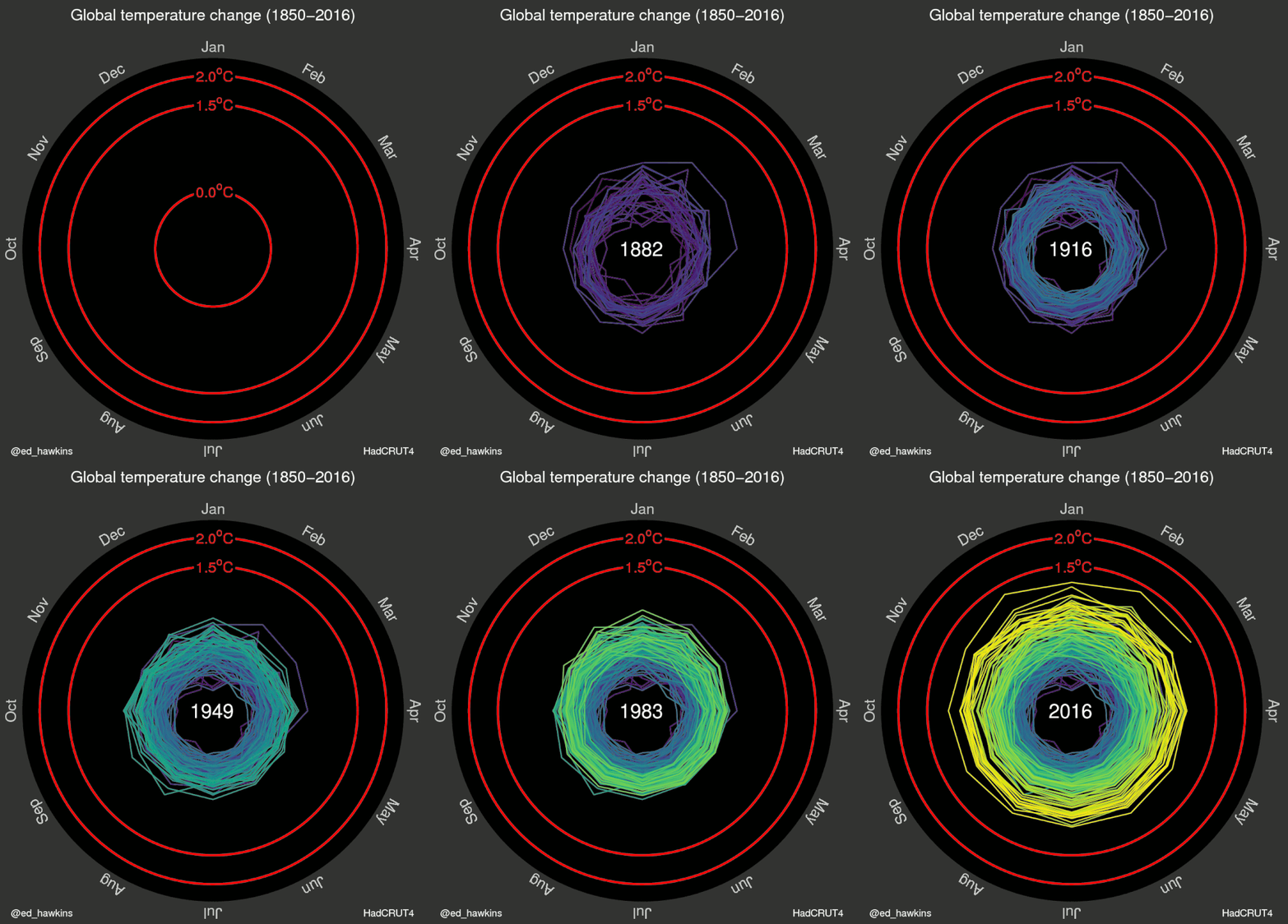 ...
...
 ...
...