Sat, Nov 12, 2016 from Climate Central: Trump Wins US Presidency The election of Donald Trump as the nation's next president spurred celebration in some quarters and dismay in others, including among those concerned about the steady warming of the planet....
Trump's comments on climate change have included calling it a hoax and warning that Environmental Protection Agency policies are costing the country jobs, though he has talked about the importance of maintaining clean air and water. He has suggested he will pull out of the landmark Paris agreement and scuttle the Clean Power Plan, as well as boost the domestic coal and oil industries.
While the U.S. is only one country, it is a linchpin to the viability of international agreements and to moving the needle on limiting warming.
...
"Sticking it to the Man," in this case, results in "F***ing Humankind."
Wed, Aug 31, 2016 from National Geographic: One of the World's Biggest Fisheries Is on the Verge of Collapse Years ago Christopher Tubo caught a 660-pound blue marlin in the South China Sea. The fishing was good there, he says. Tuna fishermen would come home from a trip with dozens of the high-value fish as well as a good haul of other species....
Glancing over at his wife, Leah, and the other children, he says, "It's just chance, whether or not we can feed our families now."...
Encompassing 1.4 million square miles (3.7 million square kilometers), the South China Sea is of critical economic, military, and environmental importance: $5.3 trillion in international trade plies its waters annually; in terms of biodiversity, it is thought of as the marine equivalent of the Amazon rain forest; and its fish provide food and jobs for millions in the 10 countries and territories that surround it.
Of those, seven--China, the Philippines, Vietnam, Taiwan, Malaysia, Brunei, and Indonesia--have competing claims to the sea's waters and resources. So it's understandable why all eyes have been focused on the political and military wrangling. If war broke out over these claims, it would pit two superpowers, China and the United States--a longtime Philippine ally and guarantor of freedom of navigation in the Pacific Ocean--against each other.
...
I was told there were plenty of fish in the commons.
Fri, Jan 22, 2016 from Phys.org: Evolutionary clock ticks for snowshoe hares facing climate change Snowshoe hares that camouflage themselves by changing their coats from brown in summer to white in winter face serious threats from climate change, and it's uncertain whether hare populations will be able to adapt in time, according to a North Carolina State University study.
Based on field research with radio-collared snowshoe hares in Montana, mismatched snowshoe hares suffer a 7 percent drop in their weekly survival rate when snow comes late or leaves early and white hares stand out to predators like "light bulbs" against their snowless backgrounds....
Camouflage mismatch has the potential to impact at least 14 species worldwide that change coat colors seasonally, Mills says. His team of researchers is expanding the coat color research to other species globally, including mountain hares, white-tailed jackrabbits, weasels and arctic foxes.
...
Mon, Aug 10, 2015 from Dahr Jamail, via TruthOut: The New Climate "Normal": Abrupt Sea Level Rise and Predictions of Civilization Collapse ... As if that's not enough, Hansen's study comes on the heels of another study published in Science, which shows that global sea levels could rise by at least 20 feet, even if governments manage to keep global temperature increases to within the agreed upon "safe" limit of 2 degrees Celsius.... Disconcertingly, another new "normal" this month comes in the form of huge plumes of wildfire smoke over the Arctic. At the time of this writing, well over 12 million acres of forest and tundra in Canada and Alaska have burned in wildfires, and the smoke covering the Arctic sea ice is yet another anthropogenic climate disruption (ACD) amplifying feedback loop that will accelerate melting there. The additional smoke further warms the atmosphere that quickens the melting of the Arctic ice pack....
"The results show that based on plausible climate trends, and a total failure to change course, the global food supply system would face catastrophic losses, and an unprecedented epidemic of food riots," the Institute's director, Dr. Aled Jones, told Insurge Intelligence. "In this scenario, global society essentially collapses as food production falls permanently short of consumption."... ...
Well, as long as the American Way of Life™ isn't threatened!
Sun, Jul 19, 2015 from Grand Forks Herald: Bat Reclamation: Bat study hones-in on nesting trees ... The bat seemed fine -- the experts saw no sign of the deadly white-nose syndrome fungus -- and was quickly sent on her way to chase mosquitoes for the rest of the night....
And with northern long-ears newly protected by the federal Endangered Species Act, scientists are scrambling to fill in the blanks on the bat's life cycle.
Bats eat lots of bugs. They winter in caves. They fly at night. Beyond that?
"It's amazing how much we don't know about them,'' said Ron Moen, biologist for the Natural Resources Research Institute at the University of Minnesota Duluth, who is helping coordinate the effort. ...
Apocaiku:
The little brown bat
is now deaf. Our next best hope:
the Northern Long-ear.
Tue, May 19, 2015 from Climate Central: Heat is Piling Up in the Depths of the Indian Ocean The world's oceans are playing a game of hot potato with the excess heat trapped by greenhouse gas emissions. Scientists have zeroed in on the tropical Pacific as a major player in taking up that heat. But while it might have held that heat for a bit, new research shows that the Pacific has passed the potato to the Indian Ocean, which has seen an unprecedented rise in heat content over the past decade. ...
Rise up, couch potatoes; this is no small potatoes that oceans are passing this hot potato around.
Tue, Jan 13, 2015 from Scientific American: 2015 Begins with CO2 above 400 PPM Mark The new year has only just begun, but we've already recorded our first days with average carbon dioxide levels above 400 parts per million, potentially leading to many months in a row above this threshold, experts say.
The Scripps Institution of Oceanography records of atmospheric carbon dioxide levels show that Jan. 1 was the first day of the new year above that concentration, followed by Jan. 3 and Jan. 7. Daily averages have continued at this level or higher through Jan. 9, though they could continue to dance up and down around that mark due to day-to-day variations caused by weather systems. But even with those fluctuations, 2015 will likely see many months above 400 ppm, possibly starting with the very first month of the year. ...
I'm pretty sure that 400 ppm was a Wild-Assed Guess (WAG), and so isn't really anything to fear, much, really.
Tue, Dec 30, 2014 from Reuters: Monarch butterfly eyed for possible U.S. endangered species protection Monarch butterflies may warrant U.S. Endangered Species Act protection because of farm-related habitat loss blamed for sharp declines in cross-country migrations of the orange-and-black insects, the U.S. Fish and Wildlife Service said on Monday.
Monarch populations are estimated to have fallen by as much as 90 percent during the past two decades because of destruction of milkweed plants they depend on to lay their eggs and nourish hatching larvae, according to the Xerces Society for Invertebrate Conservation. ...
Sun, Nov 9, 2014 from TED Global, via WeatherNetwork.com: The Sound of a Dying Ecosystem When sound engineer Bernie Krause first visited the Lincoln Meadow in the Sierra Nevada Mountains in 1988, the lush land vibrated with natural soundscapes -- a sign of a healthy, thriving ecosystem.
This is what it sounded like when Krause turned on his gear to capture the environment before selective logging began...
One year later, he returned to record once more from the same spot. This time, all birds had gone, with the exception of one lonesome woodpecker who appears halfway through the recording....
"When I began recording over four decades ago, I could record for ten hours and capture one hour of usable material good enough for an album, a film soundtrack or museum installation," said Krause, on the TEDGlobal stage. "Now, because of global warming, resource extraction and human noise, among other factors, it can take up to 1,000 hours or more to capture the same thing."
...
Thu, Oct 16, 2014 from PhysOrg: Amphibian communities collapse in wake of viral outbreak Two closely related viruses that have been introduced to northern Spain in recent years have already led to the collapse of three different species of amphibian--the common midwife toad, the common toad, and the alpine newt--in the protected area of Picos de Europa (literally "Peaks of Europe") National Park. In all, six amphibian species have suffered from severe disease and mass mortality as a result of the outbreak, and researchers who report their findings in the Cell Press journal Current Biology on October 16 say that the viruses appear to be on the move.
Preliminary evidence shows that related ranaviruses are emerging in other parts of Europe, which surely means more bad news for amphibians ahead.
"The capacity of these viruses to infect multiple species means that there is the possibility that some host populations may be extirpated due to infection," says Stephen Price, now of UCL....
...
The Amphibian News Network: "worse than Ebola," calls for cancelling all tadpole adoptions from Spain.
Thu, Sep 11, 2014 from Guardian: Amazon deforestation jumps 29 percent last year The destruction of the world's largest rainforest accelerated last year with a 29 percent spike in deforestation, according to final figures released by the Brazilian government on Wednesday that confirmed a reversal in gains seen since 2009.
Satellite data for the 12 months through the end of July 2013 showed that 5,891 sq km of forest were cleared in the Brazilian Amazon, an area half the size of Puerto Rico.
Fighting the destruction of the Amazon is considered crucial for reducing global warming because deforestation worldwide accounts for 15 percent of annual emissions of heat-trapping gases, more than the entire transportation sector. Besides being a giant carbon sink, the Amazon is a biodiversity sanctuary, holding billions of species yet to be studied. ...
That biodiversity will just have to go somewheres else. There's money waiting to be made!
Fri, Aug 22, 2014 from Climate Central: Epic Drought in West is Literally Moving Mountains Climate change is driving the Greenland Ice Sheet to melt, which is contributing to sea level rise. But imagine that the same amount of water melting from Greenland each year is being lost in California and the rest of the West because of the epic drought there.
What happens? The land in the West begins to rise.
In fact, some parts of California's mountains have been uplifted as much as 15 millimeters (about 0.6 inches) in the past 18 months because the massive amount of water lost in the drought is no longer weighing down the land, causing it to rise a bit like an uncoiled spring, a new study shows. ...
In the post-apocalypse, the mountains will ascend into the sky.
Mon, Aug 4, 2014 from University of New South Wales: Atlantic warming turbocharges Pacific trade winds Rapid warming of the Atlantic Ocean, likely caused by global warming, has turbocharged Pacific Equatorial trade winds. This has caused eastern tropical Pacific cooling, amplified the Californian drought, accelerated sea level rise three times faster than the global average in the Western Pacific and has slowed the rise of global average surface temperatures since 2001.... While active, the stronger Equatorial trade winds have caused far greater overturning of ocean water in the West Pacific, pushing more atmospheric heat into the ocean... This increased overturning appears to explain much of the recent slowdown in the rise of global average surface temperatures.
Importantly, the researchers don't expect the current pressure difference between the two ocean basins to last. When it does end, they expect to see some rapid changes, including a sudden acceleration of global average surface temperatures.
...
A tale of two oceans ... and one world on the precipice of climate chaos.
Sun, Jul 27, 2014 from Telegraph (UK): Sea temperature off Plymouth hotter than California Ocean temperatures have a soared to a seven-year high off southwest Britain - making our seas as hot as California.
Marine scientists say the water has reached 20.4C (68.7F) off Start Bay, Devon, and 20.1C (68.2F) off Perranporth, Cornwall.
That is even warmer than readings taken from Santa Monica beach in Los Angeles, where its currently lagging behind at 19.4C (66.9F) and only 8C short of the sea temperature in Bali.
Temperatures off the British coast are also rising by almost 4C a month - twice as fast as normal....
"Increasing sea temperatures will change the community structure and certain species will be better adpated to the warmer temperatures. That's both the microscopic plants, the phytoplankton and the large plants, the kelp.
"Jellyfish tend to like warm waters so there might be an increase in the jellyfish population although bathers shouldn;t be unduly concerned."
Meanwhile hot temperatures blowing in from Europe are bringing with it pollutants and these are reacting with sunlight to produce a soup of chemical smog which endangers health. ...
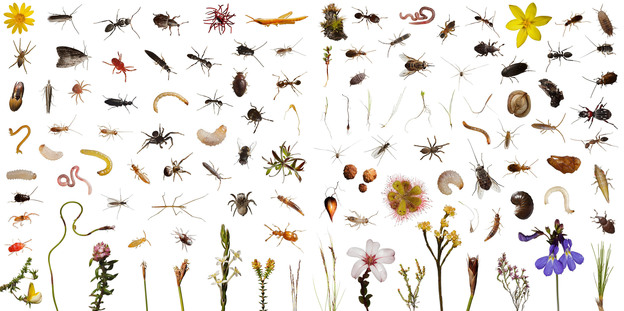
Sat, Jul 26, 2014 from The Independent (UK): Vital invertebrates decline by 45 per cent, study finds Insects, worms and other small animals that carry out vital functions for life on earth have declined by 45 per cent on average over 35 years, threatening human health, water quality and food supplies, a study has found.
The rapid decline in the number of invertebrates - animals without backbones - is at least as bad as the well publicised plight of the larger animals, according to scientists who said they were shocked by the findings.
Although there has has been far less research on invertebrates than on vertebrates, what little has been done suggests that they are undergoing a catastrophic fall in abundance which is having a severe impact on "ecosystem services" such a pollination of crops, water treatment and waste recycling, the scientists said. ...
Mon, Jul 14, 2014 from TrueActivist.com: Forest, Trees; Choose Two In this fascinating video, UBC Professor Suzanne Simard explains how trees are much more complex than most of us ever imagined. Although Charles Darwin assumed trees are simply individual organisms competing for survival of the fittest, Simard demonstrates just how wrong he was. In fact, the opposite is true: trees survive through mutual co-operation and support, passing around essential nutrients "depending on who needs it".
Nitrogen and carbon are shared through miles of underground fungi networks, ensuring that all trees in the forest eco-system give and receive just the right amount to keep them all healthy. This invisible web works in a very similar way to the networks of neurons in our brains, and when one tree is destroyed it has consequences for all.
...
Sun, Jun 8, 2014 from University of Central Florida: Climate change: Termites, fungi play more important role in decomposition than temperature Climate change models could have a thing or two to learn from termites and fungi, according to a new study. For a long time scientists have believed that temperature is the dominant factor in determining the rate of wood decomposition worldwide. Decomposition matters because the speed at which woody material are broken down strongly influences the retention of carbon in forest ecosystems and can help to offset the loss of carbon to the atmosphere from other sources. That makes the decomposition rate a key factor in detecting potential changes to the climate... The team suggests that scientists need to embrace the variability found across data collected from many different sites instead of averaging it all together to create better models with more accurate predictions.
...
Mon, May 26, 2014 from Mother Jones: Something Is Seriously Wrong on the East Coast--and It's Killing All the Baby Puffins Now, thanks to a grant from the Annenberg Foundation, the Puffin Cam offered new opportunities for research and outreach. Puffin parents dote on their single chick, sheltering it in a two-foot burrow beneath rocky ledges and bringing it piles of small fish each day. Researchers would get to watch live puffin feeding behavior for the first time, and schoolkids around the world would be falling for Petey.
But Kress soon noticed that something was wrong. Puffins dine primarily on hake and herring, two teardrop-shaped fish that have always been abundant in the Gulf of Maine. But Petey's parents brought him mostly butterfish, which are shaped more like saucers. Kress watched Petey repeatedly pick up butterfish and try to swallow them. The video is absurd and tragic, because the butterfish is wider than the little gray fluff ball, who keeps tossing his head back, trying to choke down the fish, only to drop it, shaking with the effort. Petey tries again and again, but he never manages it. For weeks, his parents kept bringing him butterfish, and he kept struggling. Eventually, he began moving less and less. On July 20, Petey expired in front of a live audience. Puffin snuff....
Why would the veteran puffin parents of Maine start bringing their chicks food they couldn't swallow? Only because they had no choice. Herring and hake had dramatically declined in the waters surrounding Seal Island, and by August, Kress had a pretty good idea why: The water was much too hot. ...
Thu, May 22, 2014 from European Association of Geochemistry: Iron from melting ice sheets may help buffer global warming A newly-discovered source of oceanic bioavailable iron could have a major impact our understanding of marine food chains and global warming. A UK team has discovered that summer meltwaters from ice sheets are rich in iron, which will have important implications on phytoplankton growth. The findings are reported in the journal Nature Communications on 21st May, 2014. It is well known that bioavailable iron boosts phytoplankton growth in many of Earth's oceans. In turn phytoplankton capture carbon -- thus buffering the effects of global warming. The plankton also feed into the bottom of the oceanic food chain, thus providing a food source for marine animals. ...
Wed, May 14, 2014 from U of VT, via EurekAlert: Surprising global species shake-up discovered ... But the researchers did discover something changing rapidly: which species were living in the places being studied. Almost 80 percent of the communities the team examined showed substantial changes in species composition, averaging about 10 percent change per decade -- significantly higher than the rate of change predicted by models.
In other words, this new report shows that a huge turnover of species in habitats around the globe is under way, resulting in the creation of novel biological communities. "Right under our noses, in the same place that a team might have looked a decade earlier, or even just a year earlier, a new assemblage of plants and animals may be taking hold," Gotelli says. ...
Maybe this proves that Nature will evolve itself out of the crisis humans have created!
Sun, Apr 13, 2014 from Guardian: Entire marine food chain at risk from rising CO2 levels in water Researchers studied the behavior of coral reef fish at naturally occurring CO2 vents in Milne Bay, in eastern Papua New Guinea.
They found that fish living near the vents, where bubbles of CO2 seeped into the water, "were attracted to predator odour, did not distinguish between odours of different habitats, and exhibited bolder behaviour than fish from control reefs".
The gung-ho nature of CO2-affected fish means that more of them are picked off by predators than is normally the case, raising potentially worrying possibilities in a scenario of rising carbon emissions.
More than 90 percent of the excess CO2 in the atmosphere is soaked up by the oceans. When CO2 is dissolved in water, it causes ocean acidification, which slightly lowers the pH of the water and changes its chemistry. Crustaceans can find it hard to form shells in highly acidic water, while corals risk episodes of bleaching. ...
When you say "entire marine food chain," can you be more specific?
Fri, Mar 7, 2014 from New York Times: Minnesota Mystery: What's Killing the Moose? For moose, this year's winter-long deep freeze across the Upper Midwest is truly ideal weather ... Yet moose in Minnesota are dying at an alarming rate, and biologists are perplexed as to why... In Northeast Minnesota, the population has dropped by half since 2006, to 4,300 from more than 8,800... Seth Moore, a wildlife biologist in Grand Portage, theorizes that recent years of warmer, shorter winters and hotter, longer summers have resulted in a twofold problem. The changing climate has stressed out the moose, compromising their immune systems. And warmer temperatures have allowed populations of white-tailed deer, carriers of brain worm -- which is fatal to moose -- to thrive. ...
Sun, Mar 2, 2014 from EcoWatch: Melting starfish are 'keystone species' for their ecosystem ['Keystone species'] refers to particular organisms that keep the relationships between the ecosystem's other plants and animals functioning properly. Without them, ecosystems collapse--like an arch would without its center block. Well, as it so happens, when ecologist Robert T. Paine first coined the term back in 1969, he got the idea by messing around with a bunch of starfish.
Paine crawled along the tidal plains of Washington's Tatoosh Island, pulling up all the ochre stars (Pisaster ochraceus) he could find and tossing them out into the ocean beyond his study area. He played this game of starfish Frisbee for three years, and discovered that without the seastars, his study area became so thick with mussels that little else could survive.
Ochres mow down mussel beds like it's closing time at Old Country Buffet. What was once a rich community of 28 species of animals and algae along Tatoosh Island, Paine turned into a mussel monoculture. And today, more of this mussel dominance could be on its way, since ochres are one of the 15 starfish species currently turning into mush. ...
Not to worry -- today those mussels are losing the battle with ocean acidification.
Sun, Feb 23, 2014 from American Live Wire: Google Joins Deforestation Fight By Launching Global Forest Watch Website The Global Forest Watch website produced by the search giant Google itself is about to change all that. It is an online forest monitoring system available to anyone with an Internet connection around the globe.
World Resources Institute partnered with Google to create the site and system along with a team of more than 40 other partners.
The website will make use of the technology that includes Google's own Earth Engine and the Maps Engine to track forests around the world with the help of satellite imagery. It will also detect changes taking place in forests in close to real-time. All the information will be made available for free to the general public through the World Wide Web.
...
This'll help us find the sweetest spots to mow down!
Mon, Feb 17, 2014 from Agence France-Press: Jet stream shift could prompt harsher winters: scientists A warmer Arctic could permanently affect the pattern of the high-altitude polar jet stream, resulting in longer and colder winters over North America and northern Europe, US scientists say.
The jet stream, a ribbon of high altitude, high-speed wind in northern latitudes that blows from west to east, is formed when the cold Arctic air clashes with warmer air from further south.
The greater the difference in temperature, the faster the jet stream moves.
According to Jennifer Francis, a climate expert at Rutgers University, the Arctic air has warmed in recent years as a result of melting polar ice caps, meaning there is now less of a difference in temperatures when it hits air from lower latitudes..."But over the past two decades the jet stream has weakened. This is something we can measure," she said.
As a result, instead of circling the earth in the far north, the jet stream has begun to meander, like a river heading off course.
This has brought chilly Arctic weather further south than normal, and warmer temperatures up north. Perhaps most disturbingly, it remains in place for longer periods of time. ...
Mon, Feb 10, 2014 from University of New South Wales: Pacific trade winds stall global surface warming ... for now Heat stored in the western Pacific Ocean caused by an unprecedented strengthening of the equatorial trade winds appears to be largely responsible for the hiatus in surface warming observed over the past 13 years. The strongest trade winds have driven more of the heat from global warming into the oceans; but when those winds slow, that heat will rapidly return to the atmosphere causing an abrupt rise in global average temperatures, scientists say.
...
You're still reading! Good for you!
You really should read our short, funny, frightening book FREE online (or buy a print copy): Humoring the Horror of the Converging Emergencies!
We've been quipping this stuff for more than 30 months! Every day!
Which might explain why we don't get invited to parties anymore.
Sat, Feb 8, 2014 from Nature Scientific Reports, via SaveOurSeasAndShores: Anthropogenic noise causes body malformations and delays development in marine larvae Here we provide the first evidence that noise exposure during larval development produces body malformations in marine invertebrates. Scallop larvae exposed to playbacks of seismic pulses showed significant developmental delays and 46 percent developed body abnormalities. Similar effects were observed in all independent samples exposed to noise while no malformations were found in the control groups (4881 larvae examined). Malformations appeared in the D-veliger larval phase, perhaps due to the cumulative exposure attained by this stage or to a greater vulnerability of D-veliger to sound-mediated physiological or mechanical stress. Such strong impacts suggest that abnormalities and growth delays may also result from lower sound levels or discrete exposures during the D-stage, increasing the potential for routinely-occurring anthropogenic noise sources to affect recruitment of wild scallop larvae in natural stocks. ...
Scallops just need to evolve little hands to put over their little ears.
Sun, Feb 2, 2014 from PBS: Mysterious epidemic devastates starfish population off the Pacific Coast KATIE CAMPBELL: As a diver and underwater videographer, James was equipped to do something. She decided to take her camera to a spot popular among both divers and starfish. These pilings are usually covered with a rainbow of starfish. On a recent dive, James discovered a scene from a horror film.
LAURA JAMES: There were just bodies everywhere. And they were just like splats. To me, it always looked like somebody had taken a laser gun and just zapped them and they just vaporized.
KATIE CAMPBELL: Starfish, also known as sea stars, are wasting away by the tens of thousands, not just in Puget Sound, but up and down North America's Pacific Coast. And nobody knows why....
BEN MINER: One of them was very sick, and the other two individuals started ripping themselves apart. The arms just crawl away from the particular body.
KATIE CAMPBELL: You heard that right. The arms crawl in opposite directions, until they tear away from the body and their insides spill out. And unlike most starfish, the arms don’t regenerate. Stars that came in with symptoms died within 24 hours. ...
Nature is tearing itself apart, and 'nobody knows why.'
Sat, Feb 1, 2014 from New York Times: Migration of Monarch Butterflies Shrinks Again Under Inhospitable Conditions Faltering under extreme weather and vanishing habitats, the yearly winter migration of monarch butterflies to a handful of forested Mexican mountains dwindled precipitously in December, continuing what scientists said was an increasingly alarming decline.
The migrating population has become so small -- perhaps 35 million, experts guess -- that the prospects of its rebounding to levels seen even five years ago are diminishing. At worst, scientists said, a migration widely called one of the world's great natural spectacles is in danger of effectively vanishing.
The Mexican government and the World Wildlife Fund said at a news conference on Wednesday that the span of forest inhabited by the overwintering monarchs shrank last month to a bare 1.65 acres -- the equivalent of about one and a quarter football fields. Not only was that a record low, but it was just 56 percent of last year's total, which was itself a record low.
At their peak in 1996, the monarchs occupied nearly 45 acres of forest.
...
Children of the future will thank Monsanto and RoundupReady™ for the enhanced shareholder value.
Sat, Jan 25, 2014 from Environment 360: Northern Mystery: Why Are Birds of the Arctic in Decline? "These and other seabirds are superbly adapted to the sea ice environment. Without that ice, and with polar bears and mosquitoes hitting them hard, the only future in the Arctic for them is to move north." ...
Predators such as the peregrine, the gyrfalcon, the snowy owl, and the Greenland long-tailed skua depend on peaks in these prey species to reproduce in numbers that will sustain their populations. For these birds, collapsing prey cycles are bad news. A team of Danish scientists, for example, recently documented how a collapse in collared lemming cycles at two sites in Greenland between 1998 and 2010 resulted in a 98 percent decline in the snowy owl population. They also documented a similar, albeit less drastic, decline in the population of long-tailed jaegers, part of the skua family....
University of Alberta biologist Alastair Franke has unequivocal evidence of peregrine falcon nestlings starving to death on the west coast of Hudson Bay. But lack of food, he says, is not the main thing killing these birds. According to a recent study led by graduate student Alexandre Anctil of the University of Quebec, some regions of the Arctic are now experiencing more periods of heavy rain each summer when compared to the early 1980s. With their downy white coats insulating them against the snow and the cold, these chicks do just fine. When it rains heavily, however -- as it has increasingly been doing along the west coast of Hudson Bay since 1980 -- up to a third of the peregrine chicks in the study area die of hypothermia as their wet feathers rapidly draw heat from their bodies. Some even drowned in their nests.
...
I think it's because what they're witnessing makes 'em so damned sad they forget to eat.
Sat, Jan 25, 2014 from Grist: Plant STD linked to honeybee colony collapse Major crops including soybeans and tobacco can suffer from a crippling malady called tobacco ringspot virus. The disease is spread through sex, which in the plant kingdom involves the freaky use of vibrating creatures: bees. Honeybees and other pollinators carry infected pollen from one plant to the other and, in doing so, can spread the virus, which is also called TRSV.
What's really freaky is that scientists have discovered that bees can become infected with the ringspot virus of the plants upon which they feed. The researchers report in the journal mBio that the unusual inter-kingdom host-species jump could be linked to colony collapse disorder....
When these researchers investigated bee colonies classified as "strong" or "weak," TRSV and other viruses were more common in the weak colonies than they were in the strong ones. Bee populations with high levels of multiple viral infections began failing in late fall and perished before February, these researchers report. In contrast, those in colonies with fewer viral assaults survived the entire cold winter months. ...
...
You wouldn't call this STD the clap -- more the buzzkill.
Wed, Jan 22, 2014 from Texas A&M University : Air Pollution from Asia Affecting World's Weather Extreme air pollution in Asia is affecting the world's weather and climate patterns, according to a study by Texas A&M University and NASA's Jet Propulsion Laboratory researchers... Using climate models and data collected about aerosols and meteorology over the past 30 years, the researchers found that air pollution over Asia -- much of it coming from China -- is impacting global air circulations. ...
Sun, Jan 19, 2014 from Telegraph (UK): UK weather: mild spell causes birds to break into song and flowers to bloom ... Wildlife experts have received dozens of reports of snowdrops blooming across the UK, nearly a month before they would normally be expected....
Some birds have also been recorded nesting while the first reports of song thrush singing arrived on 13 January now several have been spotted around the country....
"For insects and amphibians it is not so rosy. Ladybirds, for example, have finite energy reserves and nectar at this time of year will be thin on the ground, so they might not make it through to the spring.
"Similarly frogs only get one chance to breed each year and if it gets very cold the spawn can freeze and will be lost if they are fooled into breeding too early."
Since the start of January much of the country has seen temperatures in double figures, with the average temperature for the whole country last week being around 47.6 degrees F....
However, the heavy rain, strong winds and tidal surges that have accompanied the mild conditions have also taken their toll on many species.
Waterfowl such as ducks, which have been nesting earlier than usual due to the mild conditions, had their nests destroyed by flooding.
Sussex Wildlife Trust has reported swallows nesting and several species of butterflies on its nature reserve.
...
Fri, Jan 10, 2014 from BBC: More than three quarters of large carnivores now in decline When they looked at 31 big meat eaters, they found that they were under increasing pressure in the Amazon, South East Asia, southern and East Africa.
"Globally, we are losing our large carnivores," said lead author Prof William Ripple from Oregon State University.
"Their ranges are collapsing. Many of these animals are at risk of extinction, either locally or globally."...
When they looked at wolves and cougars in Yellowstone National Park in the US, they found that having fewer of these big predators resulted in an increase in animals that browse such as elk and deer.
While this might seem like good news, the researchers found that the rise of these browsers is bad for vegetation and disrupts the lives of birds and small mammals, leading to a cascade of damaging impacts.
...
Wed, Jan 8, 2014 from Florida State University: Snowball Effect of Overfishing Highlighted Florida State University researchers have spearheaded a major review of fisheries research that examines the domino effect that occurs when too many fish are harvested from one habitat. The loss of a major species from an ecosystem can have unintended consequences because of the connections between that species and others in the system. Moreover, these changes often occur rapidly and unexpectedly, and are difficult to reverse.
"You don't realize how interdependent species are until it all unravels," said Felicia Coleman, director of the Florida State University Coastal and Marine Laboratory and a co-author on the study. ...
Wed, Jan 8, 2014 from Climate Central: Polar Vortex in U.S. May be Example of Global Warming While the ongoing cold snap is breaking records from Minnesota to Florida, it will not go down in history as the most significant Arctic outbreak in U.S. history, not even by a longshot. Scientists said the deep freeze gripping the U.S. does not indicate a halt or reversal in global warming trends, either. In fact, it may be a counterintuitive example of global warming in action. Researchers told Climate Central that the weather pattern driving the extreme cold into the U.S. -- with a weaker polar vortex moving around the Arctic like a slowing spinning top, eventually falling over and blowing open the door to the Arctic freezer -- fits with other recently observed instances of unusual fall and wintertime jet stream configurations. ...
Sun, Jan 5, 2014 from Yale360: Atlantic Ocean Zooplankton Are Now Reproducing in Arctic Waters For the first time, scientists have discovered species of Atlantic Ocean zooplankton reproducing in Arctic waters. German researchers say the discovery indicates a possible shift in the Arctic zooplankton community as the region warms, one that could be detrimental to Arctic birds, fish, and marine mammals.... The researchers found fertile females as well as individuals at all stages of development, showing that the Atlantic species is reproducing in the frigid waters. The one-centimeter amphipods are smaller than respective Arctic species, meaning that the spread of the Atlantic crustaceans northward could reduce the volume of food available to Arctic predators. ...
The Arctic ecosystem is just not stepping up to the new requirements.
Mon, Dec 16, 2013 from Ohio State University: East Antarctica Is Sliding Sideways: Ice Loss On West Antarctica Affecting Mantle Flow Below It's official: East Antarctica is pushing West Antarctica around. Now that West Antarctica is losing weight--that is, billions of tons of ice per year--its softer mantle rock is being nudged westward by the harder mantle beneath East Antarctica.
The discovery comes from researchers led by The Ohio State University, who have recorded GPS measurements that show West Antarctic bedrock is being pushed sideways at rates up to about twelve millimeters--about half an inch--per year. This movement is important for understanding current ice loss on the continent, and predicting future ice loss. ...
Wed, Dec 11, 2013 from London Guardian: Russia to boost military presence in Arctic as Canada plots north pole claim The political temperature in the Arctic rose on Tuesday when Vladimir Putin vowed to step up Russia's military presence in the region in response to a claim by Canada to the north pole.
In typically trenchant style, the Russian president told his defence chiefs to concentrate on building up infrastructure and military units in the Arctic. He said the region was again key to Russia's national and strategic interests, following a retreat in the post-Soviet period. ...
Mon, Dec 9, 2013 from ThinkProgress: The 2014 Shrimp Season In The Gulf Of Maine Has Been Canceled They're small and sweet, beloved by locals and tourists alike, and will soon be indefinitely unavailable. The Northern shrimp population in the Gulf of Maine has officially collapsed and a moratorium on shrimping is being recommended for the 2014 season. Restaurants in Maine are rushing to get their hands on whatever is left over from last year's catch....
"I think everyone was startled by what we saw in 2012, and there was a lot of pressure to close down the fishery for the 2013 season," said John Annala, Chief Scientific Officer at the Gulf of Maine Research Institute. "The survey this summer found just 20 percent of the 2012 record low, so it has fallen off incredibly sharply."
Perhaps most worrying is the fact that juvenile shrimp have not been picked up in a survey since 2010. Northern shrimp live about five years, so the lack of younger shrimp for three years straight may mean empty nets for years to come. ...
Those juvenile-delinquent shrimp are playing hookey!
Mon, Dec 9, 2013 from Climate Central: Study Adds to Arctic Warming, Extreme Weather Debate A new study for the first time found links between the rapid loss of snow and sea ice cover in the Arctic and a recent spate of exceptional extreme heat events in North America, Europe, and Asia. The study adds to the evidence showing that the free-fall in summer sea ice extent and even sharper decline in spring snow cover in the Northern Hemisphere is reverberating throughout the atmosphere, making extreme events more likely to occur.
The study, published Sunday in the journal Nature Climate Change, is the first to find correlations between rapid Arctic warming and extreme summer weather events, since previous research had focused on the links between Arctic warming and fall and winter weather patterns. ...
What happens in the Arctic doesn't stay in the Arctic!
Mon, Dec 9, 2013 from New York Times: Eastern States Press Midwest to Improve Air In a battle that pits the East Coast against the Midwest over the winds that carry dirty air from coal plants, the governors of eight Northeastern states plan to petition the Environmental Protection Agency on Monday to force tighter air pollution regulations on nine Rust Belt and Appalachian states... governors have long criticized the Appalachian and Rust Belt states, including Ohio, Kentucky and Michigan, for their more lenient rules on pollution from coal-fired power plants, factories and tailpipes -- allowing those economies to profit from cheap energy while their belched soot and smog are carried on the prevailing winds that blow across the United States. ...
We need to build sky fences that go up to the heavens.
Thu, Dec 5, 2013 from Science Daily: Rising Ocean Acidification Leads to Anxiety in Fish A new research study combining marine physiology, neuroscience, pharmacology, and behavioral psychology has revealed a surprising outcome from increases of carbon dioxide uptake in the oceans: anxious fish.
A growing base of scientific evidence has shown that the absorption of human-produced carbon dioxide into the world's oceans is causing surface waters to decline in pH, causing a rise in acidity. This ocean acidification is known to disrupt the growth of shells and skeletons of certain marine animals but other consequences such as behavioral impacts have been largely unknown....
The researchers say the anxiety is traced to the fish's sensory systems, and specifically "GABAA" (neural gamma-aminobutyric acid type A) receptors, which are also involved in human anxiety levels. Exposure to acidified water leads to changes in the concentrations of ions in the blood (especially chloride and bicarbonate), which reverses the flux of ions through the GABAA receptors. The end result is a change in neuronal activity that is reflected in the altered behavioral responses described in this study. ...
Update: Rising Ocean Acidification Leads to Anxiety in Humans
Tue, Nov 19, 2013 from AP, via WHTI: Zooplankton decline reported in North Atlantic The microscopic creatures that make up a critical link in the ocean food chain declined dramatically the first half of this year in the North Atlantic as ocean temperatures remained among the warmest on record, federal scientists say.
Springtime plankton blooms off the coast of northern New England were well below average this year, leading to the lowest levels ever seen for the tiny organisms that are essential to maintaining balance in the ocean food chain, said Kevin Friedland, a marine scientist with the National Oceanic and Atmospheric Administration.
The absence of the normal surge of plankton in the spring is a concern because that's when cod and haddock and many other species produce offspring, Friedland said....
"The first six months of 2013 can be characterized by new extremes in the physical and biological environment," Friedland said from his office in Rhode Island.
The findings come after temperatures off the Northeast U.S. hit an all-time high in 2012.
...
I had no idea the zooplankton-bone was connected to the cod-bone.
Fri, Nov 15, 2013 from Lawrence Livermore National Laboratory: Global Precipitation Linked to Global Warming The rain in Spain may lie mainly on the plain, but the location and intensity of that rain is changing not only in Spain but around the globe. A new study by Lawrence Livermore National Laboratory scientists shows that observed changes in global (ocean and land) precipitation are directly affected by human activities and cannot be explained by natural variability alone. The research appears in the Nov. 11 online edition of the Proceedings of the National Academy of Sciences. Emissions of heat-trapping and ozone-depleting gases affect the distribution of precipitation through two mechanisms. Increasing temperatures are expected to make wet regions wetter and dry regions drier (thermodynamic changes); and changes in atmospheric circulation patterns will push storm tracks and subtropical dry zones toward the poles. ...
Sat, Oct 19, 2013 from ScienceDaily: Pacific Ocean Temperature Influences Tornado Activity in US University of Missouri researcher has found that the temperature of the Pacific Ocean could help scientists predict the type and location of tornado activity in the U.S.
Laurel McCoy, an atmospheric science graduate student at the MU School of Natural Resources, and Tony Lupo, professor and chair of atmospheric science in the College of Agriculture, Food and Natural Resources, surveyed 56,457 tornado-like events from 1950 to 2011. They found that when surface sea temperatures were warmer than average, the U.S. experienced 20.3 percent more tornados that were rated EF-2 to EF-5 on the Enhanced Fuijta (EF) scale. (The EF scale rates the strength of tornados based on the damage they cause. The scale has six category rankings from zero to five.)
McCoy and Lupo found that the tornados that occurred when surface sea temperatures were above average were usually located to the west and north of tornado alley, an area in the Midwestern part of the U.S. that experiences more tornados than any other area. McCoy also found that when sea surface temperatures were cooler, more tornadoes tracked from southern states, like Alabama, into Tennessee, Illinois and Indiana. ...
The Pacific is, after all, only three days' drive away from Hurricane Alley.
Tue, Oct 15, 2013 from Sydney Daily Telegraph: Climate change moves Nemo current to south THE ocean current off the coast of Australia made famous in Finding Nemo has moved 350km south and is accelerating toward the pole, a draft international climate change report has found.
And with it so too are moving some species of shark and large fish such as Tuna, it has warned.
The Intergovernmental Panel on Climate Change's second and yet to be released report into the impact of climate change has claimed average climate zones in Australia have already shifted 200km southward along the north east coast. ...
Tue, Oct 15, 2013 from Los Angeles Times: Nutrient pollution threatens national park ecosystems, study says National parks from the Sierra Nevada to the Great Smoky Mountains are increasingly being fertilized by unwanted nutrients drifting through the air from agricultural operations, putting some of the country's most treasured natural landscapes at risk of ecological damage, a new study has found.
Thirty-eight of 45 national parks examined by scientists are receiving doses of nitrogen at or above a critical threshold that can harm sensitive ecosystems, such as lichens, hardwood forests or tallgrass prairie, scientists found...
Scientists looked at nitrogen oxides and ammonia that are released by vehicles, power plants and farms and carried on air currents into national parks, including those in some of the most remote areas of the West. ...
Tue, Oct 15, 2013 from University of Sydney: Evidence of Unsustainable Fishing in the Great Barrier Reef Sea cucumber fishing in the Great Barrier Reef Marine Park shows worrying signs of being unsustainable. Many species being targeted are endangered and vulnerable to extinction, as determined by the International Union for Conservation of Nature.... "Sea cucumbers play a vital role in reef health and our previous research indicates that they may help reduce the harmful impact of ocean acidification on coral growth. The viability of their numbers may well be crucial to the condition of coral reef ecosystems." ...
Mon, Oct 14, 2013 from BBC: Global warming will increase intensity of El Nino, scientists say Scientists say they are more certain than ever about the impact of global warming on a critical weather pattern.
The El Nino-Southern Oscillation (ENSO) occurs in the Pacific Ocean but plays an important part in the world's climate system.
Researchers have until now been unsure as to how rising temperatures would affect ENSO in the future.
But this new study suggests that droughts and floods driven by ENSO will be more intense. ...
Mon, Oct 7, 2013 from Los Angeles Times: Study: Honeybees can't smell flowers well amid pollution When it comes to zeroing in on nectar-rich flowers, worker honeybees rely heavily on their expert sense of smell. But new research suggests pollution from diesel exhaust may fool the honeybee's "nose," making their search for staple flowers all the more difficult. ...
Mon, Sep 30, 2013 from Pittsburgh Tribune-Review: W.Pa. forests being fragmented by natural gas drilling A U.S. Geological Survey study of Butler and surrounding counties found thousands of acres of land and forest disturbance because of Marcellus shale and traditional gas well drilling.... The USGS study also examined forest fragmentation, which occurs when large areas of forest are altered into smaller, "less functional" habitat areas.
The smaller sections reduce the amount of "central forest," which is preferable to many species because it's the inner-most part of the forest, according to the study.
...
Wed, Sep 18, 2013 from NewScientist: Heatwave and wildfires worsened Colorado flooding A truly ferocious and exceptional event. That is how Kevin Trenberth of the National Center for Atmospheric Research in Boulder, Colorado, describes the storm that pummelled his state last week.
"This was a once-in-1000-year rainfall," he says, meaning that the storm was of such an intensity and duration that it had a 1-in-1000 chance of occurring in any given year in Colorado.... That huge volume was due in part to a lingering heatwave that for months blocked tropical moisture from the Gulf of Mexico from reaching the Rocky Mountains, he says. When that heatwave began to move east last week, weak winds allowed the growing storm system to sit above the Colorado peaks for days. Once that deluge hit the ground, more trouble awaited. Because of Colorado's mountainous terrain, the region is flood-prone anyway but recent wildfires exacerbated things near Boulder and Fort Collins, two areas hardest hit by floodwaters. The fires had cleared land of vegetation that would normally absorb rainwater, says Trenberth. ...
Nice to have the flooding placed in an apocalyptic context.
Tue, Sep 17, 2013 from Chemical and Engineering News: Microplastic Beads Pollute Great Lakes An array of skin care cleansers on the market promise to exfoliate and unclog pores. Some of these skin-scrubbing products contain tiny beads of plastic scattered through a gel or creamy paste. After washing with these cleansers, consumers rinse the soapy stuff -- along with its teeny spheres -- down the drain, giving nary a thought to what happens to the plastic bits, which are less than 1 mm in diameter.
Now, researchers are finding plastic microbeads in the Great Lakes. They say the miniscule spheres could harm aquatic animals that mistake them for food. Perhaps more ominously, they worry that the plastic balls could help transfer toxic pollutants from the Great Lakes to the food chain, including fish that people eat.
...
Fri, Sep 13, 2013 from Salon: Study shows that 60 percent of plantlife can be saved In partnership with Duke University and North Carolina State University, Microsoft researchers used computer algorithms to identify the smallest set of regions worldwide that could contain the largest numbers of plant species. The result, they say, is a model showing how putting just 17 percent of the planet's land surface off limits to human contamination could save a huge number of important plant species. ...
Microsoft-Funded Study Shows 60 percent of Operating System Might Be Saved
Thu, Sep 12, 2013 from E&E Publishing: Warming climate begins to taint Europe's blood supplies A whole new set of ungovernable pathogens are being loosed on the world's blood supplies. A warming climate has allowed blood-borne tropical diseases to flourish where once they were unheard of, and they're getting around....
Hospitals and blood banks now routinely screen potential donors for HIV and hepatitis in order to keep these diseases from accidentally finding their way into patients. But recent outbreaks of diseases such as West Nile fever, dengue fever and malaria -- all carried by mosquitoes -- have posed new problems for the health of European blood banks. ...
Wed, Aug 21, 2013 from E&E Publishing: A scientist explains the mystery behind the 2010-2011 sea-level drop For the past couple of decades, the oceans have been steadily rising. Each year, sea-level increases by about 3 millimeters, a constant and ominous creep responding to climate warming.
Scientists have been measuring this rise from satellites since 1993, using instruments called altimeters. But for an 18-month period that began in the middle of 2010, something surprising happened. Instead of rising, sea levels fell.... From 2010 to 2011, enough rain fell on Australia to fill the lower part of the lake almost completely, and the upper portion at least 75 percent. Australia got about a foot of rain more than normal over that period, said Fasullo.
The continent stored that excess water for long enough to change global sea levels. ...
Tue, Aug 20, 2013 from Wiley: How Shale Fracking Led to an Ohio Town's First 100 Earthquakes Since records began in 1776, the people of Youngstown, Ohio had never experienced an earthquake. However, from January 2011, 109 tremors were recorded and new research in Geophysical Research-Solid Earth reveals how this may be the result of shale fracking. The study authors analyzed the Youngstown earthquakes, finding that their onset, cessation, and even temporary dips in activity were all tied to the activity at the Northstar 1 well. The first earthquake recorded in the city occurred 13 days after pumping began, and the tremors ceased shortly after the Ohio Department of Natural Resources shut down the well in December 2011. ...
Tue, Aug 13, 2013 from American Geophysical Union: Ozone Hole Might Slightly Warm Planet, Computer Model Suggests A lot of people mix up the ozone hole and global warming, believing the hole is a major cause of the world's increasing average temperature. Scientists, on the other hand, have long attributed a small cooling effect to the ozone shortage in the hole. Now a new computer-modeling study suggests that the ozone hole might actually have a slight warming influence, but because of its effect on winds, not temperatures. The new research suggests that shifting wind patterns caused by the ozone hole push clouds farther toward the South Pole, reducing the amount of radiation the clouds reflect and possibly causing a bit of warming rather than cooling. ...
Sun, Aug 11, 2013 from Peruvian Times: Ten Year Ban on Genetically Modified Seeds and Foods Takes Force Thursday A 10-year ban on genetically modified foods in Peru came into effect this week, state news agency Andina reported.
Peru's executive has approved the regulations for the law that prohibits the importation, production and use of GMO foods in the country.
Violating the law can result in a maximum fine of 10,000 UIT tax units, which is about 36.5 million soles ($14 million). The goods can also be seized and destroyed, according to the norms.
The law, which was approved by President Ollanta Humala last year, is aimed at preserving Peru's biodiversity and supporting local farmers, Environment Minister Manuel Pulgar Vidal said. ...
Sat, Jul 27, 2013 from Forbes: Baby Oysters In 'Death Race' With Acidifying Oceans Scientists at Oregon State University have pinpointed a reason for the mysterious die-offs of young oysters in the Pacific Northwest, a phenomenon that threatens the survival of one of America's prime seafood delicacies.
Pacific oyster larvae, two days old or younger, are among the shellfish most at risk as the oceans become more acidic, according to a study released in a June issue of Geophysical Research Letters. The release of carbon into the atmosphere, caused by humans' burning of fossil fuels, is in turn adding carbon to the ocean, changing its chemistry and endangering entire marine food webs.
During the first two days of life, an oyster's prime directive is to build a shell of calcium carbonate to protect itself against predators. To do this, it relies entirely on energy from its own egg, as it has not yet developed the ability to feed....
Many of America's favorite seafoods, including mussels, crabs, scallops, abalone and lobster, are at risk for perishing in coming decades as their shells fail to develop properly in more acidic ocean water. The scourge also affects tiny plankton that are the base of the food web that produces prized Alaskan salmon. ...
Mon, Jul 15, 2013 from The Daily Climate: Big temblors halfway across the globe can trigger smaller shakers in oil and gas fields pockmarked with waste injection wells, a study finds Wells filled with waste injection fluids at oil and gas fields across the United States are at risk of small earthquakes triggered by larger temblors across the globe, according to a new study published Thursday. Waste injection wells are on the rise as domestic energy production soars and companies increasingly use water and chemicals to unlock natural gas from shale or force oil from wells, a process known as hydraulic fracturing, or fracking. As oil and gas industries pump waste into sub-surface wells, the pressure can weaken nearby faults and leave them vulnerable to seismic waves passing by from other earthquakes -- even ones on the other side of the Earth, according to a new study published in the journal Science. ...
If, like, the earth was flat, like it should be, we wouldn't have this problem.
Wed, Jun 19, 2013 from Science Daily: Predators Affect the Carbon Cycle, Study Shows A new study shows that the predator-prey relationship can affect the flow of carbon through an ecosystem. This previously unmeasured influence on the environment may offer a new way of looking at biodiversity management and carbon storage for climate change....
The study found that the presence of spiders drove up the rate of carbon uptake by the plants by about 1.4 times more than when just grasshoppers were present and by 1.2 more times than when no animals were present. It was also revealed that the pattern of carbon storage in the plants changed when both herbivores and carnivores were present. The grasshoppers apparently were afraid of being eaten by the spiders and consumed less plant matter when the predators were around....
Appreciating the role of predators is also important currently, given that top predators are declining at rates faster than that of many other species in global trends of biodiversity loss. ...
Mon, May 13, 2013 from BBC: 'Dramatic decline' warning for plants and animals More than half of common plant species and a third of animals could see a serious decline in their habitat range because of climate change.
New research suggests that biodiversity around the globe will be significantly impacted if temperatures rise more than 2C.
But the scientists say that the losses can be reduced if rapid action is taken to curb greenhouse gases....
The scientists projected that if no significant efforts were made to limit greenhouse gas emissions, 2100 global temperatures would be 4C above pre-industrial levels.
In this model, some 34 percent of animal species and 57 percent of plants would lose more than half of their current habitat ranges. ...
Sat, May 11, 2013 from New Scientist: Plague of locusts blankets Madagascar A locust plague of epic size is devastating the island nation of Madagascar, threatening the lives of 13 million people already on the brink of famine.
Billions of locusts are destroying crops and grazing lands across half the country. The UN Food and Agriculture Organization (FAO) expects the plague to get worse, with two-thirds of the country likely to be affected by September....
"In Africa this is sometimes a cruel twist," says Jerome Buhl from the University of Sydney, Australia, who studies the swarming of locusts. "A good year for crops, with promises of unusually good harvests after bad years, also often means a potential locust outbreak which could devastate the entire harvest and make it end as a terrible year." ...
Wed, May 8, 2013 from Huffington Post: Ocean Acidification Threatens Arctic Ecosystem, Study Shows The Arctic ecosystem, already under pressure from record ice melts, faces another potential threat in the form of rapid acidification of the ocean, according to an international study published on Monday....
Cold water absorbs carbon dioxide more readily than warm water, making the Arctic especially vulnerable. The report said the average acidity of surface ocean waters worldwide was now about 30 percent higher than at the start of the Industrial Revolution.
"Arctic marine waters are experiencing widespread and rapid ocean acidification," said the report by 60 experts for the Arctic Monitoring and Assessment Programme, commissioned by the eight nations with Arctic territories.
"Ocean acidification is likely to affect the abundance, productivity and distribution of marine species, but the magnitude and direction of change are uncertain." ...
There's an ecosystem up there? I thought it was just ice!
Sun, Apr 28, 2013 from Bangor Daily News: Ocean surface temperatures off Northeast coast highest in 150 years Data collected from the Gulf of Maine indicates that the average sea surface temperature in the gulf has risen 1.5 degrees from 2011 to 2012 and that in the past four years, it has risen between 2 and 3.5 degrees, depending on how one looks at the data collected from scientific studies.
With the rising temperatures come concerns, and some indication, about how marine life along the coast will be affected.
Officials and scientists in Maine have suggested that higher temperatures in the Gulf of Maine have been a factor in bacterial outbreaks in bivalves and in sea lice infestations in Cobscook and Passamaquoddy bays. Some have put partial blame on the gulf's warmer waters for a northeasterly shift of cod in the gulf into colder waters, for declining shrimp catches and for the glut of soft-shell lobsters last summer that caused a plummet in prices lobstermen were receiving for their catch....
Over the past 40 years, roughly half of 36 fish stocks in the northwest Atlantic Ocean studied by NEFSC have shifted northward, the statement added. ...
Tue, Apr 16, 2013 from Science: Color-Changing Hare Can't Keep Up With Climate Change For hares, fashion is a life or death proposition. Whereas Peter Rabbit could always jump down his hole to escape a fox, his cousin, the hare, has to rely on blending in with his environment to avoid detection. But as the climate warms, hares may no longer be able to stay in sync with their environment, according to a new study. The animals will be switching from earthy brown to snowy white or vice versa at the wrong time and becoming targets for hungry predators....
With the initiation dates for molting fixed, that shift would result in hares being mismatched for as much as 36 days by 2050 and for double that amount of time by the end of the century.
...
Tue, Apr 16, 2013 from UCSB, via PhysOrg: Effect of ocean acidification may not be so dire "The story years ago was that ocean acidification was going to be bad, really bad for calcifiers," said Iglesias-Rodriguez, whose team discovered that one species of the tiny single celled marine coccolithophore, Emiliania huxleyi, actually had bigger shells in high carbon dioxide seawater conditions. While the team acknowledges that calcification tends to decline with acidification, "we now know that there are variable responses in sea corals, in sea urchins, in all shelled organisms that we find in the sea."...
"The E. huxleyi increased the amount of calcite they had because they kept calcifying but slowed down division rates,"slower growth could become problematic. If other species grow faster, E. huxleyi could be outnumbered in some areas.
...
Ocean acidity may not be a problem for many [ocean] calcifiers.*
* Some restrictions may apply.
Sat, Apr 13, 2013 from Wired Science: Pesticide Suspected in Bee Die-Offs Could Also Kill Birds According to a report by the American Bird Conservancy, the dangers of neonicotinoid pesticides to birds, and also to stream- and soil-dwelling insects accidentally exposed to the chemicals, have been underestimated by regulators and downplayed by industry.
"The environmental persistence of the neonicotinoids, their propensity for runoff and for groundwater infiltration, and their cumulative and largely irreversible mode of action in invertebrates raise environmental concerns that go well beyond bees," stated the report, which was co-authored by pesticide policy expert Cynthia Palmer and pesticide toxicologist Pierre Mineau, both from the American Bird Conservancy....
Insect-eating birds are indeed declining in the Netherlands and elsewhere, a trend that dates to the 1960s and is blamed on a variety of factors, including earlier generations of pesticides, habitat alteration and climate change. Neonicotinoids represent a fairly new threat, but van der Sluijs is not alone in his concerns.
Ecotoxicologist Christy Morrissey of the University of Saskatchewan said there is "considerable circumstantial evidence that these chemicals are causing large-scale reductions in insect abundance. At the same time, we are observing serious declines in many species of birds in Canada, particularly aerial insectivores, swifts and swallows for example, that are highly dependent on insects to raise their young." ...
I thought "the birds and the bees" was a love story!
Tue, Apr 9, 2013 from Great Lakes Echo: Toxic chemicals turn up in Great Lakes plastic pollution Toxic chemicals clinging to plastics could cause health problems for fish and other organisms in the Great Lakes.
They were discovered in samples from the first-ever Great Lakes plastic survey in Lake Erie, Lake Huron and Lake Superior last summer, Lorena Rios Mendoza, an assistant chemistry professor at the University of Wisconsin -- Superior, announced Monday.
And instead of just sitting in sediments as some scientists previously thought, those pollutants might be traveling with plastics to other parts of the Great Lakes. ...
Tue, Apr 9, 2013 from Mother Jones: The Worst Wildlife Disease Outbreak Ever in North America Just Got Way Worse The US Fish and Wildlife Service confirms white-nose syndrome (WNS) is present at Fern Cave National Wildlife Refuge in Alabama. This cave provides winter hibernation space for several bat species, including the largest documented wintering colony of endangered gray bats. More than a million individuals of this federally listed and IUCN listed species nest at Fern Cave.
White-nose syndrome--a fungal disease possibly imported from Europe on the boots of spelunkers (cave explorers)--hits bats at their winter hibernation roosts. It was first identified in North America in New York in 2006/2007 and has since spread to 22 states (more on that here) and five Canadian provinces. WNS has decimated bat populations with mortality rates reaching 100 percent at some sites. In the northeastern US, bat numbers have plummeted by at least 80 percent, says the USGS, with ~6.7 million bats killed continent wide. The Center for Biological Diversity reports that biologists consider this the worst wildlife disease outbreak ever in North America. ...
The boots of spelunkers? All this time I thought the bats were doing drugs!
Tue, Apr 9, 2013 from New Scientist: Sea urchins evolving to cope with ocean acidification As the oceans become more acidic, many marine animals will have a harder time extracting the calcium from seawater that they need to build their skeletons. Marine biologists fear an ecological catastrophe could be imminent unless animals evolve to take up calcium more efficiently....
In their lab, they reared larvae of the purple sea urchin in water of normal or elevated acidity, corresponding to atmospheric CO2 levels of 400 and 900 parts per million. To their surprise, they found that the more acidic water had no apparent negative effect on the development of the larval skeletons.
Behind that apparent stability, though, was a lot of genetic change. When Pespeni used gene sequencing to study the developing larvae, she found that gene frequencies had shifted dramatically during that time. In particular, genes related to growth, lipid metabolism and the movement of ions into and out of cells showed significantly more changes in urchins reared under high-acidity conditions. All these types of genes help cells cope with increased acidity - a strong hint that the changes are the result of natural selection. ...
Howzabout we evolve them to digest microplastic, too!
Mon, Apr 1, 2013 from New York Times: Study Shows Bacteria Moves From Animals to Humans A new study used genetic sequencing to establish that a strain of antibiotic-resistant bacteria has been transmitted from farm animals to people, a connection that the food industry has long disputed. ...
It's strangely as if humans are somehow related to animals.
Tue, Mar 26, 2013 from London Guardian: Scientists link frozen spring to dramatic Arctic sea ice loss Climate scientists have linked the massive snowstorms and bitter spring weather now being experienced across Britain and large parts of Europe and North America to the dramatic loss of Arctic sea ice.
Both the extent and the volume of the sea ice that forms and melts each year in the Arctic Ocean fell to an historic low last autumn, and satellite records published on Monday by the National Snow and Ice Data Centre (NSIDC) in Boulder, Colorado, show the ice extent is close to the minimum recorded for this time of year.... the Arctic ice loss adds heat to the ocean and atmosphere which shifts the position of the jet stream -- the high-altitude river of air that steers storm systems and governs most weather in northern hemisphere. ...
So you're saying there's no benefit at all from global warming???
Tue, Mar 5, 2013 from New Scientist: Globetrotting Sahara sand takes rain to California If the Sahara gets any drier, it could make California wetter. That's because the dust and microbes that help form clouds can travel around the world on narrow air streams called "atmospheric rivers", causing rain.
The particles, or aerosols, help clouds form by acting as seeds for water vapour to condense around. Atmospheric rivers carry this dust-laden water until they hit mountains, such as California's Sierra Nevada, where their cargo turns to precipitation....In two storms with otherwise identical conditions, the one containing more dust was much wetter, suggesting that in future, extra dust from desertification and activities such as agriculture could make far-flung places wetter. ...
All right, already. Enough with the Gaia teaching moments!
Wed, Feb 6, 2013 from PhysOrg: Research says biodiversity helps protect nature against human impacts Their research, published today as the cover story in Nature, suggests farmers and resource managers should not rely on seemingly stable but vulnerable single-crop monocultures. Instead they should encourage more kinds of plants in fields and woods as a buffer against sudden ecosystem disturbance. Based on a 10-year study, their paper also lends scientific weight to esthetic and moral arguments for maintaining species biodiversity....
McCann, who studies food webs and ecosystem stability, said many ecosystems are at a "tipping point," including grasslands that may easily become either woodlands or deserts. "They're a really productive ecosystem that produces year in and year out and seems stable and then suddenly a major perturbation happens, and all of that biodiversity that was lost earlier is important now," said McCann.
...
Clearly, Monsanto needs to engineer more biodiversity into its corn and soybean genomes.
Mon, Jan 21, 2013 from Boston Globe: New illness, transmitted by same tick that carries Lyme, is discovered in Northeast Researchers have discovered a new human disease in the Northeast transmitted by the same common deer tick that can infect people with Lyme disease.
The bacterial illness causes flu-like symptoms, the researchers from Tufts, Yale, and other institutions reported Wednesday, but they also described the case of an 80-year-old woman who became confused and withdrawn, lost weight, and developed hearing difficulty and a wobbly gait. ...
Fri, Jan 18, 2013 from The Guardian: Can vegans stomach the unpalatable truth about quinoa? Sales took off. Quinoa was, in marketing speak, the "miracle grain of the Andes", a healthy, right-on, ethical addition to the meat avoider's larder (no dead animals, just a crop that doesn't feel pain). Consequently, the price shot up - it has tripled since 2006 - with more rarified black, red and "royal" types commanding particularly handsome premiums.
But there is an unpalatable truth to face for those of us with a bag of quinoa in the larder. The appetite of countries such as ours for this grain has pushed up prices to such an extent that poorer people in Peru and Bolivia, for whom it was once a nourishing staple food, can no longer afford to eat it. Imported junk food is cheaper. In Lima, quinoa now costs more than chicken. Outside the cities, and fuelled by overseas demand, the pressure is on to turn land that once produced a portfolio of diverse crops into quinoa monoculture. ...
Mon, Dec 10, 2012 from New York Times: Mighty Old Trees Are Perishing Fast, Study Warns The death rate of many of the biggest and oldest trees around the world is increasing rapidly, scientists report in a new study in Friday's issue of the journal Science. They warned that research to understand and stem the loss of the trees is urgently needed... The research team found that big, old trees are dying at an alarmingly fast clip around the world at all latitudes -- Yosemite National Park in California, the African savanna, the Brazilian rain forest, Europe and the boreal forests around the world. ...
I think I shall never see an old poem as lovely as an old tree.
Tue, Dec 4, 2012 from Associated Press: Judge tosses Asian carp suit; states can amend it A federal judge Monday threw out a lawsuit filed by five states that want barriers placed in Chicago-area waterways to prevent Asian carp from invading the Great Lakes, but said he would consider new arguments if the case were filed again ... U.S. District Judge John Tharp ... said he was "mindful of, and alarmed by, the potentially devastating ecological, environmental, and economic consequences that may result from the establishment of an Asian carp population in the Great Lakes." But he said the proper way for the states to win approval of separating the waterways is through Congress. ...
The Asian carp are about to file a filibuster on the Great Lakes.
Sun, Dec 2, 2012 from Munich Re, via AlJazeera: Insurance report: Extreme weather already costing us dearly ... Indeed, less than a week before Sandy first started forming as a tropical storm, global reinsurance giant Munich Re issued a report about the long-term trend of increasing extreme events, and the threats to life and property that they pose.Severe Weather in North America: Perils - Risks - Insurance runs 277 pages, focusing on the period 1980-2011 - during which losses totalled just over $1 trillion - and notes: "The number of natural catastrophes per year has been rising dramatically on all continents since 1980, but the trend is steepest for North America," adding, "This increase is entirely attributable to weather events, as there has been a negative trend for geophysical events."...
While the corporate media habitually frames the environment and the economy in opposition to one another, the insurance industry generally and reinsurers like Munich Re in particular reflect the deeper reality that the economy and the environment are deeply intertwined with one another. There can be no jobs and no businesses if the environment itself is decimated. But almost no other businesses confront this reality directly.
When questioned about this, Hoppe responded with typical understatement and restraint. "We must have an interest in keeping things calculable," he said. "If we get global warming of four degrees or so, we'll reach tipping points and have abrupt changes, then we'll have a problem with our business model. ...
Without the economy, the environment would have no reason to exist!
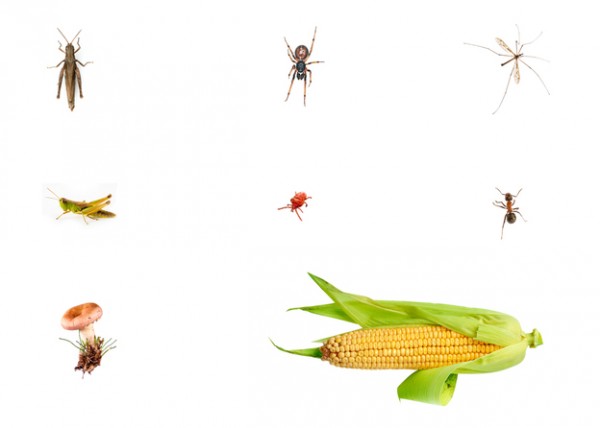
There were no bees. The air, the ground, seemed vacant. He found one ant "so small you couldn't pin it to a specimen board." A little later, crawling to a different row, he found one mushroom, "the size of an apple seed." (A relative of the one pictured below.) Then, later, a cobweb spider eating a crane fly (only one). A single red mite "the size of a dust mote hurrying across the barren earth," some grasshoppers, and that's it. Though he crawled and crawled, he found nothing else.
"It felt like another planet entirely," he said, a world denuded.
...
I think the cornfield biodiversity looks lots tidier!
Tue, Nov 20, 2012 from PhysOrg: Scientists pioneer method to predict environmental collapse The researchers have applied a mathematical model to a real world situation, the environmental collapse of a lake in China, to help prove a theory which suggests an ecosystem 'flickers', or fluctuates dramatically between healthy and unhealthy states, shortly before its eventual collapse. Head of Geography at Southampton, Professor John Dearing explains: "We wanted to prove that this 'flickering' occurs just ahead of a dramatic change in a system - be it a social, ecological or climatic one - and that this method could potentially be used to predict future critical changes in other impacted systems in the world around us."
...
'What we can predict we can prevent', right? Right?
Tue, Oct 9, 2012 from London Guardian: Warm North Atlantic Ocean causing UK's wet summers, study shows The UK's dismal recent summers can be blamed on a substantial warming of the North Atlantic Ocean in the late 1990s, according to new scientific research. The shift has resulted in rain-soaked weather systems being driven into northern Europe, increasing summer rainfall by about a third.... The summer of 2012 was the wettest in a century and follows a series of above average years for summer rainfall. ...
Thu, Sep 27, 2012 from PhysOrg: Sea of the living dead The world's coral reefs have become a zombie ecosystem, neither dead nor truly alive, and are on a trajectory to collapse within a human generation according to an academic from The Australian National University.
Professor Roger Bradbury, an ecologist from the Crawford School of Public Policy in the ANU College of Asia and the Pacific, said overfishing, ocean acidification and pollution are pushing coral reefs into oblivion. "The scientific evidence for this is compelling and unequivocal, but there seems to be a collective reluctance to accept the logical conclusion--that there is no hope of saving the global coral reef ecosystem," he said. "There is no real prospect of changing the trajectory of coral reef destruction in less than 20 to 50 years. In short, these forces are unstoppable and irreversible. "By persisting in the false belief that coral reefs have a future, we grossly misallocate the funds needed to cope with the fallout from their collapse. Money isn't spent to study what to do after the reefs are gone."
...
Mon, Sep 24, 2012 from University of Utah: Stratosphere Targets Deep Sea to Shape Climate: North Atlantic 'Achilles Heel' Lets Upper Atmosphere Affect the Abyss A University of Utah study suggests something amazing: Periodic changes in winds 15 to 30 miles high in the stratosphere influence the seas by striking a vulnerable "Achilles heel" in the North Atlantic and changing mile-deep ocean circulation patterns, which in turn affect Earth's climate. "We found evidence that what happens in the stratosphere matters for the ocean circulation and therefore for climate," says Thomas Reichler, senior author of the study published online Sunday, Sept. 23 in the journal Nature Geoscience. ...
What happens in the stratosphere ... doesn't stay in the stratosphere!
Fri, Sep 21, 2012 from CBC: Scientists predict record ocean temperatures in 2012 Canadian and U.S. scientists are predicting 2012 will set records for warm ocean temperatures on the eastern Seaboard.
Dave Hebert, a research scientist with the Bedford Institute of Oceanography, said temperatures off Nova Scotia in August were about two degrees above normal.
"We're actually seeing it in all the Gulf of St. Lawrence, the Scotian Shelf all the way up to the Labrador Shelf. All warming up a couple of degrees," Hebert told CBC News.
He said the department of fisheries and oceans has not yet calculated temperatures for 2012, however he expects it to break records....
"When the fish migrate from fresh water, they will be entering a much warmer ocean with a more aggressive predator field so that the warmer it gets there would be higher mortality occurring on these stocks," said Friedman.
...
Call me a WARMISTA: Want A Recovery, Mankind? I Suspect Trauma Ahead.
Fri, Sep 14, 2012 from ScienceDaily: Reduced Sea Ice: Fewer Consequences Than Anticipated? Recent data show that we face a historical and dramatic decline in the Arctic summer sea ice extent. This has believed to be bad news for marine organisms living under the ice. But new research show that perhaps some of the species actually have adapted to minimal ice cover in summer. The scientists call their hypothesis the "Nemo hypothesis."...
The scientists point to an unresolved paradox concerning the evolution and current distribution of ice associated organisms within the Arctic Ocean: How is it possible to retain a large and viable population of organisms totally dependent on sea ice when their habitat is annually reduced by up to 75-80 percent through melting and the Transpolar Drift through the Fram Strait? ...
Sweet! Knowing that a few species will survive lets me stay guilt-free!
Mon, Sep 10, 2012 from University of California - Santa Cruz: How Sea Otters Can Reduce CO2 in the Atmosphere: Appetite for Sea Urchins Allows Kelp to Thrive Can an abundance of sea otters help reverse a principal cause of global warming? A new study by two UC Santa Cruz researchers suggest that a thriving sea otter population that keeps sea urchins in check will in turn allow kelp forests to prosper. The spreading kelp can absorb as much as 12 times the amount of CO2 from the atmosphere than if it were subject to ravenous sea urchins, the study finds. ...
Fri, Sep 7, 2012 from AP, hosted on Google: Report: 'Time is running out' for Caribbean coral An international conservation organization is painting a grim picture of the Caribbean's iconic coral reefs.
The International Union for Conservation of Nature says the Caribbean's reefs are in sharp decline, with live coral coverage down to an average of just 8 percent. That's down from 50 percent in the 1970s. The non-governmental organization released a report Friday at an international environmental conference in Korea.
The causes include overfishing, pollution, disease and bleaching caused by rising global temperatures. The group says the situation is somewhat better in some places, including the Dutch islands of the southern Caribbean and the British territory of the Cayman Islands, with up to 30 percent cover in places.
But the union concludes that "time is running out" and new safeguards are urgently needed. ...
What an opportunity! Nanocoral™ anyone? How 'bout micro-robotic coral?
Thu, Sep 6, 2012 from LA Times: Bottom trawling flattens seafloor Fishing trawlers that scrape the seafloor with nets are altering the submarine landscape and may affect sensitive marine ecosystems, according to researchers.
Likening the effect of bottom trawling to agriculture plowing or forest clear-cutting on land, marine scientists say the practice has flattened undersea slopes across the globe. In the process, the fishing equipment threatens the diversity of sea life by altering their habitat. ...
Mountaintop mining, deep-sea trawling... soon the Earth will be the smooth billiard ball that consumers demand!
Tue, Aug 28, 2012 from ScienceDaily: Loss of Predators in Northern Hemisphere Affecting Ecosystem Health A survey on the loss in the Northern Hemisphere of large predators, particularly wolves, concludes that current populations of moose, deer, and other large herbivores far exceed their historic levels and are contributing to disrupted ecosystems....
It found that the loss of major predators in forest ecosystems has allowed game animal populations to greatly increase, crippling the growth of young trees and reducing biodiversity. This also contributes to deforestation and results in less carbon sequestration, a potential concern with climate change....Densities of large mammalian herbivores were six times greater in areas without wolves, compared to those in which wolves were present, the researchers concluded. They also found that combinations of predators, such as wolves and bears, can create an important synergy for moderating the size of large herbivore populations. ...
Mon, Aug 13, 2012 from Scientific American: Invasive Fungi Wreak Havoc on Species World-Wide ...Fungi have afflicted species as varied as amphibians, bats, arabica coffee, mangrove crabs, wheat, coral, bees, oak trees, sea turtles and even humans. (For instance, infectious meningitis is caused by a fungus.) ... Long thought to reproduce asexually through mitosis, where each offspring is the identical clone of its parent, scientists have discovered fungi can also reproduce sexually, via meiosis. By nimbly changing their reproductive strategy in response to new environmental conditions, fungi transfer genetic advantages from both parents--just like humans do--giving their offspring a better shot at survival. They also readily hybridize (interbreed between different species), outcross (selectively breed with individuals of different strains within a species) and recombine (exchange genetic material during cell division). ...
Fungi aren't just bisexual, they're, like, quintsexual!
Thu, Aug 9, 2012 from University of Alberta : Hibernation Altered by Climate Change Takes a Toll On Rocky Mountain Animal Species ... A University of Alberta-led international research team examined data on a population of Columbian ground squirrels and found a trend of late spring snow falls has delayed the animals' emergence from hibernation by 10 days over the last 20 years. "Losing just 10 days during their short active period reduces their opportunity to eat enough food so they can survive through the next hibernation period of eight to nine months," said [U of A Evolutionary Ecologist Jeff Lane]... The period of plant growth, their food supply, is only three to four months long on their home turf, skirting the Rocky Mountains. ...
Tue, Jul 31, 2012 from National Geographic News: Caffeinated Seas Found off U.S. Pacific Northwest The Pacific Northwest may be the epicenter of U.S. coffee culture, and now a new study shows the region's elevated caffeine levels don't stop at the shoreline.
The discovery of caffeine pollution in the Pacific Ocean off Oregon is further evidence that contaminants in human waste are entering natural water systems, with unknown consequences for wildlife and humans alike, experts say. Surprisingly, caffeine levels off the potentially polluted areas were below the detectable limit, about 9 nanograms per liter. The wilder coastlines were comparatively highly caffeinated, at about 45 nanograms per liter. ...
Tue, Jun 5, 2012 from E&E Publishing: Exotic diseases from warmer climates gain foothold in the U.S. Diseases once thought to be rare or exotic in the United States are gaining a presence and getting new attention from medical researchers who are probing how immigration, limited access to care and the impacts of climate change are influencing their spread.
Illnesses like schistosomiasis, Chagas disease and dengue are endemic in warmer, wetter and poorer areas of the world, often closer to the equator. According to the World Health Organization, almost 1 billion people are afflicted with more than one tropical disease. ...
Weird. My cats' names are Schistosomiasis, Chagas and Dengue!
Tue, Jun 5, 2012 from International Institute for Applied Systems Analysis: US and European Energy Supplies Vulnerable to Climate Change Higher water temperatures and reduced river flows in Europe and the United States in recent years have resulted in reduced production, or temporary shutdown, of several thermoelectric power plants, resulting in increased electricity prices and raising concerns about future energy security in a changing climate.... A study just published in Nature Climate Change projects further disruption to supply, with a likely decrease in thermoelectric power generating capacity of between 6-19 percent in Europe and 4-16 percent in the United States for the period 2031-2060, due to lack of cooling water. ...
No worries! We'll have icebergs and ice shelves galore breaking off and cooling the waters!
Tue, May 15, 2012 from PhysOrg: Scientists sound acid alarm for plankton The microscopic organisms on which almost all life in the oceans depends could be even more vulnerable to increasingly acidic waters than scientists realised, according to a new study.
Previous experiments have given an unduly optimistic view of the impact of acidifying oceans on plankton; it turns out that the methods used may have biased their results.
"Plankton often grow in clumps or aggregates," says Professor Kevin Flynn of Swansea University, lead author of the study. "But the way they are handled tends to break these clumps up. When a scientists starts working on a plankton sample in the lab, the first thing they do is give it a good shake."...
They found that if predictions of general ocean acidification come true, many kinds of plankton will face much more acidic conditions, and more widely varying conditions over each day, than previously realized - conditions far beyond anything seen in recent history. The results are likely to be stunted growth, or even death....
In another twist, as seawater gets more acidic, its capacity to protect against even more acidity diminishes, so general ocean acidification will increase the impact of the local acidification that plankton trigger. ...
Fri, May 11, 2012 from Telegraph.co.uk: Great Pacific Garbage Patch 'has increased 100-fold since the 1970s' US scientists warned the killer soup of microplastic - particles smaller than five millimetres - threatened to alter the open ocean's natural environment.
In the period 1972 to 1987, no microplastic was found in the majority of samples taken for testing, said the paper in the Royal Society journal Biology Letters.
Today, scientists estimate the swirling mass of waste known as the North Pacific Subtropical Gyre (NPSG) or the Great Pacific Garbage Patch, is roughly the size of Texas.
"The abundance of small human-produced plastic particles in the NPSG has increased by 100 times over the last four decades," said a statement on the findings of researchers from the University of California.
The United Nations Environment Programme says around 13,000 pieces of plastic litter are found in every square kilometre of sea, but the problem is worst in the North Pacific. ...
I heard on FOX that the plastic is just natural variation, and will be solved by clouds.
Tue, Apr 24, 2012 from CBC News: Arctic fishing moratorium needed, thousands of scientists say A group of more than 2,000 scientists from 67 countries has called for a moratorium on commercial fishing in the Arctic until more research can be completed on waters that were once covered by ice year-round.
The scientists said the loss of permanent sea ice has opened up as much as 40 per cent of the Central Arctic Ocean during recent summers, making industrial fishing viable for the first time.
But they said such activities should be prohibited until there's a better understanding of the area and sustainable fishing quotas can be set.
"The ability to fish is not the same as having the scientific information and management regimes needed for a well-managed fishery," the scientists said in an open letter released Sunday by the U.S.-based Pew Environment Group....
"In the absence of this scientific data and a robust management system, depletion of fishery resources and damage to other components of the ecosystem are likely to result if fisheries commence." ...
But it's brand new territory to suck dry! I can't resist!! Gold rush!!!
Tue, Apr 17, 2012 from New York Times: More on the Link Between Earthquakes and Fracking Scientists from the United States Geological Survey have cautiously weighed in on a subject that has sparked public concern in some parts of the country: spates of small earthquakes in oil- and gas-producing areas.
In a report to be presented next week at a meeting of seismologists in San Diego, the scientists say that increases in the number of quakes in Arkansas and Oklahoma in the last few years are "almost certainly" related to oil and gas production. ...
Mon, Apr 9, 2012 from PhysOrg: Loss of predators in Northern Hemisphere affecting ecosystem health A survey done on the loss in the Northern Hemisphere of large predators, particularly wolves, concludes that current populations of moose, deer, and other large herbivores far exceed their historic levels and are contributing to disrupted ecosystems.
The research, published today by scientists from Oregon State University, examined 42 studies done over the past 50 years.
It found that the loss of major predators in forest ecosystems has allowed game animal populations to greatly increase, crippling the growth of young trees and reducing biodiversity. This also contributes to deforestation and results in less carbon sequestration, a potential concern with climate change.
"These issues do not just affect the United States and a few national parks," said William Ripple, an OSU professor of forestry and lead author of the study. "The data from Canada, Alaska, the Yukon, Northern Europe and Asia are all showing similar results. There's consistent evidence that large predators help keep populations of large herbivores in check, with positive effects on ecosystem health." ...
Mon, Apr 9, 2012 from The Daily Climate: Warming Atlantic primes the Amazon for fire ...Scientists used to think the rainforest, especially in the western Amazon, was too wet to burn. But major fire seasons in 2005 and 2010 made them reconsider. Fires are a major source of carbon emissions in the Amazon, and scientists are beginning to worry that the region could become a net emitter, instead of a carbon sink. New findings link rising ocean temperatures off the northern coast of Brazil to changing weather patterns: As the Atlantic warms, it draws moisture away from the forest, priming the region for bigger fires.
"We are reaching a tipping point in terms of drought, beyond which these forests can catch fire," says Daniel Nepstad, international program director at the Amazon Environmental Research Institute in Brasilia, Brazil. ...
Tue, Apr 3, 2012 from HuffingtonPost: Missouri Bats Discovered With Deadly 'White Nose' Fungus A disease that has killed millions of bats across multiple states and Canada has been found in Missouri, marking its advent west of the Mississippi River and spelling possible trouble for agriculture in the region, officials said Monday.
White nose syndrome has been confirmed in three bats in two caves in Lincoln County, north of St. Louis, the Missouri Department of Conservation said. The name describes a white fungus found on the faces and wings of infected bats and has not been found to infect humans or other animals. Scientists estimate the ailment has killed at least 5.7 million bats in 16 states and Canada....
"White-nose syndrome in Missouri is following the deadly pattern it has exhibited elsewhere," Mollie Matteson, a bat specialist with the conservation group Center for Biological Diversity said in a release. "First the fungus shows up on a few healthy bats. A couple of years later, the disease strikes. And if the pattern continues, we can expect that in another few years, the majority of Missouri's hibernating bats will be dead." ...
Tue, Apr 3, 2012 from Mother Jones: America's Top 10 Most-Polluted Waterways If you are a fly-fisher, a rafter, or heck, just a person who drinks water, here is some troubling news: Our waterways are in rough shape. An eye-opening new report (PDF) from Environment America Research and Policy Center finds that industry discharged 226 million pounds of toxic chemicals into America's rivers and streams in 2010. The pollution included dead-zone-producing nitrates from food processors, mercury and other heavy metals from steel plants, and toxic chemicals from various kinds of refineries. Within the overall waste, the researchers identified 1.5 million pounds of carcinogens, 626,000 pounds of chemicals linked to developmental disorders and 354,000 pounds of those associated with reproductive problems. ...
Mon, Apr 2, 2012 from Windsor Star: New chemicals piling up in environment New flame retardants meant to replace their toxic predecessors are showing up in the air around the Great Lakes in increasing concentrations and travelling as far north as the Arctic.
These new findings raise a red flag that these chemicals need to be more closely examined to see if they accumulate in the environment and animals, according to Hayley Hung, a research scientist at Environment Canada, who found concentrations of tetrabromobenzoate (TBB) and tetrabromophthalate (TBPH) in both Canada's High Arctic and the Tibetan Plateau.
"It's not just a localized problem," Hung said. "(They) could become a global pollutant."
...
Fri, Mar 23, 2012 from CBC: Don't ease fish protection rules, PM urged by 625 scientists In a letter sent Thursday to Prime Minister Stephen Harper and Fisheries and Oceans Minister Keith Ashfield, a group of 625 scientists urged the government to abandon changes to the Fisheries Act outlined in an internal government document leaked late last week.
The document suggested the act is to be revised so Ottawa would be responsible for fish, but not their surrounding habitat.
The act currently requires projects such as oil pipeline and road culvert construction to show their plans will preserve fish habitat.
"Removing those provisions … would basically give proponents of projects license to do anything they pleased," said David Schindler, the University of Alberta ecologist who is the lead author of the letter....
Schindler said the signatories of his letter include many national and international prize-winning scientists and the number of them supporting the letter indicates how important habitat protection is.
...
Thu, Mar 22, 2012 from Telegraph.co.uk: Honeybee decline blamed on lethal combination of chemicals and disease In the latest study a laboratory at Universite Blaise Pascal in France studied bees infected with a disease known as nosemosis and bees exposed to an insecticide known as fipronil. Neither of the case studies resulted in many deaths.
However when the bees were exposed to both the disease and the insecticide, in any combination, a large number died.
Nicolas Blot, who led the study, said only "multi-factors" could explain the worldwide decline.
He said the world community now has to work on how to minimise the stress on insects.
"Until now nobody could find one single reason why bees were in decline worldwide," said he said. "Many worked on one kind of stress. What we show here it is not one insecticide or one disease that explains what is happening but a combination of factors in the environment. Bees are not exposed to one stress they are exposed to many."
...
Which part of "immunosuppression" didn't you understand?
Tue, Mar 13, 2012 from PNAS, via Treehugger: Tar Sands Industry Claims About Restoring Ecosystems Just Greenwashing, New Report Says New research in Proceedings of the National Academy of Sciences has examined the impact of tar sands mining in Canada on boreal forest and peatlands, finding that contrary to industry claims that such landscape can be restored post-mining, full restoration is not possible.
Furthermore, due to the fact that currently approved mines will cause the destruction of more than 29,500 hectares (114 square miles) of peatland, an additional 11.4-47.3 million metric tons of carbon emissions will be released by the mining. The destruction of the peat swamps will also remove carbon storage potential of up 7,200 metric tons per year, even after restoration is done.
The release of these greenhouse gases has never previously been included in calculations of the life-cycle emissions of fuel produced from tar sands. ...
It's strangely as if we actually can't put Humpty together again.
Mon, Mar 12, 2012 from National Geographic: Spiderwebs Blanket Countryside After Australian Floods In an arachnophobe's worst nightmare, swarms of spiders spin webs in a bush in flood-ravaged Wagga Wagga (map), Australia, Tuesday.
After a week of record rain, floodwaters across eastern Australia have forced the ground-dwelling spiders--and at least 13,000 people--to flee their homes, according to Reuters.
The rampant webs blanketing vast stretches of Wagga Wagga are likely "a dispersal mechanism that allows [spiders] to move out of places where they'd surely be drowned," said Robert Matthews, a professor emeritus of entomology at the University of Georgia.
Producing large quantities of silk creates a sort of "vast trampoline" that supports the spiders as they're fleeing the water, he noted. ...
Wed, Mar 7, 2012 from Reuters: Landslide Near Papua New Guinea Quarry Raises Futher Questions About Exxon A deadly landslide in the mountains of Papua New Guinea, near where US oil giant Exxon Mobil is building a $15.7 billion gas project, is raising fresh questions about the global energy industry's scramble for ever harder-to-reach resources.
The landslide tore through a quarry used by Exxon in January, killing at least 25 people in the poor South Pacific country, but it has stirred little international publicity even though an expert report had questioned the safety of the excavations.
The controversy also raises some familiar issues aired by critics of "big oil" in previous disasters: a pressure to deliver results, contractors found to have cut corners and remote operations that limit government oversight. ...
Even the earth itself is mobil when Exxon is around.
Mon, Mar 5, 2012 from The Tyee: Spill from Hell: Diluted Bitumen On a July morning in 2010 in rural Michigan, a 30-inch pipeline owned by Calgary-based Enbridge Energy Partners burst and disgorged an estimated 843,000 gallons of thick crude into a tributary of the Kalamazoo River. This was no ordinary crude -- it was the first ever major spill into water of diluted bitumen from the Alberta oil sands.
The cleanup challenges and health impacts around Kalamazoo were unlike anything the U.S. Environmental Protection Agency had ever dealt with, and raise serious questions about the preparedness in British Columbia to respond to such a disaster on the B.C. coast -- or the Vancouver harbour. ...
Thu, Mar 1, 2012 from New Scientist: No-waste circular economy is good business - ask China For centuries the global economy has been linear. Companies extract resources from the environment, turn them into products and sell them to consumers - who eventually throw them out. As a result we are burning through Earth's natural resources and wasting useful materials.
But it doesn't have to be that way, says Felix Preston of think tank Chatham House in London. Instead, we could have a circular economy in which waste from one product is used in another. ...
Next you'll be saying we should take pointers from Nature!
Tue, Feb 28, 2012 from CBC News: U.S. Supreme Court rejects Asian carp measures The U.S. Supreme Court refused Monday to order emergency measures that might prevent Asian carp from reaching the Great Lakes, despite a warning that the exotic fish pose a "dire threat" to the region's environment and economy.
Michigan and four neighboring states wanted the U.S. Army Corps of Engineers to install nets in two Chicago-area rivers and to expedite a study of permanent steps to head off an invasion by bighead and silver carp, which have advanced up the Mississippi River and its tributaries to within 88.5 kilometres of Lake Michigan.
Scientists say if the large, prolific carp spread widely in the lakes, they could starve out native species and devastate the $7 billion US fishing industry. ...
Mon, Feb 27, 2012 from Knoxville News Sentinel: Elevated mercury found in fish in Poplar Creek, Clinch River East Fork Poplar Creek has been posted as a hazard for decades because of mercury discharges from the Y-12 nuclear weapons plant, where the creek originates.... Sampling by Oak Ridge National Laboratory scientists and environmental staff has documented the elevated presence of mercury in fish in Poplar Creek -- downstream of the point where East Fork enters it -- and into the Clinch River and the upper part of Watts Bar Reservoir. ...
Tue, Jan 31, 2012 from ArsTechnica: Ocean acidification already well beyond natural variability Ocean acidification entails a decrease in the pH of ocean water as the carbonate that buffers it is consumed. That carbonate does more than just maintain pH, though. Lots of marine organisms, from plankton to mollusks to coral, use it to build shells and skeletons. As the buffer is depleted, the saturation state of carbonate minerals like calcite (and its polymorph aragonite) decreases, making it more difficult for organisms to incorporate them. In most areas of the surface ocean, calcite and aragonite are supersaturated, making it easy for organisms to build shells and skeletons. In undersaturated water, the equilibrium tilts the other way, and dissolution of these structures becomes possible....
In all areas where coral reefs are found (these are often described as the "rainforests of the sea" for their astonishing diversity and abundance of life), the researchers find that the current saturation state of aragonite is well below the pre-industrial average. To put it into concrete terms, they estimate that calcification rates of reef organisms have already dropped by about 15 percent. Under the A1B emissions scenario, calcification rates would decrease by a total of 40 percent (relative to pre-industrial) by 2100. ...
I'd have to accept this, were I to kowtow to the tyranny of facts.
Sat, Jan 14, 2012 from Live Science: How Warmer Summers Cause Colder Winters Counter to what logic might suggest, warm summers actually trigger cold winters, according to a new study.
The study, detailed in the Jan. 13 issue of the journal Environmental Research Letters,offers an explanation for the recent harsh winters in the Northern Hemisphere: Increasing temperatures and melting ice in the Arctic regions are creating more snowfall in the autumn months at lower latitudes, which, in turn, affects an atmospheric pattern that leads to colder winters. ...
Mon, Jan 9, 2012 from Wall Street Journal: Taking Fears of Acid Oceans With a Grain of Salt The Natural Resources Defense Council has called ocean acidification "the scariest environmental problem you've never heard of." Sigourney Weaver, who narrated a film about the issue, said that "the scientists are freaked out." The head of the National Oceanic and Atmospheric Administration calls it global warming's "equally evil twin."
But do the scientific data support such alarm? Last month scientists at San Diego's Scripps Institution of Oceanography and other authors published a study showing how much the pH level (measuring alkalinity versus acidity) varies naturally between parts of the ocean and at different times of the day, month and year.
"On both a monthly and annual scale, even the most stable open ocean sites see pH changes many times larger than the annual rate of acidification," say the authors of the study, adding that because good instruments to measure ocean pH have only recently been deployed, "this variation has been under-appreciated."...
Off Papua New Guinea and the Italian island of Ischia, where natural carbon-dioxide bubbles from volcanic vents make the sea less alkaline, and off the Yucatan, where underwater springs make seawater actually acidic, studies have shown that at least some kinds of calcifiers still thrive--at least as far down as pH 7.8. ...
See? If the Wall Street Journal says so, then Adam Smith says so, too. Move along.
Fri, Jan 6, 2012 from Christian Science Monitor: Climate change models flawed, extinction rate likely higher than predicted As climate change progresses, the planet may lose more plant and animal species than predicted, a new modeling study suggests. This is because current predictions overlook two important factors: the differences in how quickly species relocate and competition among species, according to the researchers, led by Mark Urban, an ecologist at the University of Connecticut.
Already evidence suggests that species have begun to migrate out of ranges made inhospitable by climate change and into newly hospitable territory.
"We have really sophisticated meteorological models for predicting climate change," Urban said in a statement. "But in real life, animals move around, they compete, they parasitize each other and they eat each other. The majority of our predictions don't include these important interactions." ...
"Real life"? Didn't we already innovate ourselves out of that mess?
Fri, Jan 6, 2012 from Inter-Research: Modelling the effects of fishing on the biomass of the world's oceans from 1950 to 2006 Using primary production, sea surface temperature, transfer efficiency, fisheries catch and TL of species, the model was applied on a half-degree spatial grid covering all oceans. Estimates of biomass by TLs were derived for marine ecosystems in an unexploited state, as well as for all decades since the 1950s. Trends in the decline of marine biomass from the unexploited state were analyzed with a special emphasis on predator species as they are highly vulnerable to overexploitation. This study highlights 3 main trends in the global effects of fishing: (1) predators are more affected than organisms at lower TLs; (2) declines in ecosystem biomass are stronger along coastlines than in the High Seas; and (3) the extent of fishing and its impacts have expanded from north temperate to equatorial and southern waters in the last 50 yr. More specifically, this modelling work shows that many oceans historically exploited by humans have seen a drastic decline in their predator biomass, with approximately half of the coastal areas of the North Atlantic and North Pacific showing a decline in predator biomass of more than 90 percent. ...
Without predator species, there's no need for fear!
Tue, Dec 27, 2011 from University of Miami via ScienceDaily: Link Between Earthquakes and Tropical Cyclones: New Study May Help Scientists Identify Regions at High Risk for Earthquakes A groundbreaking study led by University of Miami (UM) scientist Shimon Wdowinski shows that earthquakes, including the recent 2010 temblors in Haiti and Taiwan, may be triggered by tropical cyclones (hurricanes and typhoons), according to a presentation of the findings at the 2011 AGU Fall Meeting in San Francisco. ...
Tue, Dec 20, 2011 from Press Asociation: Stray showers of mercury getting into food chain Earth is being showered with mercury that can land anywhere and enter the food chain, a study has shown. The poisonous metal is released as a vapour by burning fuel then falls back to Earth and is easily absorbed by the aquatic ecosystem. Thousands of tonnes of mercury vapour are pumped into the air each year. Scientists discovered that in time mercury is oxidised it can then be deposited back on Earth, either in rain or snow. Bacteria transform the oxidised mercury into methyl mercury, which easily enters the food chain. US scientist Dr Seth Lyman, who led the research while at the University of Washington Bothell, said: "Much of the emitted mercury is deposited far from its original sources.["] ...
Thu, Dec 15, 2011 from NPR: Putting Farmland On A Fertilizer Diet The U.S. Department of Agriculture released a document yesterday that got no attention on the nightly news, or almost anywhere, really.... this document represents the agency's best attempt to solve one of the country's -- and the world's -- really huge environmental problems: The nitrogen and phosphorus that pollute waterways.... around the world, environmentalists and scientists are mobilizing to fight the plague of over-nutrition. That's where the new USDA document comes in. It lays out a host of steps that farmers can take -- and will have to take, if they get funding from certain USDA programs -- to minimize the spread of nutrients outside farm fields. Essentially, it involves putting farmland on a sensible diet. Only feed the land as much as it really needs. And don't apply fertilizer, including manure, when the crops don't need it. Also, try to capture and store any excess nutrients. For instance, grow wintertime "cover crops" that can trap free nitrogen before it leaches into groundwater. ...
Tue, Dec 13, 2011 from CBS News: Pollution from China alters weather in U.S. West A U.N. conference on climate change ended Sunday without a major deal to cut toxic emissions. No country emits more carbon dioxide than China -- a byproduct of its booming economy. And, as CBS News correspondent John Blackstone reports, those Chinese emissions are having a big impact in the U.S.
Chinese officials insist the murky air over Beijing this month is just fog. But measurements taken at the U.S. embassy there show dangerously high levels of air pollution -- so bad that traffic has been disrupted and flights have been delayed or cancelled.
"It's no longer just their problem; it's our problem," said Kim Prather of the Scripps Institution of Oceanography.
Prather studies atmospheric chemistry. CBS News met her at a scientific conference in San Francisco, where she was presenting research that shows what's in the air over China can affect the weather in America. ...
Sheesh, you'd think, given our flat earth, that pollution would just fall off into space.
Tue, Dec 6, 2011 from PLoS One -- IU-Bloomington: Study finds climate changes faster than species can adapt The ranges of species will have to change dramatically as a result of climate change between now and 2100 because the climate will change more than 100 times faster than the rate at which species can adapt, according to a newly published study by Indiana University researchers.
The study, which focuses on North American rattlesnakes, finds that the rate of future change in suitable habitat will be two to three orders of magnitude greater than the average change over the past 300 millennia, a time that included three major glacial cycles and significant variation in climate and temperature. ...
Let's feed 'em steroids, caffeine and sugar to speed 'em up.
Tue, Nov 29, 2011 from MSNBC, via DesdemonaDespair: Snowless Scandinavians wonder 'where's winter?' This fall on track to become one of the warmest on record For some reason, Scandinavia is not its frigid self, with unusually warm weather delaying the onset of winter in northern latitudes normally decked in white.
The lack of snow has been bad news for winter sports -- World Cup ski races have been dropped, or held on artificial snow, and mountain ski resorts are unable to open.
There are even reports of bird song and blooming gardens in some places typically entering the winter freeze at this time of year.
"Some flowers, like roses, have actually begun to blossom for a second time," said Mats Rosenberg, a biologist in Orebro, south-central Sweden....
Animals -- such as stoats, hares and willow grouse -- that change color with the season turned white weeks before the snows came, bringing an eerie feeling to the snowless wilds of Lapland.
"It was really very weird -- ghost-like white figures darting among the yellow leaves and lichen," said Viljo Pesonen, mayor of the town of 9,000. ...
The "ghost-like figures" of winters past and future.
Fri, Nov 25, 2011 from Princeton University via ScienceDaily: Do Not Harm Invasive Species That Pollinate, Study Warns In an irony of nature, invasive species can become essential to the very ecosystems threatened by their presence, according to a recent discovery that could change how scientists and governments approach the restoration of natural spaces...destructive, non-native animals that have been deservedly maligned by conservationists the world over can take on important biological roles -- such as flower pollination -- once held by the species the interlopers helped eliminate.
As a result, campaigns to curb invasive animal populations should include efforts to understand the role of the invasive species in question... ...
Fri, Nov 18, 2011 from Telegraph.co.uk: Are lemmings turning the Arctic green? Researchers found that large populations of lemmings are turning the Arctic green as the herbivores graze on plants and fertilise the soils.
But for all it appears the the retreat of Arctic the tundra is encouraging global warming it may actually cool down the climate as plants can grow bigger and store more carbon.
The team from the University of Texas at El Paso found when lemmings are excluded from the Arctic environment in enclosures in Alaska there is an increase in certain plant types called lichens and bryophytes.
However when the lemmings were present there were surprising increases in grass and sedge, the plant material that lemmings actually feed on....
Dr Johnson said the increasing plant matter could reduce global warming as bigger plants absorb more carbon. On the other hand soil decomposition increases with warmer temperatures meaning soil microbes are respiring and releasing carbon into the atmosphere and potentially increasing climate warming.
"We still don't know the relative magnitude of these two feedbacks to warming...." ...
Tue, Nov 15, 2011 from Center for Public Integrity: In polluted Pennsylvania suburb, a Republican takes on state regulators From his 13th-floor office in the Berks County Services Center, Commissioner Mark Scott fields constituent complaints about suffocating odors from an old battery recycling plant in the working-class borough of Laureldale, a northern suburb of this city.
Scott, a Republican, reacts to these calls in a way that might seem blasphemous to GOP hard-liners. As he sees it, regulators aren't doing enough. ...
Mon, Nov 14, 2011 from London Independent: Now you Dead Sea it... ...the Dead Sea is also on the way to becoming a man-made environmental disaster zone. For decades water has been pillaged for agriculture and domestic use from its main water provider, the River Jordan; and secondly from the Sea itself, for the hugely lucrative extraction of its vital minerals.
Now the Sea is shrinking with alarming rapidity. Its level is falling at a rate of 1.1 metres a year. Drive a few kilometres north of here along Route 90 and you arrive at where members of the British Palestinian Exploration Fund in 1917 painted a red line in the primeval limestone cliffs towering above them. ...
Mon, Nov 14, 2011 from McClatchy: Can the oceans continue to feed us? Yet tuna still aren't fished sustainably, something that conservationists and big U.S. tuna companies are trying to fix. This illustrates one part of the pressure on the world's oceans to feed a growing global population, now 7 billion. It also underscores the difficulties people have in balancing what they take against what must be left in order to have enough supplies of healthy wild fish....
"It's serious. On a global basis, we've pretty much found all the fish we're going to find," said Mike Hirshfield, chief scientist at the advocacy group Oceana. "There's not a lot of hidden fish out there. And we're still heading in the wrong direction, taken as a whole."
Some 32 percent of the world's fish are overfished, up from 10 percent in the 1970s and 25 percent in the early 1990s, according to the United Nations Food and Agriculture Organization.
...
Teach a man to fish, and his great-grandchildren will be hungry.
Wed, Oct 26, 2011 from Yale Environment 300: A Rise in Fungal Diseases is Taking Growing Toll on Wildlife In an increasingly interconnected world, fungal diseases are spreading at an alarming rate and have led to deadly outbreaks in amphibian, bat, and bee populations. And in the last decade, researchers note, some of the most virulent strains have infected people. On the southeastern outskirts of Washington, D.C., inside the Smithsonian Institution's cavernous Museum Support Center, one can see some frogs that no longer exist. Alcohol-filled glass jars hold preserved specimens of Incilius periglenes, the Monte Verde golden toad; the Honduran frog Craugastor chrysozetetes, which in life was olive-brown with purple palms and soles; its Costa Rican cousin, Craugastor escoces; and Atelopus ignescens, a black toad not seen in the wild for decades.
All of these extinct species are likely victims of the fungus Batrachochytrium dendrobatidis, which attacks the outer skin layers of amphibians, disrupting their water and electrolyte intake so severely that infected animals can die of cardiac arrest. ...
Wed, Oct 26, 2011 from The Daily Climate: Yukon delivers a plug of mercury in response to a changing climate The Yukon River is delivering upwards of five tons of mercury a year to the Arctic environment, likely in response to a warming climate, scientists from the U.S. Geological Survey announced Tuesday... Permafrost in the Yukon basin has been absorbing naturally occurring mercury - chiefly from volcanoes - since the end of the last ice age 10,000 years ago. Now those soils, as a result of changing climate conditions, are thawing at increased rates. That could be releasing a substantial reservoir of the metal into the marshes and streams feeding the Yukon River, the world's 19th largest river.
More recently, industrial pollution has coated the basin. Prevailing winds from Europe and Asia funnel industrial pollution, including mercury, directly to interior Alaska and the Yukon River drainage, [USGS hydrologist Paul] Schuster said.
"If we had funding, we could prove this. We could determine whether this comes from coal or volcanoes. But that's very expensive," he said. ...
Maybe they can raise the money by selling the mercury.
Mon, Oct 10, 2011 from Atlanta Journal-Constitution: Factory farms rarely cited for polluting Acting on a tip, state environmental inspectors in February paid a surprise visit to a dairy farm in Eatonton. They found the owner pumping gallon upon gallon of liquefied cow manure into a freshwater pond. From there the toxic brew leached into neighboring streams, the inspectors said.
Seven months later, the farmer signed a consent order agreeing to bring his farm up to regulations, update some equipment and take classes on managing the huge amounts of manure his cows generate. (A single dairy cow may produce an astonishing 140 pounds of manure a day.)
The Georgia Environmental Protection Division chose not to fine the Eatonton farmer. ...
Tue, Oct 4, 2011 from University of Hull via ScienceDaily: Weeds Are Vital to the Existence of Farmland Species, Study Finds Weeds, which are widely deemed as a nuisance plant, are vital to the existence of many farmland species according to a new University of Hull study published in the journal Biological Conservation. Since many weeds produce flowers and seed, they are an integral part of our ecosystem and together with other crop and non-crop seeds found on farms, they provide food for over 330 species of insects, birds and animals. ...
Wed, Sep 28, 2011 from New York Times: Climate Change and the Exodus of Species To most humans, so far, climate change is still more of an idea than an experience. For other species, it is an immediate reality. Many will be left behind as the climate alters, unable to move quickly enough or with nowhere to move to. Others are already adapting. An iconic example of these swift changes is the recent discovery that Atlantic and Pacific populations of bowhead whales -- long kept apart by the frozen Arctic -- are now overlapping in the open waters of the Northwest Passage. A team of scientists from the University of York examined the movement of 2,000 animal and plant species over the past decade. According to their study, published in Science last month, in their exodus from increasing heat, species have moved, on average, 13.3 yards higher in altitude -- twice the predicted rate -- and 11 miles higher in latitude -- three times faster than expected. These changes have happened most rapidly where the climate has warmed the most.
Chris Thomas, an author of the study, says, these changes "are equivalent to animals and plants shifting away from the equator at around 20 centimeters per hour" for the past 40 years. ...
Tue, Sep 27, 2011 from Associated Press: Kansas agencies assessing algae's impact in lakes State parks officials are assessing the impact of large-scale, blue-green algae blooms at Kansas lakes and reservoirs that kept people and animals out of the lakes this summer.
Dangerous levels of the toxic algae prompted Kansas health officials to post advisories and warnings since May. Ron Kaufman, spokesman for the Kansas Department of Wildlife, Parks and Tourism, said the algae blooms, along with weather conditions, prompted numerous cancellations at state cabins and campsites... The algae conditions occurred as many people were looking to spend their scarce leisure dollars staying closer to home enjoying Kansas parks and lakes. ...
Tue, Sep 20, 2011 from Reuters: "Missing" global heat may hide in deep oceans The mystery of Earth's missing heat may have been solved: it could lurk deep in oceans, temporarily masking the climate-warming effects of greenhouse gas emissions, researchers reported on Sunday.
Climate scientists have long wondered where this so-called missing heat was going, especially over the last decade, when greenhouse emissions kept increasing but world air temperatures did not rise correspondingly.
The build-up of energy and heat in Earth's system is important to track because of its bearing on current weather and future climate... Computer simulations suggest most of it was trapped in layers of oceans deeper than 1,000 feet (305 metres) during periods like the last decade when air temperatures failed to warm as much as they might have. ...
Tue, Sep 20, 2011 from London Independent: Antibiotics losing the fight against deadly bacteria Our last line of defence against bacterial infections is fast becoming weakened by a growing number of deadly strains that are resistant to even the strongest antibiotics, according to new figures given to The Independent on Sunday by the Health Protection Agency (HPA).
The disturbing statistics reveal an explosion in cases of super-resistant strains of bacteria such as E.coli and Klebsiella pneumoniae, a cause of pneumonia and urinary tract infections, in less than five years.... Years of over-prescribing antibiotics, bought over the counter in some countries, and their intensive use in animals, enabling resistant bacteria to enter the food chain, are among the factors behind the global spread...In a statement issued during a WHO conference in Baku, Azerbaijan, last week, the organisation warned that doctors and scientists throughout Europe fear the "reckless use of antibiotics" risks a "return to a pre-antibiotic era where simple infections do not respond to treatment, and routine operations and interventions become life-threatening." ...
Just so we have more than fireflies to light our operating rooms.
Tue, Sep 20, 2011 from University of Florida via ScienceDaily: Invasive Amphibians, Reptiles in Florida Outnumber World, Study Finds Florida has the world's worst invasive amphibian and reptile problem, and a new 20-year study led by a University of Florida researcher verifies the pet trade as the No. 1 cause of the species' introductions... Florida law prohibits the release of non-native species without a state permit, but offenders cannot be prosecuted unless they are caught in the act. To date, no one in Florida has been prosecuted for the establishment of a non-indigenous animal. Researchers urge lawmakers to create enforceable policies before more species reproduce and become established. The study names 56 established species: 43 lizards, five snakes, four turtles, three frogs and a caiman, a close relative of the American alligator. ...
Where I come from we call these invasives Snowbirds.
Thu, Sep 15, 2011 from Telegraph.co.uk: Butterfly numbers fall after coldest summer in two decades The results of the Big Butterfly Count 2011 revealed that the number of individual butterflies seen by each person counting the insects was down 11 per cent on last year.
The common blue saw numbers tumble by 61 per cent in the count, which involved more than 34,000 people across the country recording sightings of 322,000 butterflies.
Experts at wildlife charity Butterfly Conservation say they had expected a bumper summer for butterflies after a record-breaking hot, dry spring, but the cold summer with prolonged spells of rain hit the insects....
''The dismal summer weather, the coldest for 18 years, is undoubtedly to blame, although many butterflies have suffered long-term declines as a result of destruction of their habitats by human activities.''...
Butterfly Conservation warns that the last four years have seen butterfly numbers plummet to an all-time low, and that almost half of the 59 British species are now under threat. ...
Mon, Sep 12, 2011 from BBC: Supercomputer predicts revolution Feeding a supercomputer with news stories could help predict major world events, according to US research.
A study, based on millions of articles, charted deteriorating national sentiment ahead of the recent revolutions in Libya and Egypt.
While the analysis was carried out retrospectively, scientists say the same processes could be used to anticipate upcoming conflict.
The system also picked up early clues about Osama Bin Laden's location.
Kalev Leetaru, from the University of Illinois' Institute for Computing in the Humanities, Arts and Social Science, presented his findings in the journal First Monday. ...
I wonder what it would predict with our news feed?
Thu, Sep 8, 2011 from BBC: Giant crabs make Antarctic leap King crabs have been found on the edge of Antarctica, probably as a result of warming in the region, scientists say.
Writing in the journal Proceedings B, scientists report a large, reproductive population of crabs in the Palmer Deep, a basin cut in the continental shelf.
They suggest the crabs were washed in during an upsurge of warmer water.
The crabs are voracious crushers of sea floor animals and will probably change the ecosystem profoundly if and when they spread further, researchers warn.
Related species have been found around islands off the Antarctic Peninsula and on the outer edge of the continental shelf.
But here the crabs (Neolithodes yaldwyni) are living and reproducing in abundance right on the edge of the continent itself. ...
Wed, Sep 7, 2011 from Marine Conservation Biology Institute, via EurekAlert: Deep-sea fish in deep trouble A team of leading marine scientists from around the world is recommending an end to most commercial fishing in the deep sea, the Earth's largest ecosystem. Instead, they recommend fishing in more productive waters nearer to consumers.
In a comprehensive analysis published online this week in the journal Marine Policy, marine ecologists, fisheries biologists, economists, mathematicians and international policy experts show that, with rare exceptions, deep-sea fisheries are unsustainable....
Some deep-sea fishes live more than a century; some deep-sea corals can live more than 4,000 years. When bottom trawlers rip life from the depths, animals adapted to life in deep-sea time can't repopulate on human time scales. Powerful fishing technologies are overwhelming them.
"The deep sea is the world's worst place to catch fish" says marine ecologist Dr. Elliott Norse... "Deep-sea fishes are especially vulnerable because they can't repopulate quickly after being overfished."...
The deep sea provides less than 1 percent of the world's seafood....
Orange roughy take 30 years to reach sexual maturity and can live 125 years. Compared with most coastal fishes, they live in slow-motion. Unfortunately for them and the deep-sea corals they live among, they can no longer hide from industrial fishing. ...
Looks like we're floundering in the deep end of deep shit.
Tue, Sep 6, 2011 from Miami Herald: Wall of saltwater snaking up South Florida's coast South Florida's lakes, marshes and rivers pump fresh, crystal clear water across the state like veins carry blood through the body.
But cities along South Florida's coast are running out of water as drinking wells are taken over by the sea.
Hallandale Beach has abandoned six of its eight drinking water wells because saltwater has advanced underground across two-thirds of the city.
"The saltwater line is moving west and there's very little that can be done about it,� said Keith London, a city commissioner for Hallandale Beach, who has worked on water conservation and reuse for the last decade.
A wall of saltwater is inching inland into the Biscayne Aquifer -- the primary source of drinking water for 4.5 million people in South Florida.
...
Wed, Aug 31, 2011 from Wall Street Journal: With Trouble on the Range, Ranchers Wish They Could Leave It to Beavers Clyde Woolery wants his beavers back.
Mr. Woolery's ranch on Beaver Creek outside Kinnear, Wyo., has been beaver-free for decades, but he could sure use their help now. A small beaver colony, he says, would engineer dams that raise the water table under his pastures, opening up drinking holes for his cattle... It's a bit of a turnabout in these parts, where beavers have long been considered something of a nuisance -- blamed for everything from damming irrigation canals and gnawing fruit orchards to just generally wreaking havoc with agriculture. In many states, it's legal to shoot a beaver on private land. In Oregon, the Beaver State, the nocturnal creatures can be designated as "predators."
But their slick skill set is what many landscapes now need, says a cadre of pro-beaver ranchers and environmentalists who work on behalf of people like Mr. Woolery. ...
A love for beaver makes for some strange bedfellows.
Tue, Aug 30, 2011 from University of Hawai'i: Scientist creates new hypothesis on ocean acidification Aragonite is the mineral form of calcium carbonate that is laid down by corals to build their hard skeleton. Researchers wanted to know how the declining saturation state of this important mineral would impact living coral populations....
In the past, scientists have focused on processes at the coral tissues. The alternative provided by Jokiel's "proton flux hypothesis" is that calcification of coral skeletons are dependent on the passage of hydrogen ions between the water column and the coral tissue. This process ultimately disrupts corals' ability to create an aragonite skeleton. Lowered calcification rates are problematic for coral reefs because it creates weakened coral skeletons leaving them susceptible to breakage, and decreasing protection....
The model is a radical departure from previous thought, but is consistent with existing observations and warrants testing in future studies." In general, this hypothesis does not change the general conclusions that increased ocean acidification is lowering coral growth throughout the world, but rather describes the mechanism involved. ...
Wed, Aug 24, 2011 from Mongabay: Humanity knows less than 15 percent of the world's species Scientists have named, cataloged, and described less than 2 million species in the past two and a half centuries, yet, according to an new innovative analysis, we are no-where near even a basic understanding of the diversity of life on this small blue planet. The study in PLoS Biology, which is likely to be controversial, predicts that there are 8.7 million species in the world, though the number could be as low as 7.4 or as high as 10 million. The research implies that about 86 percent of the world's species have still yet to be described....
"We have only begun to uncover the tremendous variety of life around us," says co-author Alastair Simpson, also with Dalhousie. "The richest environments for prospecting new species are thought to be coral reefs, seafloor mud and moist tropical soils. But smaller life forms are not well known anywhere. Some unknown species are living in our own backyards—literally."Less is even known about the threats to species in what scientists say is an age of mass extinction. ...
Fri, Aug 19, 2011 from Washington Post: Plants and animals fleeing climate changes Across the globe, plants and animals are creeping, crawling, slithering and winging to higher altitudes and latitudes as temperatures climb.
Moreover, the greater the warming in any given region, the farther its plants and animals have migrated, according to the largest analysis to date of the rapidly shifting ranges of species in Europe, North America, Chile and Malaysia....
"This more or less puts to bed the issue of whether these shifts are related to climate change. There isn't any obvious alternative explanation for why species should be moving poleward in studies around the world."...
On average, species migrated uphill 36 feet per decade and moved away from the equator -- to cooler, higher latitudes -- at 10 miles per decade. The rates are two to three times those estimated by the last major migration analysis, published in 2003....
As species shift ranges, they're coming into contact with other species in new patterns, Chen said, a phenomenon called reshuffling. But ecologists are just beginning to study how species reshuffling may affect ecosystems. ...
Wait a minute -- there's a card game? And we're "all in" already?
Wed, Aug 17, 2011 from PNAS, via IdahoStatesman.com: Idaho trout face climate trouble, study finds "Fundamentally, skepticism is a good thing in science," said Wenger, a fisheries researcher with Trout Unlimited in Boise.
Both Wenger and Isaak, a fisheries biologist at the U.S. Forest Service's Rocky Mountain Research Station in Boise, were a part of a team of 11 scientists who said trout habitat could drop by 50 percent over the next 70 years because of a warming world. The paper, published Monday in the peer-reviewed science journal Proceedings of the National Academy of Sciences, predicts native cutthroat habitat could decline by 58 percent.
The two men, who have devoted their lives to scientific research, say they depend on the scientific method and peer review to judge the quality of the research that underscores their findings. The climate predictions are based on 10 of the 20 climate models developed independently worldwide that all show the world is getting warmer.
"The climate models have been right for 30 years and they are getting better all the time," Isaak said.
The data these men have collected in the watersheds of the West shows the same trends, they said. And warmer water isn't the only problem.
The research also shows that warmer winters are causing more winter floods that wash away the gravel that holds brook and brown trout eggs.
The changing spring and summer flows give rainbow trout an advantage over native cutthroat trout in the rivers they share, allowing the invaders to crowd out the natives. And the forecast for the future is more unnerving to these researchers and anglers than even they want to believe.
The most dire climate models show temperatures in Idaho rising an average of 9 degrees in 70 years, Wenger said. "That would make Boise pretty unpleasant," he said. "None of us want to believe that."
But Wenger is a scientist. He may hope the models that predict only a 4- to 5-degree rise over 70 years are more accurate, but he has to use the science that is available.
"I have to set aside my feelings and use the best data," he said. ...
If, of course, you believe in so-called "evidence."
Thu, Aug 4, 2011 from Telegraph.co.uk: Record breaking UK spring due to warm weather The Woodland Trust survey of 40,000 volunteers found that the traditional signs of spring were on average 17 days earlier because of the hot weather in April.
The orange-tipped butterfly was spotted almost a month early on 13th April, the earliest sighting since records began in 1891. The horse chestnut, dog rose and purple lilac also broke records for coming into leaf early....
Professor Tim Sparks, nature advisor to the Woodland Trust, said it was the earliest spring since 'bulk recording' began.
People were also mowing lawns early and spotting rooks nesting and frog spawn in ponds early.
"We had a cold winter but this was followed by a particularly warm and dry spring, which included the warmest April on record. This warmth is undoubtedly the main factor which led to many events occurring earlier than usual. ...
Tue, Aug 2, 2011 from ScienceDaily: The Last Great Wilderness: Human Impact On the Deep Sea The oceans cover 71 percent of our planet, with over half with a depth greater than 3000 m. Although our knowledge is still very limited, we know that the deep ocean contains a diversity of habitats and ecosystems, supports high biodiversity, and harbors important biological and mineral resources. Human activities are, however increasingly affecting deep-sea habitats, resulting in the potential for biodiversity loss and, with this, the loss of many goods and services provided by deep-sea ecosystems....
The impacts were grouped in three major categories: waste and litter dumping, resource exploitation, and climate change. The authors identified which deep-sea habitats are at highest risk in the short and mid-term, as well as what will be the main anthropogenic impacts affecting these areas, in a paper published in PLoS ONE on Aug. 1, 2011....
In particular, the accumulation of plastics on the deep seafloor, which degrade into microplastics, called mermaid tears, that can be ingested by the fauna, has consequences still unknown but predicted to be important. Moreover, there is increasing evidence of the accumulation of chemical pollutants of industrial origin, such as mercury, lead and persistent organic pollutants (e.g. dioxins, PCBs) in the sediment and fauna, including in species of commercial interest....
The main problem is that we still know very little of what we call the deep sea, making it difficult to evaluate accurately the real impact of industrial activities, litter accumulation and climate change in the deep sea habitats. ...
Sun, Jul 31, 2011 from Telegraph.co.uk: One-third of freshwater fish threatened with extinction Among those at the greatest risk of dying out are several species from UK rivers and lakes including the European eel, Shetland charr and many little known fish that have become isolated in remote waterways in Wales and Scotland.
Others critically endangered include types of sturgeon, which provide some of the world's most expensive caviar, and giant river dwellers such as the Mekong giant catfish and freshwater stingray, which can grow as long as 15 feet.
The scientists have blamed human activities such as overfishing, pollution and construction for pushing so many species to the brink of extinction.
They also warn that the loss of the fish could have serious implications for humans. In Africa alone more than 7.5 million people rely on freshwater fish for food and income....
"Sadly, it is also not going to get any better as human need for fresh water, power and food continues to grown and we exploit freshwater environments for these resources."...
"We have to find ways of reducing impacts on these ecosystems while allowing people to continue to use the resources that freshwater environments have to offer." ...
Only thirty percent? That means we haven't even reached "peak biodiversity" yet!
Tue, Jul 26, 2011 from Bloomberg News: Threat to Japanese Food Chain Multiplies as Cesium Contamination Spreads Radiation fallout from the wrecked Fukushima nuclear plant poses a growing threat to Japan's food chain as unsafe levels of cesium found in beef on supermarket shelves were also detected in more vegetables and the ocean.
More than 2,600 cattle have been contaminated, Kyodo News reported July 23, after the Miyagi local government said 1,183 cattle at 58 farms were fed hay containing radioactive cesium before being shipped to meat markets.
Agriculture Minister Michihiko Kano has said officials didn't foresee that farmers might ship contaminated hay to cattle ranchers. That highlights the government's inability to think ahead and to act, said Mariko Sano, secretary general for Shufuren, a housewives organization in Tokyo. ...
Thu, Jul 21, 2011 from Reuters: Ohio leads list of top 20 states with toxic air People living in Ohio, Pennsylvania and Florida are most at risk in the United States from toxic emissions spewing from coal and oil-fired power plants, two leading American enviromental groups said in a report on Wednesday.
Electricity generation and chemical processing were the top culprits for dangerous emissions, which can lead to or worsen ailments such as asthma and cancer, according to the report by the Natural Resources Defense Council and Physicians for Social Responsibility... "Power plants are the biggest industrial toxic air polluters in our country, putting children and families at risk by dumping deadly and dangerous poisons into the air we breathe," said Dan Lashof, director of the climate center at the Natural Resources Defense Council...The findings underline the need for strong action by the Environmental Protection Agency to spur industry to clean up the emissions, Lashof said. ...
Or, we can just consider this outrage as acceptable casualties.
Wed, Jul 20, 2011 from Texas A&M University via ScienceDaily: 2011 Gulf of Mexico 'Dead Zone' Could Be Biggest Ever Researchers from Texas A&M University have returned from a trip to examine the scope and size of this year's "dead zone" in the Gulf of Mexico and have measured it currently to be about 3,300 square miles, or roughly the size of Delaware and Rhode Island combined, but some researchers anticipate it becoming much larger...During the past five years, the dead zone has averaged about 5,800 square miles and has been predicted to exceed 9,400 square miles this year, which would make it one of the largest ever recorded, according to the Louisiana Universities Marine Consortium.
Hypoxia occurs when oxygen levels in seawater drop to dangerously low levels, and severe hypoxia can potentially result in fish kills and harm marine life, thereby creating a "dead zone" of life in that particular area. ...
If I eva have another child I'm gonna name her Hypoxia.
Tue, Jul 19, 2011 from CNN: Study: Changes to ocean expected to damage shellfish around world Massive global greenhouse gas pollution is changing the chemistry of the world's oceans so much that scientists now predict it could severely damage shellfish populations and the nations that depend on the harvests if significant action isn't taken.
A new study from the Woods Hole Oceanographic Institution in Massachusetts shows that ocean acidification is becoming a very serious problem. The study was published in July online in the journal Fish and Fisheries....Ocean acidification, or the changing chemical make-up of seawater, has occurred since the industrial revolution as ocean waters absorbed too much carbon dioxide. Carbon dioxide is a by-product of human industrial activities, mainly the burning of fossil fuels.The Woods Hole study found that many marine animals like mollusks and corals that build hard shells and skeletons are most at risk from this. ...
Seems the shelflife of shellfish is deteriorating.
Tue, Jul 19, 2011 from Pittsburg Post-Gazette: Pa. wind turbines deadly to bats, costly to farmers ...The 420 wind turbines now in use across Pennsylvania killed more than 10,000 bats last year -- mostly in the late summer months, according to the state Game Commission. That's an average of 25 bats per turbine per year, and the Nature Conservancy predicts as many as 2,900 turbines will be set up across the state by 2030... Bat populations go down, bug populations go up and farmers are left with the bill for more pesticide and crops...If one turbine kills 25 bats in a year, that means one turbine accounted for about 17 million uneaten bugs in 2010.
...
Do THIS math: If I don't have electricity I don't have TV!
Mon, Jul 18, 2011 from GiltTaste: The Most Important Fish in the Sea With two smaller boats at its side, the Reedville encloses a school of fish in a stiff black purse seine net. With practiced efficiency, workers onboard hoist a vacuum pump into the net and suck tens of thousands of small silvery fish out of the water. It looks like an unusual way to catch fish; it's all the more unusual when you realize that this particular industrial catch is actually banned by every state on the East Coast. Every state, that is, save for one: Virginia.
The fish going up the tube are Atlantic menhaden, known to ocean ecologists as the "breadbasket of the ocean," though some prefer to call them "the most important fish in the sea." Because there's money to be made, menhaden, all the fish that rely on them for food, and the entire ocean ecosystem are in trouble.
Found in estuarine and coastal waters from Nova Scotia to Florida, menhaden are oily, bony, and inedible to humans, which is why you've probably never heard of them. But their nutrient-packed bodies are a staple food for dozens of fish species you have heard of, as well as marine mammals and sea birds. Located near the bottom of the food chain, menhaden are the favored prey for many important predators, including striped bass and bluefish, tuna and dolphin, seatrout and mackerel....
This is the "menhaden reduction" process, the basis for a lucrative industry controlled, on the East Coast, by exactly one company: Omega Protein, Inc. ...
Sat, Jul 16, 2011 from Fast Company: The Bacon Uprising ...The Chinese middle class is eating more and more meat, and Beijing wants to keep prices low. That means finding a way to feed all those pigs with grain imported from land cut from the Brazilian rainforest, leading to conflict within the BRICs... Since Deng Xiaoping, China's leaders have been obsessed with "food security" the same way America's are haunted by not having enough oil. And as Chinese diets become more meat centric, fears of the dangers in the fluctuation of pork prices led China to establish a top-secret "strategic pork reserve" in 2007, the only one of its kind. But maintaining all those pigs has led to a massive dependence on corn and soybean imports for animal feed, which in turn is leading China's agribusinesses to fan out abroad in a quest to control the means of production. China's attempts to control the means of production in other countries just rising out of developing world is causing tension with its natural allies, and could be just the first step in an ever-escalating series of resource-based conflicts. ...
One day, we can sort out all this mess together in Hog Heaven.
Thu, Jul 14, 2011 from PBS, through Scientific American: Loss of Top Predators Has More Far-Reaching Effects than Thought Sea otters eat sea urchins and sea urchins eat kelp. When sea otters are present, the coastal kelp forests maintain a healthy balance. But when the fur trade wiped out the otters in the Aleutian Islands in the 1990s, sea urchins grew wildly, devouring kelp, and the kelp forest collapsed, along with everything that depended on it. Fish populations declined. Bald eagles, which feed on fish, altered their food habits. Dwindled kelp supplies sucked up less carbon dioxide, and atmospheric carbon dioxide increased.
The animal that sits at the top of the food chain matters, and its loss has large, complex effects on the structure and function of its ecosystem, according to an article published on Thursday in the online issue of the journal, Science....
"We see it on land, we see it on water, we see it in high latitudes, we see it in low latitudes," said James Estes, a research scientist at the Institute for Marine Sciences at the University of California, Santa Cruz and the paper's lead author. "We do not not see it anywhere." ...
I'm not not uncertain whether double negatives are not not less confusing than more.
Thu, Jul 14, 2011 from Huffington Post: Global Warming: Nature Can't Save Us From Ourselves The notion that nature itself will act as a check on the atmospheric excesses of humanity has long held a fair amount of appeal, not least because it draws on a nugget of high-school science that most people can quickly comprehend. Plants inhale carbon dioxide, after all -- they need it to grow. Add more CO2 to the air, as human civilization has been doing in copious amounts since the dawn of the Industrial Revolution, and the result will surely be thicker, more expansive biomass....
It's a conviction readily embraced by climate skeptics....
But scientists generally agree that the influence of increased biomass will be modest, essentially acting like a brake on a runaway freight train. It might be able to slow steadily rising temperatures, but it will hardly be enough to stop global warming in its tracks....
"To solve the carbon-climate problem, we need to transform our energy system into one that does not dump its waste into the sky," Caldeira said. "Land plants help. It looks like they won't help quite as much as we thought they would. Clearly, we can't expect nature to solve our problems for us." ...
Aren't we lucky that just around the corner, there's technology to save us from ourselves!
Tue, Jul 12, 2011 from VietNamNet: Pollution threatens HCM City water supply The pollution on Sai Gon River has become worse over the years as increasing industrialisation along the river bank threatens the main water source of HCM City.
The river flows through 40 industrial parks in Binh Duong, Binh Phuoc and Tay Ninh provinces and HCM City. Only 21 of them have an industrial waste treatment system.
Most of the treated water released from facilities does not meet the quality required by environmental authorities.
The Sai Gon River also is polluted by industrial and agricultural waste water from small-sized enterprises operating along the river, amounting to 65,000 cubic metres a day.
In addition, every day the river receives over 748,000 cubic metres of waste water, discharged from residential areas in localities, with more than 90 per cent of the waste water coming from HCM City...An expert said that with the limited number of waste water treatment plants, less than 20 per cent of household waste water was collected and treated, with the rest discharged directly into the river.
...
Tue, Jul 12, 2011 from Deutsche Press-Agentur: Mixed mating creates hybrid bears Polar bears and brown bears are coming together again to survive the next major climate change, which is expected to have dire effects on their endangered populations, a study published Thursday said.
Melting arctic ice, the result of global warming blamed on massive carbon emissions, could force polar bears into the natural home of the brown bear, setting the two species up for more genetic mixing, according to the study in the twice-monthly scientific journal Current Biology.
"When they come into contact, there seems to be little barrier to them mating," said Beth Shapiro, researcher at The Pennsylvania State University. ...
Mon, Jul 11, 2011 from PlanetForward: Evolution and Climate: Thoreau's Woods Reveal Patterns Primack combined his data with that of Henry David Thoreau, a 19th century naturalist, to illustrate that the effect of climate change on different plant species is biased against certain lineages. Groups of closely related plants that have not shifted the timing of traits (such as when they flower) to match changes in temperature have decreased in abundance due to climate change.
Primack wanted to know how evolutionary relationships influence plant species' susceptibility to climate change. He and his students surveyed Thoreau's woods for flowering-time responses and abundance of the same plants Thoreau and other botanists counted a century and a half earlier. Thoreau's woods, located in the town of Concord, Massachusetts, are ideal for such studies because up to 60 percent of Concord land is protected or undeveloped....
More specifically, there was a correlation between flowering-time tracking of seasonal temperatures and changes in abundance, indicating that plant species that did not track temperatures have experienced greater declines than species that do track temperature. This pattern was found in plant families such as dogwood, mint, orchids and roses. The study is notable because it shows that climate change-induced species loss is happening and does not occur randomly. Entire lineages, encompassing many closely related species, are being lost completely. ...
Mon, Jul 11, 2011 from George Monbiot, in the Guardian: Have jellyfish come to rule the waves? Last year I began to wonder, this year doubt is seeping away, to be replaced with a rising fear. Could it really have happened? Could the fishing industry have achieved the remarkable feat of destroying the last great stock?
Until 2010, mackerel were the one reliable catch in Cardigan Bay in west Wales. Though I took to the water dozens of times, there wasn't a day in 2008 or 2009 when I failed to take 10 or more. Once every three or four trips I would hit a major shoal, and bring in 100 or 200 fish: enough, across the season, to fill the freezer and supply much of our protein for the year....
I pushed my kayak off the beach and felt that delightful sensation of gliding away from land almost effortlessly - I'm so used to fighting the westerlies and the waves they whip up in these shallow seas that on this occasion I seemed almost to be drifting towards the horizon. Far below me I could see the luminous feathers I used as bait tripping over the seabed.
But I could also see something else. Jellyfish. Unimaginable numbers of them. Not the transparent cocktail umbrellas I was used to, but solid, white rubbery creatures the size of footballs. They roiled in the surface or loomed, vast and pale, in the depths. There was scarcely a cubic metre of water without one.Apart from that - nothing. It wasn't until I reached a buoy three miles from the shore that I felt the urgent tap of a fish, and brought up a single, juvenile mackerel. ...
In every gaping void there is an opportunity, right? Right?
Fri, Jul 8, 2011 from The Independent: Extinction of the Big Cats? "There were 450,000 lions when we were born and now there are only 20,000 worldwide," says Dereck, white-ponytailed and ramrod-straight at 55. "Leopards have declined from 700,000 to 50,000, cheetahs from 45,000 to 12,000 and tigers are down from 50,000 to just 3,000," his elegant wife and collaborator adds.
The bleak prospect is that our grandchildren will never be able to see these animals - or even the elephants, buffalo, zebra and antelope who survive by fleeing their predators - in the wild.
"We're expecting mass extinctions of big cats within 10 or 15 years unless something is done about it," Dereck says. He's looking to African governments to do this, without whose change of heart and legislation all efforts to save the beasts will be fruitless.
"Look at tigers - despite all the conservation efforts going on around them, there are less than 900 left in India, and whatever happens to tigers will happen to lions. We are in real trouble."
"Every year, 600 male lions are taken legally in safari hunts in Tanzania, Zimbabwe, Namibia, South Africa, Zambia - seven countries in total," Beverly adds. "You can shoot leopards in all those countries too, and 2,000 a year become a legal hunting trophy." ...
Kellogg's better get on this. Frosted flakes would never be grrrrrreat again!
Wed, Jul 6, 2011 from Environmental Health News: Scientists warn that chemicals may be altering breast development Exposure to chemicals early in life may alter how breast tissue develops and raise the risks of breast cancer and lactation problems later in life, scientists concluded in a set of reports published Wednesday.
The scientists are urging federal officials to add new tests for industrial chemicals and pesticides to identify ones that might disrupt breast development. In some cases, they said, mammary glands are more sensitive to effects of hormone-disrupting chemicals than any other part of the body, so low levels of exposure may be causing breast changes. ...
Wed, Jul 6, 2011 from San Francisco Chronicle: UCSF, Stanford autism study shows surprises Environmental factors play a more important role in causing autism than previously assumed and, surprisingly, an even larger role than genetics, according to a new study out of UCSF and Stanford that could force a dramatic swing in the focus of research into the developmental disorder.
The study, published in Monday's issue of the Archives of General Psychiatry, looked at 192 pairs of twins in California and, using a mathematical model, found that genetics account for about 38 percent of the risk of autism, and environmental factors account for about 62 percent.
...
Thu, Jun 30, 2011 from EcoHearth: Eerily Silent Summer Nights: Dead Crickets and Poisoned California Water I remembered recently reading an article about the top pesticide source that is disrupting aquatic life in the Sacramento San Joaquim Delta, which supplies water to 23 million Californians.
The culprits are Pyrethroids, a common synthetic pesticide that researchers first suspected entered the water cycle with agricultural runoff. But the largest quantities actually flow from urban Sacramento and cities in surrounding counties, either from an excessive use of shampoos to eliminate lice and fleas, or from people pouring leftover household pesticides down their drains.
Pyrethroids are linked to neurological and thyroid damage as well as hormonal disruption, and they're extremely harmful to beneficial insects, including bees....
... Borneo where, in the 1950s, the World Health Organization had sprayed roofs with DDT to eradicate malaria. This eliminated mosquitoes as well as the wasps that kept the thatch-eating caterpillars in check, which then thrived and ate the thatched roofs. So the government replaced the roofs with sheet metal, but the pounding rains kept people awake at night. The DDT-killed bugs were eaten by geckos, which were eaten by cats that also eventually died. Then the rats multiplied. Finally, the government had to commission Singapore's Royal Air Force to parachute cats into the country....
Lovins told this story to illustrate how everything is connected. Or as John Muir said, "When we try to pick out anything by itself, we find it hitched to everything else in the universe."
...
I'm loathe to accept that everything's connected, if that means that I'm responsible for what I do.
Tue, Jun 28, 2011 from New Scientist: Tasmanian devils were sitting ducks for deadly cancer Despite its ferocious nature, the Tasmanian devil is a creature faced with extinction, the victim of a gruesome facial tumour disease. Now the first genetic sequencing of these carnivorous marsupials has revealed that we had a hand in their decline: centuries of human interference left the devils stripped of genetic diversity and vulnerable to disease.
This meant that when the parasitic face cancer dubbed "Devil facial tumour disease" appeared in 1996 it rapidly spread through the entire population. As a result, the Tasmanian devil, or Sarcophilus harrisii, population has fallen over 60 per cent since 1996.
The disease is transmitted by physical contact, mostly biting during sex. It is almost always fatal and has spread across most of Tasmania....
Some studies estimate the marsupials could be wiped out within decades....
Humans had a heavy hand in this. First the devils were wiped out in mainland Australia by dingoes brought in by settlers, then those that remained in Tasmania were hunted as pests, causing several population crashes. As their genetic diversity was slashed, the devils were left vulnerable to disease. ...
Tue, Jun 28, 2011 from The Telegraph: Warming oceans cause largest movement of marine species in two million years Warming ocean waters are causing the largest movement of marine species seen on Earth in more than two million years, according to scientists.
In the Arctic, melting sea ice during recent summers has allowed a passage to open up from the Pacific ocean into the North Atlantic, allowing plankton, fish and even whales to into the Atlantic Ocean from the Pacific.
The discovery has sparked fears delicate marine food webs could be unbalanced and lead to some species becoming extinct as competition for food between the native species and the invaders stretches resources....
The highly venomous Portuguese Man-of-War, which is normally found in subtropical waters, is also regularly been found in the northern Atlantic waters....
"In 1999 we discovered a species in the north west Atlantic that we hadn't seen before, but we know from surveys in the north Pacific that it is very abundant there.
"This species died out in the Atlantic around 800,000 years ago due to glaciation that changed the conditions it needed to survive.
"The implications are huge. The last time there was an incursion of species from the Pacific into the Atlantic was around two to three million years ago....
"Large numbers of species were introduced from the Pacific and made large numbers of local Atlantic species extinct. ...
Sun, Jun 26, 2011 from AP, via PhysOrg: Sportsmen monitor gas drilling in Marcellus Shale A new coalition of outdoors groups is emerging as a potent force in the debate over natural gas drilling. The Sportsmen Alliance for Marcellus Conservation isn't against the process of fracking for gas, but its members want to make sure the rush to cash in on the valuable resource doesn't damage streams, forests, and the various creatures that call those places home.
The movement grew out of grass-roots anger as passionate outdoorsmen found their questions about drilling and wildlife brought few answers from local or state officials.
"Either we didn't get a response or the answer we got didn't seem feasible or acceptable. It didn't seem like the people who were in charge had their pulse on what was actually happening," said Ken Dufalla of Clarksville, Pa....
Already, preliminary water testing by sportsmen is showing consistently high levels of bromides and total dissolved solids in some streams near fracking operations, Dufalla said. Bromide is a salt that reacts with the chlorine disinfectants used by drinking water systems and creates trihalomethanes....
Dufalla stands alongside Whiteley Creek, a little mountain stream in Greene County. But something is wrong. The grass is lush and the woods are green, but the water is cloudy and dead-looking.
"It used to be a nice stream," teeming with minnows, crawfish and other aquatic life, he told The Associated Press. No more, said Dufalla, a former deputy game and fish warden for Pennsylvania.
He's worried that nearby gas drilling has damaged the creek, either from improper discharges of waters used in fracking, or from extensive withdrawals of water.
...
Fri, Jun 24, 2011 from BBC: Serengeti road scrapped over wildlife concerns Controversial plans to build a tarmac road across the Serengeti National Park have been scrapped after warnings that it could devastate wildlife.
The Tanzanian government planned a two-lane highway across the park to connect Lake Victoria with coastal ports.
But studies showed it could seriously affect animals such as wildebeest and zebra, whose migration is regarded as among the wonders of the natural world.
The government confirmed the road across the park will remain gravel. ...
Wed, Jun 22, 2011 from Guardian: Experts puzzled by big decline in honeybees over winter Honeybee populations declined by 13.6 percent over the winter, according to a survey of beekeepers across England. Losses were most severe in the north-east, where the survey recorded a loss rate of 17.1 percent.
Experts worry that the declines will affect plant productivity. There are also concerns that the declines, along with drought conditions in some areas, will mean less English honey this year....
However, there is good news that the rate of colony loss has slowed. Four years ago, one in three hives was wiped out....
A campaign being launched next week to save all bees, spearheaded by Sam Roddick and Neal's Yard Remedies, pins the blame for the decline on pesticide. It will start a petition to hand to Downing Street in October to ban the use of a class of pesticides that has been implicated in bee deaths across the world.
Roddick said: "These neonicotinoid pesticides penetrate the plant and indiscriminately attack the nervous system of insects that feed off them, disorientating bees, impairing their foraging ability and weakening their immune system, causing bee Aids. On current evidence, Italy, Germany and Slovenia have banned some varieties. In the UK, it's up to the people to show the government that if there is any doubt that they are contributing to bee deaths, we need to ban them." ...
The rate of decline slowed! That's almost the same as recovering, right?
Mon, Jun 20, 2011 from BBC: World's oceans in 'shocking' decline The oceans are in a worse state than previously suspected, according to an expert panel of scientists.
In a new report, they warn that ocean life is "at high risk of entering a phase of extinction of marine species unprecedented in human history".
They conclude that issues such as over-fishing, pollution and climate change are acting together in ways that have not previously been recognised.
The impacts, they say, are already affecting humanity....
"The findings are shocking," said Alex Rogers, IPSO's scientific director and professor of conservation biology at Oxford University.
"As we considered the cumulative effect of what humankind does to the oceans, the implications became far worse than we had individually realised.
"We've sat in one forum and spoken to each other about what we're seeing, and we've ended up with a picture showing that almost right across the board we're seeing changes that are happening faster than we'd thought, or in ways that we didn't expect to see for hundreds of years." ...
I hear Britney is showing off plenty of skin on her new "Femme Fatale" tour!
Mon, Jun 20, 2011 from SciDev.net: Small hydro could add up to big damage A belief that 'small' hydropower systems are a source of clean energy with little or no environmental problems is driving the growing interest in mini, micro, and pico hydro systems that generate from less than 5 kilowatts up to 10 megawatts of energy.
Hydropower appears to be the cleanest and most versatile of renewable energy sources. But experience shows that optimism about its potential can be misplaced....
By the end of 1970s it had become clear that the very optimistic, almost reverential, attitude towards hydropower projects that had prevailed during the early 1950s was misplaced. These projects damaged the environment as seriously as did fossil-fuelled power projects....
A turbine here or there may not affect the river noticeably; but if we are to use the technology extensively and put turbines in every other waterfall in a river, and make small dams on most of its tributaries or feeder streams, the environmental degradation -- per kilowatt of power generated -- will likely be much higher than that caused by large hydropower systems.
The factors that harm a river habitat with large hydropower projects are also at play with small projects: interrupted water flow, barriers to animal movement, water loss from evaporation and loss of biodiversity from the sacrificed portion of river are some examples. ...
There goes all my plans for our Three Gullies Dam.
Fri, Jun 17, 2011 from ScienceDaily: Where Have All the Flowers Gone? High-Mountain Wildflower Season Reduced, Affecting Pollinators Like Bees, Hummingbirds It's summer wildflower season in the Rocky Mountains, a time when high-peaks meadows are dotted with riotous color. But for how long? Once, wildflower season in montane meadow ecosystems extended throughout the summer months. But now scientists have found a fall-off in wildflowers at mid-season....
"Some pollinators with short periods of activity may require only a single flower species," write the ecologists in their paper, "but pollinators active all season must have flowers available in sufficient numbers through the season."
For example, bumblebees, important pollinators in many regions, need a pollen and nectar supply throughout the growing season to allow the queen bee to produce a colony.
As mid-summer temperatures have warmed in places like the Elk Mountains of Colorado, the researchers have found that the mid-season decline in flowering totals is ecosystem-wide....
Such changes in seasonal flower availability across large areas, or in individual habitats, could have serious consequences for entire pollinator populations, says Inouye, which include not only bees, but hummingbirds and others that feed on pollen and nectar. ...
Going to graveyards, every one. When will we ever learn?
Wed, Jun 15, 2011 from London Daily Telegraph: Cows are having fewer calves because of climate change Warmer springs are encouraging cows to breed earlier in the year so their calves are born in the middle of winter, when they have less chance of survival
The changes have been observed in a herd of cattle in Chillingham, Northumberland, which were first studied by Charles Darwin, the biologist. Dr Sarah Burthe, of the Centre for Ecology and Hydrology, studied the change in breeding patterns over the last 60 years.
She said: "Winter-born calves don't do very well and are more likely to die before they reach the age of one. This suggests that the cattle are responding to climate change but this is having a negative impact on them." ...
Tue, Jun 14, 2011 from Associated Press: Dead Sea threatened both by shrinking and flooding The Dead Sea is dying, goes the conventional wisdom: The water level of the fabled salty lake is dropping nearly 4 feet a year. Less well known: Part of the lake is actually overflowing, threatening one of Israel's key tourism destinations.
Israel is feverishly campaigning to have the Dead Sea -- the lowest point on earth and repository of precious minerals -- named one of the natural wonders of the world. At the same time, it's racing to stabilize what it calls "the world's largest natural spa" so hotels on its southern end aren't swamped and tourists can continue to soak in the lake's therapeutic waters.
...
I find this news story both upsetting and comforting.
Tue, Jun 7, 2011 from Stanford University via ScienceDaily: Climate Scientists Forecast Permanently Hotter Summers The tropics and much of the Northern Hemisphere are likely to experience an irreversible rise in summer temperatures within the next 20 to 60 years if atmospheric greenhouse gas concentrations continue to increase, according to a new climate study by Stanford University scientists... "According to our projections, large areas of the globe are likely to warm up so quickly that, by the middle of this century, even the coolest summers will be hotter than the hottest summers of the past 50 years," said the study's lead author, Noah Diffenbaugh... ...
Mon, Jun 6, 2011 from Christian Science Monitor: US: Canadian oil pipeline hazardous to the environment A controversial oil-sands pipeline operated by a Canadian oil company was ordered shut down Friday by the US Department of Transportation on charges that its continued operation "would be hazardous to lives, property, and the environment." TransCanada, a leading North American pipeline operator, started operation of Keystone I, a 36-inch pipeline system, in June 2010, making it possible to deliver Canadian oil to markets across Midwest farmland in several states, from the Dakotas through Illinois. ...
Thu, Jun 2, 2011 from Newsweek: Are You Ready for More? ...Even those who deny the existence of global climate change are having trouble dismissing the evidence of the last year. In the U.S. alone, nearly 1,000 tornadoes have ripped across the heartland, killing more than 500 people and inflicting $9 billion in damage. The Midwest suffered the wettest April in 116 years, forcing the Mississippi to flood thousands of square miles, even as drought-plagued Texas suffered the driest month in a century. Worldwide, the litany of weather's extremes has reached biblical proportions. The 2010 heat wave in Russia killed an estimated 15,000 people. Floods in Australia and Pakistan killed 2,000 and left large swaths of each country under water. A months-long drought in China has devastated millions of acres of farmland. And the temperature keeps rising: 2010 was the hottest year on earth since weather records began.
From these and other extreme-weather events, one lesson is sinking in with terrifying certainty. The stable climate of the last 12,000 years is gone. Which means you haven't seen anything yet. And we are not prepared. ...
Wed, May 25, 2011 from via ScienceDaily: Mediterranean Sea Invaded by Hundreds of Alien Species More than 900 new alien species have been encountered in the coastal environments of the eastern Mediterranean Sea in recent decades, including the poisonous pufferfish. The invasion of alien species has had the consequence that the whole food chain is changing, while there is a lack of knowledge on which to base relevant risk assessments, a four-year study conducted at the University of Gothenburg shows. ...
Tue, May 17, 2011 from Agence France-Press: Extreme makeover: are humans reshaping Earth? If alien geologists were to visit our planet 10 million years from now, would they discern a distinct human fingerprint in Earth's accumulating layers of rock and sediment?
Will homo sapiens, in other words, define a geological period in the way dinosaurs -- and their vanishing act -- helped mark the Jurassic and the Cretaceous?
A growing number of scientists, some gathered at a one-day symposium this week at the British Geological Society in London, say "yes"... For the first time in Earth's 4.7 billion year history, a single species has not only radically changed Earth's morphology, chemistry and biology, it is now aware of having done so. ...
Tue, May 17, 2011 from London Guardian: Vast Mongolian shantytown now home to quarter of country's population It is a supreme irony in a country once known as the land without fences. Stretching north from the capital, Ulan Bator, an endless succession of dilapidated boundary markers criss-cross away into the distance.
They demarcate a vast shantytown that sprawls for miles and is now estimated to be home to a quarter of the entire population of Mongolia.
More than 700,000 people have crowded into the area in the past two decades. Many are ex-herders and their families whose livelihoods have been destroyed by bitter winters that can last more than half the year; many more are victims of desertification caused by global warming and overgrazing; the United Nations Development Programme estimates that up to 90 percent of the country is now fragile dryland. ...
Thu, May 5, 2011 from Beijing Global Times: Sandstorm covers Shanghai in dust The eastern coast of China has borne the environmental brunt of a massive sandstorm that has swept across a large swath of the country, causing air quality in Shanghai to plummet to its worst level in years.
The sandstorm originated in the Southern Xinjiang Basin and has been traveling all the way east to the coastal regions since Thursday, blasting Shanghai and other cities in the Yangtze River Delta with sand and dust.
Statistics from the State Forestry Administration show the sandstorm has swept through 10 provinces and regions in the north and west of China, affecting an area of 2.3 million square kilometers and a population of 90 million. Beijing was hit by the sandstorm Saturday. ...
Wed, May 4, 2011 from New York Times: Army Corps Blows Up Missouri Levee Ruben Bennett, his back bent and his fingers gnarled from a lifetime of labor, has lived all of his 88 years on an expanse of rich farmland here, just below where the Ohio River pours into the Mississippi. He survived his share of floods -- including the record-setting one that swept away his boyhood home -- but he has never run from one, until now....The Mississippi River, already at record levels here, keeps rising, fed by punishing rains. As the flood protection systems that safeguard countless communities groan under the pressure, federal officials executed a fiercely debated plan to destroy a part of the levee holding back the river in the area Mr. Bennett calls home for the greater good of the region. ...
Sat, Apr 30, 2011 from USA Today: Climate change could spawn more tornadoes As with any major weather disaster these days -- from floods and hurricanes to wildfires and this week's tornado outbreak in the South -- people ask questions about its relation to the huge elephant that's lurking in the corner, global climate change.
Two separate studies in 2007 reported that global warming could bring a dramatic increase in the frequency of weather conditions that feed severe thunderstorms and tornadoes by the end of the 21st century.
One study, in the Proceedings of the National Academy of Sciences, found that locations could see as much as a 100 percent increase in the number of days that favor severe thunderstorms. ...
And by "elephant," are we referring to those blood-sucking, climate-denying Republicans??
Thu, Apr 28, 2011 from Duke University via ScienceDaily: Record Number of Whales, Krill Found in Antarctic Bays Scientists have observed a "super-aggregation" of more than 300 humpback whales gorging on the largest swarm of Antarctic krill seen in more than 20 years in bays along the Western Antarctic Peninsula. The sightings, made in waters still largely ice-free deep into austral autumn, suggest the previously little-studied bays are important late-season foraging grounds for the endangered whales. But they also highlight how rapid climate change is affecting the region..."The lack of sea ice is good news for the whales in the short term, providing them with all-you-can-eat feasts as the krill migrate vertically toward the bay's surface each night. But it is bad news in the long term for both species, and for everything else in the Southern Ocean that depends on krill," says Ari S. Friedlaender, co-principal investigator on the project and a research scientist at Duke. ...
Wed, Apr 27, 2011 from EnvironmentalResearchWeb: Siberia's boreal forests 'will not survive climate change' The boreal forests of Siberia are a vast, homogenous ecosystem dominated by larch trees. The trees survive in this semi-arid climate because of a unique symbiotic relationship they have with permafrost - the permafrost provides enough water to support larch domination and the larch in turn block radiation, protecting the permafrost from intensive thawing during the summer season.
This relationship has now been successfully modelled for the first time, revealing its sensitivity to climate change.
Ningning Zhang and colleagues from Nagoya University, Japan, have predicted that the larch trees will not be able to survive even the most optimistic climate change scenario of a 4 degree C increase in summer temperature in Siberia by the year 2100.
"We found that the larch-dominated boreal forest-permafrost coupled system in Siberia would be threatened by future warming of 2 degrees C or more," Zhang told environmentalresearchweb. "However, our simulations also show that, even with 4 degree C warming, some tree species can still survive, but with considerable loss of biomass." ...
Sounds like a great place for a palm oil plantation!
Wed, Apr 27, 2011 from London Guardian: Forest fires around Chernobyl could release radiation, scientists warn A consortium of Ukrainian and international scientists is making an urgent call for a $13.5m (£8.28m) programme to prevent potentially catastrophic wildfires inside the exclusion zone surrounding Chernobyl's ruined nuclear power plant.
The fear is that fires in the zone could release clouds of radioactive particles that are, at the moment, locked up in trees, held mainly in the needles and bark of Scots pines....If there is a catastrophic or "crown" fire (a high-intensity wildfire affecting a large part of the CEZ) radionuclides could be dispersed over a wide area; a big fire could send radioactivity as far as Britain. ...
Smokey the Russian Bear says Only YOU can prevent nuclear radiation.
Tue, Apr 26, 2011 from Columbia University via ScienceDaily: Ozone Hole Linked to Climate Change All the Way to the Equator In a study to be published in the April 21st issue of Science, researchers at Columbia University's School of Engineering and Applied Science report their findings that the ozone hole, which is located over the South Pole, has affected the entire circulation of the Southern Hemisphere all the way to the equator. While previous work has shown that the ozone hole is changing the atmospheric flow in the high latitudes, the new Columbia Engineering paper demonstrates that the ozone hole is able to influence the tropical circulation and increase rainfall at low latitudes in the Southern Hemisphere. This is the first time that ozone depletion, an upper atmospheric phenomenon confined to the polar regions, has been linked to climate change from the Pole to the equator. ...
Mon, Apr 25, 2011 from Toronto Star: Activists embark on five-day walk to protest 'mega quarry' Farmers, ranchers and First Nations groups embarked on a 115-kilometre trek to Melancthon Township on Friday to show their opposition to a "mega quarry" planned for the region.
The group departed on foot from Queen's Park, where roughly 200 people had gathered to discuss the project's potentially negative impact on the region's water, farming and quality of life.... "It's going to be the second-largest quarry in North America["]...The application for the project, put forward by The Highland Companies, says the limestone quarry planned for Dufferin County will use 600 million litres of groundwater every day... ...
Sometimes, just getting up off your butt is the hardest part.
Mon, Apr 25, 2011 from University of Kansas Biodiversity Institute via ScienceDaily: Brown Recluse Spider: Range Could Expand in N. America With Changing Climate One of the most feared spiders in North America is the subject a new study that aims to predict its distribution and how that distribution may be affected by climate changes...The researchers concluded that the range may expand northward, potentially invading previously unaffected regions. Newly influenced areas may include parts of Nebraska, Minnesota, Wisconsin, Michigan, South Dakota, Ohio, and Pennsylvania. ...
Mon, Apr 25, 2011 from London Observer: Spring may lose song of cuckoos, nightingales and turtle doves Some of Britain's most cherished spring visitors are disappearing in their thousands. Ornithologists say species such as the cuckoo, nightingale and turtle dove are undergoing catastrophic drops in numbers, although experts are puzzled about the exact reasons for these declines.
The warning, from the RSPB, comes as the songs of the cuckoo, nightingale and wood warbler herald the return of spring...There is almost certainly a significant problem caused by climate change. Migrant birds arrive and breed and then have chicks at times which are no longer synchronised with the best periods when food, such as insects, is available. ...
Fri, Apr 22, 2011 from Wall Street Journal: Drilling fluid gushes from northern Pa. gas well A blowout at a natural gas well in rural northern Pennsylvania spilled thousands of gallons of chemical-laced water Wednesday, contaminating a stream and leading officials to ask seven families who live nearby to evacuate as crews struggled to stop the gusher.
Chesapeake Energy Corp. lost control of the well site near Canton, in Bradford County, around 11:45 p.m. Tuesday, officials said. Tainted water flowed from the site all day Wednesday, though by the mid-afternoon, workers had managed to divert the extremely salty water away from the stream. ...
Wed, Apr 20, 2011 from Discovery News: As Gold Prices Go Up, Forests Are Coming Down A worldwide growth in the price of gold has accelerated the pace of deforestation in some of the most pristine parts of the Peruvian Amazon, where miners are cutting down trees in order to extract the valuable natural resource.
From 2003 to 2009, found a new study, the rate of deforestation in two gold-mining areas increased six-fold alongside record-setting leaps in the international price of gold. During one two-year period, as gold prices climbed steadily, forests disappeared at a rate of 4.5 American football fields a day from one of the two sites.
Alongside the accelerating paces of both mining and deforestation, the study found, there has also been an exponential rise in the use of mercury, which helps miners extract gold from the Earth. ...
Someday soon we'll realize these trees were worth their weight in gold.
Thu, Apr 14, 2011 from ScienceDaily: Invasive Mussels Causing Massive Ecological Changes in Great Lake The ongoing spread of non-native mussels in the Great Lakes has caused "massive, ecosystem-wide changes" throughout lakes Michigan and Huron, two of the planet's largest freshwater lakes, according to a new University of Michigan-led study.
The blitzkrieg advance of two closely related species of mussels -- the zebra and quagga -- is stripping the lakes of their life-supporting algae, resulting in a remarkable ecological transformation and threatening the multibillion-dollar U.S. commercial and recreational Great Lakes fisheries....
"These are astounding changes, a tremendous shifting of the very base of the food web in those lakes into a state that has not been seen in the recorded history of the lakes," said Mary Anne Evans, lead author of a paper scheduled for publication in the April 15 edition of the journal Environmental Science & Technology. "We're talking about massive, ecosystem-wide changes." ...
Tue, Apr 12, 2011 from Discovery News: Penguin, Krill Populations in Freefall Numbers of Chinstrap and Adelie penguins in the Antarctic Peninsula region have dropped by more than 50 percent in the last 30 years, driven mainly by dramatic declines in supplies of tiny, shrimp-like krill, their main prey, says a new study.
Krill, meanwhile, have declined by 40 to 80 percent, due primarily to rapidly warming temperatures in the area -- the South Shetland Islands near the tip of the Antarctic Peninsula and nearby sites.
This is one of the fastest-warming places on the planet with winter mean temperatures some 10 degrees Fahrenheit warmer now than in pre-industrial times....
The krill rely on phytoplankton growing in mats on the underside of sea ice for food at critical stages, he said.
"The young krill that are spawned in the Antarctic summer can't survive the winter without food," he said. "Once they get one year or older they can fast through the winter. We would get these long stretches of two, three or four warm, ice-free winters and there would be no survival of krill from the year before."
"We put together the pieces of the puzzle and said what's driving the penguin declines is a change in climate," he concluded. ...
Fri, Apr 8, 2011 from Reuters: Biodiversity vital to streams as extinctions rise As Earth enters a period of mass extinction, a study released on Wednesday offers a new reason to preserve biodiversity: it's an effective, natural pollution scrubber in streams.
Environmental activists have long warned that waning biodiversity means the loss of such ecological services as stream-cleaning, control of pests and diseases and increased productivity in fisheries.
The latest study, published in the journal Nature, shows how this works, demonstrating that streams that contain more species have better water quality than streams that have fewer.
The species being discussed are microorganisms such as algae that incorporate elements of pollution into their bodies. The more types of algae there are in a stream, each with a minutely different habitat, the better they are collectively at filtering pollution out of the water. ...
Fri, Apr 8, 2011 from St. Petersburg Times: USF study concludes that common fungicide is deadly to frogs Two years ago some University of South Florida researchers began studying the effects of the most widely used fungicide in the country to see if it might kill more than just fungus.
Turns out it's also a pretty effective frog-icide... The fungicide, chlorothalonil, sold under such names as Bravo, Echo and Daconil, is used to treat farmers' fields, lawns and golf courses and is an ingredient in mold-suppressing paint.
It's part of the same chemical family, organochlorines, as the banned pesticide DDT. It is known to cause severe eye and skin irritation in humans if handled improperly. ...
Bravo, indeed, for our unending creativity when it comes to the mindless destruction of the habitat!
Tue, Mar 29, 2011 from The Daily Climate: Shift in boreal forest has wide impact Vegetation change underway in northern forests as a result of climate change creates feedback loop that prompts more warming, scientists say. Boreal forests across the Northern hemisphere are undergoing rapid, transformative shifts as a result of a warming climate that, in some cases, is triggering feedback loops producing even more regional warming, according to several new studies. Russia's boreal forest - the largest continuous expanse of forest in the world - has seen a transformation in recent years from larch to conifer trees, according to new research by University of Virginia researchers.... "The climate has shifted. It's done, it's clear, and the climate has become unsuitable for the growth of the boreal forest across most of the area that it currently occupies," said Glenn Juday, a forestry professor at the University of Alaska, Fairbanks. ...
I wish that durn scientist wouldn't beat around bush.
Mon, Mar 28, 2011 from St. Petersburg Times: Bill will adversely affect environment, but will it create jobs? Builders of homes, offices, roads and other projects have been allowed to wipe out more wetlands in Florida than in any other state. But now, in the name of sparking job growth, state lawmakers want to make it even easier to develop wetlands and just write a check for the damage.
The 63 pages of CS/HB 991, which passed its latest committee vote Wednesday 14-0, are packed with changes to the state's wetlands, water pollution and development permitting rules.
The bill makes it easier to build roads through wetlands, easier for polluters to escape punishment, easier to open new phosphate mines and harder for regulators to yank a permit from someone who did things wrong. ...
No worries. All this raping of the earth will create plenty of jobs in the Post-Apocalypse.
Mon, Mar 28, 2011 from Helmholtz Association of German Research Centres via ScienceDaily: Freshwater Content of Upper Arctic Ocean Increased 20 Percent Since 1990s, Large-Scale Assessment Finds The freshwater content of the upper Arctic Ocean has increased by about 20 percent since the 1990s, according to a new large-scale assessment... The freshwater content in the layer of the Arctic Ocean near the surface controls whether heat from the ocean is emitted into the atmosphere or to ice. In addition, it has an impact on global ocean circulation...This freshwater lies as a light layer on top of the deeper salty and warm ocean layers and thus extensively cuts off heat flow to the ice and atmosphere. Changes in this layer are therefore major control parameters for the sensitive heat balance of the Arctic. ...
That's the problem with this planet. It's sooooo sensitive.
Sat, Mar 26, 2011 from National Science Foundation via ScienceDaily: Kudzu Vines Spreading North from US Southeast With Warming Climate Kudzu, the plant scourge of the U.S. Southeast. The long tendrils of this woody vine, or liana, are on the move north with a warming climate. But kudzu may be no match for the lianas of the tropics, scientists have found. Data from sites in eight studies show that lianas are overgrowing trees in every instance.
If the trend continues, these "stranglers-of-the-tropics" may suffocate equatorial forest ecosystems. ...
Sounds like someday we will all live in the Land of Kudzuliana.
Thu, Mar 24, 2011 from London Daily Mail: The European invader that's after your blood: Ticks from continent discovered in UK A breed of blood-sucking tick normally found on the continent has been discovered in Britain for the first time.
Scientists say that climate change has brought the parasite to the UK - and warned that it may have brought with it new strains of disease from Europe.
The researchers, from the University of Bristol, also found that the number of pet dogs infested with ticks was far higher than previously thought.
This increases the risk thatdiseases carried by the foreign tick - Dermacentor reticulatus - will spread quickly to people and animals in this country, they cautioned.
...
Thu, Mar 24, 2011 from The Spokesman-Review: Flooding spiked lead levels in Lake Coeur d'Alene An estimated 352,000 pounds of lead washed into Lake Coeur d'Alene on Jan. 18 after flooding related to a rain-on-snow event.
That's the weight equivalent of 70 Dodge Ram 1500 pickups - and the highest volume of lead recorded in a 24-hour period since major flooding in February 1996.
Greg Clark, a U.S. Geological Survey hydrologist, attributed high lead concentrations to a rapid rise in the Coeur d'Alene River caused by pounding rains and melting snow. ...
Could you please translate that into how many Mini Coopers?
Wed, Mar 23, 2011 from AlaskaDispatch: Warmer Arctic could increase threat of disease for caribou, other foods Climate change in the Arctic could change the balance of power between humans, animals and the germs or pathogens that make them both sick, according to a paper by University of Alaska Fairbanks microbiologist Karsten Hueffer....
The rates of predicted climate change for the Arctic could spell disaster for this longstanding host-pathogen balance. A warmer Arctic could increase survival of organisms that carry disease and decrease survival of the animals they infect - including animals used as subsistence food by people living in the Arctic.
"What happens when a caribou has its calf on ground warm enough to have pathogens the calf cannot fight off?" said Hueffer. "The same issue could face bears giving birth in dens."Muskoxen are affected by a lung worm known to develop much faster when it's warmer. "The faster the worm grows the more generations are born, which increases the disease pressure on the muskoxen," said Hueffer.
Humans are at risk as well. A warmer Arctic and the prospect of an ice-free Northwest Passage is expected to drive an increase in development and other human activity in the North, all of which will increase contact among wildlife, humans and domesticated animals. ...
Tue, Mar 22, 2011 from Discover: Made in China: Our Toxic, Imported Air Pollution Mercury, sulfates, ozone, black carbon, flu-laced desert dust. Even as America tightens emission standards, the fast-growing economies of Asia are filling the air with hazardous components that circumnavigate the globe. "There is no place called away." It is a statement worthy of Gertrude Stein, but University of Washington atmospheric chemist Dan Jaffe says it with conviction: None of the contamination we pump into the air just disappears. It might get diluted, blended, or chemically transformed, but it has to go somewhere. And when it comes to pollutants produced by the booming economies of East Asia, that somewhere often means right here, the mainland of the United States. ...
Mon, Mar 21, 2011 from Mongabay: UN: Want water? Save forests The UN-backed Collaborative Partnership on Forests (CPF) is urging nations to conserve their forests in a bid to mitigate rising water scarcity problems.
"[Forests] reduce the effects of floods, prevent soil erosion, regulate the water table and assure a high-quality water supply for people, industry and agriculture," said the Forestry Department Assistant Director General, Eduardo Rojas-Briales, with the UN Food and Agriculture Organization (FAO). "Forests are part of the natural infrastructure of any country and are essential to the water cycle."
In addition, forests reduce the impact of droughts, while preventing desertification and salinization, while loss of tropical rainforests has been shown to decrease local rainfall. In addition, cutting-edge research has even established a link between forest cover and winds delivering rainfall, one that remains quite controversial....
According to the UN, within 15 years 1.8 billion people could suffer from 'absolute water scarcity', while two-thirds of the global population could see water scarcities. Currently, 20 percent of people in the developing world don't have access to clean water. ...
Sat, Mar 19, 2011 from The Vancouver Sun: Ocean garbage: Floating landmines No matter where you travel on the B.C. coast, no matter how remote or seemingly untrammelled and pristine the fiord or inlet, a piece of plastic, Styrofoam or other garbage has been there before you. God knows how it got there: Dumped recklessly off a vessel, swept down a river or through a storm drain, blown by the wind off the land, or brought in by the ocean currents flowing across the vast North Pacific - including debris from the Japanese tsunami, which could start arriving on our coast in two years.
What we do know is that marine garbage is ubiquitous and wreaking havoc at every level of the marine environment.
A new B.C. study estimates there are 36,000 pieces of "synthetic marine debris" -garbage the size of fists to fridges -floating around the coastline, from remote inland fiords to 150 kilometres offshore.
...
We are the only species that shits where it sleeps and pisses into the wind.
Wed, Mar 16, 2011 from New York Times: E.P.A. Proposes New Emission Standards for Power Plants The Environmental Protection Agency proposed the first national standard for emissions of mercury and other toxins from coal-burning power plants on Wednesday, a rule that could lead to the early closing of dozens of generating stations and is certain to be challenged by the utility industry and Republicans in Congress. Lisa P. Jackson, the agency's administrator, unveiled the new rule with fanfare at agency headquarters, saying control of dozens of poisonous substances emitted by power plants was two decades overdue and would prevent thousands of deaths and tens of thousands of cases of disease a year. ...
Apparently, the utility industry and Republicans in Congress are impervious to death and disease.
Mon, Mar 14, 2011 from PhysOrg: Source of nutrients for ecosystem lost as coastal fisheries decline A new study by researchers at the University of Georgia and Florida International University has found that the elimination of large marine predators through overfishing and habitat alteration removes a vital source of nutrients for coastal ecosystems.... "When you eliminate these large predators, you also eliminate a major source of nutrients for algae and plants in the food web, especially in tropical and sub-tropical coastal areas."...
Allgeier said that tropical and sub-tropical coastal waters are typically low in nutrients. "That's why places like the Bahamas have such clear water," he said. "That's also why the fish are so important there. They recycle the nutrients they take in from the food that they eat, making them available for lower-level organisms, like algae, that form the base of the food web."
The researchers found significantly higher fish densities at the sites that experienced no human impacts, which led to much higher quantities of nutrients being recycled at these sites: 4.6 times more nitrogen and 5.4 times more phosphorus....
In a related paper currently in review in the journal Ecology, Allgeier and Layman continue their investigation into the mechanisms by which fish excretion enhances algal growth through a series of experiments using artificial reef habitats. ...
Sun, Mar 13, 2011 from The Denver Post: Colorado farmland goes dry as suburbs secure water supplies Colorado farmers still own more than 80 percent of water flowing in the state, but control is rapidly passing from them as growing suburbs move to secure supplies for the future.
The scramble is intensifying as aging farmers offer their valuable water rights to thirsty cities, drying up ag land so quickly that state overseers are worried about the life span of Colorado's agricultural economy.... Since 1987, Colorado farmers and ranchers have sold at least 191,000 acre-feet of water to suburbs, according to a review of water transactional data. (That's enough water to fill Chatfield Reservoir nine times-- and enough to sustain 382,000 families of four for a year.)
...
Few truly appreciate the value of a well-watered lawn and a sparkling-clean car.
Sat, Mar 12, 2011 from Los Angeles Times: Toxin found in dead sardines Sardines that suffocated and died en masse this week in King Harbor have tested positive for a powerful neurotoxin that scientists believe may have distressed 1 million or more fish off the Los Angeles coastline and caused them to swim chaotically into the Redondo Beach marina.
Researchers still believe critically low oxygen levels, not the toxin or an algae bloom, caused the fish to suddenly die Monday night in the Redondo Beach marina.
But the discovery of domoic acid in dead fish -- reported Friday by USC biologists -- could help explain why millions of sardines swam into the harbor in the first place... Domoic acid is often found in the stomachs of fish that have been feeding on plankton on the ocean's surface during toxic algae blooms. The toxin has been linked to neurological disorders, illnesses and deaths of seabirds, sea lions, sea otters and whales. When it accumulates in edible fish and shellfish, it can sicken humans.
...
Tue, Mar 8, 2011 from PNAS, via New Scientist: Bird boom in wake of mad cow outbreak Mad cow disease in Europe seems a world apart from the lives of sparrows in North American pastures. But populations of sparrows and other pasture birds boomed three years after outbreaks of the disease hit Europe, according to a new study by Joseph Nocera and Hannah Koslowsky of Trent University in Peterborough, Ontario, Canada....
To keep beef on consumers' tables, the affected countries import more meat, and many of those imports come from the US and Canada....
This in turn leaves more natural vegetation for grassland birds such as sparrows and meadowlarks, which respond with a population boom a year after that.
There's nothing particularly surprising in any of this - every step in the causal link between BSE and the sparrows is exactly what one might have predicted. But by putting it all together and backing it up statistically, the pair provide an unusual and striking illustration of the way globalisation weaves the planet into a single fabric of cause and effect.
...
Other times, cause and effect can kick you in the jujubes.
Tue, Mar 8, 2011 from SEED Daily, on DesdemonaDespair: Unregulated pesticide use in Asia destroys ecosystems and threatens resistant 'pest storms' The unbridled manufacture and use of pesticides in Asia is raising the spectre of "pest storms" devastating the region's rice farms and threatening food security, scientists have warned.
Increased production of cheap pesticides in China and India, lax regulation and inadequate farmer education are destroying ecosystems around paddies, allowing pests to thrive and multiply, they said.
The problem has emerged over the last decade and -- if left unchecked -- pests could lay waste to vast tracts of Asia's rice farms, according to scientists who took part in a workshop in Singapore last week....
"There are big outbreaks of pests or what they are calling in China 'pest storms' as a result of the over-application of pesticides," Lukacs said....
The problem is compounded by indiscriminate application, which has destroyed the ecosystem surrounding the paddies, including the predators such as spiders and dragonflies that would normally keep pest numbers down. ...
If pesticides kill more than just pests, why don't they call it something else, like "poison"?
Sat, Mar 5, 2011 from LiveScience: Arctic's Spring Phytoplankton Blooms Arrive Earlier When summer comes to the Arctic, the tiny plants that feed the ocean's food chain form green blooms in the water. In some Arctic waters, the peak of this bloom has been arriving earlier every year since 1997, a study has found.
These areas, where peak bloom time is creeping up, are roughly the same as those with decreasing sea ice in June, according to the researchers....
In some areas, the change was quite dramatic. For example, in the Baffin Sea, southwest of Greenland, the peak bloom moved from September to early July.
Phytoplankton is crucial to the marine ecosystem, because it forms the base of the food chain. The creatures that eat the tiny plants, including fish and tiny animals called zooplankton, have adapted to make the most of these blooms.
It's not clear if they are able to sync up with the earlier blooms and avoid disruptions to critical life stages, such as egg hatching and larvae development, according to lead study author Mati Kahru, a research oceanographer in the Integrative Oceanography Division at the Scripps Institution of Oceanography in California. ...
Wed, Mar 2, 2011 from Asheville (NC) Citizen-Times: White-nose syndrome shows up in Yancey County Biologists have confirmed white-nose syndrome at a third site in North Carolina, meaning two counties are now positive for the disease that has killed hundreds of thousands of bats in the Eastern United States.
The disease was confirmed last week in Yancey County. It was previously discovered in a retired Avery County Mine and in a cave at Grandfather Mountain State Park. While the news last week that a deadly bat disease had arrived in North Carolina was tragic, it did not come as a surprise to biologists....
"We knew that white-nose syndrome was coming and began preparing for its arrival, but we have a lot of work to do to address the impact of this disease on bats and our natural systems" said Chris McGrath, Wildlife Diversity Program Coordinator in the Commission's Wildlife Management Division.
"We and our conservation partners must focus resources upon collaborative efforts, including monitoring the spread of the disease, understanding how the potential loss of a significant proportion of bats will affect the balance of nature and our lives, and finding ways to combat those effects." ...
Mon, Feb 28, 2011 from London Daily Mail: Water demand will 'outstrip supply by 40 percent within 20 years' due to climate change and population growth Water demand in many countries will exceed supply by 40 per cent within 20 years due to the combined threat of climate change and population growth, scientists have warned.
A new way of thinking about water is needed as looming shortages threaten communities, agriculture and industry, experts said.
In the next two decades, a third of humanity will have only half the water required to meet basic needs, said researchers. Agriculture, which soaks up 71 per cent of water supplies, is also likely to suffer, affecting food production.
...
Mon, Feb 28, 2011 from The Bay View Compass: Female mice disabled by parents'pesticide intake A white mouse is placed in the center of a maze. She is hungry because she hasn't eaten all night. As soon as the gate is raised she takes off in search of her breakfast, scurrying down the channels. She quickly realizes that turning left at every point in the maze gets her food.
A few minutes later, a second mouse is set down in the center of the maze. She looks the same as the first mouse, but when the gate is raised she just sits there and seems afraid to move. Slowly and hesitantly she starts moving and eventually finds a piece of food. She continues slowly down the maze but doesn't seem to have learned or remember that taking left turns leads to food. You might call her a slow learner.... Why is it hard for the second mouse to learn? Three months earlier when she was growing in her mother's womb, her mother was exposed to a pesticide called chlorpyrifos at levels comparable to what humans encounter in the environment. ...
Is this why I can't find my way out of my garage most mornings?
Sun, Feb 27, 2011 from New York Times: Regulation Lax as Gas Wells' Tainted Water Hits Rivers The American landscape is dotted with hundreds of thousands of new wells and drilling rigs, as the country scrambles to tap into this century's gold rush -- for natural gas.... energy companies are clamoring to drill. And they are getting rare support from their usual sparring partners. Environmentalists say using natural gas will help slow climate change because it burns more cleanly than coal and oil. Lawmakers hail the gas as a source of jobs. They also see it as a way to wean the United States from its dependency on other countries for oil.... thousands of internal documents obtained by The New York Times from the Environmental Protection Agency, state regulators and drillers show that the dangers to the environment and health are greater than previously understood. ...
Fri, Feb 25, 2011 from CBC: Starving B.C. eagles swarm to dumps A weak chum salmon run along B.C.'s coast is having a devastating effect on the local bald eagle population.
The fish is a staple in their diets and and the lack of it has the eagles starving and fighting for what little food is out there....
"We've had a few in that were hungry," Day told CBC News Thursday. "We got one in the other night that had been drowning. It got into the water and didn't have the strength to get out. Some people hauled it out."
There have been reports on Vancouver Island of eagles falling out of trees, dead from starvation.
The weak chum salmon run was made worse earlier this month by heavy rains that washed away many of the few remaining salmon carcasses.
The birds have been forced to scavenge in garbage dumps, like the Vancouver landfill.... The dump might seem provide easy pickings, but wildlife officials said it can be a dangerous place. Poisoned pests, such as rats, are often disposed of in landfills, which in turn will poison an eagle. ...
Good thing they're not American bald eagles. That would be a threat to our national icon!
Thu, Feb 24, 2011 from TreeHugger: Amazon Deforestation Up 1000 Percent From Last Year Over the last several years, the rate of forest loss in the Brazilian Amazon had been in steady decline, but the latest data is yet again proving that the problem is far from over. According to figures released today, deforestation in the world's largest rainforest has increased nearly 1,000 percent from the same period the year before, marking the first rise in over two years -- though only time will tell if it is merely a disappointing uptick, or a troubling reverse of trends.
A newly disclosed report from the Amazon Institute of People and the Environment (IMAZON) reveals that 175 square kilometers (68 mi2) of forest were cleared this past December, compared with just 16 km2 (6 mi2) reported last year for December 2009, a rise of 994 percent....
Just last month, 83 km2 (32 mi2) of forest were cleared and 376 km2 (145 mi2) degraded -- representing increases over last year's rates of 22 and 637 percent, respectively. ...
No big deal. It's only part of the lungs of the world.
Wed, Feb 23, 2011 from BBC: Coral reefs heading for fishing and climate crisis Three-quarters of the world's coral reefs are at risk due to overfishing, pollution, climate change and other factors, says a major new assessment.
Reefs at Risk Revisited collates the work of hundreds of scientists and took three years to compile.
The biggest threat is exploitative fishing, the researchers say, though most reefs will be feeling the impact of climate change within 20 years....
"The report is full of solutions - real world examples where people have succeeded to turn things around," said Dr Spalding.
"However, if we don't learn from these successes then I think that in 50 years' time, most reefs will be gone - just banks of eroding limestone, overgrown with algae and grazed by a small variety of small fish." ...
You guys are forgetting all the flooded coastal cities -- there'll be new reef areas galore!
Mon, Feb 21, 2011 from Donga: Schools nervous over burial sites for culled animals A tomb-like object was seen Friday afternoon behind Yangshin Elementary School at the village of Buncheon-ri in Yesan County, South Chungcheong Province. It turned out to be a burial site for livestock culled due to foot-and-mouth disease.
Spotted around the burial site was fluid that appeared to be leachate from the site, measuring around 10 meters wide by 10 meters long. Gas emission pipes were erected atop the burial site, which was protruding and covered with vinyl. It was only about 70 meters from the school's fence.
On the school grounds was a piped well for pumping underground water. Since tap water is not supplied to this school, underground water was used as drinking water. The underground water well and the burial site were only 150 meters apart. ...
Mon, Feb 21, 2011 from Washington Post: Predator fish in oceans on alarming decline, experts say Over the past 100 years, some two-thirds of the large predator fish in the ocean have been caught and consumed by humans, and in the decades ahead, the rest are likely to perish, too.
In their place, small fish such as sardines and anchovies are flourishing in the absence of the tuna, grouper and cod that traditionally feed on them, creating an ecological imbalance that experts say will forever change the oceans. ...
Thu, Feb 17, 2011 from Associated Press: Scientists connect global warming to extreme rain Extreme rainstorms and snowfalls have grown substantially stronger, two studies suggest, with scientists for the first time finding the telltale fingerprints of man-made global warming on downpours that often cause deadly flooding.
Two studies in Wednesday's issue of the journal Nature link heavy rains to increases in greenhouse gases more than ever before... For years scientists, relying on basic physics and climate knowledge, have said global warming would likely cause extremes in temperatures and rainfall. But this is the first time researchers have been able to point to a demonstrable cause-and-effect by using the rigorous and scientifically accepted method of looking for the "fingerprints" of human-caused climate change. ...
Wed, Feb 16, 2011 from Mongabay News: Cambodia approves titanium mine in world's 'most threatened forest' The Cambodian government has approved a mine that environmentalists and locals fear will harm wildlife, pollute rivers, and put an end to a burgeoning ecotourism in one of the last pristine areas of what Conservation International (CI) recently dubbed 'the world's most threatened forest'. Prime Minister, Hun Sen, approved the mine concession to the United Khmer Group, granting them 20,400 hectares for strip mining in Cambodia's Cardamom Mountains. The biodiverse, relatively intact forests of the Cardamom Mountains are a part of the Indo-Burma forest hotspot of Southeast Asia, which CI put at the top of their list of the world's most threatened forests. With only 5 percent of habitat remaining, the forest was found to be more imperiled than the Amazon, the Congo, and even the forests of Indonesia and Malaysia. ...
Like I always say: If you're heading for the cliff might as well accelerate!
Mon, Feb 14, 2011 from The Columbus Dispatch: Ohio EPA tries to limit brine dumps in rivers Fast-growing interest in natural-gas drilling could create a flood of cash for Ohio cities eager to treat wastewater used to coax the gas from deep inside Utica and Marcellus shale.
But what's good for the cities might be bad for the state. The process could pollute Ohio streams and rivers, environmental officials say.... With the new drilling technique, called hydraulic fracturing, or "fracking," drillers shoot millions of gallons of water laced with industrial chemicals down the wells to break the shale and release the gas.
About 15 percent of the water shot down the well comes back up, tainted with salt and hazardous metals that can include barium, cadmium and chromium. After the initial surge of "flow back" water, wells continue to produce brine that contains even higher concentrations of salt, metals and minerals. ...
Fri, Feb 11, 2011 from BioScience Magazine: Oyster Reefs at Risk and Recommendations for Conservation, Restoration, and Management Native oyster reefs once dominated many estuaries, ecologically and economically. Centuries of resource extraction exacerbated by coastal degradation
have pushed oyster reefs to the brink of functional extinction worldwide. We examined the condition of oyster reefs across 144 bays and 44
ecoregions; our comparisons of past with present abundances indicate that more than 90 percent of them have been lost in bays (70 percent) and ecoregions
(63 percent). In many bays, more than 99 percent of oyster reefs have been lost and are functionally extinct. Overall, we estimate that 85 percent of oyster reefs have
been lost globally. Most of the world's remaining wild capture of native oysters (greater than 75 percent) comes from just five ecoregions in North America, yet
the condition of reefs in these ecoregions is poor at best, except in the Gulf of Mexico. We identify many cost-effective solutions for conservation,
restoration, and the management of fisheries and nonnative species that could reverse these oyster losses and restore reef ecosystem services. ...
Wed, Feb 9, 2011 from Reuters: Buffalo, NY bans hydraulic fracturing The city of Buffalo, New York, banned the natural gas drilling technique of hydraulic fracturing on Tuesday, a largely symbolic vote that demonstrates concern about potential harm to groundwater from mining an abundant energy source.
The city council voted 9-0 to prohibit natural gas extraction including the process known as "fracking" in which chemicals, sand and water are blasted deep into the earth to fracture shale formations and allow gas to escape.
The ordinance also bans storing, transferring, treating or disposing of fracking waste within the city. ...
Sat, Feb 5, 2011 from EnvironmentalResearchWeb: Wolverines threatened by climate change The wolverine - a member of the weasel family that resembles a small bear - could disappear from the US as a direct result of man-made climate change, according to predictions by researchers at the US National Center for Atmospheric Research (NCAR).
The wolverine is unique among mammals in that it is heavily dependent on spring snow pack. Deep snow is required for successful wolverine reproduction because female wolverines dig elaborate dens in the snow for their offspring. These dens are not only insulating for the newborn kits, but also protect them from predators.
"While other species such as the Arctic fox or caribou are adapted to snow, their relationship with snow is not as critical as that of the wolverine," NCAR's Synte Peacock told environmentalresearchweb. "Other species may be able to adapt if there is no spring snow, but without dens, the wolverine cannot reproduce."... "The impact of their disappearance would probably be relatively low and it is possible that the wolverine may continue to thrive in parts of Canada and Scandinavia where conditions are cold year-round and snow cover persists throughout spring." ...
Sat, Feb 5, 2011 from BBC: New Zealand scientists record 'biodiversity breakdown' Scientists in New Zealand say they have linked the modern-day decline of a common forest shrub with the local extinction of two pollinating birds over a century ago.
They say the disappearance of two birds - the bellbird and stitchbird - from the upper North Island of the country has lead to a slow decline in common plants, including the forest shrub New Zealand gloxinia.
Ship rats and stoats imported into the country around the year 1870 are blamed for the birds' demise.... The researchers wanted to observe the impact on New Zealand gloxinia of these disappearing bird populations and so compared the situation on the mainland with that of three nearby island bird sanctuaries where the birds remain abundant.
What they found was that pollination rates were vastly reduced on the mainland with seed production per flower 84 percent lower compared with the islands.
While this has yet to fully manifest itself in the density of adult gloxinia populations on the mainland, the researchers found 55 percent fewer juvenile plants per adult plant on the mainland vis-a-vis the islands....
An estimated 49 percent of all land birds have been lost in New Zealand, say the researchers, and the consequences of that are far greater than those outlined in this study. ...
Sat, Jan 29, 2011 from University of Colorado at Boulder via ScienceDaily: Warming North Atlantic Water Tied to Heating Arctic The temperatures of North Atlantic Ocean water flowing north into the Arctic Ocean adjacent to Greenland -- the warmest water in at least 2,000 years -- are likely related to the amplification of global warming in the Arctic, says a new international study involving the University of Colorado Boulder...The team believes that the rapid warming of the Arctic and recent decrease in Arctic sea ice extent are tied to the enhanced heat transfer from the North Atlantic Ocean..."Cold seawater is critical for the formation of sea ice, which helps to cool the planet by reflecting sunlight back to space..." ...
Sat, Jan 22, 2011 from Climatewire: Greenland's Ice Feels the Heat in Record-Setting 2010 Greenland's massive ice sheet experienced record surface melting and runoff last year, according to research released today. Unusually warm conditions in much of the country helped extend the annual melting season by up to 50 days longer in 2010 than the average observed between 1979 and 2009, researchers found... Last year was the warmest in Greenland's capital, Nuuk, since record keeping began there in 1873. Nuuk, on the country's southwest coast, also set records in 2010 for warmest winter, spring and summer seasons. ...
Sat, Jan 22, 2011 from New York Times: For Many Species, No Escape as Temperature Rises ...Over the next 100 years, many scientists predict, 20 percent to 30 percent of species could be lost if the temperature rises 3.6 degrees to 5.4 degrees Fahrenheit. If the most extreme warming predictions are realized, the loss could be over 50 percent, according to the United Nations climate change panel.
Polar bears have become the icons of this climate threat. But scientists say that tens of thousands of smaller species that live in the tropics or on or near mountaintops are equally, if not more, vulnerable. These species, in habitats from the high plateaus of Africa to the jungles of Australia to the Sierra Nevada in the United States, are already experiencing climate pressures, and will be the bulk of the animals that disappear. ...
Fortunately, we will always have electric sheep and other animatronic animals.
Fri, Jan 21, 2011 from The Australian: Engineer's emails reveal Wivenhoe Dam releases too little, too late LEAKED email communications from a Wivenhoe Dam engineering officer underline concerns that the Brisbane River flood was mostly caused by massive releases from the dam after it had held on to water too long over a crucial 72 hours before the severe rainfall that hit the region last week.
The emails, which become increasingly urgent in tone as the situation became critical as the dam's levels rise rapidly, were provided to The Australian by a source who said the stream of data had convinced him the river flood of Brisbane could have been largely avoided if the dam's operators had taken action much earlier....According to figures from Wivenhoe's operator, SEQWater, the dam's capacity went from 106 per cent full on the morning of Friday, January 7, to 148 per cent full on the morning of Monday, January 10, due to the limited weekend releases.
...
I know when my weekend releases are limited, I tend to burst!
Fri, Jan 21, 2011 from Chicago Tribune: Seeking permission to pollute A monitor at George Washington High School on the Southeast Side shows that air in the neighborhood has the distinction of containing the state's highest levels of toxic heavy metals, chromium and cadmium, as well as sulfates, which can trigger asthma attacks and increase the risk of heart disease.
The school sits across from a long-shuttered industrial site where Leucadia National Corp. plans to build a $3 billion coal-to-gas plant that would add even more pollution to one of the nation's most polluted areas.
Two hurdles remain for the plant to become reality. Gov. Pat Quinn only needs to sign a bill that muscled its way through the General Assembly during the recent lame-duck session. And the state Pollution Control Board must decide whether the owners of the industrial site can sell their permission to pollute to New York-based Leucadia. ...
You certainly have my permission to let rich people get richer while ruining the environment.
Tue, Jan 18, 2011 from Detroit News: Invasive species rules stall A year after the Asian carp's threat to the Great Lakes threw a national spotlight on invasive species, critics say no definitive action on the issue's two key focal points has been made.
Ballast water from oceangoing ships, considered the largest source of invasive species in the Great Lakes, remains largely unregulated. And the Mississippi River system, where the Asian carp is firmly entrenched, remains connected to the Great Lakes. While there has been progress on both issues behind the scenes, conservationists say the pace is unacceptable and leaves the Great Lakes playing a game of Russian roulette year after year.
...
From now on the Great Lakes shall be called the Wait Lakes.
Tue, Jan 18, 2011 from Medill National Security Journalism Initiative: Losing the Andes glaciers Glacier melt hasn't caused a national crisis in Peru, yet. But high in the Andes, rising temperatures and changes in water supply have decimated crops, killed fish stocks and forced entire villages to question how they will survive for another generation.
U.S. officials are watching closely because without quick intervention, they say, the South American nation could become an unfortunate case study in how climate change can destabilize a strategically important region and, in turn, create conditions that pose a national security threat to Americans thousands of miles away.
"Think what it would be like if the Andes glaciers were gone and we had millions and millions of hungry and thirsty Southern neighbors," said former CIA Director R. James Woolsey. "It would not be an easy thing to deal with." ...
Kind of a bummer for those Southern neighbors as well.
Tue, Jan 18, 2011 from Michigan Messenger: EPA proposes landscaping as dioxin solution A U.S. Environmental Protection Agency proposal to reduce dioxin exposure for people who live downstream from Dow Chemical by spreading gravel on contaminated yards and building raised garden beds is being called "insulting" by some residents.
Dioxin, a highly toxic and cancer-causing chemical that was a byproduct of chemical manufacturing at Dow Chemical's Midland complex, has spread 52 miles down the Tittabawassee and Saginaw Rivers and into Lake Huron's Saginaw Bay. Clean up of the immense contaminated zone is expected to take a decade.
In June 2009 the EPA promised to take swift action to reduce exposure to dioxin at areas within the floodplain that are both highly contaminated and frequently used.
In a document released by the agency last week EPA is asking the public to comment on three options for actions that could be undertaken by Dow Chemical -- do nothing, apply control barriers, or move land features such as fire pits or garden beds. ...
Thu, Jan 13, 2011 from Montreal Gazette: Quebec forest fires cast wide pall When lightning sparks a fire in a Quebec forest, people living as far as 1,000 kilometres away can end up breathing polluted air.
A new study has found air pollution levels in northern New York state jumped last summer as more than 50 forest fires burned around La Tuque, about 300 kilometres northeast of Montreal.
Researchers at Clarkson University in Potsdam, N.Y., found the amount of fine particulate matter, one component of air pollution, jumped to 18 times its normal level because of smoke blown south from Quebec.
Fine particulate matter is about one-30th the diameter of a human hair, and is linked to premature death from heart and lung disease, as well as heart attacks, respiratory problems, asthma attacks and bronchiolitis.
...
Keep your bloody Canadian smoke out of my airspace!
Tue, Jan 11, 2011 from McClatchy Newspapers: Why the CIA is spying on a changing climate ... As [CIA] intelligence officials assess key components of state stability, they are realizing that the norms they had been operating with -- such as predictable river flows and crop yields -- are shifting...Back in the 1990s, the CIA opened an environmental center, swapped satellite imagery with Russia and cleared U.S. scientists to access classified information. But when the Bush administration took power, the center was absorbed by another office and work related to the climate was broadly neglected.
In 2007, a report by retired high-ranking military officers called attention to the national security implications of climate change, and the National Intelligence Council followed a year later with an assessment on the topic. But some Republicans attacked it as a diversion of resources.
And when CIA Director Leon Panetta stood up the climate change center in 2009, conservative lawmakers attempted to block its funding.
"The CIA's resources should be focused on monitoring terrorists in caves, not polar bears on icebergs," Sen. John Barrasso, R-Wyo., said at the time.
...
Sun, Jan 9, 2011 from UPI: Tree die-off presents human health risk A recent die-off of aspen trees in the U.S. West has swelled the population of rodents that carry a virus that can be deadly to humans, researchers say.
A tree-killing syndrome called sudden aspen decline, which has wiped out swaths of trees across the West in the past decade, has changed the numbers of creatures living around the trees, including some carriers of human disease, ScienceNews.org reported.
Deer mice at hard-hit sites in 2009 were almost three times as likely to carry sin nombre virus, which can be fatal to humans, compared with mice in less-ravaged aspen stands, researchers from Fort Lewis College in Durango, Colo., said.
People inhaling virus wafting from mouse urine or saliva can get hantavirus pulmonary syndrome, a disease that kills more than one-third of its victims.
...
Sat, Jan 8, 2011 from EnvironmentalResearchWeb: What triggers mass extinctions? Study shows how invasive species stop new life An influx of invasive species can stop the dominant natural process of new species formation and trigger mass extinction events, according to research results published today in the journal PLoS ONE.
The study of the collapse of Earth's marine life 378 to 375 million years ago suggests that the planet's current ecosystems, which are struggling with biodiversity loss, could meet a similar fate.
Although Earth has experienced five major mass extinction events, the environmental crash during the Late Devonian was unlike any other in the planet's history.
The actual number of extinctions wasn't higher than the natural rate of species loss, but very few new species arose.... In a departure from previous studies, Stigall used phylogenetic analysis, which draws on an understanding of the tree of evolutionary relationships to examine how individual speciation events occurred.... As sea levels rose and the continents closed in to form connected land masses, however, some species gained access to environments they hadn't inhabited before.
The hardiest of these invasive species that could thrive on a variety of food sources and in new climates became dominant, wiping out more locally adapted species.
The invasive species were so prolific at this time that it became difficult for many new species to arise. ...
Hmmm. Wasn't it about 200,000 years ago that we left the savannah and began to take over the world?
Thu, Jan 6, 2011 from Reuters: "Dangerous" beetle found at Los Angeles airport U.S. customs officials said on Wednesday they had found a beetle considered one of the world's most dangerous agricultural pests in a shipment of rice arriving at Los Angeles International Airport.
Agricultural specialists with U.S. Customs and Border Protection found an adult khapra beetle, eight larvae and a shed skin in a shipment of Indian rice from Saudi Arabia last week, spokesman Jaime Ruiz said.
The khapra beetle, which is native to India and not currently established in the United States, is considered one of the most destructive pests of grain products and seeds. ...
Wed, Jan 5, 2011 from Associated Press: Reinsurer says costs from natural disasters jumped in 2010, shows evidence of climate change A leading reinsurer said Monday that extreme natural catastrophes in 2010, including severe earthquakes, floods and heat waves, led to the sixth-highest total of insurers' losses since 1980 and showed evidence of climate change.
Munich Re AG said in its annual review that insured losses came in at $37 billion (euro27.69 billion) this year, up from $22 billion in 2009. It said total economic losses, including losses not covered by insurance, rose to $130 billion from last year's $50 billion.
"The high number of weather-related natural catastrophes and record temperatures both globally and in different regions of the world provide further indications of advancing climate change," the company said in a statement. ...
Tue, Jan 4, 2011 from PNAS, via PhysOrg: US sees massive drop in bumble bees: study Weakened by inbreeding and disease, bumble bees have died off at an astonishing rate over the past 20 years, with some US populations diving more than 90 percent, according to a new study. The findings are of concern because bees play a crucial role in pollinating crops such as tomatoes, peppers and berries, said the findings of a three-year study published in the Proceedings of the National Academy of Sciences (PNAS).
Similar declines have also been seen in Europe and Asia.... Researchers examined eight species of North American bumble bees and found that the "relative abundance of four species has dropped by more than 90 percent, suggesting die-offs further supported by shrinking geographic ranges," said the study.
"Compared with species of relatively stable population sizes, the dwindling bee species had low genetic diversity, potentially rendering them prone to pathogens and environmental pressures."
Their cousins, the honey bees, have also experienced catastrophic die-offs since 2006 in a phenomenon known as "colony collapse disorder," though the causes have yet to be fully determined. ...
Fri, Dec 31, 2010 from PNAS, via EnvironmentalResearchWeb: Ocean acidification changes nitrogen cycling in world seas Increasing acidity in the sea's waters may fundamentally change how nitrogen is cycled in them, say marine scientists who published their findings in this week's issue of the journal Proceedings of the National Academy of Sciences (PNAS).
Nitrogen is one of the most important nutrients in the oceans. All organisms, from tiny microbes to blue whales, use nitrogen to make proteins and other important compounds.
Some microbes can also use different chemical forms of nitrogen as a source of energy.
One of these groups, the ammonia oxidizers, plays a pivotal role in determining which forms of nitrogen are present in the ocean. In turn, they affect the lives of many other marine organisms.... In six experiments spread across two oceans, Beman and colleagues looked at the response of ammonia oxidation rates to ocean acidification.
In every case where the researchers experimentally increased the amount of acidity in ocean waters, ammonia oxidation rates decreased.
These declines were remarkably similar in different regions of the ocean indicating that nitrification rates may decrease globally as the oceans acidify in coming decades, says David Hutchins of the University of Southern California, a co-author of the paper.... As human-derived carbon dioxide permeates the sea, ammonia-oxidizing organisms will be at a significant disadvantage in competing for ammonia.... "What makes ocean acidification such a challenging scientific and societal issue is that we're engaged in a global, unreplicated experiment," says Beman, "one that's difficult to study--and has many unknown consequences." ...
It's not like Neptune would allow this to continue. Nor would Aquaman. Atlantis would rise up!
Tue, Dec 28, 2010 from Time: The Northeast Blizzard: One More Sign of Global Warming It's become as much a winter tradition as eggnog at Christmas and champagne on New Year's Eve -- the first major snowstorm of the year bringing out the climate-change skeptics. And the bona fide blizzard that has frozen much of the Northeast just a few days after winter officially began definitely qualifies as major. But while piles of snow blocking your driveway hardly conjure images of a dangerously warming world, it doesn't mean that climate change is a myth. The World Meteorological Organization recently reported that 2010 is almost certainly going to be one of the three warmest years on record, while 2001 to 2010 is already the hottest decade in recorded history. Indeed, according to some scientists, all of these events may actually be connected... The loss of Arctic sea ice helps accelerate the warming of the atmosphere in the far north, thanks to what's known as the albedo effect. White ice reflects sunlight into space, cooling the air, but when ice melts and is replaced with dark ocean water, the effect is reversed and more of the sun's heat is absorbed. As the Arctic air warms, it raises the altitude of discrete areas of high pressure, which can then alter wind patterns. This, in turn, can weaken the jet stream, allowing more cold air to seep out of the Arctic and into Europe and the eastern U.S. ...
Mon, Dec 27, 2010 from National Science Foundation via ScienceDaily: Global Rivers Emit Three Times IPCC Estimates of Greenhouse Gas Nitrous Oxide ...Human-caused nitrogen loading to river networks is a potentially important source of nitrous oxide emission to the atmosphere. Nitrous oxide is a potent greenhouse gas that contributes to climate change and stratospheric ozone destruction. It happens via a microbial process called denitrification, which converts nitrogen to nitrous oxide and an inert gas called dinitrogen. When summed across the globe, scientists report this week in the journal Proceedings of the National Academy of Sciences (PNAS), river and stream networks are the source of at least 10 percent of human-caused nitrous oxide emissions to the atmosphere.That's three times the amount estimated by the Intergovernmental Panel on Climate Change (IPCC). ...
I thought denitrification was when I got my teeth fixed up.
Sun, Dec 26, 2010 from Science News: Flower sharing may be unsafe for bees Wild pollinators are catching honeybee viruses, possibly from pollen... Eleven species of wild pollinators in the United States have turned up carrying some of the viruses known to menace domestic honeybees, possibly picked up via flower pollen.
Most of these native pollinators haven't been recorded with honeybee viruses before, according to Diana Cox-Foster of Penn State University in University Park. The new analysis raises the specter of diseases swapping around readily among domestic and wild pollinators, Cox-Foster and her colleagues report online December 22 in PLoS ONE.
...
Thu, Dec 23, 2010 from Politics Daily: Salinas, California: The Salad Bowl of Pesticides Locals call this place the world's salad bowl. Dole, Naturipe and Fresh Express are here, where much of the global fruit and vegetable trade emerges in neat green fields just over the hills from the Pacific Coast... It is here that University of California, Berkeley public health professor Brenda Eskenazi and her colleagues have spent the past 12 years studying mothers and children who are exposed to pesticides used in the fields... Investigators tracked the women throughout their pregnancies, waiting at hospitals as babies were born to collect the umbilical cord blood. As the children grew, Eskenazi and her team also charted their growth, mental development and general health.
This group is now 10 and a half years old, and Eskenazi's work has set off alarms among public health officials. She and her colleagues have found that at age 2, the children of mothers who had the highest levels of organophosphate pesticide metabolites in their blood had the worst mental development in the group. They also had the most cases of pervasive developmental disorder.
...
Wed, Dec 22, 2010 from University of Bristol, via EurekAlert: New fossil site in China shows long recovery of life from the largest extinction in Earth's history Some 250 million years ago, at the end of the time known as the Permian, life was all but wiped out during a sustained period of massive volcanic eruption and devastating global warming. Only one in ten species survived, and these formed the basis for the recovery of life in the subsequent time period, called the Triassic. The new fossil site - at Luoping in Yunnan Province - provides a new window on that recovery, and indicates that it took about 10 million years for a fully-functioning ecosystem to develop.... 'The fossils at Luoping have told us a lot about the recovery and development of marine ecosystems after the end-Permian mass extinction,' said Professor Benton. 'There's still more to be discovered there, and we hope to get an even better picture of how life reasserted itself after the most catastrophic global event in the history of our planet.' ...
I think the word "heretofore" may be missing from that description.
Tue, Dec 21, 2010 from London Guardian: That snow outside is what global warming looks like ... There is now strong evidence to suggest that the unusually cold winters of the last two years in the UK are the result of heating elsewhere.... Here's what seems to be happening.
The global temperature maps published by Nasa present a striking picture. Last month's shows a deep blue splodge over Iceland, Spitsbergen, Scandanavia and the UK, and another over the western US and eastern Pacific. Temperatures in these regions were between 0.5C and 4C colder than the November average from 1951 and 1980. But on either side of these cool blue pools are raging fires of orange, red and maroon: the temperatures in western Greenland, northern Canada and Siberia were between 2C and 10C higher than usual. Nasa's Arctic oscillations map for 3-10 December shows that parts of Baffin Island and central Greenland were 15C warmer than the average for 2002-9. There was a similar pattern last winter. These anomalies appear to be connected.
...
In the future all our anomalies will be connected.
Mon, Dec 20, 2010 from Associated Press: 2010's world gone wild: Quakes, floods, blizzards This was the year the Earth struck back.
Earthquakes, heat waves, floods, volcanoes, super typhoons, blizzards, landslides and droughts killed at least a quarter million people in 2010 -- the deadliest year in more than a generation. More people were killed worldwide by natural disasters this year than have been killed in terrorism attacks in the past 40 years combined.
"It just seemed like it was back-to-back and it came in waves," said Craig Fugate, who heads the U.S. Federal Emergency Management Agency. It handled a record number of disasters in 2010.
"The term `100-year event' really lost its meaning this year."
And we have ourselves to blame most of the time, scientists and disaster experts say.
Even though many catastrophes have the ring of random chance, the hand of man made this a particularly deadly, costly, extreme and weird year for everything from wild weather to earthquakes. ...
The hand of man is a mighty instrument of ineptitude.
Sun, Dec 19, 2010 from Toronto Globe and Mail: On the move in a warming world: The rise of climate refugees ... Across the Sahel, a band of semi-arid land south of the Sahara stretching from the Atlantic Ocean to the Red Sea, an estimated 10 million people suffered food shortages this year, including 850,000 children who are acutely malnourished and could die without urgent care. In the Sahel region of Chad, more than 20 per cent of children are acutely malnourished, on top of a chronic malnutrition rate of about 50 per cent. In some regions, mothers are desperately digging into anthills in search of tiny grains and seeds for their children. And this is just one of many places around the world where the changing climate has left the people dependent on foreign aid.
When the 190-nation climate conference in Cancun, Mexico, staggered to an end last weekend, there was no binding agreement on curbing carbon emissions and no sign of a treaty to replace the soon-expiring Kyoto Protocol. The negotiators will try again next December. But regardless of those negotiations, the facts on the ground will not change: The climate is growing more precarious, and millions of people are on the move. The question now is whether to encourage them to migrate - or to salvage their ravaged land with long-term investment, instead of simply handing out emergency aid. ...
Is there no other option, such as colonizing Mars? C'mon, people, where's the can-do vision?
Thu, Dec 16, 2010 from NASA, via environmentalresearchweb: Humans consume increasing amounts of the biosphere NASA satellite images have revealed that the biosphere is being placed under increasing strain as rising population on a global scale is accompanied by increased consumption of crops and animals per capita. If population and consumption continue to grow at present rates then by 2050 more than half of the new plant material generated on Earth each year will be required for humans. These findings were presented on Tuesday by NASA scientists at the American Geophysical Union (AGU) Fall Meeting in San Francisco.... "These images tell us very dramatically that we do need to look at what kind of impact human consumption rates have on the ability of the biosphere to generate the supply," said Imhoff. He believes that the need for more plant products will have big implications for land management. As more land is required for agriculture, planning authorities will be faced with difficult decisions as they try to protect important ecosystems, such as boreal forest. ...
Don't worry -- the natural law of "supply and demand" means that the biosphere will just produce more widgets.
Thu, Dec 16, 2010 from ScienceDaily: Earthworms Absorb Discarded Copper Nanomaterials Present in Soil In a study funded by the U.S. Environmental Protection Agency, a team of scientists from the University of Kentucky determined that earthworms could absorb copper nanoparticles present in soil.
One crucial step in determining the uptake of nanomaterials was discerning whether uptake of metal ions was released from the nanomaterials or the nanomaterials themselves. Using x-ray analysis, researchers were able to differentiate between copper ions and copper nanoparticles by examining the oxidation state of copper in the earthworm tissues.... Jason Unrine, the lead author of the study said, "This was one of the first studies to demonstrate that engineered nanomaterials can be taken up from the soil by soil organisms and enter food chains, and it has significant implications in terms of potential exposure to nanomaterials for both humans and ecological receptor species." ...
Uh-oh! Looks like "ecological receptor species" and "humans" are an intersecting set!
Tue, Dec 14, 2010 from Edmunton Journal: Mystery under our feet troubling ...one of Shell Canada's open pit mines in the oilsands...has sprung a leak at the bottom -- but instead of water running out, it's running in.
Ever since October, brackish water from an underground source has been pouring into the bottom of the open mine like water filling a bathtub up through the drain hole. Shell initially dumped dirt into the leak as a sort of stopper but the water kept coming.
And it's still coming, gradually filling up the pit that at its mouth is 400 metres by 400 metres. Shell officials have built a higher earthen wall around the pit and expect that in the coming months the water pressure will equalize and the leak will stop before it overflows...what's troubling here -- and why you should care about a watery mine pit in a remote part of northeastern Alberta -- is that experts don't know where the water came from, how much has flowed into the pit or how they can stop it.That's troubling because it demonstrates how little we know about the water under our feet. We don't know much about underground sources of drinking water and we know even less about the vast underground aquifers of salt water where we hope one day to dump vast amounts of carbon dioxide via carbon capture and sequestration (CCS).
...
Fri, Dec 10, 2010 from Houston Chronicle: Study: Clouds' cooling role weakens in warmer world Until now one of the biggest uncertainties in climate change is whether a warming world will change how clouds regulate temperature. Will they trap more heat, or will they offer a net cooling by reflecting more of the sun's heat?
A Texas A&M University scientist, Andrew Dessler, has produced some of the first data to address this question, and his conclusion is that current climate models do a pretty good job of simulating the changing nature of clouds in a warmer world.
The new study, published Thursday in the journal Science, also appears to strike at a central tenet of some climate skeptics who believe clouds will offset much of the projected warming in a world with elevated greenhouse gases.
"Scientists are always thinking about where we could be wrong," Dessler said. "Clouds are one of the last places where scientists could really be wrong with respect to climate change. My work is really a first step toward removing this possibility.
"The opportunities for legitimate skepticism are drying up." ...
Those climate skeptics just have their heads in the clouds.
Fri, Dec 10, 2010 from Los Angeles Times: Cholera now throughout Haiti, U.S. says A cholera outbreak in Haiti that has sickened more than 91,000 people and killed more than 2,000 has spread to all of the Caribbean nation and into the neighboring Dominican Republic, the U.S. Centers for Disease Control and Prevention said Wednesday. Nearly half of the ill were hospitalized.
In some cases, the deaths are occurring as rapidly as two hours after people fall ill, according to a CDC report published Wednesday in the Morbidity and Mortality Weekly Report. Patients can lose as much as one liter of fluid an hour, said Dr. Jordan W. Tappero, director of the Health Systems Reconstruction Office at the CDC's Center for Global Health. ...
Thu, Dec 9, 2010 from Reuters: Blue Tongue, Blight, Beetles Pester A Warmer World Beetles killing trees in North America, blue tongue disease ravaging livestock in Europe, and borers destroying African coffee crops are examples of migrating invasive species not getting enough attention at global climate talks, scientists said on Wednesday.
Invasive pests have plagued agriculture and nature for thousands of years as mankind's migrations brought them to places without natural enemies. But the price tag to battle them, now estimated at $1.4 trillion annually, may go up as rising temperatures and more storms and floods unleash species to new areas.
"The problem of invasive species has been all but omitted from the U.N. talks here in Mexico," A.G. Kawamura, the secretary of California's Department of Food and Agriculture, told Reuters.
He said scientists want to reintroduce the issue of invasive insects, germs and plants so at next year's talks in Durban, South Africa, pests will be a top subject. ...
Sun, Dec 5, 2010 from Toronto Globe and Mail: Who will pay for the environmental mess we're in? Many leaders from the developing world and Western activists are demanding trillion-dollar reparations for the developed world's damage to the Earth's atmosphere at the expense of the poor. Their argument is an extension of the anti-globalization, anti-corporate credo that assigns moral blame for the vast gap in global living standards.
Representatives from developing countries arrived at Cancun determined to hold rich nations to account for their role in causing what scientists say is a growing climate crisis, one that will hit poor nations the hardest.
However, the United States and the European Union are mired in the worst economic slump since the Great Depression. The heightened level of economic insecurity -- and the perception that China is overtaking Western economies -- will make it increasingly difficult for those governments to win public support for massive climate-related transfers to developing countries that would have been politically problematic even before the global slump. ...
Sat, Dec 4, 2010 from Nature, via SciDev: Loss of biodiversity increases spread of disease A review of several dozen studies that examined 12 different diseases in various ecosystems found that biodiversity seems to protect ecosystems against the transmission of diseases.
"A pattern is emerging," said Felicia Keesing, a biologist at Bard College, United States.
Researchers still do not know why this is the case but they have suggested that, in more diverse environments, disease-causing organisms, or pathogens, more often end up in a 'dead end' host that does not transmit it as efficiently.
But the study also found that, in areas with higher biodiversity, diseases might be more prone to jumping from animals to humans.
Keesing thinks that it could be greater interaction between humans and wildlife, such as hunting for bush meat, that fosters the jump into humans -- not biodiversity itself.
"Biodiversity could be a source of new diseases but, once a disease emerges, greater biodiversity is protective," she said. ...
With more critters to pick on, maybe they won't need to pick on us humans!
Mon, Nov 29, 2010 from Chicago Tribune, via Portland Press-Herald: Great Lakes bird die-off still a mystery The hunt is on in the upper reaches of Lake Michigan to count what's believed to be thousands of bird carcasses that have washed ashore this fall -- a staggering toll blamed on the disruptive powers of invasive species that have taken root in the Great Lakes.
All invasive species bring consequences that few can predict, leading scientists to ponder the thousands of gulls, loons, mergansers and other migratory birds whose remains wash ashore along the beaches in northern Wisconsin and Michigan's upper peninsula each fall.
There is a somewhat controversial theory for this annual die-off, which by some estimates has claimed more than 100,000 birds in the past 15 years, involving a type of naturally occurring but deadly botulism linked to the spread of invasive zebra and quagga mussels, which entered the Great Lakes decades ago aboard ocean vessels.
"There's still a lot about this we don't know," said Joe Kaplan, of the Michigan-based nonprofit Common Coast Research & Conservation. "The one thing we do know is that it's killing a lot of birds that are important to us."... The first sizable bird die-off count came in 1999, when researchers recorded 311 birds off the shores of Lake Erie. The following year, they found 8,000 around the Great Lakes and the death counts have remained in the thousands every year since. ...
Those are naturally occurring invasive species, y'know.
Sun, Nov 28, 2010 from Huffington Post: Russian Scientist Working To Recreate Ice Age Ecosystem Wild horses have returned to northern Siberia. So have musk oxen, hairy beasts that once shared this icy land with woolly mammoths and saber-toothed cats. Moose and reindeer are here, and may one day be joined by Canadian bison and deer.
Later, the predators will come - Siberian tigers, wolves and maybe leopards.
Russian scientist Sergey Zimov is reintroducing these animals to the land where they once roamed in millions to demonstrate his theory that filling the vast emptiness of Siberia with grass-eating animals can slow global warming.
"Some people have a small garden. I have an ice age park. It's my hobby," says Zimov, smiling through his graying beard. His true profession is quantum physics.... He believes herds of grazers will turn the tundra, which today supports only spindly larch trees and shrubs, into luxurious grasslands. Tall grasses with complex root systems will stabilize the frozen soil, which is now thawing at an ever-increasing rate, he says. ...
Wed, Nov 24, 2010 from PNAS: Improved probability of detection of ecological "surprises" Ecological "surprises" are defined as unexpected findings about the natural environment. They are critically important in ecology because they are catalysts for questioning and reformulating views of the natural world, help shape assessments of the veracity of a priori predictions about ecological trends and phenomena, and underpin questioning of effectiveness of resource management. Despite the importance of ecological surprises, major gaps in understanding remain about how studies might be done differently or done better to improve the ability to identify them.... Based on these case studies, we identify important lessons to guide both existing studies and new investigations to detect ecological surprises more readily, better anticipate unusual ecological phenomena, and take proactive steps to plan for and alleviate "undesirable" ecological surprises.... We argue that the increased anticipatory capability resulting from these lessons is critical given that ecological surprises may become more prevalent because of climate change and multiple and interacting environmental stressors. ...
Mon, Nov 22, 2010 from Journal of Electronic Publishing: University Presses in the Ecosystem of 2020 In the short term--perhaps the next three to seven years--we'll be able to continue to pretend that everything's normal--just like we've been pretending, in policy and practice, that 95 percent of climate scientists might have it wrong.
However, I've come to believe that the marketplace, the economy, the basis on which we have been making so many of our decisions, actually has no clothes, and that the greater likelihood is one of dramatic nakedness. This will have profound effects on university presses--not to mention effects on this essay.... Overall, we've overshot our world's resources, using them up much faster than they can recover. And in the boom times of the last few decades, we've put systems in place--profit motives, giant centralization, organizational inertia--that virtually guarantee that we'll continue to overshoot, and virtually guarantee, I fear, that we'll be facing a collapse of the economy that we've mistaken for an ecosystem....
Further, this essay is not the natural place to address the interrelationships of warming oceans, dying coral, monocrops and corporate farming, antibiotic resistance, hermaphroditic fish, amphibian collapse, climate chaos, dead zones, and the rest. This is, after all, an essay about university presses.
But for the purposes of this essay, let's imagine I'm possibly right, that a thousand days of daily investigation may lead to useful conclusions, and let's then explore the possible impacts of an ecosystem and economic collapse on university presses, over the next decade or two. ...
What are ya thinking? Now you'll never get tenure.
Sun, Nov 21, 2010 from AFP, via DesdemonaDespair: Fading fish stocks driving Asian sea rivalries Maritime incidents in the East and South China Seas, such as the one that sparked a major row between China and Japan, could intensify in a fight over dwindling fish stocks, experts say. Past incidents have been sparked by regional competition for strategic sea routes and the search for oil, but fishermen from Japan, China, Taiwan, South Korea, the Philippines and Vietnam are increasingly heading outside their own territorial waters -- and into disputed areas -- to earn a living.... "Fish stocks are depleting very rapidly in eastern Asia and there is a scramble for fish," Jonathan Holslag, a researcher at the Brussels Institute of Contemporary Chinese Studies, told AFP.... Fish has become "a kind of new gold in Asia", he said.... "China is consuming more and more fish, and global fish stocks are down, especially in that region -- it makes perfect sense that Chinese boats are going to go farther and farther" and into disputed waters, he added. ...
It's strangely as if the more we overfish, the more reason there is for overfishing.
Thu, Nov 18, 2010 from Environmental Health News: Wind whisks lead across the Pacific Ocean to California A new study finds lead from Asia in California air samples, providing evidence that wind can transport airborne pollutants across continents and oceans. This new research is further proof that air pollution is a global issue and needs international cooperation to reduce environmental and health impacts. Approximately one-third of the lead found in the air samples taken from sites in the San Francisco Bay area originated in Asia, but the fraction varied by season and weather patterns. It is likely that other contaminants originating in Asia may reach the U.S. in the same way. ...
Wed, Nov 17, 2010 from Climatewire: The 'Fate of the World' Will Soon Be in Your Hands (Virtually Speaking) ...A British game designer is launching "Fate of the World," a climate change video game giving the gamer total control of the world's energy economy -- and a bird's-eye view of what happens if he or she flips the wrong switches.
In a way, a computer game is the perfect medium for the topic. Part of the reason U.S. action is so lukewarm, environmentalists have complained, is that climate's too big to grasp. Carbon dioxide is invisible, and its consequences are too far away. The likely consequences -- future floods, drought, famine -- lack a personal touch. ...
Only problem is with most video games, it's most fun when you destroy things.
Tue, Nov 16, 2010 from Associated Press: EPA announces Fla. water pollution rules The federal Environmental Protection Agency for the first time Monday in Florida set numeric water pollution standards for a state although 13 others already have adopted such rules on their own.
The federal standards are required by the settlement of a lawsuit last year. They replace Florida's vague descriptive regulations for determining when rivers, lakes and other inland waters are polluted with such contaminants as fertilizer and animal and human waste. Those pollutants are blamed for toxic algae blooms that have clogged Florida's waterways.
"The EPA has stepped in to rescue Florida from a powerful gang of polluters who for decades have used campaign contributions and intimidation to stop state government in Tallahassee from taking this action," said Frank Jackalone, Florida staff director for the Sierra Club.
His is one of five environmental groups that sued EPA for failing to enforce the Clean Water Act of 1972, charging Florida was allowed to get away without adopting numeric standards. ...
This is especially important in a state that will have so much more water once sea levels rise.
Sun, Nov 14, 2010 from New York Times: As Glaciers Melt, Scientists Seek New Data on Rising Seas ...As a result of recent calculations that take the changes into account, many scientists now say that sea level is likely to rise perhaps three feet by 2100 -- an increase that, should it come to pass, would pose a threat to coastal regions the world over.
And the calculations suggest that the rise could conceivably exceed six feet, which would put thousands of square miles of the American coastline under water and would probably displace tens of millions of people in Asia... A large majority of climate scientists argue that heat-trapping gases are almost certainly playing a role in what is happening to the world's land ice. They add that the lack of policies to limit emissions is raising the risk that the ice will go into an irreversible decline before this century is out, a development that would eventually make a three-foot rise in the sea look trivial. ...
This will be remembered, my friends, as the Age of Fiddling Around.
Fri, Nov 12, 2010 from Our Amazing Planet: Study: Common Flame Retardant Polluting Globally A widely used flame retardant taints the air and water between Greenland and Antarctica, a new study reveals. The chemical, Dechlorane Plus, joins a list of chemicals that are detected far from the factories where they were originally created. Scientists are unsure how Dechlorane Plus travelled so far, or even how dangerous it is in these environments. But now that they've found it, the next step is to figure out what it will do to marine ecosystems.
"The facts on how bad [Dechlorane Plus] is to the environment has really yet to be worked out," said Ed Sverko of Environment Canada. Sverko also studies Dechlorane Plus, but was not involved with the study. ...
Something tells me Dechlorane Plus will be a minus.
Fri, Nov 12, 2010 from Environmental Health News: Antimicrobials murderous in nature When released into waterways from wastewater treatment plants, the antimicrobial triclosan continues to do what it was designed to do -- kill bacteria -- and starts doing what it was not designed to do -- interfere with photosynthesis in algae.
The results from a study in Spain suggest that triclosan carries a high environmental risk and warrants concern about its presence in waterways. The findings agree with prior studies that find the antimicrobial is toxic to bacteria at levels measured in water.
However, this is one of just a few published studies to report that triclosan can reduce photosynthesis in a type of algae known as diatoms. Through photosynthesis, diatoms produce oxygen and food that other aquatic organisms rely upon. It is estimated that 80 percent of the oxygen in our atmosphere comes from diatoms, making these microscopic organisms essential for life on earth.
Triclosan is an anti-microbial chemical widely used in personal care products, like toothpaste and anti-bacterial hand soap. It is added to cleaning products and is applied to many items, including clothing, toys, shower curtains and kitchenware. ...
Sun, Nov 7, 2010 from ScienceAlert: Ecosystems need sharks The study reports that when hunted by large predators, such as sharks and snapper, small fish hide and move around less. When predator numbers are seriously reduced, their prey move greater distances, take more risks, and change feeding behaviours. These behavioural responses in prey species also drive significant changes in the balance of ecosystems.... The study looked at coral reefs of the central Pacific Ocean's northern Line Islands, a small equatorial archipelago thousands of miles from the nearest landmass. Predators had been heavily fished near some islands and virtually never fished near others.... "By removing predators and changing the grazing behaviour of small fish, there were dramatic changes in the seaweed patterns on coral reefs, giving the reefs a new look," Dr Madin said.
"Seaweed is important because lush areas of seaweed inhibit the settling and growth of coral - the critically important engineers of the reef. By changing where seaweed grows, fishing may be limiting where coral can grow." ...
Sharks... change seaweed and coral? Things are that connected?
Wed, Nov 3, 2010 from USA Today: Global warming may bring giant, voracious crabs to Antarctica Changing ocean temperatures may allow giant, voracious, predatory crabs to enter the unique continental-shelf ecosystems of Antarctica.
Research by scientists at the National Oceanography Centre in Southampton in the United Kingdom found that even small increases in water temperature due to global warming could bring king crabs into new areas.
King crabs are a popular food source. But historically they haven't been able to live in the high-Antarctic continental shelves, so the species that currently live there have not evolved to cope with them. ...
Mon, Nov 1, 2010 from Cape Cod Times: Report links mercury on Cape Cod to global pollution Unlike many other states, Massachusetts significantly reduced mercury emissions coming from electric power plants and incinerators in recent years.
According to a study by the Environmental Integrity Project, mercury emissions in the state dropped from 292 pounds in 2000 to 97 pounds in 2008.
Now, Massachusetts is about to embark on a second phase to bring mercury emissions down by 95 percent from 1999 levels by 2012, but it could have little impact on the Cape and Islands.
A combination of low-mercury coal, technological improvements that remove mercury from the smokestack and use of other fuels, has had an immediate effect lowering mercury levels in fish in the northeast portion of the state, said Michael Hutcheson, head of the Massachusetts Department of Environmental Protection long-term mercury monitoring program.
But there is evidence that the mercury affecting ponds here on the Cape could come from as far away as China, said John Colman, a water quality scientist with the United States Geological Survey in Northboro. ...
Sun, Oct 31, 2010 from The Missoulian: Milltown sediment spread near Opportunity won't grow grass OPPORTUNITY - Milltown Reservoir's exiled dirt won't behave in its new home.
The 2.5 million cubic yards of fine-grained sediment dredged from the former reservoir east of Missoula has been spread 2 feet thick over more than 600 acres of wasteland between Anaconda and its satellite community of Opportunity. But it won't grow grass.
"This would have been the first year we wanted to see vegetation everywhere," said Charlie Coleman, the U.S. Environmental Protection Agency's Anaconda site project manager. "But the vegetation never took off." ...
How will we geo-engineer our way out of global warming if we can't even grow grass in dirt?
Sun, Oct 24, 2010 from ScienceDaily: From Bees to Coral Reefs: Mutualisms Might Be More Important to Global Ecosystem Than Previously Thought Mutually beneficial partnerships among species may play highly important but vastly underrecognized roles in keeping the Earth's ecosystems running, a group of evolutionary biologists suggests in a study.... Experts from several fields joined forces in this study and published their conclusions in Ecology Letters, one of the most influential journals in the field of ecology.
"The alarmist view is that if you disrupt an interaction, you lose the interaction, you lose the community, and, ultimately, the ecosystem," Bronstein said. "We are trying to challenge people to make that explicit and to figure out whether their data support that. We need to ask, 'What is the range of possible things that can happen?'"
"It is not all doom-and-gloom," lead author E. Toby Kiers added. "There are clear cases in which mutualisms show a surprising ability to adapt to global change." ...
Thu, Oct 21, 2010 from CBC: Canada's marine ecosystems face threat: report A multi-year study by the federal government has produced a troubling report card on the health of Canada's marine environments, with major changes detected in all three oceans.
Vanishing sea species, warming water temperatures and a new wave of contaminants have struck Canada's marine ecosystems, according to the document from the federal Fisheries Department.
The 38-page report was released, without fanfare, this summer....
"What we do know, from a biodiversity trend perspective, is that things have been getting worse -- much worse," said Dalhousie University's Jeff Hutchings, who reviewed a draft of the report card for Environment Canada.
"What we don't know, to be fair, is what the consequences of those reductions will always be. But we have reasonable evidence in some instances to know that they're not going to be good."...
Overfishing has caused numerous commercial fish stocks to plummet. For example, the report said that one Pacific herring stock is "at record low levels of abundance."
In the Canadian Arctic Archipelago, warming ocean temperatures have decimated ivory gull populations by more than 80 per cent since the 1980s. ...
They told me Canada would benefit from global warming.
Thu, Oct 21, 2010 from Guardian: India set to be first country to publish 'natural wealth' accounts India is today expected to become the first country in the world to commit to publishing a new set of accounts which track the nation's plants, animals, water and other "natural wealth" as well as financial measurements such as GDP.
The announcement is due to be made at a meeting of world governments in Japan to try to halt global destruction of biodiversity, and it is hoped that such a move by a major developing economy will prompt other countries to join the initiative.
Work on agreeing common measures, such as the value of ecosystems and their "services" for humans - from relaxation to clean air and fertile soils - will be co-ordinated by the World Bank, which hopes it can sign up 10-12 nations and publish the results by 2015 at the latest.
The move fulfils one of the key demands of a major report also being published today at the Japan meeting, a UN study of The Economics of Ecosystems and Biodiversity (TEEB). ...
C'mon, if humans didn't build it, does it really count?
Wed, Oct 20, 2010 from Telegraph.co.uk: World must start putting a value on nature Natural goods and services, such as the pollination provided by bees or filtration of water by wetlands, should be included in a nation's economic value in the same way as GDP, according to a major new United Nations report.
The ground-breaking move was suggested at a UN meeting of more than 190 countries in Nagoya, Japan to discuss the loss of wildlife around the world....
Allowing nature to remain unaccounted for within the economy would lead to the continuing rapid extinction of species and huge financial losses. At current rates 1.3 - 2.8 trillion pounds worth of damage is done every year just cutting down trees....
"Teeb can have the same impact for biodiversity as Stern had for climate change and will be a useful tool to help reduce the loss of species and habitats ... economically, we have to take action to reduce the loss of our natural environment before the cost becomes too high," she said. ...
But if we start measuring Nature as if it counted, our entire economic model will be threatened!
Tue, Oct 19, 2010 from AP, via HuffingtonPost: Oil spill 6 months on: a 'concussion' not death blow ... The spill wasn't the near-death blow initially feared. Nor is it the glancing strike that some relieved experts and officials said it was in midsummer.
"It is like a concussion," said Larry McKinney, who heads the Gulf of Mexico research center at Texas A&M University-Corpus Christi. "We got hit hard and we certainly are seeing some symptoms of it."...
[T]he Georgia scientists say the samples smelled like an auto repair shop. They took 78 cores of sediment and only five had live worms in them. Usually they would all have life, said University of Georgia scientist Samantha Joye. She called it a "graveyard for the macrofauna."... "I think populations are going to be affected for years to come," said Diane Blake, a Tulane University biochemist. "This is going to cause selective (evolutionary) pressure that's going to change the Gulf in ways we don't even know yet."...
After 1989's much smaller Exxon Valdez spill, it took awhile for the effects on Alaska's herring to be noticed, but the once prolific species crashed to extremely low levels. While other species in Prince William Sound recovered, the herring population has yet to bounce back. And Gulf researchers are wondering if that sort of thing will happen again.
...
Tue, Oct 12, 2010 from Philadelphia Inquirer: Philly academy study finds gas drilling threatens streams A preliminary study by Academy of Natural Sciences researchers suggests that even without spills or other accidents, drilling for natural gas in Pennsylvania's rich Marcellus Shale formation could degrade nearby streams.
The researchers compared watersheds where there was no or little drilling to watersheds where there was a high density of drilling, and found significant changes.
Water conductivity, an indicator of contamination by salts that are a component of drilling wastewater, was almost twice as high in streams with high-density drilling.
Populations of salamanders and aquatic insects, animals sensitive to pollution, were 25 percent lower in streams with the most drilling activity. ...
Tue, Oct 12, 2010 from National Geographic News: Plane Exhaust Kills More People Than Plane Crashes There's a new fear of flying: You're more likely to die from exposure to toxic pollutants in plane exhaust than in a plane crash, a new study suggests.
In recent years, airplane crashes have killed about a thousand people annually, whereas plane emissions kill about ten thousand people each year, researchers say.
Earlier studies had assumed that people were harmed only by the emissions from planes while taking off and landing. The new research is the first to give a comprehensive estimate of the number of premature deaths from all airline emissions. ...
Mon, Oct 11, 2010 from New York Times: Water Crisis Threatens Asia's Rise Framed by banana and eucalyptus trees, the caramel-colored Mekong River rolls through this lush corner of Yunnan Province in southwestern China with an unerring rhythm that is reassuring in its seeming timelessness.
Yet as recently as April, a fearsome drought had shriveled the Mekong to its narrowest width in 50 years. Water levels were so low that at Guanlei, a river town not far from here, dozens of boats were laid up for more than three months....the incident highlighted the strains that are being generated as the unslakable Asian thirst for water collides with the reality of a supply that is limited and, if climate change projections are borne out, may shrink sharply....The risk of conflict over water rights is magnified because China and India are home to more than a third of the world's population yet have to make do with less than 10 percent of its water. ...
Mon, Oct 11, 2010 from Press Trust of India: Pollinator crisis shrinking vegetable production: scientists Vegetable production in India is shrinking over the years due to a decline in the population of pollinating insects like bees and butterflies, a new study has claimed.
The study, carried out by researchers at the University of Calcutta, found a disturbing trend in the growth of yields of several vegetables despite an increase in their cultivation area over the past 45 years.
Led by Parthiba Basu, a researcher at the varsity's Ecology Research Unit, the team analysed the growth of yield and cultivated area of 11 major pollinator-dependent vegetable crops, including cucumbers, brinjals, pumpkins, tomatoes and gourds, between 1963 and 2008.
Basu and his student Ritam Bhattacharya presented their findings at a recent British Ecological Society meeting held at the University of Leeds.
It was found that although the area used for cultivating those vegetables has gone up by 340 per cent (over six times), their absolute yield has increased by a meagre 63 per cent taking 1963 as the base year. ...
Sun, Oct 10, 2010 from Associated Press: Great Lakes are invasive species playground For thousands of years, the Great Lakes were protected by Niagara Falls on the east and a subcontinental divide on the west, but those barriers to the country's grandest freshwater system were obliterated over the past century so that oceanic freighters could float in and Chicago sewage could float out.
Unwanted species have been invading with tick-tock regularity ever since.
It is a problem that lacks the graphic horror of the gulf oil spill, but is more environmentally catastrophic in that it unleashes a pollution that does not decay or disperse -- it breeds.
Native fish populations have crashed, freshwater beaches have suffocated under mounds of rotting algae, bird-killing botulism outbreaks have soared and the lakes' invasive species problems have spread down Chicago's canals, into the vast Mississippi basin and across the continent. ...
It's a playground where everyone and everything is a bully.
Sat, Oct 9, 2010 from BBC: Toxic algae rapidly kills coral Scientists studying coral reefs in the Gulf of Oman have issued the warning after being shocked by the impact of one large-scale bloom, which destroyed a coral reef in just three weeks.
Around 95 percent of the hard coral beneath the algae died off and 70 percent fewer fishes were observed in the area.
The rapidly growing patches of microscopic marine plants starve coral of sunlight and oxygen. Coral reefs are increasingly under threat from environmental stress in the form of climate change, coastal development, overfishing, and pollution. Climate change is suspected of causing a number of coral bleaching events, as rising sea temperatures stress coral communities. But the latest study, published in the journal Marine Pollution Bulletin, suggests that algal blooms could pose another significant threat. ...
Sounds like the algae is just putting the coral out of its misery.
Sat, Oct 9, 2010 from Washington Post: Hungary sludge reservoir at risk of collapse The cracking wall of an industrial plant reservoir could collapse at any moment and send a new wave of caustic red sludge into towns devastated by a deluge this week, Hungary's prime minister said Saturday.
A crack in the concrete wall widened by 2.76 inches (7 centimeters) overnight, Prime Minister Viktor Orban told reporters gathered at a fire station near the alumina plant that dumped up to 184 million gallons (700,000 cubic meters) of highly polluted water and mud onto three villages in about an hour Monday, burning people and animals. At least seven people were killed and hundreds injured. ...
Another slow motion ecological disaster ... for your viewing pleasure.
Thu, Oct 7, 2010 from Associated Press: Hungary: Toxic red sludge has reached the Danube The toxic red sludge that burst out of a Hungarian factory's reservoir reached the mighty Danube on Thursday after wreaking havoc on smaller rivers and creeks, and downstream nations rushed to test their waters.
The European Union and environmental officials fear an environmental catastrophe affecting half a dozen nations if the red sludge, a waste product of making aluminum, contaminates the Danube, Europe's second-longest river. ...
Thu, Oct 7, 2010 from Science News: Pesticide in womb may promote obesity, study finds One-quarter of babies born to women who had relatively high concentrations of a DDT-breakdown product in their blood grew unusually fast for at least the first year of life, a study finds. Not only is this prevalence of accelerated growth unusually high, but it's also a worrisome trend since such rapid growth during early infancy has -- in other studies -- put children on track to become obese.
Affected babies in the new study weighed no more than normal at birth, so growth in the womb was unaffected. Their moms were also normal weight -- which is significant because babies born to overweight and obese women sometimes undergo rapid growth. ...
They may be obese, but at least they're pest-free.
Tue, Oct 5, 2010 from Climatewire: Developing Countries Could Sue for Climate Action -- Study A new study out says vulnerable countries could sue the United States and other industrialized nations for action on climate change.
The report, published by the Foundation for International Environmental Law and Development (FIELD), based in the United Kingdom, says small island nations and other threatened countries have the right and likely the procedural means to pursue an inter-state case before the United Nations' International Court of Justice.
"Some of these countries are getting increasingly desperate," Christoph Schwarte, the paper's lead author, said. With little movement toward a new global climate change treaty, he said, many leaders are looking for ways to make the United States and others understand the threats they face from rising sea levels, droughts and storm surges. ...
Other than the fact this judicial process would probably take decades this is an outstanding idea!
Tue, Oct 5, 2010 from Reuters: Rocky Mountain bighorn sheep ravaged by disease Across the northern Rocky Mountains, bighorn sheep are dying by the hundreds from pneumonia and alarmed wildlife officials are hunting and killing the majestic animals to halt the spread of the disease.
Since winter, nine disease outbreaks across five states in the West have claimed nearly 1,000 bighorns, prized as a game animal for the prominent curled horns of the adult males, or rams.
Scientists recently confirmed what they long suspected -- the cause of the plague is contact between the wild bighorns and domestic sheep flocks.
Putting the blame on domestic sheep has heightened a furious debate between advocates of the wild bighorns and sheep ranchers -- one skirmish in a bigger war between proponents of economic interests and those seeking protection of remaining wild areas and species in America's West. ...
Mon, Oct 4, 2010 from London Guardian: Malaria threatens 2 million in Pakistan as floodwaters turn stagnant More than 2m cases of malaria are expected in Pakistan in the coming months in the wake of the country's devastating floods, aid workers have warned.
Two months into the crisis, large areas remain submerged in southern Sindh province, creating stagnant pools of standing water that, combined with the heat, are powerful incubators of a disease spread by mosquitoes that breed and hatch in the pools.
More than 250,000 cases of suspected malaria, including some of the fatal falciparum strain, have been reported, according to the World Health Organisation. ...
Noah should have known to leave mosquitoes behind.
Wed, Sep 29, 2010 from SPX: Wildfires: A Symptom Of Climate Change This summer, wildfires swept across some 22 regions of Russia, blanketing the country with dense smoke and in some cases destroying entire villages. In the foothills of Boulder, Colo., this month, wildfires exacted a similar toll on a smaller scale.
That's just the tip of the iceberg. Thousands of wildfires large and small are underway at any given time across the globe. Beyond the obvious immediate health effects, this "biomass" burning is part of the equation for global warming. In northern latitudes, wildfires actually are a symptom of the Earth's warming. ...
"Global burning" is so much more dramatic a term than "global warming."
Wed, Sep 29, 2010 from London Guardian: One in five plant species face extinction One in five of the world's plant species - the basis of all life on earth - are at risk of extinction, according to a landmark study published today.
At first glance, the 20 percent figure looks far better than the previous official estimate of almost three-quarters, but the announcement is being greeted with deep concern.
The previous estimate that 70 percent of plants were either critically endangered, endangered or vulnerable was based on what scientists universally acknowledged were studies heavily biased towards species already thought to be under threat.
Today the first ever comprehensive assessment of plants, from giant tropical rainforests to the rarest of delicate orchids, concludes the real figure is at least 22 percent. It could well be higher because hundreds of species being discovered by scientists each year are likely to be in the "at risk" category. ...
If only that 22 percent was comprised solely of kudzu.
Tue, Sep 28, 2010 from London Independent: GM maize 'has polluted rivers across the United States' An insecticide used in genetically modified (GM) crops grown extensively in the United States and other parts of the world has leached into the water of the surrounding environment.
The insecticide is the product of a bacterial gene inserted into GM maize and other cereal
crops to protect them against insects such as the European corn borer beetle. Scientists have detected the insecticide in a significant number of streams draining the great corn belt of the American mid-West.
The researchers detected the bacterial protein in the plant detritus that was washed off the corn fields into streams up to 500 metres away. They are not yet able to determine how significant this is in terms of the risk to either human health or the wider environment. ...
We will never find a way out of our polluted labyrinth.
Mon, Sep 27, 2010 from New York Times: Move Over, Bedbugs: Stink Bugs Have Landed ...Damage to fruit and vegetable crops from stink bugs in Middle Atlantic states has reached critical levels, according to a government report. That is in addition to the headaches the bugs are giving homeowners who cannot keep them out of their living rooms -- especially the people who unwittingly step on them. When stink bugs are crushed or become irritated, they emit a pungent odor that is sometimes described as skunklike.
Suddenly, the bedbug has competition for pest of the year.
Farmers in Maryland, New Jersey, Pennsylvania and other states are battling a pest whose appetite has left dry boreholes in everything from apples and grapes to tomatoes and soybeans. Stink bugs have made their mark on 20 percent of the apple crop at Mr. Masser's Scenic View Orchards here. Other farmers report far worse damage. ...
We can only hope the stink bugs won't get into bed with the bedbugs.
Wed, Sep 22, 2010 from Miller-McCune: Climate Change Could Spell Disaster for National Parks Glacier National Park in Montana, one of the 10 oldest parks in the United States, is celebrating its centennial this year, but its glaciers won't be around for another 100 years: They will melt away by 2030, if not sooner, because of global warming.
In California, Joshua Tree National Park is preparing to celebrate its 75th anniversary in 2011, but the trees themselves, iconic symbols and "life centers" of the Mojave Desert, are projected to die out this century. Joshua trees need winter freezes to flower and produce seed, and the Mojave is heating up...In a strategic plan released this month, National Park Service Director Jon Jarvis calls climate change "the greatest threat to the integrity of our national parks that we have ever experienced." ...
Tue, Sep 21, 2010 from Inter Press Service: ARGENTINA: Fighting to Save Glaciers as They Retreat BUENOS AIRES, Sep 19 (IPS) - Argentina's glaciers, along with Chile's the most extensive of South America, manifest the damage caused by climate change, while they also face threats from
mining and major transportation infrastructure projects. A law to protect them has been postponed yet again. Glaciers are vast reserves of freshwater, vital for feeding rivers, lakes and
underground water tables. But rising global temperatures are shrinking their ability to serve that function.
"Climate change is the main cause of glacier retraction, but also affecting them are the petroleum industry, large-scale mining, high-impact tourism and infrastructure projects," glaciologist Ricardo Villalba, director of the Argentine Institute of Snow and Glacier Research and Environmental Sciences (IANIGLA), told Tierramerica.
From 1984 to 2004, glacier decline in eight areas studied averaged between 10 and 15 percent, he said. In some cases, the loss was greater, such as the Upsala glacier, in the southern province of Santa Cruz, which is shrinking rapidly. It is the second largest glacier in South America, with an area of approximately 870 square kilometres. ...
Fri, Sep 17, 2010 from PLOS-One, through DesdemonaDespair: Bottom trawling more damaging to sea floor than all other human activities combined Scientists have for the first time estimated the physical footprint of human activities on the deep seafloor of the North East Atlantic. The findings published in the journal PLoS ONE reveal that the area disturbed by bottom trawling commercial fishing fleets exceeds the combined physical footprint of other major human activities considered.... Using available data for the year 2005, they mapped and estimated the spatial extent of intentional human activities occurring directly on the seafloor as well as structures and artefacts present on the seafloor resulting from past activities.... Even on the lowest estimates, the spatial extent of bottom trawling is at least ten times that for the other activities assessed, with a physical footprint greater than that of all the others combined. ...
You're implying that something I can't see is more important than things I ignore?
Mon, Sep 13, 2010 from Moscow News: Radiation scare for Moscow parks Levels of radiation on Moscow's streets have reached a level so high that the authorities are about to spend 4.7 billion roubles to get rid of it.
The $153 million clean-up will run from 2011-2013 amid reports of no fewer than 18 dangerous radioactive objects within the capital.
And they can be found in heavily built-up areas like Kuzminki, or on slopes vulnerable to landslips close to the Moskva river... During the intensive work with nuclear energy in 1950s a lot of radioactive material was moved beyond the city borders. "The used minerals and radioactive materials were simply taken out in cars and dumped into ravines outside the city," the head of radiation control laboratory of the institute of city ecology Gennady Akulkin said. "It was acceptable then. But Moscow grew, and the ravines outside the city limits became part of it. Now the radioactive waste needs to be removed." ...
Let's hope they at least washed their hands afterward!
Sun, Sep 12, 2010 from Contra Costa Times: Delta: A lake in the making The toxic blue-green algae floating in the scientist's jar is a symptom of a disturbing shift in the West Coast's biggest estuary.
Common in lakes and reservoirs around the world, this kind of algae is less likely to be found in estuaries where rivers and ocean tides tangle in a restless ebb and flow.
But the slime has spread in an increasingly stagnant Delta.
After five years of studies, scientists are coalescing around the idea that diverting fresh water to farms and cities has led to a fundamental change in the Delta by slowing flows for most of the year.
Other factors are also at play, especially the dramatic conversion of a once vast tidal marsh into a network of deep channels and "islands" first built for farming.
In short, the Delta is becoming more like a lake or a lagoon, researchers say.
...
Revelations chapter 2, verse 17: "And the deltas shall become like lakes or lagoons."
Fri, Sep 10, 2010 from Der Spiegel: Military Study Warns of a Potentially Drastic Oil Crisis The term "peak oil" is used by energy experts to refer to a point in time when global oil reserves pass their zenith and production gradually begins to decline. This would result in a permanent supply crisis -- and fear of it can trigger turbulence in commodity markets and on stock exchanges.
The issue is so politically explosive that it's remarkable when an institution like the Bundeswehr, the German military, uses the term "peak oil" at all. But a military study currently circulating on the German blogosphere goes even further.
The study is a product of the Future Analysis department of the Bundeswehr Transformation Center, a think tank tasked with fixing a direction for the German military. The team of authors, led by Lieutenant Colonel Thomas Will, uses sometimes-dramatic language to depict the consequences of an irreversible depletion of raw materials. It warns of shifts in the global balance of power, of the formation of new relationships based on interdependency, of a decline in importance of the western industrial nations, of the "total collapse of the markets" and of serious political and economic crises. ...
Imagine... a think tank that's actually thoughtful!
Thu, Sep 9, 2010 from EuropeanVoice: 'No extra money' for biodiversity protection European politicians warn that there will be no additional funding for developing nations.
The European Union looks set to disappoint developing countries by turning down requests for more money to protect biodiversity outside the EU.... "They are asking for more financing. That's normal. But we have a problem, we don't have it," said Joke Schauvliege, the Flemish minister for environment, who is leading discussions with her counterparts from other member states. "We are now in a financial situation where we are not in a position to put more money on the table," she told journalists at a biodiversity conference in Ghent, Belgium.... But the Commission's environment department spies a window of opportunity, with reforms of the Common Agricultural Policy and the Common Fisheries Policy also getting under way - two policies long under fire for failing to prevent habitat loss, pesticide pollution and overfishing.
"Biodiversity is not just about protecting species. It is also about nature's ability to produce the goods and services that we need," Potocnik told delegates. "We have to go beyond lip service and truly integrate biodiversity into our policies." ...
Worldwide upport for coal production: 334.6 billion. Tax breaks for millionaires: 481.4 billion. A functioning ecosystem: priceless.*
Tue, Sep 7, 2010 from Sydney Morning Herald, from DesdemonaDespair: 20 years left: mammals plunge into extinction in northern Australia At dusk, the dry savannah of the Kimberley was once alive with the scuttling and foraging of the burrowing bettong, a marsupial whose ''countless numbers'' were marvelled at by early surveyors.
Along with many species of quolls, bandicoots, possums and marsupial rats, the bettongs had thrived for millions of years in northern Australia, surviving ice ages, surging sea levels and human hunters.
But many of these natives are unlikely to survive another decade or two, according to a new report which reveals an abrupt, stunning plunge towards mass extinction in the past few years. At the 136 sites across northern Australia that have been repeatedly surveyed since 2001, the mammal populations have dropped by an average of 75 per cent. The number of sites classified as ''empty'' of mammal activity rose from 13 per cent in 1996 to 55 per cent in 2009.
''Twenty years ago we would go out and it would be a bonanza of native animals,'' a Charles Darwin University researcher, John Woinarski, said. ''Now we hardly catch anything - it's silent.'' ...
Tue, Sep 7, 2010 from Jakarta Globe: Feces, Arsenic Pervade Water Supply, Sickening Half a Nation Water contaminated by feces and harmful chemicals may be responsible for making almost half of all Indonesians sick, health experts say.
World Bank data shows that in 2006, 42 percent of Indonesians suffered from diarrhea caused by waterborne diseases, up from 28 percent in 1996.
A study two years ago by the Ministry of Health showed that in addition to bacteria that cause the more common infectious diseases, many of Indonesia's sources of water also contained unacceptably high levels of toxic chemicals that could lead to more serious illnesses such as cancer and anemia. ...
Water contaminated by feces that creates diarrhea sounds like a vicious, shitty cycle.
Mon, Sep 6, 2010 from Miller-McCune: Viewing Poisons at Our National Parks America's national parks are heralded as pristine pockets of natural beauty, but that news hasn't stopped airborne pollutants from accumulating at alarmingly high rates in parks in the West.
Eight years ago, spurred by reports of contaminants found in alpine and polar ecosystems far from where the pollutants originated, National Park Service leaders assembled an interdisciplinary team of researchers drawn from experts at several universities, government agencies and research groups.... The news wasn't good:
• Of the 100 or more toxic substances tested for, 70 were found...• Many fish in parks have reached or exceeded the threshold level of contaminants for consumption by humans or other animals that eat them. ...
How do we know they aren't just tourist airborne pollutants?
Mon, Sep 6, 2010 from via ScienceDaily: Global Warming's Silver Lining? Northern Countries Will Thrive and Grow, Researcher Predicts ...As worldwide population increases by 40 percent over the next 40 years, sparsely populated Canada, Scandinavia, Russia and the northern United States will become formidable economic powers and migration magnets, Laurence C. Smith writes in "The World in 2050: Four Forces Shaping Civilization's Northern Future" (Dutton Books), scheduled for publication Sept. 23....these resources will pour from northern rim countries -- or NORCs, as Smith calls them -- precisely at a time when natural resources elsewhere are becoming critically depleted, making them all the more valuable... Other tantalizing predictions:
* New shipping lanes will open during the summer in the Arctic, allowing Europe to realize its 500-year-old dream of direct trade between the Atlantic and the Far East, and resulting in new access to and economic development in the north.
* Oil resources in Canada will be second only to those in Saudi Arabia, and the country's population will swell by more than 30 percent, a growth rate rivaling India's and six times faster than China's.... ...
Sun, Sep 5, 2010 from The Asian Age: Indian Ocean rising faster than others Newly detected rising sea levels in parts of the Indian Ocean have led Indian scientists to conclude that the Indian Ocean is rising faster than other oceans.
Dr Satheesh C. Shenoi, director, Indian National Centre for Ocean Infor-mation Services, speaking at a workshop on "Coasts, Coastal Populations and their Concerns" organised by the Centre for Science and Environment, warned that sea surface measurements and satellite observations confirm that an anthropogenic climate warming is amplifying regional sea rise changes in the Indian Ocean. This would have far-reaching impacts on the climate of vulnerable nations, including the coastlines on the Bay of Bengal, the Arabian Sea, Sri Lanka and parts of Indonesia as a result of human-induced increases in atmospheric greenhouse gases. ...
Being ahead of everyone else ain't always a good thing.
Sat, Sep 4, 2010 from Chemical and Engineering News: Accumulating Contaminants Kick Off Concerns Certain members of a class of compounds used in personal-care and cleaning products have been steadily growing in the waters around Manhattan, delivered through shower drains and passing relatively unscathed through wastewater treatment plants into the environment. Now researchers report that levels of at least one of these contaminants have increased exponentially over the past decade...
Rarely studied, these quaternary ammonium compounds--known as QACs or "quacks"--are cationic surfactants used in household cleaners, fabric softeners, shampoos, and other personal care products. Various compounds from this chemical family have been reported in watery sediments in Europe and the U.S., at concentrations sometimes as high as micrograms per gram. But long-term trends have remained unreported. ...
Hey, Cationic Surfactants is the name of my surf rock band, dude! How weird!
Sat, Sep 4, 2010 from San Diego Union-Tribune: Dead zones a coastal threat Dead zones increased dramatically in U.S. waters over the past 50 years, threatening ecosystems and fisheries nationwide, according to a sweeping report Friday by the federal Office of Science and Technology Policy.
The multiagency assessment said that incidents of hypoxia -- a condition in which oxygen levels drop so low that fish and other animals are stressed or killed -- have risen nearly 30-fold since 1960 due in part to man-made pollutants...."If current practices are continued, the expansion of hypoxia in coastal waters will continue and increase in severity, leading to further impacts on marine habitats, living resources, economies, and coastal communities,� the report's authors said. ...
Fri, Sep 3, 2010 from PhysOrg: Rolling the dice with evolution: Massive extinction will have unpredictable consequences New research by Macquarie University palaeobiologist, Dr John Alroy, predicts major changes to the rules of evolution as we understand them now. Those changes will have serious consequences for future biodiversity because no one can predict which groups will come to dominate after the current mass extinction..... Thus, a group's average rate of diversification or branching into new species in the past is not a good predictor of how well it will fare after a mass extinction event.... Organisms that might have adapted in the past may not be able to this time, he said.
"You may end up with a dramatically altered sea floor because of changes in the dominance of major groups. That is, the extinction occurring now will overturn the balance of the marine groups."
When there is a major mass extinction, it's not just a temporary drop in richness of species, he said.
Alroy likens what is happening now to rolling the dice with evolution.
"What's worrisome is that some groups permanently become dominant that otherwise wouldn't have. So by causing this extinction, we are taking a big gamble on what kind of species will be around in the future. We don't know how it will turn out. People don't realise that there will be very unpredictable consequences." ...
Thu, Sep 2, 2010 from Jeffrey Sachs, in Scientific American: The Deepening Crisis: When Will We Face the Planet's Environmental Problems? During the four years of this column, the world's inability to face up to the reality of the growing environmental crisis has become even more palpable. Every major goal that international bodies have established for global environmental policy as of 2010 has been postponed, ignored or defeated. Sadly, this year will quite possibly become the warmest on record, yet another testimony to human-induced environmental catastrophes running out of control.
This was to be the year of biodiversity. In 2002 nations pledged, under the auspices of the United Nations Convention on Biological Diversity, to slow significantly the planetary loss of biodiversity by 2010. This goal was not even remotely achieved. Indeed, it was barely even noticed by Americans: the U.S. signed the convention in 1992 but never ratified it. Ratification fell victim to the uniquely American delusion that virtually all of nature should be subdivided into parcels of private property, within which owners should have their way.... The Senate, true to form, sustained its 18th year of inaction on global warming since ratifying the U.N. Framework Convention on Climate Change in 1992.... Fifth, vested corporate interests have mastered the dark arts of propaganda, and they can use their deep pockets to purchase a sea of deliberate misinformation to deceive the public.
...
The free market of corporate politics is my friend! They told me so!
Thu, Aug 26, 2010 from Church of England, via Christian Ecology: Bellringing for Biodiversity, Sept. 22 Church bells across the country will ring in tune with the United Nations next month to mark crucial international talks on biodiversity.
As the bells toll at the UN headquarters in both New York and Nairobi, bell ringers from small parish churches to large cathedrals and minsters are being encouraged to ring on September 22. 2010 is the UN's International Year of Biodiversity (IYB) and the Church of England is one of the official partners in the UK.
The UN General Assembly will discuss for the first time ever the crisis affecting the world's biodiversity on September 22, underlining the importance of how plants, animals and life as we know it are all linked and the loss of one species through human actions can affect many others.... "Ringing the church bells is a great way for the wider community to be reminded and to celebrate the beauty of creation. Rural churches are at the heart of village life and their churchyards are part of the collective history and memory of that community. Celebrating the biodiversity of countryside and churchyard will bring a community together and ringing the bells is a very prominent way of doing it." ...
Ring it in the morning, ring it in the evening, all over this la-and.
Mon, Aug 23, 2010 from New Scientist: Biosemiotics: Searching for meanings in a meadow Biology, of course, already concerns itself with information: cell signalling, the genetic code, pheromones and human language, for example. What biosemiotics aims to do is to weave these disparate strands into a single coherent theory of biological meaning.... "Biosemiotics", then, might sound like the name of some arcane mix of biological science and linguistic philosophy. Luckily, though, the true message of biosemiotics is clear: we may do better to stop thinking about the biological world solely in terms of its physical and chemical properties, but see it also as a world made up of biological signs and "meanings".... For von Uexküll, both views were wrong. Each creature in the meadow lived in "its own world filled with the perceptions which it alone knows", and it was in accordance with that experiential world - and not the entirety of the whole, unseen but physically existing world - that the creature had to coordinate its actions to eat, flee, mate and sustain itself.... [Pierce] saw logic as a formal doctrine of signs, and his theory of signs is important in modern biosemiotics.
Most of us naively conceive of a "sign" as standing for something concrete: a red traffic light for most of us simply means "stop". In other words, the two things - a sign and its meaning - are directly connected in a sign relationship. Peirce, however, saw a sign as representing a relation between three things. ...
Said the dying songbird/to the dying bee/I wish those humans/would finally see./Burma Shave
Fri, Aug 20, 2010 from Bangor Daily News: Gulf of Maine: changing? ... But what would happen if the entire Gulf of Maine ecosystem changed at once?
We may soon find out. Excess carbon dioxide, or CO2, in our atmosphere is causing ocean acidification. The ocean absorbs atmospheric CO2, and when CO2 mixes with seawater, carbonic acid develops. Increasing CO2 in the atmosphere has subsequently increased the acidity of seawater, lowering its pH. And the oceans are expected to become even more acidic over the next 200 years, as CO2 levels in the atmosphere continue to rise. In fact, atmospheric CO2 levels are predicted to nearly double over that time.... [S]helled organisms exhibit different responses to increasingly acidic marine environments. Mollusks such as bay scallops, whelks, periwin-kles, oysters, conchs, quahogs and softshell clams build their shells more slowly as the amount of atmospheric CO2 increases. And in some cases, the shells of these organisms actually begin to dissolve away.... Under high CO2 conditions, quahog shells had fewer ridges, conch shells had smaller knobs and the spines of pencil urchins became truncated. These organisms are thought to have evolved their ridges, knobs and spines for burrowing, stability and motility, respectively. Without them, these animals would be even more vulnerable to predators.... The bottom line is that the net effect of ocean acidification on marine ecosystems will likely be more severe than the sum of the responses of individual species. At the ecosystem level, it is unlikely that the weakening of some species (the mollusks) will be offset by the strengthening of others (the crustacea). ...
That's the "symphony effect": if it sucks for one instrument, it makes every other instrument off key. Wait -- is that right?
Thu, Aug 19, 2010 from Climatewire: Pakistan -- a Sad New Benchmark in Climate-Related Disasters Devastating flooding that has swamped one-fifth of Pakistan and left millions homeless is likely the worst natural disaster to date attributable to climate change, U.N. officials and climatologists are now openly saying. Most experts are still cautioning against tying any specific event directly to emissions of greenhouse gases. But scientists at the World Meteorological Organization (WMO) in Geneva say there's no doubt that higher Atlantic Ocean temperatures contributed to the disaster begun late last month.
Atmospheric anomalies that led to the floods are also directly related to the same weather phenomena that a caused the record heat wave in Russia and flooding and mudslides in western China... ...
Better to be "sad" about climate change than terrified.
Sun, Aug 15, 2010 from InvestigateWest: States struggle to curb pollution by cruise ships In a single day, the federal Environmental Protection Agency estimates, passengers aboard a typical cruise ship will generate:
* 21,000 gallons of sewage
* One ton of garbage
* 170,000 gallons of wastewater from sinks, showers and laundry
* More than 25 pounds of batteries, fluorescent lights, medical wastes and expired chemicals
* Up to 6,400 gallons of oily bilge water from engines
* Four plastic bottles per passenger - about 8,500 bottles per day for the Carnival Spirit
Cruise ships incinerate between 75 and 85 percent of their garbage, according to the EPA in its 2008 study, contributing to smog in coastal communities and on the ocean. They also release incinerator ash and sewage sludge into the ocean. They contribute nutrients, metals, ammonia, pharmaceutical waste, chemical cleaners and detergent to deep marine environments from sewage treatment systems that either don't work as planned or aren't able to remove such substances, according to tests in Washington and Alaska, interviews with state officials, the EPA study, and information provided by the Olympic Coast National Marine Sanctuary. It's legal to discharge untreated sewage in most areas of the United States farther than three miles from shore. ...
Sat, Aug 14, 2010 from BBC: Rain triggers fresh China landslides Torrential rain has brought landslides to more areas in China, as relief teams in devastated Zhouqu county battle against the bad weather.
Teams are continuing to recover bodies in the remote region in Gansu province, in the wake of Saturday's landslides that left 1,700 people dead or missing.
Elsewhere in Gansu 24 people were killed in landslides, and five people died in Sichuan province to the south.
More rain is forecast for the area in the next few days. ...
Sat, Aug 14, 2010 from London Independent: Children bear the brunt of Pakistan's nightmare ...Two weeks after unprecedented monsoon rains started causing chaos and devastation in the north-west of the country, in this region the effects are still being felt. Further south, in Sindh province, it is likely that the worst is yet to come.... Half the people being rescued by the troops and volunteers are children. Experts estimate that of the 14 million people affected by these floods, six million children are at risk. In every natural disaster, it is often children who suffer the most. When food is in short supply, they are often the last to eat, they are more vulnerable to contagious diseases and water-borne illnesses such as cholera, and under such hardship a child's needs may not always be a family's priority.
In these floods, many children, inclined to swim and splash in the deep brown waters, have been attacked by snakes. ...
Whatever happened to the meek inheriting the earth?
Fri, Aug 13, 2010 from Christian Science Monitor: China mudslides were predicted 13 years ago Monster monsoon rains may have loosened the mud and rock that buried and killed more than 1,000 people in the northwestern Chinese Province of Gansu over the weekend, but the mudslide in Zhouqu was more than a natural disaster.
Official records show that government-run lumber companies cut 313,000 acres of forest from the slopes of Zhouqu county between 1952 and 1990, denuding the geologically vulnerable mountainsides and subjecting them to soil erosion.
Thirteen years ago two Chinese scientists published a paper warning that following "the destruction of the eco-system" in the district, "a rainstorm will carry debris down the gully, destroying farmland, houses, roads, bridges, water facilities, and power systems and causing death and injury." ...
What were those scientists' names -- Nostra and Damus?
Fri, Aug 13, 2010 from Scientific American: Plastic Surf: The Unhealthful Afterlife of Toys and Packaging By now even schoolchildren know that the plastics we discard every year in the millions of tons persist in the environment for hundreds of years. And we have all heard of the horrors caused by such debris in the sea: fur seals entangled by nylon nets, sea otters choking on polyethylene six-pack rings, and plastic bags or toys stuck in the guts of sea turtles....Scientists fear the possible effects of this plastic confetti on zooplankton and other creatures at the base of the marine food web, which get consumed by larger organisms--turtles, fish, birds--and, ultimately, by us. ...
So if schoolkids know this, then why do they keep asking Santa for this crap!?
Thu, Aug 12, 2010 from Agence France-Press: New superbugs spreading from South Asia: study Plastic surgery patients have carried a new class of superbugs resistant to almost all antibiotics from South Asia to Britain and they could spread worldwide, researchers reported Wednesday.
Many hospital infections that were already difficult to treat have become even more impervious to drugs thanks to a recently discovered gene that can jump across different species of bacteria.
This so-called NDM-1 gene was first identified last year by Cardiff University's Timothy Walsh in two types of bacteria -- Klebsiella pneumoniae and Escherichia coli -- in a Swedish patient admitted to hospital in India.
Worryingly, the new NDM-1 bacteria are resistant even to carbapenems, a group of antibiotics often reserved as a last resort for emergency treatment for multi-drug resistant bugs. ...
Nothing gets an ApocaDoc's blood racing like a new class of superbugs!
Wed, Aug 11, 2010 from New York Times: Russian Fires Raise Fears of Radioactivity As if things in Russia were not looking sufficiently apocalyptic already, with 100-degree temperatures and noxious fumes rolling in from burning peat bogs and forests, there is growing alarm here that fires in regions coated with fallout from the Chernobyl nuclear disaster 24 years ago could now be emitting plumes of radioactive smoke. Several fires have been documented in the contaminated areas of western Russia, including three heavily irradiated sites in the Bryansk region, the environmental group Greenpeace Russia said in a statement released Tuesday. Bryansk borders Belarus and Ukraine. ...
Where there's radioactive smoke there's radioactive fire!
Wed, Aug 4, 2010 from Telegraph.co.uk: What Lies Beneath The Sea: Census of Marine Life The Census of Marine Life also points to the effect of so-called "alien species" being found in many of the world's marine ecosystems. The Mediterranean has the largest number of invasive species - most of them having migrated through the Suez Canal from the Red Sea. So far, more than 600 invasive species have been counted, almost 5 per cent of the total marine creatures in the Mediterranean.
Those annoying jellyfish on the Spanish holiday beaches may be sending us a message, or at least a warning. In recent years there have been other jellyfish "invasions". In 2007, 100,000 fish at Northern Ireland's only salmon farm were killed by the same "mauve stingers" that are affecting the Spanish beaches. The swarming jellies covered 10 square miles of water.
In 2005, and again last year, Japanese fishermen battled swarms of giant Nomura jellyfish, each measuring six feet across and weighing 200kg. Once seen infrequently, they now regularly swarm across the Yellow Sea, making it impossible for Japanese boats to deploy their nets. One fishing boat capsized after the jellyfish became entangled in its nets.
There is evidence that the global jellyfish invasion is gathering pace. As Mediterranean turtles lose their nesting sites to beach developments, or die in fishing nets, and the vanishing population of other large predators such as bluefin tuna are fished out, their prey is doing what nature does best: filling a void. Smaller, more numerous species like the jellyfish are flourishing and plugging the gap left by animals higher up the food chain. According to the Spanish environment ministry: "Jellyfish blooms have been increasing in recent years, and one of the suggested causes is the decline in natural predators - as well as climate change and pollution from land-based sources." ...
I'm so happy that I can choose to believe that our actions don't have consequences.
Wed, Jul 28, 2010 from Dalhousie University via ScienceDaily: Marine Phytoplankton Declining: Striking Global Changes at the Base of the Marine Food Web Linked to Rising Ocean Temperatures A new article published in the 29 July issue of the journal Nature reveals for the first time that microscopic marine algae known as "phytoplankton" have been declining globally over the 20th century. Phytoplankton forms the basis of the marine food chain and sustains diverse assemblages of species ranging from tiny zooplankton to large marine mammals, seabirds, and fish. Says lead author Daniel Boyce, "Phytoplankton is the fuel on which marine ecosystems run. A decline of phytoplankton affects everything up the food chain, including humans."... documented phytoplankton declines of about 1 percent of the global average per year. This trend is particularly well documented in the Northern Hemisphere and after 1950, and would translate into a decline of approximately 40 percent since 1950.The scientists found that long-term phytoplankton declines were negatively correlated with rising sea surface temperatures and changing oceanographic conditions. ...
Does this mean I won't be able to get my Phytoplankton Krispies?
Wed, Jul 28, 2010 from San Francisco Chronicle: Scientists say soot a key factor in warming Soot from diesel engines, coal-fired power plants and burning wood is a bigger cause of global warming than previously thought, and is the major cause of the rapid melting of the Arctic's sea ice, Stanford climate experts say.
The evidence of mounting pollution by carbon particles in soot has been inadequately counted in international government debates over policies to cope with the warming problem, according to Stanford's Mark Z. Jacobson, leader of the university's Atmosphere and Energy program and a professor of civil and environmental engineering.
...
Tue, Jul 27, 2010 from The Daily Climate: Spread of disease linked to warming climate A deadly infectious disease once thought to be exclusively tropical has gained a toehold in the Pacific Northwest, and health experts suspect climate change is partially to blame. Last week the CDC issued a report warning U.S. doctors to be alert for patients showing signs of a cryptoccocal infection.
The infection is spread by a fungus, Cryptococcus gattii, that attacks the nasal cavity and spreads to other body sites, causing pneumonia, meningitis and other lung, brain or muscle ailments. The disease also affects animals.
Until 1999 most human cases were limited to Australia and other tropical and sub-tropical regions, including Asia and Africa, along with parts of southern California. ...
Mon, Jul 26, 2010 from Christian Science Monitor: Activists frustrated at Obama's environmental record ...recently, Obama and his administration have been taking flak from the left on the environment.
This past week, the Center for Biological Diversity sued the US Forest Service for failing to monitor and protect endangered species and habitat in Arizona and New Mexico national forests....But it is the inability to get comprehensive energy and climate legislation that environmental advocates see as Obama's biggest failure.
"Obama is the first president in history to articulate in stark terms both the why and how of the sustainable clean energy vision," writes physicist and author Joseph Romm. "But the question now is whether he really believed what he said." ...
Give it a rest, activists. With all your complaining... you'd think the world was at stake!
Thu, Jul 22, 2010 from GMA News: Adaptation critical in fight vs climate change - CCC As the country braces for the possible arrival of stronger typhoons this year, the Climate Change Commission (CCC) said adaptation is the "critical aspect" in the fight against climate change.
CCC, the government arm tasked to promote climate change mitigation and adaptation, said it will forge an agreement with the Department of Interior and Local Government (DILG) to ensure that aggressive adaptation measures will be advocated in all levels of governance.
CCC vice-chairman Secretary Heherson Alvarez said the CCC will sign this month a Memorandum of Understanding (MOU) with the DILG and the Centre for Initiatives and Research in Climate Change Adaptation (CIRCA) of Albay province.
...
Tue, Jul 20, 2010 from Yale environment 360: Does Egypt Own The Nile? A Battle Over Precious Water A simmering dispute over who owns the waters of the River Nile is heating up. From its headwaters in Ethiopia and the central African highlands to the downstream regional superpower Egypt, the Nile flows through 10 nations. But by a quirk of British colonial history, only Egypt and its neighbor Sudan have any rights to its water.
That is something the upstream African nations say they can no longer accept. Yet as the nations of the Nile bicker over its future, nobody is speaking up for the river itself -- for the ecosystems that depend on it, or for the physical processes on which its future as a life-giving resource in the world's largest desert depends. The danger is that efforts to stave off water wars may lead to engineers trying to squeeze yet more water from the river -- and doing the Nile still more harm. What is at risk here is not only the Nile, but also the largest wetland in Africa and one of the largest tropical wetlands in the world -- the wildlife-rich Sudd. ...
That ownership thing humans do... just hasn't worked out so well.
Tue, Jul 20, 2010 from ILRI, via EurekAlert: Experts warn rapid losses of Africa's native livestock threaten continent's food supply Urgent action is needed to stop the rapid and alarming loss of genetic diversity of African livestock that provide food and income to 70 percent of rural Africans and include a treasure-trove of drought- and disease-resistant animals, according to a new analysis presented today at a major gathering of African scientists and development experts.... "Africa's livestock are among the most resilient in the world yet we are seeing the genetic diversity of many breeds being either diluted or lost entirely," said Abdou Fall, leader of ILRI's livestock diversity project for West Africa. "But today we have the tools available to identify valuable traits in indigenous African livestock, information that can be crucial to maintaining and increasing productivity on African farms." ...
If monoculture is good for Iowa, it's good for Africa.
Mon, Jul 19, 2010 from The Daily Climate: New conservation model emerges in Canada's boreal The scale of the conservation effort is staggering: 470,000 square miles - half the size of the Louisiana Purchase, five times the size of the U.S. national park system - forever shielded from logging, mining and damming. It is part of an ongoing and unprecedented drive to protect Canada's northern boreal forests, peat bogs, wetlands and tundra - a drive that is also changing how land managers view their stewardship, civic leaders approach economic growth and companies view their bottom line. And for the first time, some of the protections have a climate component. "It's our gift to future generations," said Alan Latourelle, chief executive officer of Parks Canada, the agency managing the nation's parks, which is in the process of doubling their size. "We're the last generation that can do that." ...
Hey, climate refugees! Have I got an ideal place for you!
Thu, Jul 15, 2010 from New York Times: Animal Autopsies in Gulf Yield a Mystery The Kemp's ridley sea turtle lay belly-up on the metal autopsy table, as pallid as split-pea soup but for the bright orange X spray-painted on its shell, proof that it had been counted as part of the Gulf of Mexico's continuing "unusual mortality event."... Despite an obvious suspect, oil, the answer is far from clear. The vast majority of the dead animals that have been found -- 1,866 birds, 463 turtles, 59 dolphins and one sperm whale -- show no visible signs of oil contamination. Much of the evidence in the turtle cases points, in fact, to shrimping or other commercial fishing, but other suspects include oil fumes, oiled food, the dispersants used to break up the oil or even disease. ...
Wed, Jul 14, 2010 from University of Colorado at Boulder via ScienceDaily: Sea Levels Rising in Parts of Indian Ocean; Greenhouse Gases Play Role, Study Finds Newly detected rising sea levels in parts of the Indian Ocean, including the coastlines of the Bay of Bengal, the Arabian Sea, Sri Lanka, Sumatra and Java, appear to be at least partly a result of human-induced increases of atmospheric greenhouse gases, says a study led by the University of Colorado at Boulder. The study, which combined sea surface measurements going back to the 1960s and satellite observations, indicates anthropogenic climate warming likely is amplifying regional sea rise changes in parts of the Indian Ocean, threatening inhabitants of some coastal areas and islands, said CU-Boulder Associate Professor Weiqing Han, lead study author. The sea level rise -- which may aggravate monsoon flooding in Bangladesh and India -- could have far-reaching impacts on both future regional and global climate. ...
At least maybe the encroaching ocean will be warm.
Tue, Jul 13, 2010 from Reuters: Climate-related farmer suicides surging in eastern Kenya Eastern Kenya is seeing a surge in suicides after farmers hit by unusual weather and unable to repay loans are taking their lives, police say.
As many as 2,000 people in Kenya's Eastern Province, many of them farmers, have committed suicide in the past year, up from a normal suicide rate of 300 per year in the area, Kenyan police records show.
The deaths come as eastern Kenya has experienced extremely poor crop harvests as result of prolonged drought and unusual rainfall at harvest time, which has led to contamination of maize harvests with aflatoxins, produced by fungus that grows in wet grain. ...
As our habitat deteriorates, voluntary exit will become all the rage.
Tue, Jul 13, 2010 from Seattle Times: Puget Sound waters now more corrosive The waters in Puget Sound's main basin are acidifying as fast as those along the Washington Coast, where wild oysters have not reproduced since 2005.
And in parts of Hood Canal, home to much of the region's shellfish industry, water-chemistry problems are significantly worse than the rest of Puget Sound.
Scientists from the University of Washington and the National Oceanic and Atmospheric Administration (NOAA) warned Monday that the changing pH of the seas is hitting Puget Sound harder and faster than many other marine waters.
That increasingly corrosive water -- a byproduct of carbon-dioxide releases from industries, power plants and vehicles -- is probably already harming shellfish, and over time it could reverberate through the marine food chain. ...
Plus, it will burn your swim suit right off your body!
Mon, Jul 12, 2010 from Reuters: Rising sea drives Panama islanders to mainland Rising seas from global warming, coming after years of coral reef destruction, are forcing thousands of indigenous Panamanians to leave their ancestral homes on low-lying Caribbean islands.
Seasonal winds, storms and high tides combine to submerge the tiny islands, crowded with huts of yellow cane and faded palm fronds, leaving them ankle-deep in emerald water for days on end.... World leaders have failed so far to reach a global accord to curb the greenhouse gas emissions blamed for climate change. A U.N. climate change conference later this year in Mexico aims to make progress toward a binding agreement.
If the islanders abandon their homes as planned, the exodus will be one of the first blamed on rising sea levels and global warming. ...
Mon, Jul 12, 2010 from Columbia University: What's Killing Farmed Salmon? New Virus May Also Pose Risk to Wild Salmon Farmed fish are an increasingly important food source, with a global harvest now at 110 million tons and growing at more than 8 percent a year. But epidemics of infectious disease threaten this vital industry, including one of its most popular products: farmed Atlantic salmon. Perhaps even more worrisome: these infections can spread to wild fish coming in close proximity to marine pens and fish escaping from them....Now, using cutting-edge molecular techniques, an international team led by W. Ian Lipkin, MD, the John Snow Professor of Epidemiology and director of the Center for Infection and Immunity at Columbia University's Mailman School of Public Health, has found evidence that the disease may be caused by a previously unknown virus. The newly identified virus is related but distinct from previously known reoviruses, which are double-stranded RNA viruses that infect a wide range of vertebrates. ...
Nothing gets the blood flowing like "a previously unknown virus."
Sun, Jul 11, 2010 from Associated Press: Scientists roll out mats to kill Lake Tahoe clams Scuba-diving scientists are unrolling long rubber mats across the bottom of Lake Tahoe coves in an attempt to quell a clam invasion that could cloud the world-reknown cobalt waters.
The half-acre mats are designed to smother dime-sized nonnative Asian clams that can reach populations of 5,000 per square yard.
Geoffrey Schladow, director of the Tahoe Environmental Research Center run by the University of California, Davis, said the clams promote so much algae growth that they can turn some coves from blue to green.
"They suck in the water and they filter out the algae. Their excretions are highly concentrated packages of nutrients," he said. ...
Sun, Jul 11, 2010 from Associated Press: BP claims progress on new cap as oil spews freely Oil was spewing freely into the Gulf of Mexico as BP crews claimed progress Sunday in the first stages of replacing a leaky cap with a new containment system they hope will finally catch all the crude from the busted well.
There's no guarantee for such a delicate operation nearly a mile below the water's surface, officials said, and the permanent fix of plugging the well from the bottom remains slated for mid-August.
"It's not just going to be, you put the cap on, it's done. It's not like putting a cap on a tube of toothpaste," Coast Guard spokesman Capt. James McPherson said. ...
Hell, I can't even get my kids to do that at home.
Fri, Jul 9, 2010 from New Scientist: Prawns on Prozac, whatever next? Crabs on cocaine? Second-hand Prozac in waste water could be sending shrimps' swimming patterns haywire, making them easy targets for predators.
Alex Ford and Yasmin Guler at the University of Portsmouth in the UK collected local shrimp, Echinogammarus marinus, and observed their behaviour in the lab. The shrimp were exposed to different levels of the antidepressant fluoextine - or Prozac - to test whether the presence of the drug would affect the way the shrimp respond to light.
In humans, Prozac acts as a mood enhancer by prolonging the effect of serotonin at nerve terminals. The shrimp, on the other hand, responded to increased serotonin levels by swimming towards the light (Aquatic Toxicology DOI:10.1016/j/aquatox.2010.05.019).
The pair found that shrimps exposed to the same Prozac levels present in waste water that flows to rivers and estuaries are five times more likely to swim toward the light instead of away from it. ...
Whatever you do... don't... go... to... the light!
Thu, Jul 8, 2010 from London Guardian: China launches armada to head off algae plume Chinese authorities have dispatched a flotilla of more than 60 ships to head off a massive tide of algae that is approaching the coast of Qingdao.
The outbreak is thought to be caused by high ocean temperatures and excess nitrogen runoff from agriculture and fish farms.
Scientists involved in the operation say the seaweed known as enteromorpha needs to be cleaned up before it decomposes on beaches and releases noxious gases.
According to the domestic media, the green tide covers an area of 400 sq km. Newspapers ran pictures of coastguard officials raking up the gunk as soon as it reached the shore.
As well as the 66 vessels sent to intercept the approaching algae, a net has been stretched offshore as an extra defence. Ten forklift trucks, seven lorries and 168 people were clearing up the many tonnes of seaweed that still got through. ...
Thu, Jul 8, 2010 from Word Resources Institute, via Mongabay: Goodbye to the Gulf: oil disaster hits region's 'primary production' According to a new analysis by the World Resources Institute (WRI), the many ecosystem services provided by the Gulf of Mexico will be severely impacted by BP's giant oil spill. 'Ecosystem services' are the name given by scientists and experts to free benefits provided by intact ecosystems, for example pollination or clean water. In the Gulf of Mexico, such environmental benefits maintain marine food production, storm buffers, tourism, and carbon sequestration, but one of the most important of marine ecosystem services is known as 'primary production'.
The backbone of the marine food chain, primary production refers to the process whereby some marine organisms turn carbon dioxide into organic compounds--in this case corals, sea grass, algae, and the most important of all phytoplankton.... Although considered 'free' by most economists, ecosystem services are worth far more than most people realize. According to Earth Economics one acre of Mississippi Delta produces approximately $13,000 in ecosystem services annually. But oil pollution will greatly diminish such long depended on and cryptic returns.... The WRI argues that from now on ecosystem services must be taken into account when officials grant offshore drilling licenses. They are currently ignored by public officials handling oil drilling. ...
Jeez, Mom, you want me to help pay for groceries? I'm only 51!
Thu, Jul 8, 2010 from New Scientist: Sea otters worth $700 million in carbon credits Want to slow global warming? Save a sea otter. So says Chris Wilmers at the University of California, Santa Cruz, whose team has calculated that the animals remove at least 0.18 kilograms of carbon from the atmosphere for every square metre of occupied coastal waters.
That means that if sea otters were restored to healthy populations along the coasts of North America they could collectively lock up a mammoth 1010 kg of carbon - currently worth more than $700 million on the European carbon-trading market.... The figures are part of a growing realisation that predators play a crucial ecological role, promoting the growth of vegetation by controlling herbivore populations. Just as wolves benefit trees and shrubs by killing deer, sea otters allow the luxuriant growth of kelp by consuming sea urchins.
In former kelp forests that have lost their otters, Wilmers says, "all you are left with is piles of urchins and very little else". ...
Are you crazy? We're not even paying them minimum wage!
Wed, Jul 7, 2010 from Science Daily: Thousands of Undiscovered Plant Species Worldwide Face Extinction, Study Reveals Dr Joppa explained: "By using a model that incorporates taxonomic effort over time, we calculated that the current number of species should grow by ten to 20 percent, meaning that there are between ten and 20 percent more undiscovered flowering plant species than previously thought -- a finding that has enormous conservation implications, as any as-yet-unknown species are likely to be overwhelmingly rare and threatened."
Dr Roberts said: "If we take the number of species that are currently known to be threatened, and add to that those that are yet to be discovered, we can estimate that between 27 percent and 33 percent of all flowering plants will be threatened with extinction."
Dr Joppa added: "That percentage reflects the global impact of factors such as habitat loss. It may increase if you factor in other threats such as climate change." ...
I think you're mixing "known unknowns" with "unknown unknowns."
Tue, Jul 6, 2010 from New Scientist: IPCC report is 'reliable but flawed': Netherlands A tendency to highlight worst-case scenarios undermined parts of the last assessment by the Intergovernmental Panel on Climate Change, according to a new study by the Netherlands Environmental Assessment Agency (PBL).
The inquiry was ordered by embarrassed Dutch ministers after it emerged that a mistake in the 2007 IPCC report originated with its own scientists. The report stated that 55 per cent of the Netherlands is below sea level, when in fact the true figure is half that.
Overall, the Dutch investigators said, the IPCC report's conclusions were "well-founded". But it found several judgements that were "misleading" and appeared to have no firm research basis.
For instance, the IPCC concluded that by 2050, "freshwater availability in central, south, east and south-east Asia, particularly in large river basins, is projected to decrease". This matters because some 3 billion people live in this part of the world and most rely on river flows to irrigate their crops. However, the Dutch investigators found confusion over data. Some studies cited measured absolute river flows, while others assessed per-capita flows. This made it "hard to establish the line of reasoning" and meant the conclusion could not be relied on, they said. In another case, the IPCC stated that "on balance health risks are very likely to increase" as a result of climate change. The PBL researchers said the report lacked a "quantitative underpinning for the statement". ...
Imagine! Scientists can be imperfect in predicting world-scale complexity!
Mon, Jul 5, 2010 from Wired: Study claims hydroelectric dams hurt climate more than oil Hydroelectric power is normally listed in the same breath as solar, wind and wave as a world-saving renewable energy source. But a study from Brazil's National Institute for Research in the Amazon claims that it could be considerably more damaging to the atmosphere than generating the same amount of energy from oil.
The study, which is due to be published in Mitigation and Adaptation Strategies for Global Change, asserts that Hydroelectric's "green" image is false and that traditional dam-based hydroelectric power generation systems could be releasing significant amounts of methane into the environment, thanks to the rotting vegetation submerged when the reservoir floods. ...
Sat, Jul 3, 2010 from McClatchy: Oil found in Gulf crabs raises new food chain fears University scientists have spotted the first indications oil is entering the Gulf seafood chain -- in crab larvae -- and one expert warns the effect on fisheries could last "years, probably not a matter of months" and affect many species.
Scientists with the University of Southern Mississippi and Tulane University in New Orleans have found droplets of oil in the larvae of blue crabs and fiddler crabs sampled from Louisiana to Pensacola, Fla.
"I think we will see this enter the food chain in a lot of ways -- for plankton feeders, like menhaden, they are going to just actively take it in," said Harriet Perry, director of the Center for Fisheries Research and Development at the Gulf Coast Research Laboratory. "Fish are going to feed on (crab larvae). We have also just started seeing it on the fins of small, larval fish -- their fins were encased in oil. That limits their mobility, so that makes them easy prey for other species. The oil's going to get into the food chain in a lot of ways."... "I had a sort of breakdown last week," Perry said. "I've driven down the same road on East Beach in Ocean Springs for 42 years. As I was going to work, I saw the shrimp fleet going out, all going to try to work on the oil, and I realized the utter futility of that, and I just lost it for a minute and had to gather myself."
...
I guess we'll soon find out who's the weakest link!
Thu, Jul 1, 2010 from New Scientist: Zoo plans to bring rare animals back from the dead TAKE frozen cells from a dead animal, reprogram them to become sperm and eggs, then use these to bring endangered species back from the brink.
That's the aim of a collaboration between the San Diego zoo and The Scripps Research Institute in La Jolla, California.... The team's long-term goal is to coax iPS cells into becoming sperm and eggs. They will be making iPS cells from tissue held by San Diego zoo's Frozen Zoo project - which has samples from some 8400 individuals representing more than 800 species. The sperm and eggs could be used in IVF treatments to add genetic diversity to captive breeding programmes. "You could actually breed from animals that are dead," says Loring. ...
Wed, Jun 30, 2010 from PhysOrg: Nutrients, viruses and the biological carbon pump Adding nutrients to the sea could decrease viral infection rates among phytoplankton and enhance the efficiency of the biological pump, a means by which carbon is transferred from the atmosphere to the deep ocean, according to a new mathematical modelling study. The findings, published in the Journal of Theoretical Biology, have implications for ocean geo-engineering schemes proposed for tackling global warming.
Tiny free-floating algae called phytoplankton dominate biological production in the world's oceans and sit at the base of the marine food web. Their population dynamics are controlled by sunlight, nutrient availability, grazing by tiny planktonic animals (zooplankton) and mortality caused by viral infection.
"Viruses are the most abundant organism in the world's oceans, and it is thought that all phytoplankton species are susceptible to infection. Our aim was to model the interaction between viruses, phytoplankton, zooplankton grazing and nutrient levels".... The researchers took an 'eco-epidemic' modelling approach, taking into account the mutual interaction between the effects of ecology and disease epidemiology. This approach has been used previously to model the effects of infection by pathogens on the population dynamics of mammals and invertebrate animals.... Artificial enhancement of the biological carbon pump by fertilizing the oceans with nutrients has been proposed as a possible geo-engineering 'fix' for global warming caused by the increase of atmospheric carbon dioxide from anthropogenic sources.
"The decrease in viral infection rates caused by artificially adding nutrients to the sea could in the future benefit humans by increasing the efficiency of the biological carbon pump, making these proposed ocean geo-engineering schemes more viable," said Dr Rhodes. ...
As far as I know, extra nutrients never caused any problems anywhere else.
Fri, Jun 25, 2010 from Washington University in St. Louis, via PhysOrg: Pond communities bear lasting imprint of random events in their past A seven-year experiment shows that pond communities bear the imprint of random events in their past, such as the order in which species were introduced into the ponds. This finding locates one of the wellsprings of biodiversity but also suggests that it may not be possible to restore ecosystems whose history we cannot recreate.... He set out 45 Rubbermaid cattle tanks in an old field, added a bit of dirt to each and filled them with well water.
The 300-gallon tanks are not as big as regular ponds, he says, but they're "decent sized. "I've even had herons come and try to hang out in them, although they're a bit small for that." He dosed the ponds with nutrients in the form of nitrogen- or phosphorus-containing chemicals. Each pond received either low, medium or high levels of nutrients throughout the experiment.
And then he began inoculating the ponds with species. The species pool for inoculation consisted of zooplankton from each of 15 ponds, 30 insects and small invertebrates such as snails, 9 vascular aquatic plants and 12 kinds of filamentous green algae.... So each pond received species in a different order but in the end, every pond got exactly the same species.
"Then we let nature take over," Chase says.... "The low productivity ponds were very predictable, very deterministic," he says. "The high productivity ponds were more stochastic. History mattered more."... Far from being carbon copies, ecosystems are historical artifacts, their final form a sensitive record of their past. ...
So we can't recreate ecosystems we've already changed. I'm sure we can do it better!
Thu, Jun 24, 2010 from New York Times: Asian Carp gets to threshold of Great Lakes After months of worrying over hints and signs and DNA traces suggesting that Asian carp, a voracious, nonnative fish, might be moving perilously close to the Great Lakes, the authorities here have uncovered the proof they did not want. They caught a fish. One bighead carp -- a 19.6-pound, 34.6-inch male -- became entangled Tuesday in a fishing net about six miles from Lake Michigan, in part of a waterway that connects the Mississippi River system to the Great Lakes. The authorities have searched for nearly a half-year with nets, chemicals and electrofishing equipment, but the fish was the first actual Asian carp to be found beyond an elaborate electric fence system officials spent years devising to avoid this very outcome.... Around the Great Lakes, where scientists fear that the arrival of Asian carp could upend the ecosystem, the discovery reopened a simmering fight. ...
But I had heard that carp-pooling was a good thing.
Thu, Jun 24, 2010 from Penn State, via EurekAlert: Discovery of how coral reefs adapt to global warming could aid reef restoration Discovering how corals respond to ocean warming is complicated because corals serve as hosts to algae. The algae live in the coral and feed on its nitrogen wastes. Through photosynthesis, the algae then produce the carbohydrates that feed the coral. When this complex and delicate symbiosis is upset by a rise in ocean temperature, the coral may expel the algae in a phenomenon known as coral bleaching, which may cause the death of both algae and coral. The challenge is to figure out why some corals cope with the heat stress better than others.... "Our study shows that the response of larvae to changing conditions depends upon where the parent colonies lived," says Baums. "Clearly the coral larvae from Mexico and Florida respond differently to heat stress, even though they belong to the same species, showing adaptations to local conditions. The two populations have different adaptive potential."... "Variation among populations in gene expression offers the species as a whole a better chance of survival under changing conditions," Baums said. "We might be able to screen adult populations for their ability to produce heat-resistant larvae and focus our conservation efforts on those reefs." ...
Wed, Jun 23, 2010 from 3News New Zealand, from DesdemonaDespair: Squid-fishing industry starving whales of food Mr O'Shea has been studying beached whales for seven years and their food source, squid, for 20 - and he doesn't like what he's seeing.
Around 10,000 whales have died on New Zealand beaches in the last 30 years. Research by marine biologist Steve O'Shea shows many of these whales now beaching are in such a poor state of health he believes they may be starving.
"We're exploring the possibility that these animals are hungry, are both hungry and thirsty in fact, because they get all of their food and their water from squid and if you take the squid out of the food chain there's obviously going to be cascading effects," he says. Mr O'Shea's team will take samples from the dead whales' stomachs; almost 100 percent of the whales they've studied so far have had ulcers.... The young pilot whales at Raglan have worn teeth, a sure sign they're eating the wrong food - in their case that's anything other than squid. ...
Tue, Jun 22, 2010 from CBC: Scientist apologizes to oilsands researchers A scientist who works for the Alberta government has apologized to two scientists for calling their research "a lie."
Dr. Preston McEachern, an environmental effects biologist who works for the government of Alberta, issued a letter of apology and retraction to Kevin Timoney, a researcher with Treeline Ecological Research, and Peter Lee, executive director with Global Forest Watch Canada.
Timoney's and Lee's lawyer had contacted him after he said in a presentation at the University of Alberta in March that the two "chose to remove data" from a study about the environmental impact of the oilsands, and called their findings a "lie."
"You did not lie," McEachern wrote. "You did not choose to remove data from your study. You did not actually remove data from 1985, 2003 and 2004. The statements in my presentation that you did these things were false and I regret very much that I made these statements. I unequivocally retract them."...
Timoney and Lee published the study "Does the Alberta Tar Sands Industry Pollute? The Scientific Evidence," which suggested the physical and ecological changes that result from oilsands industrial activities are detectable.
One of the conclusions in the study is that the ecological and health effects of these activities deserve immediate and systematic study....
"The government of Alberta seems more concerned about the reputation of the tarsands industry than it is about learning about the destructive and dangerous impacts this industry has."
...
With such a controversial conclusion -- "more study is needed" -- it's no surprise that the tar sands industry freaked.
Mon, Jun 21, 2010 from Telegraph.co.uk: Nightingale population down 91 per cent The number of nightingales in Britain has declined by 91 per cent in 40 years, prompting fears over the survival of the species. The population of the songbird was known to have dropped but researchers were shocked to learn of the rate at which nightingales are dying out.
A study by the British Trust for Ornithology (BTO) revealed that numbers reduced by more than nine in ten between 1967 and 2007 - the largest recorded fall of any bird still breeding in Britain except the tree sparrow (93 per cent).... Experts believe the dwindling population could be down to an increasing number of deer, who are blamed for destroying the undergrowth which is the bird's natural habitat.
There could also be factors relating to its winter home in west Africa, which it shares with other declining species including the willow warbler, garden warbler and cuckoo. ...
Was it a vision, or a waking dream?/
Fled is that music:--Do I wake or sleep?
Fri, Jun 18, 2010 from Associated Press: Gulf oil full of methane, adding new concerns It is an overlooked danger in the oil spill crisis: The crude gushing from the well contains vast amounts of natural gas that could pose a serious threat to the Gulf of Mexico's fragile ecosystem.
The oil emanating from the seafloor contains about 40 percent methane, compared with about 5 percent found in typical oil deposits, said John Kessler, a Texas A&M University oceanographer who is studying the impact of methane from the spill.
That means huge quantities of methane have entered the Gulf, scientists say, potentially suffocating marine life and creating "dead zones" where oxygen is so depleted that nothing lives.
"This is the most vigorous methane eruption in modern human history," Kessler said. ...
In other words this is the most massive fart ever!
Fri, Jun 18, 2010 from Utrecht University via ScienceDaily: Climate Change Threatens Food Supply of 60 Million People in Asia According to an article by three Utrecht University researchers published in the journal Science on 11 June, climate change will drastically reduce the discharge of snow and ice meltwater in a region of the Himalayas, threatening the food security of more than 60 million people in Asia in the coming decades. The Indus and Brahmaputra basins are expected to be the most adversely affected, while in the Yellow River basin the availability of irrigation water will actually increase. ...
Doesn't McDonald's sooo feed that many folks in, like, ten minutes?
Thu, Jun 17, 2010 from London Guardian: Cutting greenhouse gases will be no quick fix for our weather, scientists say Global warming will continue to bring havoc to the world's weather systems for decades after reductions are made in greenhouse gas emissions, a new study shows.
Scientists at the Met Office Hadley Centre in Exeter say climate change could bring greater disruption to the planet's water cycle than previously thought.
The research suggests that increased floods and droughts could continue long after future efforts to stabilise temperature may succeed. ...
Creedence asks: "Who'll stop the rain?" ...looks like nobody!
Wed, Jun 16, 2010 from CanWest News Service: Arctic bird poop loaded with environmental poisons, biologists say High Arctic seabirds carry a "cocktail" of contaminants, confirms new research, which analyzed the excrement of Arctic terns and eiders nesting on a small island north of Resolute Bay.
The seabirds' cocktail is not a particularly healthy mix for the birds or the land they nest on, a team of biologists from the Canadian Wildlife Service and Queen's University in Kingston, Ont., determined.
That's because, in addition to pesticides, the seabirds are loaded with heavy metals such as cadmium and lead, which they pick up from the foods they eat. ...
Tue, Jun 15, 2010 from Politico: Henry Waxman puts Big Oil on trial Henry Waxman's war on Big Oil has begun.
The California Democrat, along with Rep. Ed Markey (D-Mass.), will force top oil executives to defend or condemn industry practices and profits, according to series of pre-hearing questions obtained by POLITICO, foreshadowing an intense, made-for-TV hearing Tuesday that could create an iconic Washington moment for the petroleum industry... BP may be first in the line of fire, but experts said the whole industry will be on trial Tuesday. Executives from BP, ConocoPhillips, ExxonMobil, Shell and Chevron are scheduled to testify.
...
Tue, Jun 15, 2010 from New York Times: Efforts to Repel Gulf Oil Spill Are Described as Chaotic ...For much of the last two months, the focus of the response to the Deepwater Horizon explosion has been a mile underwater, 50 miles from shore, where successive efforts involving containment domes, "top kills" and "junk shots" have failed, and a "spillcam" shows tens of thousands of barrels of oil hemorrhaging into the gulf each day.
Closer to shore, the efforts to keep the oil away from land have not fared much better, despite a response effort involving thousands of boats, tens of thousands of workers and millions of feet of containment boom.
From the beginning, the effort has been bedeviled by a lack of preparation, organization, urgency and clear lines of authority among federal, state and local officials, as well as BP. As a result, officials and experts say, the damage to the coastline and wildlife has been worse than it might have been if the response had been faster and orchestrated more effectively. ...
Somehow I think our response to the Apocalypse will be similarly disorganized.
Thu, Jun 10, 2010 from New York Times: Going to War Against Grasshoppers LUSK, Wyo. -- The duel began just after sunrise on Wednesday, at 150 miles per hour, 50 feet above the ground. Below: billions of voracious, recently hatched migratory grasshoppers, Melanoplus sanguinipes, shock troops of the worst insect infestation here in at least 25 years....Bug wars have long punctuated life in the nation's grassy midsection, but this year is an exclamation point. At least $25 million in hay, wheat and alfalfa alone in this corner of Wyoming is up for grabs, state officials say, to be eaten by insects, or saved. Huge areas of Montana and South Dakota are also at risk, especially from sanguinipes, the migrator, one of the most feared of 100 grasshopper species on the plains because of its startling mobility. In Wyoming alone, about 7,800 square miles -- an area the size of New Jersey -- is infested and scheduled for aerial treatment. ...
Thank goodness the chytrid fungus is preventing the follow-on "plague of frogs."
Sat, Jun 5, 2010 from PhysOrg: Some Iowa cicadas make unexpected appearance four years ahead of schedule The 17-year cicadas found in central and southeast Iowa aren't supposed to come out until 2014, but a small percentage are emerging now, four years ahead of schedule. "These cicadas appeared in 1963, 1980, and 1997," said Donald Lewis, professor of entomology at Iowa State University. "They should not have appeared until 2014."... Lewis started getting reports of these early-risers two weeks ago. The insects are found in much of the state from Boone County south to the Missouri border and east to the Mississippi River.
Periodical cicadas live underground for 17 years then transform to the adult stage to appear above ground for a brief period. They are known for their mass emergences of tens of thousands per tree. The adults mate, lay eggs and die. The 17-year cycle is by far the longest of any insect in Iowa.... "There's a whole lot of mystery to what the cicada is counting and what happened in (some) winters that made it count it twice," he said. "We do know we've got to enjoy it while we've got it.... "The alarming part is, what has changed so much in our lifetime that the cicadas would change a fundamental part of their lifecycle and make this mistake?" he asks. "Climate change is one possibility." ...
Sat, Jun 5, 2010 from Mongabay, via DesdemonaDespair: French company to break moratorium on shipments of illegally logged rosewood from Madagascar SEAL, a French transport company, is scheduled to ship 79 containers of rosewood tomorrow from the port of Toamasina on its vessel Terra Bona, reports Midi Madagascar. The shipment -- worth nearly $16 million -- comes less than three months after Madagascar's ruling authority banned timber exports after international uproar over the organized logging of the country's national parks in the aftermath of last year's military coup. SEAL's shipment of timber will be in direct violation of the moratorium.
Madagascar's Ministry of Environment estimates there are some 1,500 containers' worth of precious hardwoods awaiting shipment in northeastern Madagascar. The street value of a container full of rosewood is around $200,000, according to a study published last year by researchers at the Missouri Botanical Garden. ...
Fri, Jun 4, 2010 from Boulder Daily Camera: Oil from Gulf spill likely to reach Atlantic, travel up coast The oil that has been gushing out of a broken well in the Gulf of Mexico for more than a month will likely reach the Atlantic Ocean and then travel up the coast to North Carolina with the Gulf Stream, according to a scientist at the National Center for Atmospheric Research in Boulder....The model focused on the Loop Current, which connects the Gulf to the Atlantic. ...
Wed, Jun 2, 2010 from Bloomberg News: BP Oil Leak May Last Until Christmas in Worst Case Scenario ..."The worst-case scenario is Christmas time," Dan Pickering, the head of research at energy investor Tudor Pickering Holt & Co. in Houston, said...
Ending the year with a still-gushing well would mean about 4 million barrels of oil spilled into the Gulf, based on the government's current estimate of 12,000 to 19,000 barrels leaking a day. That would wipe out marine life deep at sea near the leak and elsewhere in the Gulf, and along hundreds of miles of coastline, said Harry Roberts, a professor of Coastal Studies at Louisiana State University.
So much crude pouring into the ocean may alter the chemistry of the sea, with unforeseeable results, said Mak Saito, an Associate Scientist at Woods Hole Oceanographic Institution in Massachusetts. ...
Instead of coal, Santa will be pouring oil into our Christmas stockings.
Sun, May 30, 2010 from AP, via PhysOrg: Alaska sues feds over predator control The state of Alaska sued the U.S. Fish and Wildlife Service Friday, seeking a court order allowing it to go ahead with a controversial predator control program. At issue is the state's plan to kill wolves to preserve a caribou herd inside the Alaska Maritime National Wildlife Refuge on Unimak Island, beginning as early as Tuesday.... While the program is in place in at least six locations around Alaska, it would be the first time in recent history that aerial predator control would be used inside a national refuge in Alaska.... The feds responded Monday, cautioning the state that killing the wolves without a special use permit would be considered "a trespass on the refuge" and immediately referred to the U.S. attorney. ...
Natural systems out of whack? Just call Humans™ and we'll set things right!
Sat, May 29, 2010 from Charlottesville Daily Progress: Creeping kudzu poses new threat Researchers have found a new reason to hate kudzu, the much maligned and rapidly spreading invasive plant that is often referred to as the "vine that ate the South."
Kudzu, a green leafy vine native to Japan and southeastern China, emits the chemicals isoprene and nitric oxide, which combine with nitrogen in the air to form ozone -- a pollutant that can be harmful to human health and crops, trees and other vegetation.
A new study has found that kudzu is a significant contributor to surface ozone pollution and the problem is projected to grow as the vine continues to spread. ...
Soon, we shall call it the "vine that ate the planet."
Fri, May 28, 2010 from Toronto Star: Polar bear population could fall by 30 per cent in a year: study A mathematical analysis for the first time has uncovered the prospect of a sudden, dramatic decline among Canadian polar bears as they starve to death.
"This is much, much different. This is not a gradual change," said Dr. Andrew Derocher, one of the world's leading polar bear authorities and co-author of the study. "We're looking at a decrease by 20 or 30 per cent or even much more in a year."....Scientists factored in the shrinking sea ice, which affects how many seals the bears can eat before they hibernate and how easily they can find mates. Without enough food or opportunity, mating is less successful, fewer, less robust cubs are born, and teenage bears spend longer "wandering around trying to find something to eat." ...
Tue, May 25, 2010 from Kansas City Star: Cancer panel warning: Babies born pre-polluted Toxic chemicals - some known to cause cancer - are in our bodies and in our newborns as well. Researchers have found some 300 contaminants - industrial chemicals, consumer product ingredients, pesticides and pollutants from burning fossil fuels - in umbilical cord blood of newborn babies, rendering our babies 'pre-polluted' according to the esteemed scientists and medical experts of the President's Cancer Panel... Some 80,000 chemicals are produced and used in the U.S. The U.S. Environmental Protection Agency has been able to require testing on just 200 and only five have been regulated under the Toxics Substances Control Act. Even asbestos, known to cause lung cancer, has not been entirely banned from use in commercial products because of flaws in the law.
...
Mon, May 17, 2010 from Brown University, via EurekAlert: Geologists show unprecedented warming in Lake Tanganyika Lake Tanganyika, the second oldest and the second-deepest lake in the world, could be in for some rough waters.
Geologists led by Brown University have determined the east African rift lake has experienced unprecedented warming during the last century, and its surface waters are the warmest on record. That finding is important, the scientists write in the journal Nature Geoscience, because the warm surface waters likely will affect fish stocks upon which millions of people in the region depend.... Lake Tanganyika, one of the richest freshwater ecosystems in the world, is divided into two general levels. Most of the animal species live in the upper 100 meters, including the valuable sardines. Below that, the lake holds less and less oxygen, and at certain depths, it is anoxic, meaning it has no oxygen at all. What this all means is the lake is highly stratified and depends on wind to churn the waters and send nutrients from the depths toward the surface as food for algae, which supports the entire food web of the lake. But as Lake Tanganyika warms, the mixing of waters is lessened, the scientists find, meaning less nutrients are funneled from the depths toward the surface. Worse, more warming at the surface magnifies the difference in density between the two levels; even more wind is needed to churn the waters enough to ferry the nutrients toward the fish-dwelling upper layer. ...
Isn't it time these darned scientists started reporting the good news?
Sun, May 16, 2010 from London Daily Mail: After 12,000-mile flight to green meeting, there's MUTINY in the Climate Camp A decision by a climate-change group to fly leading activists 12,000 miles to a conference threatens to tear the movement apart.
The leadership of Climate Camp - which is opposed to flying and airport expansion - have been accused of hypocrisy after they sent two members on a 1,200 [pounds] round-trip to Bolivia.
The leaders argued it was necessary to attend the 'transnational protest' - even though the flights generated eight tons of carbon dioxide greenhouse gases. Now a furious backlash against the trip threatens to split the group, which in the past has blockaded Heathrow airport and clashed with police at demonstrations against coal-fired power stations.
...
Thu, May 13, 2010 from Post-Tribune: Feds: State pollution regulations too soft MERRILLVILLE -- The state of Indiana is too lax in its proposed rules for when polluters can discharge more pollution into Lake Michigan and other lakes and rivers, the U.S. Environmental Protection Agency says.
In some circumstances, revamped state rules would allow up to 2.5 times more pollution than federal law allows, the EPA says.
By request from environmentalists, the agency has intervened to require the Indiana Department of Environmental Management to change the rules to make them acceptable. ...
Hoosiers tend to be 2.5 times more resilient than average Americans.
Wed, May 12, 2010 from SciDev.net: Biodiversity leaders lament failure to reach the powerful Poor communication has contributed to the failure to meet the 2010 global conservation targets, according to a major report released yesterday (May 10).
The world is nearing ′tipping points′ in which whole ecosystems could collapse, said the third Global Biodiversity Outlook, produced by the Convention on Biological Diversity (CBD).
But, though the importance of biodiversity loss has reached some parts of many governments around the world, it has failed to be absorbed by those with the power to act, the report finds....
"The CBD has very nearly universal participation from the world's governments, yet those involved in its implementation rarely have the influence to promote action at the level required to effect real change," says the report. ...
There, there, biologists. You just go and do another of your little studies, and we'll put it on our "to be read" stack.
Mon, May 10, 2010 from London Times: BP to try golf long shot to stop Gulf of Mexico oil leak BP was last night considering a new plan of attack in its attempts to stop a massive oil leak in the Gulf of Mexico - blocking the ruptured well with golf balls and rubber tyres.
Forced back to the drawing board following the failure of a salvage effort on Saturday - when a 120-tonne steel box was lowered to the seabed to cover the leak, only to become blocked by icy sludge - it was looking into changing tack with an operation that its chief executive, Doug Suttles, likened to "stopping up a toilet."
Thad Allen, commandant of the US Coast Guard, explained: "The next tactic is going to be something they call a 'junk shot'.
They're actually going to take a bunch of debris - shredded up tyres, golf balls and things like that - and under very high pressure shoot it in...and see if they can clog it up and stop the leak." ...
Gosh, if that doesn't work, how about a giant piece of bubblegum?
Mon, May 10, 2010 from BBC: Nature loss 'to damage economies' The Earth's ongoing nature losses may soon begin to hit national economies, a major UN report has warned.
The third Global Biodiversity Outlook (GBO-3) says that some ecosystems may soon reach "tipping points" where they rapidly become less useful to humanity.
Such tipping points could include rapid dieback of forest, algal takeover of watercourses and mass coral reef death.
Last month, scientists confirmed that governments would not meet their target of curbing biodiversity loss by 2010.... The global abundance of vertebrates - the group that includes mammals, reptiles, birds, amphibians and fish - fell by about one-third between 1970 and 2006, the UN says.... "If the world made equivalent losses in share prices, there would be a rapid response and widespread panic."... "Humanity has fabricated the illusion that somehow we can get by without biodiversity, or that it is somehow peripheral to our contemporary world: the truth is we need it more than ever on a planet of six billion heading to over nine billion people by 2050." ...
And who are you to be calling my belief system an illusion?
Sun, May 9, 2010 from Times Online: Third of all plants and animals face extinction ANIMAL and plant species are being killed off faster than ever before as human populations surge and people consume more, a United Nations report is expected to say this week.
It will warn that the expansion of countries such as China, India and Brazil is adding hugely to the environmental threats already generated by developed western nations, and that a third of species could face extinction this century.
The report is one of the starkest issued by the UN and the decision to draw an explicit link between extinction rates and economic growth makes it politically sensitive.
It will point out that the extinction threat extends across all main ecosystems, affecting living things as diverse as tree frogs, coral reefs and river dolphins.... "The magnitude of the damage [to ecosystems] is much bigger than previously thought," said Djoghlaf. "The rate of extinction is currently running at 1,000 times the natural historical background rate of extinction." ...
That sounds a little alarmist. How about "only three orders of magnitude greater"?
Sat, May 8, 2010 from ThinkProgress: Gulf Coast Wildlife: 'All Bets Are Off' As Nancy Rabalais, a scientist who heads the Louisiana Universities Marine Consortium, said, "The magnitude and the potential for ecological damage is probably more great than anything we've ever seen in the Gulf of Mexico."... ThinkProgress' Brad Johnson was blogging from the Gulf Coast and spoke with Gulf Coast marine scientists who all agreed that the "unfolding oil disaster could mean devastation beyond human comprehension" and "all bets are off."... "I can't imagine we're not going to have some mass casualties" among birds in the Gulf region, predicted Michael Parr of the American Bird Conservancy.... At least 38 endangered sea turtles "have washed up dead on beaches along the Gulf of Mexico,"... Comyns told Johnson that he found blue fin tuna larvae "right in the vicinity" of the oil rig's discharge. Even the dispersant BP is using -- Corexit 9500 -- has a "toxicity to early life stages of fish, crustaceans and mollusks" four times greater than petroleum.... Officials shut down additional fishing grounds, effectively putting out of work hundreds more in an industry that is the lifeblood of the region, as well as the Breton National Wildlife Sanctuary. Out in the gulf, birds dove into oily water, dolphins coughed and sharks swam in weird patterns, said marine specialists who have been out on the water tracking the disaster." ...
Thank you, BP, for using the lowest bidder and thereby saving each of us a trillionth of a cent.
Fri, May 7, 2010 from Inter Press Service: Small Islands Urge Action at UN Oceans Meet Faced with rising sea levels, dying coral reefs and decreasing fish stocks, small island developing states (SIDS) are feeling the effects of ocean decline, and they want wealthier countries to do more to ensure the survival of the world's seas and other waterways.
"We are seeing the threat that fisheries will collapse, the threat of tourism-collapse and the loss of biodiversity," said Rolph Payet, special advisor to the President of the Seychelles.
"Some people think that this is just a simple matter to be brushed aside, and to continue with business as usual, emitting greenhouse gases (GhGs) as usual,'' Payet said. "The data shows us that we should be worried, and we should be acting. In fact we should have acted yesterday," he said.
...
Thu, May 6, 2010 from University of Leeds via ScienceDaily: Organic Farming Shows Limited Benefit to Wildlife, Researchers in UK Find Organic farms may be seen as wildlife friendly, but the benefits to birds, bees and butterflies don't compensate for the lower yields produced, according to new research from the University of Leeds. In the most detailed, like-for-like comparisons of organic and conventional farming to date, researchers from Leeds' Faculty of Biological Science found that the benefits to wildlife and increases in biodiversity from organic farming are much lower than previously thought -- averaging just over 12 percent more than conventional farming. ...
Thu, May 6, 2010 from Environmental Health News: President's Cancer Panel: Environmentally caused cancers are 'grossly underestimated' and 'needlessly devastate American lives.' The President's Cancer Panel on Thursday reported that "the true burden of environmentally induced cancers has been grossly underestimated" and strongly urged action to reduce people's widespread exposure to carcinogens.
The panel advised President Obama "to use the power of your office to remove the carcinogens and other toxins from our food, water, and air that needlessly increase health care costs, cripple our nation's productivity, and devastate American lives."
The 240-page report by the President's Cancer Panel is the first to focus on environmental causes of cancer. The panel, created by an act of Congress in 1971, is charged with monitoring the multi-billion-dollar National Cancer Program and reports directly to the President every year. ...
Thu, May 6, 2010 from Associated Press: Deep beneath the Gulf, oil may already be wreaking havoc on sea life, contaminating food chain The oil you can't see could be as bad as the oil you can.
While people anxiously wait for the slick in the Gulf of Mexico to wash up along the coast, globules of oil are already falling to the bottom of the sea, where they threaten virtually every link in the ocean food chain, from plankton to fish that are on dinner tables everywhere... Oil has been gushing into the Gulf of Mexico at a rate of at least 200,000 gallons a day since an offshore drilling rig exploded last month and killed 11 people. On Wednesday, workers loaded a 100-ton, concrete-and-steel box the size of a four-story building onto a boat and hope to lower it to the bottom of the sea by week's end to capture some of the oil.
Scientists say bacteria, plankton and other tiny, bottom-feeding creatures will consume oil, and will then be eaten by small fish, crabs and shrimp. They, in turn, will be eaten by bigger fish, such as red snapper, and marine mammals like sea turtles. ...
Tue, May 4, 2010 from Guardian: Fears for crops as shock figures from America show scale of bee catastrophe Disturbing evidence that honeybees are in terminal decline has emerged from the United States where, for the fourth year in a row, more than a third of colonies have failed to survive the winter.
The decline of the country's estimated 2.4 million beehives began in 2006, when a phenomenon dubbed colony collapse disorder (CCD) led to the disappearance of hundreds of thousands of colonies. Since then more than three million colonies in the US and billions of honeybees worldwide have died and scientists are no nearer to knowing what is causing the catastrophic fall in numbers.
The number of managed honeybee colonies in the US fell by 33.8 percent last winter, according to the annual survey by the Apiary Inspectors of America and the US government's Agricultural Research Service (ARS).
The collapse in the global honeybee population is a major threat to crops. It is estimated that a third of everything we eat depends upon honeybee pollination, which means that bees contribute some £26 billion to the global economy.... The disappearance of so many colonies has also been dubbed "Mary Celeste syndrome" due to the absence of dead bees in many of the empty hives. ...
Mon, May 3, 2010 from Agence France-Press: Jordan River could die by 2011: report The once mighty Jordan River, where Christians believe Jesus was baptised, is now little more than a polluted stream that could die next year unless the decay is halted, environmentalists said on Monday.
The famed river "has been reduced to a trickle south of the Sea of Galilee, devastated by overexploitation, pollution and lack of regional management," Friends of the Earth, Middle East (FoEME) said in a report.
More than 98 percent of the river's flow has been diverted by Israel, Syria and Jordan over the years.
"The remaining flow consists primarily of sewage, fish pond water, agricultural run-off and saline water," the environmentalists from Israel, Jordan and the West Bank said in the report to be presented in Amman on Monday.
...
Mon, May 3, 2010 from GlobalPost: 10 worst man-made environmental disasters As oil threatens the Gulf Coast, a list of 10 other disasters both forgotten and infamous, from the Dust Bowl to Bhopal... The oil slick in the Gulf of Mexico is now about the size of Puerto Rico. It's already reached the marshes of Louisiana. Oil-covered wildlife are starting to show up along the shores. Shrimp, fish and oyster harvest areas have been closed. Residents of Mississippi and Alabama are just waiting for the oil to hit.
As environmental calamity for the Gulf Coast appears imminent, GlobalPost looks at 10 other man-made environmental disasters -- both forgotten and infamous -- that could have been prevented. ...
Strangely, nowhere on the list is Donald Trump's "Celebrity Apprentice."
Sun, May 2, 2010 from The ApocaDocs: From the ApocaDesk: The 'Docs are in We've been hearing from you. You're calling, you're emailing (ApocadocsATgmail.com), you're hurting. This oil of river pouring from the wound in the Gulf of Mexico is just beginning.
Your hearts are breaking, and so are ours, but we are Doctors of the Apocalypse and we are here to help with some advice.
First: Keep an eye on it. Take breaks, but stay with the horror. Look it square in the face.
Second: Realize that, despite how terrible this seems, it is happening, more or less, all over the planet. Just read our site -- Biology Breach is a clarifying scenario for this. Climate Chaos, too. People everywhere are already in the grips of habitat collapse, whether due to toxins like oil or ewaste or plastic -- or by climate change itself. Ask the Inuits, the Indians, the Australians, the Tanzanians.
Third: Do something, today. Commit to some change in your consumer or energy-use behavior. Stop driving your car. One day a week. Then make it two. Stop using plastic, whether in packaging or, worst of all, water bottles. Let this be the beginning of your stewardship of the earth.
Fourth: Speaking of stewardship, start something. Go to our Recovery scenario, then read the amazing feats that humans can do. Just yesterday, we found the story of an 82 year old woman who convinced her town of Concord, Massachusetts, to outlaw plastic water bottles.
Fifth: Hold the criminals accountable, whether they are politicians who do nothing to address climate change, or CEOs who don't change their corporate cultures to care for the planet. The rights of nature MUST BECOME transcendent.
Sixth: Download our book. This is not self-promotion. The book is free. You can read it in one afternoon (if you have the stomach). We want you to see what we are learning, what we are witnessing.
Let the horror of what's happening in the Gulf of Mexico be the awakening we need.
Sun, May 2, 2010 from Mobile Press-Register: Gulf of Mexico oil spill 2010: The worst-case scenario The worst-case scenario for the broken and leaking well gushing oil into the Gulf of Mexico would be the loss of the wellhead currently restricting the flow to 5,000 barrels -- or 210,000 gallons per day.
If the wellhead is lost, oil could leave the well at a much greater rate, perhaps up to 150,000 barrels -- or more than 6 million gallons per day -- based on government data showing daily production at another deepwater Gulf well.
By comparison, the Exxon Valdez spill was 11 million gallons total. The Gulf spill could end up dumping the equivalent of 4 Exxon Valdez spills per week. ...
Fri, Apr 30, 2010 from NUVO Newsweekly: Oil disaster as metaphor Some are calling it a "river of oil" now, instead of an oil spill. "Spill" makes it sound like the oil rig exploded, then "spilled" some oil, which is now creeping toward the coast.
Instead, the broken rig is pouring 210,000 gallons of oil into the sea each day, and might continue, according to estimates, for two months or more.
I could weep, I could scream, I could wax holy as I did not use petroleum products to get to work today. Except for all I know the asphalt I rode my bicycle on -- as well as parts of the bicycle itself (and my helmet), were made of petroleum.
Or the keyboard I type on.
But I don't want to go there. I want to see this event as larger, as a metaphor.
Think of it this way.
We humans are the initial explosion. ...
Tue, Apr 27, 2010 from Nashville Public Radio: Bat-Killing Fungus Spreading Faster Than Expected, Could Affect Agriculture A fungus that kills bats by the thousand is spreading faster than expected through Tennessee's caves. White-nose syndrome first turned up a few years ago in a cave in New York, and has since rippled out from one cave to the next, wiping out millions of bats. And in this last few months it's begun to show up in caves in Middle Tennessee.... The fungus has wiped out millions of bats in New England and can devastate populations in just a few years' time. And that's bad news for farmers, who depend on the bats to keep many flying insects in check. "Bats are the number-one predator of night-flying insects. You think about the night-flying insects we have in the southeast in Tennessee and it's mosquitoes, it's moths, beetles - things that can be large crop pests and agricultural pests." ...
I'll just spray-mist Moth-B-Gone and Beetle-B-Dead hourly, all night long. Problem solved!
Tue, Apr 27, 2010 from NPR: How Cap And Trade Was 'Trashed' It's not clear whether climate-change legislation has any chance in the Senate this year. What is clear is that even if the chamber does manage to pass a bill, it will be much less ambitious than the version approved by the House last year.
Sen. Lindsey Graham (R-SC) spent months negotiating with Sens. John Kerry (D-MA) and Joseph Lieberman (I-CT) over what was expected to be the Senate's blueprint for action on the issue. Over the weekend, Graham pulled out of the effort, canceling the bill's introduction, which had been set for Monday... Graham has been castigated in his home state for working with Democrats on the issue and had not been able to win over any GOP co-sponsors. Climate change has become an increasingly partisan issue. ...
The planet is not partisan, though the poor will suffer far more than the rich.
Mon, Apr 26, 2010 from Agence France-Press: BP struggles to cap leak as US oil slick spreads British oil giant BP used robotic underwater vehicles Sunday to try to cap a leaking well and prevent a growing oil slick in the Gulf of Mexico from developing into an environmental disaster.
Satellite images showed the slick had spread by 50 percent in a day to cover an area of 600 square miles (1,550 square kilometers), although officials said some 97 percent of the pollution was just a thin veneer on the sea's surface.
BP has dispatched skimming vessels to mop up the oil leaking from the debris of the Deepwater Horizon rig, which sank on Thursday, still blazing almost two days after a massive explosion that left 11 workers missing presumed dead. ...
Use of fossil fuels is ALREADY an environmental disaster.
Mon, Apr 26, 2010 from Telegraph.co.uk: David Attenborough warns of ecological disaster in 'Silent Summer' The naturalist made his comments in the foreword to a new book, Silent Summer, in which 40 prominent British ecologists explain how humankind is wiping out many species.... The new book explains the negative impact of pesticides, population growth, farming and other factors on the plants and species that prop up Britain's ecosystems.... The book details how three quarters of British butterfly species are in decline, thanks in part to the destruction of the plants caterpillars feed on, treated by farmers as weeds.
Moth numbers were down by a third from 1968 to 2002 for the same reasons, with at least 20 species having seen populations decline by more than 90 per cent.
Rivers in Britain have also suffered, with caddis flies, mayflies and stoneflies said to have badly suffered from the increased use of pesticides on sheep and cattle, which can wash off and poison the water if the animals enter a river or stream. ...
Sun, Apr 25, 2010 from BBC: Scientists investigate Ecuador's receding glaciers ...A study to be published this year by Ecuadorean glaciologist Bolivar Caceres suggests that the country's glaciers lost more than 40 percent of their surface area between 1956 and 2006.
For example, the Cotopaxi mountain with its famous volcanic cone has lost 40 percent of its glacial cap since 1976.... The gradual disappearance of the glaciers is not just a matter of aesthetic regret. Several Andean cities are thought to be dependent on the melting glaciers for part of their drinking supply, particularly in the dry season. ...
The German word for "nostalgia for lost glaciers" is heimglagefyhlput.
Sun, Apr 25, 2010 from Minnesota Public Radio: Study finds levels of pharmaceuticals in wastewater widespread In the most comprehensive study of a variety of chemical compounds coming from municipal sewage plants, the Minnesota Pollution Control Agency confirmed widespread, but low concentrations of water contamination from human medications and antibiotics... The study reinforced what earlier researchers learned, that pharmaceutical compounds used by people are very common in rivers and lakes across the state.
Researchers also found another class of chemical compounds in their water samples -- endocrine disruptors proven to alter fish reproduction.
The compounds researchers found most often include carbamazapine, a drug used to treat attention deficit disorder. They also found various antibiotics and diphenhydramine, a common antihistamine. ...
Sun, Apr 25, 2010 from Sacramento Bee: Bee exclusive: Livestock waste found to foul Sierra waters ...parts of the high Sierra are not nearly as pristine as they look.
Nowhere is the water dirtier, [Robert Derlet] discovered, than on U.S. Forest Service land, including wilderness areas, where beef cattle and commercial pack stock - horses and mules - graze during the summer months. There, bacterial contamination was easily high enough to sicken hikers with Giardia, E. coli and other diseases. In places, slimy, pea-green algae also blossomed in the bacteria-laden water. That contrast has prompted Derlet and Charles Goldman, director of the UC Davis Tahoe Research Center, to mount a publicity campaign calling for dramatic management change in the Sierra. Cattle, they say, should be moved to lower elevations. And Forest Service areas where they now graze should be turned into national parks.
"At one time, cattle were important for developing civilization here," said Derlet. "But now, with 40 million people in California, the Sierra is not for cattle. It's for water. We need water more than Big Macs."
...
Sun, Apr 25, 2010 from : Full Godwin, complicity, and consumption 'Doc Michael muses on the Weltanschauung of the Germans during the Nazi period, the worldview of pride and certainty, economic expansion, and a belief in natural hierarchy, and finds parallels with our current worldview of human dominance, economic expansion, and pride and certainty. The parallels aren't pretty. "In the mid-1930s, after a deep depresion, the German economy was rolling again. The Nazi programs had brought them out of their depression, and they were riding high. A hundred thousand upper-middle-class careers were entwined with the worldview.... It created a framework of it-must-be-so, of organizations and commissions and businesses and offices and departments, each with territory to protect, and a mission to further the cause. The Weltanshauung produced a set of legal government policies that were intrinsically self-justifying, and a set of business rules that were self-rational. The bureaucracy then mobilized to manifest and profit from the policies implicit in their laws and rules." ...
Sat, Apr 24, 2010 from Living on Earth: Carp Cuisine Roughly 600 million invasive Asian Carp have made themselves at home in Midwestern Rivers. As officials struggle to keep them out of the Great Lakes, one local company has a solution. It's started to ship the carp back to China as food, where they're considered a delicacy... HARONO: Absolutely. Asian carp is viewed as a delicacy in Asia. The bones don't create a problem because we're used to eating with chopsticks and we spit the bones out. It's just sort of an educated mouth and tongue in how to eat these fish. And they're very tasty, so that there is a tremendous demand for this fish in Asia.... part of the marketing strategy is that we're marketing it as a natural fish grown wild in the Mississippi River and Illinois River that jumps out it has so much energy, so when you eat it you'll get some of that energy also.
...
Perhaps they could take our zebra and quagga mussels as well!
Fri, Apr 23, 2010 from Los Angeles Times: Flaming oil rig sinks in Gulf of Mexico As the odds of survival for 11 missing workers diminished Thursday, officials warned that the dramatic explosion and fire that sank an oil rig off the Louisiana coast may pose a serious environmental threat if oil is leaking thousands of feet below the surface.
"It certainly has the potential to be a major spill," said Dave Rainey, vice president of Gulf of Mexico exploration for the oil company BP, which leased the Deepwater Horizon, the $600-million mobile offshore rig that vanished underwater Thursday morning. ...
Thu, Apr 22, 2010 from The Charleston Gazette: Study links stream pollution to higher cancer rates West Virginians who live near streams polluted by coal mining are more likely to die of cancer, according to a first-of-its kind study published by researchers at West Virginia University and Virginia Tech. The study provides the first peer-reviewed look at the relationship between the biological health of Appalachian streams and public health of coalfield residents.
Published in the scientific journal EcoHealth, the paper compares cancer death rates to population figures, coal production figures and a new index of how far people live to various types of coal-mining operations.
"We've known for years that stream organisms can be sentinels of environmental quality," said study co-author Nathaniel Hitt, a Virginia Tech stream ecologist who now works for the U.S. Geological Survey. "What we have now shown is that these organisms are also indicators of public health." ...
Wed, Apr 21, 2010 from Associated Press: International Court of Justice backs paper mill, says Uruguay and Argentina must cooperate A U.N. court rejected Argentina's claims Tuesday that a Uruguayan pulp mill is pumping dangerous pollution into the river on their mutual border, angering Argentine protesters who have waged a three-year campaign against the mill.
The dispute over the mills has soured normally friendly relations between the countries, with Argentine protesters blockading a key bridge over the river.
Uruguayans hoped that the court ruling would lead quickly to the reopening of the international bridge between Guayleguachu, Argentina, and Fray Bentos, Uruguay. But activists blocking the bridge Tuesday reacted angrily to the verdict and vowed not to give up their fight, raising the possibility of a violent confrontation if Argentine police intervene.
Watching on a big screen beside their roadblock, many shouted and cried, complaining that the court let them down. ...
Tue, Apr 20, 2010 from Dayton Daily News: $44M in crops threatened by high honeybee deaths through winter Think the 2009-10 winter was tough on you? Consider the state's honeybees.
An estimated 50 to 70 percent of hives kept by beekeepers died, said Cindy Kalis, spokeswoman for the Ohio Department of Agriculture.
The losses are in keeping with heavy fatality rates experienced since 2006 -- a year when 600,000 bee colonies in the U.S. mysteriously fled their homes and disappeared, said James Tew, Ohio State University's state honeybee specialist.
"The average person should care," he said. "Bees of all species are fundamental to the operation of our ecosystem." ...
Then as an above average person, I should care a lot!
Tue, Apr 20, 2010 from Hartford Courant: Deadly Bat Fungus Appears To Be Spreading It's the grim news that wildlife biologists have dreaded all winter: Officials from the state Department of Environmental Protection will confirm this morning that population counts of hibernating bats show that they continue to be decimated by the disease known as white-nose syndrome, and that some species might even be threatened with extinction... in one Litchfield County cave from 2007 to 2009, the population of little brown bats plummeted from 2,320 to 108, results that are expected to be even more ominous when the DEP announces its cave counts today... Bats are one of nature's most efficient filters. Individual bats can consume as many as 1,200 mosquitoes and flies an hour as they flit around at night, making them a vital insect-control species. Some species -- such as Connecticut's big brown bat -- also are critical to agriculture because they consume large hatches of insects and moths that swarm upon crops. ...
Tue, Apr 20, 2010 from Greenwire: Iconic Status Can't Spare Grand Canyon From Myriad Threats From the rim, the Grand Canyon, 15 miles wide at its most expansive and a mile deep, looks like one of the wildest, most timeless places on earth... But a closer look reveals a canyon ecosystem that has been deeply altered by human forces. And today, the park is facing an unprecedented convergence of threats, the long-term effects of which are largely unknown... But as more and more people have followed Roosevelt's advice -- about 4.5 million tourists visit the Grand Canyon each year, compared to about 44,000 in 1918, the year Congress elevated the monument to national park status -- pressures on the unique environment have increased in ways Roosevelt likely could not have foreseen.
A major upstream dam now regulates the Colorado River's flow through the park and has rendered the river unnaturally clear and cool. And invasive species like salt cedar and trout are crowding out native species such as willow and the endangered humpback chub. ...
Sat, Apr 17, 2010 from Reuters: Ice cap thaw may awaken Icelandic volcanoes A thaw of Iceland's ice caps in coming decades caused by climate change may trigger more volcanic eruptions by removing a vast weight and freeing magma from deep below ground, scientists said on Friday. They said there was no sign that the current eruption from below the Eyjafjallajokull glacier that has paralysed flights over northern Europe was linked to global warming. The glacier is too small and light to affect local geology.
"Our work suggests that eventually there will be either somewhat larger eruptions or more frequent eruptions in Iceland in coming decades," said Freysteinn Sigmundsson, a vulcanologist at the University of Iceland.
"Global warming melts ice and this can influence magmatic systems," he told Reuters. The end of the Ice Age 10,000 years ago coincided with a surge in volcanic activity in Iceland, apparently because huge ice caps thinned and the land rose. ...
All those extra, unnecessary consonants can't be helping the situation!
Thu, Apr 15, 2010 from USDA/Agricultural Research Service via ScienceDaily: Geraniums Could Help Control Devastating Japanese Beetle Geraniums may hold the key to controlling the devastating Japanese beetle, which feeds on nearly 300 plant species and costs the ornamental plant industry $450 million in damage each year, according to scientists with the Agricultural Research Service (ARS). The beetle, Popillia japonica Newman, can feast on a wide variety of plants, including ornamentals, soybean, maize, fruits and vegetables. But within 30 minutes of consuming geranium petals, the beetle rolls over on its back, its legs and antennae slowly twitch, and it remains paralyzed for several hours. The beetles typically recover within 24 hours when paralyzed under laboratory conditions, but they often succumb to death under field conditions after predators spot and devour the beetles while they are helpless. ...
Wed, Apr 14, 2010 from University of Washington via ScienceDaily: Traumatized Trees: Bug Them Enough, They Get Fired Up Whether forests are dying back, or just drying out, projections for warming show the Pacific Northwest is becoming primed for more wildfires. The area burned by fire each year is expected to double -- or even triple -- if temperatures increase by about 3.5 degrees Fahrenheit (2 C) in our region, according to University of Washington and USDA Forest Service research... "The difference between now and our prior history is the magnitude of the impact," said Elaine Oneil, UW research associate in forest resources. "We basically have massive bark beetle outbreaks in the western U.S. and Canada over the entire extent of pines that are susceptible. We're seeing these massive mortality events of millions and millions of acres." ...
The trees' trauma may include grief for fallen comrades.
Sun, Apr 11, 2010 from CanWest News Service: Scientists turn to Inuit traditions to collect data on Arctic weather Using traditional Inuit weather knowledge passed down through generations, environmental scientists have uncovered new data on Arctic climate change.
In a study appearing this month in the journal Global Environmental Change, researchers working closely with Inuit elders were able to "zero in on what we'd been hearing from the Inuit people for a number of years," said Elizabeth Weatherhead, chief author of the study and environmental scientist at the University of Colorado at Boulder... the study found Inuit consider a number of environmental factors when predicting the weather, such as interactions between wind, ocean currents, cloud formations and animal behaviour. The researchers were able to use that traditional knowledge to find evidence of the changes Inuit were describing. ...
Sounds to me like nothing more than a bunch of nanookery.
Fri, Apr 9, 2010 from BBC: UN climate talks to resume amid fear of more divisions The first round of UN climate talks since December's bitter Copenhagen summit opens in Bonn on Friday with the future of the process uncertain.
Developing countries are adamant that the UN climate convention is the right forum for negotiating a global deal and want it done by the year's end.
But others, notably the US, appear to think this is not politically feasible.
Some delegates are concerned that the whole process could collapse, given the divisions and lack of trust. ...
Fri, Apr 9, 2010 from USA Today: On Plains, concern about another Dust Bowl ...Seventy-five years have passed since the worst of the Dust Bowl, a relentless series of dust storms that ravaged farms and livelihoods in the southern Great Plains that carried a layer of silt as far east as New York City. Today, the lessons learned during that era are more relevant than ever as impending water shortages and more severe droughts threaten broad swaths of the nation...Gary McManus, a climatologist for Oklahoma's state-run climate organization, says global warming could have a "catastrophic" impact across the parts of Texas, New Mexico, Colorado, Kansas and Oklahoma that suffered most in the "Dirty Thirties."
He says the region's climate is so dry, even in the best of times, that just a small increase in average temperatures could quickly cause critical amounts of moisture in the soil to evaporate. ...
My concern is more that we won't have John Steinbeck around this time.
Fri, Apr 9, 2010 from Bloomberg News: Great Barrier Reef at Risk as Coal-Ship Traffic May Jump 67 percent The corals, whales and giant clams of Australia's Great Barrier Reef are in the path of a "coal highway" to China that may see shipments jump 67 percent by 2016, increasing the threat of an ecological disaster after a coal carrier ran aground last week.
Trade at Gladstone port in Queensland may rise to about 140 million tons, mostly coal, in six years from 84 million tons in the year ending in June, Gladstone Ports Corp. Chief Executive Officer Leo Zussino said in an interview. The port was the loading point for the Shen Neng 1, which hit a sand bank on April 3 at full speed carrying 68,000 metric tons of coal and 975 tons of fuel oil.
"It's only a matter of time before a serious oil spill occurs unless we have a better system for regulating the traffic," said Peter Harrison, a professor at Southern Cross University in New South Wales who has studied the impact of oil pollution on coral reefs for three decades. "It's a difficult place to navigate." ...
Perhaps a name change is in order: the Great Passageway Reef.
Thu, Apr 8, 2010 from Greenwire: Frightened, Furious Neighbors Undermine German Co2-Trapping Power Project ...The first electric utility in the world to launch a coal-fired power plant designed from the ground up to capture its carbon dioxide emissions, Vattenfall has found that building the complicated 70 million [Euros] pilot plant may have been the easy part. Finding a home for its captured gas? Now that's hard.
For more than a year, the plant has been doing its job, capturing 90 percent of its CO2, the heat-trapping gas that drives global warming. Nestled in strip-mining country in eastern Germany, the plant could provide the prototype for the next generation of relatively affordable "clean" coal plants. But until Vattenfall finds a place to stash its CO2, those dreams will be as intangible as the CO2 it collects and vents every few days back into the atmosphere. Vatenfall AB, which is owned by the Swedish government, has been frustrated by boisterous local opposition to its plans to pump CO2 more than a kilometer underground into porous rock formations. ...
NIMUPRF: Not In MY Underground Porous Rock Formations
Thu, Apr 8, 2010 from Yale 360: The Natural World Vanishes: How Species Cease To Matter Once, on both sides of the Atlantic, fish such as salmon, eels, and, shad were abundant and played an important role in society, feeding millions and providing a livelihood for tens of thousands. But as these fish have steadily dwindled, humans have lost sight of their significance, with each generation accepting a diminished environment as the new norm.... Every generation takes the natural environment it encounters during childhood as the norm against which it measures environmental decline later in life. With each ensuing generation, environmental degradation generally increases, but each generation takes that degraded condition as the new normal. Scientists call this phenomenon "shifting baselines" or "inter-generational amnesia," and it is part of a larger and more nebulous reality -- the insidious ebbing of the ecological and social relevancy of declining and disappearing species.... As species disappear, they lose both relevance to a society and the constituency to champion their revival, further hastening their decline. A vivid example of this was highlighted in a recent study in Conservation Biology, in which researchers found that younger residents along China's Yangtze River knew little or nothing of the river dolphin, the bajii -- now believed to be extinct -- and the threatened paddlefish. ...
If a species falls in a forest and nobody cares, does it matter?
Wed, Apr 7, 2010 from London Guardian: Salvage experts work to stabilise Chinese ship aground on Great Barrier Reef Salvage workers and tugboats were today attempting to stabilise a coal-carrying ship that ran aground on Australia's Great Barrier Reef in order to prevent it breaking up and further damaging the world's largest coral structure.
The Chinese-registered Shen Neng 1 was off course and travelling at full speed when it hit the Douglas Shoals - an area in which shipping is restricted - late on Saturday.
Environmentalists warned that the effects could be devastating if the vessel broke up.
"We would potentially be looking at an environmental disaster," Gilly Llewellyn, the director of conservation for the World Wide Fund for Nature (WWF) in Australia, told Reuters. "It would be an extremely large spill."
Around two of the 950 tonnes of fuel on board the ship have leaked, creating a slick stretching for two miles (3km). ...
This stranded ship, my friends, is starting to sound more and more like a metaphor for the whole planet.
Tue, Apr 6, 2010 from Oregon State University, via EurekAlert: Forest epidemic is unprecedented phenomenon, still getting worse The Swiss needle cast epidemic in Douglas-fir forests of the coastal Pacific Northwest is continuing to intensify, appears to be unprecedented over at least the past 100 years, and is probably linked to the extensive planting of Douglas-fir along the coast and a warmer climate, new research concludes.
Scientists in the College of Forestry at Oregon State University have also found that this disease, which is affecting hundreds of thousands of acres in Oregon and Washington and costing tens of millions of dollars a year in lost growth, can affect older trees as well as young stands - in some cases causing their growth to almost grind to a halt.... "We can't say yet whether climate change is part of what's causing these problems, but warmer conditions, milder winters and earlier springs would be consistent with that."
Another key suspect, scientists say, is the planting for decades of a monoculture of Douglas-fir in replacement of coastal forests, which previously had trees of varying ages and different species. ...
Biodiversity is so messy. Monocultures are at least consistent.
Sun, Apr 4, 2010 from South Bend Tribune: Local beekeepers worry about downward trend Last winter, he lost more than half of his colonies.
It's a trend noticed around the region and the country.
"We're all losing bees, lots of bees," beekeeper Jerry Shaw said.
Shaw's collection once topped 600 hives. Now he's down to 200. He suspects Colony Collapse Disorder is responsible for the population decline.
"You'll generally have quite a bit of honey left, but there are no bees," Shaw said....
"We think the deaths are caused by viruses, parasitic mites, diseases and pesticide residue, or a combination of those things," said Michael Hansen of the Michigan Department of Agriculture. "The big problem is more colonies of bees are dying now than they did 10 or 20 years ago. "
...
These bees got the blues: they're leaving their honeys behind.
Sun, Apr 4, 2010 from Los Angeles Times: Great Barrier Reef rammed by Chinese coal ship Australians on Sunday scrambled to ensure that a Chinese-owned bulk coal carrier that rammed into the Great Barrier Reef would not break apart and seriously damage the planet's largest coral reef.
Peter Garrett, the nation's environment protection minister, told reporters that the federal government is concerned about the impact an oil spill could have on the environmentally sensitive reef, which was selected as a World Heritage site in 1981.
Environmentalists said they were "horrified" at the possible damage the mishap might cause to the ecosystem, which is 1,800 miles long and comprised of more than 3,000 individual reefs, cays and islands -- providing a habitat for countless sea species.
Video taken late Sunday showed the 755-foot vessel stranded about nine miles outside the shipping lane, leaking what seemed to be a streak of oil into the Great Barrier Reef Marine Park near Great Keppel Island off the west coast of Queensland state.... The Shen Neng 1, hauling more than 65,000 tons of coal, hit the reef at full speed late Saturday in a restricted zone of the marine park. The impact ruptured the vessel's fuel tanks, prompting Australian officials to activate a national oil spill response plan. ...
Whoops! Sorry officer, I must've taken a wrong turn back there!
Sun, Apr 4, 2010 from The Charleston Gazette: EPA study confirms damage from strip mining Federal government scientists say a "growing body of evidence" shows that mountaintop removal coal mining is destroying Appalachian forests and dangerously polluting vital headwater streams...While EPA scientists focused on direct damage to streams that are buried and on pollution downstream from valley fills, the 119-page report also warns that damage to ecologically important forests is greater than some routinely cited statistics suggest.
Last week, EPA published the study by the agency's Office of Research and Development in conjunction with the issuance of new water quality guidance intended to reduce mining's adverse impacts on aquatic life. ...
This study, courtesy of the Duh!partment of the Obvious.
Sat, Apr 3, 2010 from Political Economy Research Institute via Truthout: Meet the Toxic 100 Corporate Air Polluters Researchers at the Political Economy Research Institute (PERI) at the University of Massachusetts Amherst today released the Toxic 100 Air Polluters, an updated list of the top corporate air polluters in the United States.... The Toxic 100 Air Polluters index is based on air releases of hundreds of chemicals from industrial facilities across the United States. The rankings take into account not only the quantity of releases, but also the toxicity of chemicals, transport factors such as prevailing winds and height of smokestacks, and the number of people exposed. The top five air polluters among large corporations are the Bayer Group, ExxonMobil, Sunoco, DuPont, and Arcelor Mittal. ...
We're gonna need, like, a whole extra planet to detox from all this poison.
Sat, Apr 3, 2010 from Scientific American: Are cadmium-contaminated insects killing endangered carnivorous plants? Around the world carnivorous plants are on the decline, the victims of habitat loss, illegal poaching and pollution. But now a new factor has come to light: The very insects the plants rely on for food may be poisoning them.
According to new research by Christopher Moody and Iain Green of Bournemouth University in England, prey insects could be contaminated with toxic metals such as cadmium that, when ingested by meat-eating flora, affect the plants' growth.... Cadmium is widely used in fertilizers, metal coatings, electronics, batteries and other products. Both metals can accumulate in the environment, and thus in insects, through improper waste disposal. ...
Thu, Apr 1, 2010 from NUVO Newsweekly: Waste in our water: The coal ash problem For the past thirty years Jeff Stant has gained a reputation around Indiana as a relentless and tenacious environmental defender. "I grew up in the woods in Zionville, springing animals from traps before trappers got them, I was in love with nature," he says. His current battle is to get coal ash, the by product of burning coal for power, deemed as a hazardous waste by the federal government, "It could be an epic move," says Stant.
The push to regulate coal ash comes from those like Stant, who believe it to be harmful. Because coal contains traces of heavy metals, so will the ash that is left behind after coal is burned to produce electricity. Arsenic, lead, copper, mercury, nickel, selenium, zinc and many other metals are commonly left behind in coal ash....The EPA has waffled on the subject for 30 years, meandering through missed deadlines and lawsuits. But the coal ash problem is one that has lingered, refusing to go away. The EPA is now poised to make another ruling on the byproduct of burning coal. ...
Tue, Mar 30, 2010 from New Scientist: A killer in the bat cave CORPSE upon corpse they lie, a carpet of emaciated, fungus-ridden carcasses. Where once healthy animals hung in slumber from the cave roof, now there is a mass grave on the floor. It is a scene that is repeated throughout the eastern US, from Vermont to West Virginia. America's bats are in crisis, under threat from a mysterious killer.
The first sign that something was up emerged in February 2006, when a caver photographed hibernating bats with white muzzles at Howe's Cave in Albany, New York state. Soon afterwards bats were observed behaving strangely - waking from hibernation early and in a state of serious starvation. Some even ventured out of their roosts during daylight to search for food. Inside the caverns, the floors were littered with bodies, most with the characteristic fuzzy white mould growing on their noses, ears and wings... The fungus has recently been identified as Geomyces destructans.... It is the prime suspect and the focus of an intense research effort. Even so, there remains the possibility that it is not actually the killer but just an opportunistic pathogen hitching a ride on the back of some other deadly foe.... "It terrifies everybody in the bat community," says Emma Teeling at University College Dublin, Ireland.... The most promising candidate kills the fungal spores on culture plates and does not harm healthy bats, but it does not seem to cure sick ones. "[It has] very strange results on the pathology of WNS bats," is all Barton will say. ...
I'm sure ubiquitous pesticides wouldn't weaken bat immune systems. After all, they're birds.
Sun, Mar 28, 2010 from London Guardian: The trillion-dollar question is: who will now lead the climate battle? Some of the planet's most powerful paymasters will gather in London on Wednesday to discuss a nagging financial problem: how to raise a trillion dollars for the developing world. Those charged with achieving this daunting goal will include Gordon Brown, directors of several central banks, the billionaire philanthropist George Soros, the economist Lord (Nicholas) Stern and Larry Summers, President Obama's chief economics adviser.
As an array of expertise, it is formidable: but then so is the task they have been set by the UN secretary general, Ban Ki-moon. In effect, the world's top financiers have been told to work out how to raise at least $100bn a year for the rest of this decade, cash that will be used to help the world's poorest countries adapt to climate change. ...
Since nothing else has worked, I'd say let's give the antichrist a shot!
Sun, Mar 28, 2010 from Pottstown Mercury: Toxic plumes spreading into groundwater Twin underground plumes of potentially carcinogenic chemicals from two industrial sites are merging and mingling with the groundwater beneath 47 homes, fouling their wells and posing health hazards for the residents there, state officials have confirmed.
The source of the contamination is believed to be the Teleflex Inc. plant on South Limerick Road and the former Stanley Tool Works, on Lewis Road, said Lynda Rebarchak, spokeswoman for the Pennsylvania Department of Environmental Protection... The chemicals found in the well water samples are familiar to those familiar with headlines in the region in recent years -- trichloroethylene, more commonly known by its call letters TCE; tetrachloroethylene, or PCE; 1,1-dichloroethylene, or DCE; 1,2 dichloroethene or Cis, as well as 1,4-dioxane. ...
Thu, Mar 25, 2010 from The Vancouver Sun: New way of fish farming could help fix environment New designs for fish farms could keep them in the ocean and help restore damaged marine environments at the same time, says a biologist working on a five-year nationwide aquaculture project.
Marine biologists in New Brunswick and in B.C. are employing mussels, oysters, sea cucumbers, urchins and seaweed to dramatically increase the amount of food created by salmon farms, and they believe they can extract excess carbon and nitrogen pollution from the sea in the process. ...
That's a win-win! Er, except for the fish, of course.
Thu, Mar 25, 2010 from Discovery News: Taking Showers Could Contaminate Drinking Water With every shower you take, you may be unwittingly polluting the environment.
As you scrub off dirt, you also wipe off medicines from your skin and pharmaceuticals excreted in sweat, according to a new study. Those chemicals pass through the sewage system and might even end up in our drinking water... Their research revealed that human skin fails to absorb much of the medicine that is applied topically, such as antibiotic ointments and steroid creams. Showers, baths and laundry wash those drugs directly into the sewage system. Chemically, these compounds often remain whole, unlike the broken-down versions in feces and urine. ...
Mon, Mar 22, 2010 from London Guardian: Wind contributing to Arctic sea ice loss, study finds Much of the record breaking loss of ice in the Arctic ocean in recent years is down to the region's swirling winds and is not a direct result of global warming, a new study reveals.
Ice blown out of the region by Arctic winds can explain around one-third of the steep downward trend in sea ice extent in the region since 1979, the scientists say.
The study does not question that global warming is also melting ice in the Arctic, but it could raise doubts about high-profile claims that the region has passed a climate "tipping point" that could see ice loss sharply accelerate in coming years.
The new findings also help to explain the massive loss of Arctic ice seen in the summers of 2007-08, which prompted suggestions that the summertime Arctic Ocean could be ice-free withing a decade. About half of the variation in maximum ice loss each September is down to changes in wind patterns, the study says. ...
Shoo-eeee!! Maybe we can bio-engineer ourselves out of this mess after all!
Mon, Mar 22, 2010 from Reuters: Waste water kills mlns of children, pollutes sea Human beings are flushing millions of tonnes of solid waste into rivers and oceans every day, poisoning marine life and spreading diseases that kill millions of children annually, the U.N. said on Monday.
"The sheer scale of dirty water means more people now die from contaminated and polluted water than from all forms of violence including wars," the United Nations Environment Programme (UNEP) said. In a report entitled "Sick Water" for World Water Day, UNEP said the two million tonnes of waste, which contaminates over two billion tonnes of water daily, had left huge "dead zones" that choke coral reefs and fish.
It consists mostly of sewage, industrial pollution, pesticides from agriculture and animal waste ...
Sun, Mar 21, 2010 from National Geographic News: Silent Streams ...Lakes, swamps, and rivers make up less than 0.3 percent of fresh water and less than .01 percent of all the water on Earth. Yet these waters are home to as many as 126,000 of the world's animal species, including snails, mussels, crocodiles, turtles, amphibians, and fish. Almost half the 30,000 known species of fish live in lakes and rivers, and many aren't doing well; in North America, for instance, 39 percent of freshwater fish are imperiled, up from 20 percent only a few decades ago. Freshwater animals in general are disappearing at a rate four to six times as fast as animals on land or at sea. In the United States nearly half the 573 animals on the threatened and endangered list are freshwater species.... ...
Sat, Mar 20, 2010 from Winnipeg Free Press: Mysterious bat-killing illness previously seen in the U.S. now in Ontario A mysterious illness that has killed upwards of 500,000 bats in the northeastern United States has now been detected in the animals in Ontario.
The Ministry of Natural Resources is confirming the first case of bats with a disease known as white-nose syndrome in the Bancroft-Minden area, in eastern Ontario.... It was first documented in Albany, N.Y., in the winter of 2006.
Since then, the syndrome has spread across nine states in the northeastern U.S. and has wiped out anywhere from 75 to 98 per cent of the overwintering bat population.
Ontario says it will continue monitoring for the syndrome until bats leave hibernation sites in May. ...
Thu, Mar 18, 2010 from Guardian: Bluefin tuna fails to make UN's list of protected fish Japan, Canada and scores of developing nations opposed the measure on the grounds that ban would devastate fishing economies.... Global talks on the conservation of endangered species have rejected calls to ban international trade in bluefin tuna, raising new fears for the future of dwindling stocks.
Countries at the meeting of the Convention on International Trade in Endangered Species (Cites) in Qatar voted down a proposal from Monaco to grant the fish stronger protection. The plan drew little support, with developing countries joining Japan in opposing a measure they feared would hit fishing economies. ...
It's clear the long-term interests of the economy are in good hands.
Wed, Mar 17, 2010 from AP, through DesdemonaDespair: Nonbinding shark conservation proposal defeated at UN meeting China, Japan and Russia helped defeat a U.S.-endorsed proposal at a U.N. wildlife trade meeting Tuesday that would have boosted conservation efforts for sharks, expressing concern it would hurt poor nations and should be the responsibility of regional fisheries bodies.
The opposition to the shark proposal came hours after the marine conservation group Oceana came out with a report showing that demand for shark fin soup in Asia is driving many species of these big fish to the brink of extinction. The nonbinding measure, which called for increased transparency in the shark trade and more research into the threat posed to sharks by illegal fishing, had been expected to gain approval by a committee of the 175-nation Convention on International Trade in Endangered Species, or CITES.... Oceana, a Washington, D.C.-based group, found that as many as 73 million sharks are killed each year, primarily for their fins, with much of the trade going to China.... Shark fin soup has long played central part in traditional Chinese culture, often being served at weddings and banquets. Demand for the soup has surged as increasing numbers of Chinese middle class family become wealthier. ...
It's as if our short-sighted rapaciousness never stops moving forward.
Wed, Mar 17, 2010 from London Daily Telegraph: The Biggest Dump in the World Fifty years ago, most flotsam was biodegradable. Now it is 90 per cent plastic. In 2006, the United Nations Environment Programme estimated that there were 46,000 pieces of floating plastic in every square mile of ocean. With its stubborn refusal to biodegrade, all plastic not buried in landfills - roughly half of it - sweeps into streams and sewers and then out into rivers and, finally, the ocean. Some of it - some say as much as 70 per cent - sinks to the ocean floor. The remainder floats, usually within 20 metres of the surface, and is carried into stable circular currents, or gyres "like ocean ring-roads", says Dr Boxall. Once inside these gyres, the plastic is drawn by wind and surface currents towards the centre, where it steadily accumulates. The world's major oceans all have these gyres, and all are gathering rubbish. Although the North Pacific - bordering California, Japan and China - is the biggest, there are also increasingly prominent gyres in the South Pacific, the North and South Atlantic and the Indian Oceans. Our problems with plastics are only just beginning. ...
Tue, Mar 16, 2010 from New York Times: A Risk of Poisoning the Deepest Wells Fertilizing the oceans with iron has been proposed as a way of fighting climate change. The idea is that iron will promote blooms of phytoplankton that will remove carbon dioxide from the atmosphere through photosynthesis. When the phytoplankton dies and sinks, the carbon will effectively be sequestered in the deep ocean. Enthusiasm for the idea has waned, in part because of concerns about large-scale manipulation of ocean ecosystems. Now, a study in The Proceedings of the National Academy of Sciences points out a specific risk: by promoting the growth of certain organisms, iron enrichment may result in the harmful production of a neurotoxin[, domoic acid].... The researchers found evidence that increased domoic acid production enabled Pseudonitzschia to outcompete other phytoplankton. "So it's more toxic than it was before," Dr. Trick said, "and there's more of it." ...
Good thing we have other consequence-free geoengineering options to turn to!
Tue, Mar 16, 2010 from NUVO Newsweekly: Lucky animals get a whole week! Governor Daniels proclaimed March 15-21 as National Wildlife Week in Indiana. To celebrate, animals throughout Indiana will experience a pause in the relentless destruction of their habitat.
Indiana animals will enjoy a pristine environment for seven days, as coal-fired plants will suspend operations. Therefore the mercury, arsenic and other damaging pollutants will temporarily cease to contaminate the air, water and soil.
Indiana CAFO operators won't dump hog, chicken and cow manure and Indiana farmers won't pour fertilizer into nearby streams and waters, so the fish and amphibians and other aquatic beings won't have to ingest phosphorus and other dangerous toxic substances -- or have the oxygen in the water robbed by algal blooms. ...
Mon, Mar 15, 2010 from Vancouver Sun: Chinese dams blamed for Mekong's dwindling flows and fish stocks ...there are widely differing views on why the Mekong has shrunk to its lowest levels in 20 years, with only half its normal volume in some places, so that vital fish migrations have been disturbed and river shipping had to be halted.
Some blame global warming and shrinking glaciers in Tibet where the Mekong starts its 4,900-kilometre journey through China, Myanmar, Laos, Thailand and Cambodia before spreading out through Vietnam's "Nine Dragons" delta and easing into the South China Sea.
Others blame the El Niño effect on Southeast Asia's monsoons and especially the lack of rain in Laos, which in normal times supplies 35 per cent of the water in the main reaches of the Mekong. But a favourite culprit among the peoples of the five countries of the lower Mekong is China and its massive program of hydroelectric dam building on the river as it flows through Yunnan province. ...
Thu, Mar 11, 2010 from National Geographic News: Sea Spray Detected 900 Miles Inland Sea spray has been detected in the middle of the United States, some 900 miles (1,400 kilometers) from any ocean, a new study says.
Scientists discovered chlorine -- "a key element in sodium chloride, or the type of salt found in seawater -- "in Boulder, Colorado's (see map) mountain air.
Boulder's sea spray is too sparse to taste or even smell. But it's still much more abundant than previously thought "and it may be contributing to air pollution, said study team member Joel Thornton, an atmospheric chemist at Seattle's University of Washington.
"We discovered chlorine chemistry happening in a region that we didn't expect it to be happening," Thornton said. ...
Crazy! You'd think the earth was one, holistic entity!
Wed, Mar 10, 2010 from CBC: Seal pups beached -- lack of sea ice off Newfoundland An exceptional lack of sea ice on the Gulf of St. Lawrence this winter has left seal mothers with few places to bear their young or to feed their pups.
The conditions have led to numerous sightings of fuzzy, days-old critters wallowing on beaches, where many will die.
Some of those seals are being born on Newfoundland's Northern Peninsula....
But Mike Hammill doesn't believe the added deaths would have a major impact on the Eastern Canada seal populations, which number about seven million in total.
An Environment Canada ice forecaster recently said the sea-ice levels recorded in the Gulf this winter are about as low as any readings since the 1960s.
Earlier this week, Federal Fisheries Minister Gail Shea said poor ice conditions may cause the cancellation of this year's Gulf of St. Lawrence seal hunt. It usually begins at the end of March.
...
Operation Ice-Free Arctic is going exactly according to plan....
Sun, Mar 7, 2010 from Charleston Gazette: EPA delays action on mountaintop removal plan The Obama administration has delayed action on a set of broad-ranging and specific measures to reduce the environmental impacts of mountaintop removal, after details of the plan were leaked to coal-state mining regulators...Agency officials are pushing for more stringent water pollution standards, tougher permit requirements and more extensive monitoring downstream from mining operations.
Among the initiatives are initial steps toward tighter mining discharge limits on the toxic pollutant selenium and on electrical conductivity, which serves as a measure of harmful salts and metals and has been identified by scientists as an indicator of coal-mining water damage. An announcement had been planned for Wednesday, but has been delayed for at least several weeks. ...
If you've been to the mountaintop, then you know there is no more time to waste.
Fri, Mar 5, 2010 from Freeport Tribune: 'Too great a risk for the Bahamas' The commercial fishing of Yellow-fin Tuna using purse seine nets in Bahamian waters poses too great a risk for the Bahamas, fisheries conservationist Dr David Philip warned.
He is urging the government not to permit the use of this technique - in which, he says, large game fish, dolphins, sea turtles, and other species are likely to be caught and killed along with the tuna in the large nets. "This is a huge issue and the Bahamas should take leadership and stand to be leaders in this manner and say no to this kind of fishing," said Dr Philips, a representative of the Fisheries Conservation Foundation.... Craig Riker, president of the Grand Bahama Dive Association, says no one wins with purse seine fishing. "If you take the big fish out of the ocean, what fills its place is jellyfish. Jellyfish eat baby fish and fish eggs, and even if you leave some fish to breed they can't because the jellyfish get them.
"Once that happens there is very little chance of getting fish back. It is a very dangerous slope to jump off," he said. ...
You want to take away my freedom to fish just to save the ecosystem?
Thu, Mar 4, 2010 from SciDev.net: Farmers and pesticide blamed in Thai rice pest invasion Thai farmers keen to exploit high rice prices have made an outbreak of a devastating pest worse by overplanting and using too much pesticide, according to ecologists.
An outbreak of brown planthoppers has destroyed 368,000 hectares -- about four per cent of Thailand's rice paddies -- since August last year.
The pests have periodically plagued Asian rice farming for decades, eating their way through rice crops and spreading viral diseases that can stunt growth and prevent rice grain formation.... To ensure good yields, farmers overuse fertilisers -- thought to increase the planthopper's fertility -- and pesticides such as synthetic pyrethroids, which have no effect on planthoppers but kill many of their natural enemies such as spiders.
Golsalvitra said the problem remains unabated despite state efforts to control the situation and the pest is migrating south to the Central Plains -- the country's rice bowl, which is preparing for the next rice season in May.... He said the outbreaks are preventable and that the best way to deal with them is to restore biodiversity rather than destroy it. ...
Thu, Mar 4, 2010 from New York Times: Fuel Taxes Must Rise, Harvard Researchers Say To meet the Obama administration's targets for cutting greenhouse gas emissions, some researchers say, Americans may have to experience a sobering reality: gas at $7 a gallon.
To reduce carbon dioxide emissions in the transportation sector 14 percent from 2005 levels by 2020, the cost of driving must simply increase, according to a forthcoming report by researchers at Harvard's Belfer Center for Science and International Affairs.
The 14 percent target was set in the Environmental Protection Agency's budget for fiscal 2010. ...
Wed, Mar 3, 2010 from Vector-Borne and Zoonotic Diseases: Mountain Plover Responses to Plague in Montana We studied the effects of plague and colony spatial characteristics on the occupancy of 81 prairie dog colonies by nesting plovers in Phillips County, Montana, during a 13-year period (1995-2007).... A recent study using many of these same prairie dog colonies (Augustine et al. 2008) found that declines in prairie dog colony area as a result of plague corresponded to rapid (<2 years) declines in mountain plover nesting activity. This is presumably a response to vegetative (Hartley et al. 2009) and possibly other changes that negatively impact the plover.... In this study we further demonstrated negative effects of plague to the plover by examining how they depart and later recolonize colonies affected by plague.... ...
Tue, Mar 2, 2010 from New York Times: For Pennies, a Disposable Toilet That Could Help Grow Crops A Swedish entrepreneur is trying to market and sell a biodegradable plastic bag that acts as a single-use toilet for urban slums in the developing world. Once used, the bag can be knotted and buried, and a layer of urea crystals breaks down the waste into fertilizer, killing off disease-producing pathogens found in feces. The bag, called the Peepoo, is the brainchild of Anders Wilhelmson, an architect and professor in Stockholm. ...
Tue, Mar 2, 2010 from Sacramento Bee: Study of hospitals puts price tag on California's dirty air California's dirty air led to nearly $200 million in hospital spending over a three-year period -- including $9 million in Sacramento County -- because of asthma, pneumonia and other pollution-triggered ailments, according to a study released today.
With its research, Rand Corp. attempts to put a price tag on the state's bad air. The study analyzed records from hospitals and air quality agencies from 2005 to 2007. As many as 30,000 people statewide sought relief in emergency rooms because of air pollution during that period, the report states...The study focused on pollution from ozone, most commonly derived from automobile tailpipe emissions, and fine particulate matter, such as soot from fireplaces and wood-burning stoves. ...
Mon, Mar 1, 2010 from West Virginia Public Broadcasting: More bats infected with deadly disease found in WV cave An expedition into Hellhole cave in Pendleton County last month revealed that bats in one of the largest and most important bat hibernation caves in the state are infected with white-nose syndrome.... "We've had a constant stream of bats just flying out of the cave during the day, during snow, so they’re obviously very distressed and fleeing the site," he added.... Seth Perlman, who lives in New York, accompanied Youngbaer into Hellhole Cave. He hopes white-nose syndrome does not have the same effect in West Virginia that it's had in the North East.
"We've seen up to 90 percent mortality in some of the bats and it's manifested in caves where there are just piles of dead bats," Perlman said. ...
Is that a cloud on the horizon, or an insect swarm?
Sun, Feb 28, 2010 from Living on Earth: Here Comes the Sound ...Across the American West, millions of acres of forests are dead because of beetles about the size of a grain of rice -- the pine bark beetles. The beetles' range is expanding due, in part, to climate change. Warmer winters mean the beetles survive farther north and higher up. And drought weakens a tree's resistance.
Forestry experts call it the largest insect infestation in North American history and warn some 20 million acres could be lost in the next decade or so. Now an unusual trio of researchers -- a sound artist, a scientist, and a student -- might have a powerful new way to control the beetles... why not use military control technology where they use acoustics to control crowds or Somali pirates to push them off. ...
Sun, Feb 28, 2010 from Madison Wisconsin State Journal: Tracking a rising tide of waste Wisconsin is churning out permits for industrial-scale farms to spread millions of gallons of manure on state fields but provides little oversight after that, inspecting them only once or twice every five years, a Wisconsin State Journal investigation has found.
At stake is the health of thousands of homeowners who draw their drinking water from wells near the giant farms or the fields where the manure is spread... But a review of the state's oversight of the huge farms turned up weaknesses and missteps, including farms operating without permits, a dearth of on-site inspections and a monitoring system that consists largely of inspectors filling out paperwork at their desks. ...
Sun, Feb 28, 2010 from US News and World Report: Air Pollution: It's Not Just Your Lungs That Suffer ...research has revealed more about how far air pollution's harms go beyond the respiratory system. "People thought that when we inhale pollutants the lung is the main target, but the lung is surprisingly resilient. It turns out the cardiovascular effects are predominant," says Aruni Bhatnagar, an environmental cardiology researcher at the University of Louisville. One major study, which followed subjects for 16 years, found that people living in cities with higher levels of fine particulates were at greater risk of cardiovascular death. A difference of 10 micrograms per cubic meter increased the risk of dying from ischemic heart disease (narrowed arteries) by 18 percent, arrhythmia by 13 percent, and cardiac arrest by 21 percent, the study revealed. It seems air pollutants incite processes that lead to high blood pressure, blood clotting, and electrical instability in the heart, which can translate into heart attack, stroke, and sudden cardiac death. Even short-term exposure can be hazardous. Research shows spikes in cardiac deaths, emergency room visits, and hospital admissions in the hours and days that follow a spike in cities' levels of particulate matter. ...
Sat, Feb 27, 2010 from Shanghai Daily News: Country's infertility rate 'on the rise': Shanghai The country appears to be suffering from rising infertility levels, with a number of regional surveys showing up to 10 percent of couples who have regular sex being unable to conceive within a year, reproduction experts have said.
No nationwide epidemiology surveys on infertility have been conducted yet, but experts have estimated that the infertility rate stood at 3 percent in the early 1980s.
For women, childbirth after 35 years of age and previous abortions were often to blame for increasing infertility, said Zhou Canquan, director of the department of obstetrics and gynecology under the First Affiliated Hospital of Sun Yat-sen University.
Male infertility was on the rise as well, with sperm counts decreasing from 100 million per ml on average in the 1970s to 40 million per ml currently, Zhou said on Friday. ...
Sat, Feb 27, 2010 from CBC: Massive icebergs drift from Antarctic coast An iceberg about the size of Luxembourg that struck a glacier off Antarctica and dislodged another massive block of ice could lower the levels of oxygen in the world's oceans, Australian and French scientists said Friday.
The two icebergs are now drifting together about 100 to 150 kilometres off Antarctica following the collision on Feb. 12 or 13, said Australian Antarctic division glaciologist Neal Young.... This area of water had been kept clear because of the glacier, said Steve Rintoul, a leading climate expert. With part of the glacier gone, the area could fill with sea ice, which would disrupt the ability for the dense and cold water to sink.
This sinking water is what spills into ocean basins and feeds the global ocean currents with oxygen, Rintoul explained.
As there are only a few areas in the world where this occurs, a slowing of the process would mean less oxygen supplied into the deep currents that feed the oceans.
"There may be regions of the world's oceans that lose oxygen, and then of course most of the life there will die," said Mario Hoppema, chemical oceanographer at the Alfred Wegener Institute for Polar and Marine Research in Germany.
...
Wed, Feb 24, 2010 from Haaretz: Bomb plant seepage creating Israel's worst-ever water pollution Rocket fuel and remains of explosives that seeped into the aquifer from the Israel Military Industries Ramat Hasharon plant are continuing to spread, according to data presented yesterday for the first time by the Water Authority and obtained by Haaretz.
The materials, which are now present in a 16 square-kilometer area, were detected at levels thousands of times greater than allowable U.S. standards, constituting the worst instance of water pollution in Israel's history. Ten water wells have been closed so far as a result... One toxic material discovered in the ground water is an explosive known as RDX, detected at 1,300 times recommended safe levels for drinking water in the United States.
...
Wed, Feb 24, 2010 from Mongabay: Extinct animals are quickly forgotten: the baiji and shifting baselines Lead author of the study, Dr. Samuel Turvey, was a member of the original expedition in 2006. He returned to the Yangtze in 2008 to interview locals about their knowledge of the baiji and other vanishing megafauna in the river, including the Chinese paddlefish, one of the world's largest freshwater fish. In these interviews Turvey and his team found clear evidence of 'shifting baselines': where humans lose track of even large changes to their environment, such as the loss of a top predator like the baiji. "'Shifting baseline syndrome' is a social phenomenon whereby communities can forget about changes to the state of the environment during the recent past, if older community members don't talk to younger people about different species or ecological conditions that used to occur in their local region," Turvey explains. "These shifts in community perception typically mean that the true level of human impact on the environment is underestimated, or even not appreciated at all, since the original environmental 'baseline' has been forgotten."In other words, a community today may see an ecosystem as 'pristine' or 'complete', which their grandparents would view as hopelessly degraded. In turn what the current generation sees as a degraded environment, the next generation will see as 'natural'. The shifting baseline theory is relatively new—first appearing in 1995—and so it has not been widely examined in the field. ...
How handy! The extinctions are just a figment of our memories.
Tue, Feb 23, 2010 from New York Times: EPA's Gradual Phase In of GHG Regs Garners Qualified Praise From Senators Facing mounting pressure from congressional lawmakers on both sides of the aisle, the Obama administration yesterday vowed to gradually phase in climate regulations for industrial sources. U.S. EPA Administrator Lisa Jackson said that no stationary sources will face greenhouse gas regulations this year and that small sources will not be subject to permitting requirements any sooner than 2016. EPA is also considering "substantially" raising the thresholds in its proposed "tailoring" rule to exempt more facilities from requirements that they minimize their greenhouse gas emissions. ...
Mon, Feb 22, 2010 from London Independent: Methane levels may see 'runaway' rise, scientists warn Atmospheric levels of methane, the greenhouse gas which is much more powerful than carbon dioxide, have risen significantly for the last three years running, scientists will disclose today -- leading to fears that a major global-warming "feedback" is beginning to kick in.
For some time there has been concern that the vast amounts of methane, or "natural gas", locked up in the frozen tundra of the Arctic could be released as the permafrost is melted by global warming. This would give a huge further impetus to climate change, an effect sometimes referred to as "the methane time bomb". ...
Mon, Feb 22, 2010 from Associated Press: Study: Warming to bring stronger hurricanes Top researchers now agree that the world is likely to get stronger but fewer hurricanes in the future because of global warming, seeming to settle a scientific debate on the subject... The study offers projections for tropical cyclones worldwide by the end of this century, and some experts said the bad news outweighs the good. Overall strength of storms as measured in wind speed would rise by 2 to 11 percent, but there would be between 6 and 34 percent fewer storms in number. Essentially, there would be fewer weak and moderate storms and more of the big damaging ones, which also are projected to be stronger due to warming.
An 11 percent increase in wind speed translates to roughly a 60 percent increase in damage, said study co-author Kerry Emanuel, a professor of meteorology at MIT.
The storms also would carry more rain, another indicator of damage, said lead author Tom Knutson, a research meteorologist at NOAA. ...
How about just one giant storm?! Oh wait... that's the Apocalypse.
Mon, Feb 22, 2010 from Penn State via ScienceDaily: Diversity of Corals, Algae in Warm Indian Ocean Suggests Resilience to Future Global Warming Penn State researchers and their international collaborators have discovered a diversity of corals harboring unusual species of symbiotic algae in the warm waters of the Andaman Sea in the northeastern Indian Ocean. "The existence of so many novel coral symbioses thriving in a place that is too warm for most corals gives us hope that coral reefs and the ecosystems they support may persist -- at least in some places -- in the face of global warming," said the team's leader, Penn State Assistant Professor of Biology Todd LaJeunesse. According to LaJeunesse, the comprehensiveness of the team's survey, which also included analysis of the corals and symbiotic algae living in the cooler western Indian Ocean and Great Barrier Reef area of Australia, is unparalleled by any other study. ...
Sun, Feb 21, 2010 from Reuters: Senate weighs final push to move climate bill A last-ditch attempt at passing a climate change bill begins in the Senate this week with senators mindful that time is running short and that approaches to the legislation still vary widely, according to sources.
"We will present senators with a number of options when they get back from recess," said one Senate aide knowledgeable of the compromise legislation that is being developed. The goal is to reduce emissions of carbon dioxide and other greenhouse gases that scientists say threaten Earth. ...
Sun, Feb 21, 2010 from Associated Press: Feds outline plan to nurse Great Lakes to health The Obama administration has developed a five-year blueprint for rescuing the Great Lakes, a sprawling ecosystem plagued by toxic contamination, shrinking wildlife habitat and invasive species.
The plan envisions spending more than $2.2 billion for long-awaited repairs after a century of damage to the lakes, which hold 20 percent of the world's fresh water... Among the goals it hopes to achieve by 2014: finishing work at five toxic hot spots that have languished on cleanup lists for two decades; a 40 percent reduction in the rate at which invasive species are discovered in the lakes; measurable decreases in phosphorus runoff; and protection of nearly 100,000 wetland acres. ...
I know how to push that 40 percent to 100: just ignore 'em!
Sun, Feb 21, 2010 from Scientific American (per DesdemonaDespair): Bad news for bats: white-nose syndrome reaches Tennessee The bat-killing fungal infection known as white-nose syndrome (WNS) has spread into Tennessee for the first time. The Tennessee Wildlife Resources Agency (TWRA) has confirmed that infected bats were found in Worley's cave in Sullivan County, where they had been hibernating....WNS has killed hundreds of thousands of bats in the U.S. since it was discovered in New York State just three years ago, including large numbers of endangered Indiana bats (Myotis sodalis). Vermont has lost at least 95 percent of its bats since WNS was first observed within its borders.... Unfortunately, funding to help study WNS has been cut from the Obama administration's most recent budget. Congress approved $1.9 million for WNS research last year. Any continuing WNS research will now need to be funded by private and state sources. ...
We'll just import bats from China or Mexico. Problem solved!
Sat, Feb 20, 2010 from University of Miami via ScienceDaily: Arctic Glacial Dust May Affect Climate and Health in North America and Europe Residents of the southern United States and the Caribbean have seen it many times during the summer months -- a whitish haze in the sky that seems to hang around for days. The resulting thin film of dust on their homes and cars actually is soil from the deserts of Africa, blown across the Atlantic Ocean. Now, there is new evidence that similar dust storms in the arctic, possibly caused by receding glaciers, may be making similar deposits in northern Europe and North America...dust activity from the newly exposed glacial deposits will most likely increase in the future in Iceland and possibly from other glacial terrains in the Arctic. ...
That means I'll have to use scarce water resources to wash my car more often!
Fri, Feb 19, 2010 from Telegraph.co.uk: Penguins in Antarctica to be replaced by jellyfish due to global warming The results of the largest ever survey of Antarctic marine life reveal melting sea ice is decimating krill populations, which form an integral part of penguins' diets.
The six-inch-long invertebrates, also eaten by other higher Southern Ocean predators such as whales and seals, are being replaced by smaller crustaceans known as copepods. These miniscule copepods, measuring just half a millimetre long, are too small for penguins but ideal for jellyfish and other similarly tentacled predators.... Any decrease in sea ice will inevitably affect the delicate balance of the Antarctic marine food chain.
For creatures such as penguins who lives on the melting sea ice, a rise in temperatures will also shrink the size of their breeding grounds. ...
Fri, Feb 19, 2010 from Nature: Asian pollution delays inevitable warming The grey, sulphur-laden skies overlying parts of Asia have a bright side -- they reflect sunlight back into space, moderating temperatures on the ground. Scientists are now exploring how and where pollution from power plants could offset, for a time, the greenhouse warming of the carbon dioxide they emit.
A new modelling study doubles as a thought experiment in how pollution controls and global warming could interact in China and India, which are projected to account for 80 percent of new coal-fired power in the coming years. If new power plants were to operate without controlling pollution such as sulphur dioxide (SO2) and nitrogen oxides (NOX), the study finds, the resulting haze would reflect enough sunlight to overpower the warming effect of CO2 and exert local cooling. ...
I think I'd rather die of pollution than be killed by global warming.
Wed, Feb 17, 2010 from Chicago Tribune, via DesdemonaDespair: Carp invasion 'catastrophic' for Illinois river towns While Midwest lawmakers and the White House ratchet up efforts to keep Asian carp out of Lake Michigan, boating and fishing communities up and down the Illinois River are under siege.
In Peoria and farther downstate, invasive bighead and silver carp are so abundant that they're out-competing native fish for food, disrupting spawning habits and injuring boaters and water skiers.
In Spring Valley, an old coal-mining town 100 miles southwest of Chicago, signs proclaim the city the sauger fishing capital of the world. The Illinois River is so critical to the local economy and tourism that area residents say the town might cease to exist without it.
"Losing the river would be catastrophic, at least," said Bill Guerrini, a longtime Spring Valley resident and founder of the town's Walleye Fishing Club. "That's what we're talking about here, the loss of the river. And, unfortunately, there are a lot of people who won't realize it until it's gone." ...
Mon, Feb 15, 2010 from Cleveland Plain Dealer: Oil and gas drilling's threat to our drinking water is local, national debate GRANGER TOWNSHIP, Ohio -- Sandy Mangan draws a small glass of water from her kitchen faucet. It stinks and small bubbles slip up the side of the cup.
She looks almost as if she is about to gulp down a nasty soft drink. But the Mangans don't drink their tainted tap water anymore. They haven't since Sept. 29, 2008 -- the day a Mahoning County company was drilling a gas well in a park near their State Road home.
They say their well went temporarily dry, then returned at lower pressure five days later -- murky, salty, bubbly and smelly. ...
Mon, Feb 15, 2010 from Telegraph.co.uk: Pollution creating acid oceans Researchers from the University of Bristol looked at how levels of acid in the ocean have changed over history.
They found that as ocean acidification accelerated it caused mass extinctions at the bottom of the food chain that could threaten whole ecosystems in the future. The rapid acidification today is being caused by the massive amount of carbon dioxide being pumped out by cars and factories every year, which is absorbed by the water. Since the industrial revolution acidity in the seas have increased by 30 per cent.... Dr Ridgwell said acidification is actually occurring much faster today than in the examples they looked at from the past therefore "exceeding the rate plankton can adapt" and theatening the basis of much of marine life. This would mean fish and other creatures further up the food chain that human beings eat may be affected as soon as the end of this century. ...
Plankton? We don't need plankton! We just need fish.
Sun, Feb 14, 2010 from TIME Magazine: How Global Warming will Change Ecosystems ...It's reasonable to expect, for example, that ecosystems will change as plants and animals respond to a rising thermometer -- but how do you measure the change of an ecosystem that may consist of hundreds or even thousands of species?... A team of scientists led by Stephen Thackeray, an expert on lake ecology at the United Kingdom's Centre for Ecology and Hydrology, has combed through observations of more than 700 species of fish, birds, mammals, insects, amphibians, plankton and a wide variety of plants across the U.K. taken between 1976 and 2005, and found a consistent trend: more than 80 percent of "biological events" -- including flowering of plants, ovulation among mammals and migration of birds -- are coming earlier today than they were in the 1970s.
On average, these events are occurring about 11 days earlier, and the pace of change has been accelerating with every decade.
...
If everything comes earlier and earlier how will I ever catch up?
Sun, Feb 14, 2010 from Health Day: Witnessing Uplifting Behavior May Spur Good Deeds Seeing someone else do a good deed appears to inspire you to do the same by making you feel uplifted, new research suggests.
In an experiment, researchers recruited volunteers who watched a "neutral" video clip of scenes from a nature documentary or a clip from "The Oprah Winfrey Show" in which musicians thanked their mentors. The participants then wrote essays about what they watched, were paid for their time and asked to indicate whether they'd want to take part in another study.
Those who saw the Oprah Winfrey clip were more likely to volunteer to take part in another study.
The positive, uplifting emotion that makes people feel good and may inspire them to help others is known as "elevation," the researchers explained in a news release about the experiment from the Association for Psychological Science. ...
But what if it's only Oprah that has this power to inspire?
Sun, Feb 14, 2010 from Indianapolis Star: Cold air traps pollution, leading to city smog alert Officials are predicting a rare wintertime Knozone Air Quality Action Day for the high pollution levels expected in the Indianapolis area today.
Lingering cold temperatures combined with snow on the ground have formed a pollution pocket over the city that could pose a health risk -- especially to the young, elderly and asthma sufferers, said Kären Haley, director of the city's Office of Sustainability. "Our temperature has been pretty stagnant," Haley said, noting that the city's air quality monitors began seeing pollution levels spike in the past few days.
The smog from vehicle engines, factories and other sources typically rises into the jet stream and blows away. ...
There's something downright vengeful about our smog not blowing away!
Fri, Feb 12, 2010 from London Times: Tofu can harm environment more than meat, finds WWF study Becoming a vegetarian can do more harm to the environment than continuing to eat red meat, according to a study of the impacts of meat substitutes such as tofu.
The findings undermine claims by vegetarians that giving up meat automatically results in lower emissions and that less land is needed to produce food.
The study by Cranfield University, commissioned by the environmental group WWF, found that many meat substitutes were produced from soy, chickpeas and lentils that were grown overseas and imported into Britain.
It found that switching from beef and lamb reared in Britain to meat substitutes would result in more foreign land being cultivated and raise the risk of forests being destroyed to create farmland. Meat substitutes also tended to be highly processed and involved energy-intensive production methods. ...
Fri, Feb 12, 2010 from TIME Magazine: Glaciers: Changing at a Less Than Glacial Pace ...a new study published in the Feb. 12 issue of Science indicates that the balance of the world's ice may be shifting faster than scientists thought, which may have consequences in a warming world. A team of scientists traveled to the Spanish island of Mallorca, where they visited a coastal cave that has been submerged off and on by the Mediterranean Sea for hundreds of thousand of years, as glacial periods have waxed and waned. They dated the layers of the mineral calcite, which were deposited by the seawater in rings on the cave walls, as on a bathtub.... "It's fair to say that this means glaciers may change somewhat faster than we once inferred," says Jeffrey Dorale, a geoscientist at the University of Iowa and the lead author of the Science paper.
...
Maybe we need a different word for "glaciers." How about raciers?
Thu, Feb 11, 2010 from Guardian, via DesdemonaDespair: Climate changes desynchronizing biological cycles in Britain The analysis confirms that spring and summer are occurring earlier, but also shows that this trend appears to be accelerating. The shift could pose problems for animals, birds and fish that rely on springtime flowering of plants to supply food for their young.... The new study compiled 25,000 records of springtime trends for 726 species of plants, animals, plankton, insects, amphibians, birds and fish across land, sea and freshwater habitats. It analysed them for changes in the timing of lifecycle events, such as egg laying, first flights and flowering, a science known as phenology.
The results showed that more than 80 percent of trends between 1976 and 2005 indicated earlier seasonal events. On average, the study showed the seasonal timing of reproduction and population growth shifted forward by eleven days over the period, and that the change has accelerated recently. ...
If springtime comes early, won't Punxatawny Phil always see his shadow?
Wed, Feb 10, 2010 from NUVO Newsweekly: On Easter Island and Asian carp The story of the devastation of Easter Island is a compelling narrative, so next time the conversation wanes at a dinner party or in a bar, you can tell your friends all about it. This comes from author Jared Diamond (Collapse), whose recounting of the story first appeared in Discover Magazine in 1995.
This tale gets more metaphoric every day... There's something delicious (so to speak) about a society that would destroy itself through -- in part -- the transportation of these statues. Food and warmth is one thing, but transporting statues seems superfluous, a symptom of a diseased magical thinking, and thus, well, just plain stupid.
You'd think we've gotten smarter over the centuries, but this whole saga reminds me of the controversy surrounding the Asian carp and their inexorable march to the Great Lakes. ...
Tue, Feb 9, 2010 from BBC: Climate change will make world more 'fragrant' As CO2 levels increase and the world warms, land use, precipitation and the availability of water will also change.
In response to all these disruptions, plants will emit greater levels of fragrant chemicals called biogenic volatile organic compounds.
That will then alter how plants interact with one another and defend themselves against pests, according to a major scientific review.
According to the scientists leading the review, the world may already be becoming more fragrant, as plants have already begun emitting more smelly chemicals. ...
Plus, there'll be the additional smell of us crapping our pants!
Tue, Feb 9, 2010 from Washington Post: U.S. proposes new climate service The Obama administration proposed a new climate service on Monday that would provide Americans with predictions on how global warming will affect everything from drought to sea levels. The National Oceanic and Atmospheric Administration Climate Service, modeled loosely on the 140-year-old National Weather Service, would provide forecasts to farmers, regional water managers and businesses affected by changing climate conditions... A Web portal launched Monday at www.climate.gov provides a single entry point to NOAA's climate information, data, products and services. ...
Mon, Feb 8, 2010 from Los Angeles Times: Industrial solvent linked to increased risk of Parkinson's disease Exposure to the industrial solvent trichloroethylene increases a person's risk of developing Parkinson's disease nearly sixfold, California researchers said Sunday. Animal studies had suggested a potential problem with the solvent, but the new study by Dr. Samuel Goldman of the Parkinson's Institute in Sunnyvale is the first to quantify the risk.
Parkinson's disease, caused by the death of cells in the brain that secrete the neurotransmitter dopamine, is characterized by severe tremors, rigidity in the limbs and other symptoms. It strikes an estimated 100,000 Americans each year and is ultimately fatal. Genetics play a role in susceptibility to Parkinson's, but it has also been linked to head trauma, pesticides and illicit drugs.
Trichloroethylene, or TCE, is a solvent that was once widely used in dry cleaning and to clean grease off metal parts, and it was once used as an anesthetic, especially during childbirth. ...
Used "during childbirth"? So the newborns would be spankin' clean?
Mon, Feb 8, 2010 from Associated Press: Even if you're careful, drugs can end up in water The federal government advises throwing most unused or expired medications into the trash instead of down the drain, but they can end up in the water anyway, a study from Maine suggests.
Tiny amounts of discarded drugs have been found in water at three landfills in the state, confirming suspicions that pharmaceuticals thrown into household trash are ending up in water that drains through waste, according to a survey by the state's environmental agency that's one of only a handful to have looked at the presence of drugs in landfills.
That landfill water - known as leachate - eventually ends up in rivers. Most of Maine doesn't draw its drinking water from rivers where the leachate ends up, but in other states that do, water supplies that come from rivers could potentially be contaminated.
The results of the survey are being made known as lawmakers in Maine consider a bill, among the first of its kind in the nation, that would require drug manufacturers to develop and pay for a program to collect unused prescription and over-the-counter drugs from residents and dispose of them. ...
Seems the only right course is to consume the unused or expired meds and store them — permanently — in your fatty tissues.
Mon, Feb 8, 2010 from Society for Maternal-Fetal Medicine via ScienceDaily: Link Between Birth Defect Gastroschisis and the Agricultural Chemical Atrazine Found In a study to be presented at the Society for Maternal-Fetal Medicine's (SMFM) annual meeting, The Pregnancy Meeting, in Chicago, researchers will unveil findings that demonstrate a link between the birth defect gastroschisis and the agricultural chemical atrazine. Gastroschisis is a type of inherited congenital abdominal wall defect in which the intestines, and sometimes other organs, develop outside the fetal abdomen through an opening in the abdominal wall. The incidence of gastroschisis is on the rise, increasing two to four times in the last 30 years....Of the 805 cases and 3616 controls in the study, gastroschisis occurred more frequently among infants whose mothers resided less than 25 km from the site of high surface water contamination with atrazine. ...
I wonder if you have to be pregnant to attend The Pregnancy Meeting?
Sun, Feb 7, 2010 from Chicago Tribune: Asian carp discussion moves to Washington A critical week in the battle against Asian carp kicks off Monday when Gov. Pat Quinn plans to meet with governors from Michigan and Wisconsin at the White House to hash out a plan to keep the invasive species out of the Great Lakes.
Some think the Obama administration will use the occasion to introduce its own Asian carp attack plan, using the resources of the Fish and Wildlife Service, Army Corps of Engineers and other federal agencies.
On Tuesday, lawmakers will debate proposed Asian carp legislation at a congressional hearing of the House Transportation and Infrastructure Committee.
On Wednesday, attorneys general from Illinois and other Great Lakes states are invited to talk carp strategy with officials from the U.S. Department of Justice.
On Friday, the U.S. Environmental Protection Agency will discuss carp control efforts and take recommendations from the public and stakeholders at a meeting in Chicago. ...
Ya gotta think the carp are having their own, high-level meetings, as well.
Sun, Feb 7, 2010 from NUVO Newsweekly: The Ohio Valley's toxic kids Robert Owen would rise up from his grave in righteous indignation if he knew what has happened to the kids in his adopted Indiana home of New Harmony. The 19th-century visionary established a utopian settlement there in 1825, to establish “a model community where education and social equality would flourish,� as the University of Southern Indiana’s Historic New Harmony Web page puts it.
But the type of education that has blossomed on the banks of the Wabash can’t possibly be what Owen envisioned.
At a disturbingly high rate, students categorized as needing special education services are directly downwind of mercury-emitting, major power plants that have gone essentially uncontrolled for decades. ...
Sat, Feb 6, 2010 from Canwest News Service: Arctic melting to cost $2.4 trillion U.S. by 2050: Study IQALUIT — The global cost of Arctic melting could reach $2.4 trillion U.S. by 2050 if current warming trends continue, according to a study released Friday.
"The cumulative cost of the melting Arctic in the next 40 years is equivalent to the annual gross domestic products of Germany, Russia and the United Kingdom combined," according to the authors of the study prepared for the Pew Environment Group...
The study notes that the Arctic is warming at twice the rate of the rest of the planet.
According to the findings, Arctic melting this year alone will be "equal to 40 per cent of all U.S. industrial emission this year or (similar to) bringing on line more than 500 large coal-burning power plants"... ...
Sat, Feb 6, 2010 from London Daily Telegraph: China threatens world health by unleashing waves of superbugs China's reckless use of antibiotics in the health system and agricultural production is unleashing an explosion of drug resistant superbugs that endanger global health, according to leading scientists. Chinese doctors routinely hand out multiple doses of antibiotics for simple maladies like the sore throats and the country's farmers excessive dependence on the drugs has tainted the food chain.
Studies in China show a "frightening" increase in antibiotic-resistant bacteria such as staphylococcus aureus bacteria, also know as MRSA. There are warnings that new strains of antibiotic-resistant bugs will spread quickly through international air travel and internation[al] food sourcing. ...
Fri, Feb 5, 2010 from Science News: EPA reviews hints of weed killer's fetal risks Last October, the Environmental Protection Agency announced it was reopening what the pesticide industry had hoped was a closed chapter on allegations of a popular herbicide’s toxicity. The agency will be convening meetings of its Science Advisory Panel on pesticides throughout 2010 to probe concerns about the safety of atrazine, a weed killer on which most American corn growers rely.
The first meeting of these outside experts started Tuesday. And although a large number of studies have indicated that atrazine can perturb hormones in animals and human cells — and might even pose a possible risk of cancer amongst heavily exposed people, these outcomes were not the focus of EPA’s review Tuesday. Risks to babies were.
During the SAP’s morning session, Aaron Niman, an EPA scientist, reviewed five recent studies linking atrazine to birth defects and other risks in newborns. ...
Thu, Feb 4, 2010 from Environmental Protection: Ecologists Create a More Precise Way to Measure Human Impacts Ecologists from the University of Maryland, Baltimore County and Baylor University in Texas have developed a new method for measuring the impact of human-caused environmental degradation on biodiversity that is significantly more precise than current methods and has revealed a dramatically lower ecological "tipping point" at which species are threatened.... Baker said the precision of their new method is significantly greater than methods that have been widely used for the past 40 years.
For example, a decade-old analysis widely cited by environmental professionals and policymakers suggests that it takes up to 15 percent of impervious surface (meaning roads, roofs, or parking lots) or about 20 to 30 percent developed land in a given area before local water systems no longer sustain normal aquatic life. Baker and King's new method demonstrates that aquatic life actually shows significant loss of biodiversity with only 1 to 3 percent developed land in a watershed. ...
"Tipping points" presume that we're currently balanced.
Thu, Feb 4, 2010 from Los Angeles Times: Obama urges greater use of biofuels The Obama administration gave a boost to the corn and coal industries Wednesday, announcing a series of moves to accelerate biofuel use and deploy so-called clean-coal technology on power plants.
Unveiling the actions in a meeting with energy-state governors at the White House, President Obama said the steps would create jobs in rural areas, reduce foreign energy dependence and curb the emissions that scientists blame for global warming... Most notably, the U.S. Environmental Protection Agency made final a regulation that could give corn ethanol a much larger share of the renewable-fuel market mandated by Congress in 2007. ...
Wed, Feb 3, 2010 from Telegraph.co.uk: Giant squid invade California Giant squid weighing up to 60 pounds (27 kilograms) have swum into waters off Newport Beach and are being caught by sport fishermen by the hundreds.
The squid were noticed last week and fishermen started booking twilight fishing trips to catch them the huge creatures.... The Humboldt squid is also called the jumbo squid or jumbo flying squid and squirts ink to protect itself.
They can grow up to 100 pounds in weight and six feet long and follow food sources.... But the giant squid is not unknown off the coast of America.
In September a record-breaking 19ft-long squid, weighing 103 pounds, was caught off the Gulf of Mexico. ...
If they follow food sources... and this is unprecedented... then what's happening with their normal food sources?
Wed, Feb 3, 2010 from Associated Press: UN says nations' greenhouse gas pledges too little The reduction goals announced by the nations responsible for the bulk of the world's greenhouse gas emissions are likely to fall short of what many scientists say is needed to limit the disastrous effects of climate change, a U.N. official said Monday... "It is likely, according to a number of analysts, that if we add up all those figures that were being discussed around Copenhagen, if they're all implemented, it will still be quite difficult to reach the 2 degrees," Pasztor told The Associated Press.
"That is the bottom line, but you can look at it negatively and positively. The negative part is that it's not good enough," he said. "The positive side is that for the first time, we have a goal, a clear goal that we're all working toward, and we know what the commitments are. ... Before we would just talk." ...
Tue, Feb 2, 2010 from BBC: Brazil grants environmental licence for Belo Monte dam Brazil's government has granted an environmental licence for the construction of a controversial hydro-electric dam in the Amazon rainforest.
Environmental groups say the Belo Monte dam will cause devastation in a large area of the rainforest and threaten the survival of indigenous groups.
However, the government says whoever is awarded the project will have to pay $800m to protect the environment... However, critics say diverting the flow of the Xingu river will still lead to devastation in a large area of the rainforest and damage fish stocks.
They say the lives of up to 40,000 people could be affected as 500 sq km of land would be flooded. ...
Shouldn't the river itself have something to say about this?
Mon, Feb 1, 2010 from London Guardian: Global deal on climate change in 2010 'all but impossible' A global deal to tackle climate change is all but impossible in 2010, leaving the scale and pace of action to slow global warming in coming decades uncertain, according to senior figures across the world involved in the negotiations.
"The forces trying to tackle climate change are in disarray, wandering in small groups around the battlefield like a beaten army," said a senior British diplomat.
An important factor cited is an impasse within the UN organisation charged with delivering a global deal, which today will start assessing the pledges made by individual countries by a deadline that passed last night. ...
Sun, Jan 31, 2010 from Washington Post: Tough choices follow in wake of invasive species Which is worse? Closing two locks on a waterway that's used to ship millions of dollars' worth of goods from the Great Lakes to the Mississippi basin? Or allowing a voracious Asian carp to deplete the food supply of native fish sustaining a Midwestern fishing industry that nets $7 billion a year?
And how do you put a price tag on the damage caused by the Burmese python and other constrictor snakes that are strangling the precious ecology of the Everglades?
Invasive species, long the cause of environmental hand-wringing, have been raising more unwelcome questions recently, as the expense of eliminating them is weighed against the mounting liability of leaving them be. ...
Why don't we just sit back, relax, and let these deck chairs on the Titanic re-arrange themselves?
Sun, Jan 31, 2010 from Fort Myers News-Press: Much of Collier, Lee counties put at risk by rising sea For the first time, three big government agencies in South Florida are issuing a red alert on global warming.
They all acknowledge that global warming is happening and may be accelerating, that the climate is changing and the sea is rising because of it.
Now they want to do something about it, with each issuing new climate change directives in the last six months.... This means that any remaining debate, complacency or indecision government agencies once had about the threat of global warming has given way to urgency. ...
Sun, Jan 31, 2010 from Telegraph.com: Row threatens plan to save bees The British Beekeepers' Association (BBKA), the country's largest beekeeping body, believes that money put aside for a £2.8 million Whitehall initiative to protect the health of honeybees is being misspent.
The organisation has now walked out of the management board set up to run the Healthy Bees strategy, which is aimed at reversing the decline in honeybees in Britain.... The report says that without them, many crops would need to be pollinated by hand, an exercise that could cost 1.5 billion pounds a year.
If such action was not taken, farm income could slump by 13 per cent, costing the economy more than 440 million pounds.
The latest research has revealed that managed honeybee populations in England have declined by 54 per cent in the past 20 years while numbers of wild bees such as bumblebees have also plummeted. ...
Sat, Jan 30, 2010 from Houston Chronicle: Officials fear another whooping crane die-off The world's last remaining natural flock of endangered whooping cranes, which suffered a record number of deaths last year, will probably see another die-off because of scarce food supplies at its Texas nesting grounds this winter, wildlife managers said.
The flock lost 23 birds in the 2008-2009 winter season, in part because its main source of sustenance, the blue crab, all but vanished from drought-parched southern Texas. The rains eventually came, but they were too late to produce healthy amounts of blue crabs for this winter.
"We're looking at a pretty slender year, prey-wise, and it's going to make the cranes work harder to get food," said Allan Strand, field supervisor for the U.S. Fish and Wildlife Service in South Texas. "I feel that we're probably going to have a die-off. It's conceivable that we could have a significant die-off."... According to the most recent aerial survey, there are an estimated 263 birds in the Texas flock. The survey, conducted last week, found that one chick has already died and another was missing. ...
Fri, Jan 29, 2010 from Detroit Free Press: Fatal fish virus now in all of the Great Lakes A fatal fish virus has been detected in Lake Superior for the first time, meaning it has spread to all the Great Lakes, Cornell University researchers said Wednesday. Scientists said they recently detected the viral hemorrhagic septicemia, or VHS, while testing fish in the largest of the Great Lakes.
VHS has been identified in 28 freshwater fish species within the Great Lakes watershed since 2005, including sport and commercial varieties such as walleye, muskellunge and whitefish. It causes bleeding, bloated abdomens and bulging eyes in fish before killing them.
Although not dangerous for humans, the virus has caused large fish kills in Lakes Ontario, Erie and Huron. It also has turned up in Lake Michigan. ...
Fri, Jan 29, 2010 from Louisville Courier-Journal: Kentucky greenhouse-emission growth is worst in nation, panel told Kentucky's greenhouse gas emissions are increasing at twice the rate of the rest of the nation, according to a draft inventory prepared for state environment officials. The Center for Climate Strategies found greenhouse gases -- mainly carbon dioxide -- rose 33 percent from 1990 to 2005, compared to 16 percent for the nation. Left unchecked, emissions are projected to increase to 62 percent above 1990 levels by 2030... "it's an important issue, said Len Peters, secretary of the state's Energy and Environment Cabinet, because many thousands of jobs are at stake in the state's coal, automotive, aluminum and steel industries if electricity rates go too high.
"As we go forward, we have to link energy, the economy and the environment together," he said. ...
Thu, Jan 28, 2010 from China Daily: China sea levels reach record high The sea level in China late last year hit a record high for the past three decades, threatening the safety of thousands of people in the coastal areas, the national ocean agency said yesterday.
The average rise in sea level for the past three decades occurred at a rate of 2.6 mm a year, much higher than the average rate of 1.7 mm annually across the world, a report on the sea-level rise in China for 2009 released by the State Oceanic Administration (SOA) showed.
"Last year, the sea level was 8 mm higher than 2008 with the rise in sea level in Hainan Province reaching 113 mm, the highest across the country," Lin Shanqing, director of forecast and disaster relief department of the SOA, said yesterday. ...
Wed, Jan 27, 2010 from NUVO Newsweekly: Remembering the White River fishkill On Dec. 13, 1999, a white wall of foam came pouring out of the Anderson, Indiana, Wastewater Treatment Plant. A few days later, dead fish began to be discovered downriver, and by Christmas some 100,000 fish were estimated to be dead.
Eventually, it was understood that aquatic life for 57 miles along the White River had been profoundly harmed, either completely killed or partially killed, including the death of 4.6 million fish.
The source of the toxins: a discharge from Anderson-based Guide Corp., a factory that made automobile headlights.... Money was dispensed, remediation practices were put in place, and the White River was, ostensibly, restored.
But it wasn't. I know because the White River is in my backyard. ...
Mon, Jan 25, 2010 from London Independent: Campaign to save tropical forests failed by food giants Western food manufacturers are buying so little sustainable palm oil that the system set up to limit damage to tropical forests caused by the world's cheapest vegetable oil is in danger of collapse. Palm-oil producers say the industry may quit the Roundtable on Sustainable Palm Oil (RSPO) because so few firms are financially backing the scheme.
Houshold products giant Unilever and the World Wildlife Fund (WWF) founded the RSPO seven years ago, to encourage producers of the oil, used in products such as biscuits and margarine, to minimise forest destruction, greenhouse gas emissions and loss of endangered wildlife, such as tigers and orangutans. Palm oil is in hundreds of branded foods such as Kit Kat and Hovis and household products such as Dove soap and Persil washing powder.
The first certified RSPO supplies arrived in Europe in November 2008, yet only 27 per cent of present supply has so been sold, leading to claims of hypocrisy among Western buyers. ...
That roundtable is starting to look pretty square.
Mon, Jan 25, 2010 from Environmental Health News: Younger mothers' breast milk has highest levels of flame retardants A study of breast milk samples from more than 300 women in North Carolina finds flame retardants contaminate the milk from almost three-quarters of the woman in the study. Women older than 35 had the lowest levels of PBDEs in their milk. The highest levels were measured in breast milk from women aged 25 to 29, followed by women younger than 25 years old.
The results suggest that younger mothers may have higher exposure to these flame retardant chemicals through their environment or lifestyles.
PBDEs are chemicals used in electronics, furniture, carpeting and textiles to reduce the risk of fire. In rats, early life exposures to PBDE has been associated with altered thyroid hormone function, hyperactivity and poorer learning and memory. Human health effects are not so well understood.
Most Americans have detectable levels of PBDEs in their blood. Dust and food may be the biggest sources for people. Breast fed babies are exposed through breast milk, however, experts agree that breastfeeding also provides important nutritional and immune benefits for the infant. ...
I can eat less food... but I don't think I can give up my beloved dust!
Sun, Jan 24, 2010 from Agence France-Presse: Indians keep faith with Ganges despite pollution For India's devout Hindus, the sacred River Ganges is always clean and always pure -- even if its waters are a toxic stew of human sewage, discarded garbage and factory waste.
The belief that the Ganges washes away sin entices millions of Hindus into the river each year, and huge crowds of pilgrims are currently passing through the town of Haridwar for the three-month Kumbh Mela bathing festival.
But concern over pollution along the length of the 2,500 kilometre (1,500 mile) river is growing, and the city of Kanpur -- 800 kilometres downstream of Haridwar -- is the site of one of the worst stretches of all... Worshippers like Ram Sharma, who regularly wades in the water for an early morning bath with only a cloth tied around his waist, are proof that for many Indians faith outweighs science.
"How can you call this water dirty?" asked Sharma incredulously.
"For us it is holy water," he said as he dipped his cupped hands in the river and took a slurp. ...
Just like me in Indiana, breathing its sacred, coal-plant polluted air... every day.
Sun, Jan 24, 2010 from San Francisco Chronicle: Despite downpour, drought still with us It might seem odd to talk about a drought after a weeklong series of thundering storms drenched the Bay Area and heaped snow on the Sierra, but California's water lords know the state's lingering thirst cannot be quenched by one showy display of wet weather. The recent downpours have temporarily brought the state back from the dusty brink, but officials with the California Department of Water Resources claim much more rain and snow will have to fall if the Golden State is going to pull out of its drought... Regardless of how things go this winter, water districts across Central and Northern California will not be resting easy. If not the vagaries of the weather or climate change, they have to worry about crumbling infrastructure and environmental disputes limiting water pumping through the critical Sacramento-San Joaquin River Delta.
...
Sat, Jan 23, 2010 from Lake County Record-Bee: Growing concerns: Advisory board broaches the issue of pot on public land The unregulated land use practice of marijuana grows on public property creates a host of environmental problems. Greg Guisti, Lake County Fish and Wildlife Advisory Committee chair compares the task of tackling the subject with "wrestling an octopus."
Lake County is one of the leading counties in the state in regard to illegal growing of marijuana on public lands. That was brought home to approximately 30 area citizens who attended a meeting of the Lake County Fish and Wildlife Advisory meeting on Thursday at 6:30 p.m. Guisti said that these are the first public meetings he has heard that address the growing of cannabis on public lands.
U.S. Forest Service Chief Ranger Lee Johnson told the crowd that illegal marijuana gardens in the Mendocino National Forest are a major problem because they decimate fish, wildlife and the environment. ...
Like "wrestling an octopus"? He musta been high when he thought of that.
Sat, Jan 23, 2010 from BBC (UK): Governments 'must tackle' roots of nature crisis Governments must tackle the underlying causes of biodiversity loss if they are to stem the rate at which ecosystems and species are disappearing.
That was one of the conclusions of an inter-governmental workshop in London held in preparation for October's UN biodiversity summit in Nagoya, Japan.
Delegates agreed that protecting nature would bring economic benefits to nations and their citizens.... "We have a chance of a much tougher target for 2020 than we had for 2010, which would be about having no net biodiversity loss," he said.
"I think the key thing is whether we'll see over the next few years concerted action on the drivers of biodiversity loss -- if we don't see that in the next few years, then we certainly won't see good results by 2020." ...
Sat, Jan 23, 2010 from Fast Company: Walmart's Sustainability Consortium Developing Green Label for Electronics Last year, Walmart announced that it was developing a Sustainability Index for every product on its shelves. At the same time, the retailer revealed that it was providing seed funding to the Sustainability Consortium, a group of NGOs, government organizations, retailers, and suppliers to help develop the lifecycle database for its products. And now the consortium has embarked on its first big project: a green standard for electronics.
Greenpeace's Guide to Greener Electronics, Energy Star, and the Electronic Product Environmental Assessment Tool (EPEAT) label are all decent starting points for determining the sustainability of different gadgets, but the consortium wants to make an all-encompassing green label that takes into account everything from labor conditions to end-of-life disposal. The label will also take into account criteria used by other standards, including EPEAT and Energy Star.
The Sustainability Consortium is working quickly with partners including Best Buy, HP, Walmart, and Dell to research and publish lifecycle assessments for all types of electronics, starting with computers and monitors. Data from the first round of research will be released later this year. ...
If the label could only say how quickly obsolete this crap will be.
Fri, Jan 22, 2010 from Chambersburg PublicOpinion: Bats dying from white nose syndrome; means trouble for farmers Biologist Jim Hart said a devastated bat population will cost farmers and impact water quality.
Bats sometimes eat their own weight in insects in a single day. That's about 2,000 mosquito-sized bugs.
"They are worth their weight in gold," said Hart, a mammalogist with the Western Pennsylvania Conservancy. "They take an enormous toll on agricultural pests. If they all disappear, that's going to be a pretty bad scenario."
Birds won't immediately eat all of the extra bugs, according to Hart. Populations of farm pests will increase quickly and farmers will respond by applying more pesticides, some of which will find their way to streams.... Wildlife biologists estimate that the disorder has killed 750,000 bats in the Northeast since it was first discovered in 2006 in New York. An estimated one million bats overwinter in hundreds of hibernacula across Pennsylvania.
Science is ill-prepared for the crisis.
"In general, we don't know enough about normal bats to know what's different in sick bats," Reeder said....
"The loss of one species is a big deal," Hart said. "The loss of a whole suite of species is a catastrophe. It scares biologists."
They joke about taking up a career that has a future, like computer science. ...
Wed, Jan 20, 2010 from Telegraph.co.uk: Bee numbers in England fell by more than half over the last 20 years The University of Reading research found there was a 54 per cent decline in managed honey bee populations in England between 1985 and 2005 compared to an average of 20 per cent across Europe.
It comes as separate research in France suggested the reason bee numbers are falling is because of intensive agriculture that has led to a fall in the number of wild flowers and plants.... Dr Potts, who will be speaking on the subject in front of MPs this week, blamed the increased use of pesticides, bee disease such as the varroa mite and intensive agriculture.
Meanwhile, in a separate study, the National Institute of Agronomic Research in Avignon proved for the first time that a more diverse diet of different kinds of pollen can boost bee immunity.
This suggests that the monoculture used in today's intensive farming techniques may be contributing to the decline of the honey bee. ...
I know! Let's spray bee-vitamins to boost their bee-immune systems!
Mon, Jan 18, 2010 from The Herald Scotland: Tofu is bad for the environment, finds food study Vegetarians have claimed for years that their meat-shy ways are helping save the world but a new study has found that tofu may actually be worse for the environment than beef.
In a stark report on the environmental impact of the global food industry, WWF has warned that replacing meat with "highly refined" substitutes such as Quorn could increase the area of farmland needed to feed the UK.
Instead, the charity has said, a wide range of measures will be required to bring harmful emissions from agriculture down to a safe level. In the new report, released today, researchers said: "A broad-based switch to plant-based products through increasing the intake of cereals and vegetables is more sustainable." ...
Mon, Jan 18, 2010 from London Guardian: Shell faces shareholder revolt over Canadian tar sands project Shell chief executive Peter Voser will be forced to defend the company's controversial investment in Canada's tar sands at his first annual general meeting, after calls from shareholders that the project be put under further scrutiny.
A coalition of institutional investors has forced a resolution onto the agenda calling for the Anglo-Dutch group's audit committee to undertake a special review of the risks attached to the carbon-heavy oil production at Athabasca in Alberta.
Co-operative Asset Management and 141 other institutional and individual shareholders raise "concerns for the long-term success of the company arising from the risks associated with oil sands." ...
Mon, Jan 18, 2010 from BBC (UK): Biodiversity nears 'point of no return' Much greater concerted effort is needed to stop the plunder of our ecosystems.... Overfishing has reduced blue fin tuna numbers to 18 percent of what they were in the mid-1970s.
The burning of Indonesia's peat lands and forests for palm oil plantations generates 1.8bn tonnes of greenhouse gases a year, and demand is predicted to double by 2020 compared to 2000.
More than seven million hectares are lost worldwide to deforestation every single year.
The restoration of our ecosystems must be seen as a sensible and cost-effective investment in this planet's economic survival and growth. ...
Come on -- how many species do we really need, anyway?
Mon, Jan 18, 2010 from UCSD, via EurekAlert: Wilder weather exerts a stronger influence on biodiversity than steadily changing conditions Climate scientists predict more frequent storms, droughts, floods and heat waves as the Earth warms. Although extreme weather would seem to challenge ecosystems, the effect of fluctuating conditions on biodiversity actually could go either way. Species able to tolerate only a narrow range of temperatures, for example, may be eliminated, but instability in the environment can also prevent dominant species from squeezing out competitors.... "It may depend on the predictability of the environment. If you have a lot of violent changes through time, species may not be able to program their life cycles to be active when conditions are right. They need the ability to read the cues, to hatch out at the right time," Shurin said. "If the environment is very unpredictable, that may be bad for diversity, because many species just won't be able to match their lifecycles to that." ...
Can't they just evolve for predictable unpredictability?
Sun, Jan 17, 2010 from The Tennessean: NASA public relations flap follows official to TVA TVA's new spokesman -- brought in to help rehab its credibility after the coal ash disaster -- was enmeshed at his previous job at NASA in a Bush administration controversy in which climate change scientists said they were censored. David Mould's name is sprinkled throughout a National Aeronautics and Space Administration inspector general's 2008 investigation report that says the agency's public affairs headquarters "managed the topic of climate change in a manner that reduced, marginalized, or mischaracterized climate change science." ...
Spokespeople who dissemble are a type of toxic waste.
Sun, Jan 17, 2010 from The Columbus Dispatch: Ohio lets power plants, factories ignore federal mercury limits Since 2004, the state has allowed 42 treatment facilities, power plants and factories to ignore federal limits on dumping mercury into lakes, rivers and streams.
This year, the Ohio Environmental Protection Agency is considering more than 30 new requests for variances from companies that argue that the cost of keeping mercury out of the water far exceeds any benefits to wildlife and human health.
Some argue that the technology needed to meet the limits set in 1995 does not exist.
"There is no treatment technology available to get to these low levels," said Pat Hemlepp, a spokesman for Columbus-based American Electric Power.
But critics say governments are doing little, if anything, to make businesses develop cheap, reliable filters to remove mercury. ...
Sat, Jan 16, 2010 from NUVO Newsweekly: CAFOs in court Randolph County family farmers Judy and Allen Hutchison are finally getting their day in court. The couple's home is surrounded by more than 75,000 hogs and cows housed on what are called Concentrated Animal Feeding Operations (CAFOs), a.k.a. "factory farms."
They can see the largest CAFO manure lagoon in the county from their driveway, a manmade, uncovered, 7.2-acre pond that holds roughly 20 million gallons of liquid animal waste. Their clothes frequently smell like manure when they come out of the dryer.
The Hutchisons are among more than a dozen East-Central Indiana citizens who have sued several in- and out-of-state CAFO operators for more than just the daily indignities of life near factory farms, like the odors and the irrepressible flies.
The lawsuits also allege the families have suffered from a number of physical maladies as a result, including skin irritations, nausea, headaches, breathing difficulties, tightness of the chest, sinus infection, stress and burning eyes, noses and throats. ...
Fri, Jan 15, 2010 from London Independent: Voodoo wasps that could save the world They are so small that most people have never even seen them, yet "voodoo wasps" are about to be recruited big time in the war on agricultural pests as part of the wider effort to boost food production in the 21st century.
The wasps are only 1 or 2 millimetres long fully-grown but they have an ability to paralyse and destroy other insects, including many of the most destructive crop pests, by delivering a zombie-inducing venom in their sting... The researchers have decoded the full genomes of three species of parasitic wasp, which could lead to the development of powerful new ways of deploying these tiny insects against the vast range of pests that destroy billions of tonnes of valuable crops each year. ...
Fri, Jan 15, 2010 from Wall Street Journal: The Vexing Bugs in the Global Trading System ... As global trade has mounted, more goods are coming in from overseas, sometimes bringing with them the accidental cargo of destructive bugs and plants. An estimated 500 million plants are imported to the U.S. each year, and shipments through one plant inspection station doubled to 52,540 between 2004 and 2006, according to the U.S. Department of Agriculture. Today, about 30 new invasive insects are discovered annually in the U.S., up sharply over the last decade, the USDA says. The yearly economic impact of invasive species in the U.S. is estimated at $133.6 billion, according to a study in Agricultural and Resource Economics Review in 2006. That includes the cost of control and prevention such as pesticides, inspection programs at ports and damage to crops. ...
Fri, Jan 15, 2010 from London Independent: 42 tons of poison to purge island of rats Lord Howe, an idyllic island off the Australian mainland, carefully conserves its natural treasures. The World Heritage-listed chunk of rock has strict quarantine laws, and limits the number of tourists who may visit. But its unique birds, insects and plants are under threat from an implacable foe: the black rat. Accidentally introduced in 1918 when a ship ran aground, rats are blamed for the extinction of five endemic bird species.
Wildlife experts warn that 13 other native birds, two reptiles, five plants and numerous invertebrates are at risk. Rats are also a threat to the vital tourism industry, which relies on the island's pristine image.... Stephen Wills, chief executive of the Lord Howe Board, which administers the island as part of New South Wales, agrees that the plan -- which involves dropping nearly 42 tons of poison-laced bait from helicopters -- is radical. But there is no other option, he believes. ...
Thu, Jan 14, 2010 from PhillyBurbs.com: Scientist: Bucks County's bats will be dead by the spring White-Nose Syndrome, a mysterious disease that is killing off bat populations up and down the Northeast, has finally hit the Durham bat mine.
Although state scientists are trying a new, experimental treatment for the disease, commission biologist Greg Turner says it's most likely too late and too little to save the 8,000 to 10,000 little brown bats and other species of bats, which hibernate deep inside an abandoned iron mine tucked into a hillside in Durham.
Reports that bats across the Delaware River, in New Jersey, were being affected, brought game commission officials last week to the Durham mine, the second-largest hibernaculum in Pennsylvania.
"Right now, the Durham mine is affected," said Turner, an endangered mammal specialist. "About two-thirds of the bats we had handled all had the fungus on them already."
He estimates that 80 to 90 percent of Durham's bats will be dead by April, the month when healthy bats emerge from hibernation and begin mating season. ...
Tue, Jan 12, 2010 from UC Davis, via EurekAlert: Butterflies reeling from impacts of climate and development "Butterflies are not only charismatic to the public, but also widely used as indicators of the health of the environment worldwide," said Shapiro, a professor of evolution and ecology. "We found many lowland species are being hit hard by the combination of warmer temperatures and habitat loss."
The results are drawn from Shapiro's 35-year database of butterfly observations made twice monthly at 10 sites in north-central California from sea level to tree line.... "... it came as a shock to discover that they were being hit even harder than the species that conservationists are used to thinking about.
... Some of the 'weedy' species have been touted as great success stories, in which native butterflies had successfully adapted to the changed conditions created by European colonization of California. That was the case for many decades, but habitat loss has apparently caught up with them now." ...
What's that line? "When a butterfly doesn't flap its wings in California, a small rain doesn't fall in Kenya"...? Something like that.
Sun, Jan 10, 2010 from London Independent: Who will pay for Amazon's 'Chernobyl'? A film released this week in Britain recounts the 16-year battle by Ecuadorians for damages against Chevron for oil pollution... the people of Lago Agrio and its surrounding area have been fighting back. Sixteen years ago, 30,000 Ecuadorians began legal action against the US oil company -- now owned by Chevron -- they hold responsible. Early this year, from the town's tiny courtroom, a lone judge will deliver a verdict on their class-action case. If the judge rules in favour of the Ecuadorians, Chevron could face damages of $27.3bn (£17bn), making it the biggest environmental lawsuit in history.
This week, while both sides await the verdict, a fly-on-the-wall documentary about the case goes on release in Britain. Called Crude, it is directed by Joe Berlinger, whose movie Metallica: Some Kind of Monster charted the band's travails. ...
Now you 'mericans don't need worry your pretty little heads 'bout this.
Sun, Jan 10, 2010 from Lincoln Journal Star: Atrazine getting new scrutiny from EPA Nebraska is corn country.
It's also atrazine country.
That means thousands of corn producers are keeping a watchful eye on a new round of EPA scrutiny of one of their cheapest and most effective weed-killing chemicals. News of what's described as a comprehensive evaluation emerged a few weeks ago. As soon as February, the federal environmental regulator expects to seek a scientific peer review of its proposed plan for adding new health studies into its atrazine risk assessment.
Pulling the product off the market is always an option. Atrazine already is banned in Europe.... [Tyrone Hayes, a biologist at the University of California-Berkeley] has been studying mutating effects of atrazine on amphibians, which he said include male frogs developing female organs. He also cited EPA studies that show atrazine's impact as "an endocrine disrupter" that lowers fertility and inhibits puberty in lab rats. ...
By buying into this system, we essentially are screwing ourselves!
Sat, Jan 9, 2010 from Los Angeles Times: Maldives: Paradise threatened? ...A string of coral islands lying 3 degrees above the equator in the Indian Ocean and 477 miles west of Sri Lanka, the Maldives has 1,190 islands. Only 200 of the islands are inhabited, home to about 390,000 Maldivians. But here's the doomsday foreshadowing: The largest of these 1,190 islands is 2 miles long, and most are smaller than a football field. The highest point in all the islands is less than 8 feet. A basketball hoop is 2 feet taller than the whole country... U.N. pundits say that oceans could rise as much as 2 feet in the next 90 years. Imagine what that might do to an island the size of a football field. ...
Sat, Jan 9, 2010 from Indianapolis Star: State Fair to celebrate Indiana's hogs This year's Indiana State Fair will celebrate the state's $3 billion hog industry by putting hogs and pork products center stage during the 17-day fair.
A series of events, exhibits and displays will toast Indiana's 3,000 hog farming families during the fair's "Year of Pigs" tribute. Indiana Pork Producers executive director Mike Platt says the Aug. 6-22 fair will highlight the large role the hog industry plays in the state's economy.
Last year, Indiana hog farmers raised some 8 million pigs. ...
Displays include a booth that emits manure and urine smells!
Fri, Jan 8, 2010 from McClatchy Newspapers: After review of mountaintop mining, scientists urge ending it Scientific evidence that mountaintop-removal coal mining destroys streams and threatens human health is so strong the government should stop granting new permits for it, a group of 12 environmental scientists report in Friday's issue of the journal Science.
The consequences of this mining in eastern Kentucky, West Virginia and southwestern Virginia are "pervasive and irreversible," the article finds. Companies are required by law to take steps to reduce the damages, but their efforts don't compensate for lost streams nor do they prevent lasting water pollution, it says... "The reason we're willing to make a policy recommendation is that the evidence is so clear-cut" said Margaret Palmer of the University of Maryland, the lead author of the Science study and a specialist on the ecology of streams. ...
Fri, Jan 8, 2010 from Nature: Oceans release DDT from decades ago A computer simulation of the environmental fate of DDT (dichlorodiphenyltrichloroethane) has revealed that substantial quantities of the pesticide are still being released from the world's oceans, despite widespread restrictions on its use during the 1970s. The calculations show that although remaining DDT use today tends to be in the southern hemisphere, its concentrations are actually growing in the northern hemisphere as it moves through the world's oceans and atmosphere.
An estimated 1.5 million tonnes of DDT were used worldwide between the 1940s and 1970s, both as an agricultural insecticide and to control disease-carrying insects such as mosquitoes – the chemical was a key weapon in the war against malaria, for example. But DDT is toxic to a wide range of aquatic life, and its eggshell-thinning effects also had a drastic impact on many bird species. ...
Thu, Jan 7, 2010 from Highland News (UK): Seabird decline is a disturbing trend In many cases it seems there were so many birds that nothing could possibly adversely affect their numbers or breeding success. The drastic declines have been put down to a number of reasons, each with their supporters.
The latest is the global warning issue which is in vogue these days. Amongst the many spin-offs, it has been blamed for the absence of sand eels in any numbers. The catastrophe this has caused with puffin chicks, amongst others, starving to death has been one of the more dramatic turn of events.
However, there have been, and are, others with whole colonies of kittiwakes unable to produce any young to the flying stage and in many cases not even laying any eggs at all.
The role of the piratical great skuas that have actually increased in numbers for several years also came to a head. These large, strong seabirds used to force other birds to give up their food but in recent years they have started eating the young of other birds, the adults and even the young of their own species. The increase in grey seals has also been highlighted by many, as has the invasion of rats to many colonies. Of course, nobody would dream of blaming us for over-fishing, despite it being the scandal of all time. ...
Seabirds may just need to constrain their expectations.
Thu, Jan 7, 2010 from Santa Monica Daily Press: Researchers set sail to study plastic Cummins and Eriksen will be skimming the ocean's surface with a plankton net to collect plastic and fish that surface at night to forage for food. Past expeditions have found fish with plastic in their stomachs. Plastics act as magnets for toxic chemicals like PCB. Smaller fish consume plastics. Larger fish like tuna and mahi-mahi then eat those smaller fish, ingesting the toxins, which could ultimately harm humans.
"We want to see if there are large concentrations of these chemicals in our food chain, ending up on our dinner plates," she said.
Their journey will involve several voyages. The first will launch from St. Thomas, U.S. Virgin Islands, and take them across the Sargasso Sea -- an elongated region in the middle of the Atlantic Ocean roughly 700 miles by 2,000 miles -- to the Azores.... "It will be a honeymoon of sorts," Cummins said. "We got married recently in the middle of a garbage patch so it seemed fitting to make this our honeymoon."
...
Wed, Jan 6, 2010 from Science News: FOR KIDS: Watching out for vultures What's good for one may not be good for all, especially in the animal kingdom. Consider the case of ketoprofen. Ketoprofen is a drug that, like ibuprofen, provides pain relief and reduces swelling. In India, some farmers give ketoprofen to their cattle and other animals for pain relief.
But giving ketoprofen to cattle may ultimately poison vultures, according to a recent study. Vultures are giant, flying scavengers that eat the carcasses of dead animals, including cattle. For farmers, vultures act like nature's janitors. The birds' feasts mean that farmers don't have to figure out how to dispose of the bodies of dead animals. And vultures eat fast: Dozens of birds could take care of a dead animal in 20 minutes.
When a vulture eats a dead animal, however, it may also end up eating medications that were given to the animal. In the case of ketoprofen, this is a big problem, according to a study by Richard Cuthbert and his fellow researchers. Cuthbert is a zoologist, or a scientist who studies animals, in England. He recently led a team of scientists from around the world in a study of how ketoprofen affects vultures. He and his team found that even small amounts of the drug can kill a vulture. ...
Hey kids, the sooner you figure out how stupid adults can be, the better!
Wed, Jan 6, 2010 from San Francisco Chronicle: Vast protected area proposed for leatherbacks The battle to save Pacific leatherback turtles from extinction prompted federal biologists Tuesday to propose designating 70,000 square miles of ocean along the West Coast as critical habitat for the giant reptiles. The designation by the National Oceanographic and Atmospheric Administration would mark the first time critical habitat has ever been established in the open ocean for the endangered leatherbacks, which swim 6,000 miles every year to eat jellyfish outside the Golden Gate. If approved, the regulations would restrict projects that harm the turtles or their food. The government would be required to review and, if necessary, regulate agricultural waste, pollution, oil spills, power plants, oil drilling, storm water runoff and liquid natural gas projects along the California coast between Long Beach and Mendocino County and off the Oregon and Washington coasts.
...
Yeah, if it weren't for the turtles why even worry about waste, pollution, oil spills, etc...
Wed, Jan 6, 2010 from Washington Monthly: The Environmental Consequences of War ...With the United States now pondering a postwar future in Iraq and Afghanistan, some policymakers will wind up examining whether -- or how --America might pay for any damage done to the Afghans' and Iraqis' environment and health. Already, for instance, doctors in Iraq are reporting higher-than-normal levels of cancer and birth defects in cities like Fallujah where the fighting was heaviest. So defense planners are looking to the legacy of Agent Orange in Vietnam for clues. Yet history shows that America's use of Agent Orange was hardly the first instance in which a country has ignored the environmental and health impacts of its wartime strategies. Indeed, almost without exception, countries do not pay for these legacies, for a number of reasons: the cost of cleanup is prohibitive; policymakers worry about the impact of paying on national security; and international law cannot hold a polluter accountable. ...
Seems our primary war is the one against the environment itself.
Tue, Jan 5, 2010 from Inter Press Service: Biodiversity: Invasive Species Multiply in U.S. Waterways The U.N. says some experts put the rate at which species are disappearing at 1,000 times the natural rate, and invasive species -- which consume the food or habitat of native species, or the native species themselves -- are one factor contributing to this acceleration. Climate change is another major factor.
"Often it will be the combination of climate change and [invasive] pests operating together that will wipe species out," says Tim Low of the Australia-based Invasive Species Council.
The International Union for Conservation of Nature says that 38 percent of the 44,838 species catalogued on its Red List are "threatened with extinction" -- and at least 40 percent of all animal extinctions for which the cause is known are the result of invasive species.
...
Why can't native species fight back? Are they wussies???
Tue, Jan 5, 2010 from Toronto Globe and Mail: U.S. car ownership shifts into reverse Americans' infatuation with their cars has endured through booms and busts, but last year something rare happened in the United States: The number of automobiles actually fell.
The size of the U.S. car fleet dropped by a hefty four million vehicles to 246 million, the only large decline since the U.S. Department of Transportation began modern recordkeeping in 1960. Americans bought only 10 million cars -- and sent 14 million to the scrapyard.... And the overall drop in car ownership has prompted speculation that the long American love affair with the car is fading. Analysts cite such diverse factors as high gas prices, the expansion of many municipal transit systems, and the popularity of networking websites among teenagers replacing cars as a way of socializing. ...
Tue, Jan 5, 2010 from Agence France-Presse: China river oil spill pollution 'serious': govt Two tributaries of China's Yellow River have been "seriously polluted" by an oil spill, further contaminating badly tainted drinking water resources, the government said Tuesday.
Up to 150,000 litres (40,000 gallons) of diesel spilled into the Chishui and Wei rivers on Wednesday last week after a pipeline operated by China's largest oil producer, China National Petroleum Corp., ruptured, state media said... The two rivers flow into the Yellow River, one of China's longest rivers and the source of drinking water for millions of people, including residents of eight cities that lie downstream from the oil spill, Xinhua news agency said. ...
Mon, Jan 4, 2010 from London Independent: Deadly animal diseases poised to infect humans The world is facing a growing threat from new diseases that are jumping the human-animal species barrier as a result of environmental disruption, global warming and the progressive urbanisation of the planet, scientists have warned.
At least 45 diseases that have passed from animals to humans have been reported to UN agencies in the last two decades, with the number expected to escalate in the coming years.
Dramatic changes to the environment are triggering major alterations to human disease patterns on a scale last seen during the industrial revolution. ...
Let's kill all the animals... before they kill us!
Sun, Jan 3, 2010 from London Daily Telegraph: Battle to save tigers intensifies with only 3,200 left on Earth Conservationists say there are just 3,200 tigers left in the world as the future of the species is threatened by poachers, destruction of their habitat and climate change.
The world population of tigers has fallen by 95 per cent in the past century. The WWF said it intends to intensify pressure to save the Panthera tigris by classifying it as the most at risk on its roster of 10 critically endangered animals. ...
Sun, Jan 3, 2010 from New York Times: Fight Against Asian Carp Threatens Fragile Great Lakes Unity Asian carp, the voracious, nonnative fish whose arrival near Lake Michigan is threatening to cause havoc in the Great Lakes, are now setting off strife on land as well. In an urgent effort to close down Chicago-area passages that could allow the unwanted fish to reach Lake Michigan, the State of Michigan is suing the State of Illinois and other entities that govern the waterways here. Minnesota, Ohio and Wisconsin have filed documents in recent days supporting Michigan’s move, and Indiana says it will soon do the same.
The new rift between these Midwestern states, which would reopen a nearly century-old legal case in the United States Supreme Court over Great Lakes waters, comes at a particularly sensitive moment — just as the numerous entities with interests in the Great Lakes had united in what lakes advocates consider some of their most significant progress in decades. ...
It's the carp's intention to divide us. We can't let that happen!
Sat, Jan 2, 2010 from London Daily Telegraph: We're losing the riches of the world Species are now going extinct at between 1,000 and 10,000 times the natural rate. The consequences will be disastrous... Another year, another Year. After the official 2009 International Year of Natural Fibres -- following my favourite, the International Year of the Potato in 2008 -- we are now two days into the UN-designated International Year of Biodiversity. And though the celebrations of spuds and sisal may have happily passed you by, this one, I would suggest, is worth noticing.
For a start, it marks one of the most spectacularly broken, but least-known, of all environmental promises. In 2001, EU heads of governments said they would aim to "halt" human destruction of the world's wildlife and wild places by 2010, and the next year world leaders, meeting at the Johannesburg Earth Summit, committed themselves to "a significant reduction" in the rate of loss by the same date. ...
Mon, Dec 28, 2009 from Agence France-Presse: Need for power coal threatens Zimbabwe national park Zimbabwe's already dim electricity supply faces a new threat, as the country's main power plant says it needs to dig for new coal reserves under a river inside a national park to keep running.
Hwange Colliery says it only has enough coal to power its 940 megawatt plant for three more years.
Shortages of coal and working capital, as well as ageing and broken equipment, have already forced the shutdown of three smaller power stations across Zimbabwe, causing daily blackouts that have plagued the country for years.
The company says its only viable new deposits of coal suitable for power generation lie in the heart of the Hwange national park, under a river that supplies nearby towns -- including the world-famous Victoria Falls -- as well as thousands of endangered animals.
Accessing the new coal would mean strip mining one of the environmentally delicate region's few water supplies. ...
Sun, Dec 27, 2009 from Tucson Arizona Daily Star: Why your plants are so confused Gardeners have had a tough year: a dry winter; relatively cool, late spring and early summer; a hot and sputtering monsoon; a near freeze in October; and a warm November.
"I know plants were completely confused," says Michael A. Crimmins, a climate specialist with the Arizona Cooperative Extension.
Some of the weather wackiness can be attributed to the effects of temperature changes in the Pacific known as El Niño and La Niña. But as world climate continues to change, more confusion is inevitable for both plants and gardeners. ...
I don't think the plants are merely confused. I think they're angry.
Sat, Dec 26, 2009 from Mumbai Daily News and Analysis: Disaster is around the corner for Mumbai Mumbai: Mumbai, beware! The list of most polluted industrial clusters in the country, which were announced on Thursday, figures five in and around the city. Domivli, Navi Mumbai, Tarapur, Chembur and Pimpri-Chinchwad are names that appear in the top 50 most polluted areas out of the 88 areas identified by the Union environment and forest ministry. The areas have reached their top level in terms of air, water and land pollution. And, the worst is that all the five clusters have reached critical levels of pollution, which has forced the Centre to put on hold expansion in these areas. ...
Wed, Dec 23, 2009 from Muncie Star Press: Lawyers target pig, dairy farms WINCHESTER -- Neighbors who are fed up living next door to factory farms have found three high-powered trial lawyers who vow to make Randolph County "ground zero" in a courtroom food fight over how Indiana produces pork and milk. Highly aggressive flies, harmful odors, stacks of dead animals and mismanagement of millions of gallons of manure are among the complaints of neighbors suing pork and dairy producers.
The trial lawyers are bringing multiple lawsuits challenging Indiana's industrial or factory model of producing milk and pork in concentrated animal feeding operations (CAFOs) promoted by Gov. Mitch Daniels' agriculture department. ...
"All animals are equal, but some animals are more equal than others."
Wed, Dec 23, 2009 from Newsweek: The Great Pacific Cleanup Since the Great Pacific Garbage Patch, the world's biggest communal garbage dump, was discovered swirling about 1,000 miles north of Hawaii in 1997, scientists and environmentalists have dared to dream if a cleanup might be possible. Consisting of an estimated 3.5 million tons of trash and scattered over an area roughly the size of the continental United States, the garbage comes from countries all over the world, most of it flushed through waterways leading to the ocean.... Now an unlikely partnership between ocean scientists and the waste-management industry is working on ways to clean up the mess... There's no perfect way to fish it all out of the ocean, especially not without harming ocean creatures in the process. ...
As a species we have pissed in the wind, and shat where we sleep.
Tue, Dec 22, 2009 from Associated Press: Mich. files suit in US high court over Asian carp Michigan asked the U.S. Supreme Court on Monday to sever a century-old connection between the Great Lakes and the Mississippi River system to prevent Asian carp from invading the lakes and endangering their $7 billion fishery.
State Attorney General Mike Cox filed a lawsuit with the nation's highest court against Illinois, the U.S. Army Corps of Engineers and the Metropolitan Water Reclamation District of Greater Chicago. They operate canals and other waterways that open into Lake Michigan... The lawsuit asks for the locks and waterways to be closed immediately as a stopgap measure, echoing a call by 50 members of Congress and environmental groups last week. But the suit goes further, also requesting a permanent separation between the carp-infested waters and the lakes. ...
Those Asian carp better have a really good lawyer!
Thu, Dec 17, 2009 from Burlington Free Press: Northeast bat toll hits 90 percent Only 10 percent of the Northeast's cave-dwelling bats have survived the massive die-offs associated with a powdery white fungal infection... On Oct. 26, the U.S. Fish and Wildlife Service announced six grants totaling $800,000 to support white-nose-syndrome prevention, eradication and decontamination projects.
More than 40 research proposals, with a cumulative price tag of $4.8 million, were submitted, the service reported.
Three days later, Sen. Patrick Leahy, D-Vt., announced a $1.9 million appropriation to fund research into causes of and treatments for white-nose syndrome... A rise in mosquitoes and mosquito-borne illnesses might raise the alert level, he said; as would increased insect damage to fruits and vegetables. ...
If we thought of bats as mosquito repellent, maybe there'd be more research money.
Sun, Dec 13, 2009 from New York Times: Be Careful What You Fish For Alarms are sounding near the edge of the Great Lakes. Genetic evidence of Asian carp -- a mammoth, voracious, non-native conqueror among fish, long established in the Mississippi River -- has turned up just a few miles from Lake Michigan in the waterway that links the river system to the lake. If such creatures were to swim on into Lake Michigan, some scientists say they fear the fish would ultimately upend the entire ecosystem in the lakes that make up a fifth of the earth's fresh surface water....The carp can weigh as much as 100 pounds, and the silver carp has a habit of jumping, seeming to challenge boaters as much as it does other fish. They eat pretty much all the time, vacuuming up the plankton that other fish depend on and crowding the others out. ...
C'mon, jump... Let's see who's the conqueror here!
Sun, Dec 13, 2009 from Than Nien News (Vietnam): Pollution soon to render Dong Nai River unusable The Dong Nai River supplies water to some 15 million people in southern Vietnam, but that has not stopped callous companies from dumping so much toxic sludge in the river that scientists say it will soon be too poisonous to use.
"Tests since 2006 have found pollution near the Hoa An Pump Station has increased to serious levels with an especially high concentration of organic [toxic] substances," said Truong Khac Hoanh, vice director of Thu Duc Water Supply Company in Ho Chi Minh City.
"With such an increase in pollution, this water supply will soon be unusable," he said.
A top official at the Binh An Water Plant in HCMC also said the Dong Nai would soon be like its tributary the Thi Vai, where aquatic life can't survive due to the high levels of pollution. ...
Chwistmas Wish: widdle aqualungs for the widdle cweatures.
Sat, Dec 12, 2009 from Canadian Press, via DesdemonaDespair: Climate change played key role in B.C. sockeye stocks collapse, say scientists Food-poor, predator-rich ocean waters caused by climate change likely played a significant role in decimating millions of sockeye salmon in British Columbia's Fraser River ahead of what was supposed to be a bumper year, says a scientific think tank.
A group of more than 20 ocean and ecology experts gathered in Vancouver this week to discuss possible explanations for this year's salmon collapse and announced their assessment on Wednesday, saying they want to keep the issue afloat with a judicial inquiry approaching....
The federal Fisheries Department had estimated more than 10 million sockeye would return to the Fraser River this year, but only about one tenth of that figure showed up. ...
Actually, decimate means one in every ten dies, not nine in ten. I suspect the bears that bulk up for winter on salmon are at least decimated.
Thu, Dec 10, 2009 from PNAS Special Feature: Tipping elements in the Earth System The Earth System (ES) is defined
as the conglomerate
formed by human civilization
and its planetary matrix (i.e.,
all parts of the Earth that interact with
the members and manifestations of our
species)...
Only singular transformations
(that remove, add, or replace constitutive
traits) are able to create entirely
new characters.... but what about
the monsoon systems, jet streams, coral
mega-reefs, tropical rainforests, and
iconic landscapes of the Holocene if the
[Global Mean Temperature] rises by two, three, four, or more
degrees? When answering these quintessential
questions, it is natural to search
for the most vulnerable ES components,
i.e., those characteristic features that
will be switched (out) first and (possibly)
irreversibly as the planet warms.
These features are the so-called tipping
elements (TE)... ...
When scientists create a shorthand abbreviation for something, you know it's really scary!
Wed, Dec 9, 2009 from Telegraph.co.uk: Starving polar bears turn to cannibalism The images, taken in Hudson Bay, Canada, around 200 miles north of the town of Churchill, Manitoba, show a male polar bear carrying the bloodied head of a polar bear cub it has killed for food.
Polar bears usually subsist on seals, which they hunt from a platform of sea ice. But the melting of sea ice as a result of rising global temperatures has made it more difficult for polar bears to hunt seals at sea, confining the bears to land. This has led to malnourishment and starvation as polar bears are unable to build sufficient fat reserves for winter.... Manitoba Conservation normally receive one to two reports of bear cannibalisation annually, but scientists say they are aware of eight cases so far this year. ...
Tue, Dec 8, 2009 from The Providence Journal: Scientist says fish can save coral reefs A marine ecologist who has studied some of the most pristine and untouched coral reefs in the world says there is a way to fight back against devastating deaths of coral reefs caused by climate change and warming oceans.
Enric Sala, a former professor at Scripps Institution of Oceanography and now a National Geographic Fellow, said damaged coral will grow back if it is in a healthy environment with lots of predator fish.
A healthy fish population will graze on algae that kills coral. Filter feeders, such as giant clams, remove harmful microbes from the water. ...
Sun, Dec 6, 2009 from Washington Post: Fish kill called necessary to save the Great Lakes The poisoned fish began floating to the surface in the cold Illinois dawn, but as scientists and ecologists began hauling their lifeless catch to shore, they found only one carcass of the predator they targeted -- the ravenous Asian carp. Never before have Illinois agencies tried to kill so many fish at one time. By the time the poison dissipates in a few days, state officials estimate that 200,000 pounds of fish will be bound for landfills. But they say the stakes -- the Great Lakes ecosystem and its healthy fish population -- could hardly be higher. ...
it's like cutting off our noses to spite our fish.
Sun, Dec 6, 2009 from Inter Press Service: U.S.: "We All Breathe the Same Air and Drink the Same Water" Some 8,000 kilometres from the Climate Change Conference in Copenhagen, Native American environmental experts from 66 tribes came together at a summit here this week to address the most pressing needs in their communities - problems, all emphasised, that know no geographic boundaries... "There are those who still rely on traditional agriculture for their livelihood and for ceremonial purposes - the growing of corn, the harmonious relationship between the seasons," said Milton Bluehouse of the New Mexico Environment Department, who is also a member of the Navajo Nation.
"Global warming impacts our cultures strongly. In Navajo country, for example, if there's no snow on the mountain, we can't have our yeibichei dances," he told IPS.
A yeibiche dance is a nine-day curing ceremony performed by specially trained medicine people. ...
Think we can get on the Copenhagen agenda our world leaders doing the yeibiche dance?
Sat, Dec 5, 2009 from TIME Magazine: The Tragedy of the Himalayas ...Scientists call it the third pole -- but when it comes to clear and present threats from climate change, it may rank first. The high-altitude glaciers of the Himalayas and the Tibetan Plateau -- which cover parts of India, Pakistan, Nepal, Bhutan and China -- are the water tower of Asia. When the ice thaws and the snow melts every spring, the glaciers birth the great rivers of the region, the mightiest river system in the world: the Ganges, the Indus, the Brahmaputra, the Mekong, the Yellow, the Yangtze. Together, these rivers give material and spiritual sustenance to 3 billion people, nearly half of the world's population -- and all are nursed by Himalayan ice... a new report from the international consulting group McKinsey & Co. estimates that by 2030, India alone will have only 50 percent of the water that it needs under a business-as-usual scenario. Nor is Asia the only region that will grapple with water scarcity in a warmer world: the McKinsey report estimates that the globe will have 40 percent less water than it needs by 2030 if nothing is done to change current consumption patterns. ...
Tue, Dec 1, 2009 from USA Today: Invasive carp threatens Great Lakes Fish and wildlife officials will poison a 6-mile stretch of water near Chicago on Wednesday in a last-ditch effort to keep one of the most dangerous invasive species of fish, the Asian carp, out of the Great Lakes.
The Asian carp, a voracious eater that has no predators and negligible worth as a commercial or sport fish, now dominates the Mississippi and Illinois rivers and their tributaries.
The fish has entered the Chicago Sanitary and Ship Canal -- a man-made link between the Mississippi River system and the Great Lakes -- and is knocking on the door of Lake Michigan. Once inside a Great Lake, the carp would have free rein in the world's largest freshwater ecosystem, imperiling the native fish of the lakes and a $7 billion fishing and recreation industry....Asian carp now dominate many parts of major rivers, including the Mississippi, Tennessee, Missouri, Ohio, Columbia and Platte rivers. A survey in an offshoot of the Mississippi River near St. Louis found 97 percent of the fish were Asian carp. ...
Sun, Nov 29, 2009 from Milwaukee Journal Sentinel: Carp battle not over yet Biologist Duane Chapman knows as much about Asian carp as anyone in the United States, and he says that even though some of the giant fish apparently have breached an electric barrier protecting the Great Lakes, all is not lost...
Chapman said the leaping, plankton-hogging fish that can grow to the size of an Olympic gymnast do indeed pose a dire threat to fishing and recreational boating on the world's largest freshwater system.
But he said that at this point it is all a question about numbers. Will enough fish get into Lake Michigan to establish a breeding population?
First, he said, the fish have to find each other. Then they have to find a place to spawn. ...
Maybe we'll luck out and they won't be attracted to each other.
Sun, Nov 29, 2009 from Environmental Research Web: Arctic Ocean undersaturated for calcium carbonate Shelled organisms in the Canada Basin region of the Arctic Ocean could be about to experience a double whammy. Not only did increased ice melt lead to the area's surface waters becoming undersaturated in 2008 for aragonite, a form of calcium carbonate vital for shell-building, but the retreat of sea ice away from the coast means that undersaturated waters from the depths can now upwell and affect organisms living on the sea floor of the Arctic continental shelf.... "This is the first evidence of omega aragonite undersaturation in deep basin surface waters," Fiona McLaughlin of the Institute of Ocean Sciences, Canada, told environmentalresearchweb. "In a 2009 publication models predicted that the surface waters might be undersaturated in the Arctic within a decade. We're making those observations now, because the ice has melted so fast. Essentially the papers are almost being written at the same time."... Because the Arctic food web is quite simple and short, it could be extremely vulnerable to such changes. But McLaughlin says that it takes time to see how populations are decreasing. "I think this has identified that we need to go out and make counts and do a time series so that we can see whether there are effects and what these organisms' tolerance is," she explained. ...
Thu, Nov 26, 2009 from Toronto Star: Why media tell climate story poorly "The media (are) giving an equal seat at the table to a lot of non-qualified scientists," Julio Betancourt, a senior scientist at the U.S. Geological Survey, told a group of environment and energy reporters during a week-long learning retreat in New Mexico.... "The scientific evidence reported in peer-reviewed journals is growing by the day, and it suggests the pace of climate change has surpassed the worst-case scenarios predicted just a few years ago.... More difficult is that scientists such as Betancourt are realizing the climate changes observed are not happening in a gradual, predictable fashion but, instead, in sudden steps. Systems reach a certain threshold of environmental stress and then "pop," they act quickly to restabilize. ...
A "retreat" for "reporters"? I smell a "conspiracy." Those "reporters" and "scientists" are making "billions" selling this "story."
Sat, Nov 21, 2009 from Reuters, via DesdemonaDespair: Feared Asian carp may be near U.S. Great Lakes There are signs Asian carp may have breached barriers designed to keep the prolific fish out of the Great Lakes, which could spell ecological disaster for the vital source of fresh water, authorities said on Friday.... Environmentalists say that if the fish reach the Great Lakes, about 20 miles from the barriers, they would quickly destroy the lakes' $4.5 billion fishery by consuming other fish and their food sources. Only Lake Superior among the five lakes may be too cold for the carp, which can reproduce rapidly and reach 100 pounds (45 kg). ...
Fri, Nov 20, 2009 from Foreign Affairs: Where the Wild Things Were Ten percent of the world's terrestrial surface is now at least nominally under some kind of protection. National biodiversity assessments and the Millennium Ecosystem Assessment have provided useful information on the "state of nature" in various places. The world knows more and is doing more about conservation than in the past.
Nevertheless, the loss of biodiversity -- wildlife, genetic material, ecosystems, and evolutionary processes -- has not abated. The United States has still not ratified the CBD, and the UN system for conservation is still weak, lacking sanctions for states that fail to live up to their commitments. Trade in protected wildlife continues and poaching runs rampant. Funding for conservation remains vanishingly small, and important animal populations and entire species are in grave danger.... Savannah elephants have no exit corridors from East African drought; changes in water availability threaten natural areas and force the rural poor to resettle; migrating birds arrive at the wrong time, finding little food or nesting opportunities; small populations of animals are simply blinking out. ...
Why worry about biodiversity? Just build more zoos!
Fri, Nov 20, 2009 from Arizona Daily Sun: Grand Canyon officials to tackle warming Officials at the Grand Canyon are proposing to make the national park one of at least 50 in the country that attempts to counter and respond to global climate change.
Led in part by an administrator formerly charged with tackling global warming for the U.S. Environmental Protection Agency, the national park is weighing how to recycle more, use less energy and water, and cut its greenhouse gas emissions. It will also likely become a hub for teaching the public about climate change, said Kathryn Parker, who is now the climate change coordinator at the park.... The changes come after Park Service and other agencies met recently to discuss climate change. Researchers from Northern Arizona University outlined scenarios in which the deserts move uphill, high alpine vegetation recedes, most of the Southwest warms at the fastest rates, and the Colorado River receives less run-off. ...
Great. Now we have the Park Service behaving like environmentalists. What about the bottom line?
Sun, Nov 15, 2009 from Boston Globe: Bat soup in bat hell Thomas Kunz emerges from Aeolus cave in East Dorset, Vermont, with a half-dozen metal ID bands -- smaller than SpaghettiOs -- cupped in the palm of his latex-gloved hand. They're tiny emblems of death, having once been affixed to the forearms of little brown bats. The renowned bat biologist from Boston University, who bears a passing resemblance to Harrison Ford, minutes earlier had recovered the bands while trudging, like a real-life Indiana Jones, through a slippery mud-like ooze of rotting bat carcasses, liquefied internal organs, toothpick-sized bones, piles of guano, and a strange white fungus on the cave floor.
If bats had come out of hell, it couldn't have been worse than this.
"What we saw was bat soup. There were a lot of bones of wings and skulls and emulsified bodies," Kunz says. "There were dead bats -- decomposing bats -- hanging from the walls of the cave. ...
Bats as sympathetic characters... Who woulda thought!
Sun, Nov 8, 2009 from Cornell, via EurekAlert: Nitrogen loss threatens desert plant life, study shows As the climate gets warmer, arid soils lose nitrogen as gas, reports a new Cornell study. That could lead to deserts with even less plant life than they sustain today, say the researchers.
"This is a way that nitrogen is lost from an ecosystem that people have never accounted for before," said Jed Sparks, associate professor of ecology and evolutionary biology and co-author of the study, published in the Nov. 6 issue of Science. "It allows us to finally understand the dynamics of nitrogen in arid systems"
Available nitrogen is second only to water as the biggest constraint to biological activity in arid ecosystems, but before now, ecologists struggled to understand how the inputs and outputs of nitrogen in deserts balance. ...
Thu, Nov 5, 2009 from Milwaukee Journal Sentinel: 15,000 reasons to worry about state's lakes ...The natives of the Caspian Sea region first turned up in North America in the summer of 1988, thanks to overseas freighters' longstanding - and ongoing - practice of dumping their contaminated ballast water in the Great Lakes, which are now home to more than 185 non-native species.
None has wreaked more damage than the [zebra] mussels, which feast on Great Lakes plankton and have cost the region billions of dollars in starved fish populations, beach-trashing algae blooms and plugged industrial and municipal water intake pipes.
Now, this ecological mess is spreading inland.... Wisconsin has more than 15,000 inland lakes. ...
Mon, Nov 2, 2009 from Michigan Technical University, via EurekAlert: Wolves, moose and biodiversity: An unexpected connection Moose eat plants; wolves kill moose. What difference does this classic predator-prey interaction make to biodiversity?
A large and unexpected one, say wildlife biologists from Michigan Technological University. Joseph Bump, Rolf Peterson and John Vucetich report in the November 2009 issue of the journal Ecology that the carcasses of moose killed by wolves at Isle Royale National Park enrich the soil in "hot spots" of forest fertility around the kills, causing rapid microbial and fungal growth that provide increased nutrients for plants in the area.
"This study demonstrates an unforeseen link between the hunting behavior of a top predator -- the wolf -- and biochemical hot spots on the landscape," said Bump.... And he adds that on the Arctic tundra, where soil nutrients are limited, others have found that the impact of a muskox carcass on surrounding vegetation is dramatic even after 10 years. ...
Predators have value beyond scary bedtime stories?
Wed, Oct 28, 2009 from The Tennessean: Coal ash poses significant risk: EPA report says A new EPA report says that the potentially toxic pollutants in coal ash – from mercury to arsenic - are of particular concern because they can concentrate in large amounts that are discharged to waterways or seep into groundwater... EPA officials have said they would decide by the end of this year whether coal ash should be regulated as a hazardous waste.
Coal ash industry officials have advocated for leaving coal ash regulations up to individual states.
The EPA report documents cases of fish and other aquatic wildlife kills, as well as contaminated wells and the sublethal affects to wildlife, including damage to reproductive organs and developmental problems.
The cause has been coal ash wastewater released accidentally and also routinely discharged into the environment as part of normal coal-fired plant operations. ...
What's the decision? Whether to name it a "hazardous waste" or an "apocalyptic cesspool"?
Fri, Oct 23, 2009 from New Scientist: How green is your pet? ...As well as guzzling resources, cats and dogs devastate wildlife populations, spread disease and add to pollution. It is time to take eco-stock of our pets.
To measure the ecological paw, claw and fin-prints of the family pet, the Vales analysed the ingredients of common brands of pet food. They calculated, for example, that a medium-sized dog would consume 90 grams of meat and 156 grams of cereals daily in its recommended 300-gram portion of dried dog food. At its pre-dried weight, that equates to 450 grams of fresh meat and 260 grams of cereal. That means that over the course of a year, Fido wolfs down about 164 kilograms of meat and 95 kilograms of cereals. ...
Fri, Oct 23, 2009 from TIME Magazine: Tallying the Real Environmental Cost of Biofuels ...Are biofuels really green? A pair of new studies in the Oct. 22 issue of Science damningly demonstrate that the answer is no, at least not the way we currently create and use them. In the first study, a team of researchers led by Jerry Melillo of the Marine Biological Laboratory in Woods Hole, Mass., projected the effects of a major biofuel expansion over the coming century and found that it could end up increasing global greenhouse-gas emissions instead of reducing them. In the second paper, another team of researchers led by Tim Searchinger of Princeton University uncovered a potentially damaging flaw in the way carbon emissions from bioenergy are calculated under the Kyoto Protocol and in the carbon cap-and-trade bill currently being debated in Congress. If that error in calculation goes unfixed, a future increase in biofuel use could end up backfiring and derailing efforts to control global warming, according to the paper. ...
Thu, Oct 22, 2009 from London Times: Four-year drought pushes 23 million Africans to brink of starvation ...A four-year drought has pushed as many as 23 million people to the brink of starvation across East Africa, making it the worst in a decade or more. Close to four million of those at risk are in Kenya, where one person in ten survives on emergency rations.
Last week clouds gathered over much of the country, but the rains have come too late to bring much relief. Aid agencies have warned that with them will come flooding, cholera, malaria and hypothermia. In the arid north, pastoralists have watched as their cattle collapsed from exhaustion and thirst, and those that survive now face floods. The people are scarcely holding on and the number of armed skirmishes over water and livestock is rising. ...
When it comes to the Apocalypse... if it's not one thing... it's another.
Wed, Oct 21, 2009 from Daily Climate: Forest's death brings higher temps, researchers suspect Forests of dead beetle-kill could be speeding regional climate change, increasing temperatures and decreasing rainfalls across the American West.... [Tony] Tezak has watched in horror the past three years as mountain pine beetles have infested an estimated 900,000 acres of lodgepole pines in the forest. "The threat shows no signs of abating," he said. The infestation turns the pine needles brittle and leaves the dead trees pockmarked with hundreds of tiny boreholes where the beetles tunneled in to lay eggs and eat the moist inner bark. Tezak estimates more than a third of the national forest's 3 million trees could be dead by the time the current outbreak subsides. But there might be a more consequential impact to the carnage: The beetle kill could be accelerating regional climate change by increasing temperatures and decreasing rainfalls in Colorado, Wyoming and northern New Mexico. ...
Yesterday... all our troubles seemed so far away...
Sat, Oct 17, 2009 from Bloomberg News: Minnesota Pigs Tested for H1N1, May Be First in U.S. (Update2) Three pigs from the Minnesota state fair have been "tentatively identified" as having swine flu in what may be the first U.S. cases of the H1N1 virus among domestic livestock.
The pigs were tested at the fair from Aug. 26 to Sept. 1 and "have probably gone to slaughter," Gene Hugoson, the commissioner of the Minnesota Department of Agriculture, said today on a conference call with reporters. The pigs, which did not exhibit flu symptoms at the fair, were tested as part of a university project.... The U.S. Department of Agriculture and the World Health Organization have said the H1N1 virus is not transmitted through properly handled pork. Concern over the illness has eroded pork demand and U.S. exports of the meat, sending hog futures down 25 percent since April 23, when the outbreak started. China, once the second-largest importer of U.S. pork, has blocked shipments. ...
Fri, Oct 16, 2009 from Wall Street Journal: Aspen Trees Die Across the West [A] mysterious ailment -- or perhaps a combination of factors -- is killing hundreds of thousands of acres of the trees from Nevada, New Mexico and Arizona through Utah, Colorado, Wyoming and into Canada, according to the U.S. government and independent scientists.... That phenomenon was named Sudden Aspen Decline, or SAD, but scientists say they don't fully understand it.
It could get worse. "SAD is progressing at an exponential rate," said Wayne Shepperd, who led research into aspen decline at the U.S. Forest Service before retiring to teach at Colorado State University.
And it has left many locals reeling. "My God, it was a sad year," said landscape photographer Richard Voninski. ...
Wed, Oct 14, 2009 from UPI: Climate change may be faster than expected A team of U.S. scientists has, for the first time, successfully incorporated the nitrogen cycle into global climate change simulations.... "We've shown that if all of the global modeling groups were to include some kind of nutrient dynamics, the range of model predictions would shrink because of the constraining effects of the carbon nutrient limitations, even though it's a more complex model," Oak Ridge scientist Peter Thornton said.
By taking the natural demand for nutrients into account, the authors demonstrated the stimulation of plant growth during the coming century might be two to three times smaller than previously predicted. Since less growth implies less carbon dioxide absorbed by vegetation, the CO2 concentrations in the atmosphere are expected to increase.
...
Mon, Oct 12, 2009 from Diversitas, via EurekAlert: World will miss 2010 target to stem biodiversity loss, experts say The goal was agreed at the 6th Conference of Parties to the UN Convention on Biological Diversity in April 2003. Some 123 world ministers committed to "achieve, by 2010, a significant reduction of the current rate of biodiversity loss at the local, national and regional levels, as a contribution to poverty alleviation and to the benefit of all life on Earth."... "Yet changes to ecosystems and losses of biodiversity have continued to accelerate. Since 1992, even the most conservative estimates agree that an area of tropical rainforest greater than the size of California has been converted mostly for food and fuel. Species extinction rates are at least 100 times those in pre-human times and are expected to continue to increase."
However, she adds, "the situation is not hopeless. There are many steps available that would help but we cannot dawdle. Meaningful action should have started years ago. The next best time is now." ...
I hate goals that merely reduce the current rate of loss.
Sat, Oct 3, 2009 from London Independent: The great drought: Disaster looms in East Africa On the plains of Marsabit the heat is so intense the bush seems to shiver. The leafless scrub, bleached white by the sun, looks like a forest of fake Christmas trees. Carcasses of cattle and camels are strewn about the burnt red dirt in every direction. Siridwa Baseli walks out of the haze along a path of the dead and dying. He passes a skeletal cow that has given up and collapsed under a thorn tree. A nomad from the Rendille people, he is driving his herd in search of water... Across East Africa an extraordinary drought is drying up rivers, and grasslands, scorching crops and threatening millions of people with starvation. In Kenya, the biggest and most robust economy in the region, the rivers that feed its great game reserves have run dry and since the country relies on hydropower, electricity is now rationed in the cities. ...
Sat, Oct 3, 2009 from The Nation: The Coalfield Uprising ... More than 3.5 million pounds of explosives rip daily across the ridges and historic mountain communities in West Virginia; a similar amount of explosives are employed in eastern Kentucky, southwestern Virginia and eastern Tennessee. Mountaintop removal operations have destroyed more than 500 mountains and 1.2 million acres of forest in our nation's oldest and most diverse range, and jammed more than 1,200 miles of streams with mining waste... Coalfield residents are not waiting for the Obama administration to come to their rescue. In fact, in the past year a surging activist and citizen lobbyist campaign has emerged as a fierce counterforce to the Big Coal lobby. The leaders of this growing and increasingly powerful movement are not content with a new era of stricter regulations in the coalfields. Their aim is to abolish mountaintop removal once and for all. ...
Thu, Oct 1, 2009 from Science News: Excreted Tamiflu found in rivers The premier flu-fighting drug is contaminating rivers downstream of sewage-treatment facilities, researchers in Japan confirm. The source: urinary excretion by people taking oseltamivir phosphate, best known as Tamiflu.
Concerns are now building that birds, which are natural influenza carriers, are being exposed to waterborne residues of Tamiflu's active form and might develop and spread drug-resistant strains of seasonal and avian flu. ...
Mon, Sep 28, 2009 from Environmental Health News: Eating venison, other game raises lead exposure An avid hunter, Cornatzer was listening to a presentation on the lead poisoning of California condors when an x-ray of a mule deer flashed on an overhead screen. The deer had been shot in the chest with a high-powered rifle.
Cornatzer was shocked that the deer's entire carcass was riddled with dozens of tiny lead-shot fragments.
"My first thought had nothing to do with California condors; it had to do with what I had been doing as a hunter myself, and what I had been feeding our kids," said Cornatzer, a clinical professor of medicine at the University of North Dakota School of Medicine & Health Sciences.
"I knew good and well after seeing that image that I had been eating a lot of lead fragments over the years," he said.
That realization led Cornatzer and a radiologist last year to X-ray 100 packages of venison that had been donated by a sportsmen group to a food bank. About 60 percent of the packages contained lead-shot fragments, even though it's common practice among hunters to remove meat around the wound. ...
Wed, Sep 23, 2009 from Greenwire: Biodiversity a Bitter Pill in 'Tropical' Mediterranean Sea Two weeks ago, a group of marine biologists from Israel's National Institute of Oceanography set sail from the country's central coast... They had a rich catch that night... pucker-faced dragonet fish, sprawling octopuses and brown crabs, snapping their claws. On the examination table, it seemed a display of the sea's bounty.
Unfortunately, it was another sea's bounty.
Almost all of the species Galil found that night were natives of the Indian or Pacific oceans. Lured by warming waters and a newly improved route through the Suez Canal, tropical marine species have enacted a slow march into the Mediterranean, displacing native species and disrupting ecosystems. ...
Sun, Sep 20, 2009 from New York Times: Belatedly, Egypt Spots Flaws in Wiping Out Pigs CAIRO — It is unlikely anyone has ever come to this city and commented on how clean the streets are. But this litter-strewn metropolis is now wrestling with a garbage problem so severe it has managed to incite its weary residents and command the attention of the president... When the government killed all the pigs in Egypt this spring — in what public health experts said was a misguided attempt to combat swine flu — it was warned the city would be overwhelmed with trash.
The pigs used to eat tons of organic waste. Now the pigs are gone and the rotting food piles up on the streets of middle-class neighborhoods like Heliopolis and in the poor streets of communities like Imbaba. ...
Sat, Sep 19, 2009 from Agence France-Presse: Car sales spike in Beijing, capital nears 4 million auto mark Sales of new cars in Beijing have spiked to about 2,000 a day, a trend that will put up to four million vehicles on the streets of China's capital by year's end, state media said Friday.
About 60,100 cars were sold in the month of August in Beijing -- the largest number of auto purchases this year and nearly double the amount of vehicles sold in the same month in 2008, the China Daily said....an increase of one million cars in just two years. ...
Fri, Sep 18, 2009 from New York Times: Health Ills Abound as Farm Runoff Fouls Wells ...Agricultural runoff is the single largest source of water pollution in the nation's rivers and streams, according to the E.P.A. An estimated 19.5 million Americans fall ill each year from waterborne parasites, viruses or bacteria, including those stemming from human and animal waste, according to a study published last year in the scientific journal Reviews of Environmental Contamination and Toxicology...In Brown County [Wisconsin], part of one of the nation's largest milk-producing regions, agriculture brings in $3 billion a year. But the dairies collectively also create as much as a million gallons of waste each day. Many cows are fed a high-protein diet, which creates a more liquid manure that is easier to spray on fields.
...
Tue, Sep 15, 2009 from Yale Environment 360: Green Intelligence: Toward True Ecological Transparency Wal-Mart has handed the environmental movement a new tool for ameliorating the human footprint: using an emerging generation of information systems to create market pressures to upgrade the ecological performance of commerce and industry. This strategy entails making life-cycle-assessment data for products transparent -- that is, labeling them with a sound, independent rating so shoppers can easily take the ecological impacts into account as they decide what to buy.
Indeed, the Wal-Mart announcement has thrust what once seemed merely an intriguing idea into a market reality companies will have to deal with -- not just in tomorrow's strategic plans, but in today's logistics and operations. Wal-Mart's 100,000-plus suppliers (and the likes of Procter & Gamble counts as just one) will be required to reveal their products' ecological impacts or have them dropped from the retailer's stores worldwide.
...
Just as long as they keep using the smiley face, I'm okay with it.
Wed, Sep 9, 2009 from Telegraph.co.uk: North Sea cod 'doomed by climate change' Species of plankton, on which cod larvae feed, have moved away in search of cooler waters. The decline in cod stocks has led to an explosion in the populations of crabs and jellyfish, on which the adult fish feed.
The shortage of predators at the top of the food chain has had a knock-on effect on flat fish, such as plaice and sole, whose offspring are eaten by crabs.... The researchers studied the distribution of surface-dwelling copepod plankton on which young cod feed. Copepod's numbers have declined by more than 60 per cent as the sea has warmed over the last four decades.
Dr Kirkby said: "The plankton that young cod usually eat during March, April and May, a species of copepod that is the size of a grain of rice, prefer cold water and so they have become much less frequent as the North Sea has warmed.... "As top predators such as cod are declining, this appears to have had a cascading effect on the whole ecosystem." ...
Tue, Sep 8, 2009 from CBC News (Canada): Fungus threatens P.E.I. frogs A fungus that's potentially deadly for frogs has been found in ponds on [Prince Edward Island]. Chytrid is an infection that is causing problems for frog populations around the world. The fungus, which lives in the skin of the frog, is causing 200 species of frogs to decline severely or go extinct.
This summer, a team of researchers swabbed 114 frogs at 18 ponds across the Island. More than half those ponds showed cases of chytrid.
"Some of the frogs actually go into spasms, sort of like having a seizure," Maria Forzan, a wildlife pathologist with the Canadian Co-operative Wildlife Health Centre, told CBC News last week.
"They lose weight very quickly and within three or four days, basically they're dead." ...
There are frogs in Canada? Oh yeah, it's got that part-French thing going on, doesn't it.
Sat, Sep 5, 2009 from The Daily Climate: Seeking rapid change in human behavior Frustrated by society's inability to tackle pressing environmental dilemmas, Stanford University ecologist Paul Ehrlich on Friday announced a new endeavor aimed at rapidly turning human behavior toward a more sustainable future. Called the Millennium Assessment of Human Behavior, or MAHB (pronounced "mob"), the venture seeks to link a broad array of seemingly unrelated human activities that endanger humanity's future - from racism to climate change, loss of biological diversity, water shortages, declining food security, economic justice and pollution.
The hope, Ehrlich said, is that by making these larger connections, more effective solutions can be found.
"Basically, absolutely nothing is happening," he said. "We don't need more scientific evidence that we're screwing ourselves. We need to get beyond the cultural discussions we're having now." ...
Sat, Sep 5, 2009 from Huffington Post: Lobster Wars Turn Violent In Maine With lobster prices down, the animosity has been particularly shrill this summer.
On a July morning, it reached the boiling point when a longtime lobsterman and his daughter drew guns on two fellow islanders. The lobsterman fired, shooting a man he had known for decades in the neck, police reported.
The shooting has shone a spotlight on a long-standing territorial system all along the ragged Maine coast that gives fishermen unofficial rights to specified waters. The rights are legally unenforceable but important and usually accepted.....
Bunker said he shot in self-defense, claiming he had been threatened in the previous days and that he pulled his gun because he feared that he and his daughter were going to be shot when Ames grabbed for the shotgun....
...
Thu, Sep 3, 2009 from Press of Atlantic City: Aficionados miss butterfly's effects This scene is a far cry from spring and early June, when Sutton, a retired naturalist, literally saw no butterflies. It was the first time Sutton had seen such a scarcity in her 30 years of butterfly watching, and they did not return in large numbers to her garden until early August.
Sutton observed a similar shortage in parts of Cumberland County in late June... "It was spooky," she said during a recent garden tour. "We should have been seeing a lot more of them, and there was one of this, one of that."... "I don't think we've ever seen anything like the response we've gotten this year, unsolicited, about the dearth of butterflies," Glassberg said. "It's pretty clear (the loss) is real."... The heavy mosquito boom this year prompted government officials and homeowners to spray malathion to kill adult insects. Sutton and fellow survey volunteer Jackie Parker, of Beachwood, Ocean County, fear the pesticide could have harmed butterflies. ...
When a butterfly doesn't flap its wings, is the world also changed?
Fri, Aug 28, 2009 from Desdemona Despair: Northeast bat extinctions looming, with 1.5 Million Dead -- white-nose disease to reach U.S. West by 2012 Mounting evidence that several species of bats have been all but eliminated from the Northeast due to a new disease known as white-nose syndrome prompted a conservation group to send a letter today to Sam Hamilton, the new director of the U.S. Fish and Wildlife Service, urging that action on the bat epidemic be his first priority.... hite-nose syndrome - so named because of the fungal growth around bats' muzzles - has spread to nine states and killed an estimated 1.5 million bats. Bats from New England to West Virginia are now affected by the illness, and scientists fear that this coming winter the syndrome will show up in Kentucky and Tennessee, where some of the largest bat colonies in the world are located.
"Scientists are saying this disease could be on the West Coast in two to three years, at the rate it is spreading," said Mollie Matteson, a wildlife biologist and conservation advocate for the Center in its Richmond, Vermont office. "Some scientists are even warning that under a worst-case scenario, we may lose all bats in North America. Such a tragedy could have disastrous consequences for agriculture and ecosystems because of the role of bats in insect control and pollination." ...
Wed, Aug 26, 2009 from BBC (UK): 'Flying Fox,' world's largest fruit bat, soon hunted to extinction Researchers say the large flying fox will be wiped out on the Malaysian peninsula if the current unsustainable level of hunting continues.
Writing in the Journal of Applied Ecology they say around 22,000 of the animals are legally hunted each year and more killed illegally.
They say the species could be extinct there by as early as 2015.
Flying foxes can have a wingspan of up to 1.5m and are crucial for the rainforest ecosystems in this part of Asia. Lead author, Dr Jonathan Epstein of Wildlife Trust, told BBC News: "They eat fruit and nectar and in doing so they drop seeds around and pollinate trees. So they are critical to the propagation of rainforest plants."
The most optimistic estimates put the population of flying foxes in peninsular Malaysia at 500,000. ...
Wed, Aug 26, 2009 from University of Oklahoma, via EurekAlert: Global warming threatens tropical species, the ecosystem and its by-products Tropical lizards detect the effects of global warming in a climate where the smallest change makes a big difference, according to herpetologist Laurie Vitt.... Climate change caused by global warming threatens the very existence of these and other tropical species, the ecosystem and its by-products, Vitt maintains.... Tropical species are affected more by the very narrow temperature range of their typically warm climate than are ectotherms living where the temperatures fluctuate in greater degrees. Even the smallest change in the tropics makes a difference to the tropical species most susceptible to climate change. "Climatic shifts are part of our natural history, but years of research indicate global warming has increased the rate at which climate change is taking place, " Vitt states. ...
I know! Let's do some flyovers and spraypaint the canopy of the rainforest white!
Sat, Aug 22, 2009 from New York Times: In Brazil, Paying Farmers to Let the Trees Stand ...Deforestation, a critical contributor to climate change, effectively accounts for 20 percent of the world’s carbon dioxide emissions and 70 percent of the emissions in Brazil. Halting new deforestation, experts say, is as powerful a way to combat warming as closing the world’s coal plants.
But until now, there has been no financial reward for keeping forest standing. Which is why a growing number of scientists, politicians and environmentalists argue that cash payments ... are the only way to end tropical forest destruction and provide a game-changing strategy in efforts to limit global warming. ...
Fri, Aug 21, 2009 from The Canadian Press: Soldiers returning from Afghanistan bringing home superbug MONTREAL — Canadian soldiers are bringing home from dusty Afghanistan a powerful, drug-resistant superbug that health officials have been worrying about for several years.
Three Canadian soldiers who recently returned from Kandahar carrying so-called "Iraqibacter" are under quarantine at a civilian hospital in Quebec City.
Two civilian patients who came in close contact with the soldiers at Hopital de l'Enfant-Jesus have also been isolated for fear they may have contracted the superbug officially named Acinetobacter baumannii.
The hospital-acquired germ, commonly found in soil and water, strikes weakened immune systems, especially in those recovering from wounds.
It has been known to cause conditions such as pneumonia, meningitis as well as blood, urinary tract and wound infections. ...
Sun, Aug 16, 2009 from Newsweek: Birds vs. Environmentalists? ... a growing number of species are finding themselves at the epicenter of a new battle being waged by environmentalists and developers... The encroachers aren't the usual suspects -- say, a sprawling McMansion community developer -- but the environmentally friendly wind-energy industry.. Critics charge that wind-energy development can cause habitat fragmentation -- a displacement of a species that can eventually reduce its numbers -- as well as the deaths of birds and bats (a species that is especially vulnerable due to its low reproductive rates) that collide with the wind turbines' massive rotor blades. A 2007 study by the National Academy of Sciences puts the number of birds killed each year at about 20,000 to 30,000. That's a low estimate, says Michael Fry of the American Bird Conservancy. According to his group, turbines kill three to 11 birds per megawatt of wind energy they produce. ...
If only dead birds could be turned into biofuels...
Wed, Aug 12, 2009 from New Scientist: Stowaway insects imperil Darwin's finches The famous Galapagos finches could be among the first casualties of mosquitoes that are stowing away on aircraft, potentially bringing fatal viruses to the islands.
Live mosquitoes captured in the holds of aircraft arriving on the Galapagos from mainland Ecuador were found to survive and breed on the islands. Although none of the captured mosquitoes carried lethal viruses such as the West Nile virus (WNV) -- which decimated bird populations in the US after arriving in New York in 1999 -- they have the potential to do so.... Goodman and his colleagues found 74 live insects after searching the holds of 93 aircraft landing on Baltra Island in the Galapagos. Of these, six were Culex quinquefasciatus mosquitoes, which transmit WNV and the parasite that causes bird malaria. Two more were caught in aircraft that landed on nearby San Cristobal.
"The consequences for wildlife could be severe," says Marm Kilpatrick of the University of California, Santa Cruz. The findings are probably an underestimate of the true numbers of mosquitoes arriving, he says. ...
Maybe those mosquitoes will evolve different beaks!
Tue, Aug 11, 2009 from Globe and Mail: Crown of Thorns starfish destroying Asian reefs The predator starfish feeds on corals by spreading its stomach over them and using digestive enzymes to liquefy tissue.
The researchers found large numbers of them in Halmahera, Indonesia, which lies at the heart of the Coral Triangle. During a research trip in December, they saw a stretch of reef measuring 10 kilometres in circumference completely wiped out.
"It's quite a stark sight. The crown of thorns choose to eat some species, like staghorn corals, the branching corals disappear and you are left with just a rubble pit," Andrew Baird [said].... Dr. Baird said the outbreak was caused by poor water quality and could be an early warning of widespread reef decline.
"Humans are exacerbating the problem because we put too many nutrients in the water," he said, referring to water pollution caused by sewerage and agriculture fertilizers.
"There are lots of micro-algae and the larvae of the crown of thorns feed on the algae," said Dr. Baird, who was involved in the study. ...
Tue, Aug 11, 2009 from CBC: Acid rain falling on Saskatchewan from Alberta oilsands, says lobby The Saskatchewan Environmental Society issued a news release Monday to say that data, obtained by the society from the Saskatchewan environment ministry, reveals that rain falling in the La Loche area of the province's far north has a pH level that falls under the definition for acid rain.
The generally accepted threshold for normal rain is a pH of 5.6. Environment Canada has determined any value less than five may be termed acid rain.
Ann Coxworth, a spokeswoman for the environmental society, said data from the Saskatchewan government shows the average pH level for rain and snow in the La Loche area is 4.96.
"We have now a combination of that region being the most sensitive forest soil in Canada, most sensitive to damage by acid precipitation and an increase in the acidity of the precipitation," Coxworth told CBC News on Monday. "So it seems to us that is a situation that really needs to be attended to." ...
Mon, Aug 10, 2009 from BBC (UK): Greenpeace in anti-trawling move Greenpeace has begun sinking boulders in EU-protected cod fishing grounds to prevent what it says are destructive forms of fishing in the area.
The environmental group says it will drop 180 boulders off the Swedish and Danish coasts to prevent fishing boats from dragging nets along the sea bed.
Greenpeace says the bottom-trawling fishing method destroys both the sea bed and the marine environment.
Sweden's government described the group's action as "unnecessary".... The Greenpeace project highlights the ongoing debate over the environmental damage caused by over-fishing, in which the size of catches is not the only concern for campaigners.
The environmental impact of different methods of fishing is also a major issue, correspondents say. ...
Wait -- you mean there are ecosystems at the bottom of the ocean? I thought it was just food.
Mon, Aug 10, 2009 from Appleton Post-Crescent: Relentless Japanese beetle invades Fox Cities The Japanese beetle, an invasive bug that has caused gardeners grief for years in parts of Wisconsin and elsewhere in the country, is emerging in pockets of the Valley and spreading across Green Bay.
About two years ago, the beetle was discovered near Riverview Country Club in Appleton, said David Bayer, a horticulture agent with the Outagamie County University of Wisconsin-Extension office. It's also been spotted in other areas of the Fox Valley.
The invasive beetles attack more than 300 species of plants, killing grass, eating roses and turning tree leaves to lace. Vijai Pandian, a horticulture educator with the Brown County UW-Extension office, said the beetles are especially common on the city's west side. He said 25 traps placed last year netted 76,000 beetles. ...
Mon, Aug 10, 2009 from New York Times Op-Ed: You say tomato, I say environmental disaster But this year is turning out to be different -- quite different, according to farmers and plant scientists. For one thing, the disease appeared much earlier than usual. Late blight usually comes, well, late in the growing season, as fungal spores spread from plant to plant. So its early arrival caught just about everyone off guard.
And then there's the perniciousness of the 2009 blight. The pace of the disease (it covered the Northeast in just a few days) and its strength (topical copper sprays, a convenient organic preventive, have been much less effective than in past years) have shocked even hardened Hudson Valley farmers.... According to plant pathologists, this killer round of blight began with a widespread infiltration of the disease in tomato starter plants. Large retailers like Home Depot, Kmart, Lowe's and Wal-Mart bought starter plants from industrial breeding operations in the South and distributed them throughout the Northeast. ...
Sat, Aug 8, 2009 from Concord Monitor: The effects of white-nose on bats Biologists are watching the state's bat population this summer, looking for the fallout of white-nose syndrome, a little-understood illness that has killed thousands of hibernating bats in the Northeast and was found to have reached New Hampshire in January... In Vermont's largest hibernating colony, Mt. Aeolus, where tens of thousands of bats have been documented, scientists found the floor of the cave littered with carcasses. Thousands were dead.... In the meantime, scientists will keep chipping away at the many questions that remain. They aren't sure if the white fungus is what's responsible for killing the bats or if it's a byproduct of another culprit.
"Is it a virus?" Brunkhurst said. "Is it a bacteria? It is some kind of contaminant?"
And what will the fallout be for the bats that make it through the winter? One Westmoreland colony was between 200 and 300 bats strong. In July, someone watching the colony reported that just a few bats remain.
...
Sat, Aug 8, 2009 from BBC (UK): Extinction hits 'whole families' Whole "chunks of life" are lost in extinction events, as related species vanish together, say scientists.
A study in the journal Science shows that extinctions tend to "cluster" on evolutionary lineages -- wiping out species with a common ancestor.
The finding is based on an examination of past extinctions, but could help current conservation efforts.
Researchers say that this phenomenon can result in the loss of an entire branch of the "tree of life".... "In seabirds for example, the same drivers -- climatic change and habitat loss -- are threatening whole groups of species."
Richard Greyner likened this loss to a fire in a library.
"Because whole sections are lost -- the whole of the physics section, or all of the romantic fiction, the overall loss is much worse than if you randomly burned every 400th book." ...
'Family' comes between 'Class' and 'Genus' -- and between 'birth' and 'death.'
Fri, Aug 7, 2009 from New Scientist: Consumerism is 'eating the future' [A]ccording to leading ecologists speaking this week in Albuquerque at the annual meeting of the Ecological Society of America, few of us realise that the main cause of the current environmental crisis is human nature.
More specifically, all we're doing is what all other creatures have ever done to survive, expanding into whatever territory is available and using up whatever resources are available, just like a bacterial culture growing in a Petri dish till all the nutrients are used up. What happens then, of course, is that the bugs then die in a sea of their own waste.... He points out that like the accelerated growth of a cancer, the human population has quadrupled in the past 100 years, and at this rate will reach a size in 2025 that leads to global collapse and catastrophe.... In an ideal world, it would be a counter-advertising campaign to make conspicuous consumption shameful.
"Advertising is an instrument for construction of people's everyday reality, so we could use the same media to construct a cultural paradigm in which conspicuous consumption is despised," he says. "We've got to make people ashamed to be seen as a 'future eater'." ...
The business community and vested interests would surely sponsor those PSAs!
Fri, Aug 7, 2009 from Science, via Science Daily: Scientists Find Universal Rules For Food-web Stability New findings, published in the journal Science, conclude that food-web stability is enhanced when many diverse predator-prey links connect high and intermediate trophic levels.... Natural ecosystems consist of interwoven food chains, in which individual animal or plant species function as predator or prey. Potential food webs not only differ by their species composition, but also vary in their stability. Observable food webs are stable food webs, with the relationships between their species remaining constant over relatively long periods of time.... Applying this innovative modeling approach ... the scientists have succeeded in discovering not just one, but several universal rules in the dynamics of ecosystems.
"Food-web stability is enhanced when species at high trophic levels feed on multiple prey species and species at intermediate trophic levels are fed upon by multiple predator species," says Ulf Dieckmann of IIASA. ...
OK: biodiversity, interdependence, and varied predator-prey relationships yield ecosystem stability. Good work! Now: what happens when we screw it up?
Thu, Aug 6, 2009 from Desdemona Despair: Dramatic Decline in SE Coastal Sharks The eastern seaboard’s longest continuous shark-targeted survey (UNC), conducted annually since 1972 off North Carolina, demonstrates sufficiently large declines in great sharks to imply their likely functional elimination. Declines in seven species range from 87 percent for sandbar sharks (Carcharhinus plumbeus); 93 percent for blacktip sharks (C. limbatus); up to 97 percent for tiger sharks (Galeocerdo cuvier); 98 percent for scalloped hammerheads (Sphyrna lewini); and 99 percent or more for bull (C. leucas), dusky (C. obscurus), and smooth hammerhead (S. zygaena) sharks (Fig. 1 and table S5). Because this survey is situated where it intercepts sharks on their seasonal migrations, these trends in abundance may be indicative of coastwide population changes. ...
What happens when there are no sharks left to jump?
Wed, Aug 5, 2009 from NUVO Newsweekly: Unsafe waters in Indianapolis A fast and toxic algae growth spurt on Central Indiana waterways in recent weeks is responsible for hundreds of dead fish in White River in Indianapolis, as well as warnings to those using the Geist or Morse reservoirs for summer recreation... "When the algae are in very high concentrations, like they are right now in the White River, they make oxygen during the day, but rob oxygen from the water at night," according to Lenore Tedesco, director of [the IUPUI Center for Earth and Environmental Science]. "Without enough oxygen, fish will basically suffocate."
While the presence of this type of algae is natural, the excessive and fast growth as seen in recent weeks, and the resulting dead fish, are not produced by natural causes.
"Right now we are seeing algal blooms in may of our freshwater systems," Tedesco said. "This suggests excessive nutrients in the water." ...
Wed, Aug 5, 2009 from via ScienceDaily: Earth's Biogeochemical Cycles, Once In Concert, Falling Out Of Sync What do the Gulf of Mexico's "dead zone," global climate change, and acid rain have in common? They're all a result of human impacts to Earth's biology, chemistry and geology, and the natural cycles that involve all three. On August 4-5, 2009, scientists who study such cycles -- biogeochemists -- will convene at a special series of sessions at the Ecological Society of America (ESA)'s 94th annual meeting in Albuquerque, N.M.... Now, with global warming and other planet-wide impacts, biogeochemical cycles are being drastically altered. Like broken gears in machinery that was once finely-tuned, these cycles are falling out of sync. ...
Wed, Aug 5, 2009 from Environmental Health News: Rural well water linked to Parkinson's; California study implicates farm pesticides Rural residents who drink water from private wells are much more likely to have Parkinson's disease, a finding that bolsters theories that farm pesticides may be partially to blame, according to a new study. The risk to people in California's Central Valley was 90 percent higher for those who had private wells near fields sprayed with certain insecticides. People with the incurable neurological disease "were more likely to have consumed private well water, and had consumed it on average 4.3 years longer," UCLA scientists reported. Unlike municipal water supplies, private wells are largely unregulated and are not monitored for contaminants. ...
Mon, Aug 3, 2009 from United States Geological Survey via ScienceDaily: Large Trees Declining In Yosemite National Park, U.S. Large trees have declined in Yosemite National Park during the 20th century, and warmer climate conditions may play a role. The number of large-diameter trees in the park declined 24 percent between the 1930s and 1990s. U.S. Geological Survey and University of Washington scientists compared the earliest records of large-diameter trees densities from 1932-1936 to the most recent records from 1988-1999.
A decline in large trees means habitat loss and possible reduction in species such as spotted owls, mosses, orchids and fishers (a carnivore related to weasels). Fewer new trees will grow in the landscape because large trees are a seed source for the surrounding landscape. Large-diameter trees generally resist fire more than small-diameter trees, so fewer large trees could also slow forest regeneration after fires. ...
Mon, Aug 3, 2009 from Science News: The Biofuel Future Biofuels are liquid energy Version 2.0. Unlike their fossil fuel counterparts -- the cadaverous remains of plants that died hundreds of millions of years ago -- biofuels come from vegetation grown in the here and now. So they should offer a carbon-neutral energy source: Plants that become biofuels ideally consume more carbon dioxide during photosynthesis than they emit when processed and burned for power. Biofuels make fossil fuels seem so last century, so quaintly carboniferous. The only way that biofuels will add up is if they produce more energy than it takes to make them. Yet, depending on the crops and the logistics of production, some analyses suggest that it may take more energy to make these fuels than they will provide. And if growing biofuels creates the same environmental problems that plague much of large-scale agriculture, then air and water quality might not really improve. Prized ecosystems such as rain forests, wetlands and savannas could be destroyed to grow crops. Biofuels done badly, scientists say, could go very, very wrong. ...
What the heck are we gonna do w/ all this darn corn!
Sun, Aug 2, 2009 from New York Times: An Underwater Fight Is Waged for the Health of San Francisco Bay ...Every year the damage wrought by aquatic invaders in the United States and the cost of controlling them is estimated at $9 billion, according to a 2003 study by a Cornell University professor, David Pimentel, whose research is considered the most comprehensive. The bill for controlling two closely-related invasive mussels — the zebra and the quagga — in the Great Lakes alone is $30 million annually, says the United States Federal Aquatic Nuisance Species Task Force.
Many scientists say that San Francisco Bay has more than 250 nonnative species, like European green crab, Asian zooplankton and other creatures and plants that outcompete native species for food, space and sunlight. ...
Then there are the darn scientists themselves poking around!
Fri, Jul 31, 2009 from New Scientist: Alaska's biggest tundra fire sparks climate warning The fire that raged north of Alaska's Brooks mountain range in 2007 left a 1000-square-kilometre scorched patch of earth – an area larger than the sum of all known fires on Alaska's North Slope since 1950.
Now scientists studying the ecological impact of the fire report that the blaze dumped 1.3 million tonnes of carbon dioxide into the atmosphere – about the amount that Barbados puts out in a year. What's more, at next week's meeting of the Ecological Society of America in Albuquerque, New Mexico, two teams will warn that as climate change takes hold tundra fires across the Arctic will become more frequent.
Tundra fires only take off once certain thresholds are reached, says Adrian Rocha of the Marine Biological Laboratory, Woods Hole, Massachusetts. "But projected changes in climate over the next century – increased aridity, thunderstorms, and warming in the Arctic – will increase the likelihood that these thresholds will be crossed and thus result in more larger and frequent fires." ...
Just when you thought you'd run out of stuff to worry about...
Tue, Jul 28, 2009 from Toronto Star: Arctic's 'canary in a coal mine' Without a microscope, most plankton are easy to miss. And when the tiny marine creatures do come into focus, they aren't much to look at.
Until you peer closer, and listen to what they have to say.
Way down near the bottom of the oceans' food chain, animals known as zooplankton drift on the currents, feeding on each other, eating still lower life forms such as bacteria and viruses, or in most cases, grazing on microscopic plant life, called phytoplankton.
As tiny, and as hard to love, as plankton are, scientists studying them say that if global warming makes things go bad for these organisms, the pain will run all the way up the food chain to humans. ...
Arrrgghh, matey. We'll be forced to walk the plankton!
Mon, Jul 27, 2009 from Radio Australia: Grim climate warning for Asia Pacific A new report says climate change could produce 75 million refugees in the Asia Pacific region in the next 40 years.
It urges Australia to put new immigration measures in place to help with people movements, and to cut deeply into its own climate-changing greenhouse gas emissions.
The report, by aid agency Oxfam Australia and a think-tank, the Australia Institute, says the effects of climate change are already being felt in the region.
It says addressing the immigration question is vital, as is giving more financial assistance to the region targeted specifically at measures to help communities adapt.
...
Mon, Jul 27, 2009 from Environmental Health News: Polar bears on thinner ice Longer ice-free seasons in the Canadian Arctic are leading to diet changes and increased contaminants in polar bears.
Hudson Bay's polar bears are more contaminated with some pollutants now than in the past due to warmer temperatures that are melting ice sooner in the spring and forcing the bears to eat different food.... Fatty acid fingerprints revealed that the bears now eat more harbor and harp seals and fewer bearded seals than before. This shift in diet resulted in higher levels of PCBs and flame retardants (but not the pesticides DDT or chlordane) in their tissues. ...
I'll bet the bearded seals don't mind this change at all!
Sat, Jul 25, 2009 from London Guardian: Dragonflies in danger of extinction seek sanctuary at new rescue centre Dragonflies may have hovered and hunted across the planet for the last 325m years, but their modern relatives are staring extinction in the face. Experts warn that one-third of British species are now under threat, a plight that today sees the opening of the UK's first ever dragonfly centre to celebrate and protect one of the country's most fascinating insects. Located at Wicken Fen nature reserve in Cambridgeshire, the new centre hopes to reverse the decline of the 42 species found regularly in the UK. Conservationists blame the decline on the loss of wetlands, and pesticides and insecticides drifting from farmland. ...
Sat, Jul 25, 2009 from National Geographic News: Alien-Wasp Swarms Devouring Birds, Bugs in Hawaii Attacking from nests as big as pickup-truck beds, invasive western yellowjacket wasps in Hawaii are munching their way through an "astonishing diversity" of creatures, from caterpillars to pheasants, a new study says.
Adult yellowjackets consume only nectar. But they kill or scavenge prey to deliver needed protein to their growing broods.... "They basically just carry it in their mandibles -- you see them flying with their balls of meat," said lead study author Erin Wilson, who just finished her Ph.D. at the University of California, San Diego.
In their native habitat in the western U.S., the wasps die off in winter. But in Hawaii the wasps survive the winter, possibly due to mild year-round temperatures or subtle genetic changes. ...
Fri, Jul 24, 2009 from VOA News: Report: 85 Percent of World's Oyster Reefs Have Been Lost A recent study by environmental organizations found that nearly 85 percent of the oyster reefs worldwide have been lost. But beyond providing food around the world, oyster reefs play a key role in the oceans....
"The issue is that oysters face a multitude of stresses in coastal environments; from water quality to algae blooms, to high sediment loads and some of the places are too far gone," he said.
Oysters are ecosystem engineers that filter water and remove pollution and excess nutrients that can spark algae blooms. But, Luckenback says, their capacity has a limit and research shows that oysters expose to a variety of toxins have been shown to be more susceptible to diseases and death. ...
Wed, Jul 22, 2009 from Guardian (UK): Mountaintop mining legacy: Destroying Appalachian streams When mountains are demolished with explosives to harvest their coal seams, the millions of tons of crushed shale, sandstone, and coal detritus have to go somewhere, and the most convenient spots are nearby valleys. Mining operations clear-cut the hillsides and literally "fill" mountain hollows to the brim -- and sometimes higher -- with rocky debris. At the mouth of the hollow, the outer edge of the fill is typically engineered into a towering wall resembling a dam.... Of all the environmental problems caused by mountaintop projects -- decapitated peaks, deforestation, the significant carbon footprint -- scientists have found that valley fills do the most damage because they destroy headwater streams and surrounding forests, which are crucial to the workings of mountain ecosystems.
"There used to be pine trees, and it was a very pretty shaded area. There was a nice trail that went up the hollow and I used to take my granddaughter up there and we'd go ginsenging [harvesting ginseng roots, an Appalachian custom] on up the hill," says Miller, whose grandfather built the family homestead in 1920. "She really misses not being able to do that. She said, 'Can't we go someplace else? There's no hills to climb there.'" ...
The Appalachian Trail will soon be a jogging track.
Wed, Jul 22, 2009 from Fort Wayne Journal-Gazette: Mosquitoes 1, Bats 0 Already on the list of endangered species, the Indiana bat is one of the six species of bats threatened by the deadly syndrome that has killed hundreds of thousands of bats in the Northeastern states. And while some may find it difficult to muster sympathy over the demise of "sky rats," they should be concerned.
Bats serve the beneficial purpose of acting as nature's insecticide.
If the bats die off, insect populations will skyrocket and decimate food crops. Farmers will be forced to increase the use of pesticides leading to an increase in agricultural pollution. The demise of bats means less money in farmers' pockets, less food and more environmental pollution.... According to Parham, one bat can eat between 600 and 1,000 mosquitoes and other insect pests in just one hour. ...
If only they were sky rats, they'd be able to reproduce faster than one pup per year.
Fri, Jul 17, 2009 from BBC: Turkmenistan to create desert sea Turkmenistan has launched the latest stage of a plan to channel water across thousands of kilometres of desert to create a vast inland sea.
The lake will be filled with drainage water from the country's cotton fields.
President Kurbanguly Berdymukhamedov said the "Golden Age Lake" plan showed his country was preserving nature and improving the environment.
But critics say the water will be full of fertiliser and insecticides, and will evaporate quickly.
The project is one of the biggest and most ambitious in the world, and could cost up to $20bn (£12bn). ...
It's charming that "Berdymukhamedov" in Turkmen means "I take on impossible tasks and fail at them."
Thu, Jul 16, 2009 from Haaretz: Israeli study sees link between oral cancer, cell phones A recent study documents a sharp rise in the incidence of salivary gland cancer in Israel that researchers believe may be linked to the use of mobile phones.
The study was commissioned by the Israel Dental Association and directed by Avi Zini of the community dentistry department at the Hebrew University-Hadassah School of Dental Medicine. The study included examination of the incidence of oral cavity cancers in Israel from 1970 to 2006. Among salivary gland cancer cases, researchers found a worrying rise in the number of cases of malignant growth in parotid glands - the salivary gland located under the ear, near the location where cell phones are held during conversations. ...
Thu, Jul 16, 2009 from New York Times: At Wal-Mart, Labeling to Reflect Green Intent Shoppers expect the tags on Wal-Mart items to have rock-bottom prices. In the future they may also have information about the product's carbon footprint, the gallons of water used to create it, and the air pollution left in its wake. As the world's largest retailer, Wal-Mart Stores is on a mission to determine the social and environmental impact of every item it puts on its shelves. And it has recruited scholars, suppliers, and environmental groups to help it create an electronic indexing system to do that.
The idea is to create a universal rating system that scores products based on how environmentally and socially sustainable they are over the course of their lives. Consider it the green equivalent to nutrition labels. ...
Tue, Jul 14, 2009 from London Daily Telegraph: Invasive species 'spread around world in ships' ballast tanks' Creatures such as the Chinese mitten crab, which is on the rise in the Thames and other English rivers, have been able to establish themselves in new habitats after being transported from their natural homes in ballast water.
Around 7,000 marine and coastal species travel across the world's oceans every day, a report for conservation charity WWF said. Some of them become invasive in new sites, breeding prolifically by "escaping" the predators or diseases which would normally keep their numbers under control, competing with local species, disrupting food chains or damaging habitats.
The report estimated that in the last five years, invasive species have cost marine and coastal activities including fisheries, aquaculture, industrial infrastructure and harbours some £31 billion worldwide. ...
It's like these ships are taking a giant crap on us!
Sun, Jul 12, 2009 from European Space Agency via ScienceDaily: Declining Aral Sea: Satellite Images Highlight Dramatic Retreat New Envisat images highlight the dramatic retreat of the Aral Sea's shoreline from 2006 to 2009. The Aral Sea was once the world's fourth-largest inland body of water, but it has been steadily shrinking over the past 50 years since the rivers that fed it were diverted for irrigation projects. As the Aral Sea evaporated, it left behind a 40 000 sq km zone of dry, white salt terrain now called the Aral Karakum Desert. Each year violent sandstorms pick up at least 150 000 tonnes of salt and sand from the Aral Karakum and transport it across hundreds of km, causing severe health problems for the local population and making regional winters colder and summers hotter. In an attempt to mitigate these effects, vegetation that thrives in dry, saline conditions is being planted in the former seabed. ...
Thu, Jul 9, 2009 from New Scientist: Disease runs riot as species disappear Could biodiversity protect humans from disease? Conservationists have long suspected it might, and now they have the evidence to back this up.
Keeping complex ecosystems intact is thought to pay big dividends, by preserving natural balances among species that keep animal diseases in check. These include zoonoses -- animal diseases that affect humans.
Rodents in the Americas carry hantaviruses, which can be lethal to people who inhale them from dried droppings. Some 500 people a year in the US die after being infected with the "sin nombre" hantavirus (SNV) from the common deer mouse.
Laurie Dizney and colleagues at Portland State University in Oregon put four different kinds of live traps in five parks around Portland over four years. In each park, they found variation in both the number of mammal species and the proportion of deer mice with SNV. The less mammal diversity there was, the more deer mice were infected.... In the park with the lowest diversity, infection levels were sky-high. ...
Zoonoses? That's what we get when we visit the monkey house.
Wed, Jul 8, 2009 from Nature: Adapt and die? The ability to adapt to a new environment may not always be beneficial for long-term success -- in flour beetles at least. Beetles that were offered and ate a novel food, even with their ancestral food all around them, suffered over multiple generations, according to a study presented last month at the Evolution 2009 meetings in Moscow, Idaho. The work provides some of the first empirical data for whether behavioural plasticity -- the ability to adapt immediately to changing environments -- helps or hinders the evolutionary success of organisms.
"We saw that these beetles have a massive degree of behavioural plasticity, but that their evolutionary success was hindered due to their adaptability," says Deepa Agashe, a postdoctoral fellow at Harvard University... ...
Thu, Jun 25, 2009 from Foreign Policy: Climate change will soon be the world's greatest health crisis ... [C]limate change is also a public health issue, one whose profound effects on the lives and wellbeing of billions of people are just beginning to be understood. A major new report launched jointly by The Lancet and University College London, which I coauthored, has concluded that climate change is the biggest global health threat of the 21st century. Our findings strongly suggest that health experts and advocates ought to be at the forefront of calling for action on climate change. Their help is urgently needed: plans need to be put in place immediately to manage the worst effects, requiring unprecedented levels of international cooperation.... As temperatures rise, there will be an increased risk of transmission of insect-borne diseases like dengue fever and malaria. As many as 260 to 320 million more people may be affected by malaria by 2080 as mosquitoes spread into newly warm areas. Pathogens also mutate faster at higher temperatures, making treatment more difficult. ...
Sat, Jun 20, 2009 from Florida State University, via EurekAlert: Troubled waters: Low Apalachicola River flow may hurt gulf fisheries Reductions in the flow of the Apalachicola River have far-reaching effects that could prove detrimental to grouper and other reef fish populations in the northeastern Gulf of Mexico, according to a new Florida State University study that may provide new ammunition for states engaged in a nearly two-decade water war.
The Florida State researchers found that in years with low river flow, the concentration of phytoplankton -- the microscopic plant-like organisms that feed into the food chain -- decreased over a large area of the continental shelf. This is significant because scientists have hypothesized that year-to-year changes in the phytoplankton can alter the availability of food for the very young fish larvae... The findings broaden the environmental considerations of managed flow reductions in the Apalachicola-Chattahoochee-Flint (ACF) river system. The Apalachicola River, the final leg of the river system, has been the focus of a nearly 20-year legal battle between Florida, Georgia and Alabama, known as the Tri-State Water War. At the heart of the dispute is Georgia's desire to divert water from the ACF river system to the burgeoning population of the Atlanta metropolitan area, and Florida and Alabama's contention that this flow reduction could have negative consequences for the downstream river environment. ...
Hot 'Lanta will have its water, phytoplankton or no phytoplankton. We call it the "peculiar institution."
Thu, Jun 18, 2009 from Environmental Health News: Antibacterial found in dolphins For the first time, the popular antibacterial agent triclosan is found in the blood of a marine mammal.
A bacteria-killing chemical widely used in an array of consumer products has made its way down kitchen and bathroom sinks and into dolphins living in US coastal waters.
Researchers report for the first time that a marine mammal -- the bottlenose dolphin -- is accumulating triclosan from water bodies where treated sewage is released. The study examined animals from rivers, an estuary, a harbor and a lagoon in South Carolina and Florida.
Triclosan is a common additive in soaps, deodorants, toothpastes and other personal care products that is included to help control bacteria and their related illnesses. It is also put into consumer products like socks, cutting boards and garbage bags to curb the growth of bacteria. ...
Wed, Jun 17, 2009 from Associated Press: Ocean current experts warn of risks if eastern Gulf is opened to drilling While Congress considers opening the eastern Gulf of Mexico to oil-and-gas drilling, experts on ocean currents warn of a potential environmental nightmare that could reach the coast of South Florida.
If a rig in the eastern Gulf springs a leak, the spill could turn into an oil slick that gets caught in a fast-moving current that runs south to the Florida Keys. The current turns into the Gulf Stream, which could drag the polluted mess through the Florida Straits and carry it north to the beaches of southeast Florida. ...
Ocean currents experts...let me introduce you to a tsunami of oil greed!
Wed, Jun 10, 2009 from Toronto Globe and Mail: World faces daunting refugee crisis because of climate change The world should brace itself for millions of climate refugees in coming decades, a mass migration that will be larger than any in human history, says a new report.
Although it's too early to estimate exactly how many people might be on the move, the report, compiled by researchers at Columbia University, developmental aid agency Care International and the United Nations University, cites other studies that suggest the number could be as high as 700 million by 2050.
“In coming decades, climate change will motivate or force millions of people to leave their homes… Although the precise number of migrants and displaced people may elude science for some time, the mass of people on the move will likely be staggering and surpass any historical antecedent,” says the report, which is being released Wednesday. ...
Wed, Jun 10, 2009 from Associated Press: Pollution experts: Save fish from drugs in water Pollution experts on Tuesday pressed a congressional panel for stronger action to keep pharmaceuticals and other contaminants out of the water, saying they are hurting fish and may threaten human health.
Thomas P. Fote, a New Jersey conservationist who sits on the Atlantic States Marine Fisheries Commission, said the pollutants are damaging commercial fisheries. He told congressmen not to "study a problem to death and never do anything."
Fote appeared in a lineup of witnesses Tuesday before the subcommittee on Insular Affairs, Oceans and Wildlife of the House Natural Resources Committee. The witnesses pointed to research showing damage to fish and other aquatic species from pharmaceuticals, pesticides and other industrial chemicals, especially those that alter growth-regulating endocrine systems. Some scientists worry about the potential of similar harm to humans. ...
Mon, Jun 8, 2009 from ABC News: Jellyfish threaten to 'dominate' oceans Giant jelly fish are taking over parts of the world's oceans due to overfishing and other human activities, say researchers... Jellyfish are normally kept in check by fish, which eat small jellyfish and compete for jellyfish food such as zooplankton...
But, with overfishing, jellyfish numbers are increasing. Jellyfish feed on fish eggs and larvae, further impacting on fish numbers.
To add insult to injury, nitrogen and phosphorous in run-off cause red phytoplankton blooms, which create low-oxygen dead zones where jellyfish survive, but fish can't. ...
If we can figure out a way to create a peanutbutterfish our global food problems are over!
Mon, Jun 8, 2009 from Philadelphia Inquirer: Pa. orders all rescued bats to be destroyed Seeking to halt the spread of a disease ravaging bat populations in the Northeast, the Pennsylvania Game Commission laid down the law: All bats collected by wildlife rescuers - regardless of whether they were sick or injured - would have to be euthanized.
The order, issued in response to white-nose syndrome, a highly contagious fungal disease, came just before the busy spring season when baby bats take flight. It has angered bat advocates, who consider the Game Commission's response extreme.
"It's a draconian approach," said Laura Flandreau, a volunteer from Chestnut Hill who launched a petition drive urging Gov. Rendell to persuade the commission to lift the ban. She says none of the other eight states where the disease has been found has banned rescue and release efforts. In New Jersey, she said, efforts are under way to treat infected bats in a research facility.
But Game Commission officials say they issued the bat-release ban to protect thousands of bats from the fatal and, so far, untreatable disorder. ...
Kind of calls into question the whole idea of "rescue."
Sat, Jun 6, 2009 from Alternet: California's Water Woes Threaten the Entire Country's Food Supply ...Here are some not-so-fun facts: California's agricultural sector grows approximately one-third of the nation's food supply and is nourished by diverted rivers and streams filled yearly by runoff from its prodigious Sierra Nevada snowpack, as well as groundwater pumping and other less-reliable methods. That snowpack -- which once sparked the first, but not the last, water war that helped transform a semi-arid Los Angeles into an unsustainable oasis less populous than only New York City -- is disappearing fast...To make matters worse, a crushing drought, now well into its third year, has made simply everything problematic. In California's central valley, home to a majority of the state's agricultural output, farmers are leaving hundreds of thousands of acres fallow, and the resultant economic depression is having a domino effect that could cost California $1 billion to start and is causing residents of a one-time food powerhouse to go hungry. ...
"An unsustainable oasis"... sounds like planet Earth to me!
Fri, Jun 5, 2009 from New York Times: Greening the Herds: A New Diet to Cap Gas Since January, cows at 15 farms across Vermont have had their grain feed adjusted to include more plants like alfalfa and flaxseed -- substances that, unlike corn or soy, mimic the spring grasses that the animals evolved long ago to eat.As of the last reading in mid-May, the methane output of Mr. Choiniere's herd had dropped 18 percent. Meanwhile, milk production has held its own.
The program was initiated by Stonyfield Farm, the yogurt manufacturer, at the Vermont farms that supply it with organic milk. Mr. Choiniere, a third-generation dairy herder who went organic in 2003, said he had sensed that the outcome would be good even before he got the results.
"They are healthier," he said of his cows. "Their coats are shinier, and the breath is sweet." ...
The best ideas make everyone happier -- including the cows!
Tue, Jun 2, 2009 from CBC (Canada): Scientists unveil plans for online directory of life on Earth The directory will be a free resource that everyone — not just those working in the scientific community — can contribute to or use, say the people behind the project. The idea is to link together the efforts of thousands of observers around the world who already log their observations of flora and fauna online into one comprehensive, searchable directory.... The Encyclopedia of Life (EOL), one of the databases chronicling life on earth, will contribute data to the new directory. Those running EOL -- based out of the Smithsonian Institute in Washington, D.C. -- are among the major backers of the project.
"We are creating a virtual observatory for world biodiversity, where environmental observations, specimen data, experimental results, and sophisticated modelling can be done across all levels of biodiversity -- from genes to ecosystems," Dr. James Edwards, executive director of EOL, said of the proposed directory. ...
They better hurry, or it could be a really short directory.
Tue, Jun 2, 2009 from North Carolina State University, via EurekAlert: When hosts go extinct, what happens to their parasites? But what happens to the parasites hosted by endangered species? And although most people would side with the panda over the parasite, which group should we worry about more? ... For example, each fig species tends to be pollinated by a single fig wasp such that the loss of one should result in the loss of the other.... "The models suggest thousands of coextinctions have already occurred and that hundreds of thousands may be on the horizon. Yet we have observed few such events," Dunn says. "So we're not sure if all of these coextinctions are happening and not being tracked, or if parasites and mutualist species are better able to switch partners than we give them credit for, or something in between."... "There is a distinct possibility that declines in host species could drive parasite species to switch onto alternative hosts, which in turn could escalate the rate of emerging pathogens and parasites both for humans and our domesticated animals and plants," Dunn says. "Put simply, when a host becomes rare, its parasites and mutualists have two choices: jump ship to another host or go extinct. Either situation is a problem." ...
Fri, May 29, 2009 from The Daily Climate: Climate change hitting poor in U.S. hardest. Climate change is disproportionately affecting the poor and minorities in the United States – a "climate gap" that will grow in coming decades unless policymakers intervene, according to a University of California study.
Everyone, the researchers say, is already starting to feel the effects of a warming planet, via heat waves, increased air pollution, drought, or more intense storms. But the impacts – on health, economics, and overall quality of life – are far more acute on society's disadvantaged, the researchers found. ...
Tue, May 26, 2009 from Washington Post: In Ecuador, an Unusual Carbon-Credit Plan to Leave Oil Untapped QUITO, Ecuador -- Beneath the tropical jungles of northeastern Ecuador lies a vast pool of oil, representing one-fifth of the small Andean country's petroleum reserves and potentially billions of dollars in revenue. Directly above that pool, the Yasuni National Park is home to a diversity of wildlife that is among the richest on the planet, Ecuadoran and U.S. biologists say.
Faced with these two treasures, Ecuador is pursuing an unusual plan to reap the oil profits without actually drilling for oil.
The idea envisions wealthy countries effectively paying Ecuador to leave its oil -- and the carbon dioxide that would result from using it -- in the ground. Environmentalists hail the proposal as a potentially precedent-setting approach to conservation in developing countries.
...
Tue, May 26, 2009 from Denver KUSA-TV: Contamination concerns rise out of gas wells ..."We're starting to see complaints by people that live in the area," said Geoffrey Thyne, a professor at Colorado School of Mines.
For years, Thyne has been studying the technique often used to remove gas from the ground.
It's called hydraulic fracturing, or fracing (pronounced "fracking"), and it involves injecting chemical-filled fluid thousands of feet below the surface, which expands existing fractures in the rock and allows gas to rise.
Allegations are now popping up across the country that fracing is contaminating groundwater and causing illnesses and environmental problems.
But Thyne says no one can prove a link because no one outside the oil and gas companies knows what chemicals are going into the ground.
"Without that knowledge, then there's always going to be some ambiguity or lack of positive assignment of responsibility," Thyne said.
The oil and gas industry won the right to keep their chemical mixture secret in 2005, when the government exempted fracing from the Safe Drinking Water Act. ...
What's really freaky about fracing is the freakin' fibbing going on!
Mon, May 25, 2009 from London Times: The Living Seas ...It is man's predatory overfishing that has emptied the seas, a relentless destruction that has gathered pace in the past century and brought much marine life to the brink of extinction.
A conference that opens in Vancouver tomorrow will present a Census of Marine Life, which has reconstructed from old ship logs, tax accounts, legal documents and even mounted trophies the vast populations of fish and marine mammals that once populated the oceans of the world. Before 1800, the sea between Australia and New Zealand supported around 27,000 right whales -- roughly 30 times the population of today. But rampant whaling so decimated the population that by 1925 only an estimated 25 were left. ...
Mon, May 25, 2009 from Associated Press: Amazon hit by climate chaos of floods, drought SAO PAULO -- Across the Amazon basin, river dwellers are adding new floors to their stilt houses, trying to stay above rising floodwaters that have killed 44 people and left 376,000 homeless.
Flooding is common in the world's largest remaining tropical wilderness, but this year the waters rose higher and stayed longer than they have in decades, leaving fruit trees entirely submerged. Only four years ago, the same communities suffered an unprecedented drought that ruined crops and left mounds of river fish flapping and rotting in the mud.
Experts suspect global warming may be driving wild climate swings that appear to be punishing the Amazon with increasing frequency.
It's "the $1 million dollar question," says Carlos Nobre, a climatologist with Brazil's National Institute for Space Research. ...
Hey, if it's only a million bucks let's have a bake sale!
Fri, May 22, 2009 from Center for Biological Diversity: Massive Effort Needed to Save Bat Species From Extinction The Center for Biological Diversity and 60 other national and regional organizations sent a letter today to members of Congress requesting increased funding for research on white-nose syndrome, a disease that has been devastating bat populations in the eastern United States over the past two years. Scientists are predicting that if current trends continue, several species of bat may be extinct in just a few years. The cause of the illness has not been definitively identified, and no cure is known.
Bats are crucial insect eaters and pollinators whose loss could leave devastating gaps in ecosystems and profoundly disrupt the food chain.
The letter was signed by scientists, farmers, and conservation, wildlife, sustainable farming, and anti-pesticide organizations. Biologists predict that the widespread loss of insect-eating bats will lead to burgeoning bug populations, including those that attack crops. Increased use of pesticides on farms may result from the bat die-off. ...
Thu, May 21, 2009 from Globe and Mail (Canada): Save the birds? Save their habitat In fact, migratory songbirds are experiencing one of the most precipitous declines of any animal group on earth.
We have already seen startling declines in the populations of some species that depend on the boreal forest. The olive-sided flycatcher and the Canada warbler, once common boreal breeding species, are now listed as threatened by the Committee for the Status of Endangered Wildlife in Canada. Trends in long-term breeding-bird surveys have revealed population declines in flycatchers, boreal chickadees and bay-breasted warblers. In fact, more than half the birds profiled in the National Audubon Society's "20 common birds in decline" list depend on Canada's boreal forest as a breeding ground.... Yet despite its global significance, just 12 per cent of Canada's boreal forest is currently protected, while almost 500 million hectares have been handed over to industry. Oil and gas exploration, logging, mining, road building and hydro development threaten to ravage boreal regions inhabited by birds and other wildlife. ...
Saving their habitat seems so... inefficient. Can't we just keep 'em in cages?
Wed, May 20, 2009 from Globe and Mail (Canada): Bison turn back the clock on a patch of prairie Three years ago, 72 pure-blooded animals were introduced to the 181-square-kilometre refuge as part of a Parks Canada initiative to bring large herbivores to an area that hasn't felt bison hooves in more than 120 years.
Now, that little herd has become prolific beyond expectations.
"I've looked at bison populations across North America during my career and I've never seen a population adapt as well to a system as this one has," said Wes Olson, who oversees the herd for the park.... The landscape is changing in other ways and so is the wildlife. Officials hope endangered and threatened species will one day thrive.
Grass is being grazed in lengths ranging from barely picked through to golf-course groomed greens. Songbirds are lining their nests with shed bison fur, an ideal material for protecting fledglings from the cold and rain. The chicken-like sharp-tailed grouse has been dusting itself in buffalo wallows and using short green lawns as leks, or mating areas. Ideally, the endangered greater sage-grouse, known for its elaborate courtship rituals, will follow suit. There's also hope the new landscape will be hospitable to struggling birds, including the Sprague's pipit, long-billed curlew and burrowing owl. ...
Tue, May 19, 2009 from MIT, via EurekAlert: MIT: Climate change odds much worse than thought The most comprehensive modeling yet carried out on the likelihood of how much hotter the Earth's climate will get in this century shows that without rapid and massive action, the problem will be about twice as severe as previously estimated six years ago -- and could be even worse than that.... While the outcomes in the "no policy" projections now look much worse than before, there is less change from previous work in the projected outcomes if strong policies are put in place now to drastically curb greenhouse gas emissions. Without action, "there is significantly more risk than we previously estimated," Prinn says. "This increases the urgency for significant policy action."
To illustrate the range of probabilities revealed by the 400 simulations, Prinn and the team produced a "roulette wheel" that reflects the latest relative odds of various levels of temperature rise. The wheel provides a very graphic representation of just how serious the potential climate impacts are.
"There's no way the world can or should take these risks," Prinn says. And the odds indicated by this modeling may actually understate the problem, because the model does not fully incorporate other positive feedbacks that can occur, for example, if increased temperatures caused a large-scale melting of permafrost in arctic regions and subsequent release of large quantities of methane, a very potent greenhouse gas. Including that feedback "is just going to make it worse," Prinn says. ...
How can "positive feedbacks" be so danged negative?
Tue, May 19, 2009 from UPI: Study predicts worldwide coral catastrophe An Australian-led World Wild Life study predicts worldwide catastrophic losses of coral by the end of this century due to climate change.
The WWF-commissioned study, led by University of Queensland Professor Ove Hoegh-Guldberg, determined coral reefs could disappear entirely from the Coral Triangle region of the Pacific Ocean, thereby threatening the food supply and livelihoods for about 100 million people.
Researchers said averting such a catastrophe will depend on quick and effective global action on climate change, as well as implementation of regional solutions to problems of over-fishing and pollution.... ...
Sat, May 16, 2009 from Charleston Gazette: Obama's EPA clears 42 of 48 new mountaintop removal mining permits The Obama administration has cleared more than three-dozen new mountaintop removal permits for issuance by the U.S. Army Corps of Engineers, drawing quick criticism from environmental groups who had hoped the new president would halt the controversial practice.
In a surprise announcement Friday, Rep. Nick J. Rahall said 42 of the 48 permits already examined by the U.S. Environmental Protection had been approved by EPA for issuance by the corps.
"It is unfortunate that, when EPA once again began reviewing proposed coal mining permits earlier this year, alarmists claimed that a moratorium on permit issuance was being proposed," Rahall said in a telephone news conference. "That was not that case then, and it is not the case now."
The West Virginia Democrat is chairman of the House Natural Resources Committee, which oversees the federal strip mining law, and represents a district that includes most of the state's southern coal counties.
...
Fri, May 15, 2009 from Greenwire: Climate change, water shortages conspire to create 21st century Dust Bowl Dust storms accelerated by a warming climate have covered the Rocky Mountains with dirt whose heat-trapping properties have caused snowpacks to melt weeks earlier than normal, worrying officials in Colorado about drastic water shortages by late summer. Snowpacks from the San Juan Mountains to the Front Range have either completely melted or will be gone within the next two weeks... The rapid melting is linked to a spate of intense dust storms that kick up dirt and sand that in turn are deposited on snow-topped mountains. The dust darkens the snow, allowing the surface to absorb more heat from the sun. This warms the snow -- and the air above it -- significantly, studies show. ...
Fri, May 15, 2009 from Inter Press Service: West Bank Becomes Waste Land Israel has found a cheap and easy way to get rid of its waste, much of it hazardous: dump it into the West Bank. A few Palestinians can be bought, the rest are in no position to complain...
"Israel has been dumping waste, including hazardous and toxic waste, into the West Bank for years as a cheaper and easier alternative to processing it properly in Israel at appropriate hazardous waste management sites," Palestinian Environmental Authority (PEA) deputy director Jamil Mtoor told IPS.
Shuqbah, a village of 5,000, lies near the border of Israel and the Palestinian Authority, not far from Ramallah. Israeli companies have been using land owned by a Palestinian middleman in the village to dump tonnes of garbage for as little as 30 dollars per tonne, significantly cheaper than dumping it at Israeli waste sites. ...
Mon, May 11, 2009 from London Times: River Jordan, the site of Jesus' baptism, a 'sewage pipe' If Pope Benedict hoped to immerse himself yesterday in the waters of the River Jordan, where Jesus was said to have been baptised by his cousin John, he will have been disappointed: the river is now such a polluted, denuded shadow of its former self that bathing is prohibited in its sluggish, brown waters.
A United Nations report described the biblical waterway as a "sewage pipe" made filthy by pollution from farming in Israeli settlements in the Jordan Valley, by poorly managed sewage disposal from Palestinian cities in the West Bank and by waste water from Jordan and Syria. ...
Mon, May 11, 2009 from ARC, via EurekAlert: Rules proposed to save the world's coral reefs An international team of scientists has proposed a set of basic rules to help save the world's imperiled coral reefs from ultimate destruction.... The key to saving threatened coral ecosystems is to maintain the links (connectivity) between reefs allowing larvae to flow between them and re-stock depleted areas, the team led by Pew Fellow Dr Laurence McCook of Australia's Great Barrier Reef Marine Park Authority (GBRMPA) argues.
"Ecological connectivity is critically important to the resilience of coral reefs and other ecosystems to which they are linked," says Dr McCook. "The ability of reefs to recover after disturbances or resist new stresses depends critically on the supply of larvae available to reseed populations of key organisms, such as fish and corals. For reefs to survive and prosper they must in turn be linked with other healthy reefs." ...
Wonder what the acidifying ocean will have to say about this?
Thu, May 7, 2009 from Sacramento News and Reviews: An outsider's view of Earth Believing that an outsider perspective may be illuminating in evaluating today’s news, we imagine here what The Briefer would tell "a volunteer" about Earth’s present situation.... How serious is the situation with the biosphere?
Very serious. Humanity will either build new renewable energy-powered economies and live, or fail to do so and die. As in the early days of the Industrial Revolution, people will have to consume far less and invest far more in building a new economy. They will have to live with less now so that they -- and their kids and grandkids -- will not only live well but simply live. Doing so is technically feasible but politically difficult....
What evidence is there for the magnitude of this threat?
The world's scientists, traditionally competing for grants and laurels like the Nobel Prize, rarely agree. For the first time in scientific history, however, climate scientists have not only reached a near-unanimous consensus that human-made global warming threatens humanity, but have formed a global organization -- the Intergovernmental Panel on Climate Change -- to try and prevent it. ...
Could an outsider truly understand human problems? As if!!!
Thu, Apr 30, 2009 from Inter Press Service: HEALTH-ARGENTINA: Half of Children at Risk for Lack of Clean Water More than half of all children in Argentina are at risk of illness because of lack of access to clean, running water, while a large proportion are also threatened by polluting industries and the use of pesticides in agriculture, according to a study by the ombudsman's office... More than one-third of the causes of child mortality are related to modifiable environmental factors, says the study. These include lack of access to safe water, inadequate waste disposal, pollution, accidents and occupational illnesses or injuries in the countryside, industry or informal sector activities. ...
Mon, Apr 20, 2009 from The Daily Climate: California takes on King Corn California regulators, trying to assess the true environmental cost of corn ethanol, are poised to declare that the biofuel cannot help the state reduce global warming.
As they see it, corn is no better -- and might be worse -- than petroleum when total greenhouse gas emissions are considered.
Such a declaration, to be considered later this week by the California Air Resources Board, would be a considerable blow to the corn-ethanol industry in the United States. If passed, the measure could serve as a model as other states and the federal government tackle carbon emissions.
That has the ethanol industry in a full-court press against the proposal, saying it risks killing investments needed to create the next generation of cleaner, more efficient biofuels. ...
Fri, Apr 17, 2009 from Associated Press: As bears die, hunters and climate change blamed Hunters are killing grizzly bears in record numbers around Yellowstone National Park, threatening to halt the species' decades-long recovery just two years after it was removed from the endangered species list.
Driving the bloodshed, researchers say, is the bear's continued expansion across the 15,000-square-mile Yellowstone region of Montana, Idaho and Wyoming.
Bears are being seen - and killed - in places where they were absent for decades. And with climate change suspected in the devastation of one of the bear's food sources, there is worry the trend will continue as the animals roam farther afield in search of food. ...
The bears are now far outnumbered by all us Goldilocks.
Wed, Apr 8, 2009 from Edinburgh Scotsman: Wet summers taking a toll as butterflies suffer their worst year BUTTERFLIES have suffered their worst year for a quarter of a century, with populations of many species plunging by more than half due to a series of wet summers.
In total 12 species -- the highest number ever recorded -- suffered their worst year since monitoring began in the mid 1970s.
They include the pearl bordered fritillary, for which Scotland is a stronghold, which saw its numbers plummet by 56 per cent in 2008. The small tortoiseshell, common in Scotland, experienced a 45 per cent decline and is becoming rare in some areas. And the orange tip, easily recognisable in Scottish gardens due to the distinctive colourings on its wings, was down 26 per cent.
A series of wet summers, as well as habitat loss, have been blamed for the decline. ...
A world without a pearl bordered fritillary is a world I don't want to live in!
Sat, Apr 4, 2009 from TIME Magazine: The New Age of Extinction ...There have been five extinction waves in the planet's history — including the Permian extinction 250 million years ago, when an estimated 70 percent of all terrestrial animals and 96 percent of all marine creatures vanished, and, most recently, the Cretaceous event 65 million years ago, which ended the reign of the dinosaurs. Though scientists have directly assessed the viability of fewer than 3 percent of the world's described species, the sample polling of animal populations so far suggests that we may have entered what will be the planet's sixth great extinction wave. And this time the cause isn't an errant asteroid or megavolcanoes. It's us... Through our growing numbers, our thirst for natural resources and, most of all, climate change — which, by one reckoning, could help carry off 20 percent to 30 percent of all species before the end of the century — we're shaping an Earth that will be biologically impoverished. A 2008 assessment by the International Union for Conservation of Nature found that nearly 1 in 4 mammals worldwide was at risk for extinction... ...
Thu, Apr 2, 2009 from Agence France-Presse: Climate change to bring more whale beachings Experts studying the mass beaching of whales along Australia's coast have warned that such tragedies could become more frequent as global warming brings the mammals' food stocks closer to shore.
Almost 90 long-finned pilot whales and bottlenose dolphins died after washing up last week at Hamelin Bay, on the country's west coast.
It was the second mass stranding in March, and took the total number of cetaceans to beach in southern Australia in the past four months beyond 500, including a single stranding of almost 200 on King Island.
Researchers tracking the beaching of whales in the region since 1920 said strandings tended to occur in 12-year cycles which coincided with cooler, nutrient-rich ocean currents moving from the south and swelling fish stocks. ...
Aren't beached whales one of the Seven Signs of the Apocalypse?
Thu, Mar 26, 2009 from Newcastle University, via Eurekalert: Drop in daddy long legs is devastating bird populations Warm summers are dramatically reducing populations of daddy long legs, which in turn is having a severe impact on the bird populations which rely on them for food.
New research by a team of UK scientists spells out for the first time how climate change may affect upland bird species like the golden plover -- perhaps pushing it towards local extinction by the end of the century.... "This is the most worrying development that I have found in my scientific career to date. However, by understanding these processes, we now have the chance to respond. If we can maintain good quality habitats for craneflies then we can help the birds too...." ...
I'm so sorry now that I pulled the legs off that little guy, back when I was 12.
Sun, Mar 22, 2009 from Merced Sun-Star: Overrun by waste: Large agriculture operations add billions to our economy but what price are we paying? Welcome to one of the most serious tradeoffs of the 21st century: as America and the world gird to become green, they're finding that ecology and economy sometimes don't stroll hand in hand into an unpolluted sunset.
The cost of cleaning and greening has to come from somewhere. Increasingly, that cost is being paid by consumers in the form of higher prices passed along by businesses trying to meet ever-stricter environmental regulations.
Another factor is that residents of communities where some companies may pollute have to decide whether the jobs offered at those companies are enough to offset any environmental harm that may occur. With an unemployment rate pushing 20 percent, Mercedians have to ask themselves whether the fate of a fairy shrimp or more chicken guano in their soil matters more to them than a world-class research university or a decent-paying blue-collar job. ...
Me... I'd always be on the side of the fairy shrimp.
Sat, Mar 21, 2009 from Pocono Record: What jellyfish can tell us about climate change Acidic ocean water has already affected sea life, from hearty sea corals to the shells of open ocean snails called pteropods, which swim on the surface. The shells of these snails are made out of calcium carbonate, which is starting to dissolve from the acid.
Hunt and his fellow researchers observed a startling cascade effect, noting that the young red paper lantern jellyfish roost in the shells of these snails. As the snails have started to wilt from acidic oceans, it has left young red paper lantern jellyfish vulnerable.
"If that snail goes, the red lantern goes. If the red lantern goes, maybe the sea spider and shrimp will go. We just don't know," Hunt said. "If we're not careful, we may well hinder some network of species that does impact us." Hunt and his fellow researchers were caught off guard by the speed with which acidic water affected creatures on the ocean surface, which, in turn, rippled thousands of feet below. ...
Thu, Mar 19, 2009 from Agence France-Presse: Global warming leaving its mark on polar bears Potentially fatal to the polar bear, global warming has already left its mark on the species with smaller, less robust bears that are increasingly showing cannibalistic tendencies.
Top experts who gathered this week in Tromsoe in northern Norway to discuss ways of protecting the species sounded alarm bells over the dramatic consequences of the melting ice... The primary observation is that as the sea ice shrinks away, so are the polar bears -- they're not growing as big as they used to.
In Canada's Hudson Bay, home to a large polar bear population, the ice season is now three weeks shorter than it was 30 years ago, chipping away at the bears' opportunity to hunt seals, their primary source of food and an essential source of fat needed for their long summer fast. ...
Wed, Mar 18, 2009 from Associated Press: US births break record; 40 pct out-of-wedlock Remember the baby boom? No, not the one after World War II. More babies were born in the United States in 2007 than any other year in the nation's history — and a wedding band made increasingly little difference in the matter. The 4,317,119 births, reported by federal researchers Wednesday, topped a record first set in 1957 at the height of the baby boom.
Behind the number is both good and bad news. While it shows the U.S. population is more than replacing itself, a healthy trend, the teen birth rate was up for a second year in a row.
The birth rate rose slightly for women of all ages, and births to unwed mothers reached an all-time high of about 40 percent, continuing a trend that started years ago. More than three-quarters of these women were 20 or older. ...
Remind me: why would population growth be good news?
Wed, Mar 18, 2009 from Los Angeles Times: Who owns Colorado's rainwater? Every time it rains here, Kris Holstrom knowingly breaks the law. Holstrom's violation is the fancifully painted 55-gallon buckets underneath the gutters of her farmhouse on a mesa 15 miles from the resort town of Telluride. The barrels catch rain and snowmelt, which Holstrom uses to irrigate the small vegetable garden she and her husband maintain. But according to the state of Colorado, the rain that falls on Holstrom's property is not hers to keep. It should be allowed to fall to the ground and flow unimpeded into surrounding creeks and streams, the law states, to become the property of farmers, ranchers, developers and water agencies that have bought the rights to those waterways. ...
Maybe people should try to get ownership of the sky.
Wed, Mar 11, 2009 from Telegraph.co.uk: Garden birds suffer worst breeding season ... Only the reed warbler managed a slightly better than average breeding season.
And the blackbird, great tit and song thrush saw their productivity drop by more than 30 per cent, with the thrushes witnessing a fall of 38 per cent in the number of young they managed to rear.
The CES monitoring is undertaken using mist nets to catch and ring the birds for periods during the breeding season at 120 sites in the UK and Ireland, comparing the number of juvenile birds with adults to analyse breeding success.
Last year's problems followed on from 2007's low productivity, with seven species suffering their worst breeding season to date in the wake of the wettest May to July on record. ...
I so wanted to have a songbird's music to accompany this posting. But I couldn't find it.
Mon, Mar 9, 2009 from Register-Herald (WV): Global warming forcing shift in migratory pattern Scientists for the National Audubon Society say "new and powerful" evidence compiled over the last 40 years suggests that nearly 60 percent of the 305 species of birds that winter in North America are shifting their ranges northward due to the impact global warming has on their ecosystems. According to a news release by Audubon officials, their scientists analyzed citizen-gathered data from the past 40 years and concluded the birds have shifted their ranges to the north by an average of 35 miles since 1968.
"Movement was detected among species of every type, including more than 70 percent of highly adaptable forest and feeder birds," the release said.
...
Sun, Mar 8, 2009 from Telegraph.co.uk: The toxic sea: the other CO2 problem They are calling it "the other CO2 problem". Its victim is not the polar bear spectacularly marooned on a melting ice floe, or an eagle driven out of its range, nor even a French pensioner dying of heatstroke. What we have to mourn are tiny marine organisms dissolving in acidified water.
In fact we need to do rather more than just mourn them. We need to dive in and save them. Suffering plankton may not have quite the same cachet as a 700-kilo seal-eating mammal, but their message is no less apocalyptic. What they tell us is that the chemistry of the oceans is changing, and that, unless we act decisively, the limitless abundance of the sea within a very few decades will degrade into a useless tidal desert. ... On average, each person on Earth contributes a tonne of carbon to the oceans every year. The result is a rapid rise in acidity -- or a reduction in pH, as the scientists prefer to express it -- which, as it intensifies, will mean that marine animals will be unable to grow shells, and that many sea plants will not survive. With these crucial links removed, and the ecological balance fatally disrupted, death could flow all the way up the food chain, through tuna and cod to marine mammals and Homo sapiens. As more than half the world's population depends on food from the sea for its survival, this is no exaggeration. ...
It's just a little evolutionary pressure. Come on, species, get with it!
Sat, Mar 7, 2009 from Rochester Post-Bulletin: Many factors to blame for our bad air On the surface, it would seem to be a mystery: Why would Rochester, a far smaller city, have air quality similar to that of the Twin Cities?
The answer lies in the old business adage: Location, location, location. Unfortunately, Rochester's is not so hot. Geography and meteorology conspire against the city.
Rochester is the victim of large southerly air masses that slowly drift northward. On a bad air day, the air mass is laden with particle pollutants collected from a broad swath of territory stretching from Sioux Falls, S.D., to Milwaukee and even Chicago.
...
Hmmm... Could it be everything is connected, including the sky?
Wed, Mar 4, 2009 from Environmental Health News: Migrating vultures succumb to lead An increasingly rare species of vulture that migrates from Mongolia to overwintering grounds in South Korea can pick up enough lead along the way to poison and kill them.
Lead poisoning may be the reason a globally threatened species of vulture is frequently found dead in the wild. The vulture is native to Europe and Asia. One large population overwinters in South Korea near the demilitarized zone (DMZ). Researchers examined 20 dead birds found in the area. They analyzed the animals' kidneys, liver and bones for lead and other metals.
They found very high levels of lead in these birds. Fourteen individuals had potentially toxic levels in their liver and kidneys.... The results also highlight that wildlife can transport toxic chemicals to new locations where it can then enter different food webs.
The authors suggest that the birds may pick up the poisonous lead during their migration by feeding on other animals that are contaminated with the heavy metal. The lead might come from ammunition used for hunting. ...
Tue, Mar 3, 2009 from KSU, via EurekAlert: Birds in Flint Hills of Kansas, Oklahoma face population decline despite large habitat "Because of its size, the Flint Hills is assumed to be a population stronghold for grassland birds," said Kimberly With, a K-State associate professor of biology who led the study. "Mostly this has been based on bird counts, but they can be misleading because they don't show what the region is capable of producing. Birds are very mobile and thus birds could come from elsewhere to give the appearance of a stable population year after year. This is especially true if the region attracts birds because of its size, but birds do not breed successfully once they settle here."... They conducted a two-year study of regional viability of three grassland birds: the dickcissel, grasshopper sparrow and eastern meadowlark. With and her colleagues found that none of these bird species is viable in the 4 million-acre Flint Hills region. They estimated population declines of as much as 29 percent per year during the years studied. ...
We've put the grassland to productive use -- who needs a few more birds, anyway?
Fri, Feb 27, 2009 from Edmonton Journal: Athabasca 'mostly untouched': report Biodiversity institute finds only 7 percent of region affected by oilsands projects.... When the institute examined the region north and east of Edmonton, home to most of Alberta's oilsands development, only seven per cent of the 93,000 square kilometres had been altered by human development.... The report found that: 29 of the 52 bird species were below the normal level; 62 of the 97 plant species were below normal. However, most of the species were close enough to their normal levels that when averaged out, the intactness of biodiversity ended up at 94 per cent. ...
More than half of these numbers round sideways to less than two thirds of a rounding error. Averaged out.
Fri, Feb 27, 2009 from Scientific American: The Great Garbage Patch In 1997 Captain Charles Moore, founder of the Algalita Marine Research Foundation, set sail from Hawaii and discovered, in a remote part of the North Pacific, an island -- made of plastic.
Moore measured about 300,000 tiny pieces of plastic per square kilometer back then, but a decade later there are approximately 2.3 million pieces of plastic per square kilometer. What is known as the Great Pacific Garbage Patch is now the size of the United States, according to Moore.... The plastic never degrades, but sunlight and wave friction break it into tiny particles, smaller than five millimeters, that remain suspended in the water. Holly Bamford, of the National Oceanic and Atmospheric Administration, says it's likely that filter feeders like clams or jellyfish are eating the plastic, which may prove dangerous all the way up the food chain. Ongoing studies will try to determine the patch's impact. ...
Thu, Feb 26, 2009 from USFS, via EurekAlert: Study finds hemlock trees dying rapidly, affecting forest carbon cycle Otto, NC -- New research by U.S. Forest Service Southern Research Station (SRS) scientists and partners suggests the hemlock woolly adelgid is killing hemlock trees faster than expected in the southern Appalachians and rapidly altering the carbon cycle of these forests.... Eastern hemlock, a keystone species in the streamside forests of the southern Appalachian region, is already experiencing widespread decline and mortality because of hemlock woolly adelgid (a tiny nonnative insect) infestation. The pest has the potential to kill most of the region's hemlock trees within the next decade. As a native evergreen capable of maintaining year-round transpiration rates, hemlock plays an important role in the ecology and hydrology of mountain ecosystems.... The authors suggest that infrequent frigid winter temperatures in the southern Appalachians may not be enough to suppress adelgid populations. ...
But at least we'll have one fewer means of suicide!
Thu, Feb 26, 2009 from Charleston Gazette: White-nose disease confirmed in Pendleton bats CHARLESTON, W.Va. -- Bats in Pendleton County have white-nose syndrome, a condition associated with the death of more than 100,000 hibernating bats in the Northeast, a laboratory has confirmed.... West Virginia caves provide some of the nation's most important hibernation sites for endangered Virginia big-eared bats and Indiana bats, as well as for a variety of more abundant bat species.
A cold-loving fungus not previously scientifically described has been linked to white nose syndrome, which was first observed in bat hibernation sites near Albany, N.Y., in 2006. Since then, the syndrome has spread to caves and abandoned mines in Connecticut, Vermont, Massachusetts, Pennsylvania, New Jersey and West Virginia, and is suspected to be present in New Hampshire.... "The void in the night skies created by the absence of thousands of bats could affect all West Virginians, because bats prey on a variety of insect pests." ...
Sun, Feb 22, 2009 from Milwaukee Journal Sentinel: Great Lakes scourge infects West ...Zebra and quagga mussels have been making a particular mess of the Great Lakes ecosystem and economy since they were discovered in the late 1980s. The filter-feeding machines have cost this region billions of dollars by plugging industrial water intake pipes, starving fish populations and spawning noxious algae outbreaks that have trashed some of the Midwest's most prized shoreline.
For nearly two decades the western U.S. was spared this havoc.
No more.
The first quagga mussel west of the Continental Divide was discovered on Jan. 6, 2007. It was likely a stowaway hiding on the hull or in the bilge water of a Midwestern pleasure boat pulled across the Great Plains, over the Rockies and down a boat ramp at Lake Mead near Las Vegas, where a marina worker found some suspicious shells clinging to an anchor.... What took decades to unfold in the Great Lakes has played out in a matter of months in Lake Mead. Quaggas can lay eggs six or seven times a year in the warmer water, compared with once or twice a year in the Great Lakes.
If you drained Lake Mead above Hoover Dam, says National Park Service biologist Bryan Moore, it would reveal that brown canyon walls that were mussel-free just two years ago are now black with quaggas at densities of up to 55,000 per square meter. ...
Quaggas sound like a possible renewable resource to me.
Tue, Feb 17, 2009 from Mother Jones: What Invasive Species Are Trying to Tell Us Nowadays when species obey the commandment to "be fruitful and multiply, to fill the waters in the seas, to let the birds multiply on the Earth," all is decidedly not good. Proliferation on a biblical scale generally signals biological apocalypse, what scientists call invasion—the establishment and spread of introduced species in places they've never lived before. Species have always been on the move. But they've also been held in check by Earth's geographical barriers, like mountains and oceans. Today the rate of invasions has skyrocketed because of our barrier-hopping technology—jets, ships, trains, cars, which transport everything from mammals to microorganisms far beyond their natural ranges. The process is further accelerated by global climate change, that enormous human experiment unwittingly redistricting the natural world.
The results devastate both planetary and human health—most disease organisms, from influenza to malaria, are invaders over most of their range -- and few invasions can be stopped once they're successfully established. Biological invasions are now second only to habitat loss as a cause of extinction -- the leading cause of the extinction of birds and the second-leading cause of the extinction of fish. Twenty percent of vertebrate species facing extinction are doing so because of pressures from invasive predators or competitors. In a classic example, brown tree snakes arrived in Guam (snakeless but for a worm-sized insectivore) sometime after World War II and systematically ate 15 bird species into extinction while consuming enough small reptiles and mammals to redesign the food web. They also began traveling an expanding network of power lines, electrocuting themselves and causing about 200 power failures annually. In all, invasive species are estimated to cost $1.4 trillion each year. ...
For some reason I can't hear what they're trying to tell us. What? Must be nothing.
Tue, Feb 17, 2009 from Rutland Herald: VT Residents Warned about Bats and White Nose Syndrome WATERBURY -- The Vermont Agency of Natural Resource's Fish & Wildlife Department recently issued a reminder to residents who live near caves and mines to expect unusual levels of bat activity as a result of the White Nose Syndrome that is afflicting hibernating bats.
Reports of sick bats have been coming in most recently from Norwich, Thetford and Strafford, near the Elizabeth Mine, where thousands of bats hibernate each winter.
Some people are finding dead bats on their porches or screen windows, some have bats entering their homes and some are seeing bats flying during the day.
"One of the symptoms of White Nose Syndrome is that bats are extremely emaciated, and many are awakening early and flying out of the cave in search of food," said State Wildlife Biologist Scott Darling. ...
Beware: once again the flapping dead are on the move.
Tue, Feb 17, 2009 from Indianapolis Star: Study: Birds wintering farther north could signal climate change A recently released report by the National Audubon Society has tied changes in migratory bird habits to global warming. According to data from the group's annual Christmas bird count gathered over the past 40 years, nearly 60 percent of the 305 bird species sampled in North America now winter farther north than they did previously.... "The birds are an indicator of what's happening," said Greg Butcher, the lead scientist on the study and the National Audubon Society's director of bird conservation. "They are showing us that global warming has been going on for years, and it's having strong biological effects in Indiana and elsewhere." ...
Do those numbers include the migratory patterns of canaries in coal mines?
Tue, Feb 17, 2009 from New York Times: The Unintended Consequences of Changing Nature's Balance In 1985, Australian scientists kicked off an ambitious plan: to kill off non-native cats that had been prowling the island's slopes since the early 19th century. The program began out of apparent necessity -- the cats were preying on native burrowing birds. Twenty-four years later, a team of scientists from the Australian Antarctic Division and the University of Tasmania reports that the cat removal unexpectedly wreaked havoc on the island ecosystem.
With the cats gone, the island's rabbits (also non-native) began to breed out of control, ravaging native plants and sending ripple effects throughout the ecosystem. The findings were published in the Journal of Applied Ecology online in January. ...
Sun, Feb 15, 2009 from BBC (UK): Global warming 'underestimated' The severity of global warming over the next century will be much worse than previously believed, a leading climate scientist has warned.
Professor Chris Field, an author of a 2007 landmark report on climate change, said future temperatures "will be beyond anything" predicted.
Prof Field said the Intergovernmental Panel on Climate Change (IPCC) report had underestimated the rate of change.
He said warming is likely to cause more environmental damage than forecast.... "We are basically looking now at a future climate that is beyond anything that we've considered seriously in climate policy," he said. ...
Sat, Feb 14, 2009 from Contra Costa Times: Newest Delta victims: Killer whales California's thirst is helping drive an endangered population of West Coast killer whales toward extinction, federal biologists have concluded.
The southern resident killer whale population, which numbers 83, spends much of its time in Puget Sound but since 2000 many of them have been spotted off the California coast as far south as Monterey Bay.
In a draft scientific report, biologists conclude the damage that water operations are doing to California's salmon populations is enough to threaten the orcas' existence because the water mammals depend on salmon for food. Federal officials confirmed the conclusions of the report to MediaNews on Friday; the data have not been released....
The findings, contained in a draft report by the agency's scientists, could elevate public support for environmental protection in the Delta, where the conflict between environmental advocates and water users has centered on Delta smelt, a nondescript fish that grows a couple of inches long and smells like cucumbers.
"People have a hard time looking at the Delta smelt for its own sake," said Zeke Grader, executive director of the Pacific Coast Federation of Fishermen's Associations. "If it's Shamu, that's a different thing."
...
If only, say, Angelina Jolie was threatened, we could really "elevate public support"!
Tue, Feb 10, 2009 from Guardian (UK): Tories propose 'biocredits' to put cash value on damage to habitats and species Under radical new Conservative proposals to stop biodiversity loss in the UK, all would be given a cash value.
The scheme is designed to halt the decline of hundreds of habitats and species by assigning a cost to be paid by proposed development schemes that would lead to their destruction. The damage done by a project would be given a cash value and developers asked to compensate for that damage by investing an equivalent amount in projects to protect or improve biodiversity at another location.
The plan being put forward by the new Conservative shadow environment secretary, Nick Herbert, is modelled on similar "bio-credits" initiatives, including in the US, Malaysia and Australia, which have created markets in biodiversity worth tens of millions of pounds a year. ...
We need some science going on, to figure out what critters have value. Like, are humans really necessary to biodiversity?
Tue, Feb 10, 2009 from Stanford University, via EurekAlert: No joy in discoveries of new mammal species -- only a warning for humanity In the era of global warming, when many scientists say we are experiencing a human-caused mass extinction to rival the one that killed off the dinosaurs, one might think that the discovery of a host of new species would be cause for joy. Not entirely so, says Paul Ehrlich, co-author of an analysis of the 408 new mammalian species discovered since 1993.
"What this paper really talks about is how little we actually know about our natural capital and how little we know about the services that flow from it," said Paul Ehrlich, the Bing Professor of Population Studies at Stanford.
"I think what most people miss is that the human economy is a wholly owned subsidiary of the economy of nature, which supplies us from our natural capital a steady flow of income that we can't do without," Ehrlich said. "And that income is in the form of what are called 'ecosystem services' -- keeping carbon dioxide out of the atmosphere, supplying fresh water, preventing floods, protecting our crops from pests and pollinating many of them, recycling the nutrients that are essential to agriculture and forestry, and on and on." ...
Another of those "we're all interconnected" messages. Didn't we already hear that once before?
Sun, Feb 8, 2009 from McClatchy Newspapers: Citizen scientists' notes document affects of climate change WASHINGTON -- It has to do with brown-headed cowbirds and clear-cut forests, lilacs and wildfires, vineyards in the Rhine Valley, marmots, dandelions, tadpoles, cherry trees around the Tidal Basin in Washington and musty old records stuffed in shoe boxes in people's closets and stacked on museum shelves.
As scientists track global warming, they're using sometimes centuries-old data to assess its impact on plants, animals, insects, fish, reptiles and amphibians. Increasingly, they're discovering that it can take only one seemingly insignificant change to disrupt an entire ecosystem.
"People talk about a 1- or 2-degree rise in temperature and it's inconsequential to us. Who cares?" said Greg Jones, an environmental studies professor at Southern Oregon University who's been studying wine grapes. "But in an ecosystem it can have dramatic effects." As the study of phenology, or life cycles, attracts growing attention, researchers are turning more and more to citizen scientists for help.
...
Tue, Feb 3, 2009 from Ecological Society of America, via EurekAlert: Ecologists report quantifiable measures of nature's services to humans Some of the best-described ecosystem services include pollination of crops, flood and storm protection, water filtration and recreation. The challenging part is translating these services into something with a measurable value. Economic valuation methods take changes in the supply of ecosystem services and translate these into changes in human welfare.... The InVEST software has also shown that high levels of biodiversity often go hand-in-hand with the provision of more ecosystem services, suggesting that the preservation of biodiversity will enhance ecosystem services. This correlation is also reflected in the success of ecosystem service projects: The authors report that although conservation initiatives that focus on ecosystem services are still in their infancy, many are as successful as traditional biodiversity preservation approaches, and can often garner as much or more funding from the private sector. ...
Ecosystem services -- "nature as janitor." Maybe paying minimum wage is a little risky. What if the janitor just quits?
Mon, Feb 2, 2009 from New Scientist: Drought warning as the tropics expand California's governor, Arnold Schwarzenegger, warned on Thursday that his state "is headed toward one of the worst water crises in its history".
Now new research suggests that the three-year drought in the Golden State may be a consequence of the expanding tropics, which are gradually growing as human emissions of greenhouse gases warm the planet....the simplest and most easily tracked characteristic of the tropics lies high above, at the boundary between the troposphere, where weather systems form, and the stratosphere above it.
Over the tropics, the tropopause, as this boundary is known, tends to lie several kilometres higher up in the atmosphere. The change in altitude is relatively easy to measure. "It is much more difficult to detect significant changes in the lower levels of the atmosphere and surface rainfall pattern," says Jian Lu of the US National Center for Atmospheric Research in Colorado. ...
The "tropopause"... Is that when the troposphere experiences menopause?
Fri, Jan 30, 2009 from Michigan State University, via EurekAlert: What we don't know still hurts us, environmental researchers warn A worldwide 2005 Millennium Ecosystem Assessment enlisted hundreds of scientists to develop a view of ecosystems through the lens of services those ecosystems provide humanity, said Thomas Dietz, director of the MSU Environmental Science and Policy Program and professor in sociology and crop and soil sciences. The MEA found about 60 percent of ecosystem services supporting life -- including fresh water, fisheries, clean air, pests and climate -- are being degraded or used unsustainably. The MEA projected continued deterioration at current rates.... But drawing conclusions is still limited by what researchers call discipline-bound approaches that don't fully describe the range of the Earth's dynamic and complex biophysical and social systems.
"In only a few cases are the abilities of ecosystems to provide human well-being holding steady, and in almost every case we're seeing declines in ecosystems underpinning human well-being," said Dietz, who was involved in the original MEA.... "The conclusion that things are getting worse in general comes out of the Millennium Ecosystem Assessment," he said. "Our job was to say 'OK, what science do we need to do?'" ...
You mean we've been doing all this shit without understanding what we've been doing all along!?
Thu, Jan 29, 2009 from Guardian (UK): Absence of wolves causes imbalance in US ecosystem, say scientists Settlers and trappers killed them all in little more than three decades.
But the loss of the stealthy predators in the early 1900s left a hole in the landscape that scientists say they are just beginning to grasp. The ripples extend throughout what is now Olympic National Park, leading to a boom in elk populations, overbrowsing of shrubs and trees, and erosion so severe it has altered the very nature of the rivers, says a team of Oregon State University biologists.
The result, they argue, is an environment that is less rich, less resilient and - perhaps - in peril.
"We think this ecosystem is unravelling in the absence of wolves," said OSU ecologist William Ripple.
Everything from salmon to songbirds could feel the fallout from the missing predators, the scientists say. ...
It's as if we barely understand the interrelated complexities of ecosystems. Could that be?
Tue, Jan 27, 2009 from Functional Ecology, via EurekAlert: Hoarding rainwater could 'dramatically' expand range of dengue-fever mosquito [C]limate change and evolutionary change could act together to accelerate and expand the mosquito's range. But human behaviour -- in the form of storing water to cope with climate change -- is likely to have an even greater impact.... "The potential direct impact of climate on the distribution and abundance of Ae. aegypti is minor when compared to the potential effect of changed water-storage behaviour. In many Australian cities and towns, a major impact of climate change is reduced rainfall, resulting in a dramatic increase in domestic rainwater storage and other forms of water hoarding."
"Water tanks and other water storage vessels such as modified wheelie bins are potential breeding sites for this disease-bearing mosquito. Without due caution with water storage hygiene, this indirect effect of climate change via human adaptation could dramatically re-expand the mosquito's current range," he says. ...
Maybe by then the rain will be so toxic that mosquito breeding will be curtailed...
Tue, Jan 27, 2009 from BBC (UK): Emperor penguins face extinction Based on predictions of sea ice extent from climate change models, the penguins are likely to see their numbers plummet by 95 percent by 2100.
That corresponds to a decline to just 600 breeding pairs in the world.... What is more, the extent of sea ice cover influences the abundance of krill and the fish species that eat them -- both food sources for the penguins.... "Unlike some other Antarctic bird species that have altered their life cycles, penguins don't catch on so quickly," she said.
"They are long-lived organisms, so they adapt slowly. This is a problem because the climate is changing very fast." ...
If the Emperor is in trouble, what about us peons?
Mon, Jan 26, 2009 from Agence France-Presse: Study predicts ocean 'dead zones' Global warming may create "dead zones" in the ocean that would be devoid of fish and seafood and endure for up to two millennia, according to a study published on Sunday.
Its authors say deep cuts in the world's carbon emissions are needed to brake a trend capable of wrecking the marine ecosystem and depriving future generations of the harvest of the seas.
In a study published online by the journal Nature Geoscience, scientists in Denmark built a computer model to simulate climate change over the next 100,000 years.
At the heart of their model are two well-used scenarios which use atmospheric levels of carbon dioxide (CO2), the main greenhouse gas, as an indicator of temperature rise.
Under the worst scenario, CO2 concentrations would rise to 1,168 parts per million (ppm) by 2100, or about triple today's level.
Under the more optimistic model, CO2 would reach 549 ppm by 2100, or roughly 50 percent more than today. ...
Perhaps these dead zones could serve as giant trash receptacles.
Mon, Jan 26, 2009 from BBC (UK): 'Climate hope' in economic plans Economic stimulus packages being drawn up around the world show governments are taking the environment seriously, the UN's top climate official believes.
Yvo de Boer, executive secretary of the UN climate convention, cited plans to boost growth by investing in renewable energy and public transport.
He said leaders "could not afford to fail" on climate change.... Mr de Boer, who heads negotiations within the UN climate convention, said developments in Beijing and Washington were signs that governments were using the economic troubles as a window of opportunity for reforming their economies.
"The high emissions, debt-driven, resource intensive model is dying," he said.
"The impacts of climate change would put the final nail in its coffin." ...
Could it really be that the survival instinct has finally kicked in?
Mon, Jan 26, 2009 from Mongabay: Palm oil may be single most immediate threat to the greatest number of species Efforts to slow the rapid expansion of oil palm plantations at the expense of natural forests across Southeast Asia are being hindered by industry-sponsored disinformation campaigns, argue scientists writing in the journal Trends in Ecology and Evolution. The authors, Lian Pin Koh and David S. Wilcove, say that palm oil may constitute the "single most immediate threat to the greatest number of species" by driving the conversion of biologically rich ecosystems -- including lowland rainforests and peatlands.... Despite substantial scientific evidence to the contrary, the industry claims that expansion has not occurred in natural forest areas and that oil palm plantations sequester more carbon than rainforests.... "To effectively mitigate the threats of oil palm to biodiversity, conservationists need to persuade consumers to continue to demand both greater transparency in land-use decisions by governments and greater environmental accountability from oil palm producers." ...
If the information is as bad as it sounds, I'd diss it too!
Sun, Jan 25, 2009 from Associated Press: Tasmanian devils threatened by contagious cancer CANBERRA, Australia-- Tasmania is trying to save the devil.
The Tasmanian devil, a ferocious, snarling fox-sized marsupial, is in danger of going extinct because of a contagious facial cancer. In the meantime, its biggest rival -- the European fox -- is thriving, and may become so dominant that the devil never comes back.
Scientists now want to build a double fence standing more than three feet tall to stop the cancer's relentless spread toward the rugged northwest of the island, home to disease-free devils and World Heritage-listed rain forest. Devils spread the cancer when they bite each other during mating or squabble over food.
But for any chance of success, the fences would have to be completed within two years, said Hamish McCallum, the senior scientist in the devil rescue program. He predicts the devil will go extinct in the wild within 20 years. ...
Fri, Jan 23, 2009 from Toronto Globe and Mail: Seasons come and go ... and they're doing so nearly two days earlier than they used to In the depths of winter, it may provide some comfort to think that summer will be here earlier than usual. But so will next winter.
In fact, the arrivals of all seasons have been sped up by nearly two days, according to new research, part of a worldwide trend that scientists say is tied to climate change.
Not only are temperatures rising, but the hottest and coldest days of the year are falling ever earlier in the calendar, a trend that accelerates from the late 1970s onward.
The research, conducted by scientists from the University of California at Berkeley and Harvard University, is published in the latest edition of the scientific journal Nature.
...
Next year, I will read this story two days earlier!
Fri, Jan 23, 2009 from London Times: Ecologists warn the planet is running short of water A swelling global population, changing diets and mankind's expanding "water footprint" could be bringing an end to the era of cheap water.
The warnings, in an annual report by the Pacific Institute in California, come as ecologists have begun adopting the term "peak ecological water"-- the point where, like the concept of "peak oil", the world has to confront a natural limit on something once considered virtually infinite.
The world is in danger of running out of "sustainably managed water", according to Peter Gleick, the president of the Pacific Institute and a leading authority on global freshwater resources.... A glass of orange juice, for example, needs 850 litres of fresh water to produce, according to the Pacific Institute and the Water Footprint Network, while the manufacture of a kilogram of microchips -- requiring constant cleaning to remove chemicals -- needs about 16,000 litres. A hamburger comes in at 2,400 litres of fresh water, depending on the origin and type of meat used. ...
Reading this article, I used 34 litres of fresh water!
Mon, Jan 19, 2009 from Associated Press: Palm oil frenzy threatens to wipe out orangutans ...the red apes ... in Indonesia are on the verge of extinction because forests are being clear-cut and burned to make way for lucrative palm oil plantations... The demand for palm oil is rising in the U.S. and Europe because it is touted as a "clean" alternative to fuel. Indonesia is the world’s top producer of palm oil, and prices have jumped by almost 70 percent in the last year.
But palm oil plantations devastate the forest and create a monoculture on the land, in which orangutans cannot survive.... There are only an estimated 50,000 to 60,000 orangutans left in the wild, 90 percent of them in Indonesia, said Serge Wich, a scientist at the Great Ape Trust of Iowa. Most live in small, scattered populations that cannot take the onslaught on the forests much longer. ...
Tue, Jan 13, 2009 from Associated Press: Removing cats to protect birds backfires on island BANGKOK, Thailand -- It seemed like a good idea at the time: Remove all the feral cats from a famous Australian island to save the native seabirds.
But the decision to eradicate the felines from Macquarie island allowed the rabbit population to explode and, in turn, destroy much of its fragile vegetation that birds depend on for cover, researchers said Tuesday.
Removing the cats from Macquarie "caused environmental devastation" that will cost authorities 24 million Australian dollars ($16.2 million) to remedy, Dana Bergstrom of the Australian Antarctic Division and her colleagues wrote in the British Ecological Society's Journal of Applied Ecology. ...
Tue, Jan 13, 2009 from New York Times: Research Ties Human Acts to Harmful Rates of Species Evolution Human actions are increasing the rate of evolutionary change in plants and animals in ways that may hurt their long-term prospects for survival, scientists are reporting. Hunting, commercial fishing and some conservation regulations, like minimum size limits on fish, may all work against species health... Based on an analysis of earlier studies of 29 species — mostly fish, but also a few animals and plants like bighorn sheep and ginseng — researchers from several Canadian and American universities found that rates of evolutionary change were three times higher in species subject to “harvest selection” than in other species. Writing in The Proceedings of the National Academy of Sciences, the researchers say the data they analyzed suggested that size at reproductive maturity in the species under pressure had shrunk in 30 years or so by 20 percent, and that organisms were reaching reproductive age about 25 percent sooner. ...
Whatever happened to 'if it don't kill ya it makes ya stronger'? ...wussy nature...
Sat, Jan 10, 2009 from New Scientist: Medicinal plants on verge of extinction THE health of millions could be at risk because medicinal plants used to make traditional remedies, including drugs to combat cancer and malaria, are being overexploited. "The loss of medicinal plant diversity is a quiet disaster," says Sara Oldfield, secretary general of the NGO Botanic Gardens Conservation International.
Most people worldwide, including 80 per cent of all Africans, rely on herbal medicines obtained mostly from wild plants. But some 15,000 of 50,000 medicinal species are under threat of extinction, according to a report this week from international conservation group Plantlife. Shortages have been reported in China, India, Kenya, Nepal, Tanzania and Uganda.
Commercial over-harvesting does the most harm, though pollution, competition from invasive species and habitat destruction all contribute. "Commercial collectors generally harvest medicinal plants with little care for sustainability," the Plantlife report says. "This can be partly through ignorance, but [happens] mainly because such collection is unorganised and competitive." ...
Sat, Jan 3, 2009 from Science Daily (US): Hot Southern Summer Threatens Coral With Massive Bleaching Event A widespread and severe coral bleaching episode is predicted to cause immense damage to some of the world's most important marine environments over the next few months. A report from the US Government's National Oceanic and Atmospheric Administration (NOAA) predicts severe bleaching for parts of the Coral Sea, which lies adjacent to Australia's Great Barrier Reef, and the Coral Triangle, a 5.4 million square kilometre expanse of ocean in the Indo-Pacific which is considered the centre of the world's marine life.
"This forecast bleaching episode will be caused by increased water temperatures and is the kind of event we can expect on a regular basis if average global temperatures rise above 2 degrees," said Richard Leck, Climate Change Strategy Leader for WWF's Coral Triangle Program.... The bleaching, predicted to occur between now and February, could have a devastating impact on coral reef ecosystems, killing coral and destroying food chains. There would be severe impacts for communities in Australia and the region, who depend on the oceans for their livelihoods. ...
Wed, Dec 31, 2008 from The Economist: A sea of troubles -- an ocean wrapup The worries begin at the surface, where an atmosphere newly laden with man-made carbon dioxide interacts with the briny. The sea has thus become more acidic, making life difficult, if not impossible, for marine organisms with calcium-carbonate shells or skeletons. These are not all as familiar as shrimps and lobsters, yet species like krill, tiny shrimp-like creatures, play a crucial part in the food chain: kill them off, and you may kill off their predators, whose predators may be the ones you enjoy served fried, grilled or with sauce tartare. Worse, you may destabilise an entire ecosystem.... And then there are the red tides of algal blooms, the plagues of jellyfish and the dead zones where only simple organisms thrive. All of these are increasing in intensity, frequency and extent. All of these, too, seem to be associated with various stresses man inflicts on marine ecosystems: overfishing, global warming, fertilisers running from land into rivers and estuaries, often the whole lot in concatenation. ...
Concatenation, concentration, feedback loops, the underwater stripmining of biomass.... Lucky we can't see it, or we'd be adding our tears to the salt in the sea!
Mon, Dec 22, 2008 from ProPublica: How the West’s Energy Boom Could Threaten Drinking Water for 1 in 12 Americans The Colorado River, the life vein of the Southwestern United States, is in trouble.
The river's water is hoarded the moment it trickles out of the mountains of Wyoming and Colorado and begins its 1,450-mile journey to Mexico's border. It runs south through seven states and the Grand Canyon, delivering water to Phoenix, Los Angeles and San Diego. Along the way, it powers homes for 3 million people, nourishes 15 percent of the nation's crops and provides drinking water to one in 12 Americans.
Now a rush to develop domestic oil, gas and uranium deposits along the river and its tributaries threatens its future. ...
Let's see... survival? Or ... continued existence? Which shall we pick?
Sat, Dec 13, 2008 from NSF, via EurekAlert: New online report on massive jellyfish swarms released Massive swarms of stinging jellyfish and jellyfish-like animals are transforming many world-class fisheries and tourist destinations into veritable jellytoriums that are intermittently jammed with pulsating, gelatinous creatures. Areas that are currently particularly hard-hit by these squishy animals include Hawaii, the Gulf of Mexico, the east coast of the U.S., the Bering Sea, the Mediterranean Sea, Australia, the Black Sea and other European seas, the Sea of Japan, the North Sea and Namibia.... From large swarms of potentially deadly, peanut-sized jellyfish in Australia to swarms of hundreds of millions of refrigerator-sized jellyfish in the Sea of Japan, suspicion is growing that population explosions of jellyfish are being generated by human activities. ...
Refrigerator-sized jellyfish in the hundreds of millions? Is it possible they are now predator-free?
Fri, Dec 12, 2008 from CNN: Drought parches much of the U.S., may get worse ...At least 36 states expect to face water shortages within the next five years, according to a report from the U.S. Government Accountability Office. According to the National Drought Mitigation Center, several regions in particular have been hit hard: the Southeast, Southwest and the West. Texas, Georgia and South Carolina have suffered the worst droughts this year, the agency said.
Yet most people don't need a federal agency to tell them there's a water shortage. Plenty of cities have implemented water bans while state squabbles over water usage are common in some regions. What may surprise people, though, are the causes for the recent drought. It's not global warming, some climatologists say. The droughts are caused by rapid population growth and unwise agricultural choices.
John R. Christy, a professor of atmospheric science at the University of Alabama in Huntsville, says the last three years have been drier than usual in many parts of the United States, but overall there's been no shortage of rainfall. He says the U.S. mainland experienced worse droughts in the 12th and 16th centuries. ...
It doesn't just make me thirsty -- it's everything around me!
Fri, Dec 12, 2008 from New York Times: Interior Department Rule Eases a Mandate Under a Law on Wildlife The Interior Department on Thursday announced a rule that has largely freed federal agencies from their obligation to consult independent wildlife biologists before they build dams or highways or permit construction of transmission towers, housing developments or other projects that might harm federally protected wildlife.... In announcing the rule, Interior Secretary Dirk Kempthorne said his main intention was to ensure that the 1972 law was not used as a "back door" means of regulating the emission of the gases that accelerate climate change.... Pat Parenteau, a professor at the Vermont Law School, disagreed, saying, "For all federal agencies, if this isn't a carte blanche, it's certainly a broad license to decide for yourself that you don't need to consult." ...
If only these guys could be haunted forever by the ghosts of all they have destroyed.
Wed, Dec 10, 2008 from AFP: Fifth of world's corals already dead, say experts Almost a fifth of the planet's coral reefs have died and carbon emissions are largely to blame, according to an NGO study released Wednesday.
The report, released by the Global Coral Reef Monitoring Network, warned that on current trends, growing levels of greenhouse gases will destroy many of the remaining reefs over the next 20 to 40 years.
"If nothing is done to substantially cut emissions, we could effectively lose coral reefs as we know them, with major coral extinctions," said Clive Wilkinson, the organisation's coordinator. ...
Any way to turn back time, so we might learn from our mistakes?
Tue, Dec 9, 2008 from Reuters: U.N. says climate change may uproot 6 million annually POZNAN, Poland (Reuters) - The impact of climate change could uproot around six million people each year, half of them because of weather disasters like floods and storms, a top U.N. official said on Monday.
The U.N. refugee agency (UNHCR) was making plans based on conservative estimates that global warming would force between 200 million and 250 million people from their homes by mid-century, said L. Craig Johnstone, the U.N. Deputy High Commissioner for Refugees.
"That means a displacement of something like six million people a year -- that's a staggering number," he told Reuters on the sidelines of the December 1-12 U.N. climate talks in Poland. ...
Wed, Dec 3, 2008 from Telegraph.co.uk: Farmland birds in Europe fall by half Farmland birds suffered the most, with numbers falling by half. Western Europe saw the most dramatic decline with a fall of more than 50 per cent because of intensive agriculture. However in Eastern Europe, where agriculture has retained more traditional practices, farmland birds fell by just over a third.
In the UK, the population of farmland birds reached its lowest point in more than 30 years last year, according to the RSPB. Of the dozen most rapidly declining farmland birds in Europe, eight including the grey partridge, turtle dove, corn bunting, tree sparrow and starling have also declined rapidly in the UK.... EU leaders have pledged to halt the loss of biodiversity by 2010, but Mr Madge said the decline in farmland birds showed that plants and animals are declining at such a rate that the target is unlikely to be met. ...
Tue, Dec 2, 2008 from Inverness Courier: Chain reaction that stems from global warming The birds that are now in trouble feed mainly on sandeels, a small fish usually found in large shoals and forming a key element in the marine food chains. Sandeels are also part of a fishery. In the past, over-exploitation of the stocks was thought to have an impact on seabirds but now this is not reckoned to be the case.... [I]t seems clear that something other than over-fishing is affecting the sandeels and the birds that depend on them.
The RSPB scientists have pointed to reports of significant declines in the biomass of plankton that forms the basis of almost all the marine food chains.
The plant element, the phytoplankton, can be looked on as the grass of the ocean. Everything else depends on it, including the larvae of the sandeels. It is suspected that the higher winter sea-surface temperatures being recorded are somehow disrupting the food chain. ...
Where have all the plankton gone / long time passing...
Mon, Dec 1, 2008 from BBC: UN climate summit seeks clarity The talks, in the city of Poznan, mark the halfway point in a two-year process agreed at last year's UN conference.
The meeting will not produce a new deal but is likely to clarify what countries are looking for on issues such as emission cuts and forest protection.
The US will be represented by officials of the outgoing Bush administration.
The two-year process which began at last December's talks in Bali is designed to conclude in a year's time with an agreement that can enter force in 2012 when the current emission cuts under the Kyoto Protocol expire. ...
Sun, Nov 30, 2008 from Guardian (UK): Africa's vanishing herds As the rain begins to fall on Tanzania's Tarangire National Park, thousands of zebra, wildebeest and giraffe will begin one of the world's greatest migrations. But many of the herds trampling across the grass at the foot of the Rift Valley highlands are falling in number - and scientists do not know why.... Numbers of wildebeest have fallen from 50,000 to 6,000 in the past 20 years, and numbers of antelope species, such as hartebeest and oryx, have declined by 90 and 95 per cent respectively. Confusingly some species -- zebra, giraffe, gazelle and buffalo - have remained relatively stable. To understand such contrasting fortunes, scientists from America's Dartmouth and Utah universities are working to determine whether habitat loss, changed food sources, or hunting -- or a combination of all -- is responsible. ...
You mean that National Geographic special I saw in 1988 is no longer valid?!
Sat, Nov 29, 2008 from Queen: Biologists Find New Environmental Threat In North American Lakes A new and insidious environmental threat has been detected in North American lakes by researchers from Queen's and York universities. Along with scientists from several Canadian government laboratories, the team has documented biological damage caused by declining levels of calcium in many temperate, soft-water lakes.
Calling the phenomenon "aquatic osteoporosis," Queen's PhD candidate Adam Jeziorski, lead author of the study, notes that calcium is an essential nutrient for many lake-dwelling organisms. ...
Don't biologists have anything better to do than discover new and awful stuff?
Fri, Nov 28, 2008 from Reuters: Forests under threat from climate change: study OSLO -- Forests are extremely vulnerable to climate change that is set to bring more wildfires and floods and quick action is needed to aid millions of poor people who depend on forests, a study said on Thursday.
The report, by the Jakarta-based Center for International Forestry Research (CIFOR), urged delegates at a U.N. climate meeting in Poznan, Poland, from December 1-12 to work out new ways to safeguard forests in developing nations.
It said climate change could have impacts ranging from a drying out of cloud forests in mountainous regions of Central America -- making wildfires more frequent -- to swamping mangroves in Asia as seas rise. ...
Mon, Nov 17, 2008 from Telegraph.co.uk: The animals and plants we cannot live without -- five experts Nearly 17,000 species are now considered to be threatened with extinction and 869 species are classed as extinct or extinct in the wild on the International Union for Conservation of Nature's Red List. In the last year alone 183 species became more endangered.
Now, in the face of the growing threat posed by environmental changes around the globe, five leading scientists are to argue whether there is a single type of plant or animal which the planet really cannot afford to lose.
The debate, titled Irreplaceable -- The World's Most Invaluable Species, will see five experts present the case for the world's most important animals and plants from a shortlist of five: primates, bats, bees, fungi and plankton. ...
Sat, Nov 15, 2008 from NSF, via EurekAlert: Mysterious microbe plays important role in ocean ecology An unusual microorganism discovered in the open ocean may force scientists to rethink their understanding of how carbon and nitrogen cycle through ocean ecosystems.... Unlike all other known free-living cyanobacteria, this one lacks some of the genes needed to carry out photosynthesis, the process by which plants use light energy to make sugars out of carbon dioxide and water.
The mysterious microbe can do something very important, though: It provides natural fertilizer to the oceans by "fixing" nitrogen from the atmosphere into a form useable by other organisms. ...
I wonder if it can "fix" nitrogen fast enough to "fix" the atmospheric overabundance.
Tue, Nov 11, 2008 from The Daily Climate: The ocean's acid test ...according to a new report issued today by Oceana ... today’s ocean chemistry is already hostile for many creatures fundamental to the marine food web. The world’s oceans – for so long a neat and invisible sink for humanity’s carbon dioxide emissions – are about to extract a price for all that waste.
The effects are not local: Entire ecosystems threaten to literally crumble away as critters relying on calcium carbonate for a home – from corals to mollusks to the sea snail – have a harder time manufacturing their shells. Corals shelter millions of species worldwide, while sea snails account for upwards of 45 percent of the diet of pink salmon. ...
For Whom the Shell Tolls....? it tolls for us all!
Tue, Nov 11, 2008 from Census of Marine Life, via EurekAlert: Marine invasive species advance 50km per decade, World Conference on Marine Biodiversity told A rapid, climate change-induced northern migration of invasive marine is one of many research results announced Tues. Nov. 11 during opening day presentations at the First World Conference on Marine Biodiversity, Ciudad de las Artes y las Ciencias, in Valencia.
Investigators report that invasive species of marine macroalgae spread at 50 km per decade, a distance far greater than that covered by invasive terrestrial plants. The difference may be due to the rapid dispersion of macroalgae propagules in the ocean, according to Nova Mieszkovska, from the Marine Biological Association of the U.K. ... "The impacts of the pressure of climate change are particularly dramatic, according to results presented at the Conference, in the abrupt deterioration of the Arctic and coral reefs" Duarte asserts. ...
Wed, Oct 29, 2008 from BBC: Earth on course for eco 'crunch' The planet is headed for an ecological "credit crunch", according to a report issued by conservation groups.
The document contends that our demands on natural resources overreach what the Earth can sustain by almost a third.
The Living Planet Report is the work of WWF, the Zoological Society of London and the Global Footprint Network.
It says that more than three quarters of the world's population lives in countries where consumption levels are outstripping environmental renewal. ...
Maybe it's time for about 2 billion of us to check out the exciting new planet Mars!
Tue, Oct 28, 2008 from The Argosy: Biosphere barely balancing The environment appears to be swiftly falling to pieces around us. Though television commercials about carbon emissions, and reusable shopping bags signal greater awareness of the issues, our environment is in crisis, particularly our biodiversity. In the Americas alone, bats, bees and bananas appear to be in serious danger, which in turn threatens human life.... In a world where every ecosystem is connected and every species has an impact, losing biodiversity means a lot more for the human race than just having to shorten the 'B' section of the Children's encyclopedia. ...
Fri, Oct 24, 2008 from Smithsonian Tropical Research Institute, via EurekAlert: Diversity of trees in Ecuador's Amazon rainforest defies simple explanation Trees in a hyper-diverse tropical rainforest interact with each other and their environment to create and maintain diversity, researchers report in the Oct. 24 issue of the journal Science....
It is difficult to determine the effects of climate change, habitat fragmentation and species extinctions on life's diversity without a coherent model of how communities are organized; but a unified theory of diversity patterns in ecological communities remains elusive. The most complex biological systems -- such as tropical rainforests -- are the most important testing grounds for theories that attempt to generalize across ecological communities; as they pose the greatest challenge. At Yasuni, in addition to the 600 species of birds and 170 of mammals, there are approximately 1,100 species of trees in the 25 hectare plot -- more than in all of the U.S. and Canada, combined. ...
Let's hope we can figure it out before the Amazon has been turned into cattle ranches.
Thu, Oct 23, 2008 from University of Georgia via ScienceDaily: Ecosystem-level Consequences Of Frog Extinctions Streams that once sang with the croaks, chirps and ribbits of dozens of frog species have gone silent. They're victims of a fungus that's decimating amphibian populations worldwide. Such catastrophic declines have been documented for more than a decade, but until recently scientists knew little about how the loss of frogs alters the larger ecosystem. A University of Georgia study that is the first to comprehensively examine an ecosystem before and after an amphibian population decline has found that tadpoles play a key role keeping the algae at the base of the food chain productive. ...
Tue, Oct 21, 2008 from Seattle Post-Intelligencer: Redband trout's decline under study The redband index - like the Dow Jones - is headed south. On one stretch of the upper Spokane, redband counts dropped 75 percent between 1980 and last year. Though downstream counts are higher, redband populations aren't healthy in any part of the river, Donley said. The declines have occurred despite two decades of catch-and-release regulations for anglers.... But hydropower dams altered the river's flows, while withdrawals sucked water out of the river. Gravel spawning beds, where redbands lay their eggs, dry out too soon, killing the young fry.
Pollutants also hurt the trout. More than other fish in the Spokane system, redbands need cold, clean water for survival.
"They're the canary in the coal mine," Donley said. "We use them as an environmental indicator." ...
Another freakin' canary in that overpopulated mine.
Tue, Oct 21, 2008 from London Daily Telegraph: Bumblebee decline threatens British countryside The continuing decline in bees will destroy the British countryside as important iconic plants die without pollination, experts have warned. They are also key to a number of rare flowers including fox gloves, honey suckle and a range of wild orchids that cannot be pollinated by other insects. However bumblebees are in sharp decline. Of the 25 species found in the UK, three are nationally extinct and many more are seriously threatened. ...
Perhaps we could release animatronic bumblebees into the British countryside!
Mon, Oct 20, 2008 from University of Deleware: When under attack, plants can signal microbial friends for help Researchers at the University of Delaware have discovered that when the leaf of a plant is under attack by a pathogen, it can send out an S.O.S. to the roots for help, and the roots will respond by secreting an acid that brings beneficial bacteria to the rescue.... "Plants are a lot smarter than we give them credit for," says Bais from his laboratory at the Delaware Biotechnology Institute. ...
Thu, Oct 16, 2008 from University of Georgia: UGA study reveals ecosystem-level consequences of frog extinctions A University of Georgia study that is the first to comprehensively examine an ecosystem before and after an amphibian population decline has found that tadpoles play a key role keeping the algae at the base of the food chain productive.... Without tadpoles swimming along the streambed and stirring up the bottom, the amount of sediment in the stream increased by nearly 150 percent, blocking out sunlight that algae need to grow... The UGA research team is continuing to monitor the health of the streams to get valuable, long-term data. So far the stream has not rebounded. "It's still sad going back," Connelly said, to which Pringle added: "Once the frogs die, it's like an incredible silence descends over the whole area. It's eerie."
...
Sun, Oct 12, 2008 from Boston Globe: Driving Mr. Lynx ...A growing number of ecologists worry that conservation-as-usual won't be able to keep up with the predicted pace of climate change. To some of them, assisted migration is a more proactive tool for preserving nature's richness, and possibly the only hope for saving certain species. Others wonder whether it would amount to just the sort of meddling that infested the American South with kudzu and choked Northern wetlands with purple loosestrife. Scientific models are no match for the actual complexities of ecosystems, they argue, and humans have proven inartful at playing God. It is a debate that underlines a broader shift in ecology, as some say the field needs to move into a more activist role - away from simply protecting nature and toward reshaping it. ...
Think of it as a thousand Noah's Arks saving one species at a time.
Fri, Oct 3, 2008 from Texas A&M, via EurekAlert: Atlantic tuna return thousands of miles to birthplace to spawn New research findings reported in Science have critical implications for how bluefin tuna are managed on both sides of the Atlantic Ocean.... Despite the high level of mixing, the team also observed that over 95 percent of adult bluefin tuna returned to their place of origin in either the Gulf of Mexico or Mediterranean Sea to spawn.... "Rates of homing reported here are extremely high and comparable to Pacific salmon, which are known to return to the streams in which they were initially spawned, with very high frequency," according to co-author Barbara Block from Stanford University. ...
Fri, Oct 3, 2008 from Ecology Society of America, via EurekAlert: Decline in Alaskan sea otters affects bald eagles' diet Sea otters are known as a keystone species, filling such an important niche in ocean communities that without them, entire ecosystems can collapse.... [S]ea otters can have even farther-reaching effects that extend to terrestrial communities and alter the behavior of another top predator: the bald eagle.
In nearshore marine communities, towering kelp can reach heights of 250 feet and function much like trees in a forest, providing food, homes and protection for fish and invertebrates. The most important enemies of these giant algae are tiny sea urchins, only inches in diameter, which live on the kelp's holdfasts and eat its tissue. When urchin populations become too large, they can defoliate entire kelp forests, leaving only barren remains....
Otters can eat the spiky urchins whole, making them the major urchin predator. The otters' presence keeps urchin populations in check and maintains the balance of the ecosystem.... The results are the first to show that the presence or absence of otters influences a terrestrial animal, and that the complex food web linkages can reach as far as five different food chain levels: from sea otters to sea urchins, kelp, marine fish and finally bald eagles. ...
Our country's symbol is at risk? TO THE BARRICADES!
Thu, Sep 25, 2008 from National Science Foundation: Pine Bark beetles affecting more than forests Scientists suspect they are also altering local weather patterns and air quality.
A new international field project, led by scientists at the National Center for Atmospheric Research (NCAR) in Boulder, Colo., is exploring how trees and other vegetation influence rainfall, temperatures, smog and other aspects of the atmosphere.... "Forests help control the atmosphere, and there's a big difference between the impacts of a living forest and a dead forest," says NCAR scientist Alex Guenther, a principal investigator on the project. "With a dead forest, we may get different rainfall patterns, for example." ...
What? The fingerbone is connected to the footbone?
Mon, Sep 15, 2008 from New York Times: On an Infested River, Battling Invaders Eye to Eye Though awesome and even unnerving to behold, the fishy fusillade is all too common on the Illinois River -- and it is not good. These are Asian carp, a ravenous, rapidly multiplying invasive species that in the last decade has threatened the well-being of native fish, affected commercial fishing and transformed the typical workday for these researchers into a scene from "Apocalypse Now."
The Illinois, a working river that supports both churning coal barges and great blue herons, is one link in a chain of waterways connecting Lake Michigan to the Gulf of Mexico. And the thought of Asian carp invading the Great Lakes haunts the dreams of environmentalists, business owners and government officials. That fishy downturned mouth; those unblinking, low-set eyes. ...
Thu, Sep 11, 2008 from The Economist: Adapt or die Two things have changed attitudes. One is evidence that global warming is happening faster than expected. Manish Bapna of the World Resources Institute, a think-tank in Washington, DC, believes "it is already too late to avert dangerous consequences, so we must learn to adapt."
Second, evidence is growing that climate change hits two specific groups of people disproportionately and unfairly. They are the poorest of the poor and those living in island states: 1 billion people in 100 countries. Tony Nyong, a climate-change scientist in Nairobi, argues that people in poor countries used to see global warming as a Western matter: the rich had caused it and would with luck solve it. But the first impact of global warming has been on the very things the poorest depend on most: dry-land agriculture; tropical forests; subsistence fishing. ...
Tue, Sep 9, 2008 from New York Times: Friendly Invaders ...It sounds like the makings of an ecological disaster: an epidemic of invasive species that wipes out the delicate native species in its path. But in a paper published in August in The Proceedings of the National Academy of Sciences, Dov Sax, an ecologist at Brown University, and Steven D. Gaines, a marine biologist at the University of California, Santa Barbara, point out that the invasion has not led to a mass extinction of native plants. The number of documented extinctions of native New Zealand plant species is a grand total of three. ...
This phenomenon is popularly known as an enviro-mashup.
Wed, Sep 3, 2008 from NaturalNews.com: Citrus Crops in U.S Under Siege From Unknown Bacterium Citrus greening is blazing through the Florida citrus groves like wildfire. Scientists don't know how long it will take to find a treatment or cure for this contagious bacterial disease. One scenario projects that within nine to ten years, all the citrus trees currently in the ground will be dead.
Citrus greening, caused by a bacterium yet unnamed, is one of the most serious citrus diseases in the world, destroying the economic value of the fruit while compromising the tree. The disease has significantly reduced citrus output in Asia, Africa, the Arabian Peninsula, and Brazil. Now trees grown in the U.S. are in jeopardy. ...
Is this "bacterium yet unnamed" ... Lord Voldemort!?
Tue, Aug 26, 2008 from Utne Reader Online: Fish or Foul The world's oceans are being transformed, and not for the better.... Scientists now know that the eating habits of a single species, Homo sapiens, are driving these changes. By knocking out the chain's upper levels (which include predatory fish like tuna, swordfish, and shark) through violent overfishing, and skimming off the middle and bottom for industrial use, we are changing, perhaps permanently, the structure of an environment that nourishes us. ...
Overfishing is just a theory. The ocean still looks the same to me.
Thu, Aug 21, 2008 from Penn State via ScienceDaily: Future Impact Of Global Warming Is Worse When Grazing Animals Are Considered, Scientists Suggest "The impact of global warming in the Arctic may differ from the predictions of computer models of the region, according to a pair of Penn State biologists. The team -- which includes Eric Post, a Penn State associate professor of biology, and Christian Pederson, a Penn State graduate student -- has shown that grazing animals will play a key role in reducing the anticipated expansion of shrub growth in the region, thus limiting their predicted and beneficial carbon-absorbing effect." ...
If the animals order take out, they won't have to eat so many shrubs!
Sun, Aug 17, 2008 from University of California - Berkeley via ScienceDaily: Dying Frogs Sign Of A Biodiversity Crisis "Devastating declines of amphibian species around the world are a sign of a biodiversity disaster larger than just frogs, salamanders and their ilk, according to researchers from the University of California, Berkeley... researchers argue that substantial die-offs of amphibians and other plant and animal species add up to a new mass extinction facing the planet." ...
Wed, Jul 30, 2008 from Chicago Tribune: Underwater, a disturbing new world "In just a few years, the gravel and white boulders that for centuries covered the bottom of Lake Michigan between Chicago and the Door County, Wis., peninsula have disappeared under a carpet of mussels and primitive plant life... In the last three years or so, scientists say, invasive species have upended the ecology of the lakes, shifting distribution of species and starving familiar fish of their usual food supply." ...
Just so the Great Lakes are still great is what matters to me!
Mon, Jul 28, 2008 from Kansas City Star: Researchers investigate tundra's steady awakening "TOOLIK LAKE, Alaska ... Ground here that for tens of thousands of years was frozen solid is terra firma no more.
Across the tundra and coast of the Arctic Ocean, land is caving in. Soils loosed by freshly thawed earth set off a new era of rot, and of bloom -- dumping a bonanza of nutrients into a top-of-the-world environment that swirls from months of midnight sun to deep-freeze dark." ...
This no-more-terra-firma is makin' us terra-squirma!
Sat, Jul 26, 2008 from Time Magazine: Coral Reefs Face Extinction "You don't have to be a marine biologist to understand the importance of corals -- just ask any diver. The tiny underwater creatures are the architects of the beautiful, electric-colored coral reefs that lie in shallow tropical waters around the world. Divers swarm to them not merely for their intrinsic beauty, but because the reefs play host to a wealth of biodiversity unlike anywhere else in the underwater world. Coral reefs are home to more than 25 percent of total marine species. Take out the corals, and there are no reefs -- remove the reefs, and entire ecosystems collapse." ...
You don't have to be a marine biologist, but you can play one on tv!
Sat, Jul 26, 2008 from Globe and Mail (Canada), via Taras Grescoe: Finny finis? Stern trawlers the size of destroyers, purse-seiners that can encircle a dozen nuclear submarines, sonar, spotter planes, GPS and DuPont's nylon monofilament netting become the norm. Equipped with the latest technology, the fishing fleets of the world become armadas facing enemies with brains the size of chickpeas.
By the turn of the millennium, 90 per cent of the world's predator fish - tuna, sharks, swordfish - have been removed from the ocean; leading marine ecologists to project that, because of pollution, climate change and overfishing, all the world's major fisheries will collapse within the next 50 years. The saga ends where it began, in North Atlantic fishing towns, where the locals are reduced to catching slime eels and tourists in search of the quaint get served farmed-in-China tilapia at local seafood shacks. ...
Wed, Jul 23, 2008 from TIME: When Jellyfish Attack Beaches from Marseille to Monaco have been plagued this summer by millions of the gelatinous invaders, whose burning stings have sent scores of holiday-makers fleeing the surf with yelps of pain since large numbers of jellyfish were first sighted along France's coast in June. And those menacing the shorelines are simply the outriders of giant shoals that marine biologists have identified hovering between Corsica and France's southern shores.... Overfishing and other destructive human activity have prompted the prolific multiplication of jellyfish by decimating their natural predators: tuna, sharks and turtles. ...
A new status symbol: "Oh yes, I got these stings swimming off Monaco."
Thu, Jul 17, 2008 from Discover: Ocean Acidification: A Global Case of Osteoporosis "It all seemed so convenient: As our smokestacks and automobile tailpipes spewed ever more carbon dioxide into the air, the oceans absorbed the excess. Like a vast global vacuum cleaner, the world's seas sucked CO2 right out of the atmosphere, mitigating the dire consequences of global warming and forestalling the melting of glaciers, the submergence of coastlines, and extremes of weather from floods to droughts... The problem was that, having swallowed hundreds of billions of tons of greenhouse gases since the start of the Industrial Revolution, the oceans were becoming more acidic. And not just in a few spots. Now the chemistry of the entire ocean was shifting, imperiling coral reefs, marine creatures at the bottom of the food chain, and ultimately the planet's fisheries." ...
From global vacuum cleaner ... to global heartbreak.
Fri, Jul 11, 2008 from Science: Warming Spells Trouble for Fish "Global warming of the oceans will likely cause the extinction by 2050 of dozens of fish species that cannot migrate to colder waters, according to a study presented here yesterday at the 11th International Coral Reef Symposium. "The loss of biodiversity will be considerable, and replacing them with new species would take millions of years," says co-author Daniel Pauly of the University of British Columbia (UBC) in Vancouver, Canada." ...
I know! Let's break off even more of the Antarctic ice shelf to cool the waters of the ocean.
Mon, Jul 7, 2008 from Science, via Science Daily: Acidifying Oceans Add Urgency To Carbon Dioxide Cuts [H]uman emissions of carbon dioxide have begun to alter the chemistry of the ocean--often called the cradle of life on Earth. The ecological and economic consequences are difficult to predict but possibly calamitous, warn a team of chemical oceanographers in the July 4 issue of Science, and halting the changes already underway will likely require even steeper cuts in carbon emissions than those currently proposed to curb climate change.... Although the ocean's chemical response to higher carbon dioxide levels is relatively predictable, the biological response is more uncertain. The ocean's pH and carbonate chemistry has been remarkably stable for millions of years--much more stable than temperature. ...
Sun, Jul 6, 2008 from The National (United Arab Emirates): Gazelles: Changing with the winds It was not that long ago that gazelles outnumbered people in the vast deserts of the Arabian peninsula. Now, with the rapid modernisation in the UAE having had a profound effect on local flora and fauna, the Arabian gazelle is estimated to have a global population of less than 20,000 and the sand gazelle has been placed on the list of endangered species.... One of only a handful of mammals whose biological adaptations allow them to survive in the harsh desert climate, gazelles have a similar method of water conservation to that of the camel and both species can live without surface water for significant amounts of time without suffering dehydration. ...
Thu, Jul 3, 2008 from Sky News (UK): 'World Pharmacy' Being Destroyed A quarter of all our medicine is sourced from it and it hosts a mass of colourful biodiversity. But both the Peruvian Amazon's species and the world's medicine are facing their gravest threat yet.... Just as the rainforest is rich in flora, it also boasts an abundance of other, more lucrative riches.
The race to plunder the forest of fossil fuels, gold and timber for example, means that every day truckloads of trees are slashed and burned with little reforestation. The authorities turn a blind eye to the illegal activities of big business. ...
Besides, Big Pharma doesn't like competition from nature.
Tue, Jul 1, 2008 from Xinhua (China): Crustaceans, squid found where once there were fish Researchers are pointing fingers at global warming again, saying it has caused dramatic shifts in some aquatic communities in which fish populations die off and crabs, lobsters and squid take over.
The finding comes from a new analysis of 50 years worth of fish-trawling data collected in Narragansett Bay and adjacent Rhode Island Sound but may apply elsewhere, researchers said.... "We think there has been a shift in the food web resulting in more of the productivity being consumed in the water column," Collie explained. "Phytoplankton are increasingly being grazed by zooplankton, which are then eaten by planktivorous fish, rather than the phytoplankton sinking to the bottom and being consumed by bottom fish. It's a rerouting of that production from the bottom to the top." ...
A warming tide lifts all phytoplankton. It's morning in the top layer. The "trickle up" theory in action.
Fri, Jun 27, 2008 from University of Rhode Island, via EurekAlert: Climate change causing significant shift in composition of coastal fish communities A detailed analysis of data from nearly 50 years of weekly fish-trawl surveys in Narragansett Bay and adjacent Rhode Island Sound has revealed a long-term shift in species composition, which scientists attribute primarily to the effects of global warming.
According to Jeremy Collie, professor of oceanography at the University of Rhode Island's Graduate School of Oceanography, the fish community has shifted progressively from vertebrate species (fish) to invertebrates (lobsters, crabs and squid) and from benthic or demersal species – those that feed on the bottom – to pelagic species that feed higher in the water column.
"This is a pretty dramatic change"... said Collie. ...
Life's going to where the rent is cheap (though it's a tough neighborhood).
Wed, Jun 25, 2008 from The Monitor, via AllAfrica: East Africa: Saving the 'Fish Basket' From Drying Up While Lake Victoria remains the most productive fishery in Africa, with annual fishery yields fluctuating around 600,000 tonnes, valued at $350 - 400m, catches of Nile perch are steadily declining. In 2001, boats caught an average 160 kilos of Nile perch each trip, today they catch less than 20. At the same time, catches of lower valued species, such as the silver-coloured mukene are steady, if not increasing. ...
The Nile Perch was intentionally inserted into Lake Victoria in the 50s. A voracious predator of desirable fish, it has driven many of them to extinction. It may have finally gobbled up most of the surplus good stuff: "peak fish for the Nile Perch."
Mon, Jun 23, 2008 from Queen: Life on the edge: To disperse, or become extinct? "Predicting the speed at which plants are likely to migrate during climate warming could be key to ensuring their survival," says Queen's Biology professor Christopher Eckert.
Populations of plants growing at the outer edges of their natural "geographic range" exist in a precarious balance between extinction of existing populations and founding of new populations, via seed dispersal into vacant but suitable habitat. "Policy makers concerned with preserving plant species should focus not only on conserving land where species are now, but also where they may be found in the future," says Dr. Eckert. ...
Policymakers tend to make it a practice to not think about the future.
Thu, Jun 12, 2008 from Telegraph.co.uk: Sharks 'functionally extinct' in Mediterranean Researchers used fishermens' notes and archives to show that numbers had declined by as much as 99 per cent in the last two centuries.... The scientists who conducted the study said that 47 species of sharks live in the Mediterranean, but that many of them had not been seen for decades.
They added that other predators, such as whales, turtles and large fish such as tuna, "had declined similarly" and that the entire ecosystem of the Mediterranean was at risk. Sharks help control the populations of various fish and keep the food chain balanced. ...
Fri, Jun 6, 2008 from BioScience, via Science Daily (US): Western U.S. Forests At Risk: Complex Dynamics Underlie Bark Beetle Eruptions Biological interactions involving fungi as well as trees and competing insects drive bark beetle outbreaks. The processes are sensitive to a forest's condition and the local climate, but prediction is difficult because the processes turn on multiple critical thresholds.... Forest management that favors single tree species and climate change are just two of the critical factors making forests throughout western North America more susceptible to infestation by bark beetles, according to an article published in the June 2008 BioScience. ...
Sun, Jun 1, 2008 from RedOrbit: Species Disappearance Puzzles Scientists U.S. scientists say they are baffled by the disappearance of Diporeia, a shrimplike major food source for fish in the Great Lakes.
The declining populations of the energy-dense creature are threatening lake whitefish and many prey fish upon which salmon, trout and walleye rely... Collaborating researcher Tom Nalepa ... said the Diporeia are already gone from many large areas of lakes Michigan, Huron, Erie and Ontario, with nearly no Diporeia found in Lake Michigan at depths shallower than 90 meters. Just 15 years ago, their density often exceeded 10,000 animals per square meter at such depths. ...
But now we can swim without that nasty Diporeia buildup.
Fri, May 30, 2008 from Guardian (UK): Ecosystem destruction costing hundreds of billions a year The steeply accelerating decline of the natural world is already costing hundreds of billions of pounds a year, say leading economists, in a review of the costs and benefits of forests, rivers and marine life. The losses will increase dramatically over the next generation unless urgent remedial action is taken, they say.... The economists warn that on current trends, 11 percent of the world's untouched forests and 60 percent of its coral reefs could be lost by 2030. About 60 percent of the Earth's ecosystem, examined by the researchers, has been degraded in the past 50 years. Population growth, changing land use and global climate change will lead to further declines. ...
Wed, May 21, 2008 from World Wildlife Fund via ScienceDaily: Biodiversity Loss Puts People At Risk: World Wildlife Fund "Future generations face hunger, thirst, disease and disaster if we carry on losing biodiversity. And as biodiversity plummets our use of resources soars. WWF now estimates that biodiversity has declined by more than a quarter in the last 35 years." ...
Sat, May 17, 2008 from The Earth Institute at Columbia University via ScienceDaily: Warming Climate Is Changing Life On Global Scale, Says New Study "A vast array of physical and biological systems across the earth are being affected by warming temperatures caused by humans, says a new analysis of information not previously assembled all in one spot. The effects on living things include earlier leafing of trees and plants over many regions; movements of species to higher latitudes and altitudes in the northern hemisphere; changes in bird migrations in Europe, North America and Australia; and shifting of the oceans' plankton and fish from cold- to warm-adapted communities." ...
Putting the whole "duh" factor aside, this study is the Mother of All Proof that humans are causing global warming.
Fri, May 16, 2008 from Science, via EurekAlert: Atmosphere threatened by pollutants entering ocean, prof says Human-caused atmospheric nitrogen compounds are carried by wind and deposited into the ocean, where they act as a fertilizer and lead to increased production of marine plant life. The increase in plant life causes more carbon dioxide to be drawn from the atmosphere into the ocean. This process results in the removal of about 10 percent of the human-caused carbon dioxide in the atmosphere, thus potentially reducing the climate warming potential, according to the team's paper.... However, some of the nitrogen deposited in the ocean is re-processed to form another nitrogen compound called nitrous oxide, which is then released back into the atmosphere from the ocean. Nitrous oxide is a powerful greenhouse gas itself – about 300 times more powerful per molecule than carbon dioxide – thus cancelling out about two-thirds of the apparent gain from the carbon dioxide removal, Duce explained. "But of course, the whole system is so complex that we're still rather unsure about what some of the other impacts might be within the ocean," he said. ...
Thu, May 15, 2008 from The Statesman (India): Flora species on verge of extinction in Sikkim Forty-six species of flora are facing extinction in Sikkim, says a recent survey by the Botanical Survey of India.
"The bio-diversity is being threatened in some areas of the state owing to easy accessibility, large scale extraction, collection of medicinal herbs, poaching and encroachment in the natural habitat... The forest is being cleared for various developmental activities like road, building, dams and industrial development which is threatening the species in Sikkim." ...
Sikkim is an ecological hotspot, one of only three among the ecoregions of India, nestled in the lower Himalayas. And yeah, we didn't know either.
Wed, May 14, 2008 from Ecological Society of America, via Eurekalert: Restoring fish populations leads to tough choice for Great Lakes Gulls You might think that stocking the Great Lakes with things like trout and salmon would be good for the herring gull. The birds often eat from the water, so it would be natural to assume that more fish would mean better dining. But a new report says that the addition of species such as exotic salmon and trout to the area has not been good for the birds, demonstrating that fishery management actions can sometimes have very unexpected outcomes. ...
Daddy, why is it hard to fix my broken lake? It worked before I broke it.
Wed, May 14, 2008 from Wilson Center: Fishing for Families in the Philippines The Philippines' rapidly rising population has overwhelmed the fisheries that have traditionally supported the country, bringing grinding poverty and malnutrition to many coastal communities. But a new approach to conservation may save families along with the fish and their habitats... By integrating the delivery of family planning and conservation services, the Integrated Population and Coastal Resource Management (IPOPCORM) project found that it could improve reproductive health and coastal resource management more than programs that focused exclusively on reproductive health or the environment -- and at a lower total cost. ...
Recognizing that we're all related, and caring for each other by caring for Nature. Radical!
Sat, May 10, 2008 from Public Library of Science via ScienceDaily: Seed Dispersal In Mauritius -- Dead As A Dodo? "...Recent work has highlighted how it is not species diversity per se, which breathes life into ecosystems, but rather the networks of interactions between organisms. Thus, the real ghosts in Mauritius are not as much the extinct animals themselves, but more importantly the extinct networks of interactions between the species." ...
Sounds like this island could use an internet social networking site!
Sun, May 4, 2008 from NPR: Beavers Offer Solution to Climate Change "In the Southwest U.S., biologists are talking about returning beavers to rivers they once inhabited in order to fight droughts -- which are expected to get worse as the globe warms. Beaver dams create great sponges that store lots of water." ...
It's about dam time we looked toward natural solutions.
Fri, Apr 25, 2008 from The Examiner: Loss of prairie chickens worries scientists WICHITA, Kan. - The Flint Hills are no longer the "Prairie Chicken Capital of the World," because a combination of ranching practices, invasive trees and encroaching civilization is causing the birds' population to plummet, scientists say. Studies from the Kansas Department of Wildlife and Parks show the number of prairie chickens in the Flint Hills' eastern edge has fallen 90 percent in the past 30 years and 50 percent throughout the rest of area.
"Prairie chickens are right at the top of our list of species we're concerned about," said Ron Manes of the Nature Conservancy of Kansas. "They are an excellent indicator of the health of the prairie." ... Biologists fear that a decline in the prairie chicken could start a chain reaction that would also endanger the eastern meadowlark, Henslow's sparrows, grasshopper sparrows and others. ...
Even at half strength, where else could the Prairie Chicken Capital be?
Thu, Apr 24, 2008 from Brown University, via Eurekalert: Brown Scientists Say Biodiversity Is Crucial to Ecosystem Productivity In the first experiment involving a natural environment, scientists at Brown University have shown that richer plant diversity significantly enhances an ecosystem's productivity.... the results confirmed tests charting how biodiversity affects aboveground plant productivity in artificial ecosystems.... the greater the number of plant species, the more productive the ecosystem. ...
This casts a shadow on endless square miles of monocrops. And they were so efficient.
Wed, Apr 23, 2008 from BBC (UK): Biodiversity loss "bad for our health" A new generation of medical treatments could be lost forever unless the current rate of biodiversity loss is reversed, conservationists have warned.... Further research [on the southern gastric brooding frog (Rheobatrachus silus)] could have lead to new ways of preventing and treating stomach ulcers in humans, but the amphibian was last recorded in the wild in 1981. "These studies could not be continued because both species of Rheobactrachus became extinct... The valuable medical secrets they held are now gone forever." ...
At least now we have a reason to stop the species-cide: stomach ulcers.
Tue, Apr 22, 2008 from The London Independent: Global warming threat to native dragonfly species "Britain's dragonflies, which date back to the dinosaurs but are increasingly threatened by habitat destruction, pollution and climate change, are to be the subject of a major national survey. The five-year project, to be launched on Thursday, will result in a new atlas of the 39 species of dragonfly and damselfly that breed in Britain – which are soon likely to be joined by several others." ...
Clearly, we need a knightinshiningarmorfly to save the damselfly from the dragonfly.
Sun, Apr 20, 2008 from Science Daily (US): Mercury In River Moves Into Terrestrial Food Chain Through Spiders Fed To Baby Birds Songbirds feeding near the contaminated South River are showing high levels of mercury, even though they aren't eating food from the river itself, according to a paper published by William and Mary researchers in the journal Science.... one of the first, if not the first, to offer scientific documentation of the infiltration of mercury from a contaminated body of water into a purely terrestrial ecosystem. "In bodies of water affected by mercury, it's always been assumed that only birds or wildlife that ate fish would be in danger," said Cristol, an associate professor in William and Mary's Department of Biology. "But we’ve now opened up the possibility that mercury levels could be very high in the surrounding terrestrial habitat, as well." ...
Sat, Apr 12, 2008 from London Daily Telegraph: Pollution is making flowers smell less "Air pollution from power plants and cars is destroying the fragrance and thereby inhibiting the ability of pollinating insects to follow scent trails to their source, a new University of Virginia study indicates. This could partially explain why wild populations of some pollinators, particularly bees - which need nectar for food - are declining in areas around the world, from California to the Netherlands.... The result, potentially, is a vicious cycle where pollinators struggle to find enough food to sustain their populations, and populations of flowering plants, in turn, do not get pollinated sufficiently to proliferate and diversify."
...
Sun, Apr 6, 2008 from Nature, via NSF: Emission Reduction Assumptions for Carbon Dioxide Overly Optimistic, Study Says Reducing global emissions of carbon dioxide (CO2) over the coming century will be more challenging than society has been led to believe, according to a research commentary appearing this week in the journal Nature.... Recent changes in "carbon intensity"--CO2 emissions per unit of energy consumed--already are higher than those predicted by the IPCC because of rapid economic development, says lead author Pielke. In Asia, for instance, the demands of more energy-intensive economies are being met with conventional fossil-fuel technologies, a process expected to continue there for decades and eventually move into Africa. ...
So we can't just have a technological fix? You mean this will be hard?
Thu, Apr 3, 2008 from US News and World Report: Land Once Preserved Now Being Farmed "Since the mid-1980s, the U.S. government, in an attempt to reduce the environmental fallout from large-scale farming, has been paying farmers to set aside less-than-ideal land for conservation. The results have been overwhelmingly positive: Soil erosion has been reduced; chemical and fertilizer runoff has eased; habitats for game birds and endangered species have been created and enlarged. The pushback to climate change has been equally noteworthy: In 2007, the lands trapped 50 million metric tons of carbon dioxide, making the Conservation Reserve Program the most effective government-funded defense against greenhouse gases on private lands....But dark clouds are forming on the protected fields. Historically, farmers have been eager to participate in the program, and many still are. But as prices for crops have soared, a growing number of farmers have opted to put conservation land back into production. The trend is expected to accelerate -- to the grave concern of many observers who caution that years of steady environmental progress could be halted, or even reversed, as buffers and habitats are converted into farmland...to feed the global demand for biofuels. ...
There's clearly only one solution to this and all related problems: Kill your car!
Tue, Apr 1, 2008 from Associated Press: Maryland crab season opens to anxiety "...The prognosis for the blue crab, the Chesapeake's hallmark seafood product, is bad. Last year's catch was Maryland's second-lowest since 1945, and winter population surveys indicate this year's harvest may not be much better. Fishery regulators in Maryland and Virginia say the crab population is nearing dangerous lows. Regulators are expected to reduce the harvest even further to save crabs...The worry extends to government scientists who manage the crab fisheries in the Chesapeake. Maryland and Virginia scientists say they've got one last shot to protect the crabs or they could face the collapse of one of the region's last viable fisheries." ...
Wed, Mar 26, 2008 from The Vancouver Sun: Pine beetle infestation impacting salmon runs "VANCOUVER - If the heat of climate change weren't enough of a danger to Pacific salmon, scientists are cataloging how the effects of the global-warming-aided mountain pine beetle infestation are adding to salmon's woes.
The grain-of-rice-sized beetles have chewed through interior pine forests covering an area four-times the size of Vancouver Island, a report released Tuesday by the Pacific Fisheries Resource Conservation Council notes.
Some 60 per cent of the Fraser River watershed is affected, with loss of forest cover over salmon streams that has led to numerous impacts that "significantly alter the watershed's ecology, threatening already stressed salmon runs." ...
Hard for me to work up any sympathy for the beasts responsible for salmonella bacteria!
Wed, Mar 19, 2008 from Associated Press, via PhysOrg: Global warming rushes timing of spring "WASHINGTON - The capital's famous cherry trees are primed to burst out in a perfect pink peak about the end of this month. Thirty years ago, the trees usually waited to bloom till around April 5. In central California, the first of the field skipper sachem, a drab little butterfly, was fluttering about on March 12. Just 25 years ago, that creature predictably emerged there anywhere from mid-April to mid-May....Pollen is bursting. Critters are stirring. Buds are swelling. Biologists are worrying. "The alarm clock that all the plants and animals are listening to is running too fast," Stanford University biologist Terry Root said. Blame global warming. ...
So in other words.... spring is having a premature ejaculation!
Sat, Mar 8, 2008 from NOAA National Marine Fisheries Service: Mysterious Eel Fishery Decline Blamed On Changing Ocean Conditions "American eels are fast disappearing from restaurant menus as stocks have declined sharply across the North Atlantic. While the reasons for the eel decline remain as mysterious as its long migrations, a recent study by a NOAA scientist and colleagues in Japan and the United Kingdom says shifts in ocean-atmosphere conditions may be a primary factor in declining reproduction and survival rates." ...
No more eels for meals? What other fish dish will fill my bummy tummy?
Thu, Mar 6, 2008 from Telegraph.co.uk: Scheme to protect 1.8m acres of rainforest "A world-first rainforest conservation project which will lock up 100 million tons of carbon dioxide, the equivalent of 50 million flights from London to Sydney, has been agreed in Indonesia. The scheme will protect 1.8 million acres of rainforest in northern Sumatra, including endangered species such as the Sumatran tiger, Sumatran elephant and the northernmost population of orangutans." ...
Arguably, this sort of strategy needs to start happening plenty -- and plenty fast -- or you can add "humans" to the list of endangered species.
Tue, Mar 4, 2008 from BBC (UK): Loch Ken in crisis over crayfish "A warning has been issued of a "looming" crisis on a Scottish loch due to the advance of a major predator.
American signal crayfish, which can eat young fish and destroy their habitat, have been found in increasing numbers at Loch Ken in Dumfries and Galloway.
Bob Williams of the Glenkens Business Association said the problem was having a "major impact" on trade in the area." ...
It's also having a "major impact" on Loch Ken's internal ecosystem... but I guess it only matters if Euros are involved.
Wed, Feb 27, 2008 from The Guardian: Sumatran deforestation driving climate change and species extinction, report warns "The destruction of Sumatra's natural forests is accelerating global climate change and pushing endangered species closer to extinction, a new report warned today. A study from WWF claims that converting the forests and peat swamps of just one Sumatran province into plantations for pulpwood and palm oil is generating more annual greenhouse gas emissions than the Netherlands, and is endangering local elephant and tiger populations. The fastest rate of deforestation in Indonesia is occurring in central Sumatra's Riau province, where some 4.2m hectares (65 percent) of its tropical forests and peat swamps have been cleared for industrial plantations in the past 25 years, the study shows....The report, a joint effort between WWF, Remote Sensing Solutions and Hokkaido university in Japan, claims to be the first piece of research to analyse the connection between deforestation and forest degradation, global climate change and declining wildlife populations."
...
The first piece of research on this essential subject? Well... bring on some more!
Mon, Feb 25, 2008 from Concord Monitor (NH): River herring decline has widespread effect "The Taylor River system, which lies largely in Hampton Falls and Hampton, had 400,000 river herring return from the sea annually in the 1980s. That number is now down to less than 1,000, the state Department of Fish and Wildlife estimates.... You wouldn't eat one on a bet, so what's it matter? Oh, but it does. The little fish are food, not just for humans, but for striped bass, cod, haddock, mackerel, salmon, porpoises, seals, dolphins and whales as well as terns, puffins and other seabirds. When their food supply shrinks, fish populations crash, prices rise, fishing restrictions are put in place and the fishing industry suffers." ...
Wed, Feb 20, 2008 from National Center for Ecological Analysis and Synthesis (UCSB): A Global Map of Human Impacts to Marine Ecosystems The goal of the research presented here is to estimate and visualize, for the first time, the global impact humans are having on the ocean's ecosystems. Our analysis, published in Science, February 15, 2008, shows that over 40 percent of the world's oceans are heavily affected by human activities and few if any areas remain untouched. ...
Check out the map. It's a terrible thing to see the ocean burning.
Tue, Feb 19, 2008 from Natural Sciences and Engineering Research Council: Sharks In Peril: Ocean "Sharks are disappearing from the world's oceans. The numbers of many large shark species have declined by more than half due to increased demand for shark fins and meat, recreational shark fisheries, as well as tuna and swordfish fisheries, where millions of sharks are taken as bycatch each year." ...
Play the theme from Jaws in your head as you read this story ... then weep.
Tue, Feb 19, 2008 from The Australian: Snail loss catastrophic for food chain "GLOBAL warming is threatening the future of a tiny marine snail which, if lost, could trigger a catastrophic collapse of Antarctica's food chain, experts say. Pteropods have been dubbed the "potato chip" of the oceans because they provide food for so many different species. But the lentil-sized snails - eaten by fish and other lower life forms, which are in turn eaten by species higher up the food chain - are highly sensitive to temperature and acidity, both of which are affected by climate change. Carbon dioxide building up in the atmosphere is expected to make the oceans more acidic. This could have dire consequences for pteropods, impairing their ability to make shells." ...
They call these snails the "potato chips" of the oceans -- bet they're delicious with that tasty chicken of the sea dish.
Tue, Feb 12, 2008 from Globe and Mail: Salmon farms killing wild stocks: study "VANCOUVER -- Salmon farms are having a negative impact on wild stocks globally, in many cases causing survival rates to drop by more than 50 per cent per generation, according to a new study being released today... It compared the marine survival of wild salmon in areas with salmon farming to adjacent areas that didn't have farms - and it found wild stocks are suffering wherever they are in contact with salmon farms....Studies have clearly shown that escaped farm salmon breed with wild populations to the detriment of the wild stocks, and that diseases and parasites are passed from farm to wild salmon." ...
The big city salmon are mixing with the rural salmon and those durn city slickers are takin' over!
Sat, Jan 12, 2008 from The New York Times: In Life's Anthills "Their findings, reported in Friday's issue of the journal Science, add to the mounting evidence that relationships between plant and animal species can be far more complex than had been thought and that even seemingly benign interference can have devastating effects." ...
To the tune of "The Hip-bone's connected," everybody sing: "The ants are connected to the... tree thorns, the tree thorn's connected to the... herbivores, the herbivore's connected to the... tree's health, now hear the word of the world."
Sat, Jan 12, 2008 from Sacramento Bee (US): Fish: Delta drop sparks fears of ecological shift "Five Delta fish species continue marching toward extinction, according to new data released Wednesday, a result that some observers warn may signify a major ecological shift in the West Coast's largest estuary.... record-low numbers for three species: longfin smelt, Sacramento splittail and American shad. Two others, Delta smelt and striped bass, posted near-record lows." ...
That's ok! We'll just eat some other fish! One telling quote: "I've always maintained that a world that is not safe for fish is probably not long safe for little boys and girls." True, that.
Mon, Jan 7, 2008 from Times-Picayune (New Orleans): Study suggests big risks with fish farms "The study from Canadian researchers finds that parasites spread from farmed salmon along Canada's Pacific coast could lead to a species collapse for the area's wild salmon within four years. Previous studies have pointed to sea lice from fish farms as a threat to wild salmon populations, but this is the first to suggest effects on the entire species population." ...
Sat, Dec 29, 2007 from Current Biology (Cell Press): Deep-sea species' Loss Could Lead To Oceans' Collapse, Study Suggests "In a global-scale study, the researchers found some of the first evidence that the health of the deep sea, as measured by the rate of critical ecosystem processes, increases exponentially with the diversity of species living there." ...
Sometimes this all just seems like the Science of the Obvious. Question is: What motivates action? Does Angelina Jolie need to read this study's findings aloud to the masses? I'll curl up at her feet.