
[The Project]
[The ApocaDocs]
[Equal Share]
[Species Collapse]
[Infectious Disease]
[Climate Chaos]
[Resource Depletion]
[Biology Breach]
[Recovery]


It's weekly, funny, and free!
|
|
|
About: [The Project] [The ApocaDocs] [Equal Share] |
The Six Scenarios: [Species Collapse] [Infectious Disease] [Climate Chaos] [Resource Depletion] [Biology Breach] [Recovery] |
Explore: |
Play: It's weekly, funny, and free! |
| |||||||||||||||||||||||||||||||||||||||||||||||||||||||||||||||||||||||||||||||||||||||||||||||||||||||||||||||||||||||||||||||||||||||||||||||||||||||||||||||||||||||||||||||||||||||||||||||||||||||||||||||||||||||||||||||||||||||
|
Recent News:
from Climate Central: Trump Wins US Presidency The election of Donald Trump as the nation's next president spurred celebration in some quarters and dismay in others, including among those concerned about the steady warming of the planet.... Trump's comments on climate change have included calling it a hoax and warning that Environmental Protection Agency policies are costing the country jobs, though he has talked about the importance of maintaining clean air and water. He has suggested he will pull out of the landmark Paris agreement and scuttle the Clean Power Plan, as well as boost the domestic coal and oil industries. While the U.S. is only one country, it is a linchpin to the viability of international agreements and to moving the needle on limiting warming.
from University of Exeter, via DesdemonaDespair: Drought stalls tree growth and shuts down Amazon carbon sink A recent drought completely shut down the Amazon Basin's carbon sink, by killing trees and slowing their growth, a ground-breaking study led by researchers at the Universities of Exeter and Leeds has found. Previous research has suggested that the Amazon - the most extensive tropical forest on Earth and one of the "green lungs" of the planet - may be gradually losing its capacity to take carbon from the atmosphere. This new study, the most extensive land-based study of the effect of drought on Amazonian rainforests to date, paints a more complex picture, with forests responding dynamically to an increasingly variable climate.... Co-author Professor Oliver Phillips, from the University of Leeds, said: "For more than 20 years the Amazon has been providing a tremendous service, taking up hundreds of millions more tonnes of carbon every year in tree growth than it loses through tree death. But both the 2005 and 2010 droughts eliminated those net gains."
from http://phys.org/news/2014-07-vapor-global-amplifier.html#: New study confirms water vapor as global warming amplifier "The study is the first to confirm that human activities have increased water vapor in the upper troposphere," said Brian Soden, professor of atmospheric sciences at the UM Rosenstiel School and co-author of the study.... Using the set of climate model experiments, the researchers showed that rising water vapor in the upper troposphere cannot be explained by natural forces, such as volcanoes and changes in solar activity, but can be explained by increased greenhouse gases, such as CO2.... Climate models predict that as the climate warms from the burning of fossil fuels, the concentrations of water vapor will also increase in response to that warming. This moistening of the atmosphere, in turn, absorbs more heat and further raises the Earth's temperature.
from Slate.com: Powerful visualization of global heat over the last 166 years 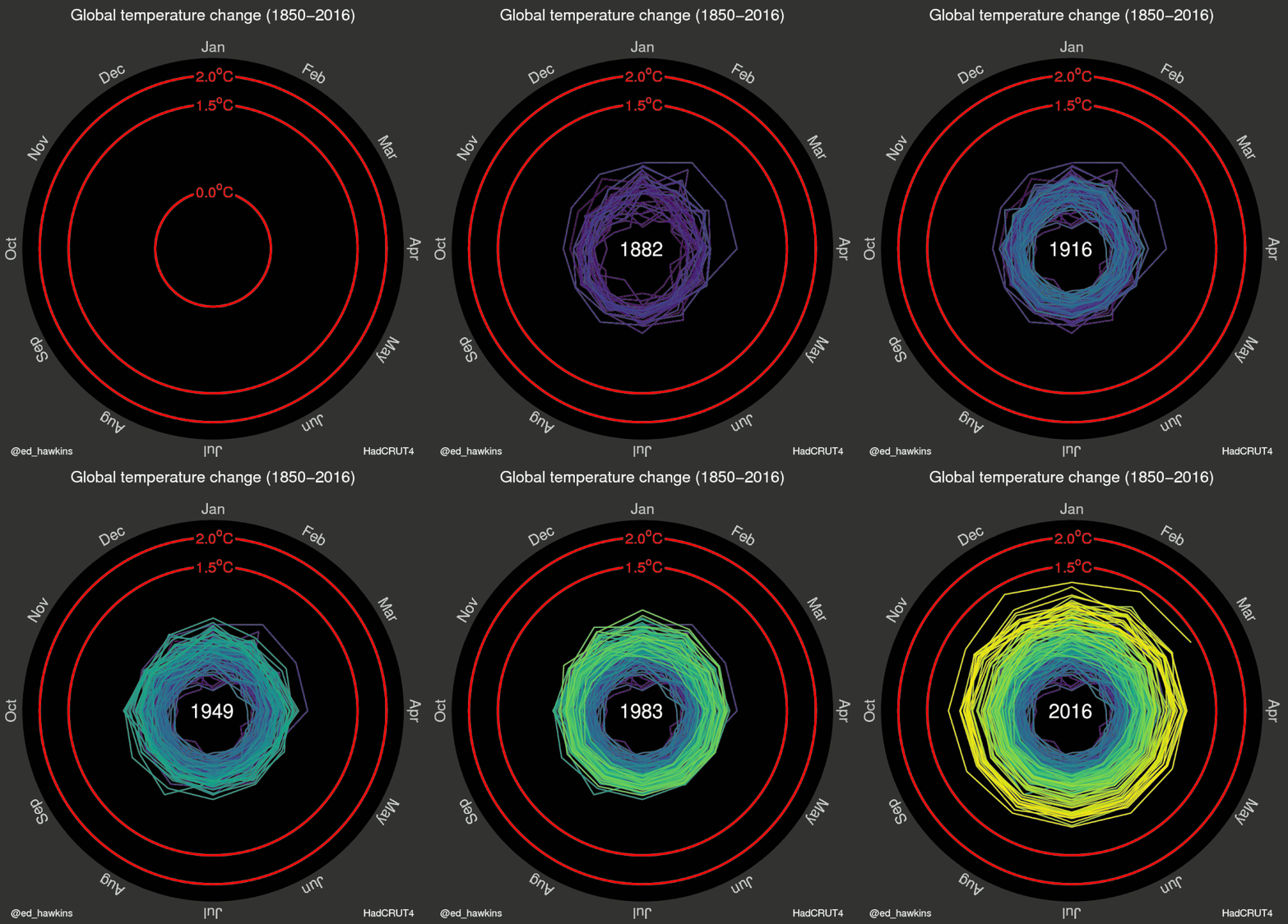
from Cosmos Magazine: Arctic sea ice hits a record low wintertime maximum The Arctic Ocean ice cap peaked for the winter on 24 March at 14.52 million square kilometres - a record low and 20,000 square kilometres less than the previous record low maximum extent. The 13 smallest maximum extents on the satellite record have happened in the last 13 years. Record high temperatures were recorded in December, January and February around the world. In the Artic average air temperatures were up to 5.5 degrees C above average at the edges of the ice pack.
from New York Magazine: New Paper Suggests Catastrophic Climate Shifts May Be Decades Away Using computer models, evidence from ancient episodes of climate change, and modern observations, Hansen and his team arrived at one essential conclusion: The melting of the Greenland and Antarctica ice sheets will set off a vicious cycle that dramatically accelerates the pace of climate change. The key concept here is ocean "stratification," a process by which cold, fresh meltwater rises to the ocean surface while warmer salt water is pushed beneath. (The Washington Post notes that an "anomalously cold 'blob' of ocean water" has been detected off the southern coast of Greenland.) That warmer salt water would eventually reach the base of the ice sheets, melting them from below, thus spurring more stratification, which would then spur more melting, which would then spur more stratification, which would spur more warming, until our grandchildren are all swallowed by the sea. But that's not all! Hansen's paper also projects that the influx of cold meltwater in the North Atlantic region, combined with warmer equatorial waters, would drive midlatitude cyclones so strong, the waves would be capable of thrusting gigantic boulders ashore.
from Globe & Mail (Canada): Winter ice coverage in Arctic sea reaching record low, scientists warn Scientists warn that the area covered by this winter's Arctic sea ice could turn out to be the lowest ever measured. The news comes on top of a long season of freakishly warm weather at the top of the planet, including above-freezing days at the North Pole and a months-long string of temperature records. "The winter, overall, has been extremely warm in the Arctic," said Ted Scambos, a glaciologist at the National Snow and Ice Data Centre in Colorado.
from PhysOrg: Degrading ice wedges reshape Arctic permafrost and landscape The wedges, which can be the size of a house, gradually formed over hundreds or even thousands of years as water seeped into permafrost cracks. On the ground surface, they form polygon shapes roughly 15-30 meters wide--a defining characteristic of northern landscapes.... Ice wedge degradation has been observed before in individual locations, but this is the first study to determine that rapid melting has become widespread throughout the Arctic. "Here we're combining observations from people working in the field across the Arctic--Russia, Canada and Alaska--where we're seeing the same ice wedge melting phenomenon," said Liljedahl, the lead author of the study.... "It's really the tipping point for the hydrology," Liljedahl said. "Suddenly you're draining the landscape and creating more runoff, even if the amount of precipitation remains the same. Instead of being absorbed by the tundra, the snowmelt water will run off into lakes and larger rivers. It really is a dramatic hydrologic change across the tundra landscape."
from ClimateCentral: CO2 in the atmosphere rose more in 2015 than scientists have ever seen in a single year ... "Carbon dioxide levels are increasing faster than they have in hundreds of thousands of years," Pieter Tans, lead scientist of NOAA's Global Greenhouse Gas Reference Network, said in a statement. The rate of increase in carbon dioxide concentrations is 200 times faster than the previous extreme jump between 11,000 and 17,000 years ago, when levels rose 80 ppm over about 6,000 years.... Michael Mann, an atmospheric science professor and director of the Earth System Science Center at Penn State University, who is unaffiliated with NOAA, said the carbon dioxide milestone shouldn't be over-interpreted. "This spike is almost certainly due in substantial part to the ongoing El Niño event, which is a fleeting effect that increases carbon dioxide concentrations temporarily," Mann said. "Carbon dioxide concentrations are a lagging indicator, and they don't accurately reflect recent trends in the more important variable -- our actual carbon emissions."
from Washington Post: Seas are now rising faster than they have in 2,800 years, scientists say "We can say with 95 percent probability that the 20th-century rise was faster than any of the previous 27 centuries," said Bob Kopp, a climate scientist at Rutgers University who led the research with nine colleagues from several U.S. and global universities.... The new research also forecasts that no matter how much carbon dioxide we emit, 21st-century sea level rise will still greatly outstrip what was seen in the 1900s. Nonetheless, choices made today could have a big impact. For a low emissions scenario, it finds that seas might only rise between 24 and 61 centimeters. In contrast, for a high emissions scenario -- one that the recent Paris climate accord pledged the world to avert -- they could rise as much as 52 to 131 centimeters, or, at the very high end, 4.29 feet.
from Desmog Canada: "The Blob" Disrupts What We Think We Know About Climate Change, Oceans Scientist Says When the abnormally warm patch of water first appeared in 2013, fascinated scientists watched disrupted weather patterns, from drought in California to almost snowless winters in Alaska and record cold winters in the northeast. The anomalously warm water, with temperatures three degrees Centigrade above normal, was nicknamed The Blob by U.S climatologist Nick Bond. It stretched over one million square kilometres of the Gulf of Alaska -- more than the surface area of B.C. and Alberta combined -- stretching down 100-metres into the ocean. And, over the next two years that patch of water radically affected marine life from herring to whales. Without the welling-up of cold, nutrient-rich water, there was a dearth of krill, zooplankton and copepods that feed herring, salmon and other species. "The fish out there are malnourished, the whole ecosystem is malnourished," said Richard Dewey, associate director for science with Ocean Networks Canada, speaking at Shaw Ocean Discovery Centre in Sidney on Thursday.... It could be an indication of what climate change will look like, with large-scale shifts in weather patterns, said Dewey, pointing out that The Blob was not anticipated by climatologists because it did not fit into existing climate models. "Climate change may look like a whole new model we haven't seen before," Dewey said.
from The Guardian: Climate change disaster is biggest threat to global economy in 2016, say experts A catastrophe caused by climate change is seen as the biggest potential threat to the global economy in 2016, according to a survey of 750 experts conducted by the World Economic Forum. The annual assessment of risks conducted by the WEF before its annual meeting in Davos on 20-23 January showed that global warming had catapulted its way to the top of the list of concerns. A failure of climate change mitigation and adaptation was seen as likely to have a bigger impact than the spread of weapons of mass destruction, water crises, mass involuntary migration and a severe energy price shock - the first time in the 11 years of the Global Risks report that the environment has been in first place.
from Australia ABC News: Baby fish may get lost in silent oceans as carbon dioxide rises Future oceans will be much quieter places, making it harder for young marine animals that navigate using sound to find their way back home, new research has found. Under acidification levels predicted for the end of the century, fish larvae will cease to respond to the auditory cues that present-day species use to orient themselves, scientists reported in the journal Biology Letters.
from The Guardian: December 2015 was the wettest month ever recorded in UK December was the wettest month ever recorded in the UK, with almost double the rain falling than average, according to data released by the Met Office on Tuesday. Last month saw widespread flooding which continued into the new year, with 21 flood alerts in England and Wales and four in Scotland in force on Tuesday morning. The record for the warmest December in the UK was also smashed last month, with an average temperature of 7.9C, 4.1C higher than the long-term average.
from Washington Post: U.S. wildfires just set an amazing and troubling new record Last year's wildfire season set a record with more than 10 million acres burned. That's more land than Maryland, the District and Delaware combined.... Lawmakers base their funding on the average cost to fight fires over the previous decade. But that doesn't account for wildfire seasons that now run from April through December instead of June to September.
from Washington Post: What scientists just discovered in Greenland could be making sea-level rise even worse Rising global temperatures may be affecting the Greenland ice sheet -- and its contribution to sea-level rise -- in more serious ways that scientists imagined, a new study finds. Recent changes to the island's snow and ice cover appear to have affected its ability to store excess water, meaning more melting ice may be running off into the ocean than previously thought.... Through on-the-ground observations, the scientists have shown that the recent formation of dense ice layers near the ice sheet's surface are making it more difficult for liquid water to percolate into the firn -- meaning it's forced to run off instead.
from Truthout: Climate Disruption Amplifies Atlantic Currents' Contribution to Sea Level Rise Anthropogenic climate disruption (ACD) has progressed to a point where it is, literally, changing one of the most important ocean circulatory currents in the world. In a paper recently published in the journal Geophysical Research Letters, NASA researchers confirmed that the circulation of the Atlantic meridional overturning circulation (AMOC) is slowing down. In 2009 and 2010 that shifting had already been linked to a sudden and extreme five-inch sea level rise on the East Coast.
from PNAS, in Washington Post: Bad news: Scientists say we could be underestimating Arctic methane emissions "...The fact that this was done not just at one site, but multiple sites, is a breakthrough in our ability to quantify [methane] budgets for tundra ecosystems." The researchers found that cold-season methane emissions are not only not negligible -- they're pretty significant. While emissions varied somewhat from one site to the next, Zona said that, overall, emissions from September to May accounted for about half of all the methane emitted from those sites throughout the entire year. This might seem a little baffling when you consider the fact that methane is generally released as Arctic soil thaws -- a process that should be most pronounced during the warmest part of the year. Zona said the key to understanding where cold-season emissions come from lies in the way Arctic soil is structured and how it reacts to changes in temperature.
from DesdemonaDespair: Sao Paulo on emergency reserve water; drought means Brazilian hydropower falls short ... The main water supply in São Paulo has been running on emergency reserves, and the system is only able to deliver about 40 percent of its usual capacity. Before 2014, it was able to supply approximately 8,700 gallons of water per second, but now, it only delivers around 3,500 gallons per second. Because two-thirds of Brazil's power comes from hydroelectric power plants, electricity has also been in short supply. Widespread blackouts have hit the country's largest cities, and increased energy rationing is a possibility, which could stunt the economy....
from CommonDreams: Overheated Planet Entering 'Uncharted Territory at Frightening Speed' With new evidence that the concentration of greenhouse gases broke yet another record in 2014, the head of the World Meteorological Organization (WMO) warned on Monday that the warming planet is hurtling "into uncharted territory at a frightening speed." The United Nations weather agency's latest Greenhouse Gas Bulletin (pdf) reports that atmospheric concentrations of carbon dioxide (CO2) reached 397.7 parts per million (ppm) in 2014, substantially beyond the 350ppm level deemed "safe" by scientists to avoid global warming.... "Every year we report a new record in greenhouse gas concentrations," Jarraud continued. "Every year we say that time is running out. We have to act NOW to slash greenhouse gas emissions if we are to have a chance to keep the increase in temperatures to manageable levels."
from NOAA, via CNN: NOAA: July hottest month on record, and 2015 could be hottest year July saw the highest average temperatures since record-keeping began -- globally, not just in the United States -- the National Oceanic and Atmospheric Administration reported Thursday. Globally, the first seven months of the year also had all-time highs. The latest global temperature data make it likely that 2015 will be the hottest year on record, the agency said. NOAA's findings follow reports by NASA and the Japan Meteorological Agency, which reached the same conclusion using their own data.
from Dahr Jamail, via TruthOut: The New Climate "Normal": Abrupt Sea Level Rise and Predictions of Civilization Collapse ... As if that's not enough, Hansen's study comes on the heels of another study published in Science, which shows that global sea levels could rise by at least 20 feet, even if governments manage to keep global temperature increases to within the agreed upon "safe" limit of 2 degrees Celsius.... Disconcertingly, another new "normal" this month comes in the form of huge plumes of wildfire smoke over the Arctic. At the time of this writing, well over 12 million acres of forest and tundra in Canada and Alaska have burned in wildfires, and the smoke covering the Arctic sea ice is yet another anthropogenic climate disruption (ACD) amplifying feedback loop that will accelerate melting there. The additional smoke further warms the atmosphere that quickens the melting of the Arctic ice pack.... "The results show that based on plausible climate trends, and a total failure to change course, the global food supply system would face catastrophic losses, and an unprecedented epidemic of food riots," the Institute's director, Dr. Aled Jones, told Insurge Intelligence. "In this scenario, global society essentially collapses as food production falls permanently short of consumption."...
from Vice, via DesdemonaDespair: The Wettest Place in North America Is Burning Vancouver Island is home to the wettest place in North America--and right now it's on fire. Drought has plunged the the Port Alberni-Clayoquot Region, part of Canada's only rainforest, into one of the worst dry seasons on record. Forest fires are spreading quickly through sun-scorched woods that, in the past, have received almost seven metres--or 22 feet--of precipitation per year. The fire, which has been burning since last Saturday on Dog Mountain near Sproat Lake, has reached over 245 hectares and is still spreading....
from Esquire: Climatologists' Psyches: When the End of Human Civilization Is Your Day Job ... I wanted to meet Box to find out how this outspoken American is holding up. He has left his country and moved his family to witness and study the melting of Greenland up close. How does being the one to look at the grim facts of climate change most intimately, day in and day out, affect a person? Is Box representative of all of the scientists most directly involved in this defining issue of the new century? How are they being affected by the burden of their chosen work in the face of changes to the earth that could render it a different planet?... Among climate activists, gloom is building. Jim Driscoll of the National Institute for Peer Support just finished a study of a group of longtime activists whose most frequently reported feeling was sadness, followed by fear and anger.... And many scientists now think we're on track to 4 or 5 degrees--even Shell oil said that it anticipates a world 4 degrees hotter because it doesn't see "governments taking the steps now that are consistent with the 2 degrees C scenario." That would mean a world racked by economic and social and environmental collapse. "Oh yeah," Schmidt says, almost casually. "The business-as-usual world that we project is really a totally different planet. There's going to be huge dislocations if that comes about." But things can change much quicker than people think, he says. Look at attitudes on gay marriage. And the glaciers? "The glaciers are going to melt, they're all going to melt," he says.... And the rising oceans? Bangladesh is almost underwater now. Do a hundred million people have to move? "Well, yeah. Under business as usual. But I don't think we're fucked." Resource wars, starvation, mass migrations . . . "Bad things are going to happen. What can you do as a person? You write stories. I do science. You don't run around saying, 'We're fucked! We're fucked! We're fucked!' It doesn't--it doesn't incentivize anybody to do anything."
from InsideClimate News: Most Extreme Weather Has Climate Change Link, Study Says In the wake of major hurricanes, floods and heat waves, scientists are quick to say that no single weather event can be attributed to climate change until careful analysis draws that conclusion. Now, a new study argues that thinking is backwards, that all extreme weather has a link to climate change... Trenberth's paper instead suggests focusing on thermodynamic changes caused by global warming, such as increased sea surface temperatures, humidity and sea level rise. ... "Because global warming is real and present, it is not a question as to whether it is playing a role, but what that role is," the authors wrote.
from InsideClimate News: Aid Package for Coal Country Goes Ignored by Congress A massive $3 billion package to help struggling coal communities transition to a new economy is sitting unappropriated in the Republican-led Congress. And lawmakers are saying little--at least publicly--about if and how they ever plan to support it. As part of the budget proposal released in February, the White House rolled out the POWER+ plan to support towns and communities struggling to cope with the decline in coal production and use. The initiative provides coal country with an influx of cash to reclaim abandoned mines, provide job training to miners, reform health and pension funds and invest in carbon capture technology. But in the four months since the White House announced the plan, leaders in Congress have not addressed it in any detail.
from Reuters: Pakistan morgues run out of space as heat wave kills more than 1,000 The worst heat wave to hit Pakistan's southern city of Karachi for nearly 35 years has killed more than 1,000 people, a charity said on Thursday, as morgues ran out of space and residents rushed to supply over-stretched public hospitals.
from New York Times: The Pope's Ecological Vow ...But there is something more profoundly subversive about Laudato Si' than what it says on climate change. On the day it was published, the pope privately told his closest advisers in Rome that the encyclical was not really an environmental document at all. Global warming is merely a symptom of a deeper malaise. Advertisement Continue reading the main story Advertisement Continue reading the main story Advertisement Continue reading the main story The real problem, he insists, is the myopic mentality that has failed to address climate change to date. The rich world's indifference to the despoliation of the environment in pursuit of short-term economic gain is rooted in a wider problem. Market economics has taught us that the world is a resource to be manipulated for our gain. This has led us into unjust and exploitative economic systems that support what Francis calls "a throwaway culture," one that treats not just unwanted things but also unwanted people -- the poor, the elderly and the unborn -- as waste.
from Philadelphia Inquirer: 'Green' roofs not always the most energy-efficient ... the white-roof craze is based on old and faulty research that has promulgated two myths - that these roofs save energy atop any building and that they decrease global warming... There is a significant heating penalty associated with using white roofs in central and northern climates, where owners use three to five times as much energy to heat their buildings than to cool them. In cities like Philly, white roofs consume more energy, which means they cause more cardon dioxide emissions.
from Arctic News: Arctic Heat Waves Warming in the Arctic is accelerating. On June 25, 2015, high temperatures hit North America. Temperatures as high as 30.3 deg C (86.54 deg F) were recorded where the Mackenzie River is flowing into the Arctic Ocean. ... The image below shows that on June 27, 2015, temperatures of well over 40 deg C (104 deg F) were recorded in Europe and in Pakistan, where temperatures earlier this month had reached 49 deg C (120.2 deg F) in some places. The heat wave reportedly killed 1233 people in Karachi alone. This in addition to the 2500 people killed earlier in India by high temperatures.... Very warm water is also flowing from the Pacific Ocean through the Bering Strait into the Arctic Ocean. As the image below shows, the water that is flowing into the Arctic Ocean from the Pacific is much warmer than it used to be, as much as 6.1 deg C (10.98 deg F) warmer.
from Bloomberg: You're About to See an Incredibly Rare Cloud, and It's Proof the Climate Is Changing Share on Facebook Share on Twitter Share on LinkedIn Share on Reddit Share on Google+ E-mail In a few weeks, you may get to see evidence the atmosphere is changing -- if you're lucky. That's when noctilucent clouds, the world's highest, peak in number and show up in the night sky just after sunset as electric-blue swirls in the mesosphere, the coldest place on the planet... Changes in the clouds reflect "how we affect the atmosphere down here," Elsayed Talaat, AIM's program scientist, said by telephone from Washington. "If you increase the methane down below, you are going to increase the water vapor up above." Carbon dioxide also may play a role, Randall said. The gas, which warms the lower atmosphere, "can actually cause the upper atmosphere to cool," she said.
from Washington Post: Your neighbors may be turning you into an environmentalist Recently published research in the journal Environment and Behavior has detected another factor involved in the shaping of an environmentalist, and this one is social rather than psychological (not that these two things can ever be fully disentangled). The factor? Spending more time with neighbors and friends, as opposed to spending it with your relatives. The former was associated with pro-environmental views and behaviors, and the latter, fascinatingly, with their opposite.
from Indiana Living Green: Geoengineering debate On Tuesday, May 12, at 1 p.m., students from the Decatur Township School of Excellence (DTSE) gathered in a nearby community center to engage in a debate. Nothing particular noteworthy there. Junior high students often engage in the academically rich tradition of debate. It requires research, public speaking acumen -- and quick-thinking skills to respond to your opposition. What was unique about this debate was its subject matter: Geoengineering. Here in Indiana, where climate change and global warming are not a daily discussion in the larger culture, these students tackled head on one of the more complex and thornier issues already facing the rest of planet.
from InsideClimate News: Global Warming's Great Hiatus Gets Another Debunking ...A new study by researchers at the National Oceanic and Atmospheric Administration finds that the world's warming never really stalled during the last 15 years--it was just masked by incomplete data records that have been improved and expanded in recent years.... The "newly corrected and updated global surface temperature data from NOAA's NCEI do not support the notion of a global warming 'hiatus,'" wrote the study authors. The scientists argue the findings even underestimate the world's warming because they don't consider what has happened in the Arctic, where temperatures have increased rapidly in recent decades, but where there is a limited number of weather recording stations.
from InsideClimate News: Coal Industry Fighting for Survival on 7 Fronts ...Perhaps no industry has inflicted such widespread costs on society as coal. From debilitating black lung disease to the devastating removal of whole mountaintops, from decades of lung-scarring smog to unrestrained emissions of greenhouse gases, coal has imposed its own deadly taxation--hiding the charges under the smoky cloak of cheap and abundant power.
from Bill McKibben, CommonDreams: How Humankind Blew the Fight Against Climate Change ... As Exxon Mobil's Rex Tillerson -- the highest-paid chief executive of the richest fossil fuel firm on the planet -- gave his talk, the death toll from India's heat wave mounted and pictures circulated on the Internet of Delhi's pavement literally melting. Meanwhile, satellite images showed Antarctica's Larsen B ice shelf on the edge of disintegration. And how did Tillerson react? By downplaying climate change and mocking renewable energy. To be specific, he said that "inclement weather" and sea level rise "may or may not be induced by climate change," but in any event technology could be developed to cope with any trouble. "Mankind has this enormous capacity to deal with adversity and those solutions will present themselves as those challenges become clear,", he said. But apparently those solutions don't include, say, the wind and sun. Exxon Mobil wouldn't invest in renewable energy, Tillerson said, because clean technologies don't make enough money and rely on government mandates that were (remarkable choice of words) "not sustainable." He neglected to mention the report a week earlier from the not-very-radical International Monetary Fund detailing $5.3 trillion a year in subsidies for the fossil fuel industry....
from Grist: California Senate candidate: "We're all going to die" ...Barbara Boxer's decision to step down from her Senate seat in 2016 has brought a host of potential contenders for her seat. (California Attorney General Kamala Harris and U.S. Representative Loretta Sanchez are believed to be the current frontrunners.) But only one candidate, Beitiks, promises to talk about absolutely nothing but climate change. His campaign photos have captions like, "We're literally going to die" and "Why aren't we all screaming?"
from Midwest Energy News: South Dakota to require climate-change lessons in school Students in South Dakota, like those in 13 other states and the District of Columbia, will be taught about climate change in public schools subsequent to a unanimous vote by the state's board of education this week. The South Dakota Board of Education on Monday adopted several curriculum changes including science standards that are based on the Next Generation Science Standards. A couple of those standards pertain to the science of climate change. And starting in 2018, students will be required to answer questions about climate science on a statewide standardized test.
from Reuters: Protesters gather in Seattle to block access to Shell oil rig May 18 About 200 protesters gathered at the Port of Seattle on Monday to block access to a Royal Dutch Shell drilling rig headed for the Arctic this summer to resume exploration for oil and gas reserves... Environmental groups have planned days of demonstrations over Shell's plans, saying drilling in the icy Arctic region, where weather changes rapidly, could lead to a catastrophic spill that would be next to impossible to clean up. They also say drilling would threaten the Arctic's vast layer of sea ice that helps regulate the global temperature and that they say has already been disappearing as a result of global warming.
from Climate Central: Heat is Piling Up in the Depths of the Indian Ocean The world's oceans are playing a game of hot potato with the excess heat trapped by greenhouse gas emissions. Scientists have zeroed in on the tropical Pacific as a major player in taking up that heat. But while it might have held that heat for a bit, new research shows that the Pacific has passed the potato to the Indian Ocean, which has seen an unprecedented rise in heat content over the past decade.
from The Daily Climate: Global warming and the "Green Rush." Global warming may give a minor twist to that classic hippie bumper sticker that quips "Acid rain: Too bad it's not as much fun as it sounds." Turns out a warming climate could boost the medicinal and psychoactive properties of plants including cannabis. But that's not all: Climate change will also open up higher elevations to growing weed clandestinely on public lands...
from London Guardian: Charlize Theron: Mad Max landscape awaits unless we tackle climate change The actor Charlize Theron, who takes a leading role in the new Mad Max movie as a one-armed warrior driving five sex slaves to safety, has expressed her fears that a bleak future awaits the planet unless global warming is addressed.
from Cedar Rapids Gazette: Man making pipeline prostitution allegation plays secret recording for reporters IOWA CITY -- A southeast Iowa landowner claiming a land agent offered him a prostitute in exchange for letting a pipeline cross his property allowed reporters to listen Wednesday to an audio recording he said he secretly made of the conversation.... A voice matching Tweedy's starts by reminding another man, purportedly the agent, of previous talks in which the agent hinted at hiring him a prostitute. The man suggests they go to St. Louis, where he can hire two or three 19-year-old prostitutes for $1,200. The man also mentions an escort service.
from PhysOrg: Ocean currents disturb methane-eating bacteria Offshore the Svalbard archipelago, methane gas is seeping out of the seabed at the depths of several hundred meters. These cold seeps are a home to communities of microorganisms that survive in a chemosynthetic environment - where the fuel for life is not the sun, but the carbon rich greenhouse gas.... There is a large, and relatively poorly understood, community of methane-consuming bacteria in this environment. They gorge on the gas, control its concentration in the ocean, and stop it from reaching the ocean surface and released into the atmosphere.... "We were able to show that strength and variability of ocean currents control the prevalence of methanotrophic bacteria", says Lea Steinle from University of Basel and the lead author of the study, "therefore, large bacteria populations cannot develop in a strong current, which consequently leads to less methane consumption."
from ThinkProgress: Sea Level Rise Is Happening Faster Than Anyone Thought "We see acceleration, and what I find striking about that is the fact that it's consistent with the projections of sea level rise published by the IPCC," Watson told the Guardian. "Sea level rise is getting faster. We know it's been getting faster over the last two decades than its been over the 20th century and its getting faster again." Because sea levels can naturally fluctuate as water is exchanged between land and sea, Watson notes that the rate of increase is too small to be statistically significant -- though he told the Washington Post that it's clear that sea levels are now rising at roughly double the rate observed in the 20th century, something that will have potentially huge ramifications for coastal areas across the world.
from New Zealand Herald: Hundreds of methane gas flares found off coast of Gisborne, NZ "Preliminary indications are that methane is reaching the ocean surface - this is the first time this has been measured in New Zealand," he said. "However, to understand how much methane, and then what this means for atmospheric contributions, will require detailed analysis of the data."... The discovery of this high concentration of gas flares in shallow water depths - 100m-300m - on an active tectonic subduction zone was unique, as gas seeps usually occurred much deeper, at 600m to 1000m below the surface. The team identified methane gas in the sediment and in the ocean, and vast areas of methane hydrates - ice-like frozen methane - below the seafloor. This year's research voyage continued the work of an international project focusing on the interactions between gas hydrates and slow-moving landslides called SCHLIP - Submarine Clathrate Hydrate Landslide Imaging Project.
from Yale360: How Long Can Oceans Continue To Absorb Earth's Excess Heat? The ocean has been heating at a rate of around 0.5 to 1 watt of energy per square meter over the past decade, amassing more than 2 X 10²³ joules of energy -- the equivalent of roughly five Hiroshima bombs exploding every second -- since 1990. Vast and slow to change temperature, the oceans have a huge capacity to sequester heat, especially the deep ocean, which is playing an increasingly large uptake and storage role. That is a major reason the planet's surface temperatures have risen less than expected in the past dozen or so years, given the large greenhouse gas hike during the same period, said Kevin Trenberth, senior scientist with the National Center for Atmospheric Research... But scientists say that when the cycle eventually swings back to its positive, warm phase, which history suggests could occur within a decade, the winds will wind down, the pumping will let up, and buried heat will rise back into the atmosphere. "There's a hint this might already be starting to happen," said Matthew England, an ocean sciences professor at the University of New South Wales in Sydney, Australia.... Scientists are also learning that the ocean has gained more heat, and at greater depth, than they had realized. That means the entire climate is even more out-of-whack than is evident today.... The long-term heat gain in the top 700 meters (.43 miles) of the world’s oceans has likely been underestimated by as much as half, according to Lawrence Livermore National Laboratories research scientist Paul Durack.
from Grist: Antarctica is basically liquefying Antarctica's icy edges are melting 70 percent faster in some places than they were a decade ago, according to a new study in the journal Science. These massive ice shelves serve as a buffer between the continent's ice-sheet system and the ocean. As they disintegrate, more and more ice will slip into the sea, raising sea levels by potentially huge amounts. This study is just the latest bit of horrible news from the bottom of the world. Last year, we found out that the West Antarctic ice sheet was in terminal collapse, which could raise sea levels by 10 to 15 feet over a few hundred years. Then, earlier this month, we learned that an enormous glacier on the other side of the continent is in the same state, and could contribute about the same amount to sea-level rise.... But the bad news doesn't seem likely to stop anytime soon: On Monday and Tuesday, it was a balmy 63 degrees Fahrenheit at the bottom of the world, a record high.
from Pictou Advocate (Nova Scotia): Town council hears need for snow equipment "It's just an exceptional (winter)," Funk said, noting six major snow storms in February and extreme temperature changes that have made it impossible to do things like popularly plowing back intersections. "I've been in the snow business for 35 years and the number of (flash) freezes this winter is unusual," he said. "The equipment has worked well. It's just not up to the winter we've had. We can hope this is not a bell weather of climate change to come."
from ThinkProgress: Smithsonian Stands By Wildly Misleading Climate Change Exhibit Paid For By Kochs But what may be most shocking of all is that the Smithsonian hasn't fixed the misleading evolution exhibit at its National Museum of Natural History, which thoroughly whitewashes the dangers of modern-day climate change. This "Hall of Human Origins" was made possible by a $15 million grant from billionaire polluter David Koch. It has now been five years since Climate Progress exposed the myriad flaws in the exhibit, a story the New Yorker and others picked up. Last week I spent some time going through the exhibit again with Dr. Lise Van Susteren, a psychiatrist and climate expert who has been featured by The Smithsonian. We were both stunned by the "Don't worry, be happy" picture it paints of current climate change.... In particular, the most embarrassing and scientifically misleading display the Smithsonian designed -- which directly suggests that humans can simply evolve to deal with global warming -- is still in the exhibit. The final section about the present and future has a nonsensical interactive video that lets visitors create a "future human" who evolves over a long period of time to a variety of changing conditions.
from Ottawa Citizen: New records detail how climate-change views scuttled an artist's grant A British Columbia artist and environmental activist accuses government of misusing its censorship powers to hide a politically driven effort to silence her because of her views on climate change and the oilsands. Franke James found herself on the federal government's radar in the spring of 2011 after Canadian diplomats agreed to offer a $5,000 grant in support of a European art tour featuring James's artwork. The grant was revoked a few days later by a senior director of the Foreign Affairs Department's climate change division, who felt the funding would "run counter to Canada's interests."... In one, a departmental trade official notes that a Canadian diplomat in Europe would not help promote the show because of "the artist's views on the oilsands."... Another email sent to the NGO Nektarina stated the reasons for the defunding decision "are not something we are able to provide in writing."
from National Snow and Ice Data Center: Arctic sea ice maximum reaches lowest extent on record Arctic sea ice appears to have reached its maximum extent for the year on February 25 at 14.54 million square kilometers (5.61 million square miles). This year's maximum ice extent is the lowest in the satellite record. NSIDC will release a full analysis of the winter season in early April, once monthly data are available for March.
from Washington Post: The melting of Antarctica was already really bad. It just got worse. A hundred years from now, humans may remember 2014 as the year that we first learned that we may have irreversibly destabilized the great ice sheet of West Antarctica, and thus set in motion more than 10 feet of sea level rise. Meanwhile, 2015 could be the year of the double whammy -- when we learned the same about one gigantic glacier of East Antarctica, which could set in motion roughly the same amount all over again. Northern Hemisphere residents and Americans in particular should take note -- when the bottom of the world loses vast amounts of ice, those of us living closer to its top get more sea level rise than the rest of the planet, thanks to the law of gravity.
from The Independent: March: Arctic sea ice near its all-time winter low and could break previous record Sea ice in the Arctic is near its all-time minimum for the end of winter and could break the previous record within the next two weeks if it fails to grow, according to the latest satellite data. The area of the Arctic covered by floating sea ice is already the lowest for this time of year, highlighting the long-term warming trend experienced by the region in both winter and summer months. Sea ice expands and contracts with the seasons but satellite data collected since the 1970s shows that it is retreating further and further during the summer months compared to 20 or 30 years ago. Sea ice in summer has shrunk by 30 per cent on average over the past 30 years while average temperatures in the Arctic have risen by about 4C - more than 3C warmer than the global average.
from Miami Herald: In Florida, officials ban term 'climate change' The state of Florida is the region most susceptible to the effects of global warming in this country, according to scientists. Sea-level rise alone threatens 30 percent of the state's beaches over the next 85 years. But you would not know that by talking to officials at the Florida Department of Environmental Protection, the state agency on the front lines of studying and planning for these changes. DEP officials have been ordered not to use the term "climate change" or "global warming" in any official communications, emails, or reports, according to former DEP employees, consultants, volunteers and records obtained by the Florida Center for Investigative Reporting.
from Mashable: Seeds of war Manmade global warming helped spark the brutal civil war in Syria by doubling to tripling the odds that a crippling drought in the Fertile Crescent would occur shortly before the fighting broke out, according to a groundbreaking new study published on March 2. The study, published in the journal Proceedings of the National Academy of Sciences, is the first to attribute the drought in Syria in large part to global warming. In doing so, it provides powerful evidence backing up the Pentagon and intelligence community's assessments that climate change is likely to play the role of a "threat multiplier" in coming decades, pushing countries that are already vulnerable to upheaval over the edge and into open conflict.
from Huffington Post: Jim Inhofe Brings A Snowball To The Senate Floor To Prove Climate Change Is A 'Hoax' The Senate's most vocal critic of the scientific consensus on climate change, Jim Inhofe of Oklahoma, tossed a snowball on the Senate floor Thursday as part of his case for why global warming is a hoax.... "In case we have forgotten, because we keep hearing that 2014 has been the warmest year on record, I ask the chair, 'You know what this is?'" he said, holding up a snowball. "It's a snowball, from outside here. So it's very, very cold out. Very unseasonable."
from Reuters: Most Americans see combating climate change as a moral duty A significant majority of Americans say combating climate change is a moral issue that obligates them - and world leaders - to reduce carbon emissions, a Reuters/IPSOS poll has found. The poll of 2,827 Americans was conducted in February to measure the impact of moral language, including interventions by Pope Francis, on the climate change debate. In recent months, the pope has warned about the moral consequences of failing to act on rising global temperatures, which are expected to disproportionately affect the lives of the world's poor.... Two-thirds of respondents (66 percent) said that world leaders are morally obligated to take action to reduce CO2 emissions. And 72 percent said they were "personally morally obligated" to do what they can in their daily lives to reduce emissions.
from InsideClimate News: Documents Reveal Fossil Fuel Fingerprints on Contrarian Climate Research After finishing a study contending that solar activity is increasing global warming, scientist Willie Soon of the Harvard-Smithsonian Center for Astrophysics reported his news to a utility company that was a major funder of his work.... The communications show that Soon called his peer-reviewed research papers "deliverables" in return for funding from fossil fuel companies. In addition, the documents reveal that Soon and Harvard-Smithsonian gave the coal utility company the right to review his scientific papers and make suggestions before they were published. Soon and Harvard-Smithsonian also pledged not to disclose Southern's [Southern Company Services, a mega utility company in the southeastern U.S. that generates power largely from coal] role as a funder without permission.
from Washington Post: Think of Earth, not just your stomach, panel advises The nation's top nutritional panel is recommending for the first time that Americans consider the impact on the environment when they are choosing what to eat, a move that defied a warning from Congress and, if enacted, could discourage people from eating red meat... the panel's findings, issued Thursday in the form of a 571-page report, recommended that Americans be kinder to the environment by eating more foods derived from plants and fewer foods that come from animals. Red meat is deemed particularly harmful because of, among other things, the amount of land and feed required in its production.
from TIME: 1 in 4 Americans Apparently Unaware the Earth Orbits the Sun A National Science Foundation study involving 2,200 participants find that about 25 percent of Americans got this question wrong: 'Does the Earth go around the sun, or does the sun go around the Earth?'... And the fact that only 74 percent of participants knew that the Earth revolved around the sun is perhaps less alarming than the fact that only 48 percent knew that humans evolved from earlier species of animals.
from Indianapolis Star: Indiana House panel OKs solar bill on party-line vote Indiana's electric companies won the first round Wednesday in a contentious fight over a bill that critics say would slam the state's startup solar energy industry.... For nearly two hours, members of the House Utilities, Energy and Telecommunications Committee listened as a parade of speakers urged them to table the solar energy bill until its full impact could be studied.... just one -- Mark Maassel, the head of the Indiana Energy Association -- was there to fully support the legislation...
from InsideClimate News: Droughts Will Hammer U.S. West as 21st Century Unfolds As harsh as the current long-running California drought has been, conditions in the American West will substantially worsen in coming years, according to new research... According to the new research, droughts in the Southwest and Central Plains will only worsen during the second half of this century. The closest comparison is to the 1930s Dust Bowl or 1950s drought, but lasting 35 years instead of just a few.
from The Hill: New GOP Senate begins assault on Obama's climate rules ... Republicans on the Senate Environment and Public Works Committee attempted to poke holes in the administration's carbon rules, calling the regulations "costly," "job killing," and "unnecessary." Sen. Jim Inhofe (R-Okla.), chairman of the committee, charged that the the rules would "do nothing to save us from global warming" and that they were "unconstitutional."
from Phys.org: Methane emissions from natural gas industry higher than previously thought World leaders are working to reduce greenhouse gas emissions, but it's unclear just how much we're emitting. In the U.S., the Environmental Protection Agency (EPA) has a new program to track these emissions, but scientists are reporting that it vastly underestimates methane emissions from the growing natural gas industry. Their findings, published in two papers in the ACS journal Environmental Science & Technology, could help the industry clamp down on "superemitter" leaks.
from InsideClimate News: Southern Forests' Ability to Suck Carbon From the Air May Be Slowing ...How are today's forests doing when it comes to sucking carbon out of the atmosphere?...[Scientists] discovered a possible reduction in the ability of these forests to absorb carbon... The biggest factor is the age of the forests. They are getting old. And old trees don't have the same capacity to absorb carbon as younger trees because they are not growing as fast.
from Daily Climate: A 50th anniversary few remember: LBJ's warning on carbon dioxide It is a key moment in climate change history that few remember: This week marks the 50th anniversary of the first presidential mention of the environmental risk of carbon dioxide pollution from fossil fuels. President Lyndon Baines Johnson, in a February 8, 1965 special message to Congress warned about build-up of the invisible air pollutant that scientists recognize today as the primary contributor to global warming.
from New York Times: Most Republicans Say They Back Climate Action, Poll Finds An overwhelming majority of the American public, including half of Republicans, support government action to curb global warming, according to a poll conducted by The New York Times, Stanford University and the nonpartisan environmental research group Resources for the Future. In a finding that could have implications for the 2016 presidential campaign, the poll also found that two-thirds of Americans said they were more likely to vote for political candidates who campaign on fighting climate change. They were less likely to vote for candidates who questioned or denied the science that determined that humans caused global warming.
from Cleveland Plain Dealer: Ohio renewable energy policies spurred growth, now driving away business, report says Ohio's renewable energy policies sparked tremendous investment in the industry, but recent moves by state lawmakers have slowed that growth and threaten its future, according to a report released Tuesday. Ohio was No. 13 in the country for new capacity and private investment in wind at the end of 2012, according to the Pew report. However, new investment halted in 2013 because of "uncertainty" created by legislative debate over Ohio's renewable energy standards and the expiration of a federal production tax credit, according to the report.
from DesdemonaDespair: 50 Doomiest Graphs from 2014 Measured number of plastic items per square kilometer in the world's oceans... Velocities of retreating glaciers in West Antarctica ... Precipitation anomalies over South America during the active monsoon season, September 2012-May 2013... 1200 scenarios of future CO2 emissions, projected to 2100... World ecological footprint of human consumption...
from Guardian: Time is running out on climate denial -- But is it running out fast enough? In short, if we take action to slow global warming, the worst case scenario involves draconian government regulations that trigger an economic recession. If we don't, the worst case scenario involves an economic recession too, but also a host of other global and societal catastrophes. Although Craven doesn't look at the probabilities of these worst case scenarios, they're also heavily weighted towards the case for taking action to curb global warming. There are lots of options to slow global warming that don't involve drastic government regulation, and that can even be beneficial for the economy. If we decide that we've gone too far in cutting carbon pollution, it's relatively easy to scale back government policies.... In other words, if we take too much action to curb climate change, the worst case scenario (upper left grid) is easily avoided. If we don't take enough action, we may not be able to avoid some of the worst consequences in the bottom right grid.
from Washington Post: Delaware-size gas plume over West illustrates the cost of leaking methane The methane that leaks from 40,000 gas wells near this desert trading post may be colorless and odorless, but it's not invisible. It can be seen from space. Satellites that sweep over energy-rich northern New Mexico can spot the gas as it escapes from drilling rigs, compressors and miles of pipeline snaking across the badlands. In the air it forms a giant plume: a permanent, Delaware-sized methane cloud, so vast that scientists questioned their own data when they first studied it three years ago.... The country's biggest methane "hot spot," verified by NASA and University of Michigan scientists in October, is only the most dramatic example of what scientists describe as a $2 billion leak problem: the loss of methane from energy production sites across the country.
from Politico: 2015, the year the GOP strikes back at Obama food policies The Obama administration is becoming increasingly involved in what Americans put on their dinner plates and in their cereal bowls, from requiring school children to be served fruit to eliminating trans fats in doughnuts. But the new Republican Congress is already laying the groundwork to push back in 2015. As the opening bell sounds for the 114th Congress, don't be surprised to see GOP lawmakers take on school nutrition. The $1.1 trillion omnibus this month included provisions to allow states more flexibility to exempt schools from the Department of Agriculture's whole-grain standards if they can show hardship and to halt future sodium restrictions...
from Al Jazeera: At least 24 killed in Malaysia, Thailand floods as 200,000 evacuated Severe flooding in Malaysia and Thailand has killed at least 24 people and forced the evacuation of more than 200,000, according to official data reported Sunday. Northeastern Malaysia and southern Thailand are regularly hit by flooding during the annual northeast monsoon, but this year the rain has been particularly heavy. Scientists have predicted that as climate change worsens, storm patterns will become less predictable and more severe.... Malaysian Prime Minister Najib Razak toured some of the worst-hit areas this weekend, stopping in Kelantan where the number of displaced people doubled to over 80,000 from Friday, following his return from a vacation in Hawaii on Friday. Najib was criticized for his absence during the calamity, after being photographed playing golf with U.S. President Barack Obama. Well, there's more stories than this -- but that was 75 of them! You may want to try the PANICloud for more specific topics! |
||||||||||||||||||||||||||||||||||||||||||||||||||||||||||||||||||||||||||||||||||||||||||||||||||||||||||||||||||||||||||||||||||||||||||||||||||||||||||||||||||||||||||||||||||||||||||||||||||||||||||||||||||||||||||||||||||||||